Steering the Machine: Our Take on the Agentic Shift at Google Marketing Live 2026

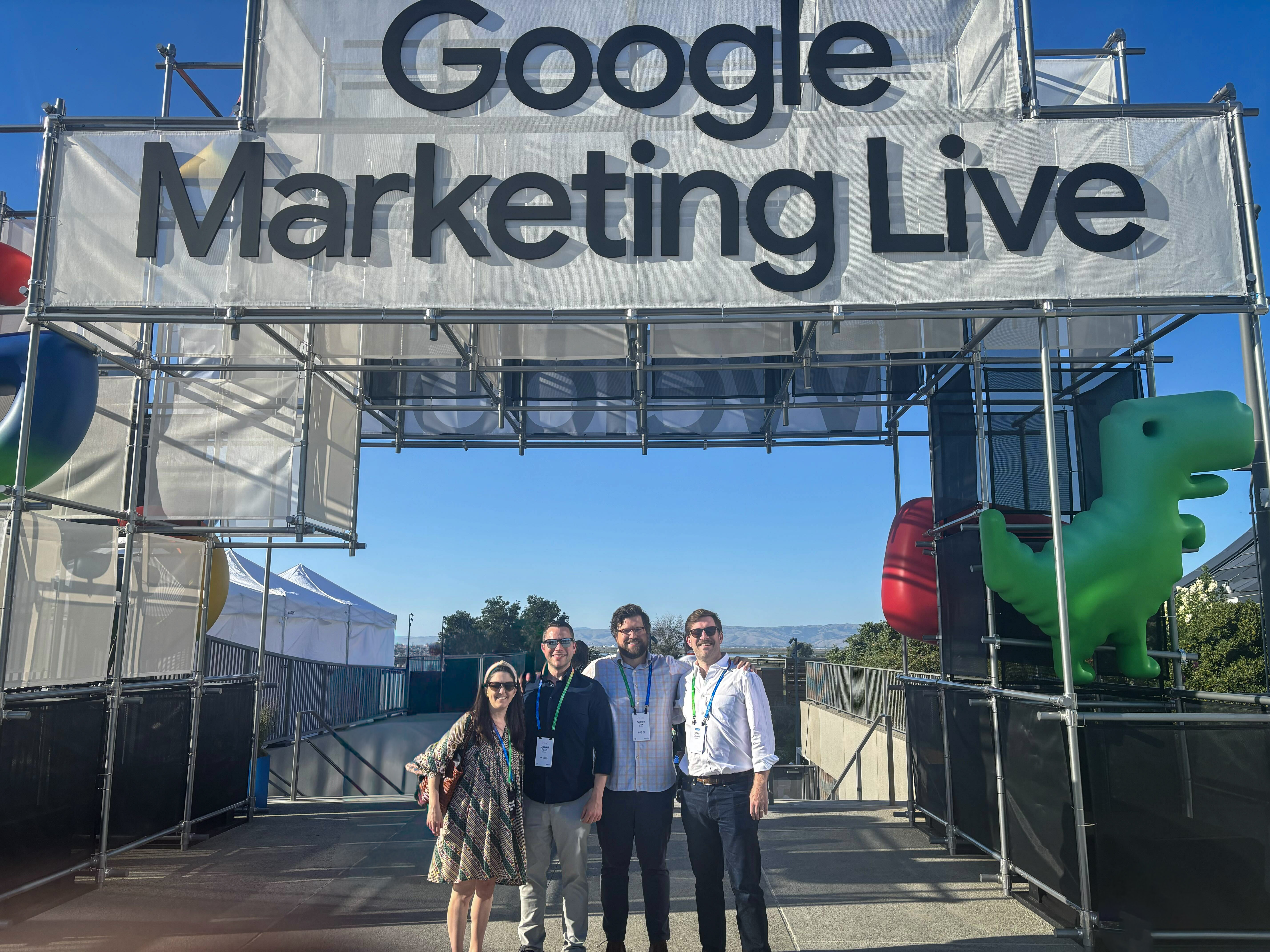
Executive Summary: The silos between text search, conversational AI, and YouTube have officially collapsed. It is now one single ecosystem. These new ad experiences arrive at a pivotal moment for Answer Engine Marketing (AEM) and search overall. Google is introducing ad units that are contextual and immersive, and with the power of agentic advisors, users won't ever need to leave their video or search experience to shop. Ultimately, with this shift to agentic products, your data architecture and your creative positioning remain the ultimate unlock for performance—the necessary “fuel” for a full-funnel approach to algorithmic buying.
Google Marketing Live 2026 made one thing abundantly clear: Google is going all-in on automation, framing its latest updates under the banner, “Our Gemini advantage is your business advantage.” Across search, shopping, video, and measurement, the platform is transitioning from a system of rigid knobs and dials to an agentic ecosystem driven by natural language desire and direction.
But while these updates drastically lower the barrier to entry for launching campaigns, they simultaneously increase the premium on human strategic oversight. The brands that win won't simply be the ones that click the new buttons—they will be the ones that understand how to steer the underlying AI models.
Google built this year's announcements around several big bets:
- Transforming search across the purchase journey
- Powering agentic commerce
- Driving a new era of performance on YouTube
- True ROI, verified
Here is our team’s deep-dive analysis of what was announced, what it means for your bottom line, and where we advise caution.
Transforming Search & Creative with Agentic AI
1. Ads in AI Mode
After sharing that AI Mode recently passed 1 billion monthly active users, Google announced that new ad placements will be introduced into the conversational search interface. Rather than looking like traditional search ads just placed into the response, these ads will look much more like a native conversational response, just with a “Sponsored” tag. To do so, they use Gemini to generate conversational text answers to long-tail user queries, drawing from asset libraries and brand guidelines. Brands can take advantage of these placements through AI Max and Performance Max.
Paired with the prior day’s announcements at Google I/O about asking follow-up questions directly from AI Overviews and the expanded “Ask YouTube” search functionality, Google is making it clear that across all products, they’re helping consumers move from queries to conversations.

Product example from Google of conversational ads in AI Mode.
2. AI Brief (Text Guidelines 2.0)
Google introduced AI Brief, a new natural language interface powered by Gemini that allows advertisers to use their own words to guide AI Max. Instead of relying entirely on traditional settings, advertisers can describe their business context, dictate what their messaging should focus on, identify what to avoid, and define specific searches they want to align with. The feature is rolling out globally in English for Search campaigns first, with Performance Max integration coming later.
“Most people use LLMs today by giving vague prompts and getting frustrated by average results,” notes Manny Delamota, Director of SEM. “If your brand brief is generic, your AI Max targeting and creative will be just as generic. With AI Brief, Google is giving us some of the ‘control’ we asked for, but now we have to prove we actually know our customers well enough to guide the machine.”
3. Asset Studio Multi-Modal Upgrades
Asset Studio has evolved into a unified creative workspace combining Google’s latest GenAI image and video creation tools. Marketers can now describe asset requirements in plain English, generate quick video concepts from text prompts, and utilize a new, one-click testing flow to pit newly generated brand assets against an account’s historical top performers during campaign construction.
While the automated capabilities sound impressive on paper, Ezra Sackett, Director of Paid Search, urges brands to distinguish between creative conceptualization and creative administration. “Where to lean into the natural language and where to lean away from it is going to be critical,” Sackett notes. “The net-new creative production of a video is probably better built by an AI-empowered creative team. But asset adjustments like video dubbing, resizing, and splicing to test different lengths of video? That is a great use of AI in Asset Studio that won't take up your creative team’s valuable bandwidth.”
Furthermore, the proliferation of purely AI-generated creative introduces a macro-risk to customer relationships. Delamota warns of a looming crisis of confidence: “One of the biggest challenges with brand trust in this environment is managing consumer skepticism with AI content that is not a direct reflection of the actual product. The way these GenAI capabilities proliferate will heavily impact long-term consumer trust.”
4. Ask Advisor
For hands-on-keys advertisers, Google’s new Ask Advisor is positioned as a helpful copilot in developing and executing your marketing strategy. The agent can answer questions and make recommendations for your business across a range of Google marketing products (Google Ads, Google Analytics, Google Merchant Center, and Google Marketing Platform).
Currently, there are brands and agencies alike surfacing these insights through MCP servers linked to other LLMs. This simplifies the experience by making the AI “analyst” live within the platform directly. “Ask Advisor feels like a major shift toward AI-powered orchestration across Google products, an always-on collaborator designed to proactively surface recommendations, solve problems, and guide campaign decisions,” says Suzanne Taylor, Group Director, Paid Search. “Brand-side advertisers will benefit from time savings they can invest into strategy, rather than manual optimization. It also shifts the expectations for agency partners: our value must come from translating AI-driven insights into smarter business decisions, validating what matters, and connecting platform recommendations back to real business outcomes.”
Powering Agentic Commerce & Profit Optimization
1. Universal Cart and Universal Commerce Protocol
The Universal Cart (announced the prior day at Google I/O) was another massive step forward in consolidating the entire customer journey down to a single experience hub. Powered by the Universal Commerce Protocol for agentic shopping support, consumers can now add products into one joint cart across the entire Google ecosystem (from search to YouTube to Gmail). From there, agents automatically help find deals, confirm compatibility of your products based on contextual reasoning, and compare loyalty offers and promotions for you—and then one native checkout experience completes the transaction without leaving the Google property you’re on.
Alicia Pachucki, Group Director of SEM, calls out that premium or challenger brands might miss out on critical exposure to audiences in this fully consolidated shopping experience. “In the old model, the ‘research tax’—those 15 open tabs when a consumer is shopping—was exactly where brands built equity, proved value, and won on nuance,” Pachucki explains. “That friction was a buffer that allowed high-priced brands to justify their price points or for challenger brands to differentiate themselves. Removing the work of research means removing the space where brands actually convince people. As Google owns the end-to-end experience and agents perform comparisons and evaluations on the consumer’s behalf, brand equity and impulsive traffic will both come at an even higher premium.”

Product example from Google of the Universal Cart analyzing loyalty and promotional opportunities.
2. AI Max for Shopping Campaigns
In an effort to prepare retail brands for conversational search behavior, Google announced a one-click upgrade toggle called AI Max for Shopping Campaigns. This feature allows retailers to dynamically transform their standard Merchant Center feeds into agile, conversational ad creatives capable of responding to long-tail, high-intent queries before shoppers even search for a specific product SKU. For brands with large product feeds, “not only will this save time on feed optimization, but it will quickly boost eligibility for longer-tail and conversational inventory that would have otherwise gone untapped without an unsustainable amount of keyword-stuffing,” says Eileen Lorenzo, Director of Paid Search.
However, this automation introduces a potentially crowded environment of overlapping campaign types. If AI Max for Shopping and Performance Max are both extending where shopping ads can serve, there’s a risk of cannibalization. We’ll need more hands-on experimentation to better understand the unique value each will provide in this context, and how to use them strategically together.
3. Product Value Adjustments (PVA)
A key tactical retail announcement is Product Value Adjustments (PVA), a pilot feature that allows advertisers to apply percentage multipliers to conversion values for specific items within Smart Bidding. This setup gives retailers the power to inject business intelligence—like inventory levels or profit margins—directly into the bidding algorithm, allowing it to bid more aggressively on high-margin or overstocked inventory. Google’s ultimate objective is to encourage brands to consolidate into fewer campaigns while relying on value adjustments to handle product-level variations.
4. Commerce Media Suite & Missed Opportunity Reporting
To round out its retail strategy, Google unveiled the Commerce Media Suite, which connects retail networks to provide SKU-level measurement in DV360, cross-retailer and cross-brand reporting in SA360, and omni-channel in-store bidding. Alongside this suite is the new Missed Opportunity Reporting dashboard, a visualization tool that uses Google AI to highlight lost conversion value resulting from restricted bids or budgets, offering “one-click” adjustments to instantly capture that traffic.
Redefining YouTube & Demand Gen Performance
1. View-Through Conversion (VTC) Optimization and Campaign Type Attribution
For mid-funnel visual formats, Google launched an open beta for Demand Gen campaigns allowing the bidding algorithm to actively optimize for View-Through Conversions (VTC) alongside traditional click-through signals. The goal is to accelerate the platform’s optimization learning window and maximize overall budget utility—and help Demand Gen data look more (accurately) competitive on paper against social platforms.
Sackett views this update as a functional fix, but warns against letting platform data dictate broader business decisions: “Demand Gen should not be compared directly to high-intent Search or bottom-funnel PMax. But at the end of the day, it really doesn't matter whether Meta and TikTok are inflating in-platform numbers and Demand Gen is underreporting... because in-platform is not the best source of truth here,” Sackett explains. “Yes, it will make them look more apples-to-apples with platform reporting on social, but smart brands are not purely relying on platform reporting for these decisions. Platform data should be used to report and optimize in-platform, not as the source of truth for the health of the business. To measure visual, mid-funnel mediums, brands need a trifecta of platform data, incrementality testing, and Media Mix Modeling (MMM)."
2. Affiliate Partnerships Boost & Demand Gen Uplift Experiments
To make visual commerce more actionable, the Affiliate Partnerships Boost pilot allows merchants to discover organic YouTube Shopping affiliate creator videos and directly boost them within paid Demand Gen campaigns. Monks has seen creator content on YouTube move the needle significantly for brands. For one client, Coursera, a creator “skits” video series pushed users down the funnel, lifting consideration and search volume: users who saw the ad were 24% more likely to search for “Coursera” than those who didn’t, proving that YouTube doesn’t just build a brand. It fuels the entire acquisition ecosystem.
Plus, to justify the investment, Google also rolled out Demand Gen Uplift Experiments, a turnkey A/B testing framework built to isolate and quantify the exact statistical lift that Demand Gen contributes to standard campaign mixes (such as PMax, Video, or Display) across core metrics like revenue, CPA, and ROAS. While this insight is critical for advertisers, Lorenzo also warns that it can’t be the end-all-be-all for measurement: “Isolating lift inside of Google’s ecosystem leaves us with a blind spot for other highly visual channels like paid social. Google might show an uplift, but multi-channel attribution tools might tell a different, and more complete story.”

Product example from Google of Affiliate Partnerships Boost for YouTube.
True ROI, Verified: Measurement & Signal Resilience
1. Campaign Type Attribution
Building on the View-Through Conversion tracking above, Google doubled down on the need to prove the impact of Demand Gen campaigns by launching a dedicated attribution solution that isolates the effects of distinct campaign types. By removing the influence of most last-click-friendly campaign types, advertisers can understand and bid toward the upstream causes of conversions and keep fueling the funnel.
“Campaign Type Attribution will hopefully help show the exact role that products like Demand Gen plays in user paths, mapping it to what is truly driving true business KPIs instead of trying to falsely compare it to other bottom-funnel campaign types,” notes Taylor. “However, I would still caution brands to validate these results with MMM models to ground your budget allocation decisions in your overall business data, and treat this platform data as directional.”
2. Qualified Future Conversions
This new metric uses AI to project future value based on signals collected earlier in the consumer journey. Google is positioning Qualified Future Conversions as the bridge “from discovery to decision,” helping marketers prove out how branded searches and engaged site traffic will translate into revenue down the line. As text search, conversational AI, and YouTube collapse into a single ecosystem, we’ll continue to see further zero-click consumer behavior permeating shopping journeys and content consumption. “This is an exciting announcement for lead generation marketers,” explains Andrea Cruz, VP of Media Strategy for B2B. “Qualified Future Conversions can help marketers understand the paths consumers and buyers are taking and build business cases for investing in mid- and upper-funnel campaigns.”

Product example from Google of the new Qualified Future Conversions metric.
3. Tagging and Data Manager advancements
Acknowledging that AI models require clean, first-party inputs to succeed, Google expanded its Data Manager hub by launching low-code and no-code API connectors for major marketing tech platforms, including Klaviyo, Mailchimp, ActiveCampaign, and Google Drive. This update consolidates first-party customer matching and conversion data pipeline setup into a single, visual interface.
Additionally, in response to the ongoing degradation of client-side tracking, Google introduced the Google Tag Gateway (GTG) pilot in the US and Canada. GTG acts as a server-side routing mechanism that upgrades existing tag setups without requiring on-page code rewrites. By routing tracking scripts directly through a website’s integrated CDN or cloud platform—such as Cloudflare, Akamai, Fastly, Google Cloud, or Webflow—brands can safeguard data integrity, preserve signal tracking fidelity, and circumvent browser-level ad blockers securely.
GML 2026’s impact on the road ahead
For consumers, Google Marketing Live 2026 represents a shift toward more conversational, multimodal experiences where more and more product discovery and shopping can take place entirely within Google’s walls, supported by contextually-informed agents. For marketers, this solidifies that search is no longer “just search.” The technical expertise and strategic skillset being tapped to excel in the Google Ads ecosystem increasingly requires marketers to be more holistic and more human in their approach.
Additionally, Google clearly demonstrated that execution friction is disappearing from advertising. As natural language guidance and one-click optimization toggles become standard across accounts, the technical ability to build a campaign will no longer provide a competitive advantage for brands or for agencies (potentially even shaking up the traditional agency model). Instead, success will depend on an advertiser’s strategic inputs: the richness of its first-party data loops, the distinctiveness of its human-led creative strategies, and the business intelligence applied to automated bidding parameters and measurement methodologies.
Read more about the rest of Google’s announcements here.
Related
Thinking


Sharpen your edge in a world that won't wait
Sign up to get email updates with actionable insights, cutting-edge research and proven strategies.
Monks needs the contact information you provide to us to contact you about our products and services. You may unsubscribe from these communications at any time. For information on how to unsubscribe, as well as our privacy practices and commitment to protecting your privacy, please review our Privacy Policy.