Choose your language

Choose your language

The website has been translated to English with the help of Humans and AI

Dismiss

How a Year of Ingenuity Influenced Experiential

How a Year of Ingenuity Influenced Experiential

5 min read
Profile picture for user mediamonks

Written by
Monks

The results are in! Four of our experiential projects have been shortlisted for the Campaign Experience Awards 2021. The Uncensored Library, the Air Jordan XXXV unveil, Super Saturday Night and BRIC’s Celebrate Brooklyn! Festival.

While these four experiences span six award categories—capturing a breadth of digital experiences and what they can accomplish—they perhaps more interestingly trace the evolution of experiential throughout 2020, from before the pandemic touched down in the Western world to today’s lived reality. But despite these changes, one through line has remained clear in our approach to experiential: leveraging digital technology to enable brand new experiences that were never possible before, which bring people together in unexpected ways. Here’s how that core aim has translated throughout a year of ingenuity.

A Digital-First Mindset Made the Pivot Easier

While in-person events that draw large crowds still aren’t possible in the present moment, experiences like Super Saturday Night, a Lady Gaga concert on the eve of last year’s Super Bowl, can offer a peek into what experiential might look like in coming years by reimagining and modernizing the concert-going experience for a digital age. Through a series of activations, the experience used cutting-edge 5G connectivity to power to connect with fans—for example, transforming the standard “step and repeat” into a screen that reflected attendees’ every action through a monster-themed digital double. These moments not only encouraged social sharing, but helped Gaga fans get into the “little monster” mindset before the show.

MONSTER WALL-FINAL (1)

And while challenges in the past year have largely migrated experiences online around the world, our Experiential team has long advocated for activations that combine broadcasting and in-person events to meet faraway audiences, an approach we call live experiential. “For us, experiential has always been focused on online amplification, regardless of whether the experience is physical or virtual,” says Ciaran Woods, Executive Producer of Experiential and Virtual Events. Woods notes that this digital-first mentality primed the team well for its quick pivot to virtualization. “The transition, albeit at lightspeed, has felt very natural and evolutionary,” he says.

Online or Off, Interactivity Remained Key

Virtual events exist to connect people—and a big part of that means giving the audience just as strong of a voice as the performers. In setting out to redefine live events for a new, digital-first era, the north star of the Virtual Solutions team has been to enable true, two-way interaction between both sides of the screen.

Think about the buzz a musician gets by seeing and hearing the crowd in front of a stage. A desire to capture that same sense of energy gave way to the development and release of LiveXP, our internal live storytelling tool enabling visually rich elements shaped in real time by the interaction of the crowd. “We realized virtual events needed a deeper level of interaction where users can experience live, personalized experiences and one-on-one interactions,” says Travis Craw, Executive Producer of Experiential.

Among the first major events that LiveXP brought to life was BRIC’s Celebrate Brooklyn! Festival, a long-running outdoor music festival enjoyed by New Yorkers every summer. With people unable to gather in large crowds because of the pandemic, we brought music fans together through a two-day livestreamed event on YouTube. Performances were augmented by trivia, live Q&As, Spotify integration (allowing fans to save songs to a playlist with a snap of their mobile camera) and more. Each of these elements showcased how drawing together myriad digital interactions feed into a memorable moment and opened the hyper-local festival to a global stage.

Virtualization Brought New Experiences to New Audiences

Last year, brands didn’t have much time to thoughtfully pivot from experiential to digital. Some missed the mark by trying to translate in-person experiences to digital ones—an impossible task that sets oneself up for failure. The brands that truly delivered, meanwhile, aimed to build experiences that weren’t ever possible before, leveraging digital tools like immersive virtual venues.

The Uncensored Library that MediaMonks built in collaboration with Reporters Without Borders is an excellent example of how virtual venues may be used to overcome traditional experiential constraints. We transformed a library of forbidden knowledge—news articles written by journalists who are censored or were killed in their home countries—into a literal library that could be accessed by readers everywhere via Minecraft.

Uncensored_library_Dome_02

Nick Fuller, SVP of Growth, notes that digital environments also have the potential to deliver more relevant experiences to audiences. “Personalized experiences are easier to deliver at scale through digital platforms, in a way that is trackable and measurable, not only for engagement purposes but for tracking ROI and lead generation.”

But there’s another key benefit to overcoming physical constraints through digital platforms: accessibility. By eliminating a need for travel, doing away with physical constraints (like seats available in a theater) and lowering the cost to access, virtualization opens up experiential activations to entire populations of people who would never have been able to take part in them before.

 Digital’s Influence will Remain

While virtual experiential is a must-have for brands to continue showing up for online audiences today, what might they look like when the pandemic subsides and in-person experiences become commonplace again? One possibility is that they will feature a more persistent digital layer. “Extended reality will play a stronger role, with experiences like the use of Oculus Venues during Facebook Connect,” says Woods.

But extended reality can enhance in-person experiences, too. When Jordan Brand unveiled its new Air Jordan XXXV shoe via livestream to industry insiders, the Monks showed up with a digital drop using AR that gave viewers the chance to check out the shoe up-close—a “had to be there” moment that was a foot above a standard reveal. One could easily see how such a feature could build on showrooms by giving all attendees a chance to inspect a product—or extend that experience to audiences from afar.

On that note, we may also see hybrid experiences that are spread across several locations. “I believe a hybrid approach will become a standard offering for live events like trade shows and conferences, mostly to survive,” says Marcel van Overveld, Business Director of Virtual Events. “Brands will have to develop other income streams, looking at data gathering and adding a digital layer on live physical events to benefit from that opportunity and maintain or extend their reach, thus staying relevant for their target audience.” For example, his team is looking for ways to use data to virtually emulate the serendipity of bumping into someone with a shared interest.

No matter the form digital takes in the near or distant future, one thing is clear: it will enable experiences that can’t be found anywhere else. For those reasons, digital’s key role in experiential will remain well into the future. “We’ve seen the benefits first-hand,” says Woods. “Bigger reach, better ROI, more accessibility, more user-centric and more sustainable—virtual events are here to stay.”

In a quick pivot, experiential has evolved dramatically in the past year. Where is it going next? How a Year of Ingenuity Influenced Experiential A series of Campaign Experience Award-shortlisted projects offer a glimpse at where experiential is going.
Virtual solutions digital events virtual events experiential livexp
How WPFC’s Digital Edition Fuels Dialogue and Interaction for a New Era

How WPFC’s Digital Edition Fuels Dialogue and Interaction for a New Era

3 min read
Profile picture for user mediamonks

Written by
Monks

How WPFC’s Digital Edition Fuels Dialogue and Interaction for a New Era

Freedom of the press is one of the most important principles for any society—and while it’s something that some of us take for granted, government censorship remains an issue in many parts of the world. And even in countries that enjoy a free press, intense polarization can blur the line between fiction and reality, calling the accuracy of stories into question and even putting reporters in danger.

We’ve always believed in pushing technology harder to deliver unique digital experiences that drive cultural impact—and our team has used that ingenuity to support journalism in unexpected ways. Earlier this year, we partnered with Reporters Without Borders to build the Uncensored Library, a massive library in Minecraft that provides users access to important stories by authors who are censored in their own countries.

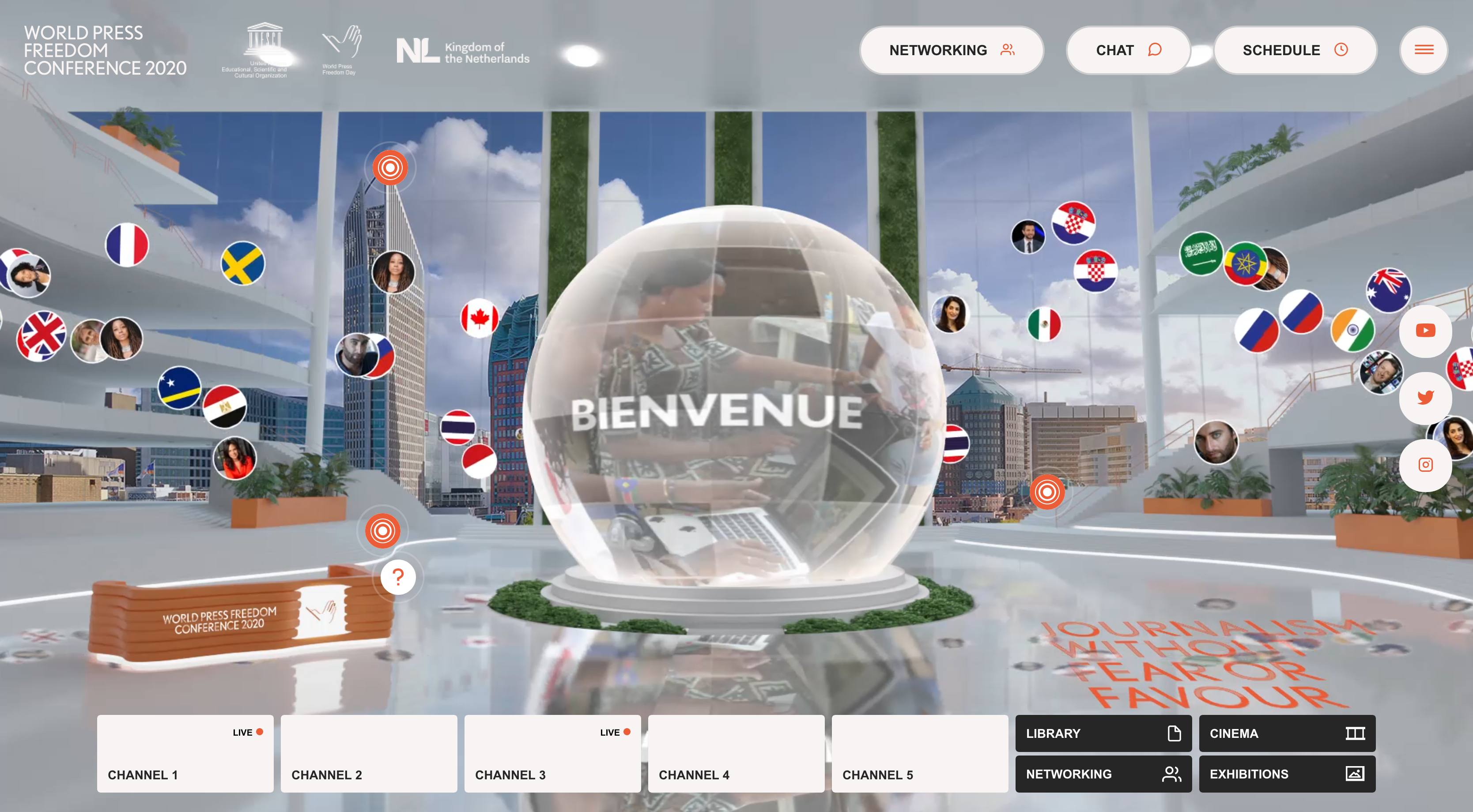
Now, we’ve taken a more hands-on approach to support the health of the press everywhere. This week, MediaMonks, NEP and the Dutch Ministry of Foreign Affairs collaborated with the World Press Freedom Conference to bring its 2020 edition online, opening the important event to the masses through a seamless integration of broadcast and platform. The virtual venue mixes in-person and digital experiences, setting a new standard for a new era of digital content and serving as a model for how digital platforms can bring people together for healthy conversation and debate.

Opening the Doors to an Intuitive Virtual Venue

Digital trade shows can be tough to navigate—typically just a playlist of broadcasts, finding the content most relevant to you often means scanning countless menus and translating time zones. More than just a broadcast or another Zoom call, our team sought to build on the experience of visiting an event in-person, augmenting it through useful digital tools.

WPFC Cinema

The cinema section of the conference puts video content at attendees' fingertips, offering a personalized journey and experience.

As attendees log into the experience, for example, they’re met with an open, airy welcome hall. From there, they can explore galleries in the virtual exhibition hall, explore articles in the library or enter the cinema to watch content on demand. Of course, they can also tune into live segments and interviews—the bread-and-butter of the event. With content organized around the metaphor of an event hall, attendees can better find the content most relevant to them. And in addition to exploring the space, they can easily book their own schedule to receive reminders when their chosen events are ready to begin.

Fueling Conversation, Debate and Networking

Networking is an important component of any trade event, and a cause like WPFC’s thrives on facilitating conversation with people across borders and communities. “The upside of virtual events is that you don’t have to be physically present to join the event and that you can meet people from all over the world,” says Rik Spruijt, Producer of Experiential and Digital Solutions at MediaMonks. “There’s fewer barriers to participate and interact.”

Enabling conversation is a critical component to the event platform’s design and takes several forms: asking speakers questions directly, connecting one-to-one with other attendees and forming group chats and breakout sessions centered around specific topics of interest. With the platform approved by Fox-IT, the Dutch Government’s national security partner, attendees could rest assured that communications were safe.

Accessibility Gives Everyone the Chance to Participate

Because the World Press Freedom Conference gathers together journalists and media luminaries from around the world, it’s incredibly important to hear and learn from voices that are often marginalized or underprivileged—and perhaps never could have attended such an event before it went digital. This truth becomes especially evident at a time when we’ve come to rely on digital more than ever before to understand and experience the world around us.

Screen Shot 2020-12-11 at 9.27.19 AM

“Especially with an event around press freedom, it’s even more important to have inclusive design,” says Spruijt. “So, we’ve took this into consideration while designing, developing and testing the platform.” 15-20% of the world’s population live with a disability, and while accessibility is required by over 1 billion people around the world, accessible options provide a better online experience to audiences overall. In addition to accounting for disabilities, the team also realized that some attendees may tune in from places with slower connections, using an adaptive video player to ensure everyone can still participate.

Press and journalism have the power to challenge the status quo and bring people together. The industry has profoundly transformed through digital over the past two decades—and has taken on a new urgency in the past year—so it’s exciting that the WPFC platform can serve as a model for how virtual conferences can adapt to provide a stronger, more interactive and intuitive digital experience to audiences around the globe.

The World Press Freedom Conference went digital for its 2020 edition, serving as a model for how digital platforms and events can fuel healthy conversation and debate. How WPFC’s Digital Edition Fuels Dialogue and Interaction for a New Era The virtual venue builds on the experience of attending an event in-person, augmenting it with digital tools.
WPFC world press freedom conference digital events virtual events

In Digital Venues, Everyone Gets a Front-Row Seat

In Digital Venues, Everyone Gets a Front-Row Seat

4 min read
Profile picture for user Labs.Monks

Written by
Labs.Monks

In Digital Venues, Everyone Gets a Front-Row Seat

With students holding graduation ceremonies in Minecraft and Travis Scott on tour performing via Fortnite, videogames have emerged and prevailed with ingenuity, with users finding new ways to communicate and socialize while at home. With a burgeoning streetwear market on Nintendo’s latest Animal Crossing release, brands are catching on to users’ craving to connect in virtual spaces.

This repurposing of platforms into digital venues might evoke the “metaverse,” or a persistent virtual world as seen in science fiction titles like “Ready Player One.” But as cultural hubs have been especially impacted by the COVID-19 pandemic, digital venues that replicate their real-world counterparts offer a great way to continue connecting with communities online. “Even though we’re seeing concerts and events move to the cloud and digital streams popping up everywhere,” says Geert Eichhorn, Director of Innovation at MediaMonks, “cultural venues, museums and other hotspots are commonly left behind.”

The Show Must Go On

Online virtual worlds certainly aren’t new, but few have captured mainstream adoption to become a killer app. Nor has there been a strong cultural drive to replicate in-person interactions virtually outside the context of gaming—until now.

“Right now, something we’re missing is the go-to platform that really owns that space,” says Eichhorn. “Second Life once had that promise, where brands would invest in virtual real estate on the platform. But given the global pandemic, it’s become more relevant to at least be prepared to have a virtual venue.” Linden Lab, the company that developed Second Life, has since built Sansar, a virtual reality entertainment platform recently sold to Wookey Project Corp. Facebook is working on a similar platform of their own called Horizon.

Xibalba

Over the years, we’ve seen museums in particular take steps toward this direction. Google Arts & Culture lets users explore world-renown museums using Streetview technology, for example, but the MediaMonks Labs team envisions fully realized 3D environments where multiple users can gather, mingle and engage in live content together. “With all of these venues currently being empty, now is the perfect time to shoot them through photogrammetry and build a custom digital space,” says Eichhorn.

Through technology like WebGL, MediaMonks has been able to design deeply engaging virtual spaces that require nothing but a web browser. With Victoria Cerveza, we built Mexico’s Biggest Offering by inviting people to honor the dead with a 3D altar. The result is a moving, collaborative tribute that users can contribute to or explore. Likewise, brands can embrace game platforms and accessible 3D technology to build culturally resonant spaces.

Free Your Venue from Physical Constraints

One of the greatest benefits of digital venues is that they allow brands and performers to continue engaging with communities at a time when consumers crave social connection and entertainment. But they’re also unbounded by physical constraints, opening up new opportunities to engage with content or personalize a space. “Consider entering a digitized museum, where you can swipe on a painting on the wall to view another by the same artist,” says Eichhorn. “You open up entirely new ways of interacting, and can even make it collaborative.”

Another idea is a personalized wall or wing filled with items from the collection, curated by data on viewers’ personal interests. “This level of interactivity and personalization applies to any experience you can do virtually,” says Eichhorn, noting that the technology is ideal for product demos, building creative customer experiences or conveying difficult concepts through visualization and virtual presentations.

Monk Thoughts Digital venues open up entirely new ways of interacting, and can even make it collaborative.
Portrait of Geert Eichhorn

There’s also no limit to the amount of people you can host within a virtual venue, enabling brands to extend their reach to wider audiences. In a world where social distancing regulations may be a part of our new normal, this could be important than ever. While platform constraints might require overflowing attendees into multiple servers or “instances,” there’s no need to shut the door on anyone. “With digital venues, you can give everyone a front-row seat if you wanted to,” says Eichhorn.

Considerations for Building Your Digital Venue

Above, we’ve discussed translating a physical space into a digital one. But brands can build entirely imagined digital venues as well. Whether you aim to bring a fictional branded space to life or want to meticulously render existing products to demo virtually, a production partner who’s skilled in VFX and digital production can provide guidance on building a space that’s not only functional, but drives emotional impact—a critical factor that’s often missing when programming is translated from a physical space to just a livestreaming platform.

For example, it’s important that you don’t just focus on visual fidelity when digitizing an existing space. Aim to replicate other senses however possible in order to add a greater sense of atmosphere. Eichhorn highlights the 360-degree work we did for Bancolombia: School of Sustainability, which not only makes a remote island community explorable, but brings it to life through the use of sound.

“We went in there to do 360 photography, but we also caught a bunch of ambient audio because the island is so densely populated, which made it feel truly alive,” says Eichhorn. “If you’re shooting in an empty place that’s harder, but brands can still make it feel like people are there with the user.”

SOS Still005

In addition to creative considerations, brands must also take a moment to consider which platform suits their goals—or their audience—best for hosting a digital venue. Game platforms may be appealing to younger audiences, for example, while platforms like Mozilla Hubs have a low barrier of entry by being available directly within a web browser. No matter the purpose for your digital venue, we can create scalable, proprietary platforms to host virtual events—and even include social features and monetization of content.

By offering digital spaces for relaxation, play and continued programming, brands can tap into a behavior that consumers have already gotten used to in response to staying at home: meeting in virtual space. No longer constrained by physical limitations, these digital venues enable new ways of interacting with patrons and can continue extending experiences to distant audiences in the future. But most importantly, they enable brands to continue serving an important aspect of consumers’ daily lives that has become difficult to hold onto: enjoying cultural touchstones together.

Rethink real-world events for digital.

While doors are closed at venues around the world, brands can continue engaging patrons through programming hosted in digital venues. In Digital Venues, Everyone Gets a Front-Row Seat The show must go on.
Digital venues virtual venues digital events online events fortnite digital concert digitization virtual reality

Choose your language

Choose your language

The website has been translated to English with the help of Humans and AI

Dismiss