Scrap the Manual: The Metaverse
Scrap the Manual: The Metaverse


What even is the metaverse?
In this episode, Angelica and Rushali expand on our metaverse-focused Labs Report with a quick overview of how they created a Roblox prototype demonstrating the metaverse concept of interoperability. You’ll get an inside look into some of the quirks of the Roblox platform as well as its developer culture—and because Roblox is viewed as a pioneer in the metaverse landscape, the process may give you some insight into what to consider when building your own metaverse experiences.
You can read the discussion below, or listen to the episode on your preferred podcast platform.
00:00
00:00
00:00
Angelica: Hey everyone! Welcome to Scrap The Manual, a podcast where we prompt “aha!” moments through discussions of technology, creativity, experimentation, and how all those work together to address cultural and business challenges. My name's Angelica.
Rushali: And my name's Rushali. We're both creative technologists with Labs.Monks, which is an innovation group within Media.Monks with a goal to steer and drive global solutions focused on technology and design evolution.
Angelica: Today, we're going to be doing our Labs Report segment, where we give a quick TLDR (too long didn’t read) of one of our lab reports and deep dive into something that we didn't get to cover in depth in the report, such as expanding on our prototype we created, a topic that has some interesting rabbit holes, but didn't fit neatly onto a slide. You know, that kind of thing.
Rushali: Today we are going to be covering…the Metaverse.
Angelica: The Metaverse!
Rushali: We have a whole bunch of research and resources for anyone interested in the Metaverse to deep dive into it from creators to C-suite. But if you need a refresher on a few things, here is a quick TLDR of the Labs Report on the Metaverse.
Angelica: What even is the Metaverse? It's like this big thing, there's a lot of buzzwords around it. There's a lot of different components. There’s a lot of different opinions about the Metaverse. But what we can do is divide it up into the key ingredients of the Metaverse.
The metaverse is 3D because, similar to the physical world that we live in, the metaverse has a collection of different worlds, all connected together into one ecosystem. One thing that we were talking about internally, as we were creating the Labs Report, we referenced a whole bunch of different ones, but Wreck-It Ralph Breaks the Internet, that particular movie, where they had Twitter and Facebook and eBay, all connected together into this one ecosystem. That's one version of—or one interpretation of—what the Metaverse could be within a 3D space.
Another thing to consider is that the Metaverse is inherently social. This came up a lot, especially during the pandemic, and how experiences are really focusing on not just the singular aspects of each individual person and their version of the Metaverse or what they see the Metaverse as, but also how they connect to other people.
There's also the aspect of the Metaverse in which Facebook, now branded as Meta (at the time of recording), is pushing towards working together within this Metaverse. So not just for fun, but also moving into how do people work within this Metaverse and how people within these more separate spaces connect and work. Something that is also an aspect of the metaverse, which we're going to talk a little bit about within our prototype, is the metaverse going beyond hardware and talking about interoperability.
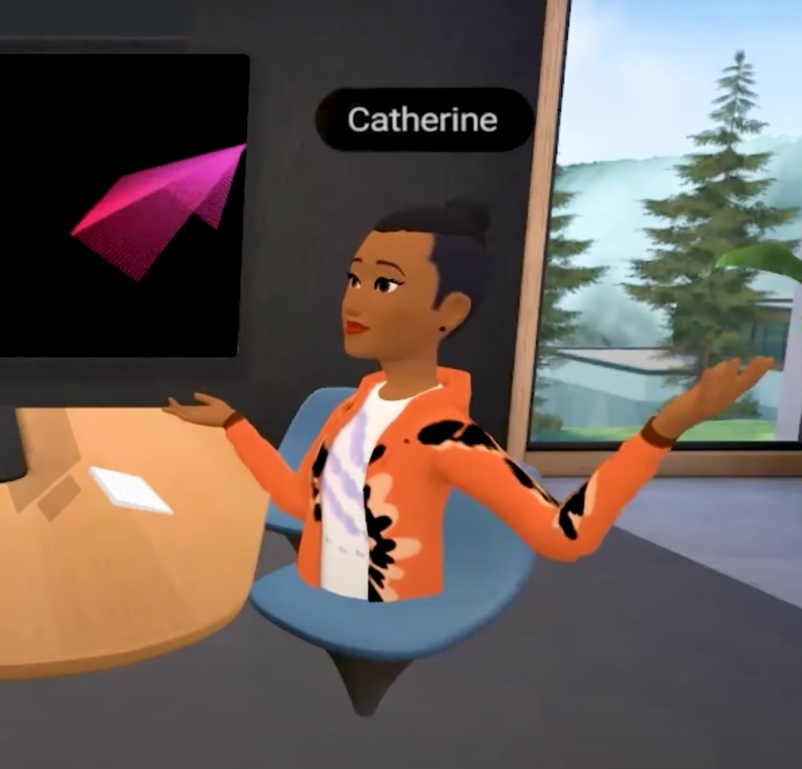
So there are certain apps or certain games and platforms that are really exclusive to a particular medium. The Metaverse is really thinking towards this interoperability and where you can access the things that we're used to accessing maybe in only one medium, but in multiple different mediums and multiple different ways, like to join a zoom office meeting in VR or like the mix and matching of things.
But essentially meaning: There's a lot of different things going on to make it accessible for a wide variety of audiences, wherever they want to be.
Rushali: Yeah, the world is headed towards more decentralized and democratized situations and solutions, which make these systems interoperable. So you can have currencies in different formats that can be exchanged.
And if you look at how the virtual world is progressing, it is headed towards something where you do not have to fit into a bucket and you can basically move from one environment to the other quite easily. So the Metaverse is headed towards that. It is trying to use these emerging technologies when it comes to cryptocurrency or blockchain.
Angelica: It's sort of like currencies, right? In the United States there's the Dollar. In Europe, you got the Euro. And you got all these different types of currencies, but they act as a way to divide between country lines.
Rushali: And not just divide, I would go further and say even discriminate.
Angelica: Yeah.
Thinking about how all those affect us currently within those different types of currencies, that's where the Metaverse would come in.
So there wasn't this sort of lost currency, just because you have to transfer from dollars to euros or whichever type of currency you use. You could have this democratization of how to even just pay for, and even earn money for goods and services.
Rushali: The last thing about the Metaverse is the user-generated content.
This place is going to be a collaborative place. We have all seen how much interaction and content gets created on social media platforms. And the Metaverse is just going to be the big nudge for creators to go from not just a 2D space, but involve the entire gaming industry and other online interactions to really push for user-generated content.
Angelica: Yeah, we see this already through gaming as well like thinking about DLC or mods that help enhance the game that's already there. That user generated content adds that extra level from fans, creators, and players that makes them feel a little bit more invested within it. And that's kind of part of the Metaverse, right? Where we're not going to be going into these cookie cutter worlds. That these worlds will be somewhat affected by the people that are participating in them.
So it’s this holistic world that we can't just say one person or one company made it. It's a collection of the many that also makes it customizable.
Rushali: Absolutely, and it's going to be a lot more collaborative than what we have right now. For example, the Metaverse is going to be able to bring in what the people watching the concert want to do in a way that we can't do right now with, let's say, gravity and other limitations. So the Metaverse is really going to be allowing for products, services, artists, to collaborate with their fans, with their users, with their customers in ways that was not possible until today.
Angelica: Exactly.
Okay, so we've covered the high level aspect of the Metaverse. Like we mentioned in the beginning, there's so many resources.
So if you want to learn more about the Metaverse and all the deep dives into it, you can see that later on in the show notes and also within our blog post. But for now, we're going to be moving forward towards the types of things that we didn't necessarily see within the Labs Report. We're going to be talking about our prototype, which is something that we do a lot with our lab reports. We're not just researching. We take that a step further and actually create something to show that what we learned has an application within the real world and how it could show itself within different types of contexts and business challenges
Rushali: We decided to build something on Roblox for the Metaverse Lab Report.
Angelica: Yeah. What we wanted to focus on in this prototype and what we ended up creating was a tangible thought piece, an interactable thought piece, on what the Metaverse would be if it was really embedded within our day-to-day lives and wasn't just something that was a one-off or something that we'd go to once but as something that is really a part of our daily lives. And that was divided into: Admin, Social and Shopping. We made sure each room had a unique approach on what we could see each of these types of environments being like moving forward and how they interconnect with each other. And then even later on, we have a bit of an easter egg about how these different types of worlds not just interact with each other really well but interact outside the world. Because that's something we don't see a lot of currently.
Rushali: In Admin world, you could basically have the central hub of personal information. You could keep your virtual currency there, you could keep an overview of your friends, your stats. Basically your inventory of things that you have.
The second part was the social part, which was this ethereal, thought bubble environment that we created that users could view what other people were doing, could share what they were doing, and would connect with others in real time. Much like what social media allows us to do, but more in a 3D space…more in a Metaverse-y space.
And the last one was the shopping world. The shopping world was a dynamic environment where you basically have countless categories of whatever you wanted to buy, whether it was virtual or physical. You could order food in the Metaverse in Roblox and it would get delivered to you at your doorstep. Or you could buy an NFT of a dress or try on something through a Snapchat lens.
There was a hidden world, which was the entertainment world, but we didn't deep dive into it, because there's a lot of examples of entertainment in the metaverse out there already.
Angelica: So that was the overview of the prototype. Diving a bit deeper into what our process was: it was a variety of different things because the metaverse is a topic that has been in the works for years and is also something that's currently in progress. So it's not something that we can retroactively reflect on this particular type of concept.
So it's something that's ever-evolving. And so our brainstorm and prototype phase was also ever-evolving based on what was going on and what we were learning throughout the process.
So it was a bit longer of a phase, more than our typical lab reports, because we ended up breaking it up into: What are the different things that we like about the Metaverse? What are the different aspects that get us inspired or what are things that we could explore more deeply within a prototype? And then once we had an idea of all these different worlds that connect with each other and seamlessly integrate within each other, how do we create that? And then what are those worlds? What do they look like? What are the interactions that people have? And so we whittle it down through all these different concepting sessions and user journeys. Our final concept was a semi-homemade approach, as I like to say, because one of the things that happens within our Labs Reports is we set a timetable to complete them at.
And for this one, it was about a month and a half, I think it was. Because of that, we need to really make smart decisions on, okay, based on this prototype, how do we want to demonstrate it? And also to what fidelity and how much interaction. The concept was really playing on the interoperability of the Metaverse.
That's really what we wanted to hit home because there weren't a lot of examples or interactable thought pieces on this concept. So we were envisioning a world and an environment where essentially people could go home from work and be able to check in on their friends from their phone. Then that translates into desktop and they're able to check in on their Admin. Then that goes into Social, checking in on what they're doing in the evening. Then that goes into Shopping, preparing for the day. “Oh, wait, I'm hungry.” You know, all those different types of things that end up affecting our day-to-day lives currently. But what would the Metaverse look like if that was a part of the equation?
Rushali: Awesome.
Should we dive into why Roblox?
Angelica: Yes. Why in the world did we choose Roblox ?
Rushali: For starters, I had never interacted with Roblox. I am not 13 years old unfortunately…
Angelica: It's open to everybody.
Rushali: That is true.
Angelica: But Roblox is considered, at least within the United States, geared towards younger audiences. And they have a lot of moderation policies that really emphasize the fact that it really was meant for audiences, let's say 15 years and younger. But it has some interesting aspects to it that made us choose Roblox particularly.
Rushali: Absolutely, and Roblox is one of the platforms where developing a game is simplified. They use a programming language called Lua, which is often a language used for teaching children how to code. And it takes very little time to grasp the concepts of Roblox and as any game engine, it has a similar interface and layout. But what is interesting is that it's not as complex as Unity or Unreal. It takes away all of the complexities so that even a 15 year old could build a pretty complex game out of it with scripts, building blocks, as well as all of the assets and essentials that you need and logic that you need to build a game.
Angelica: Yeah, and going back to your point about Unity and Unreal. There’s very similar aspects that Roblox shares, but in a much more simplified way. So like you mentioned about plugins and things. Unity has plugins. Unreal has plugins. Roblox has plugins, right? Thinking about customizing interactions, Unity has a way to do that through custom code, Unreal does as well, and so does Roblox. So it's pretty much creating this infrastructure of a general understanding of a lot of these types of game engines, but in a way that's accessible and also powerful in some instances. Another thing that is really interesting about Roblox is the generated content like we mentioned, and how there's a really open type of thought process in how other developers can help other developers. And that's also the infrastructure that we see in other game engines and coding platforms as well.
Rushali:The Roblox community is extremely well set up and there's a lot of support. So if you get stuck on something, there's always a tutorial. Or there is always someone who ran into the same issue, but someone else explaining how to resolve that issue out in the internet for you to build on top of.
Angelica: Yeah.
Roblox is this dark horse of sorts where, in the coding community, we see like the tried and true platforms. And then Roblox comes in and it's like, “Roblox? Really gonna build for Roblox?” But there's a lot of similarities between other platforms and how the development process goes, that it can really be a powerful tool if leveraged the right way and also access a lot of different types of audiences that may not be available within other platforms.
Rushali: I think while I was researching, I found a statistic that said that Roblox developers are making like, millions of dollars? So if you're a developer, hop on that Roblox train.
Angelica: Choo choo.
The other cool thing about Roblox, and one of the reasons why it was interesting for us to do the prototype on that platform, is really re-imagining what it means to be a gaming platform. Like Unity and Unreal, we call them game engines, but they can do so much more than that. Roblox is a very similar way, in thinking about where Roblox is used traditionally for games and experiences, it could be leveraged for non-game reasons. Blurring the line between these digital events and experiences outside of a game world and really transform it into something completely different and something that matures as the Metaverse will as well.
Now as much as we talk about how Roblox was great, and there's all the support, there were challenges that ended up coming up in the prototype.
If it was smooth sailing, we would be very suspicious on, wait, why is it all going so well? Or really realistically, are we pushing the bounds enough of the platform, right? Because we are an R&D group after all. And these types of things do come up because we are thinking about how to push these platforms further. So roadblocks are inevitable as a part of this process.
Rushali: One of the things that I've found really hilarious about Roblox is that you cannot upload logos of certain trademarked things. Like we couldn't upload the Media.Monks logo. Or we would get banned constantly for trying to upload something that we didn't know that we couldn’t upload. So you have to really read through the approval process and the agreements of Roblox’s constraints
Angelica: Yeah and this is because the platform was originally, and still is to a particular extent, geared towards being kid friendly. And so a lot of those are considerations of why they have those different types of policies.
Rushali: Absolutely. I think there's a couple of constraints when it comes to Lua and Roblox where certain things are not possible because they have had to simplify the way that their engine works. But it's also quite surprising that the amount of things that are possible to do when things are that simplified. So it's really a beautifully designed environment for children to learn how to code, but also for adults to sit down and really think about how complex things become, like state of the matter, for us as we grow.
Angelica: Like, should it be that complicated?
Rushali: Yes, exactly. I had a philosophical moment while working on the prototype where I was like, “Do I need to think in such complex ways in life?”
Angelica: Right.
One thing that it actually reminds me of is how Roblox is great because of the user-generated content. It's able to both support and the community be able to give back on the different types of interactions that fellow developers can do because one developer was able to open source it to everybody. Or, in some instances, for a fee. But let's remember that this platform is thought about and made for children. So with them being some or many of the developers, there are still children. And so they can still be punks like adults are. And one of the things that we ran into a few different times is: we think about how, like, bugs or different types of plugins that we bring in for other platforms can sometimes error out or just make sure to double check where you download things. That's just the general ethos of what we need to do.
And it applies here as well. Roblox is not immune to childish viruses that come up, but there were a few different plugins that we had, even as much as we go to like reading reviews, making sure that it seems reputable. When you download them and click play there are a few viruses that are just like, “Hehe, [username] got you.” And it would just put that on all the different assets and it would take so long to get rid of it. And it would slow down the experience sometimes as well.
Rushali: See this is why My Chemical Romance’s song “Teenagers” is my favorite song because teenagers are literally the scariest people on the planet. I think.
Angelica: Or preteens, too.
Rushali: Yeah. Preteens, too.
I can't say. The next generation seems like, super kind. But Roblox is where teenagers are, so be mindful and keep your guard on.
Angelica: It's more just making sure, maybe for certain plugins, test it in a separate environment that maybe isn't a part of the actual world that you want to integrate it within just to make sure the plugin is all good and isn't going to slow everything down. Or there are some that you wouldn't be able to use your mouse. Like a lot of them were very benign or minimally frustrating,
Rushali: Minimally volatile or violent.
Angelica: Yeah, yeah. But it was still something that took away from the process of developing. So those are some things that we had to keep an eye out for.
Moving on from Roblox, there's other things that just thinking retroactively about the prototype and the things that we were able to do, we're also contemplative on: what are the different things we did not do? What are the things that we hope for the prototype to achieve, but maybe isn't available yet? Or weren't able to do within the timeframe that we would like to see within the future. So one thing that was implementable is how these Roblox worlds could be accessible through an app, accessible through a desktop, accessible through VR devices. It was one of our stretch goals to be able to have it be integrated within VR. So that's something that looking back would be great to implement within future options and something that would be definitely within this Metaverse aspect of things…Or even like a console version. That would be an interesting one to deep dive into.
Within the prototype video, we discussed how someone could integrate their Uber eats account within Roblox and be able to purchase food. And it actually would be delivered as if you had ordered it from the app. That is something that's not currently available, but we would love to see that within feature iterations or as the Metaverse progresses, actually being able to see that fully functioning within our reality.
Rushali: I think integrating APIs when you're in a PG environment is slightly trickier, which is why their entire technological constraints with Roblox are a little more complex because they want to be PG-13.
Angelica: Yeah, exactly.
So we've covered a lot because the metaverse is a lot. What are the different things that we can consider moving forward?
One consideration that comes off the top of my head is the Metaverse is today. The metaverse is tomorrow. But where is the metaverse in between? How do we get to that “Ready Player One” reality that has been talked about, or within Snow Crash as well. What are these different types of Metaverse POVs that everybody's really excited to get to, or it might be like some mixed reactions to those towards the utopian and the dystopian version. But how we get to those somewhat futuristic visions of what the Metaverse could be, it takes one step at a time. It's something that isn't going to be at our doorstep tomorrow, but it will take time for many companies, creators, and individuals for us to get to that point. Thinking about hardware, advancements, software advancements that need to be done to be able to get us to that point, right?
So it's one of those classic, over estimating how much progress we could make in the future and then underestimating how soon we'll be able to get there. That type of classic dilemma. But it could be somewhere in the middle where it will take years to get to the point where we see in “Ready Player One,” or in these different types of things. But it's not to say that the Metaverse isn't going on right now. It is going on right now in these different aspects of the Metaverse. So thinking about virtual reality, augmented reality, NFTs, collectibles, user-generated content…a lot of those are the principles that the metaverse will stand on and will be built off of.
Rushali: Yeah like, basically what's happening right now is all of the key ingredients of the metaverse are available in fragmented ways but they all need to come together. So the interoperability is something that is being worked on by multiple companies across the world, not just for computation and hardware reasons that we can't get to the “Ready Player One” situation. It is something that is here right now, but at the same time, getting built as we speak.
Angelica: Yeah, the investment and participation of these platforms and those fragments today is going to greatly shape and influence what's going to look like moving forward. So it is something where us as a collective of individuals and companies and developers will be able to influence this.
Thanks everybody for listening to Scrap the Manual. Be sure to check out our blog post, in the show notes for more information and references of things that we mentioned here. If you like what you hear, please subscribe and share! You can find us on Spotify, Apple Podcasts, and wherever you get your podcasts.
Rushali: If you want to suggest topics, segment ideas, or general feedback, feel free to email us at scrapthemanual@mediamonks.com. If you want to partner with Media.Monks Labs, feel free to reach out to us over there as well.
Angelica: Until next time!