How Hackathons Can Spark Both Collaboration and Solution-Based Thinking
How Hackathons Can Spark Both Collaboration and Solution-Based Thinking


As many people in this industry (and beyond) can attest to, work often gets quite busy. When it does, it’s best to just focus on getting the work done. However, this also means putting your head down and staying in your lane, no matter how integrated your organization is. As a result, there’s little time and space left to explore other areas of the business and connect with coworkers from completely different teams, with whom you normally wouldn’t interact. And that’s a shame, isn’t it? My team and I think it is, that’s why we came up with the idea to host a hackathon for our Monks across the globe.
Together with Workato—a platform we leverage to provide automation solutions to our entire enterprise—we organized a hybrid hackathon and invited parts of the company to join virtually or in-person from our Buenos Aires, San Francisco and New York City offices. The event took place in Gather.town, a 2D metaverse. The aim of the game? To use Workato and Slack to automate anything they thought would be useful for everyday Monks. The challenge was to think beyond the simple notification bot. Been there, done that. There was no limit to the technologies teams could use. The tools they built were required to be completed within eight hours. In the end, every idea was judged based on its level of creativity, visual representation, tool use, execution and overall relevance.
Besides the many innovative solutions that came out of this event (and absolutely blew my mind by the way), I also learned another important lesson: hackathons are a fantastic way to connect people from all different corners of your organization and the world, and bring them closer together. The formula is simple: just give a group of talented people a challenging task in a tight time frame, create the right environment, and they will not only come up with incredible ideas, but also have lots of fun and build lasting friendships in the process.
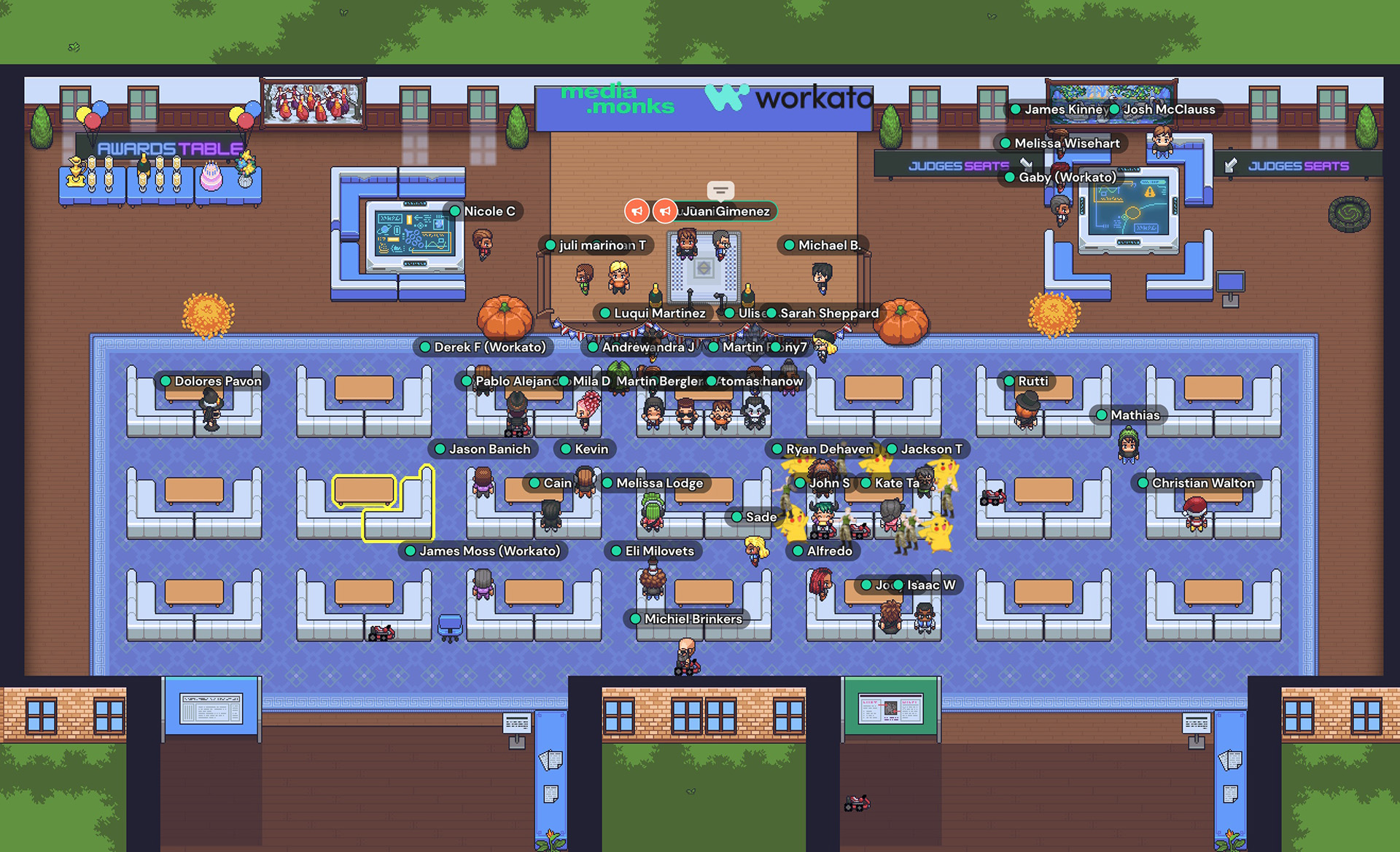
Bridging together our global hub of talent.
Each person on our rocketship diversifies our skill sets and deepens our experience—to the benefit of everyone, not just one team. Because of our integrated business model, we can stimulate people to venture outside their lane from time to time and seamlessly cross-pollinate their skills and experiences. While pitches often spur unexpected collaborations—and still result in great success, thereby confirming the power of integration—I was happily surprised to see this hackathon also highlight how easily and quickly we can connect our global hub of talent. Josh McClauss, our VP of Marketing and one of the hackathon’s judges, says that the event truly reflected the beauty of our integrated universe of talent.
It wasn’t just a cool experience, but also a truly great way to get insight into the huge amount of talent that is tucked into every different corner of the company across the globe.

Safe to say, such great talent comes with great ideas and solutions. The creativity, innovation and collaboration amongst the people that participated was outstanding, which most likely has to do with the nature of the event that brought these teams together. According to McClauss, an interactive event such as a hackathon is very well-suited to exactly the types of people that Media.Monks attracts. Why? Because of the way in which this company was built.
We may be a 9,000+ strong company, but all of our cornerstone pieces still very much carry their startup spirit. “We may have new stakeholders and constituents to build this business around, but the power in what we’re doing is still and will always be about being nimble, flexible and creative and getting together in these moments to move beyond the competition—not only because we think about things differently, but because we do them differently,” he says. It’s experiences like these that capitalize on our talent and get them excited to be here long-term as we continue to realize what the next era of a marketing services partner looks like to the world.
Fostering light bulb moments.
Judging from all the ideas the teams came up with, I can already tell this era is looking bright. It was very exciting to see each of them bring in their unique perspective and build something that’s going to be useful to the company and our clients—both now and in the future.
One team, for example, developed a bot that searches Slack for previously asked questions to direct users to the right answers, whereas another team leveraged Slack as an interface to interact with Open AI and create AI-driven images for ad creative prototypes. “These are tons of options that can be applied to our business immediately,” says our SVP Global Media Melissa Wisehart, who also served as a judge. Such ideas can be implemented right now to not only increase efficiencies and build better processes internally, but also deliver stronger results for clients.
As it turns out, the way to foster out-of-the-box and solution-based thinking is by setting clear boundaries, which stimulates people to not just think, but also realize their ideas by actually building the tools that solve their everyday challenges. “This entails both the boundary of what the end vehicle is and the boundary of the time frame that you have, that’s also very important,” says our Executive Operations Manager Nicole Chanlatte, who co-organized the hackathon. “Telling people to take this time, set it aside, and dedicate it to working on a specific problem or project—that in itself should unlock new paths.” From there on, it’s a matter of building on these ideas and solutions, while seeking ways to implement them across the business right away. “I believe that if we follow through on some of these projects, the impact could be huge to both efficiency and revenue,” McClauss adds.
Cracking the code for a successful partnership.
Ultimately, this all goes to show that hackathons are a great way to spur collaboration and spark creativity. Besides all the fun and games—yes, I did a little virtual dance while presenting on stage—the teams came up with some incredible ideas and solutions. Needless to say, the Workato team played a pivotal role in bringing this all to life, providing a helping hand in support and assisting teams new to their tool throughout the event.
The pleasure was theirs, too, says Gaby Moran, Workato’s Director of Customer & Partner Experience. “The hackathon event was truly phenomenal and so much fun. We have a lot of customers who do hackathons and this one had some of the most creative and impactful ideas I’ve seen in a while. So many of the automations created contributed to inclusivity and collaboration—it left me inspired!” And that's what happens when you connect a diverse team of global talent around a common goal.