Choose your language

Choose your language

The website has been translated to English with the help of Humans and AI

Dismiss

Budgeting: Optimize Global Media

Budgeting: Optimize Global Media

7 min read
Profile picture for user Michael Cross

Written by
Michael Cross
EVP, Measurement

a jar full of pennies falling out

Maximizing ROI on global media requires a transparent budgeting system that achieves harmony between national and global budget holders’ objectives. 

Having worked in the international area of marketing ROI for a number of years, I have found that one of the constant bugbears for global or central media directors and CFOs is how to spend budgets across markets. Inevitably the annual budget review is one of the most difficult times in the marketing calendar due to the trade-off between national marketing directors wanting to protect their budgets versus the global or central media director having a finite budget to share across these markets.

This subject becomes all the more pertinent in the current economic climate where budgets are being cut and these cuts need to be made where the impact on the business is minimized. 

The most common case that central teams are faced with in setting budgets is the feedback loop, a multi-stage process where the individual markets are asked how much they need. This inevitably ends up in a circular process that goes something like this: 

  • Round one: Central media director/CFO tasks markets to come back with a detailed plan on media requirements to hit targets (two month’s duration).
  • Round two: After each market has submitted their budgets, central media director and CFO ‘level’ the budget—i.e. overlay a reality check on each market while also shaving an amount off all markets collective estimated budget to align with the actual global/European budget (one month). 
  • Round three: Budgets are submitted back to local markets, where they have a chance to re-justify their budgets with fact-based proof of why they would need incremental monies (one month). 
  • Round four: Final stage of ‘levelling’ by the central team and budgets are given to the markets (half a month).
  • Round five: Potential repeat(s) of rounds three and four (further months).

This process works effectively if three assumptions hold: local markets know how media affects their targets (sales/profit); all markets use the same logic, assumptions and data sources; and no market over-estimates in an attempt to raise a higher local budget. 

Now, clearly, any national marketing director worth their salt will build a business case that will over-estimate what they actually need in order to get the budget they want. Hence those markets that have either strong political might, advanced data modelling and knowledge skills, or just good sources of data, will more than likely come out of the process with more budget at the expense of other markets. The issue is that these markets are not necessarily the markets that represent the most efficient use of funds to achieve the highest overall sales/profit. 

One answer to all this could be to turn the process on its head and enforce budgets by market centrally. This removes the political and local market influence, but such a big step (if not already in place) may create ill-feeling among national marketing directors. 

A more favorable option is to allocate the budgets centrally using a framework that the local markets can input into, based on a common process with common assumptions and data sources. To do this, the framework needs to be easy enough for all to understand, complex enough to incorporate all business elements, and use similar data sources across markets. 

This framework can be used centrally to allocate and justify budgets and the onus is on the national marketing managers to justify why they should have altered budgets, but only when given the facts. This minimizes political arguments, reduces time (rounds one, two and five are now obsolete) and arrives at a more optimal split of money, ensuring markets are supported where return is greatest. 

In my experience of working with international companies on market and brand portfolio allocation projects, there is a wide range of control that the center has over the individual markets. As such, the success of the framework is highly dependent on the engagement process between the center, the partnering consultancy and the local countries. Where there is a greater degree of local control, the process will take longer and needs to capture more visible inclusion of local market understanding.

A chart rising upward

The framework can consist of a range of methods, starting off with the bronze approach structured around key performance and cost metrics, up to the gold standard all-singing all-dancing optimization and forecasting software. 

The bronze approach is a good starting point. This gathers key metrics such as sales, profit, consideration metrics, cost of media, media inflation etc., and creates overall scores based on these metrics. This score, or index, then offers insight as to which markets are more attractive to invest in. 

However, it doesn’t bring to bear key points for investment, such as how much to spend in those markets (due to its linear approach) nor effectiveness of advertising in those markets. As such, this bronze approach may be unacceptable for companies where there is a lower central control level; the approach is more likely to result in opposition by the local markets due to its lack of analytical rigor versus alternatives. 

Market Mix Modelling (MMM) is a great tool to use in the first step to budget setting and allocation. However, it is only a first, but necessary, step: the ROI is not only informed by the effectiveness of the advertising, but also how much you are spending. Dixon and Shapiro spell this out, where they cite that forecasting using MMM gave a forecast error of 13% compared with the more detailed, integrated approach which had only a 3% error range. This detailed approach included understanding of rapidly changing environments, long-term impacts and finally reach, or the advertising response curve.

The response curve is a crucial factor in setting budgets. In Figure 1, if the client’s TV budget was at the current spending point, and MMM was used to measure the effectiveness, it would correctly measure the return and hence ability to calculate the ROI (in our example, £2 sales for £3 spend, £2/£3 = £0.66). However, if the client was actually to spend a reduced amount (one-third of the amount), and this spend returned only one half the amount of sales, then the ROI has increased (£1 sales for £1 spend,£1/£1 = £1.00), as the proportionate amount lost in sales is less than the decrease in spend. 

The reason this relationship of changing ROI exists at different budget levels is the diminishing returns effect of advertising. This is where, at higher spend levels, the efficiency of a medium starts to diminish as you begin to reach the same consumers again and again, and there’s also a finite level of demand for a product. 

This diminishing returns effect means that if the initial MMM ROI were to be taken in isolation, then the TV medium in our example may not be an attractive investment opportunity. However, it shouldn’t be ignored in investment decisions because at lower spend levels it is an attractive medium. This application is critical in optimizing across channels and also across markets. 

Obviously, there isn’t historical data to build response curves in all markets and for all channels, but benchmarking and intuitive client discussions can get around this. 

So the gold standard framework will build in the measured activity from MMM, and add further texture through building response curves. Future proofing the results is the next step to make sure the model has applicability in further years. This includes factors that historical data may not exist for, such as future economic trends, new product launches and new media creatives. These can be controlled for use in estimates and benchmarking against comparable events, such as a rival launching a similar product. 

The next step is to include long-term impacts. Where the effect can’t be measured, academic research can help inform the tail—of which there is some very good literature. One of the landmark studies being the Lodish behavior scan studies, “A Summary of Fifty-Five In-Market Experimental Estimates of the Long-Term Effect of TV Advertising.” 

The last step is then overlaying real-world factors and constraints: minimum spend thresholds for channels (cut-through) as well as pre-committed budgets (such as three-year sponsorship deals). 

While building these curves using consistent datasets across markets, you can then give the opportunity for local markets to feed back into the process a further time. This gives the chance to contest relationships, build in these real-world constraints and include new data—but only if it is truly justified. 

Building these curves into a tool gives the ability to trade-off millions of possible combinations to arrive at optimal allocations for given scenarios. 

Once built, this model enables the exploration of financial impacts of different investment decisions, including: altering the investment allocation between individual markets, sub-brands and media; changing the focus of the communications mix (total media versus total promotions) for the key investment targets across markets and the portfolio; and increasing and decreasing the total level of investment as well as the optimum budget scale for sales and profit maximization.

A graph trending down with dots

Regarding the latter point on optimum budget scale, this is a key benefit of the process. In Figure 2, the analytical framework has highlighted that there is no profit upside in increasing budgets beyond currently planned levels: the points on the graph are sales and profit simulations of changing the overall marketing budget by increments of £1million. 

It is, therefore, possible to increase gross sales value (GSV), but it would be at a cost to profit. However, there is a significant benefit in better allocating the current budget across brands and across media channels by moving from the black point to the turquoise point on the graph. 

This approach can thus be used by the chief marketing officer/chief financial officer to frame budget discussions based on real data. So when asked the question of cutting budgets and minimizing business impact, they can make the right decisions backed up with financial proof. 

In practice, this altering budget happens throughout the year, so having something in place to simulate these changes and illustrate the reasons why is a massive time-saver. 

In times of reduced budgets, local market politics and the need for increasing accountability, it’s important to have a budget process that everyone buys into, not only across markets but also across disciplines. In the interest of minimizing business impacts of reduced budgets, transparency is key and building a budgeting framework can go a long way to iron out the pains of the process. 

Delivering corporate accountability and ROI improvements will help put marketing further up the agenda. Optimizing the marketing mix on a single brand typically delivers ROI increases of 15% or more; further optimizing across a portfolio of brands, and then across markets, the overall ROI improvement internationally is huge. Learn more about how we can help now.

Maximizing ROI on global media requires a transparent budgeting system that achieves harmony between national and global budget holders’ objectives. media strategy media buying advertising strategy

How CPG is Winning the Digital Shelf

How CPG is Winning the Digital Shelf

3 min read
Profile picture for user tyler_pietz

Written by
Tyler Pietz

How CPG is Winning the Digital Shelf

As part of the recent WBR Digital Food & Beverage Summit, I moderated a panel discussion, “Digital Shelf 2.0: Best Practices for Winning in Digital Shelf.” The panel brought together leadership from across the CPG space—including Nestle USA, Coca-Cola Consolidated, Mondelēz International, and Crossmark—to discuss shifting content requirements and media needs as eCommerce rises in user adoption and relevance.

Winning the Digital Shelf is an Evolving Process

It’s no secret that eCommerce has enjoyed explosive growth over the past year, as the pandemic kept consumers at home: eMarketer reports that over half of internet users bought groceries online in 2020, and those who began investing in eCommerce years ago have managed to future-proof their business. Jie Cheng (Global Head of eCommerce & Direct-to-Consumer, Mondelēz International) noted that Mondelēz’s investment in eCommerce as far back as 2015 foundationally set the brand up for success in 2020, owing 6% of its global business to online sales. “Fortunately, we could capitalize on the tailwind of eCommerce and ramp up our investment quite significantly,” Cheng said.

For brands that are just dipping their toes into eCommerce now out of necessity, it’s important to realize you’re never too late to embrace the digital shelf—and as new platforms and needs arise, eCommerce should be treated as an always-evolving process. Following Mondelēz’s advances in the past year, Cheng and her team are road mapping where to go next. “The idea is, how can we continue to make sure we’re serving consumers where they are, and in the meantime make sure we are purposeful in how we approach different retailers, our D2C business or our eB2B business?” she said.

Quote from digital summit

Educate and Future-Proof Teams

One of the greatest challenges in winning the digital shelf is allocating the resources needed to fulfill new customer needs. Upon leaning into eCommerce in 2016, Coca-Cola Consolidated—the largest independent Coca-Cola bottler in the US—began shifting some of its focus from the bottling side to instead focus on customers. “We had an account team mentality but saw all this volume shifting into different channels,” said Michaela Downes, whose role as Director of Channel Commercialization – Digital exists to integrate processes and educate people throughout the business on omnichannel strategy. “This wasn’t something from just a sales perspective, but rather: where are we going into the future?”

And while brands may build a digital shelf strategy around the consumer, Gloria DeCoste (Director of Digital Marketing, eCommerce, Nestle USA) noted the importance of supporting your employees as a step toward business transformation. “What do our career paths look like—ten years from now, can you be successful without knowing this world?” she asked. “We think about how we build the knowledge to make our people successful, which builds confidence in this new space. Build out the education.”

Digital summite quote

Realize Unique Challenges in CPG

As part of the WBR Digital Food & Beverage Virtual Summit, Cheng noted that the category is a totally different beast compared to other goods being sold online, with its own unique challenges. Shipping chocolate during summer months can be challenging, she mentioned, while snacks can be crushed in delivery unless packaging is sturdy—a reminder to consider not only how your brand shows up on digital platforms, but how delivery and fulfilment factor into the consumer experience.

Another critical example is replicating the impulse buy. “You need to work with your retail or last-mile delivery partners,” Cheng said. “We did a lot of test and learn pilot projects last year to offer consumers the right time before checkout, to remind them to add something to their cart or make a complementary purchase.”

Test and Learn—Then Combine Holistic

There’s no magic bullet for winning the digital shelf; what works for one brand doesn’t translate to guaranteed success for another. But Stephen Koven (Vice President, Omnichannel & eCommerce, Crossmark) recommends that brands first consider the specific goal they’ve set out to achieve, then use a “test and learn” approach to iterate their strategy. A great example of this is how many brands have been investing in direct-to-consumer platforms.

“Use DTC as a learning channel,” said Koven. “See how products perform, and capture where things are changing on the digital shelf.” Product reviews can be a great value-add because they offer social proof and help brands get into the mind of the consumer. On that note, such experimentations in DTC can rake in valuable insights. “Where is first-party or third-party data doing to land—and will third-party data be available in the future?” Koven said.

As brands build insights and apply learnings, they shouldn’t exist in a silo; DeCoste noted how increasingly, success on both the digital shelf and physical one is closely related. “We need to create products that simultaneously fulfill in-store and online demand,” she said. “We have an opportunity to build a new gold standard shelf and think about that throughout the organization.” Whether sharing knowledge across teams, adopting entirely new channels or reallocating resources, brands can set themselves up for success to win the digital shelf—and continually adapt to consumers’ ever-evolving need

Read how leaders from across the CPG space discuss shifting content requirements and media needs as eCommerce rises in user adoption and relevance. cpg media strategy media buying ecommerce strategy

Why Branded Search Terms Are the Key to a Winning Awareness Strategy

Why Branded Search Terms Are the Key to a Winning Awareness Strategy

4 min read
Profile picture for user ellie_onoratro

Written by
Ellie Onorato

Why Branded Search Terms Are the Key to a Winning Awareness Strategy

Each year the Super Bowl, arguably the ad industry’s highest-profile event, garners high viewership and impressions—with massive ad budgets to match. This year alone, despite the COVID-19 pandemic, the Super Bowl attracted close to 100M viewers: a huge audience and opportunity for brands to generate awareness and visibility. But once marketers drop an average of $5M on a painstakingly crafted 30-second long TV commercial, what steps should be taken to ensure consumers can easily learn more about their products/services, helping escort them down the funnel after the ad airs?

How to Win (or Lose) the Super Bowl

Let’s look at an example of two different approaches to a Super Bowl ad: one focused solely on TV eyeballs and one as part of a broader awareness campaign.

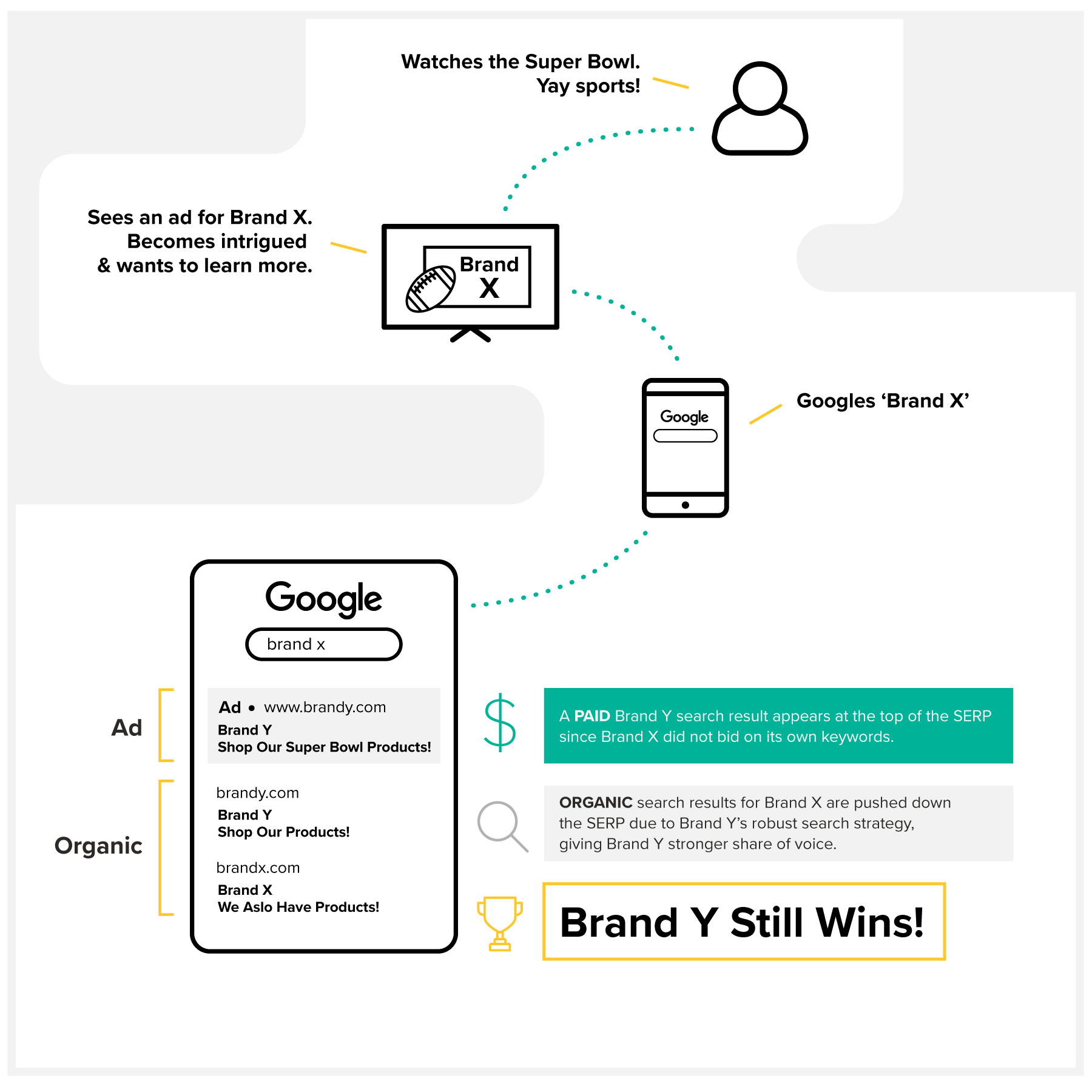
Brand X is relatively new to market, and purchases a wildly expensive Super Bowl spot to drive high-level awareness. The spot is well-produced and the creative is super sticky. Brand X’s marketing team is over the moon. They plan a watch party, their social team prepares for a huge increase in engagement, and they get the champagne ready. 

The ad airs, the team cheers, social media followers grow. But digital engagement is lackluster. Web traffic doesn’t spike as anticipated, conversion goals are missed, and the moment passes anticlimactically.

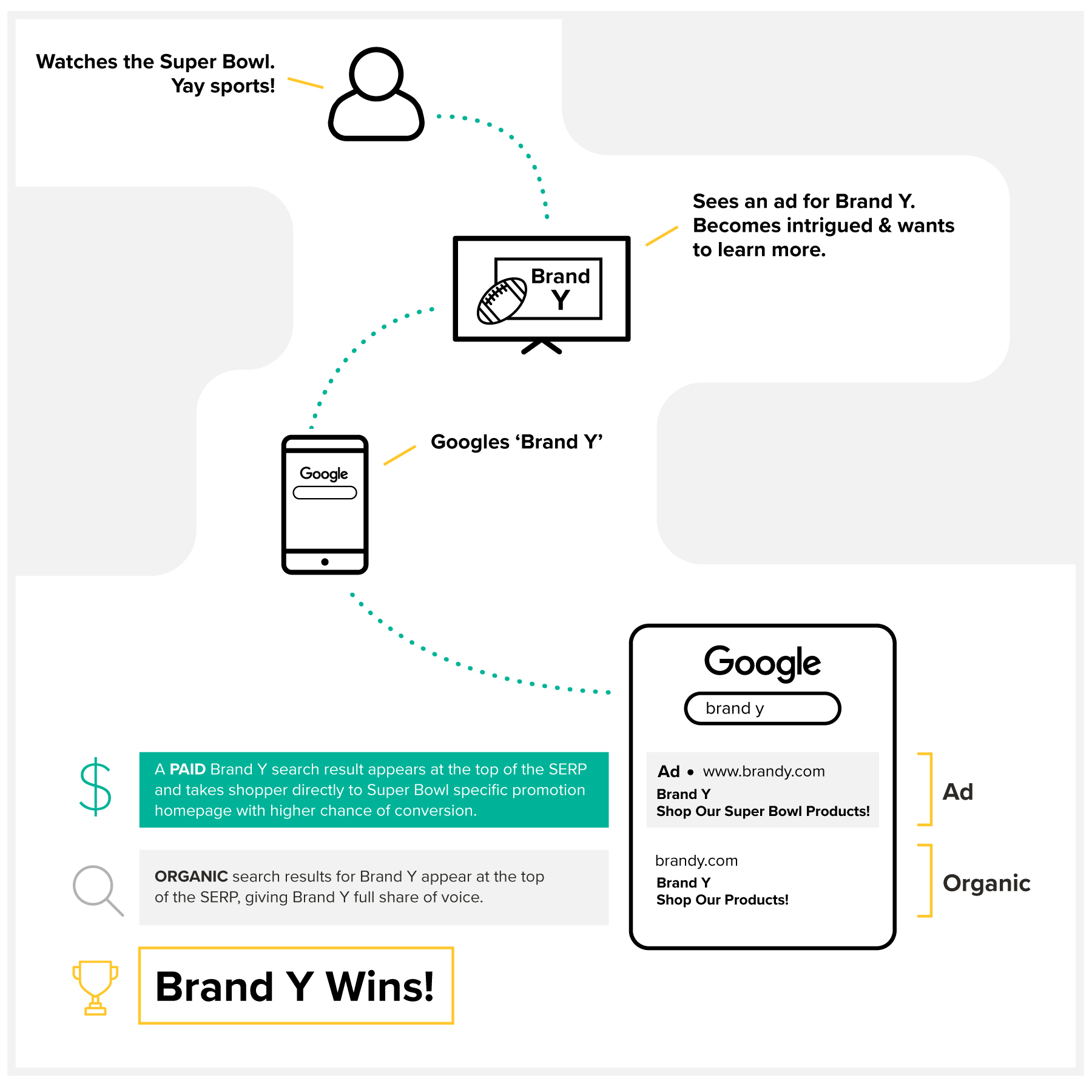
Competitor Brand Y, also pretty new to the market, purchases a similar wildly expensive Super Bowl spot to drive awareness as part of a well-planned omni-channel campaign. Brand Y, like Brand X, produces a high-quality spot, plans a watch party, and gets the champagne ready. But before popping the cork, the Brand Y digital team plans a smart search campaign, investing in its own branded keywords AND taking the added step of bidding on Brand X’s keywords.

The Brand Y ad airs, the team cheers, social media followers skyrocket. Digital engagement soars. Web traffic explodes, directing searchers to a landing page with helpful, specific information intended to help consumers decide which product to purchase, with a clear call to action and a simple checkout flow. Brand Y shatters its conversion goals, and the ad tech pundits applaud. The champagne flows freely.

Don’t Underestimate the Importance of Your Own Keywords

Brand X had a good ad. So what went wrong? Typically, when companies run TV ads, they’re looking to maximize reach and generate awareness by getting their name in front of as many eyeballs as possible. As consumers move down the marketing funnel, brands should aim to provide more detail about their products and services. One key component in this stage of the marketing funnel is running smart branded paid search campaigns, as Brand Y did in the example above.

paid search brand

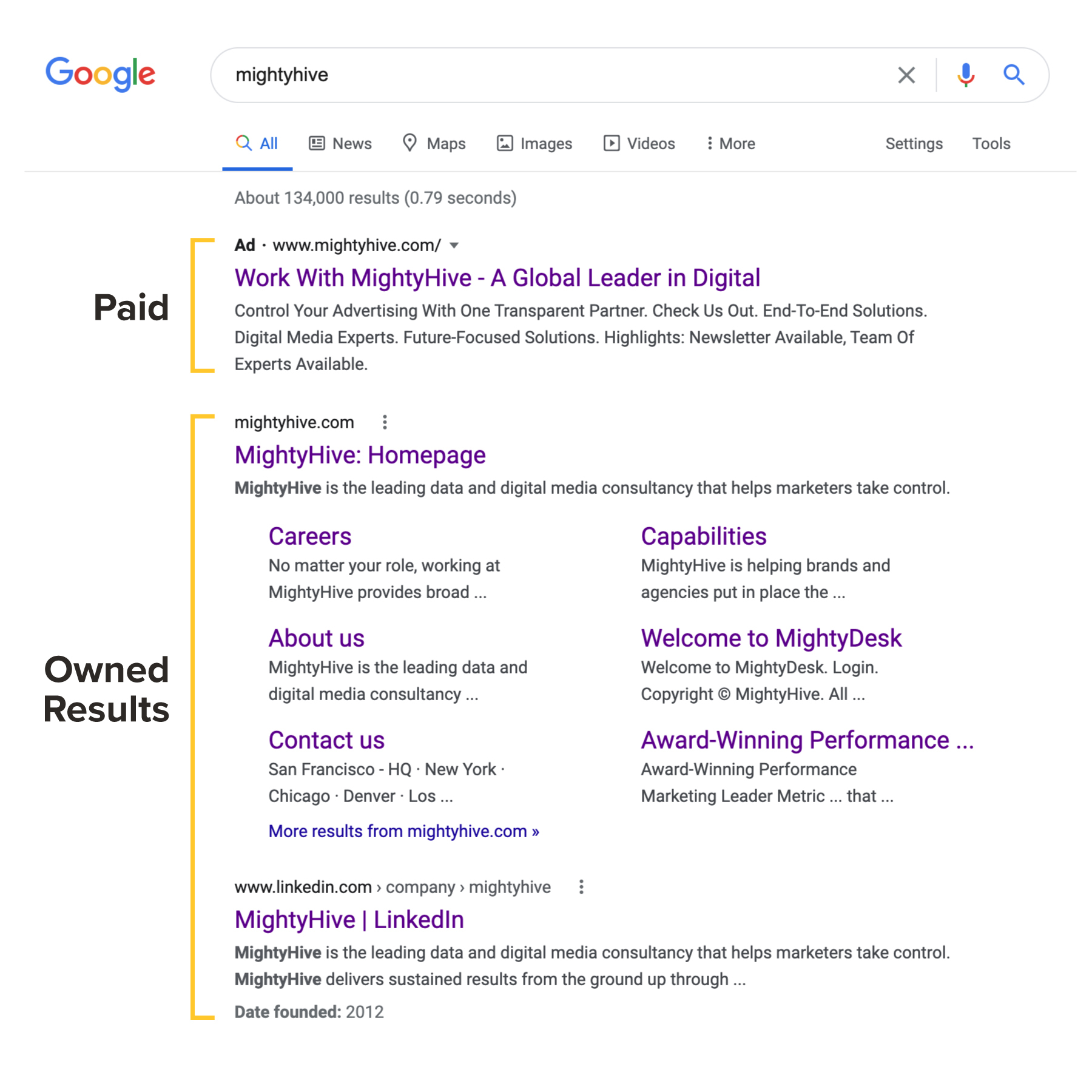
Many brands don’t believe that bidding on their own branded terms is worth the added cost, since they assume they’ll appear first on the search results page organically thanks to a solid SEO strategy. However, this may not always be the case—especially if similar brands bid on their competitors’ search terms. Branded paid search is an inexpensive and simple way to ensure that the brand is always at the top of the search results, especially during critical stages in the marketing funnel. Now let’s take a deeper look at why brands should be bidding on their own branded terms.

Dominate the SERP

The number one reason brands should run branded search is to increase visibility and ensure they are in full control over the search engine results page (SERP), especially in a mobile-first world where organic search listings are pushed even further down the page. When paid search and organic search strategies work together, marketers are more likely to establish their brands as category leaders, building credibility with potential customers and providing more opportunities for users to land on the intended website and eventually convert.

paid organic search

Defensive Bidding

Brands should also run branded campaigns because if a brand isn’t bidding on its own branded terms, competitors can easily do so. We call this “conquesting.” Conquesting is a popular tactic among competing businesses in order to intentionally gain the interest of a user who may be searching for a different company altogether. When a brand doesn’t bid on its own branded terms, a vacuum is created for competitors to capitalize on that awareness, grabbing a higher SERP slot and more market share.

paid search fail

We Rest Our Case in Defense of Branded Keyword Bidding

There’s no denying that branded terms are the best way to get in front of consumers that have strong intent to learn more about your brand. As such, with compelling branded paid search ads, marketers can deliver highly-effective and strong messaging to guide consumers down the funnel. With branded paid search, marketers can get more creative with features like dynamic copy, which updates instantly based on searched keywords, or ad extensions based on product offering. Branded search is a great way to generate revenue with highly tailored, powerful messaging to target the right user at the right time.

This past Super Bowl, we witnessed some very successful Brand Ys. Surprisingly, with all of the available resources and thought leadership around paid search, we also saw a handful of Brand Xs (their errors didn’t go unnoticed on Twitter). Don’t be a Brand X.

With compelling branded paid search ads, marketers can deliver highly-effective and strong messaging to guide consumers down the funnel. Learn how. media buying media strategy content marketing strategy

Choose your language

Choose your language

The website has been translated to English with the help of Humans and AI

Dismiss