Choose your language

Choose your language

The website has been translated to English with the help of Humans and AI

Dismiss

Using Clever UI to Lead Users on a Journey, Without Leaving Them Stranded

Using Clever UI to Lead Users on a Journey, Without Leaving Them Stranded

3 min read
Profile picture for user mediamonks

Written by
Monks

Using Clever UI to Lead Users on a Journey, Without Leaving Them Stranded

Earlier this summer, we released  Pharos AR, a mobile app that takes Childish Gambino fans on a virtual, hallucinogenic journey through the cosmos starting from wherever they stand in the real world. Fans and press alike were impressed by the artist’s bold foray into virtual space.

VentureBeat was excited by the long-term value of the app, for example: “Between the cool visual effects and Glover’s music—which the app will apparently update with new songs over time—there’s certainly enough here to merit a download for fans.” Variety, meanwhile, applauded how well it integrated within the larger Childish Gambino universe: “The whole thing is very spacey, and stays true to Childish Gamibo’s other ‘Pharos’ projects” that have expanded across performances.”

As we see interest build in augmented and mixed reality over the interim, we’re looking back on the project’s development and how multiple parties and team members came together to employ best practices in UI and design, helping everyday users ease into a mysterious–and perhaps technologically overwhelming–new interface without limiting space for play and exploration.

Made in collaboration with Google Zoo, Unity and MediaMonks, it’s the world’s first shared augmented musical experience, allowing multiple users to enjoy a unique, artistic experience together. “This app is a breakthrough for AR,” says Thomas Prevot, Sr. Producer at MediaMonks. “It serves as another outlet for Childish Gambino’s creativity, letting him update his fans with future song releases over the cloud,” says Prevot, explaining how the app fits within the larger Childish Gambino brand.

Pharos AR also showcases the power of the ARCore platform and how it can enable immersive, social storytelling experiences. In particular, it shows off the capabilities of Cloud Anchors, which lets multiple users interact in a shared virtual space–which also makes it fairly unique among AR experiences. The tech’s newness can be intimidating, though: how can apps cultivate an interactive, exploratory experience for those new to AR?

Integrate Brand Familiarity & Digital Ecosystems

Childish Gambino fans will recognize Pharos AR’s light-particle silhouette from a Pixel 3 TV ad, and scenes projected within an enigmatic pair of monoliths at this year’s Coachella festival. These elements are purposefully and artfully executed across touchpoints, and this integration with a pre-existing digital ecosystem helps to make the process of designing for emerging tech more intuitive.

VID_20190412_160740.00_00_12_14.Still002

Users were invited to try out the app at Coachella.

From the Pharos Festival to a TV spot to Coachella and beyond, you’ll find the same trademark, psychedelic motifs true to the nature of the artist. This goes to show the potential of AR as a powerful channel to not only engage audiences in an immersive way, but to bridge together the Childish Gambino gospel as well.

Get Intuitive

With AR still being fairly new to some, developers must think carefully about onboarding new users. “Experiences like Pharos AR provide an exciting opportunity for us to help make AR and VR more accessible to wider audiences,” explains Justina Sung, UX Designer at MediaMonks. “If people habitually use their phones a certain way, how do we break out of that to teach them new behaviors for emerging tech like AR?”

VID_20190412_160740.00_04_48_06.Still003

As users explore the surrounding cave, neon dancers come to life around the fire.

Inspired by Childish Gambino’s spirit of ambiguity and minimalism, the app integrates a sensory communication method, instead of verbal directions, to onboard. “Most app tutorials task the user with swiping through instructional cards, but we made it feel like the title sequence of a movie,” says Alex Otto, Associate Creative Director at MediaMonks. When users first open the app, for example, a pink laser beam dynamically snakes through space and into icons that illustrate next steps. “It’s designed to give off a mysterious feeling that builds up layers of suspense,” says Otto.

Direct Users Through Environmental Storytelling

Because AR rewards users through exploration, designing for it requires a careful balance between providing freedom versus direction. “It’s important that the design gives fans room to explore on their own to find meaning, using subtle environmental cues that nudge users in the right direction,” says Sung.

In Pharos AR, the scene gradually dims as users discover hidden glyphs on the cave walls. This nudges them to shift their focus to the altar, which lights up as users discover more paintings—a bit like a progress bar. Other cues include haptic feedback and the gradual, sonic buildup to Childish Gambino’s song “Algorythm,” which released through the app.

AR is a powerful platform for brands to tell their stories and engage directly with key audiences. In the case of Pharos AR, the technology provides users a chance to embark on a wild, immersive journey that encapsulates Childish Gambino’s message of enlightenment. As the first interactive, shared musical experience in AR, the experience truly pushes the limits on what can be achieved—inspiring brands and artists alike to consider what’s possible.

Eager to experiment with easily approachable AR?

Bringing AR entertainment to the masses, Childish Gambino’s Pharos AR app took a smart approach to onboarding users new to the tech. Using Clever UI to Lead Users on a Journey, Without Leaving Them Stranded Transforming the living room into a cosmic journey is no simple task.
AR VR mixed reality augmented reality childish gambino pharos pharos ar google ar ui

No Job Too Small: Why Side Projects are Essential

No Job Too Small: Why Side Projects are Essential

4 min read
Profile picture for user mediamonks

Written by
Monks

Side projects and hobbies are hardly child’s play. On the contrary, they can be vital for gaining new skills and sniffing out new collaborative partners.

Recently MediaMonks’ very own Animation and Art Director Fran Marquez gave a talk at the KIKK Festival on how a passion project paved the path to one of the biggest creative canvases on the internet: Google’s home page. Discussing Deep Thoughts—a web animation series developed by Marquez and his colleagues that offers several short clips in different styles per episode—Marquez explained the key role it played in the development of Google’s 20th anniversary doodle.

GoogleDoodle_ArtOverview

Learn Something New

You might be wondering: if the nature of my work is creative, what would a passion project provide that my professional work wouldn’t? Side projects allow you to spread your wings a little bit beyond the everyday humdrum; even if you tackle a variety of work throughout the week, side projects provide an opportunity to experiment in different roles or gain a more sophisticated understanding of a project’s scope. “You discover the real amount of work behind certain styles and formats,” Marquez said in his talk. “It also works to open your mind and to make you understand a little more about the industry itself.”

How that benefits an individual creative is obvious: more experience means the potential for better work. But for whole teams or agencies, such an approach can make up for dwindling time or budgets for R&D. Over the past few years, many agencies have answered this need by hosting short hackathons to spur creative ideas and camaraderie, though side projects allow for a sustained opportunity to extend outside of the comfort zone beyond a 24-hour blitz.

And the benefits to cultivating such a habit stick with you. Marquez says the side projects his team worked on helped some of his colleagues view animation beyond just the scope of traditional cartoons. Having more autonomy and working together on their own project allowed them to adopt a design-focused view on how animation could be used as a tool.

Monk Thoughts When people make that creative shift, they make a big change in themselves.

One big change from this shift is that you may be valued more as a strategic asset by colleagues or prospective collaborators. Side projects can provide heightened business and industry understanding, which places more trust in your ability to make decisions or play a bigger role in the concept stage of a collaborative project. “Clients do want creative partners,” Marquez said, but they can be cautious about who they hand over the reins to. Honing strategic acumen by stepping outside of your daily role with side projects is a great way to build that level of trust.

Expand Your Portfolio

So how do you prove yourself through your side projects? By working on them little-by-little, you develop not just some extra skills, but also a detailed portfolio to share them. The Deep Thoughts project, for example, showed off several features: a diverse array of styles, subtle storytelling and quick transitions from one clip to the next. These qualities exhibited the team’s creative output as well as their production capability and speed—all things that aligned perfectly with Google’s need for a remarkable Birthday Doodle to celebrate its 20-year milestone. And the parade of whimsical clips portrayed in Deep Thoughts seemed like a convenient extension of their style.

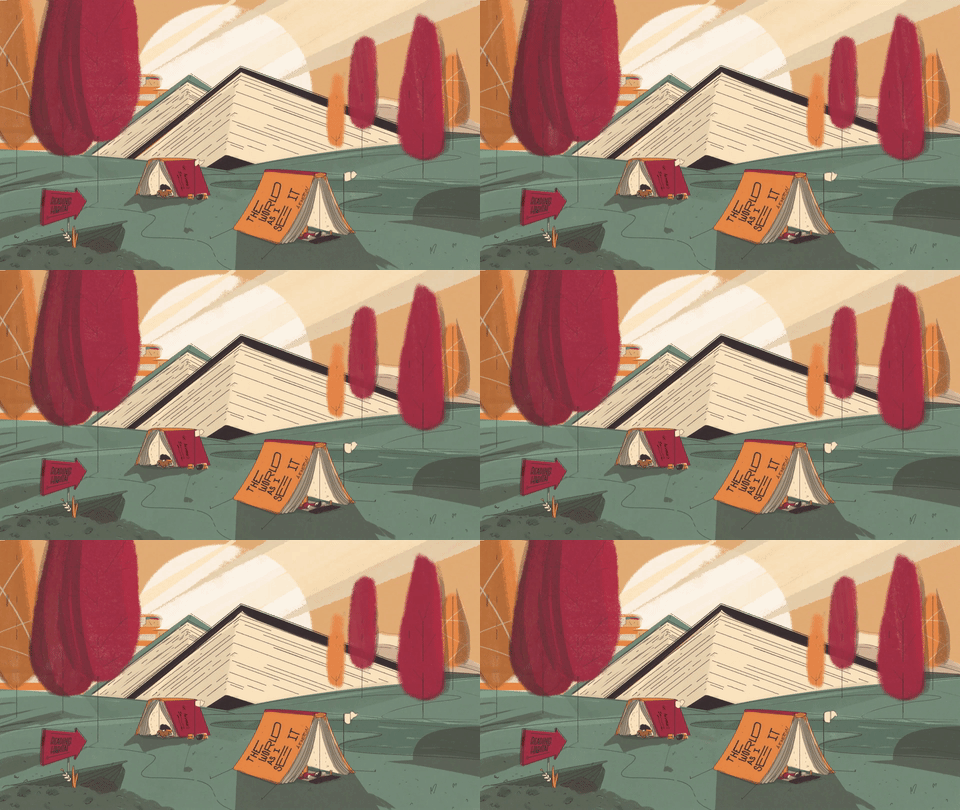
Books01
Books02
Books03

Of course, not everyone’s side project translates so closely to new collaborations and opportunities. But it’s important to remember that they don’t exist in a vacuum, either: every side project you complete provides a new opportunity to develop new skills and capabilities.

Make Work Fun Again

Side projects do more than just expand skillsets and help you prove your worth. They can also boost morale, whether you’re tackling an individual passion project or working on a team. If you are tinkering at a passion project within a group, there’s the added benefit of enhanced teamwork and visibility of each member’s skills and backgrounds.

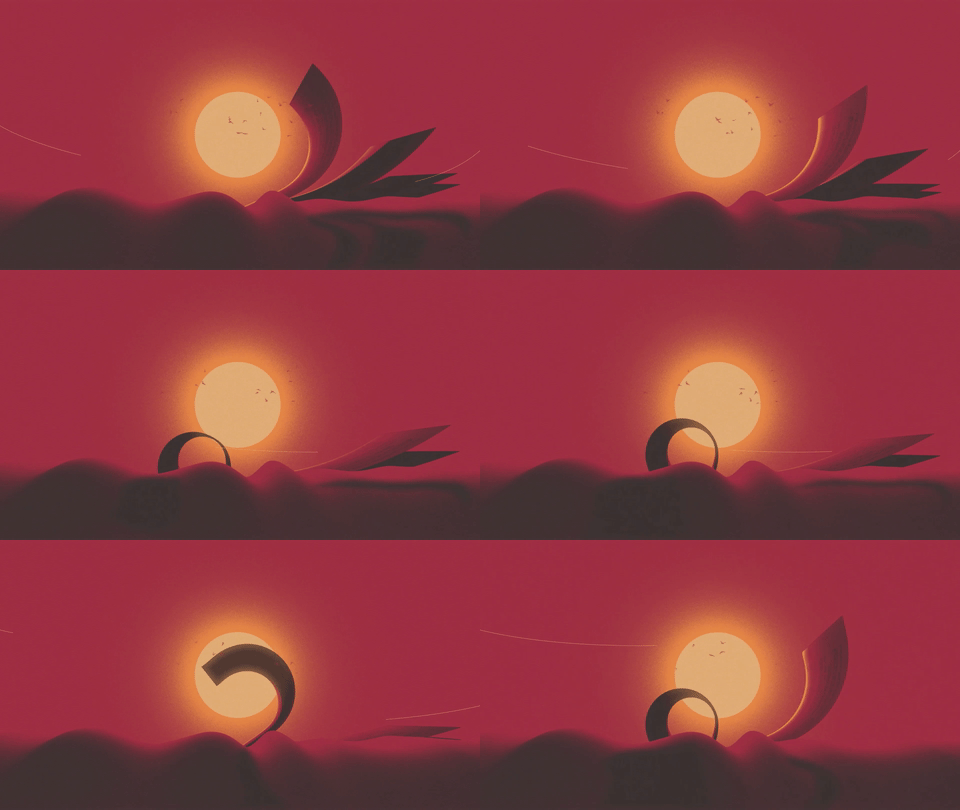
GoogleDoodle_13
GoogleDoodle_08
GoogleDoodle_02

Whether you want to nurture a culture of side projects for your team or simply begin a project yourself, start by taking stock of strengths and weaknesses. What are things you do particularly well, and what opportunities would allow you to hone the skills you’re not so great at? Once you’ve set an objective, put aside time to dedicate to the project on a regular basis. The side project should be relatively low-pressure, but keeping to a timetable holds yourself accountable and ensures you stick to it.

Remember, a big part of working on passion projects is to have fun and learn while doing something you love. Anything that takes you and your colleagues away from the daily grind (and results in tangible evidence for the portfolio) should suffice. We Monks aren’t the fortune-telling type, but we know one thing for certain: “If you put effort and trust into something,” Marquez said, “it will come back to you in a positive form.”

Passion projects aren't idle distractions--they're essential for developing new skills and creativity. Discover the importance of side projects, hackathons and other creative exercises for agencies and creatives. No Job Too Small: Why Side Projects are Essential Find out how a side project opened the door to one of the biggest creative canvases in the world: Google’s home page.
side projects passion projects hackathon creative hackathon agencies google google doodle

Choose your language

Choose your language

The website has been translated to English with the help of Humans and AI

Dismiss