Choose your language

Choose your language

The website has been translated to English with the help of Humans and AI

Dismiss

Our Map of the Metaverse Worlds: Find a Virtual Home Now

Our Map of the Metaverse Worlds: Find a Virtual Home Now
AI & Emerging Technology Consulting AI & Emerging Technology Consulting, Experience, Metaverse 7 min read
Profile picture for user mediamonks

Written by
Monks

A colorful island showing the different metaverse worlds

Given the way the metaverse has captured marketers’ imaginations for the last year, it’s easy to feel the need to make moves in the space for fear of missing out—or maybe to simply be seen as an innovator. But with roots in gaming and digital art, the lifeblood of a metaverse world is the culture that calls it home. While hopping into the hot platform of the minute may be tempting, it’s important to carefully consider what value your brand can bring to show up authentically.

Monks Thoughts The metaverse is a new canvas for creativity, but the hyped up trend wave could snuff all the incredible out of a good thing. We must see past the hype and look to the future with purposeful creativity.

00:00

00:00

00:00

Jouke Vuurmans Chief Creative Officer

The idea of people coming together in virtual environments isn’t new, as any fan of online games will tell you. But as these worlds become more mainstream, we’re seeing a shift in the role they play in our lives, whether it’s a pivot from competition to cooperation or enabling people to push beyond limits that hold them back IRL. This is virtualization in action: a set of new audience behaviors and cultural norms resulting from 30 years of digital transformation, hyper-accelerated over the past five years. These behaviors vary from one metaverse platform to the next, meaning an understanding of its culture is crucial to success in the space. In some ways, it’s not so different from identifying which city or neighborhood is the best location for a brick-and-mortar store.

Do you need to find your way into the metaverse? Don’t despair, because we’ve mapped out some of its preeminent worlds. Discover what differentiates one from the next with the information below. With a better understanding of each space, you’ll be able to better envision your brand’s place within the metaverse—wherever that may be.
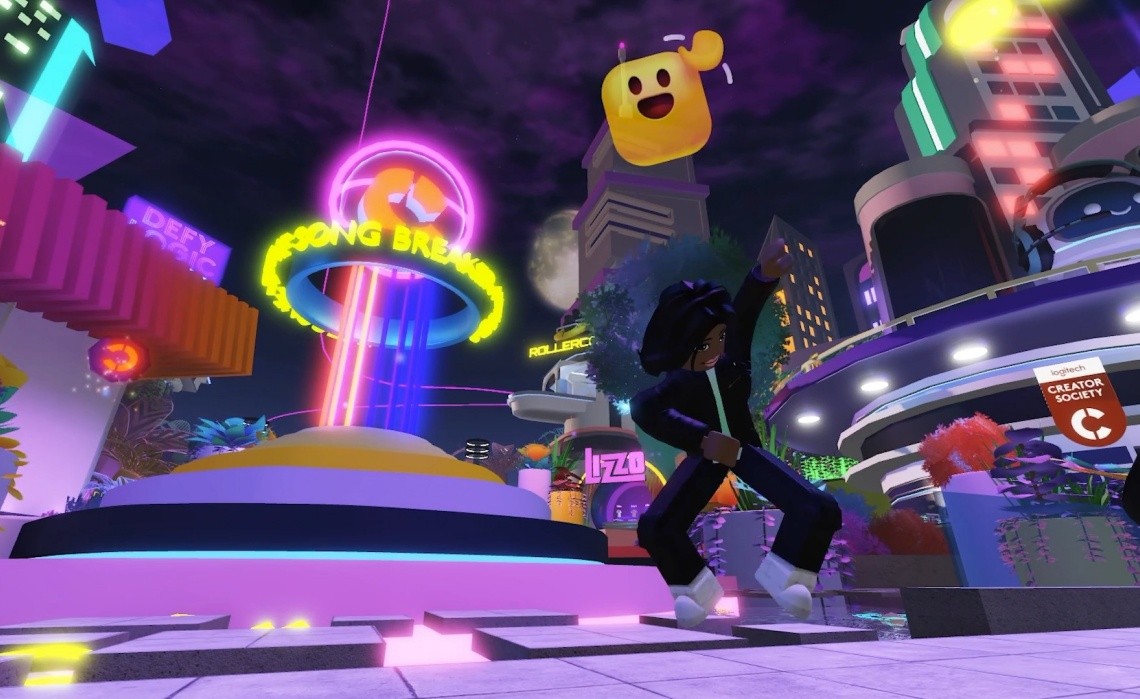
An avatar in roblox dancing
Inside the merch store within Roblox for the Song Breaker Awards

Roblox.

Despite its quick rise to fame in recent years, Roblox dates back to September 2006, and today has a monthly average user base of 190 million. Its worlds are user-created, meaning they can vary drastically in look and feel; you never know what you’re going to find there. Users have the ability to develop their own assets (models, textures, audio and more), adding to the variety on the platform. This ability to create and sample a diverse array of activities is what makes it so appealing to players. Roblox is free and multiplatform—available on PC, mobile, Xbox One and VR platforms—and its developer tools are surprisingly accessible for those without deep coding experience.

More than a game, Roblox is a creation platform that has allowed millions of amateur developers to try their hand at making games and virtual environments for the first time. Players can both create and share individual assets, build robust games or simply play. The level of creation enabled by the platform, as well as its younger-skewing audience, makes it ripe for memes. Don’t expect avatars to mirror players’ physical likeness; fanciful avatars are the norm here. One great example of a brand embracing gamified elements in Roblox is the Song Breaker Awards, presented by Logitech For Creators. The experience reinvented the awards show format to be more accessible and interactive, inviting viewers to participate in a narrative that unfolded throughout the show.

Myla Unique Minor and Renee Montgomery in the metaverse celebrating on a basketball court

Horizon Worlds.

Meta’s foray into the metaverse is the newest virtual environment on our map—and the only one that requires a headset to enter. Since its launch in December 2021, Horizon Worlds now has 350,000 monthly active users. Like Roblox, environments in Horizon Worlds are largely user-created, meaning there’s a lot of variety in the worlds you can build or step into. The Unity-powered platform has a cartoon-like look and feel, with environments ranging from the fantastical to the ordinary, like a virtual comedy club or recording studio. Based in VR, Horizon Worlds requires an Oculus headset to enter, although its creation tools are accessible and intuitive.

Built by Meta, developer of some of the biggest social platforms on the internet, Horizon Worlds is first and foremost a space to socialize and create. While users can build competitive environments, connection among communities is key. The space also lends well to cultural moments like live sports or musical performances, which users can immerse themselves within from afar. Given the platform’s connection to Facebook—users can join with an existing Facebook account, although Meta just recently announced a unique account system—avatars and identities in Horizon Worlds are meant to reflect one’s real-world identity. This also makes safety and moderation a key consideration on the platform. Speaking of identity, a stand-out Meta’s Going Beyond: Women’s History Month event, made in collaboration with the NBA, is a stand-out experience. Throughout an interview focused on representation, viewers had a front-row seat.

Birdseye view of the library showing the whole playing area
Tiles that read different uncensored materials to read from

Minecraft.

Officially launched in November 2011, Minecraft is home to 170 million monthly average users. The blocky, open-world simulation game places users within a unique, procedurally generated landscape that they can explore and manipulate to their desire. What’s really driven Minecraft’s popularity over the decade is its marketplace of downloadable content and customization tools, allowing for the design of diverse worlds and environments. While Minecraft is a paid download, its wide availability on PC, consoles and mobile make it widely accessible to audiences.  

Minecraft’s culture is focused on building. Players take enjoyment in creating environments together and sharing them with the community—or even breaking apart pre-made environments. Users are afforded complete control of virtual spaces they inhabit, allowing for a high sense of ownership and collaboration. One of our favorite Minecraft activation is the Uncensored Library, which cleverly uses the game to circumvent state censorship and offer access to articles banned around the world. Of course, we have a soft spot for the time our VP of Platforms and Products Brook Downton built our New York office in Minecraft, too.

Fortnite.

Epic Games’ wildly popular shooter, powered by the developer’s own Unreal Engine, launched in July 2017 and boasts 280 million monthly average users. Having risen to fame at the height of the “battle royale” trend in gaming, Fortnite offers a handful of different game modes that take place on an island that grows and evolves over time. It features a cartoon-like art style, similar to what you might expect from a CGI-rendered animated film. As a free-to-play, cross-platform title available on consoles, mobile and PC, Fortnite has a very low barrier of entry for players.

Fortnite is an evolving space, refreshed seasonally with new competitive modes and events featuring limited-edition skins (avatars) depicting characters and celebrities from pop culture. The promise that there’s always something new is what keeps players coming back. In late 2021, Fortnite launched Party Worlds, or social spaces where players can access minigames, concerts, movie screenings and other content. The space demonstrates the kinds of ways that metaverse worlds can uniquely bring people together in shared, persistent social spaces.

An avatar in decentraland playing duolingo game

Decentraland.

Decentraland launched in February 2020 and is frequented by 330,000 users each month. There’s a big difference between Decentraland and the other platforms mentioned above: it’s a Web3-based environment built on the Ethereum blockchain. While platforms like Roblox and Horizon Worlds invite users to jump into self-contained worlds, Decentraland is a seamless, persistent landscape in which plots of land are bought, sold and redeveloped by the community—just like in the real-world real estate. Decentraland is accessible in a browser, though the need to connect a crypto wallet can be a technical barrier of entry to users.

The culture in Decentraland is more plugged into the Web3 space and skews very digitally mature. In addition to in-world games and activities, this environment is a place to flaunt what you’ve got: art galleries designed to show off NFT collections are popular, and a bustling marketplace allows users to trade ownership of unique digital outfits and objects. Duolingo expertly captured the playfulness of the space by dropping a giant statue of Duo, its infamous mascot, into Decentraland’s leisurely Terra Zero area. Holding a billboard that cycles through snarky push notifications reminding visitors to do their language lessons, the activation cleverly emulates Duo’s pesky habit of popping up right when the leisurely activities tee off.

The Sandbox.

 Our final metaverse world covered here is also one of the oldest, having launched back in May 2012. Since then, the Sandbox is enjoyed by 300,000 monthly users. Like Decentraland, it’s a Web3-based world where users can purchase land and build their own monetized environments. The platform is relatively consistent in look and feel, taking a voxel art style reminiscent of Minecraft as a nod to its 2D roots. Available on PC and mobile platforms, the Sandbox handles onboarding very easily: new users have the choice to connect a crypto wallet or a social account if they lack one.

As far as interactions go, the Sandbox offers a mix that you’ll find in other platforms. Like Roblox, users can easily construct their own games without coding experience. A play-to-earn model rewards creators and players, incentivizing play on the platform. And similar to Decentraland, a marketplace of NFTs in the form of avatars and unique parcels of land add to the opportunities for users to earn real-world value from their digital creations. One cool example we love is a collaboration between Tony Hawk and Autograph to build the biggest skatepark in the metaverse. In addition to hanging out in the space, visitors can purchase NFTs inspired by Hawk’s career.

Find your place in the metaverse.

Just like how the universe contains too many planets to count, the metaverse is a vast space comprising unique worlds—each with their own distinct culture. From video game worlds to Web3-native environments, each platform offers different tools for people and brands to engage with one another. Before jumping into the metaverse for the sake of it, carefully consider the audience you want to reach and how your brand can uniquely add value inside the world cultivated by its community. After making the right culture fit, you’ll have made the crucial first step in building impactful, authentic metaverse experiences.

The metaverse is a natural progression of the internet, and it reflects a cultural shift brought on by the ongoing process of virtualization. The metaverse is everywhere––a universal and connected experience that transcends geographical barriers and presents exciting opportunities for brands to show up. But, the stakes are high and the barrier to entry is steeper than ever. Advertising in the metaverse shouldn’t look like advertising at all. Brands need to strike a balance between being present and being authentic by providing utility and meaning for people through creativity and technological innovation. In short, brands must create experiences people actually want. While this isn’t a new idea, marketers will have to stretch their thinking for a new, fully-virtualized medium and a highly engaged audience quick to criticize disingenuous marketing efforts.

Want your own map of the metaverse worlds? Download it below: 

For your desktop (with stats)

For your desktop (no stats)

For your phone (no stats)

Do you need to find your way into the metaverse? Don’t despair, because we’ve mapped out some of its preeminent worlds. metaverse virtual experiences gaming game engine brand virtualization Experience AI & Emerging Technology Consulting Metaverse

Welcome STAUD STUDIOS, Turbocharging Automotive Marketing

Welcome STAUD STUDIOS, Turbocharging Automotive Marketing

3 min read
Profile picture for user mediamonks

Written by
Monks

We’ve hit our stride over the past few weeks in announcing new members of the S4Capital family—but we’re not hitting the brakes just yet. Today we welcome a new member to the Media.Monks team: STAUD STUDIOS.

STAUD STUDIOS is a full-service, data-driven marketing solution serving the world’s most iconic automotive brands. Based in Stuttgart, Germany, the team enables brands to match customer insights to a data-driven production pipeline, delivering personalized assets powered by real-time production.

“STAUD STUDIOS is already playing a key part in the marcom engine solution we have developed for BMW & MINI, and their automotive expertise is second to none,” says Victor Knaap, Media.Monks CEO and S4Capital Executive Director. “Going forward, Pascal and his team in Stuttgart will become the global center of expertise and mobility at Media.Monks.”

Giving Content Production Additional Horsepower in Real Time

One of the greatest challenges faced by brands across industries is producing the volume of assets needed to offer relevance to a variety of audiences, especially when marketing budgets have been slashed due to the pandemic. This is especially tough for automotive brands, who have been hit especially hard in the past year. But as the year looks increasingly optimistic for the automotive industry, brands require a solution that will help them drive cultural relevance and conforms to local market regulations.

Of course, individual consumer preferences also play a major role in performance as well, demanding automakers represent the vast breadth of possible car configurations to cater to consumer taste. And just like our smart production approach, STAUD STUDIOS eschews the need to shoot individual assets by instead using a composition technique they compare to the way atoms make up a molecule: swapping individual details like backgrounds, car color, lighting, headlines, legal copy and more based on where it’s delivered.

StaudStudios_Family

The Staud family, posing under the Magicflash technology pioneered by René Staud in automotive photography.

Real-time 3D rendering plays an essential role in this process. Using the Unreal Engine made by Epic Games, STAUD STUDIOS dynamically builds every permutation of a car’s configuration, seamlessly delivering the most relevant one to consumers. This approach is far faster than setting up a real, in-person photoshoot of each model and its various configurations—without sacrificing quality. Last year, we were awarded an Epic MegaGrant to explore Unreal Engine’s potential in automating content production at scale. STAUD STUDIOS’ expertise will help us apply that talent with a dedicated service to auto brands around the world.

Media.Monks’ New Global Mobility Hub Built on Heritage and Craft

Founded in 1983 by legendary photographer René Staud, STAUD STUDIOS has grown alongside the automotive industry and has worked with almost every auto brand in the world. More than just a heritage, high-end production studio, STAUD has pushed the evolution of marketing technology over the decades by marrying a classic commitment to craft with innovative technological techniques, helping auto brands embrace digital in the process.

STAUD’s unique competence is its combination of real shoot capabilities with CGI and interactive production methods to develop assets at scale and in real time. An international and interdisciplinary team of 75 individuals is led by Pascal Staud (CEO), Patrick Staud (Chief Creative Technologist), Uwe Jakob (Chief Creative Engineer), Marco Rex (Chief Delivery Officer) and Dagmar Kraus-Stubenrauch as CFO.

Monk Thoughts We look forward to transforming the way automotive and mobility brands go to market alongside our new colleagues.
Pascal Staud headshot

STAUD joins in our approach to aligning data and creativity to facilitate a true, one-to-one dialogue with audiences across the customer decision journey (CDJ). Through reverse-funnel planning and helping brands seamlessly connect ownable data into third-party systems, they give tech-savvy auto brands a head-start in delivering the right creative to the right audience in the competitive race to attract consumer attention.

“We see a huge demand for change in the automotive industry with a specific need for direct-to-consumer models, personalized interactions and scalable digital and 3D experiences,” says Pascal Staud, CEO of Staud Studios. “As Media.Monks’ Global Mobility Hub, we are very excited to help clients on their path of transformation. We look forward to transforming the way automotive and mobility brands go to market alongside our new colleagues at Media.Monks and S4Capital.”

Today, brands everywhere are challenged to achieve more with less: more audiences to reach, more products and configurations to represent and more channels to serve. Martech innovation—from data-driven production pipelines to real-time 3D production and more—will prove essential for brands as they aim to capture audience attention at ever-greater speed and scale.

“The possibility to plug in our production pipeline into Media.Monks makes our work truly global and scalable, which is essential to serve car brands on their future needs,” adds Patrick Staud. With STAUD STUDIOS on the team, we’re better equipped to help auto and mobility brands tune up their marketing across the CDJ.

MediaMonks welcomes STAUD STUDIOS, a high-end production studio pushing the evolution of marketing technology. Welcome STAUD STUDIOS, Turbocharging Automotive Marketing The race is on to build better automotive experiences at speed.
Automotive automotive marketing real time production game engine unreal engine staud studios

With Epic MegaGrant, MediaMonks Takes Automated Production to the Next Level

With Epic MegaGrant, MediaMonks Takes Automated Production to the Next Level

3 min read
Profile picture for user mediamonks

Written by
Monks

MediaMonks has been awarded an Epic MegaGrant to explore the next frontier in automated tabletop and production using Epic’s Unreal Engine, the world’s most open and advanced real-time 3D creation tool built by the developer behind Fortnite and other high-profile videogames.

Product packaging and tabletop production are table stakes in the advertising industry, as bespoke assets are needed for a single brand in every market around the world. Producing assets, packaging and labels at speed and scale has never been without challenges—and in 2020 it was upended by COVID-19. That’s why MediaMonks is setting out to automate an age-old process, leveraging Unreal Engine to maximize quality, speed and efficiency in advertising production through innovation. 

“A tremendous amount of time and money is spent on product photography and videos for food, drinks and other consumer products,” said MediaMonks SVP, Growth Tim Dillon. “These shoots are costly, slow and must be repeated with each new product, or product version, for each region on a seasonal basis. It’s an aspect of the advertising industry that has been slow to innovate and could benefit from the speed, flexibility, repeatability and quality controls that Unreal Engine delivers.”

Cookies 2 Animated

Virtual production in Unreal Engine makes it easy to change color, shape and more in real time.

These benefits go well beyond the short-term solution of safely and efficiently producing creative in a time of social distancing. Virtual production in game engines like Unreal Engine are particularly attractive for global brands that seek to deliver a cohesive experience for consumers across markets. These 3D assets could also be ported to other touchpoints, including immersive experiences and more tangible product listings for ecommerce, making virtual production an approachable starting point for CPG brand virtualization.

A team of Monks in India has been especially hard at work, creating and iterating in Unreal Engine to translate these ideas into tangible outputs. With a keen eye for creativity and storytelling, they’re harnessing the power of this new technology to advance and disrupt. India CCO John Paite says, “From an artistic standpoint, I see so many opportunities to up-level our creative outputs in Unreal Engine, blending creativity and technology to shape better content and stronger stories that propel the industry forward. Having witnessed what the team has accomplished so far, I can’t wait to see what the future holds.”

“In a constant pursuit to further disrupt the industries we innovate in, I’m thrilled MediaMonks has received this support from Epic,” said MediaMonks Director of Creative Solutions Lewis Smithingham. “With our MegaGrant we have a great opportunity to develop an Unreal Engine-based solution that empowers advertising agencies and commercial production companies to efficiently, and cost-effectively increase flexibility and customization, while also improving quality.”

Monk Thoughts Our customers work at a pace that demands innovation, collaboration and interaction—all at high quality.

MediaMonks is proud to join the Epic MegaGrants community, backed by Epic’s commitment pledging $100 million to support game developers, enterprise professionals, media and entertainment creators, students, educators, and tool developers doing amazing things with Unreal Engine.

“At Epic Games, we are working constantly to give creators, agencies and brands the freedom and control to deliver cutting edge content, interactive experiences and immersive virtual worlds,” said John Buzzell, Enterprise Licensing Lead for Unreal Engine in the Americas. “Our customers work at a pace that demands innovation, collaboration and iteration—all at high quality. MediaMonks shares this vision, and I’m honored to invite them to the Epic MegaGrant community as they work to reinvent production processes with Unreal Engine.”

Around the world, MediaMonks’ future-forward teams are identifying opportunities to leverage game engines to drive efficiency across a variety of industries and sectors. MediaMonks aims to foundationally disrupt the production process for speed and scale, pushing the industry forward through branded 3D content that connects consumers seamlessly across digital ecosystems and builds brand love.

Joining the Epic MegaGrant community, MediaMonks is exploring ways to safely and efficiently power production at scale with the Unreal Engine. With Epic MegaGrant, MediaMonks Takes Automated Production to the Next Level By joining the Epic MegaGrant community, we’re supercharging production for brands at speed and scale.
Epic unreal engine game engine megagrant virtual production production at scale

Choose your language

Choose your language

The website has been translated to English with the help of Humans and AI

Dismiss