Choose your language

Choose your language

The website has been translated to English with the help of Humans and AI

Dismiss

Navigating Consent Mode in GA4 & BigQuery

Navigating Consent Mode in GA4 & BigQuery

Data Data, Data Analytics, Data Privacy & Governance 3 min read
Profile picture for user Data Monks

Written by
Pedro Ginel & Brianna Mersey

add

In today’s day and age, where we see a large amount of privacy litigation and fines, the application of Consent Mode is a step towards keeping inline with privacy compliance regulations. Join us as we explore two distinct approaches to Consent Mode—Basic and Advanced—and highlight the implications for data collection in Google Analytics 4 (GA4) and BigQuery.

Basic Mode: Compliant but at the cost of data collection.

Implementing Basic Consent Mode via GTM is a straightforward path to compliance, ensuring that Google tags remain dormant when the user denies consent. Google tags are not loaded until a user grants consent. While this expedites compliance efforts, it comes with a trade-off: data generated by unconsented users is not tracked in either BigQuery or GA4. You will not receive modelled data in your GA4 property to fill in the data gaps from unconsented traffic to your website. Though efficient in meeting compliance requirements, Basic Mode sacrifices the depth of GA4 data utilization, impacting data tracking significantly when compared to the Advanced mode implementation. Often clients see up to 30% or more of data loss.

Advanced Mode: Unveil deeper insights responsibly.

Advanced Mode takes a more sophisticated approach, allowing Google tags to trigger even without user consent. However, it omits identifiable client data, such as the _ga cookie used by GA4 for identifying users by browser and device. The use of Advanced Mode impacts both BigQuery and GA4 in different ways, which we’ll dive into below.

BigQuery: Track unconsented events.

When using Advanced Mode in BigQuery, unconsented events are still tracked, but they lack certain parameters used to identify users. This becomes evident when attempting to calculate metrics like user count, because the absence of the _ga cookie in events means the user_pseudo_id value (used to help GA4 identify users and calculate user metrics) is missing, resulting in an underestimation of user count. While BigQuery captures all events, the exclusion of critical information affects the accuracy of reporting, particularly in metrics relying on unique identifiers.

This concern doesn’t apply if the user has authenticated and their user ID is sent to GA4. That data will be then sent to BigQuery.

In short, BigQuery retains all events, including unconsented ones. Unfortunately, missing information influences the reporting of metrics like user count, demanding a strategic approach in data analysis.
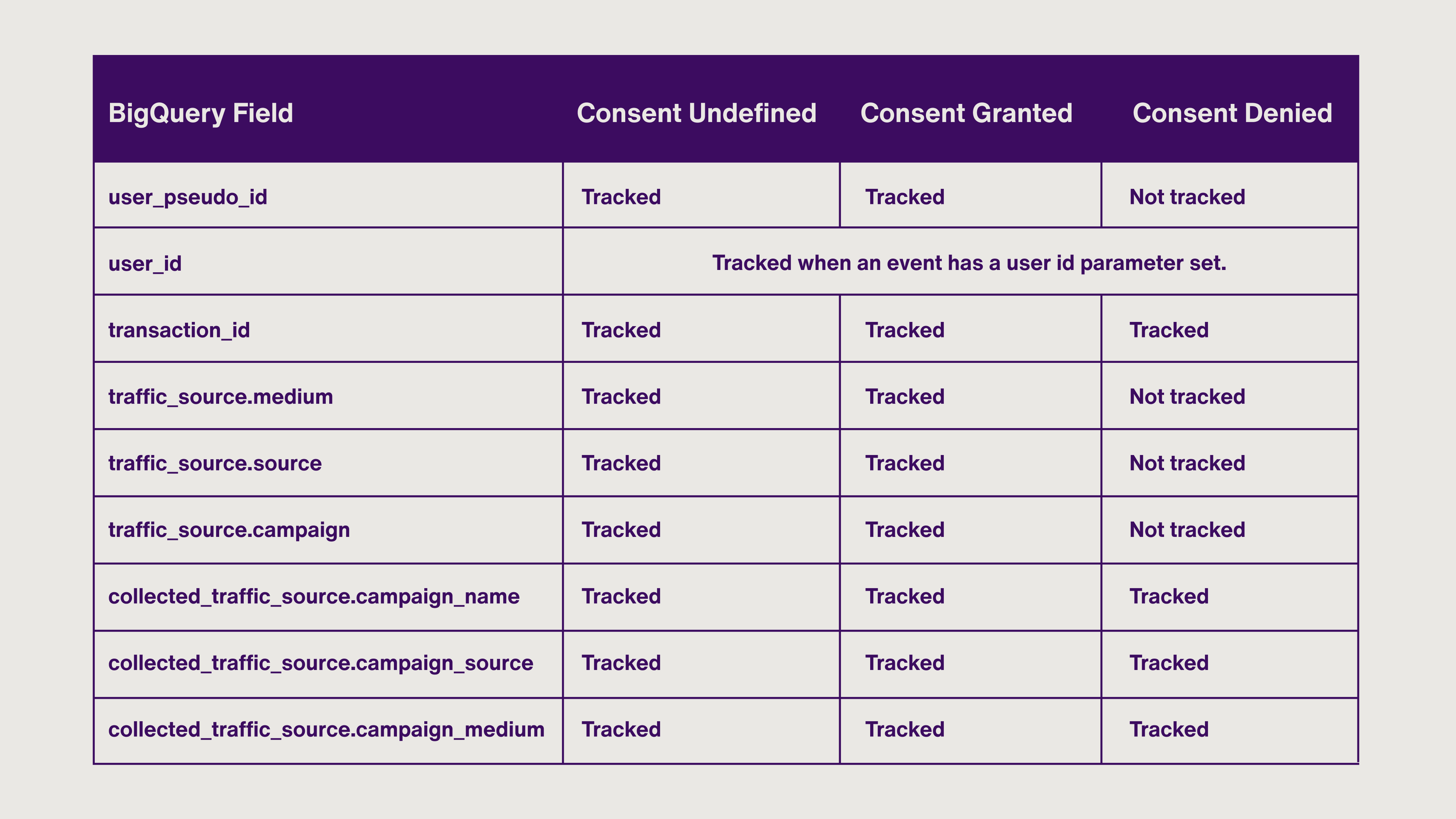
Based on experiments ran with a custom GTM container & custom GA4 tags

GA4: Model metrics beyond consent.

When using Advanced Mode in GA4, you may notice an initial drop in metrics because unconsented users and their events are not reported. However, the innovative aspect of Advanced Consent Mode lies in its ability to model data: over time, Google analyzes both consented and unconsented traffic, then builds estimations of the relevant metrics. While this modeling occurs programmatically and beyond our control, GA4 users are not restricted to reporting limitations. Metrics like user count, initially affected by unconsented data exclusion, become estimable through Google's modeling efforts.

GA4’s UI modeling will become active as soon as you implement Advanced Consent Mode. You don't necessarily need to use GTM for that; you can use any other tag manager or run it directly in your banner code

Tip: To see modeled data in your reports, choose the Blended reporting identity, under Admin > Data display > Reporting Identity > Blended, otherwise select Observed to view strictly consented data. You may switch back and forth between options without impacting data collection.

Strike the Right Balance.

Dedicate time to implementing Advanced Consent Mode to prevent complete data loss on unconsented hits. This mode provides a nuanced solution for those ready to navigate the intricacies of unconsented data tracking. Additionally, selecting a Cookie Management Platform (CMP) is essential for managing the cookie consent banner and directing the consent management process that is initiated when visitors arrive on your website and choose to allow or deny cookies. As global regulations evolve, it becomes crucial to have robust, privacy-centric measurement solutions accessible to marketers worldwide.

And finally, before you start Advanced Consent Mode implementation, get your legal team onboard and discuss any possible ramifications of collecting cookieless pings from users who declined tracking.

Unlock GA4 and BigQuery insights with our experts! Navigate consent mode complexities, explore basic and advanced approaches, and ensure privacy compliance. Google Analytics data privacy big data data analytics Data Analytics Data Data Privacy & Governance

Unless Creative and Media Play Nice, Big Data Remains Largely Untapped

Unless Creative and Media Play Nice, Big Data Remains Largely Untapped

3 min read
Profile picture for user mediamonks

Written by
Monks

It’s clear that big data is valuable, but there’s so much of it—often siloed and locked away—that marketers and agencies alike can have a tough time measuring performance. A more integrated approach between data and creative is increasingly important with the rise in programmatic spending, so how can businesses keep up?

From departmental silos to media companies that refuse to share data due to strong privacy regulations and public scrutiny, measuring performance and tracking which media spend offers the best results are common thorns in marketers’ side. And when businesses are unable to measure data with efficiency, consumers are deprived of the personalized, relevant experiences they come to expect when handing over all that data.

The problem gets even more difficult with the rise of new players and platforms entering the arena. As the adoption of voice platforms like Amazon’s Alexa grows, for example, marketers will find themselves more beholden to platforms that might make data-crunching an even bigger challenge in addition to social and traditional search. Some of the biggest players are also the most resistant in sharing user data, facing pressure from regulators and the public to use it responsibly. But marketers need it to effectively inform their ad spend and create experiences optimized for each touchpoint on the consumer journey.

Monk Thoughts Programmatic is a canvas for delivering better creative.
Victor Knapp

Programmatic’s Popularity Requires More Efficient Data

With programmatic ad delivery on the rise (41% of businesses are investing more in programmatic next year, and an additional 20% said they intend to invest significantly more, according to an Adweek Branded report), efficient access to data for measuring the performance of content becomes all the more important. But where there’s a challenge, there’s opportunity: MediaMonks CEO Victor Knaap believes the programmatic trend will prompt businesses to better integrate data into their creative process. “Programmatic is put into the outer areas of tech, start-ups and media buyers,” says Knaap, “but it is actually a canvas for delivering better creative.”

When data is built into the creative process early on, you can build much more personalized content optimized for the context of the platform. One elegant example is the U.S. Air Force website, which draws on user data to deliver dynamic, targeted content for a more relevant user experience. The U.S. Air Force needed such a data-driven approach because queries in the recruitment process ate up time and money. By tending to prospects’ needs and concerns through the content, they could better identify the most qualified applicants. And that’s important to note: the point of the website revamp wasn’t to generate more recruits, but rather more qualified ones. This heightened the need for highly accurate and actionable data.

First-Party Data to the Rescue

To achieve these goals, brands are hoping to leverage first-party data by investing in data management tools or offering platforms of their own. The U.S. Air Force website again serves as a great example of how brands can offer their own platform to meet these needs. Visitors begin their journey by providing key details like who they are, their work experience and what they hope to gain from a career with the force. This provides a starting point to surface up content that will grow more relevant as they browse.

af_02_900x575
Screen Shot 2016-01-15 at 14.21.47

Customer data platforms are useful, but it can be tough to choose the one that best fits your overall strategy or brand needs: according to the Adweek report, martech vendors have risen from a paltry 250 to about 7,000 over the past six years. Those equipped to provide a more integrated approach with marketers’ creative efforts and planning will undoubtedly prove the most attractive partners.

Aligning data with creative requires a flexible design. Once more, let’s look at how the U.S. Air Force website does it: by tracking users’ paths through the content, the front-end dynamically adapts to produce content on-the-fly. Variables in content include the images displayed, content headlines as well as the body copy itself. Suggested content for continued reading ensures users will never run out of content—and every time they click to read something else, they’re helping to train the website to identify the content they’re most interested in.

This AI-enhanced approach to A/B testing resulted in a 60% increase in conversion rates and 35% increase in higher-quality applications. While this technology is relatively advanced, any business can benefit from identifying opportunities to design with a modular, more flexible approach.

Creative is the crux where marketing and business interests meet the interests of consumers. It’s essential, then, that the marketing message is designed from the ground up to best fit the platform it’s delivered on. This makes it all the more important to adopt a performance-driven approach to creative that recognizes the context in which users interact with them.

Because of privacy concerns, departmental silos and inaccuracies, businesses commonly struggle to use data effectively. But integrating data analytics early into the creative process is essential for effective, high-performance marketing. Unless Creative and Media Play Nice, Big Data Remains Largely Untapped It goes without saying that data is useful—if you can even access it. Businesses must take an unsiloed approach that marries data with content creation to provide stellar experiences.
digital marketing omnichannel marketing multiplatform marketing big data programmatic campaign performance

Choose your language

Choose your language

The website has been translated to English with the help of Humans and AI

Dismiss