Choose your language

Choose your language

The website has been translated to English with the help of Humans and AI

Dismiss

Data-Driven Marketing for Tax Prep • Empowering TaxSlayer to Optimize Operations

  • Client

    TaxSlayer

  • Solutions

    Data Strategy & AdvisoryData

Results

  • 32% overall decrease in account-wide CPA over managed media lifetime
  • 11% improvement in Prospecting CPA over managed media lifetime
  • 8% improvement in Retargeting CPA over managed media lifetime
Google Marketing Platform logos with the TaxSlayer logo

Empowering tax preparation in the digital age.

TaxSlayer, a pioneer in online tax preparation, is committed to making tax season seamless and affordable. To reach as many individuals and small businesses as possible, they needed a smart digital marketing strategy that cut through the noise and connected with their audience. With that goal in mind, we joined forces to craft a dynamic approach to trafficking and programmatic initiatives. Starting with CM360 management and quickly scaling to DV360, we created a strategy that resonated with users and boosted engagement.

Uncovering insights for a modern marketing strategy.

Our first step was to carry out an assessment focused on identifying immediate opportunities for TaxSlayer to build toward a modern marketing strategy. Our approach revolved around key phases designed to move fast: establishing a baseline understanding of business goals and technical capabilities, conducting strategic interviews with stakeholders to uncover valuable insights, and performing a tech stack audit to pinpoint optimization opportunities.

With these findings in hand, we created a unifying project roadmap that aligned all teams. This included a consolidated media plan that streamlined trafficking needs and ensured alignment across the board.

A network of post-it notes on a dry erase board
A couple doing their taxes with a tax rep

Ensuring strategic alignment and optimal performance.

Through this thorough assessment, we uncovered valuable insights into TaxSlayer’s operations, shedding light on both strategic and technical elements. We identified opportunities for data harmonization and a more effective organizational structure, laying the groundwork for actionable recommendations that would elevate their marketing capabilities. For instance, we suggested tactical targeting improvements, such as adopting creative formats like Native, Native Video, YouTube ads, and Dynamic Creative Optimization (DCO).

We also tested Private Marketplaces (PMPs) tailored to both performance and industry-specific goals, ensuring maximum ad placement effectiveness. To further enhance efficiency, we built a trafficking taxonomy generator to standardize terminology and improve cross-team communication. Additionally, we established an account-wide optimization schedule to keep efforts aligned and proactive. By utilizing Genesis - Monks' proprietary trafficking tool - we were able to more effectively & efficiently build, manage, and optimize campaigns, driving stronger results across the board.

In partnership with

  • TaxSlayer
Clients Words Monks has been an invaluable partner in elevating TaxSlayer's display and programmatic marketing efforts, delivering exceptional technology solutions that drive efficiency and measurable results. Their seamless service, deep expertise, and proactive support have been key to optimizing our campaigns and achieving our marketing goals.
Sean McGinty

Sean McGinty

CMO, TaxSlayer

Charting a course of transformation.

In short, we helped TaxSlayer centralize its data into a single source of truth, enabling smarter marketing decisions and aligning business functions more effectively. By standardizing data and ensuring accuracy across platforms, we empower TaxSlayer to make strategic decisions that elevate customer acquisition while optimizing marketing spend. We’re not just driving immediate results—we’re redefining what success looks like in the fast-paced tax services industry, positioning TaxSlayer as a leader in this data-driven, digital-first era.

Want to talk Google Marketing Platform? Get in touch.

Hey👋

Please fill out the following quick questions so our team can get in touch with you.

Can’t get enough? Here is some related work for you!

CMOs and Product-Led Growth: A Blueprint for C-Suite Synergy

CMOs and Product-Led Growth: A Blueprint for C-Suite Synergy

CRM CRM, Data, Data Strategy & Advisory, Data maturity 5 min read
Profile picture for user Ashley Musumeci

Written by
Ashley Musumeci
Global VP of Lifecycle Marketing & CRM

A group of seven people are gathered around a wooden table in a meeting room. They have laptops, tablets, notebooks, and coffee cups in front of them. Two of the individuals are standing and shaking hands over the table, while the others are seated, engaged with their devices or each other. The setting appears collaborative and professional.

As we approach Salesforce Connections, I find now to be an opportune moment to reflect on how the role of the CMO is rapidly evolving—and the role that CRM will play in helping them refocus their strategies and meet new expectations placed upon them. My colleagues and I will be at Salesforce Connections with a range of panels and sessions that are designed to help marketing leadership stay ahead of urgent trends in digital marketing, touching on topics like how to scale personalized consumer engagement, data-driven approaches to rewards programs and connecting data to empower AI.

But here, I want to focus on a specific trend that I’ve noticed has grown over the years. CMOs have long felt the pressure to tie their marketing efforts to tangible business impact, but this need has intensified due to the increasingly elevated roles of C-suite peers like the chief product officer (CPO). This is especially true among technology-focused CMOs, who are at the forefront of adopting a product-led growth strategy to effectively address these evolving challenges.

What is product-led growth?

Product-led growth marks a significant redirection of priorities. It places the product itself at the center of the growth strategy, leveraging it as the primary driver of customer acquisition, activation and retention. In this model, funds that were traditionally allocated for upper-funnel marketing activities are increasingly being diverted to support enhanced product development. For CMOs, this shift means embracing new competencies and rethinking how to best support not just initial sales, but the entire customer lifecycle.

This approach not only ensures more sustainable growth but also aligns marketing efforts more closely with the broader business outcomes. And while it signals a major change in strategy, it doesn’t need to be treated with existential dread about your relevance as CMO. Here’s how to get ahead of the shifting expectations that CMOs face.

As C-suite dynamics shift, closer collaboration is key.

Moving away from traditional "brand" thinking, CMOs must now adopt a data-driven approach that aligns closely with product development and customer experience enhancements. This expanded role ensures that marketing strategies are deeply integrated with the product to enhance adoption from the outset, and often means looking beyond front-end acquisition metrics to also focus on deeper, more substantial metrics like customer lifetime value.

At the same time, CMOs also face a shift in power. As the product itself becomes the central tool for growth, the role of the CPO becomes more prominent. In some organizations, this shift can lead to CMOs losing some traditional powers as CPOs take a leading role in driving user acquisition and retention through product innovations—making closer collaboration across the C-suite vital, ensuring that marketing not only attracts but also materially contributes to the financial success of the company. Effective collaboration relies on understanding customer motives and mindsets across the full funnel, which we’ll touch on below.

Embrace a wide-lens view across the customer journey.

In a product-led growth strategy, the modern CMO’s duties extend beyond the initial point of sale. Successfully delivering on this strategy requires a holistic view of the customer lifecycle, ensuring that marketing strategies not only support initial product adoption but are also tightly aligned with ongoing customer retention and expansion.

Achieving this full-funnel view relies on the deployment of sophisticated CRM technologies that are capable of not only reaching new customers but also re-engaging existing ones at various stages of their journey. The effective use of CRM tools allows CMOs to maintain a continuous dialogue with customers, personalize marketing messages, and optimize the timing of outreach efforts. You can learn the ins and outs of this strategy in our Generation AI report, which goes deeper into building interconnected touchpoints that are reactive to customer needs and engagement across the full funnel.

Monk Thoughts In a product-centric organization, the ability to utilize AI for backend sales support becomes invaluable.
Ashley Musumeci headshot

Automated product recommendations can empower sales teams by predicting which products a customer is most likely to purchase next, thereby enhancing the effectiveness of sales conversations and increasing the chances of upselling.

CRM data is crucial to tying marketing activities to business objectives.

So, you’re facing the pressure to expand your horizon beyond the upper funnel and the initial point of sale, and you’re aware of the role that automation and CRM tools will play to help you get there. But how do you begin building a robust data infrastructure to make the most of your CRM data and the latent insights within?

Everything starts with your data foundations, particularly in areas such as marketing and media data warehousing. A well-structured data warehousing strategy not only facilitates better data analysis and insight generation but also helps in breaking down the silos between marketing and product teams.

Next, refine the key performance indicators (KPIs) that signal impact. In the context of product-led growth, CMOs need to look beyond traditional metrics such as cost per acquisition (CPA). Instead, shift your focus towards KPIs that offer deeper insights into customer behavior and loyalty, such as customer lifetime value (CLV) and average number of purchases per customer. These metrics provide a more nuanced understanding of how effectively the product and associated marketing efforts are retaining and engaging customers over time.

In the spirit of collaboration with your sales team, also consider how to accelerate deal cycles and enhance the sophistication of lead scoring mechanisms. These efforts help in identifying the most promising leads faster and more accurately, thereby improving the efficiency and effectiveness of the sales process.

Thrive—don’t just survive—in the evolution of the CMO’s role.

The key to successful product-led growth lies in the ability to integrate marketing, sales and product development into a cohesive strategy—and with the groundwork laid for powering relevant customer experiences, you’re ready to build new alignment with the CPO and CRO. A good first step here is to build a roadmap that aligns product release schedules with the overall marketing plan.

This enables you to communicate product innovations in the market, maximizing both product adoption and the impact of your marketing. For example, analyzing sales performance to decrease time to close can reveal insights into how marketing can better support sales. This approach resembles lead scoring but goes deeper by enabling sales teams to focus on prospects who are most ready to buy, based on predictive analytics and behavioral data provided by marketing.

When planned successfully, a product-led growth mindset ensures the entire organization is geared towards leveraging its products as the primary growth driver. By fostering this level of collaboration, CMOs, CPOs and CROs can ensure their strategies are not just aligned but are also mutually reinforcing, leading to sustained growth and competitive advantage.

As we look to the future, the evolving role of the CMO in driving product-led growth underscores a clear message: adaptability, collaboration and a deep understanding of data are paramount. CMOs are not just participants but are strategic architects in reshaping the marketing landscape to harness the full potential of product-centric strategies. By fostering robust partnerships with CPOs and CROs, and by embracing advanced technological tools, CMOs can ensure their initiatives not only align with but propel the broader business objectives. Let this be a call to action for all digital marketing leaders to embrace these changes boldly and creatively to drive sustained growth and create enduring value in their organizations.

Shifting C-suite dynamics are prompting CMOs to embrace a product-led growth strategy—integrating marketing, product development and customer experience. digital marketing marketing strategy product-led growth customer lifecycle Data CRM Data Strategy & Advisory Data maturity

The EU Digital Markets Act (DMA): A Game-Changer for Digital Marketing

The EU Digital Markets Act (DMA): A Game-Changer for Digital Marketing

Data Data, Data privacy 4 min read
Profile picture for user Julien Coquet

Written by
Julien Coquet
Senior Director of Data & Analytics, EMEA

Digital Markets Act

In March 2024, a significant shift in the digital marketing landscape will occur with the implementation of the Digital Markets Act (DMA). This new legislation aims to regulate the digital market and protect user rights, marking a paradigm shift in how businesses engage with consumers. 

One key feature that will play a crucial role in ensuring compliance and maintaining effective marketing practices is Google's Consent Mode. In this blog post, I will explore—with insightful contributions from my colleagues Asli Yidiz, Deborah Widdick and Valentina Villino—the impact of the DMA on digital marketing and delve into the details of utilizing Google’s Consent Mode.

Understanding the DMA.

The Digital Markets Act is a legislative framework developed by the European Union to address the challenges posed by dominant online platforms—or, gatekeepers—and ensure fair competition in the digital market. It aims to regulate the behavior of tech giants, prevent unfair practices, and safeguard user rights. The DMA will introduce stricter rules for digital services, including requirements for transparency, interoperability and non-discriminatory access.

Specifically on consent for marketing, recital 37 of the DMA states that “When the gatekeeper requests consent, it should proactively present a user-friendly solution to the end user to provide, modify or withdraw consent in an explicit, clear and straightforward manner.” In other words, collecting user consent should now better inform how gatekeepers respect choices in collecting and processing user data and offering personalized online experiences.

The act’s impact on digital marketing. 

The DMA will have a profound impact on how businesses approach digital marketing strategies. One of the main areas of focus is users' privacy and acting with valid consent defined in GDPR. The act places a stronger emphasis on user consent and control over personal data, especially when it comes to personalizing online experiences based on user data and preferences. It requires businesses to obtain explicit consent from users for data processing activities, ensuring transparency and empowering individuals to make informed decisions about their data.

One can see the DMA as an extension of the GDPR, where the gatekeepers, also known as “the Big 6” (Google, Amazon, Apple, ByteDance, Meta, Microsoft), need to guarantee that they will provide the right options for consent collection and processing of personal data.

What does this mean for my advertising campaigns?

The DMA mandates that without appropriate measures, our capacity as marketers to retarget within advertising campaigns could be significantly restricted. Due to this regulation, each phase of our audience strategy funnel could suffer. The absence of retargeting lists implies:

  • Many customers, who use exclusion retargeting lists to avoid targeting already converted users, might end up wasting a portion of their budget.

     
  • The restricted segmentation options hinder our ability to deliver diverse personalized experiences. Consequently, marketing messages become generic, which results in decreased click-through rates and reduced engagement in ad campaigns.

     
  • The lack of retargeting lists also presents challenges for businesses aiming to identify cross-selling or upselling opportunities by analyzing purchase histories and customer interactions.

     
  • Without retargeting lists, leveraging similar audiences in social media, for instance, becomes infeasible.

Ultimately, this may impact the ROI we can achieve from our advertising campaigns, making it more challenging for marketing departments to demonstrate the value of their paid media campaigns in driving results for their business.

Given that our ability to retarget our audiences based on website activity signals will be affected, we need to consider how audience strategies should evolve in 2024 to ensure that we:

  • Continue to test methods to generate value for our businesses through paid media campaigns, despite the new limitations on existing audiences.

     
  • Actively plan for how to adapt reporting and establish new benchmarks that accommodate these regulatory changes.

The importance of Consent Mode in these times.

Google introduced Consent Mode as a privacy-friendly tool that enables businesses to adapt to the changing landscape of user consent requirements. This API provides a framework for obtaining and managing user consent across various Google advertising products, including Google Analytics 4, DV360, SA360 or CM360.

In a digital marketing ecosystem where brands use Google products for marketing performance measurement and advertising, the Consent Mode tool offers the following benefits:

  • Enhanced user experience: Consent Mode allows businesses to deliver personalized and relevant ads to users who have provided consent. This targeted approach enhances the user experience, ensuring that ads align with the user's consent, interests and preferences.

     
  • Improved compliance: Consent Mode enables businesses to meet the stringent requirements for user consent outlined in the DMA. By implementing this feature, businesses can ensure that their marketing practices are compliant with the legislation, avoiding potential penalties and reputational damage.

     
  • Optimal performance and measurement: With Consent Mode, businesses can optimize their ad campaigns and accurately measure their performance while respecting user consent preferences. It allows for the use of aggregated data that maintains the anonymity of individual users, striking a balance between effective marketing and privacy protection.

Preparing for the Digital Markets Act. 

To prepare for this significant shift in March 2024 and work towards compliance, businesses can take the following steps:

  • Familiarize yourself with the DMA: Gain a thorough understanding of the legislation's requirements, particularly regarding data privacy, user consent and fair competition. Stay updated on any changes or guidelines issued by regulatory bodies.

     
  • Implement Consent Mode: Integrate Google's Consent Mode into your digital marketing strategy. This will enable you to adapt to evolving user consent preferences, deliver personalized ads, and stay compliant with the DMA. This is best achieved with Google Tag Manager or the Google Tag (gtag.js).

     
  • Review and update privacy policies: Ensure your privacy policies are clear, transparent and aligned with the DMA's requirements. Provide detailed information on data processing activities, user rights, and how consent is obtained and managed.

     
  • Educate and train your team: Educate your marketing and advertising teams about the DMA and the importance of complying with the new regulations. Train them on the proper use of Consent Mode and how to navigate the changing landscape of user consent.

In short, the DMA represents a significant milestone in the regulation of the digital market. As businesses prepare for its implementation early next year, understanding the impact on digital marketing strategies is crucial. Ultimately, leveraging tools like Consent Mode can help brands adapt to the changing privacy landscape and build trust with their audience in the digital realm.

Download our whitepaper below to get a quick guide on navigating the new DMA legislation.

Prepare for new DMA regulations cover image

You’re one download away from learning

  • The impact of the Digital Marketers Act and how to prepare your teams now 
  • The importance of accurate modeling for campaign measurement 
  • The benefits of using Google's consent mode

This experience is best viewed on desktop

Download Now
In light of the new Digital Markets Act legislation, our Data.Monks argue Google's Consent Mode can help ensure compliance and maintain effective marketing practices. digital marketing Google Analytics data privacy Data Data privacy
`

Partnership

Google-Certified Partner

Elevate your brand's digital journey with proven expertise.

Google application logos
An employee smiling

A trusted Google partner on the journey to digital marketing maturity.

We are a Google-certified partner with a 10-year track record in helping brands of all sizes across every industry build their digital marketing maturity: a measure of how well their advertising tools work in unison to achieve business goals. Our unified business model lets us grow and adapt to our clients’ needs throughout every step of the transformation journey, leaning on deep Google technology expertise to ensure accuracy and efficiency along the way.

One expert team across three key disciplines.

Our partnership with Google extends across three areas to help brands achieve greater results: Google Marketing Platform, Google Cloud and Google Managed Media. As a Google Marketing Platform partner, we help brands achieve marketing goals by servicing, consulting and training in media and data analysis. Through our Google Cloud partnership, we offer services and consulting to build, deploy and manage infrastructure in the cloud that accelerates digital transformation. Finally, with our expertise as a Google Media Agency, we offer media services to help brands better reach their audiences in the right time and place.

client logos that are using data foundations

Tailored Data solutions, from groundwork to liftoff.

We use Google technology as the foundation for the data strategies we build for brands. We rely on a series of platforms and solutions from Google to help brands build deeper connections with their customers through four key steps. The first step is to help them take control of their tech strategy, platforms and data in order to set the foundation for data transformation. From there, we break down silos between departments, regions and vendors to bring all data together and create a single source of truth. We then make that data actionable by translating it into meaningful insights. Finally, we plan, activate, personalize, test and optimize directly from those insights to yield tangible, measurable results for brands, all unlocked with tools from Google.

What you get from us...

  • Increased trust in marketing data
  • Data and reporting are ready in less time
  • Faster to add new use cases, integrations, and business users
  • Less friction, less time, less effort to test and innovate
McDonald's logo
A download now button in red with a cloud on it
A group of people enjoying hamburgers

Case Study

Migration to Google Analytics 4We helped McDonald’s Hong Kong migrate data to Google Analytics 4 to optimize conversions through machine learning.

See Full Case Study

Want to chat with our team of Google experts? Get in touch.

Hey👋

Please fill out the following quick questions so our team can get in touch with you.

Platform-focused media solutions to set you apart from the rest.

We are a team of full-funnel, omnichannel media experts specialized in tech-enabled media. Google technology is key to helping brands increase their visibility and engage with their audience, and we’ve united to create a single media unit that combines specialization across different types of engagement. We offer a variety of platform-focused support and activation services for client media and operations, as well as advisory services focused on producing deliverables that leverage out media expertise. We also support clients through more transformative engagements, like large-scale pivots of their media execution. Finally, we offer end-to-end stewardship of a client’s paid media footprint, enabling deep interconnectivity across Google’s tools and technology.

Moving images of generative AI ad components for Hatch including pictures of a bedroom and a yoga studio

Case Study

Monks.Flow and Google Gemini made Hatch's growth dreams a reality with AI-generated ads.

Read the case

Want to chat Google solutions? Get in touch.

Hey👋

Please fill out the following quick questions so our team can get in touch with you.

Check out more of our thinking and work

Four Predictions for Retail Media Networks in 2023

Four Predictions for Retail Media Networks in 2023

Commerce Commerce, Media, Retail media 4 min read
Profile picture for user johnl

Written by
John Ghiorso
SVP of Global eCommerce

A person's hands on a keyboard holding a credit card

As 2022 has come to a close, my team and I like to take some time to reflect on our learnings and what our focus will be in the new year. Over the past year, retail media networks (RMNs) have blown up and worked their way into the hearts of retailers, advertisers, and marketing services partners. Looking both back and ahead, I can say with absolute certainty that much of our efforts will be dedicated to helping our partners set up this technology.

In case you need a little refresher, retail media networks are advertising platforms established by retailers on their own digital platforms—it’s sort of like in-store advertising, but in digital format. This creates a new revenue stream for retailers, as RMNs enable them to monetize their first-party data through the launch of ad products. Essentially, it’s all about the data, as ad monetization with RMN allows retailers to gather new information on the behavior and interests of their customers, enhance their first-party data strategy, and engage with new audiences by meeting their specific needs. Ever since third-party cookies have started crumbling, RMNs have emerged as the sweet treat that both retailers and advertisers need—and the demand for this solution is rising at an incredibly fast pace. 

The tried and tested RMN trend will continue to accelerate in the new year. Here are four developments that retailers, advertisers and digital marketing services partners alike need to prepare for.

RMNs go global. In short, every retailer around the globe is going to have a retail media network, if they don’t already—it’s simply becoming pure table stakes. What started in North America, with Amazon leading the charge, has been rubbing off on businesses in every other part of the world. I can guarantee that only a year or two from now, even small-scale regional retailers will have an RMN, whether that’s in Italy, Thailand or Argentina. Why? Because once the flame of a business trend has been ignited and fueled by a new, but proven economic paradigm, the fire simply has to spread. That said, it is important to note that all of this may seem like a scenario with no downsides, but there is a potential one: if RMNs are not executed well, retailers and advertisers run the risk of diminished customer experience. For this reason, many brands choose to team up with a partner that’s specialized in this technology. 

Put creative differentiation at the core. Up until very recently, the game of retail media completely revolved around data and mathematics, with people and technology coming in to better execute what is essentially a quantitative effort. As such, RMNs allowed very little space for creativity. Now, however, we are seeing retailers such as Amazon move up the funnel and into the world where creativity truly matters: branding. When it comes to building brand awareness and bringing in new customers, data definitely counts—but it’s the creative that can make a real difference. So, while you still need the smartest people and the savviest technology to handle quantitative details, retail media is more and more a game of bringing in the right creative. Considering there’s so much more opportunity for creative differentiation, the brands that are best able to bridge data with creativity are the ones that will succeed. 

Tailor unified real-time strategies. So far, most brands (and even some of their partners) have been deploying retail media networks per channel, which means that an advertiser’s budget and approach for Amazon may differ from its budget and approach for Walmart. In other words, they have been working in silos and optimizing within the lengths of each different platform. However, this is all about to change. In the near future, I believe brands will view retail media networks as interconnected advertising channels instead of a handful of unrelated platforms. With that, it will become more and more feasible for brands to build a single retail media strategy, which allows them to be more flexible and seamlessly move between different channels. In the same vein, they will start to use unified real-time optimization tactics to capitalize on arbitrage opportunities between various retail media networks. This essentially means that brands will take more of an active daytrading type of approach. While some parts of this process can be automated, many others will still require manual efforts and human intervention in the form of more centralized retail media teams—both at the side of advertisers and their partners. 

Deliver dynamic in-real-life placements. As retail media networks—which are currently completely digital—expand, retailers will start to move ads from their online platforms to their offline spaces. For example, Amazon has announced that it will install more digital signage in its Whole Foods stores across the US and connect their DSP to their in-store screens. This will enable the retailer to use first-party data to dynamically serve ads in a previously analog framework and programmatically target consumers, thereby transforming the century-old concept of paid POS into an extension of digital advertising. 

In short, dynamic IRL placements can help retailers and advertisers enhance their targeting. However, one issue with this approach is that it’s still based on backward-looking data. Simply put, ad placements are currently based on average demographic numbers. This means that a retailer doesn’t actually know who is in its store in real time. However, with Amazon’s Just Walk Out technology, where cameras and sensors follow customers throughout their entire in-store journey, retailers and advertisers will be able to gather aggregated data of everyone who’s in a particular store in real time. This technology may already be in use in Amazon Go stores, but I believe it will take a few more years before it can scale, especially considering its significant privacy concerns—so I’ll save this prediction for another time.

Teamwork to make the RMN dream work. 

Over the last year, retail media networks have blown up and blown our minds. The impact of this technology is far-reaching and will only continue to expand in the coming years. Now, it’s up to retailers and advertisers to dive in and start monetizing their first-party data. As for my final piece of advice, make sure to team up with an experienced partner that can help you along the way—this will benefit every party involved. 

Curious to learn more about retail media networks? Get in touch with our team via sales-ecommerce@mediamonks.com.

Find out four developments that retailers, advertisers and digital marketing services partners alike need to prepare for. digital marketing digital retail media strategy amazon first-party data third-party cookies ecommerce Media Commerce Retail media

Privacy Sandbox Is Coming—and It Might Just Be the Privacy Solution We’ve Needed All Along

Privacy Sandbox Is Coming—and It Might Just Be the Privacy Solution We’ve Needed All Along

Consumer Insights & Activation Consumer Insights & Activation, Data, Data Privacy & Governance, Data Strategy & Advisory, Data privacy, Death of the cookie 6 min read
Profile picture for user doug_hall

Written by
Doug Hall
VP of Data Services and Technology

A hand holding a cellphone with a lock screen showing

Cookie management is currently not done well.

In a recent panel discussion hosted by The Drum, I sat down with Claire Norburn, Ads Privacy Lead UKI Google, to talk all things privacy, especially with regards to digital marketing. Together, we concluded on four key takeaways: 

  • Take control of your data
  • Embrace the regulatory spirit
  • Go beyond the bare minimum
  • Make it meaningful, memorable and manageable

These are not off-the-cuff suggestions, as the impact of ignoring or misinterpreting these recommendations is plainly visible. With privacy currently being the fastest moving field in our industry, we’re reaching the point where most—if not all—professional discussions have a privacy angle. While that’s great in terms of profile, it’s not really good in terms of quality.  

If you ask me, most cookie banners are subprime usability blockers that annoy users and turn them away. At worst, they’re dark patterns obscuring malice. When the most common denominator is so prevalent—that being lousy banners—we get what is called banner blindness, a phenomenon where web users (un)consciously ignore any banner-like information. When that symptom kicks in, it’s a downhill race to the bottom.

A likely sequence of events then plays out: marketers settle on a nice and easy bottom feeding tactic, the whack-a-mole game of privacy merry-go-round spins through another orbit as either tech, public opinion or regulators (or all of the above) make a new move to counter it. Recently, for example, it was Brave’s turn in the game of ignoring the privacy elephant in the room. The company announced it was going to block cookies by default and roll out a cookie pop-up blocking feature to Android and desktop users, which is arguably a step backwards. Rather than adding any clarity around what data is collected and why, the browser actually acts on behalf of consumers and removes choice from the user. It’s important to highlight that regulation is not anti-business, but it’s pro-consumer. Privacy-enhancing technology needs to respect this narrative. 

My former colleague (and still just as wise) Myles Younger powers his crystal ball with some nostalgia to suggest consent pop-ups are dead. “Someday soon we’ll look back on cookie consent pop-ups the same way we look back on “300 hours of free AOL” CD-ROMs littering our sidewalks. The farcical dying gasp of a dying way of transacting a digital thing,” Myles argues—and he is not wrong. It’s been seen before, as observed by the analytics supremo Simo Ahava, who argues that Do Not Track was a failure from the start. Diving into the implications of Safari’s Intelligent Tracking Prevention, better known as ITP 2.1, on web analytics, Ahava says that “Funnily enough, ITP 2.1 removes support for the Do Not Track signal in Safari, denoting the end to this miserable experiment in WebKit. Had more sites respected DNT when determining should visitors be tracked or not, perhaps we wouldn’t have seen ITP 2.1 in its current shape.” 

Consent management is anti-user.

Why are these well-meaning initiatives failing? Google surveyed over 7000 people across Europe in 2021 and found that users want to have control of their data. Recent follow-up research quantified the degree to which the feeling of control influenced customer confidence in brands. The conclusion? A positive privacy experience on a site has a measurable positive impact on a brand.  

So, how can you create such a positive privacy experience and avoid the pitfalls that we’ve seen with Do Not Track (DNT) and the current crop of Consent Management Platforms (CMP)? If it’s up to Google, brands should make the experience:

  • Meaningful by showing people what they get in return for sharing their data
  • Memorable by reminding people what data they shared and when
  • Manageable by providing tools for people to manage their privacy

The demise of third-party cookies means the future of first-party cookies. 

For many, applying this mnemonic to first-party cookies is a work in progress. Cookie consent banners are still relatively new, even though third-party cookies have been under threat for many years. We know which browsers restrict their use and we expect these restrictions to extend to Chromium browsers in 2023.

If digital marketing can’t function without third-party cookies, this has the potential to hit big tech in the coffers, and we cannot allow this to happen. There’s a clear motivation to solve existing use cases by utilizing privacy-enhancing technology—this is where The Privacy Sandbox comes in. According to a Google statement, “Privacy Sandbox for the Web will phase out third-party cookies and limit covert tracking. By creating new web standards, it will provide publishers with safer alternatives to existing technology, so they can continue building digital businesses while your data stays private.”

We’ll see the next phase of testing kick off in 2023 when the Privacy Sandbox API is publicly available for testing on Android. Right now, this is API testing, which means that they’re testing for developers rather than users. The user testing phase is where it gets real for real people. This is the opportunity to succeed, think of Google’s mnemonic, instead of failing like DNT and CMPs.  

Cookie management sitrep.

Right now, you can open the settings in your browser on each device and scroll through the list of cookies for each site, and decide to delete them. You can then visit the site and repeat the exercise in the “manage cookies” section of the CMP.  However, this current process doesn’t fit in terms of being manageable. In fact, the term laborious doesn’t even begin to describe it.

When it comes to qualifying as meaningful, cookie management has a low score because it’s so opaque—how can you tell who else is getting access to the cookies and for what purposes? As for memorability, most users only remember the frustration and tedium, but little else regarding their choices.

So, considering the future of cookie management, how might the Privacy Sandbox address the choices users have to make with regards to “tracking” and their privacy? While this section is entirely speculation and therefore not an official roadmap, it’s aspirational with the aim to be realistic and pragmatic. My thoughts are as follows. 

  • Users get to decide what topics they are interested in and willing to share with third parties.  
  • Users allow the browser to build a list of topics, but the user reviews and controls the list periodically asking to be reminded on a set schedule.
  • Users can choose to set their topics to apply across all sites they visit. Any advertising they see on any site they visit will use and respect these settings.
  • Users can choose to review their topics preferences on a per site basis. Users get to curate (and review) their own whitelist/blacklist for sites or types of sites.
  • Users ask to be reminded to check their preferences every so many days, weeks or months.
  • Users can choose to reset all data in the browser automatically every so many days, weeks or months.

Now, let’s apply similar controls to first-party cookies:

  • Users will be able to tell the browser what type of cookies they will accept, and whether they want to be measured—anonymously or otherwise.
  • Users can specify this applies to all sites, some sites (whitelist) or types of sites.
  • These settings are reviewed on a scheduled basis.

What are the right default values to apply on first use? The good news is, there are no default values. On first use, and on a frequent basis, the user must explicitly set their own first use values. In other words, no values are suggested or automatically preselected.

How is this different from a CMP banner? Set it once, and make a conscious set of decisions with no intrusive user experience on every site or app you use. This could actually be set at a “profile” level across all devices and all browsers. This requires less mark-up and coding to be done by site owners. In short, there’s less to maintain, less to go wrong, less to slow down and less to cause friction.

How is this different from DNT or Brave? A more granular approach and a genuine user-controlled choice are the fundamental differences that make this approach manageable and meaningful. The range of choice is meaningful and the act of making a choice is manageable as it is made as friction-free as possible. Moreover, having to make a choice is memorable, as well as the ability to set reminders to review these choices at your convenience.

Now is the time to apply these lessons for the future.

The challenge for The Privacy Sandbox is to reduce friction, increase transparency and enhance authority. The privacy improvements will cater for existing use cases as well as provide a manageable, meaningful and memorable privacy experience for users.

That said, what’s the takeaway for digital marketers? Google said that “The Privacy Sandbox on Android will be a multi-year effort,” so what to do right now? Circling back to the start of this article, it’s important to:

  • Take control of your data
  • Embrace the regulatory spirit
  • Go beyond the bare minimum
  • Make it meaningful, memorable and manageable

Though we accept the looming end of the third-party cookie, this doesn’t mean we have to stop digital marketing. New privacy-enhancing tech changes the methodology, as the same use cases are catered for with new tech to enable better ad serving. Having learned from the success of these technologies applied to the end of third-party cookies, we can confidently focus the lessons on our first-party data collection. What works across sites and apps must also have the same utility on individual sites and apps. Keeping that in mind, the end goals remain:

  • Build a relationship with your customers
  • Be transparent
  • Be useful
  • Be responsible with data

All in all, achieving these goals and aiming to provide a better experience has immense value for your customers and your business.

In a recent panel Doug Hall sat down with Claire Norburn, Ads Privacy Lead UKI Google, to talk all things privacy, especially with regards to digital marketing. privacy digital marketing Google first-party data third-party cookies Data Data Privacy & Governance Consumer Insights & Activation Data Strategy & Advisory Death of the cookie Data privacy

How Digital Products Define Brand Identity

How Digital Products Define Brand Identity

4 min read
Profile picture for user Fernanda González

Written by
Fernanda González
Group Experience Director

HP printing press

In the vast digital ecosystem, brands often have to play by the rules of third-party platforms. While social media is incredibly useful for business expansion, it comes with a set of general regulations, codes, and best practices. Similarly, large e-commerce sites offer few opportunities to stand out, with a few exceptions. But among these necessary platforms, a brand's own digital products stand out as flexible tools for transforming the brand experience.

The term "proprietary digital products" refers to any digital platform where the code is owned by the brand. The terms "platforms" and "digital products" are often used interchangeably, but while the former can be confused with external channels like TikTok or Instagram, the latter is, in my opinion, a better name for spaces that are uniquely a brand's own. Characterized by their flexibility and customization, these digital products range from websites to TV apps and can serve any purpose we deem necessary to achieve our goals and meet consumer desires.

Because there are no intermediaries, we can have full authority over the brand identity that our digital products project. And that is a great responsibility. The way the brand experience looks and feels on these platforms will shape how the audience perceives the brand, so what should we prioritize when creating our own digital products?

Functionality, Efficiency, and Innovation.

In the past, websites were one-way streets, serving primarily as a source of information. Today, the standards are much higher. Whether it's a content hub or a smartwatch app, successful digital products are those that strike a perfect balance between functionality, efficiency, and innovation. The audience won't stick around on websites that make it difficult to find what they're looking for, or, even worse, don't function well. But they will be loyal to those that provide a seamless user experience.

Monk Thoughts Within the entire brand ecosystem, proprietary digital products should be the most convenient channels.
Fernanda Gonzalez headshot

That said, creating functional websites from scratch is anything but easy. For this reason, many brands turn to auto-site builders, or automatic site creation tools, especially when integrating e-commerce features. This can solve the problem temporarily, but as a permanent alternative, it raises the question of whether consumers will be able to remember these standardized sites. If they open multiple tabs in search of a product, will ours stand out from the rest?

Innovation is about creating those “wow moments” that will be etched in people's minds, and adding the interesting features that make a platform very different from its competitors, even if the offering is similar. Possibility City from HP, for example, is not just another e-commerce platform. It's a showcase of HP's digital printing presses that also hosts multiple events, from product presentations and webinars to one-on-one demonstrations. And while visitors explore the product line, the platform learns from their interests to provide personalized recommendations.

HP Possibility City website screenshot of closeup of messages

Data and Personalization: The last frontier of loyalty.

If our platform is intuitive to use and pleasant in its appearance, the next step is to offer personalized features that transform the experience into something truly unique. To do that, we need a data analysis infrastructure that provides valuable information about our consumers, and a team that can turn those insights into action.

I always work closely with the data team both within the company and on the client side to improve our understanding of consumers. On one hand, a solid first-party data framework can help us identify how consumers move through the ecosystem: where they click, how they behave, and where they encounter friction points. By designing around these general trends, we can offer a smoother experience for everyone.

On the other hand, individual data opens up a new world of possibilities in terms of personalization. With Possibility City, for example, we included a virtual assistant that learns from visitors' preferences and guides them through the brand's offerings, whether they are looking for efficiency, sustainability, or security. We also linked the platform to a CRM funnel that helps automate sales closing, keeping us informed about customer needs and how to be more efficient.

Designing around the business priority.

In addition to collaborating with the data team, my colleagues and I often work with the business consulting unit, as they have valuable information about brands' digital roadmaps and their long-term business goals. Digital products must be built around this vision. Not only to help brands achieve their goals more quickly but also to ensure that their platforms are unique.

When working with multiple airlines throughout my career, for example, I discovered that some needs are universal, but no two business models are identical. Options like "search flights," "check-in," or "view my reservation" are commonplace, but while some brands simply wanted a functional app to help travelers organize their trips, others sought to increase the average ticket value, encouraging consumers to opt for upgrades, additional luggage, and other add-ons. The mere act of designing around these priorities makes each platform very different from the other.

In conclusion, digital products are both the translation of our business and the embodiment of the brand identity. To get the most out of them, we need to understand our consumers and, above all, the brand itself. When working with clients, my goal is to help them create differentiated products that drive the business, and it is the brand values that ultimately have a decisive importance. By taking identifiable brand elements and combining them with functional, innovative, and personalized digital products, we can create a truly memorable brand experience that forges deeper connections with the audience.

Discover how a brand's own digital products stand out as flexible tools to transform the brand experience. digital marketing digital platforms digital experience ecommerce first-party data

How Digital Products Define the Brand Image

How Digital Products Define the Brand Image

Brand Brand, Digital transformation, New paths to growth, Platform, Websites & Platforms, eCommerce Platforms 4 min read
Profile picture for user Fernanda González

Written by
Fernanda González
Group Experience Director

HP printing press

Lea este artículo en español aquí.

In the vast digital ecosystem, brands often have to play by the rules of third-party platforms. Social media, whilst incredibly helpful in the pursuit of business expansion, comes with a set of regulations, codes and best practices that everyone has to comply with. Similarly, large ecommerce sites offer little room for differentiation—with a few exceptions. But beyond these highly necessary platforms, digital products owned by brands themselves rise as flexible tools to transform the brand experience.

Owned digital products designate every digital platform whose code belongs to the brand. The terms “platforms” and “digital products” are often used interchangeably, but while the former can be mistaken for third-party channels like TikTok or IG, the latter is, in my opinion, a better name for a brand’s unique spaces. Marked by flexibility and potential for personalization, these digital products encompass everything from dotcoms to TV apps—and can serve whatever purpose brands deem necessary in meeting their goals and keeping with consumers’ desires.

Because there are no intermediaries, you can have full authority over the brand image that your digital products project. And that’s a big responsibility. What the brand experience looks and feels like on these platforms is how people will perceive your brand to be, so what should you prioritize when it comes to building your own digital products? 

Functionality, efficiency and innovation.

Back in the day, websites were unidirectional and served mostly as a source of information. Now, standards are higher. Whether we’re looking at content hubs or a smartwatch app, successful digital products must strike the right balance between functionality, efficiency and innovation. Consumers won’t stick around for websites that make it hard for them to find what they are looking for—or even worse, that don't fully work—but they will remain loyal to those that provide a seamless user experience.

Monk Thoughts Out of the entire brand ecosystem, owned digital products should be the most convenient channels for consumers to use.
Fernanda Gonzalez headshot

That said, building functional websites from scratch is no easy feat. Because of this, many brands resort to auto-site builders—especially when it comes to ecommerce integrations. While this may temporarily fix the problem, website templates are not a permanent solution because it begs the question of whether consumers are going to be able to remember it. As they search for product options and scour through multiple tabs, will yours stand out among the rest?

Innovation is about creating the “wow” moments that will remain engraved in people’s minds, and adding interesting features that make a platform completely different from those of your competitors—even if your offering is similar. HP’s Possibility City, for example, is not just another ecommerce platform. Rather, it’s a showcase of HP’s digital printing presses that doubles as a hub to house sales events—from product presentations and webinars to one-on-one demos. And while visitors explore the brand’s lineup, the platform learns from their interests and provides them with tailored content recommendations.

HP Possibility City website screenshot of closeup of messages

Data and personalization: the next frontier of loyalty.

Provided that your platform is intuitive in its use and delightful in its appearance, the next step is to offer personalized features that make the experience truly unique. To get there, you need the data analytics infrastructure to provide valuable information about your consumers and a team of experts who can turn that into actionable insights.

I always work closely with the data team on both the company and the client side to improve our customer understanding. On one hand, a strong first-party data framework can help you identify how consumers are moving across the ecosystem—where they click, how they behave and where they find friction points. By designing around these general trends, you can deliver a more seamless experience for all.

On the other hand, individual data unlocks a new world of possibilities in terms of personalization. With Possibility City, for example, we included a virtual assistant that learns from visitor preferences—whether they’re looking for efficiency, sustainability, security or other priorities—and guides them through the brand’s offering. We also tied the platform into a CRM funnel that helps automate the closing of sales, keeping us informed of customer needs and how to improve efficiency. 

Designing around your business priority.

In addition to collaborating with data experts, my team and I work closely with the business consulting unit, as they can provide valuable insights into a brand’s digital roadmap and long-term business goals. Digital products should be built around this vision—not only to help brands achieve their goals quicker; also, to ensure their platforms are one-of-a-kind. 

In working with multiple airlines throughout my career, for example, I found that while some needs were universal, no two business models were ever alike. Options like “book a flight,” “check-in,” or “see my reservation” were common currency—but while certain brands simply wanted a functional app to help travelers organize their trips, others sought to raise the average ticket value by encouraging consumers to opt for upgrades, extra bags and other add-ons. The mere act of designing around these priorities made each platform totally different from the next. 

The bottom line is that digital products are as much the translation of your business as they are the embodiment of your brand identity. To get the most out of them, you need to understand your consumers and, above all, your own brand. In working with clients, my goal is to help them create differentiated products that drive their business forward, and it’s the brand’s values and identity that ultimately do the trick. By taking identifiable brand elements and combining them with functional, innovative and personalized digital products, we can create a truly memorable brand experience that forges deeper connections with your audience.

Learn how digital products owned by brands themselves rise as flexible tools to transform the brand experience. digital marketing digital platforms digital experience ecommerce first-party data Platform eCommerce Platforms Websites & Platforms Brand Digital transformation New paths to growth

How to Fuel Connection Through Custom, Flexible Web Experiences

How to Fuel Connection Through Custom, Flexible Web Experiences

Brand Brand, Brand Identity & Systems, Monks news, Platform, Websites & Platforms 4 min read
Profile picture for user mediamonks

Written by
Monks

Two hands trying to touch

When it comes to flagship brand websites, it’s important to keep content current and relevant to key marketing moments. Whether adding a desired “wow” factor or signifying a key moment for the brand, custom web experiences can differentiate a platform, a brand or its content—yet many content management systems (CMS) are rigid and difficult to adapt, resulting in experiences that can feel dull even when you have the resources to keep fresh content flowing.

This was key to the design of our website, particularly our homepage, which emulates the look and feel of a newspaper. The format calls for experiences that feel new and contemporary on a regular basis, compounded by the accelerated pace in which our industry changes. Now one year since the launch of our brand, we’re looking at how our approach to content curation has panned out, solving key challenges that many brands face when it comes to delivering distinct digital experiences or breathing new life into their legacy content.

Set a foundation for flexibility at scale.

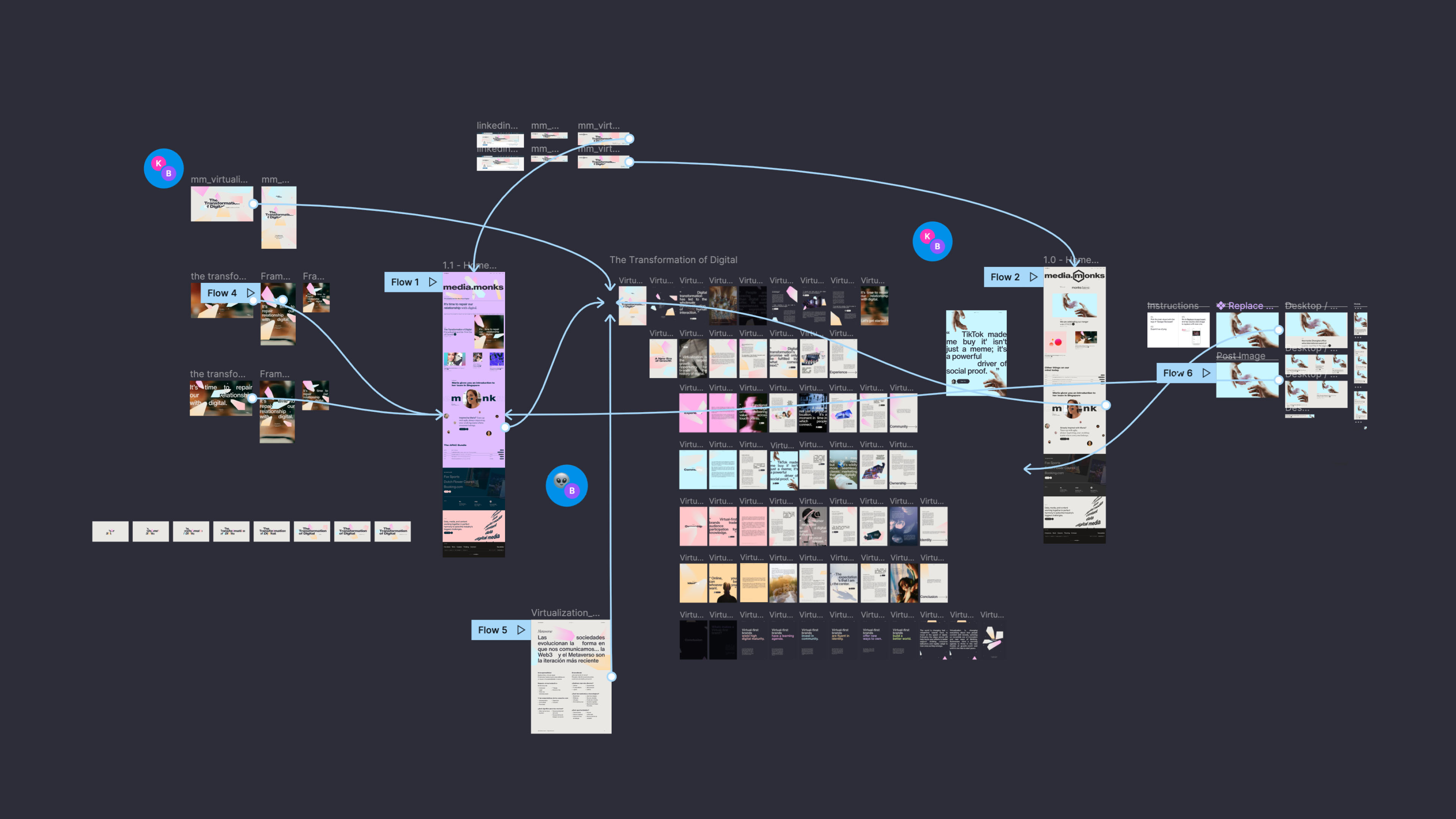
“Our homepage was designed to mark special moments in time, like a turning point for the company or when something is trending industry-wide that we have a strong point of view on,” says Vinicius Araujo, Creative Director. One recent moment was the release of The Transformation of Digital, our report detailing how consumer behaviors are shaping a new era of virtualization. To celebrate the launch of the report, our homepage took a new look: a unique color scheme, a curation of thematic content and an animated logo that represents the report’s visual identity.

Such an overhaul to the homepage may seem like a significant investment of time and resources, though the flexibility baked into our CMS made it a simple overnight change. Easy-to-update components and customizable fields also ensure that bespoke designs are scalable into the future. “It’s always ready to be updated in a heartbeat,” says Araujo. “And it’s ephemeral: it’s only there for a week, and then it’s gone.”

Monk Thoughts Our system is easy to use, but it’s balanced very well with our identity and ongoing marketing strategy. When design isn’t built to complement marketing activities, websites can become stale and flatline.
Brad Gardner headshot

On the flipside, the flexibility baked into our website keeps our content timely while ensuring we can authentically represent the breadth of our capabilities. At the same time, brands following a similar approach can iterate experiences that support the different needs of diverse audiences. “In curating the content for the virtualization takeover, one thing we considered was: How do we get someone who doesn’t want to digest the whole report to understand what this is?” noted Gardner, who gathered a wide selection of content that make virtualization tangible while also representing the diverse skills of our team.

Collaboration enables new ways to shape and expand content.

With our homepage takeover, it was important to build an experience that felt distinct right from the jump—not exactly separate from the other content on the website, but something that commanded attention as soon as people landed on the website.

Monk Thoughts The homepage has the shock factor when you enter. The first impression is completely new and different from our typical content, and past that moment everything else feels more familiar. We don't want people to have to relearn how to read our dotcom, so it has to be a measured shock.
Vinicius Araujo headshot

The first thing viewers saw when loading the page was a reanimated Media.Monks logo that leverages the bespoke identity crafted for the report—all built around a design language of four quadrilateral shapes that represented key themes of the virtualization report: ownership, identity, community and experience. These adapting shapes interact with each other at different frequencies throughout the report, keeping the audience focused on the insights. “It was important to create a wrapper that wouldn’t alienate the audience,” says Benjamin Tuffy, Design Director, noting that using iconography like VR headsets or futuristic environments could either limit virtualization’s scope, overwhelm non-technical readers or simply feel irrelevant for those who aren’t engaged in those channels.

But the shapes are just one kind of graphical element that made their way from the report to the homepage design. In discussing the role that bespoke experiences can play in enhancing the original source material, Tuffy spoke about a collaborative approach between design, copy and growth teams to pull the content into previously unforeseen directions.

Figma mockup showing the connection between our report and custom web experience

Figma mockup showing the connection between our report and custom web experience throughout the design process.

Monk Thoughts The bit I enjoyed most from the experience was finding key hooks in the language of the report that we could use to visually pull people in. The result is a series of spreads that put us on the hook for the statements we’re making.
Benjamin Tuffy headshot

Curation breathes new life into legacy content.

In addition to finding new ways to visually represent content from the report, our virtualization-themed homepage takeover also provided an opportunity to highlight ways that virtualization impacts different categories and audiences. “Leaders across different regions are bringing the story out to their teams,” says Tuffy, and viewers could see this play out through the content we curated to substantiate the report’s claims.

This highlights another purpose to building around key marketing moments: breathing new life into some of your existing content. In our case, this meant further drawing lines and connections between our multidisciplinary team. “We saw we had some content from Jam3 and a recently published piece by Chief Diversity Officer James Nicholas Kinney, both of which spoke to the purpose of virtualization from two different directions,” says Gardner, noting that the content helped showcase how we’ve been grappling with these ideas long before the report’s release.

Our special-edition homepage sought to leverage our CMS’s flexibility to deliver custom web experiences as new moments arise. Brands seeking to build bespoke, scalable web experiences can follow a similar approach by thematically curating and remixing new or legacy content, while also enhancing it further through added fit-for-format design elements. The result? A differentiated digital experience that never overstays its welcome and dazzles audiences with something new every time they visit.

We spotlight our approach to content curation, solving key challenges that brands face when it comes to delivering distinct digital experiences, and breathing new life into legacy content. content marketing strategy digital marketing digital platforms platforms digital experiences Platform Websites & Platforms Brand Brand Identity & Systems Monks news

Media.Monks Arrives on the Dot as a Single, Unitary Brand

Media.Monks Arrives on the Dot as a Single, Unitary Brand

4 min read
Profile picture for user mediamonks

Written by
Monks

cards showing various colorful designs

We’ve arrived with some new digs… and a new brand. MediaMonks and MightyHive, the marquee brands within S4Capital, have merged into something new: Media.Monks. Represented by a dynamic logo mark featuring MightyHive’s iconic hexagon, the single brand emphasizes our shared heritage in creative content and roots in data&digital. What’s more, we’re unifying a team of nearly 6,000 digital-first experts under one (digital) roof, working as a single P&L across 57 talent hubs in 33 countries.

And yeah, we get it—we’re making a big deal about adding a period and a hexagon. But in truly integrating our people both as a culture and in our operations, we’re delivering on S4Capital’s foundational promise to unify content, data&digital media and technology services—something no one has ever been able to achieve before. S4Capital plc (SFOR.L) will remain the financial brand, publicly listed on the London Stock Exchange and deployed amongst investor, financial and banking stakeholders and in reports.

00:00

00:00

00:00

“The traditional, analogue holding company model is over 70 years old, dating back to Marion Harper and IPG in the 1950s and cries out for disruptive change. Digital has altered the landscape permanently and brands need a different type of organization to execute and show up for their customers at every moment in the journey––purely digital, with data-driven creative and content, faster, better, cheaper, and with a single P&L,” says Sir Martin Sorrell, S4Capital Executive Chairman.

Monk Thoughts So far, S4Capital has brought together 24 companies that have each disrupted their industry in complementary ways, buying into our mission to create a new age/new era advertising and marketing services model and disrupting the old.
Portrait of Sir Martin Sorrell, smiling

For clients, the new brand fulfills the unitary goal that S4Capital set out to achieve three years ago. “Since the very beginning we’ve been working to combine content, data&digital media and technology under one roof. Today, we partner with 8 out of the 10 most innovative companies in the world, but we also work with many up-and-coming DTC and B2B brands, helping them own their data and build out owned customer ecosystems,” says Amy Michael, Chief Client Officer.

Monk Thoughts And now with the launch of our new identity, we’re delivering on our promise of a truly unified brand—simplifying our clients’ access to the specialized talent they need to stay competitive and future-proof in a digital-first world.
Portrait of Amy Michael

Built on Connection and Consensus 

Earlier this year, we launched our API-inspired organizational structure, designed to ignite collaboration and fuel innovation by connecting our different types of teams: countries, core, client, categories, capabilities and corporate. The hexagon in our logo, which previously represented MightyHive, has evolved to symbolize that structure and the six components it connects. 

A system for scale, the API combines disciplines globally to provide our clients seamless access to diverse subject matter experts, while creating ownable space for entrepreneurs when their teams join ours. In fact, those who have founded the teams that make up Media.Monks today are named co-founders of the brand, exemplifying the process of founder-led consensus that made us who we are today.

Monk Thoughts The single brand was not a boardroom decision. It involved input from a broad range of teams and talent, and many of our founders.
black and white photo of Wesley ter Haar

"For our people, this means they’re all colleagues and can build amazing careers across the globe and keep going and growing," ter Haar explains. "For our clients, it means they keep the same team and the day-to-day they love—but now have even simpler access to an amazingly deep pool of specialist talent. Consolidation is an engine to innovate, and this makes it easier to help our clients show up better for theirs."

Flexing Our Creativity

Our new, dynamic logo mark reflects the API and our flexible brand framework, in which “media” becomes a variable. Teams within our six operational components can personalize how they show up within the framework using a new internal tool, Brand.Lab (in fact, you may have stumbled across a few of these unique brand expressions by exploring this website).The addition of the dot represents a point of connection between our diverse talent, who each bring different experiences and expertise to the table, and encourages freedom of expression through a malleable framework.

00:00

00:00

00:00

Monk Thoughts Integrating the MightyHive hexagon into Media.Monks is a great representation of our unitary team, but even more so it reflects our operational model.
Portrait of Chris Martin

“We’ve built a structure where our people have clear, ownable space, to represent themselves and the work they do, but without the traditional fights and frictions that are built into more traditional models," Martin continues. "Hexagons are one of nature's ways of maximizing the properties of strength and space efficiently, and that's exactly what we're offering clients: the most efficient model to help them consolidate their efforts in content, data&digital media and technology services.”

This is just the start of our story. Look forward to seeing how we’ll continue to show up and adapt in new ways, both now and into the future. We never stand still—period.

00:00

00:00

00:00

S4Capital merges MediaMonks and MightyHive into Media.Monks – creating a unitary brand. The single brand emphasizes a shared heritage in content and data&digital. S4Capital merges MediaMonks and MightyHive into Media.Monks – creating a unitary brand. The single brand emphasizes a shared heritage in content and data&digital. mediamonks mightyhive digital marketing content marketing

Choose your language

Choose your language

The website has been translated to English with the help of Humans and AI

Dismiss