Choose your language

Choose your language

The website has been translated to English with the help of Humans and AI

Dismiss

Get to Know Enhanced Conversions and Value Based Bidding

Get to Know Enhanced Conversions and Value Based Bidding

Consumer Insights & Activation Consumer Insights & Activation, Data, Data Strategy & Advisory, Data maturity, Data privacy, Death of the cookie 6 min read
Profile picture for user doug_hall

Written by
Doug Hall
VP of Data Services and Technology

Abstract image of a virtual room

Following up on an internal training session at Media.Monks, this article introduces two key tactics you can use to support and grow your business through digital marketing on the Google Marketing Platform. The audience is intentionally broad with the view of sharing the “what” and the “why” across the full spectrum of digital marketer roles.

These techniques are exciting, as Google has published data demonstrating that double-digit percentage uplift in conversion value is possible. Results clearly depend on having the very best data, the best modeling capabilities and the best activation strategy, which is where Media.Monks teams play an essential role.

Who is this for? Everyone!

Are you in digital marketing as an “analytics person”? Primarily data focused? Technical? You’ll know about enhanced conversions (EC) and value-based bidding (VBB), but beyond the tagging, do you know what’s going on in the media systems and what it’s actually for?

Or are you a “non-technical” marketer? Your talents for campaign setup and management don’t overlap with tagging. Again, you’re across EC and VBB but where does the data come from? Why’s it so tricky to get right? What’s the hold up with the tags?

Regardless of our role specifics, we all need to have as full understanding of the solutions as possible. We need to get a handle on what happens “on the other side” so we can deliver the very best solutions for clients, and for users. Here’s the scoop you need. This is relevant to people on the Search Ads/Display & Video/Campaign Manager side as well as those on the Google Analytics/Google Tag Manager side. Here’s an opportunity to share knowledge… LFG.

Set the scene.

Cookie atrophy is a poorly kept secret. Browser tech continues to erode cookie usage. Third-party cookies are being deprecated from Chrome in 2024, which holds a dominant market share that’s significant for marketers. That doesn’t mean we are on safe ground when it comes to first party cookies though; just check through the details on Cookie Status to see the reality.

As data volume diminishes with sufficient signal quality, we can still use modeling techniques to mitigate for gaps in data, but that’s not a robust solution in isolation. We continue to make every effort necessary to maintain data volume, whilst evolving our tactics to improve efficiency.

This is where EC becomes a playbook entry to maximize observable conversions, while VBB drives greater efficiency by enabling optimization for value rather than volume.

Maximize observable data.

If we have less data, we must have better data quality. By that, we mean clean and clear data where we can clearly see conversions and channels. This means that the data still has utility even if it’s not complete. Where we may have holes due to browser tech and cookie loss, for example, we can still use first-party data to get better conversion accuracy. Enhanced conversions help us see more conversion data, but in a privacy-safe manner.

What it does.

Basically, on the conversion/sale/thank you page, a tag will fire—let’s say a floodlight tag for simplicity. The user’s email address is hashed (encoded using the SHA-256 algorithm), and then added to the tag data which is then sent to Google. This hashed value is then used to match the user with Google’s data to recover conversions that are absent from your data set.

You can use a range of values in addition to, or instead of, the email address. The email address is normally fine. It’s hashed, so no third party (not even Google) sees the data and it’s deleted after use. Google has published in-depth details on how the data is used, and this is essential reading for your teams.

Use best practices for tagging.

Ideally, you’d expose pre-hashed personal identifiable information (PII) on the dataLayer variable which can be picked up easily by Google Tag Manager (GTM) and added to the floodlight.

You can scrape the Document Object Model (DOM) to extract the data, but this is not a robust, long-term solution. You can use Google tag instead of GTM if a tag management system is not available. For offline conversions (leads), you can also upload conversion data via an API.

Collaboration is key.

Tech, data media and legal teams should work closely in order to correctly implement and then validate changes in data volumes.

This is not legal advice, so you need to get buy-in early from your legal team. Advise your teams to make sure EC usage is covered in your privacy policy and cookie policy and that consent is fully informed with a clear opt-out option.

Make sure you know the conversion page path, and that the PII variable is available. Scraping the DOM might be okay for a proof of concept, but don’t rely on it as a permanent solution.

Media teams need to make simple configuration changes and then report accurately on conversion volume changes. Use your data science teams to establish causality and validate EC is working. Liaise with your media teams regularly after rolling out EC to maintain scrutiny on the data volumes and changes. Be impatient for action (get it done!), but patient for results—manage expectations regarding timing, change may take weeks.

Using value-based bid optimization.

As we progress along the path of digital maturity, our tactics adapt and evolve. Where it’s normal and fine to optimize for click volume in the early days, the optimization KPI changes as our business grows. We aim to reduce cost, grow revenue, build ROI and ultimately optimize for long-term profit.

Optimizing a campaign for click volume was a brute-force budget tactic. Optimizing for value (profit stems from value) is a more precise allocation of budget. How the budget is allocated is the clever part.

Optimize for value.

Consider an ecommerce site where the obvious valuable outcome is a sale. There are other outcomes that serve as signals to indicate a user may be a valuable customer: viewing a product detail page, adding to cart, starting a checkout. All actions lead to the conversion, all with varying degrees of value. As each outcome is completed, fire a floodlight to inform GMP that the user has performed a “high-value action” worth €x. These actions and values are then used to automatically optimize the bid for the user.

Previously, defining the values associated with an action was a matter of experimentation. Now you can use an online calculator to refine these numbers.

This approach to value-based bidding needs a level of data volume and quality that is delivered by using EC with VBB—and is extremely powerful. It has few moving parts, but the values are static, commercial values that don’t always reflect the user’s likely behavior. To address this, let’s look back at an older solution to see how we can level up this approach.

Using coarse-grained optimization.

Previously, we’ve used machine learning to build a predictive model that will output an answer to “how likely is it for user X to convert”? At scale, the data is imported into GMP as an audience, and we use this to guide where the budget is spent. A simple approach here is to build a set of audiences from the model output to drive bid optimizations:

  • “No hopers” with the lowest propensity to convert: €0.
  • “Dead certs” with the highest propensity to convert: low or €0
  • “Floating voter” with medium propensity; needs convincing: €maximum

This technique has delivered great results in the past. There are shortcomings, however. With three audiences, the segmentation by propensity is quite coarse. As the number of audiences ramps up, there is more to compute and more to maintain in terms of infrastructure. The user needs to revisit the site to “get cookied” and be included in a remarketing audience.

There is a more modern approach that addresses the shortcomings from these techniques.

Modeled VBB optimization goes even further.

We’ll now blend these two solutions with server-side data collection (sGTM). Server-side data collection has a number of key features that make it very appropriate for use here:

  • First, it allows data enrichment in private—we can introduce profit as a value for optimization without exposing margin data to third parties.
  • Additionally, first-party cookie tenure is enhanced by server-side data collection. Your first-party cookies are set in a way that prevents third-party exposure—browsers like this and take a less harsh view of them. This is better for your first-party data quality.
  • There is no need to revisit the site to establish audience membership; all cookie-ing is done in the pixel execution.

So now, we can fire floodlights for our sales conversions, attach per-item profit data at the server level and optimize bids based on user profitability. Awesome, but what about the predictive model output?

At the server-side data collection point, sGTM can integrate with other Google Cloud Platform (GCP) components. As well as extracting profit data, we can interrogate a propensity model, and for each high-value action per user, ask what the propensity is for the user to convert. The predictive score is then attached to the floodlight to drive VBB.

This has fewer moving parts than the older solution. It solves for the coarse-grained audience feature by delivering per user scoring as the data is collected. Again, we team this up with EC to maximize conversion visibility and drive powerful marketing optimizations.

Optimize your marketing with EC and VBB.

These techniques have existed in isolation for some time. With a broader understanding of the data requirements, and the activation of the data, we’re all in a better position to use privacy-first marketing optimizations to deliver efficiencies for clients, and ultimately, a better, more useful online experience for consumers.

With the demise of third-party cookies, enhanced conversions and value-based bidding can help maximize observable data quality and conversion accuracy. value-based marketing data first-party data Data Data Strategy & Advisory Consumer Insights & Activation Death of the cookie Data privacy Data maturity

Modeled Value-Based Bidding, a Game-Changer in Activating First-Party Data

Modeled Value-Based Bidding, a Game-Changer in Activating First-Party Data

AI AI, AI Consulting, Consumer Insights & Activation, Data, Data Privacy & Governance, Data privacy, Death of the cookie 2 min read
Profile picture for user mediamonks

Written by
Monks

Three speaker headshots

To navigate today's digital landscape, marketers must deliver tangible business results amidst heightened competition and an increasingly complex data privacy landscape. This requires a deep understanding of advertising data, the utilization of first-party data, optimized use of marketing platforms and identification of growth opportunities. And just as marketers are looking to understand how AI and machine learning fit into their digital advertising and data strategies, it’s no surprise that Google has innovated a game-changing solution that leverages machine learning to help optimize the already complicated consumer journey.

Modeled Value-Based Bidding (mVBB) enables precise audience targeting and media optimization through highly customized machine learning models. Relying primarily on advertisers’ first-party data, mVBB derives more value from traditional value-based bid strategies by drawing insights for bid optimizations in real time. 

Modeled Value-Based Bidding addresses these challenges for marketers:

  • Third-party cookie deprecation and tightening privacy regulations pose significant headwinds for brands looking to connect with consumers.
  • With first-party data sources and data volumes growing at breakneck speeds, many marketers are overwhelmed by managing data manually.
  • Companies that have large data sets can’t manage manual bid strategies with one person or even a team.
  • More and more advertisers are looking to understand how AI and machine learning can fit into their digital advertising and data strategies to help drive efficiencies.
Modeled Value-Based Bidding Webinar Speakers

Eager to learn more?

Join our Media.Monks experts Senior Director Machine Learning & AI Solutions Michael Neveu and Senior Data Scientist Mansi Parikh, along with special guest Drew Whitehead, Predictive Modeling Specialist at Google, for a discussion about Modeled Value-Based Bidding. In this webinar our team of experts cover:

  • The value of Modeled Value-Based Bidding
  • Strategies, technical specifications and testing frameworks
  • Real-world media use cases across multiple industries
  • Advanced models that are sure to boost performance
  • Three red-light/green-light questions to help decide whether mVBB addresses your business challenges

This experience is best viewed on Desktop.

Download Now
Learn how Modeled Value-Based Bidding leverages your first-party data to enable precise audience targeting and media optimization via machine learning models. first-party data data Data Data Privacy & Governance Consumer Insights & Activation AI Consulting Death of the cookie Data privacy AI

Data Governance and Business Considerations: A Strategic Approach to Implementing a CDP

Data Governance and Business Considerations: A Strategic Approach to Implementing a CDP

CRM CRM, Consumer Insights & Activation, Data, Data Analytics, Data maturity, Death of the cookie 4 min read
Profile picture for user mediamonks

Written by
Monks

A person working on a computer analyzing data

When we think about customer data, plenty of benefits come to mind: the ability to access valuable insights into customer behavior, identify gaps in the sales funnel and optimize product development, among others. Customer data is one of the most valuable assets a business can have, especially in the pursuit of developing more meaningful and personalized connections with consumers. But as those working in data analytics know all too well, simply collecting data doesn’t cut it—especially if it lives on different platforms and the collection points are spread across the entire customer journey.

To overcome that challenge, wise marketers and data scientists resort to customer data platforms: software systems that allow businesses to collect, centralize, and manage customer data from multiple sources in one place. A CDP can help answer an abundance of questions by providing a single source of truth; though before you can get there, it’s important to understand how to handle the complexities and responsibilities that come with it.  

Not long ago, our Associate Director of Customer Data, Elia Niboldi, penned an article on how to leverage CDPs to their full potential. This time, we’re taking a step back with a new whitepaper that explores the key considerations when implementing a CDP. Let’s dissect some of the main takeaways.

With CDPs comes great responsibility.

To put it simply, CDPs aim to provide a comprehensive view of the customer across all channels and touchpoints, which allows businesses to make informed decisions and create better customer experiences. They are incredibly powerful tools, but that also means the data collected by CDPs can be sensitive and needs to be handled in a responsible and ethical manner, even if customers were happy to share it with the brand in the first place.

In other words, CDP data comes with the need for strategy and clear governance around a brand’s interactions with their customers. Having a robust consent management system in place is the bare minimum, an essential process for allowing customers to determine what information they want to share with a business—something that Salesforce Privacy Center handles very well. And this shouldn’t be limited to brands’ first interaction with a client: when changes in regulation occur or customers’ preferences change, they should be provided with an option to manage and update these preferences, and brands can keep track of those from a centralized location through a CDP.

Once the customer has shown interest in creating a value exchange between their data and the brand’s services, it’s important to set frequency capping standards that alleviate brand fatigue and ensure brand communications are effective and positive—rather than annoying and frustrating. The frequency send caps are usually reset daily, weekly or monthly, and can be adjusted based on customer behavior to optimize marketing campaigns and improve the overall customer experience.

Consider the role of CDPs in the CMO’s business.

Because they provide a unified view, CDPs are both a technical and organizational tool that can help break down silos. Traditionally, customer data has been fragmented across systems and siloed within departments, making it difficult for marketers to access that data in meaningful ways. At the same time, it’s naturally hard for technology teams to fully understand marketing needs or their specific use cases for the data they manage. CPDs bridge this gap, serving both the CMO and the CIO.

However, in order for CMOs to access the real value of CDPs, we need to remember they play three key roles: ensuring cooperation between teams, improving optimization use cases and offering better segmentation. A CDP necessitates cooperation between different teams because it’s meant to break down silos and provide a single source of truth that everyone in the organization can draw from. Through that source of truth, marketers can keep track of which channels and strategies are performing particularly well and optimize accordingly. Finally, CDPs unlock superior targeting capabilities that allow businesses to provide personalized experiences that resonate with their customers’ needs and interests. 

Salesforce Data Cloud, for example, combines the data from Google and The Trade Desk to activate audience insights beyond messaging, journeys and onsite personalization into a brand’s search and digital media campaigns. Plus, it funnels a nearly infinite amount of dynamic data to Customer 360 in real-time. This allows for deeper audience engagement, as customer data is continuously updating and feeding audio, OOH, app, web campaigns and everything in between.

Interested in implementing a CDP? Assess your readiness. 

So, you’ve installed clear governance standards around your interactions with consumers and aligned both the CMO and CIO on the importance of having one source of truth. Are you ready to start extracting meaningful customer insights? Not just yet. First, you’ll need to follow a few initial steps to ensure a successful implementation of the CDP:

  • Outcome alignment: start by workshopping the priority use cases to deliver the minimum viable product. This needs to be a cross-functional exercise that ideates, quantifies and prioritizes use cases.
  • Identity resolution strategy: build the identity graph that allows a customer profile to be stitched together to form a single customer view.
  • Data model: design a consistent global measurement framework.
  • Team vision: make sure the CDP is coupled with a clear strategic vision and the right team to extract its full potential. This team should include champions from different departments, system integration partners, executive sponsors and operational users. 
  • Implementation plan: develop the operational model. For a customer data platform to be implemented seamlessly into a business, pre-built integrations are essential. Establish which integrations are required and use this to choose a CDP solution that suits your operational needs.

All things considered, CDPs shouldn’t be thought of as “set and forget,” but rather “implement and optimize.” A CDP like Salesforce Data Cloud can provide a wealth of benefits for a business, from more efficient data management to improved customer experiences. By setting a clear governance process and taking into account key considerations before implementation, businesses can ensure that they are ready for both the benefits and the responsibilities that come with utilizing a CDP.

A CDP can help by providing a single source of truth; though before you can get there, it’s important to understand how to handle the complexities and responsibilities first. customer data data analytics data and analytics salesforce marketing Data Consumer Insights & Activation CRM Data Analytics Death of the cookie Data maturity

Blue Sky Thinking with Salesforce Data Cloud

Blue Sky Thinking with Salesforce Data Cloud

Consumer Insights & Activation Consumer Insights & Activation, Data, Data Privacy & Governance, Data Strategy & Advisory, Data maturity, Death of the cookie 1 min read
Profile picture for user mediamonks

Written by
Monks

gray background with colorful lines

Unlock deep customer insights with a CDP

While the nomenclature of Data Cloud might sound soft and fluffy, a CDP is anything but. CDPs can deliver value across an organization, from marketing operations to IT, data science to paid media, but it’s important to take a few key considerations into account before making the leap.

In this report, you will learn how to handle key considerations like data governance, efficiency management, virtualization principles, consent management, unification, and activation to build a holistic view of what is happening in your business.

gray background with text that reads "Blue Sky Thinking with Salesforce Data Cloud"

You’re one download away from…

  • Understanding governance and privacy standards that come with CDP adoption
  • Seeing how CDPs bridge the gap between the CMO and CIO
  • Assessing your readiness to implement a CDP

This experience is best viewed on Desktop.

Download Now
Thinking about a Customer Data Platform (CDP)? This report guides you through essential considerations like data governance, consent management, and data unification to help your organization gain a holistic view of its customers. AI Personalization customer data artificial intelligence creative technology emerging technology automation Data Data Privacy & Governance Consumer Insights & Activation Data Strategy & Advisory Data maturity Death of the cookie

Serving Data for Breakfast: A Spirited, On-Demand Conversation About Customer Data Platforms

Serving Data for Breakfast: A Spirited, On-Demand Conversation About Customer Data Platforms

Consumer Insights & Activation Consumer Insights & Activation, Data, Data Privacy & Governance, Data maturity, Data privacy, Death of the cookie, Transformation & In-Housing 2 min read
Profile picture for user mediamonks

Written by
Monks

Data points sprawled out across a map connecting with yellow lines

Get ready for the cookieless future with Customer Data Platforms. 

In case you hadn’t heard it yet, third-party cookies are slowly but surely crumbling. This means that your ability (as well as your competitor’s) to target users with precision is deteriorating rapidly, and there are no prospects of improvement—by 2024, it will be like third-party cookies never even existed. As many brands have been struggling to adapt to the fast-paced changes our ever-evolving digital industry faces, it’s crucial to consider alternative solutions in preparing for the cookieless future. This is where Customer Data Platforms (CDPs) come in.

Eager to learn more? Tune into a robust discussion about data and the key challenges that today’s marketers are facing—think of issues like the unification of customer journeys, how to mitigate the impact of third-party cookie deprecation, and how to best leverage audience insights.

Data for Breakfast title with a yellow video play button

By tuning into this conversation, you will:

  • Learn more about CDPs and how you can effectively use them to meet your business objectives. 
  • Hear from industry experts about the leading tech and data solutions that mitigate the impacts of third-party cookie deprecation.
  • Identify potential next steps for your CDP acquisition and strategy.

This experience is best viewed on Desktop

Download Now

What are the core capabilities of this technology? First up, CDPs support data aggregation, giving you a better and more unified view of your (prospective) customers. Second, they help you unify multiple data sources through a single ID manager, thereby facilitating ID resolution and management. Third, CDPs help you understand how customers act on different channels and thus enable you to predict consumer behavior. Finally, CDPs support customer activation. They’re first-party data tools that focus on making sense of different data sources, while executing effortless activation. 

Essentially, CDPs can help you diversify your brand’s targeting strategies and reach audiences at scale, all by leveraging your first-party data. If you ask our Associate Director of Customer Data Elia Niboldi, first-party data is your most valuable asset, not only because it’s durable and exclusive to your company, but also because it will be central to any future targeting strategy—and Customer Data Platforms are here to help you leverage this data. Niboldi sat down with Ian Curd, Global Consumer Data Director at Diageo, Martin Kihn, SVP Strategy, Marketing Cloud at Salesforce, Jackie Rousseau-Anderson, Chief Customer Officer at BlueConic, and Chris Thomson, Account Director, Strategic Finance Accounts at Treasure Data, to talk all things CDPs and why now is the time to dive into this complex technology.

Leverage first-party data through Customer Data Platforms to prepare your brand for the cookieless future. first-party data customer data third-party cookies data-driven marketing Data Transformation & In-Housing Data Privacy & Governance Consumer Insights & Activation Death of the cookie Data maturity Data privacy

Privacy Sandbox Is Coming—and It Might Just Be the Privacy Solution We’ve Needed All Along

Privacy Sandbox Is Coming—and It Might Just Be the Privacy Solution We’ve Needed All Along

Consumer Insights & Activation Consumer Insights & Activation, Data, Data Privacy & Governance, Data Strategy & Advisory, Data privacy, Death of the cookie 6 min read
Profile picture for user doug_hall

Written by
Doug Hall
VP of Data Services and Technology

A hand holding a cellphone with a lock screen showing

Cookie management is currently not done well.

In a recent panel discussion hosted by The Drum, I sat down with Claire Norburn, Ads Privacy Lead UKI Google, to talk all things privacy, especially with regards to digital marketing. Together, we concluded on four key takeaways: 

  • Take control of your data
  • Embrace the regulatory spirit
  • Go beyond the bare minimum
  • Make it meaningful, memorable and manageable

These are not off-the-cuff suggestions, as the impact of ignoring or misinterpreting these recommendations is plainly visible. With privacy currently being the fastest moving field in our industry, we’re reaching the point where most—if not all—professional discussions have a privacy angle. While that’s great in terms of profile, it’s not really good in terms of quality.  

If you ask me, most cookie banners are subprime usability blockers that annoy users and turn them away. At worst, they’re dark patterns obscuring malice. When the most common denominator is so prevalent—that being lousy banners—we get what is called banner blindness, a phenomenon where web users (un)consciously ignore any banner-like information. When that symptom kicks in, it’s a downhill race to the bottom.

A likely sequence of events then plays out: marketers settle on a nice and easy bottom feeding tactic, the whack-a-mole game of privacy merry-go-round spins through another orbit as either tech, public opinion or regulators (or all of the above) make a new move to counter it. Recently, for example, it was Brave’s turn in the game of ignoring the privacy elephant in the room. The company announced it was going to block cookies by default and roll out a cookie pop-up blocking feature to Android and desktop users, which is arguably a step backwards. Rather than adding any clarity around what data is collected and why, the browser actually acts on behalf of consumers and removes choice from the user. It’s important to highlight that regulation is not anti-business, but it’s pro-consumer. Privacy-enhancing technology needs to respect this narrative. 

My former colleague (and still just as wise) Myles Younger powers his crystal ball with some nostalgia to suggest consent pop-ups are dead. “Someday soon we’ll look back on cookie consent pop-ups the same way we look back on “300 hours of free AOL” CD-ROMs littering our sidewalks. The farcical dying gasp of a dying way of transacting a digital thing,” Myles argues—and he is not wrong. It’s been seen before, as observed by the analytics supremo Simo Ahava, who argues that Do Not Track was a failure from the start. Diving into the implications of Safari’s Intelligent Tracking Prevention, better known as ITP 2.1, on web analytics, Ahava says that “Funnily enough, ITP 2.1 removes support for the Do Not Track signal in Safari, denoting the end to this miserable experiment in WebKit. Had more sites respected DNT when determining should visitors be tracked or not, perhaps we wouldn’t have seen ITP 2.1 in its current shape.” 

Consent management is anti-user.

Why are these well-meaning initiatives failing? Google surveyed over 7000 people across Europe in 2021 and found that users want to have control of their data. Recent follow-up research quantified the degree to which the feeling of control influenced customer confidence in brands. The conclusion? A positive privacy experience on a site has a measurable positive impact on a brand.  

So, how can you create such a positive privacy experience and avoid the pitfalls that we’ve seen with Do Not Track (DNT) and the current crop of Consent Management Platforms (CMP)? If it’s up to Google, brands should make the experience:

  • Meaningful by showing people what they get in return for sharing their data
  • Memorable by reminding people what data they shared and when
  • Manageable by providing tools for people to manage their privacy

The demise of third-party cookies means the future of first-party cookies. 

For many, applying this mnemonic to first-party cookies is a work in progress. Cookie consent banners are still relatively new, even though third-party cookies have been under threat for many years. We know which browsers restrict their use and we expect these restrictions to extend to Chromium browsers in 2023.

If digital marketing can’t function without third-party cookies, this has the potential to hit big tech in the coffers, and we cannot allow this to happen. There’s a clear motivation to solve existing use cases by utilizing privacy-enhancing technology—this is where The Privacy Sandbox comes in. According to a Google statement, “Privacy Sandbox for the Web will phase out third-party cookies and limit covert tracking. By creating new web standards, it will provide publishers with safer alternatives to existing technology, so they can continue building digital businesses while your data stays private.”

We’ll see the next phase of testing kick off in 2023 when the Privacy Sandbox API is publicly available for testing on Android. Right now, this is API testing, which means that they’re testing for developers rather than users. The user testing phase is where it gets real for real people. This is the opportunity to succeed, think of Google’s mnemonic, instead of failing like DNT and CMPs.  

Cookie management sitrep.

Right now, you can open the settings in your browser on each device and scroll through the list of cookies for each site, and decide to delete them. You can then visit the site and repeat the exercise in the “manage cookies” section of the CMP.  However, this current process doesn’t fit in terms of being manageable. In fact, the term laborious doesn’t even begin to describe it.

When it comes to qualifying as meaningful, cookie management has a low score because it’s so opaque—how can you tell who else is getting access to the cookies and for what purposes? As for memorability, most users only remember the frustration and tedium, but little else regarding their choices.

So, considering the future of cookie management, how might the Privacy Sandbox address the choices users have to make with regards to “tracking” and their privacy? While this section is entirely speculation and therefore not an official roadmap, it’s aspirational with the aim to be realistic and pragmatic. My thoughts are as follows. 

  • Users get to decide what topics they are interested in and willing to share with third parties.  
  • Users allow the browser to build a list of topics, but the user reviews and controls the list periodically asking to be reminded on a set schedule.
  • Users can choose to set their topics to apply across all sites they visit. Any advertising they see on any site they visit will use and respect these settings.
  • Users can choose to review their topics preferences on a per site basis. Users get to curate (and review) their own whitelist/blacklist for sites or types of sites.
  • Users ask to be reminded to check their preferences every so many days, weeks or months.
  • Users can choose to reset all data in the browser automatically every so many days, weeks or months.

Now, let’s apply similar controls to first-party cookies:

  • Users will be able to tell the browser what type of cookies they will accept, and whether they want to be measured—anonymously or otherwise.
  • Users can specify this applies to all sites, some sites (whitelist) or types of sites.
  • These settings are reviewed on a scheduled basis.

What are the right default values to apply on first use? The good news is, there are no default values. On first use, and on a frequent basis, the user must explicitly set their own first use values. In other words, no values are suggested or automatically preselected.

How is this different from a CMP banner? Set it once, and make a conscious set of decisions with no intrusive user experience on every site or app you use. This could actually be set at a “profile” level across all devices and all browsers. This requires less mark-up and coding to be done by site owners. In short, there’s less to maintain, less to go wrong, less to slow down and less to cause friction.

How is this different from DNT or Brave? A more granular approach and a genuine user-controlled choice are the fundamental differences that make this approach manageable and meaningful. The range of choice is meaningful and the act of making a choice is manageable as it is made as friction-free as possible. Moreover, having to make a choice is memorable, as well as the ability to set reminders to review these choices at your convenience.

Now is the time to apply these lessons for the future.

The challenge for The Privacy Sandbox is to reduce friction, increase transparency and enhance authority. The privacy improvements will cater for existing use cases as well as provide a manageable, meaningful and memorable privacy experience for users.

That said, what’s the takeaway for digital marketers? Google said that “The Privacy Sandbox on Android will be a multi-year effort,” so what to do right now? Circling back to the start of this article, it’s important to:

  • Take control of your data
  • Embrace the regulatory spirit
  • Go beyond the bare minimum
  • Make it meaningful, memorable and manageable

Though we accept the looming end of the third-party cookie, this doesn’t mean we have to stop digital marketing. New privacy-enhancing tech changes the methodology, as the same use cases are catered for with new tech to enable better ad serving. Having learned from the success of these technologies applied to the end of third-party cookies, we can confidently focus the lessons on our first-party data collection. What works across sites and apps must also have the same utility on individual sites and apps. Keeping that in mind, the end goals remain:

  • Build a relationship with your customers
  • Be transparent
  • Be useful
  • Be responsible with data

All in all, achieving these goals and aiming to provide a better experience has immense value for your customers and your business.

In a recent panel Doug Hall sat down with Claire Norburn, Ads Privacy Lead UKI Google, to talk all things privacy, especially with regards to digital marketing. privacy digital marketing Google first-party data third-party cookies Data Data Privacy & Governance Consumer Insights & Activation Data Strategy & Advisory Death of the cookie Data privacy

Harnessing the Power of Customer Data Platforms

Harnessing the Power of Customer Data Platforms

CRM CRM, Consumer Insights & Activation, Data, Death of the cookie 4 min read
Profile picture for user Elia Niboldi

Written by
Elia Niboldi
Associate Director of Customer Data (CDP)

A laptop showing google analytics

Whether you work in the marketing and advertising industry or not, it’s as clear as day to all that the digital space never sleeps. Truly innovative in spirit, there are always new technologies, tools and trends on the horizon. One more recent tried-and-tested development is Customer Data Platforms (CDPs), with many of the largest adtech and martech players investing in CDP capabilities and resources. Already last year, CDPs were highlighted by Salesforce as one of the top priority investments for Chief Marketing Officers, citing that customer data can help set the stage for empathetic marketing—and they only continue to climb in importance.

CDPs are hot and happening, but what exactly is their purpose? Following Gartner’s definition, “a customer data platform is a marketing technology that unifies a company’s customer data from marketing and other channels to enable customer modeling and to optimize the timing and targeting of messages and offers.” There are three types, all of which aim to drive efficiency: “collection” CDPs, which primarily aggregate existing first-party profile data; “resolution” CDPs, which compress owned first-party profile data; and “activation” CDPs, which generate new first-party profile data. You get the gist, this marketing technology focuses on using first-party data. 

Considering the rising demand to harness the power of customer data, my team at Media.Monks and I continue to expand our CDP offering. Whether you’re working to become a data-driven organization or looking to enhance personalization, we’re here to help you set up the right platform. 

Tackling this topic through our CDP Evaluation Framework. 

We tell every brand we collaborate with to ask themselves: “What is the best CDP for us?” Companies, like people, do not live in a vacuum and should therefore make sure to account for every variable. However, not everyone knows this—since CDPs are relatively new to the scene, there’s still a lot of uncertainty in approaching this topic. Before joining forces with our team, many of our partners initially tried to go about it on their own, only to realize how complicated it is to juggle all the different vendors involved. With hundreds of platforms claiming to be a CDP, there’s an ongoing debate about what constitutes this technology, which explains why choosing the right one is not an easy feat. 

So, where to begin? First of all, we sit down with our partner and determine what exactly they’re hoping to achieve with a customer data platform. Many companies nowadays are looking to replace their Data Management Platforms (DMPs) and leverage their first-party data in driving efficiency, keeping in mind the upcoming third-party cookie deprecation. From here on, we focus on activating the user profile and picking the right tool. While both are really important, brands tend to struggle with these steps.  

This brings us back to the complex task of choosing the best CDP for your company. To smoothen and simplify the process, we’ve developed a CDP Evaluation Framework. As a strategic partner across data, media and content, we can demonstrate to brands how a specific CDP will drive value to their business. Our CDP offering consists of different phases. First, we conduct a tool assessment to understand what data you have and how it is managed. Then, we organize a discovery workshop to understand your digital strategy, define pain points and challenges, and identify digital objectives and business requirements. Hereafter, we focus on use case design. During this phase, we assess the feasibility of certain use cases based on your organization’s digital strategy and insights gathered in the discovery workshop. Finally, we recommend the right CDP for your business and, if requested, design a 12-month timeline, roadmap and activation playbook. 

Tapping into new capabilities. 

The Customer Data Platform is a hot new topic in the digital space—and for good reason, as it unlocks a number of capabilities. First of all, by creating a rich user profile, companies gain a better and more unified overview of their existing and prospective customers. In working with our partners, our main objective is to break down silos in information and data between different departments, making sure every team across the organization has a complete understanding of their users. 

Secondly, CDPs are first-party data tools that focus on deciphering different data sources in order to execute effortless activation. Such a strong first-party data strategy is increasingly necessary considering the upcoming third-party cookie deprecation, and thus helps future-proof your business. Thirdly, the centralization of user data enables companies to set up the customer journey across channels in a way that they can speak to existing and potential customers with the same tone of voice. This, in turn, makes customer communication more efficient and easier to evaluate. On top of that, leveraging user data is crucial because it helps companies predict future customer behaviors. 

Team up with an external partner to maximize your CDP’s value. 

The benefits of CDPs may be loud and clear, but actually achieving them can be quite challenging—and typically requires the support of a strong external partner. Over time, we have seen several companies pick the wrong CDP, which can reduce the ROI of the platform and, even worse, result in a loss. For example, one company came to us with the question why their CDP was not delivering the promised value. After evaluating the martech stack, we were able to conclude that they were, in fact, not getting the full value out of their CDP—because they were using the wrong CDP for their business, which was lacking certain necessary features to realize their goals. Consequently, this limited the total value that they could have derived from their first-party data. 

While some brands believe that setting up a CDP is a hop, skip and a jump into major success, our experience tells us otherwise. Bridging data sources through CDPs is just the beginning; when bringing data together in one place, the main challenge is to make sure that all the different departments work together on each activation. Interestingly, one of the main ways to achieve this is by working with an external party. This reduces the chances of attrition within an organization, as the external party is not biased and thus capable of driving activations that benefit every team within a company. 

Breaking down silos with first-party data. 

In short, setting up a CDP involves all departments and thus requires buy-in from many different people across a company. As a CDP necessitates cooperation between different teams, it’s both a technical and organizational tool that can help break down silos within an organization. While this can be challenging, we’re here to help you tackle this head-on and harness the power of first-party data.

Want to learn more? Get in touch or sign up for our virtual event “Data for Breakfast” on December 1st, where we’ll talk all things CDP. We’re looking forward to meeting you there.

Both a technical and an organizational tool, Customer Data Platforms (CDPs) enable marketing teams to unify first-party data across the company to drive efficiency. customer data first-party data data marketing Data CRM Consumer Insights & Activation Death of the cookie

Navigating the Absence of Third-Party Cookies

Navigating the Absence of Third-Party Cookies

Data Data, Data Privacy & Governance, Data Strategy & Advisory, Data privacy, Death of the cookie 7 min read
Profile picture for user Amber Knight

Written by
Amber Knight
Associate Account Manager

Hands holding an tablet shopping online

By now, you’ve heard the news: Google has shifted the phaseout of third-party cookies on Chrome until 2024. The move gives developers more time to evaluate and test the Privacy Sandbox technologies before deprecating third-party cookies altogether. With yet another extension, it’s important for businesses to ensure they are prepared for a world without third-party cookies.

When it comes to the reason why Google has chosen to deprecate third-party cookies to begin with, an increase in users’ demand for more control of their data is only the start.

Google must also comply with a long list of regulations surrounding privacy, the most notable being the General Data Protection Regulation (GDPR) and the California Consumer Privacy Act (CCPA). These regulations ensure that there are certain standards for what constitutes valid consent when collecting personal data, as well as giving consumers more control over the personal information that businesses collect about them.

The phaseout of third-party cookies will support these legislations and ensure the success of the privacy-first era. From an overall perspective, the deprecation of third-party cookies will impact how campaigns are implemented and managed by brands and their partners. Previously, brands relied on third-party cookies to learn about a target audience and their online behaviors. Without this information, we can expect significant impacts on remarketing, frequency management, personalization, attribution and measurement. 

New ways to identify are on the horizon.

Third-party cookies facilitate cross-site audience identification, which essentially allows marketers to “follow” users across the web, collecting data about their interests and online behavior. Each of the tactics above rely on this form of cross-site audience identification, and without third-party cookies, marketers will be unable to access this information about their target market so easily. 

But that doesn’t mean marketers will no longer be able to conduct successful remarketing campaigns, control the amount of times a user views an ad, deliver highly personalized ads, or identify a user’s touchpoints along the customer journey—provided they prepare for the cookie-less future now and minimize its impacts on their digital media activities. 

Since the announcement of the deprecation of third-party cookies, Google has been working on a range of solutions to continue to show relevant content and ads. FLEDGE and Topics are two examples of current Privacy Sandbox solutions for showing relevant content to audiences.  

FLEDGE’s purpose is to serve remarketing and custom audience use cases, without using third-party cookies. It enables interest-group-based advertising by asking the browser to choose which ads users see based on the sites they’ve previously visited. To keep this data secure, the browser conducts an on-device action to select relevant ads. 

Topics is a proposal that enables interest-based advertising without tracking the sites a user visits. It provides topics that a user may currently be interested in, based on their recent browsing history. These topics can supplement contextual information to help select appropriate advertisements. 

However, trials for FLEDGE and Topics are still a work in progress and the solutions are continuously changing, so we must focus on what we can do now to be able to navigate in a world without third-party cookies. Don’t take a “wait-and-see” approach. Those who look to prepare now will increase their chances of success and advancement in the privacy-first era. Here are some strategies to help you on your way to post-cookie marketing success.

Prioritize and invest in a first-party data collection strategy.

To prepare for the deprecation of third-party cookies, marketers should focus on growing quality customer data that informs both strategy and tactics. Utilizing the data from customers who have shown interest in your brand is more reliable and powerful than buying and selling access to third-party data. 

First-party data gathered from your websites, apps, physical stores (including offline transaction data), or other places where customers interact with your business, are all examples of first-party data that you passively—but directly—collect from consumers. Earning this data relies on building a fair value exchange, so that consumer data is understood to contribute to a better experience. Customer trust is built on transparency, hence it's always important to explain how you’re going to collect and use the data in your cookie consent banner or consent management platform. When collecting data about your customers, you must also make certain that you are compliant with regulations such as the GDPR, ensuring you are getting valid consent when collecting personal data and not collecting personally identifiable information (PII). 

With first-party data, brands can evaluate local touch points and preferred paths, while customizing interactions for a superior customer experience. Now is an excellent time to look inward and begin to build the foundations of your data strategy—one that will power your marketing with clean, unified and actionable data. Collecting first-party data and linking it together allows you to have a persistent, cross-device recognition for a single view of your customer, and an overall understanding of your audience. Mondelēz, for example, understood that digital marketing is most effective when you know how to play to consumers’ personalized taste. After helping them along the road to clean data, we achieved a +70% global return on investment.

Focus on collecting information and data you have access to.

As a marketer, you have access to a plethora of data about your customers, whether it be purchase data, device information or email engagement. Having an identification-first approach to customer data will give you an upper-hand to targeting effectively without third-party cookies. With data from third-party cookies being cut off, the priority should lay with first and second-party data, audience partners such as walled gardens, prominent publishers and media platforms, retailers and strategic partners. 

After prioritizing your first-party data and collection strategy, you should focus on building experience with reputable, trustworthy second-party data partners. Second-party data is essentially someone else’s first party data that you purchase access to from partners like Google, Amazon, or large publishers. You should focus not only on historical data, but real-time behavioral data such as users’ devices, interactions with your website, their carts, purchase history, media consumption, as well as the categories and products they visited while browsing on your website. By leveraging second-party data from trustworthy partners, you will have more data transparency and access to more precise and niche audiences which are crucial after the deprecation of third-party cookies.

Conduct a measurement audit. 

Conducting a measurement audit will consist of analyzing everything you’re currently tracking and identifying if it is necessary to be measuring it. It will help you to identify potential gaps and develop a roadmap to achieve measurement excellence that drives business results in a world without third-party cookies. A measurement audit includes the evaluation of current measurement tools and systems, as well as the alignment of key goals to further develop the practice. When conducting the audit, you’ll want to identify the necessary data, reporting and analysis methodology to improve measuring marketing effectiveness going forward to help with planning and forecasting.

Key considerations when conducting the audit are to understand the need and whether you can drive more value from your analysis and analysis partners. You want to develop a robust framework that will be effective and efficient to leverage in your decision making. You also want to ensure the roadmap provides added value, and is adaptive and not difficult to implement. By conducting a measurement audit, you hope to identify opportunities for maximizing the value of your measurement, strengthening your analytic capabilities and performance, and understanding how to holistically link together different techniques for marketing effectiveness in a world without third-party cookies. 

Evaluate your ad tech stack and partnerships. 

It’s important for you to evaluate your ad tech stack and partnerships to identify technologies and practices at risk of deprecation in the near future. Having a strong, well-engineered ad tech stack will create seamless, relevant, and meaningful experiences for consumers and give you a deeper insight into those interactions. When evaluating your tech stack, you must analyze how much control you have over fee transparency, brand safety, streamlined operations, data ownership, targeting and ad serving. Your tech stack should also be able to enable current operations and be able to incorporate future ones. 

A partner risk assessment should be undertaken to evaluate how reliant partners are on non-compliant tactics, data and technology; what their new publisher and media partner offerings are, and opportunities beyond basic ad units. Those partners who rely on non-compliant tactics, data and technology should be making it clear what they are doing to prepare for the third-party cookie deprecation. Marketers should carefully consider their platform partners and ad tech stack and focus on those that can deliver results without third-party cookies.

Consider a dedicated testing budget. 

Marketers should allocate a dedicated testing budget for first-party data practices, audiences and strategies across thousands of variables. These areas should be tested and leveraged, becoming an integral part of the targeting strategy where successful. One way to do this is by  testing and targeting customer experiences to improve digital performance using optimization and personalization. You’ll want to design net new campaigns and tests running without cookies, leveraging experimental design. 

As the data agency of record for Molson-Coors, we’ve spent the last year helping the brand undergo a data transformation that ranges from data acquisition, data activation and optimization. With hands-on-keyboard talent and an in-house team, Molson-Coors is able to use that data to better understand creative and media performance, then make tweaks to drive long-term growth.

By testing audiences and strategies across thousands of variables to build detailed customer profiles and to increase ad performance, scaled experimentation is the best alternative to third-party cookies when it comes to personalized customer experiences, and the performance benefits have consistently been shown to outweigh the costs of investment. 

Don’t wait to get your digital house in order.

Third-party cookies have played an instrumental role in the immense growth in online advertising. Yet their often-intrusive nature is misaligned with current attitudes toward privacy and transparency—so moving beyond our reliance on cookies, while maybe painful in the short term, is a net positive in building stronger brand-consumer relationships. That said, we can expect more changes to data collection and privacy on both the platform and legislative level in the long term; the only thing that’s certain about privacy is that there will continue to be uncertainty. A privacy partner can help you navigate the always evolving world of data privacy with ease, and our Data Foundations offering is designed to help brands build data maturity to meet the demands of a new era, including increased privacy scrutiny.

In a broad sense, laying the foundation of a first-party data strategy will enable a clearer understanding of your audience. Meanwhile, new solutions on the horizon like Topics and FLEDGE will help brands mitigate risk and continue to deliver relevant content to their audiences. But marketers shouldn’t wait for tech giants to implement new solutions before they act. Those who build and enhance the core components and practices of a customer-centric marketing strategy will be better positioned for a world without third-party cookies and thrive in the privacy-first era.

With another extension from Google, it’s important for businesses to ensure they are prepared for a world without third-party cookies. Google data privacy third-party cookies first-party data Data Data Privacy & Governance Data Strategy & Advisory Death of the cookie Data privacy

How to Build Digital Platforms for the Evolving Customer Journey

How to Build Digital Platforms for the Evolving Customer Journey

Data Data, Death of the cookie, Platform, Websites & Platforms 4 min read
Profile picture for user mediamonks

Written by
Monks

A illustration of a hand pressing on mobile prototypes

Dotcoms, microsites, mobile apps, ecommerce sites—digital platforms come in all shapes and sizes, and they’re key components in building a strong brand identity. Having a platform strategy is now a requisite for any business to thrive, as they serve as the backbone of most efforts to immerse the audience into a brand’s world. But while this truth may elude no one, the fact that platforms inhabit an ever-growing digital ecosystem poses the question of how we can make them memorable.

Because they are a direct reflection of a brand’s values, products and services, platforms should embody the brand identity in their look and feel. Above all, they should strike the perfect balance between functionality and impact. That, however, may be easier said than done. The process of developing, implementing and maintaining great platforms calls for a high level of subject-matter expertise—and here are some of our learnings from years of building brand legacies in this space.

The brand impression is determined by the digital ecosystem.

Digital platforms have evolved from playing a supportive role in the customer journey to becoming one of the main destinations in the brand’s ecosystem. That means that the experience they get will dictate their impression of the brand. “I like to say that we need to design for the ‘first date,’ because in that initial encounter, the interface is the brand,” says Creative Director Niels Dortland. "If a dotcom is flat and unremarkable, consumers will extend that perception onto the brand."

Monk Thoughts Platforms need to be functional and easy to navigate, but they must be delightful digital experiences too.
Niels Dortland headshot

As opposed to other channels in the ecosystem, dotcoms offer a fully ownable space. Because of this, astute marketers strive to make them the number one place where consumers interact with the brand. “You can’t be certain where the consumer will land within the digital ecosystem, but you can make sure your dotcom is the one they choose to come back to,” explains Dortland. “Investing in platforms that offer a great digital experience is investing in relationship-building with customers and business growth.” 

While simplicity and clarity are great attributes for a platform to have, it doesn’t stop there. To stand out in a sea of sameness, we need to add another layer to the experience. Here’s the secret: the key to uniqueness lies in the brand’s identity.

Use your brand’s truth to rise above the noise.

Digital platforms are part of a broader ecosystem, and each one of these touchpoints should reflect the brand’s identity while serving a strategic purpose in the customer journey. “The way in which we add texture to an experience and make it truly authentic is by finding the brand’s truth and designing around it,” says Dortland. “If every platform is branded around that truth, that means they will be completely different to that of their competitors.”

Climate Pledge website homepage

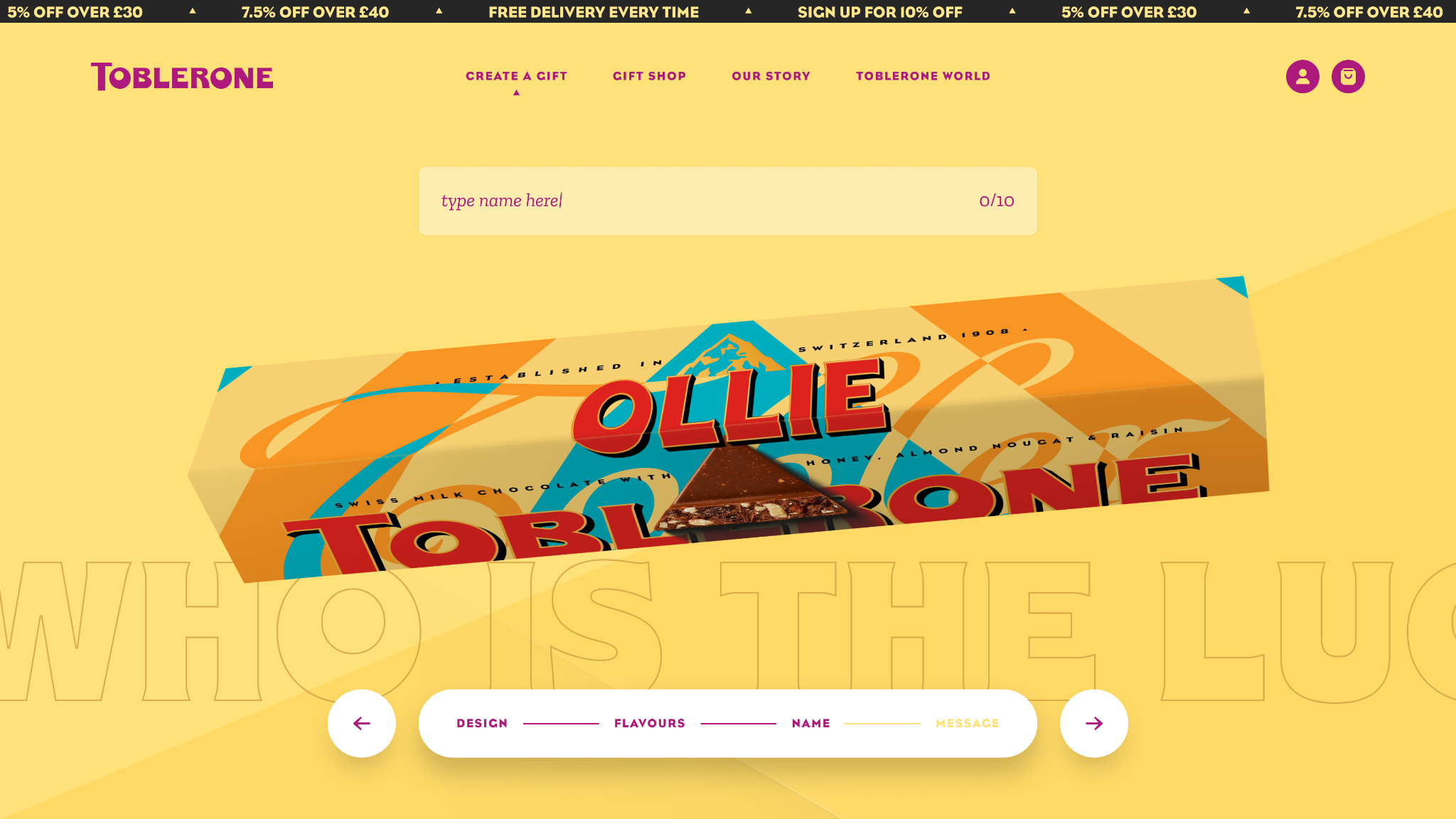
On The Climate Pledge platform, which we built in collaboration with Amazon, content comes to life through interactive elements and rich textures that fit WCAG 2.0 accessibility guidelines. When landing on the home page, visitors first see an animated intro video that spreads the optimistic ambition of the project, making for an impactful first impression. On Toblerone’s D2C platform, meanwhile, users are not only captivated by the stunning color palette, but also by the interactive features that allow them to create personalized gifts. Because they reflect the brand’s identity and tone of voice, both of these platforms are widely different, yet equally memorable.

Toblerone website with chocolate and a person eating a piece
Toblerone website with chocolate in a box

Of course, what visitors find impactful is always a moving target. With people seamlessly jumping from offline to online and into digital spaces where everything is customizable, expectations are high for what a bespoke user experience should look like. There’s a higher demand for creator-led experiences and personalization—which spurs brands to leverage the user data in ways that benefit consumers. 

First-party data elevates the potential of digital platforms.

The brand truth dictates the look and feel of your digital platforms, and data should also inform the design. Platforms facilitate interactions like product search and the purchase of goods and services, providing brands with new information about their consumers. In that process, any data collected should be used to offer experiences that are tailored to people’s needs, interests and even personalities.

What’s more, when the value exchange for someone’s data is clear, brands can establish a healthy feedback loop where they are providing a great service and gathering more information in the process. “The key to designing the right experience is listening to people’s behavior as they interact with the digital ecosystem,” says Dortland. “Our value lies in using data for customer understanding, which will ultimately help us design experiences that elevate brands, drive conversation and growth.” The more engaging the experience, the more data it will generate in return, meaning platforms can become increasingly more effective.

Platforms are more successful in a consistent brand ecosystem.

Essentially, platforms are key to enabling consumers to interact and transact with brands. They host digital experiences that optimize the customer journey and drive consumers’ loyalty. However, platforms are part of a larger brand ecosystem that needs to be consistent.

Monk Thoughts While apps and dotcoms are must-haves for brands, they can’t live up to their full potential if there isn’t a broader strategy to support them.
Niels Dortland headshot

If these touchpoints can’t be disconnected, neither should the teams that focus on each one. Working with partners that can develop an app from the ground up, create content for your brand’s social media or even deliver branded activations leads to a more cohesive narrative—a single truth that manifests itself across channels.

All of these considerations will help you forge deeper connections with your audience—and while building the perfect platform may not be easy, the good news is they are fully under your control. The customer journey never looks the same, but one thing is certain: behind every meaningful interaction is a bespoke platform strategy connecting the dots between people’s needs and a brand’s offering.

Key considerations for an impactful platform strategy in the new era of digital. digital platforms brand strategy content marketing strategy personalized content digital experience customer journey Platform Data Websites & Platforms Death of the cookie

Future-Proof Growth with a Focus on Privacy

Future-Proof Growth with a Focus on Privacy

Data Data, Data Privacy & Governance, Data Strategy & Advisory, Data privacy, Death of the cookie 4 min read
Profile picture for user mediamonks

Written by
Monks

data points going through a lock

Smita Salagonkar and Shashwith Uthappa

When retail faced physical shutdowns, more consumers flocked to digital for shopping. While ecommerce long offered time and cost savings to consumers, it now had the benefit of providing them with a safer environment to purchase during a pandemic. Southeast Asia alone saw 20 million new digital customers.

For brands, a benefit of the move to digital was that wide swaths of consumers were now sharing their purchase intent—valuable data used to surface up precise results. Consumers expect relevance in the products and content that’s recommended to them, and this expectation will only grow; imagine having to search for what you’re looking for in the 8th page of Google Search results!

On the flip side, companies face increased ethical scrutiny in how they use customer data. Business strategies designed to covertly collect personal data and monetize it are myopic; they may have implications on the customer relationships in the long-term. It’s important that companies instead look at responsible, privacy-focused strategies to earn consumer trust, even more so as we move to a post-cookie future.

Privacy is the fulcrum to the future of marketing.

With many consumers increasingly becoming aware and wary of the use of their data, and with regulatory bodies coming forward with laws and legislations, now is the time for brands to give their audiences a seat at the negotiation table when it comes to their privacy. At the recent Google Marketing Live event for the Leadership Circle in Hyderabad, India, privacy was the key theme, including how it is the fulcrum to building the future of marketing. Some key interesting stats that were shared:

  • 48% of people globally have stopped buying or using a service from a company due to privacy concerns.
  • Four out of the top five countries that searched for online privacy (in English) were from APAC.
  • Three out of five companies globally report benefits of deeper loyalty and improved agility and efficiency with being privacy mature. 

Essentially, modern brands use data to serve customers and provide a meaningful value exchange—more relevant, personalized experiences that enhance the brand-consumer relationship—rather than treat audiences as another product to auction off and sell. So while examples of data privacy misconduct often make the news, it’s instructive to acknowledge and learn from those who are handling data with utmost care. Walmart embraces privacy in the design of its organizational processes and structures, products and services by constantly monitoring the technological landscape for potential threats, for example. This way they are self-reliant on the collection and protection of data and hence subject to lesser data vulnerability. Likewise, brands can focus on privacy not as an inhibitor, but rather the key to unlocking better customer experiences through more ethical and sustainable use of data.

Focus on consent and value.

Given the fact that data security and management require a significant investment of resources by digitally mature companies, it’s important to use those tools to serve customers better, because that’s where the return on investment lies.

Two ways that brands create value is by offering transparency about data collection and control in how it is used. Ultimately it is about delivering value to end users. Consented first-party data and insights from privacy-safe technologies like Topics API provide incremental value to marketers while keeping online content and services free. Data-driven marketing focused on transparency and control can transform marketing strategies, enhance customer relationships, and yield useful content to people or even inform the product design.

A greater focus on first-party data is important because over reliance on third-party cookies, a tactic brands have taken for granted, is increasingly unwelcome by consumers and increasingly unsustainable given future plans to phase them out. Expanding beyond third-party cookies is key to building a long-term marketing strategy of the future.

Our work for Ace Hardware illustrates this philosophy. Through revamping its rewards program, Ace Hardware was able to improve the customer experience and deliver on its reputation of being “The Helpful Place” for those wanting to improve their homes. The app rewards customers for their loyalty while enriching Ace’s trove of first-party data. By unlocking insights into customer interest and intent—without the use of third-party cookies or targeted ads—the brand was able to deliver a meaningful value exchange in return for data.

Zero in on the data you need.

Another benefit of shielding consumer privacy is preventing data bloat by collecting only the data necessary to drive value for your marketing—not gobbling all your customers’ data. This enhances data hygiene, yields cleaner analytics and helps minimize risks posed by data breaches.

Software giant SAP estimates that nearly 73% of data collected by companies is never used. When data minimization efforts are put into practice, there are limited opportunities for collecting information, thereby condensing the depth of detail and timeframe in which data is possessed. This forms the nucleus of GDPR regulations, helps weed out the excess data and focus on obtaining only relevant information with focused questions and being intentional in data collection efforts.

Activate insights through continual testing.

When companies build a customer-learning and serving culture, they determine the purpose of data before asking for consent and a clear explanation is provided to customers on what they stand to gain in parting with their data.

With a focus on learning about and serving customers, brands are able to build a “test and learn” culture to inspire increasingly valuable experiences reinforced by data. Amex has been able to do this successfully with initiatives such as the small business lending program, which they piloted after having a deeper understanding of their customer data signals. Incidentally the brand also ranks high in customer privacy in the Fortune 500 companies list. Likewise, brands who are agile in responding to imminent privacy changes are breaking down the privacy era.

The right approach to data privacy can create a ripple effect of positive outcomes: deterring churn to competitors, strengthening perception, overcoming privacy obstacles and ultimately earning consumer trust. With these benefits in mind, keeping privacy the focus of your data strategy can do more than keep a brand agile amidst new regulations—it’s also a key component to future-proof growth.

Learn privacy-focused strategies that earn consumer trust and future-proof growth, even as we move towards a post-cookie future. data privacy privacy third-party cookies first-party data Data Data Privacy & Governance Data Strategy & Advisory Death of the cookie Data privacy

Choose your language

Choose your language

The website has been translated to English with the help of Humans and AI

Dismiss