Choose your language

Choose your language

The website has been translated to English with the help of Humans and AI

Dismiss

`

Data Decisioning

Bridge the gap between insight and action.

We help you unlock the value of your data by fostering data literacy, streamlining decision-making processes, and building a data-driven culture.

Data Decisioning

Data decisioning solves the following challenges:

    • Data Scarcity: Building Compliant Data Acquisition strategies

      Many businesses face challenges around data collection. It may come on the basis of legacy business models that have not yet embraced first-party data strategy or are risk-averse due to overwhelming regulation. Often businesses collect a lot of data but the value of it is not derived. Regardless of whether you are data-poor or insight-poor, Monks can help you overcome your challenges.

    • Data Sprawl: Creating Wide data is an important milestone for every organization

      Wide data effectively addresses data sprawl by creating a cohesive framework that integrates disparate datasets across an organization. By breaking down silos and establishing clear governance, wide data ensures that all departments share a consistent understanding of key metrics and definitions. This harmonization reduces fragmentation, allowing for seamless access to information from various sources—such as marketing automation tools, CRM systems, and product analytics—ultimately leading to improved collaboration and decision-making. With a unified view of data, organizations can mitigate the chaos of scattered information while enhancing its accessibility and actionability for all stakeholders.

    • Data Ignorance: The Urgency of "Aha!": Minimizing Time to Insight is crucial in the age of Wide Data

      In modern organizations, "Aha!" moments are crucial for driving innovation and competitive advantage. These insights, derived from data analysis, empower teams to make informed decisions quickly and adapt to changing market conditions. By minimizing the time to insight, businesses can capitalize on emerging trends and enhance operational efficiency while improving customer experiences. In an era where data is abundant but actionable insights are scarce, fostering a culture that prioritizes these transformative moments is essential for staying ahead of competitors and maximizing growth potential. Embracing the urgency of Aha! moments enables organizations to turn raw data into strategic opportunities that propel success in today's fast-paced environment.

    • Deferred Value: Overcoming Inertia: Post-Exposure Initiatives for Action and Outcome

      Post-exposure actions are essential for organizations to fully realize the value of their data-related initiatives. After achieving "Aha!" moments, it's crucial to implement structured strategies that translate insights into actionable outcomes. By developing clear action plans, fostering cross-functional collaboration, and ensuring effective communication of data insights, businesses can overcome inertia and combat deferred value. Additionally, prioritizing resource allocation and embracing experimentation allows organizations to mitigate risks while driving innovation. Ultimately, these post-exposure initiatives not only enhance decision-making but also maximize ROI from data investments—transforming raw insights into sustainable growth opportunities in today's competitive landscape.

Monk Thoughts In today's fast-paced business world, organizations are swimming in data. Data decisioning is the key to transforming this data into a powerful driver of growth, innovation, and competitive advantage. It is more than just collecting and processing data; it's about making data work hard to drive dollar value. This means data being practical, accessible, and actionable for everyone in the organization

Results

  • Increase revenue by 18%
  • Cost savings of 29%
  • Increase market share 2x
  • Product development time reduced by 50%
  • According to BCG “The Fast Track to Digital Marketing Maturity and McKinsey & Company, "How data and analytics can improve project performance".

00:00

00:00

00:00

Stop just admiring your data – start acting on it.

Well orchestrated data and mature digital operations are the key drivers of revenue uplift and market advantage. Let Data Decisioning empower your organization to make faster, smarter decisions and achieve measurable results.

Want to talk Data Decisioning? Get in touch.

What Gen AI Means for the Role of a Media Planner

What Gen AI Means for the Role of a Media Planner

AI AI, Media 4 min read
Profile picture for user Victoria Milo

Written by
Victoria Milo
SVP Global Media, Solutions & Emerging Technologies

two photos of the AI Deciphered event

When you hear generative AI, you probably picture LLMs generating images, text, music and other types of content that mimic human creativity—tools for creative professionals. Its role in media planning and buying isn’t typically the first thing people consider, but I’ve seen first hand how generative AI is reshaping the media planning process. 

Working with brands like Chime who have sophisticated multi-channel advertising programs, my colleagues have unlocked benefits ranging from enhanced automation to scalable personalization, all while driving cost efficiency. This topic took center stage during a panel discussion at Campaign’s AI Deciphered 2024, featuring Brayden Varr, ACD at Chime; Ashwini Karandikar, EVP of Media, Technology, and Data at The 4A’s; Jesse Waldele, and SVP of Digital Operations and Client Success at Dow Jones; along with myself.

Steve Barrett, our moderator and VP and editorial director at PRWeek & Campaign US, opened the panel discussion with a pivotal question: What do the new AI-powered tools mean for the role of a media planner? Below are some key insights from our session.

Creative and media are becoming closer together.

Historically, creative and media roles operated in silos, each adhering to their own set of responsibilities. This setup is far from ideal, because the intersection of creativity and performance analysis is crucial for brands to succeed. As Karandikar put it, "The creative arm needs to speak the language of performance while still capturing the brand message.” However, reaching a point where team members could put aside their production tasks to collaborate with others was, at the very least, challenging.

Now, with AI managing repetitive tasks and various aspects of content generation, creatives can concentrate on higher-level strategic thinking and innovation. As a result, they can collaborate more effectively with media planners—and vice versa—gaining deeper insights into target demographics and enhancing campaign optimization. Plus, it opens up new possibilities for media planners who may not have the support of creatives on their teams.

Varr, approaching the topic from the creative and design side, highlighted how performance marketers are leveraging AI tools to enhance creativity on limited budgets. “If you work in the performance space, you probably have zero creative production budget,” he said. “But we have to get noticed. With tools like Adobe and Midjourney, we can create content that helps us stand out in these feeds more than ever, and it’s positively impacting our key metrics that we evaluate every day.”

What’s more, in highly regulated markets, brands often face restrictions that prevent them from using demographic data, such as age, gender, or location, to target consumers. Instead, they can rely instead on creative content as a key input. That means exploring various attributes—such as interests, behaviors, or emotional triggers—within the creative itself to connect with consumers. Media buyers are increasingly collaborating with creative teams, brand strategists and media strategists to craft campaigns that resonate with target audiences. 

It’s not just about automation; it’s about intelligence.

As mentioned earlier, automation allows creatives and media planners to focus on high-value tasks rather than routine analytics. But it doesn’t end there. Gen AI excels at processing vast datasets to reveal patterns and trends that human analysts may miss. By generating actionable insights, generative AI helps inform media strategies, allowing planners to optimize their approaches based on real-time data rather than relying solely on historical experiences.

Waldele said, “Where we really see a huge opportunity is not just in media plan automation, but in media plan intelligence. We can create media plans that are performing and infused with that intelligence.” To provide an example, working with enterprise clients with complex media programs, we can automatically tag thousands of potential attributes within our creatives. This used to be a cumbersome task that required building complex taxonomies to capture various elements of an ad. Marketers had to create detailed tags for simple attributes like “red background” or “blue background,” while also specifying the product’s context. This method imposed limits on the number of characters allowed in an ad name and often left teams struggling to log every attribute of the creative that could impact performance.

Now, the automatic tagging capability streamlines the process and enhances the depth of analysis. AI can pick up subtle details that were previously imperceptible to the human eye—such as whether a card is positioned at the top of a phone or next to it—and understand how these elements resonate with audiences. Moreover, many ad platforms integrate generative AI to dynamically alter creatives in response to immediate audience feedback. It’s a significant leap forward—not just in terms of efficiency, but in the depth of intelligence that drives media planning today.

There’s value in taking risks.

From highly personalized creative content to real-time insights, brands have much to gain by incorporating generative AI into their media strategies. Still, many find themselves caught up in the challenges, risks and considerations. As Varr said, it’s easy to say no to these tools, but doing so can be costly. Once your competitors start effectively harnessing the untapped potential of generative AI, catching up becomes a formidable challenge.

While smaller brands tend to be more agile and willing to take risks, established enterprises have just as much—if not more—to gain from embracing innovation. To secure your team’s buy-in, Varr suggests, “Find someone who believes in it, and then demonstrate the impact. If you can do that, that’s when you’ll succeed.”

We are entering a new era of collaboration, agility and intelligence. By breaking down traditional silos and fostering collaboration among creative, media, and strategic teams, organizations can leverage the full potential of their insights and automate routine tasks. This empowerment not only enhances creative quality and campaign effectiveness but also positions brands to respond swiftly to market dynamics. In a time when agility and informed decision-making are crucial, those embracing generative AI will not only stay ahead of the competition but also redefine what's possible in media planning and execution.

Explore how generative AI is reshaping media planning by enhancing automation, collaboration and insights, bridging the gap between creativity and data-driven strategies. Discover how generative AI transforms media planning with automation, data-driven insights and enhanced collaboration for smarter campaigns. media buying Generative AI customer data automation AI workflows Media AI

Your UA Data is About to Expire—Here’s How to Save It

Your UA Data is About to Expire—Here’s How to Save It

Customer Data Platforms Customer Data Platforms, Data, Data Analytics, Data Strategy & Advisory, Data maturity 3 min read
Profile picture for user Candace Riddle

Written by
Candace Riddle
Director, Growth - Data Science & Technology Sales

A digital illustration of a cloud symbol on a dark, grid-like background with intersecting lines, representing cloud computing and data connectivity.

In recent years, July 1 has loomed large over the data analytics industry. Back in 2022, Google announced that Universal Analytics would cease collecting new data exactly a year later, prompting organizations to start transitioning to Google Analytics 4 (GA4). This year, July 1 brings another major milestone in UA’s phase-out: its official shutdown.

For those who already migrated to GA4, the retrieval of historical UA data might still be a challenge, but one that needs to be addressed as soon as possible. The end of UA brings the irrevocable loss of priceless historical data, which is key to understanding performance over time. This loss prevents you from identifying trends or addressing questions about past purchases or campaigns, creating gaps that can impact your bottom line. 

That said, If exporting historical data from UA properties was easy, I wouldn’t be writing about it. To tackle these challenges, Media.Monks has developed our own Universal Analytics Data Export & Archive Tool, a custom tool that helps clients efficiently extract and store their historical data.

A tailored solution designed to solve common challenges.

Unlike off-the-shelf tools, the UA Data Export & Archive Tool offers tailored data extraction, ensuring data is accurately captured and organized according to your specific business needs. On top of that, standard UA users had very limited data export capabilities. But even with an upgraded 360 version, achieving a seamless and comprehensive export is difficult due to backfill limitations.

With a focus on frictionless delivery, the UA Data Export & Archive Tool addresses these limitations to guarantee a smooth transition. “Our data scientists have created a custom script to solve our clients UA export issues, whether your property was upgraded to 360 and linked to BigQuery or not.” says Brianna Mersey, Senior Director, Data. “The tool uses the Google Analytics Reporting API (v4) to export data into BigQuery or any designated data warehouse.”


Monk Thoughts We can go back and export the data as far as it sits in your property.
Brianna Mersey headshot

In other words, UA Data Export & Archive Tool lets you export and own your UA historical data in a first-party environment—even if you don’t have the 360 version. 

Seven steps for a straightforward process.

The UA Data Export & Archive Tool is designed to make the data extraction and archiving process seamless and efficient. Here’s a breakdown of how it works:

  • Initial Assessment: We begin with a thorough assessment of your current UA setup and data needs. This helps us understand the scope of data to be exported and any specific requirements you may have.
  • Custom Python Scripts: Using Python code in Google Colab, our data scientists have developed scripts that automate the data export process. These scripts are customized to create aggregated reporting tables aligned with your desired dimensions and metrics.
  • Data Aggregation and Structuring: The exported data is aggregated and organized into structured tables. 
  • Data Storage: Once the data is exported and structured, it is securely stored in the data warehouse of your choice, such as BigQuery or any other designated storage solution. This ensures you maintain control over your historical data.
  • Custom Reporting: Our solution offers the ability to build up to five custom tables or reports based on your specific requirements, enabling you to access the most relevant insights for your business.
  • Expert Support: Throughout the process, our team provides expert support to ensure your data is accurately captured and properly aligned with your new analytics system. This includes assistance in setting up a secure data warehousing solution if desired.
  • Privacy and Compliance: The tool adheres to industry best practices for privacy and data security, ensuring that your data remains confidential and compliant with all relevant regulations.

Efficiently organized data turns into capitalized opportunities.

In times of economic uncertainty and in a data era where everything is moving faster, having historical data is essential for adjusting marketing strategies and making predictive and informed business decisions. That’s why the urgency to properly export your UA data cannot be overstated. “If you have even the slightest concern about losing your data, for benchmarking and year on year comparisons, now is the time to act,” says Mersey.

With only weeks left before UA shuts down, every day counts. Don’t risk losing valuable historical data and keep the insights crucial for your business’s success.

If you need to retrieve and store your historical UA data, we're here to help. Fill out the form below to get in touch with one of our data experts. 

Need to retrieve your UA data? We're here to help

Before Google shuts UA down, learn how our custom export tool ensures seamless transition to GA4.

data analytics Google Analytics customer data Data Customer Data Platforms Data Analytics Data Strategy & Advisory Data maturity

The Theme That Defined Salesforce Connections 2024: Unification

The Theme That Defined Salesforce Connections 2024: Unification

CRM CRM, Customer loyalty, Data, Data maturity 4 min read
Profile picture for user Jeremy Bunch

Written by
Jeremy Bunch
GM, Pre-Sales and Advisory Services

Collage of images featuring the Media.Monks team at Salesforce Connections 2024.

Last week, Salesforce Connections set the stage for a whirlwind of exciting product announcements and invaluable insights. As expected, the premier AI and marketing conference focused on innovation and practical AI applications, offering marketers actionable strategies for leveraging technology and data.

But a key theme was the need to unify disparate data sources, orchestrating teams around unified workflows to maximize data impact—in one word, the event focused on integration. This strongly resonated with me, because it’s exactly what my team is built to help brands achieve; as a unitary partner and systems integrator, we specialize in creating platform solutions that seamlessly integrate AI and customer data to drive growth. From new product announcements to sales stories, let’s look at the growing need for an integrated approach to customer relationship management (CRM) and the role that a unitary partner can play in helping brands maximize its impact.

Here's what Salesforce announced this year.

One of the most exciting announcements was the introduction of Einstein Copilot for Marketers, set to release in June. This tool translates customer data into actionable campaign briefs, offering generative AI features like copy creation and automated communications. Salesforce is also now orchestrating seamless handoffs between multiple Copilots to enhance team collaboration. These innovations bridge the gap between customer data insights and content creation to drive impact across the business. For example, you can pair Einstein Copilot for Marketers with Einstein Copilot for Merchandisers to uncover up-selling opportunities.

Salesforce also announced enhancements to Data Cloud for Commerce, providing a unified view of customer data from numerous commerce data points. This empowers marketers to create hyper-personalized experiences—but when paired with Einstein Copilot products, these efforts become even more impactful.

Another major announcement was the Zero Copy Data Partner Network, connecting technology, system integration, and data ecosystem partners. This network allows marketers to draw data from a broader array of sources (without that data needing to be housed on their Salesforce platform), amplifying their AI-driven efforts.

What’s interesting about these announcements is the emerging, overarching theme of integration and collaborative workflows to help marketing teams work better together. This is the bread and butter of a unitary partner who can ensure that data accessibility, unified customer views and team collaboration are optimized across the business. By bridging together expertise across disciplines like data, media, content, and technology, such a partner is best suited to deliver the full potential of these solutions as they work in harmony with one another.

Peek inside the success stories that were shaped by seamless integration.

While at Salesforce Connections, I had the chance to speak with brands—learning their needs, pain points and the opportunities they most look forward to—and got to watch the different speaker sessions that we hosted or participated in. These conversations presented a range of success stories demonstrating how integrated solutions helped brands unlock new possibilities in their marketing. Here are three goals that my team has been able to help brands achieve.

Data integration and unified customer views. In a talk that is available on demand, Alex Furth, Marketing Manager, Digital Innovation from Gatorade shared how Einstein AI and Data Cloud unified fragmented consumer data, enabling effective and tailored marketing strategies. Theresa McCombs Marketing Director, Brokerage Services and Julia Homier Digital Marketing Consultant, from Holmes Murphy told a similar story in the talk “Drive Financial Services Marketing ROI with AI-Powered Data,” where they detailed their journey with Salesforce's Marketing Cloud to enhance customer engagement and data management through centralized automation tools and Einstein AI. Both brands’ successes show how unified data solutions significantly enhance engagement and performance metrics, exemplifying the need for centralized, strategic data management.

Personalized engagement and customer loyalty. Our session with PepsiCo, “Data-Driven Engagement for PepsiCo Tasty Rewards,” focused on their Tasty Rewards loyalty program, which uses Salesforce Marketing Cloud and Einstein to drive loyalty and increase long-term value. They achieved a 100% increase in open rates and a 170% increase in click rates. If you missed the talk, you can still learn more about PepsiCo’s approach to scaled personalization from a different angle in a previously recorded webinar.

Meanwhile, Broadway Across America showcased how Salesforce’s solutions personalized customer experiences, significantly increasing month-over-month (MoM) subscriptions. “My favorite part of Connections was talking about some of the innovations we’re helping Broadway Across America with, mainly the SMS texting strategy for them in 25 different markets, and they’ve seen awesome results,” my colleague Amy Downs, VP of Commercial at Media.Monks, noted. “Their MoM subscription increase was 7%, compared to a 0.14% increase before we implemented that strategy.”

The lesson: data-driven engagement strategies drive significant increases in subscriptions and long-term customer loyalty—an important consideration for marketers who are embracing product-led growth strategies.

Marketing automation and strategic alignment. Another significant consideration that Theresa and Julia at Holmes Murphy emphasized was the importance of consolidating varied automation tools. By implementing Einstein AI and aligning marketing strategies with business objectives, together we were able to streamline operations and surpassed industry engagement benchmarks. Centralizing operations through consolidated automation tools not only boosts engagement but also enhances overall marketing efficiency, demonstrating the critical role of integrated, strategic automation in achieving business goals.

That’s a wrap on an event that’s all about connections.

Attending Salesforce Connections was an exhilarating experience, showcasing the transformative potential of integrating AI and data to drive marketing innovation. The success stories from brands like PepsiCo, Gatorade, Broadway Across America and Holmes Murphy highlighted how unifying data with Salesforce's powerful tools opens up new possibilities. These brands have achieved remarkable success by leveraging coordinated workflows and seamless data integration, and I’m excited to continue supporting brands in their journey to do the same by unlocking the full potential of their CRM and the technologies like AI that rely on it.

The key theme at Salesforce Connections was the unification and integration of data sources, workflows, and AI tools to maximize marketing impact.
customer data automation salesforce connections Data CRM Customer loyalty Data maturity

Activating Your Data with Google Cloud Platform’s Natural Language AI

Activating Your Data with Google Cloud Platform’s Natural Language AI

AI AI, Data, Data Strategy & Advisory, Data maturity 4 min read
Profile picture for user Juliana.Jackson

Written by
Iuliana Jackson
Associate Director, Digital Experience EMEA

Activating textual data

If you ever find yourself wondering why anyone in this world would collect valuable first-party and zero-party data without activating it, you’d be surprised to hear that many brands do. More often than I’d like, I see them sitting on glimmering gold in the form of surveys, feedback forms, open-ended submissions and comments. Just like the valuable metal, this textual customer data can be mined to extract meaning and insights into a customer’s attitude towards your products and services.

As a digital treasure hunter, I know better than to leave this gold in the ground—and as a Google partner, I also know how to mine it. Through Google Cloud Platform’s (GCP) Natural Language Processing (NLP) AI, digital marketing partners can help brands conduct sentiment analysis, among other methods, to gather insights into customer behavioral patterns, expectations, complaints and moods, and therefore determine the level of brand loyalty. 


The quantitative data that you obtain through this research method allows you to build dashboards and visualize brand sentiment across regions. The aim here is to discover any areas for improvement, as these data points can be used to optimize a brand’s mobile and web applications or products and services—thus informing their next steps in the experimentation process and helping them get closer to meeting their audience’s needs. 


Over the last few months, I’ve focused on integrating sentiment analysis into our experimentation offering, and it’s quickly changing the game. In the spirit of sharing learnings and making sure no brand leaves their valuable data untouched, let’s talk about why this method is as good as gold. 

Leveraging textual data to determine brand sentiment.

Imagine you’re a top-tier global brand in the food and beverage industry. You’ve recently added new features to your app, and so you’re eager to find out if customers are enjoying this enhanced experience. Right now, there are over 500 thousand reviews on the Google Play Store. Scouring through them would most certainly go a long way, but who’s got that kind of time? It’s a classic case that we see all the time: brands tracking everything, but not doing anything with the info they keep track of. However, this trove of data from active customer interactions is only a treasure if it’s activated and applied effectively. 


This is where sentiment analysis comes in. Made possible by GCP’s suite of tools, this research technique analyzes digital text to determine the emotional tone of a message, such as a review. As part of experimentation, which is all about creating impactful changes to meet the needs of your customers, sentiment analysis allows you to translate qualitative textual data into quantitative numerical data. The aim is to surface key insights about brand loyalty—in the case of said brand, how customers feel about the app’s new features. And then? That’s right, much-needed data activation.  

Put your data to work to improve your business. 

Diving into the nitty-gritty of conducting sentiment analysis, you’ll see it’s very easy to adopt this method. With this AI solution, there’s no need for marketers to manually go through one review after another to get a sense of people’s opinions.


Here's the rundown. Once you have access to a Google Cloud account, you can organize your qualitative, transactional and behavioral data in Google Sheets and Google Cloud Storage. Then, use Apps Script (or another cloud client library) to create a custom menu and leverage GCP’s natural language API. Once you've enabled the natural language API and created an API key, you can start processing your data in a request to the NLP API and then automatically perform sentiment analysis. Ultimately, this opens the door for you to act on those insights through A/B testing campaigns, web and app optimization, brand marketing, and product marketing.


GCP’s Natural Language Processing API is so powerful because it combines sentiment analysis with named-entity recognition, which is a sub-task of information extraction that seeks to locate and classify named entities mentioned in unstructured text into predefined categories. For example, in the sentence “I get a cappuccino every day and I love that I can now earn points on the app and get a discount on my favorite product” we can already identify two types of entities: the product and the platform. So, the tool not only provides information about people’s sentiment, but it also connects this sentiment to the entities in the text.

Monk Thoughts If you ask me, using Google Cloud Platform’s tools in conjunction with GA4 as your data collection tool is one of the coolest things that’s happened to marketing.
Iuliana Jackson headshot

Of course, this isn’t all new—it’s just become mainstream now that Universal Analytics has officially sunsetted, and we’re all moving on with GA4 (if you haven’t yet, this is your sign to do so).

Never let your customer data go to waste. 

Understanding user behavior, expectations and struggles should always be at the core of your efforts. Such critical information fuels all your experiments and supports you in fine-tuning your products and services. So, next time you’re thinking of leaving reviews unread and letting gold wither away, think again—because this easy, AI-powered solution and the partners that know how to apply it are here to help you extract meaning from your valuable first-party and zero-party data. And to add some fresh cherries to the pie, Google has new AI services that would allow you to automatically reply to those reviews and comments, using a Large Language Model (LLM)—but more on that next time.

As a Google partner, we can help brands conduct sentiment analysis using Google Cloud Platform's AI tools to understand their customers' level of loyalty. Google Analytics customer data AI Data Strategy & Advisory Data AI Data maturity

Raising Media-Driven Revenue With Market Mix Modeling

Raising Media-Driven Revenue With Market Mix Modeling

AI AI, AI & Emerging Technology Consulting, Data maturity, Media, Media Analytics, Media Strategy & Planning, Performance Media 5 min read
Profile picture for user Michael Cross

Written by
Michael Cross
EVP, Measurement

Raising Media-Driven Revenue

In light of current economic conditions, which make it critical to do more with less budget, measurement of media effectiveness is becoming ever more important. In this context, incrementality—a term that has long been used in the world of consumer-packaged goods and promotions—is making its way onto the media scene, while innovations such as AI are used to accelerate the work.

The reason why we measure more and more is straightforward: so that we can forecast the performance of different strategic scenarios, and thereby help the brands we partner with optimize their media efforts. And just like any other discipline within advertising, the field of media continues to evolve, so let’s put a spotlight on what matters right now and will support your media measurement. 

Welcoming incrementality in the media world. 

First, let’s take a step back and look at what incrementality entails. Simply put, it refers to the lift in conversions or sales that can be attributed to a specific advertising campaign above those that would have occurred regardless—also known as the base. Incrementality has recently been adopted by us media folks, and the term has risen in importance because it’s a media measurement solution that isolates the incremental uplift. This matters because otherwise you can’t tell which media is driving growth and which is just harvesting conversions that you would have gotten anyway. As such, incrementality delivers a far more accurate view of how your media channels are driving conversions.

For example, traditional multi-touch attribution (MTA) often fails to separate the base from the uplift of the advertising campaign. This can lead to overstated results. Instead, in order to accurately measure incrementality, it's important to use MTA in conjunction with incremental techniques like market mix modeling (MMM). This way, you can better understand the true impact of advertising campaigns, move from ROAS to ROI, and as such have a more sensible conversation with your finance teams on the effectiveness of media.

How market mix modeling has got media measurement’s back. 

Market mix modeling—sometimes referred to as media mix modeling, but I prefer the former—is certainly not new to the scene, and this technique has been around in its commercial application to understand media uplifts for several decades now. However, the discipline has significantly improved, especially in the last few years.  

Contemporary MMM has come a long way. In the old days, annual updates would take months to bear results, while today you can get a pilot up and running within six weeks and use automation and machine learning to obtain monthly updates in just a matter of days. Besides, visualizations have also become much better, as today’s reporting dashboards offer analysts a plethora of ways to approach the data sets.


Monk Thoughts From the economy to seasonality, market mix modeling considers all drivers of sales, which makes the technique useful for CMOs as well as CFOs and a company’s board.
Portrait of Michael Cross

It's important to note that market mix models consider the whole market—including drivers like promotions to pricing, the recent pandemic, seasonality and more—and thus offer a holistic view. If you fail to take these other factors into account, you can’t get an accurate read on media and risk overstating its impact. As such, we’re seeing more and more brands partner with specialist MMM experts to help build the market mix models, or work with them to in-house this capability.

I have to point out that some players out there might say they execute “media mix modeling,” but are actually just building a simple regression with media variables or using multi-touch pathway techniques (which is not an incremental analysis). What’s so concerning about this is that they offer so-called MMM solutions at very cheap rates, which may sound appealing, but the damage of using these cannot be underestimated. Basing your decisions on a cheap but bad model could go wrong and cost you over 40% of your media-driven revenue—compared to an increase of roughly 30% if the technique is applied properly. You can make the call on what’s best for your brand.  

Leveraging AI to accelerate our analysis. 

Another very timely reason why I’m so excited about applying market mix modeling is the recent rise of artificial intelligence and the automation solutions that have stemmed from it—AI has been advancing fast in various areas, and it did not forget about MMM. 

At Media.Monks, we’re bullish about AI. That said, we also know that it’s important to be cautious and do our due diligence, especially as we see many AI providers claiming to build market mix models without having the right experience and tools to do so. When it comes to MMM, we believe that AI and automation solutions can be incredibly useful in speeding up the process, but of course there are also some instances that require manual labor. Let’s take a look.  

Raw data and processing. This can be automated using APIs or templates to stream data in, and then pre-ordained processes automate cleaning, saving lots of time. Beware of providers who take several months to initially onboard data pipes, as you really should be up and running in a matter of weeks.

Initial models. We use evolutionary algorithms to automate the initial model build, running thousands of models instantly in the cloud and scoring them, which enables us to arrive at a base model much faster and save weeks across MMM projects with multiple KPIs.

Final models. Note that this (still) requires manual intervention with a very experienced modeling team. We need to sense-check the models, triple-check the data, and use our extensive experience to spot any anomalies and alternative analysis to interrogate any controversial findings.

Sales effects and ROI calculations. These can be automated without the use of AI—this is just a process that can easily be repeated using code.

Automated reporting. Once all the numbers are calculated, it’s easy to automatically populate dashboards and media optimization tools. One thing that can’t be automated, however, is the answering of bespoke client questions around most effective second length, audience, and more. 

Engagement. Reporting ROIs and optimizations is one thing, but gaining an understanding of and trust in the models is another. Therefore, in the early stages of MMM engagements, it's imperative to have people who can explain the models and results to the wider team—not just marketing, but also finance, sales, the board, to name a few. My advice would be to circle back to this in later stages, once people understand and trust the model, and then you can move to more automated reports.

In short, automation can replace a lot of the heavy lifting of data and results processing and visualization, while AI can be used in the initial modeling stage. But what can’t be replaced is the sense-checking, interpretation, and experience of a good modeler to ensure the results are robust, realistic, understood and therefore usable.

Decreasing time, while increasing results. 

In the context of economically uncertain times, a time-saving—and thus cost-saving—solution like market mix modeling, especially when it’s powered by AI and automation, comes in very handy. Based on these models, media measurement typically enables brands to forecast different sales scenarios. In turn, having a robust forecast of performance is critical in justifying different strategic scenarios to the board, owners and investors of a company.

Incrementality is critical in the quest for accurate ROI, and MMM is a main way to get there. Though this technique has been around for decades, its pace of change and adoption rate is accelerating, which I’m sure will be further driven forward by AI. That said, in order for you to reap the many rewards of this tried and tested technique, it’s critical to work with a media partner who includes the whole mix of sales drivers and can take your models from sheer numbers to clear business actions.


Through market mix modeling, we help brands measure media effectiveness to forecast the performance of different strategies and optimize their media efforts. media strategy market research campaign performance campaign optimization data and analytics customer data Media AI & Emerging Technology Consulting Media Strategy & Planning Media Analytics Performance Media Data maturity AI

Data Governance and Business Considerations: A Strategic Approach to Implementing a CDP

Data Governance and Business Considerations: A Strategic Approach to Implementing a CDP

CRM CRM, Consumer Insights & Activation, Data, Data Analytics, Data maturity, Death of the cookie 4 min read
Profile picture for user mediamonks

Written by
Monks

A person working on a computer analyzing data

When we think about customer data, plenty of benefits come to mind: the ability to access valuable insights into customer behavior, identify gaps in the sales funnel and optimize product development, among others. Customer data is one of the most valuable assets a business can have, especially in the pursuit of developing more meaningful and personalized connections with consumers. But as those working in data analytics know all too well, simply collecting data doesn’t cut it—especially if it lives on different platforms and the collection points are spread across the entire customer journey.

To overcome that challenge, wise marketers and data scientists resort to customer data platforms: software systems that allow businesses to collect, centralize, and manage customer data from multiple sources in one place. A CDP can help answer an abundance of questions by providing a single source of truth; though before you can get there, it’s important to understand how to handle the complexities and responsibilities that come with it.  

Not long ago, our Associate Director of Customer Data, Elia Niboldi, penned an article on how to leverage CDPs to their full potential. This time, we’re taking a step back with a new whitepaper that explores the key considerations when implementing a CDP. Let’s dissect some of the main takeaways.

With CDPs comes great responsibility.

To put it simply, CDPs aim to provide a comprehensive view of the customer across all channels and touchpoints, which allows businesses to make informed decisions and create better customer experiences. They are incredibly powerful tools, but that also means the data collected by CDPs can be sensitive and needs to be handled in a responsible and ethical manner, even if customers were happy to share it with the brand in the first place.

In other words, CDP data comes with the need for strategy and clear governance around a brand’s interactions with their customers. Having a robust consent management system in place is the bare minimum, an essential process for allowing customers to determine what information they want to share with a business—something that Salesforce Privacy Center handles very well. And this shouldn’t be limited to brands’ first interaction with a client: when changes in regulation occur or customers’ preferences change, they should be provided with an option to manage and update these preferences, and brands can keep track of those from a centralized location through a CDP.

Once the customer has shown interest in creating a value exchange between their data and the brand’s services, it’s important to set frequency capping standards that alleviate brand fatigue and ensure brand communications are effective and positive—rather than annoying and frustrating. The frequency send caps are usually reset daily, weekly or monthly, and can be adjusted based on customer behavior to optimize marketing campaigns and improve the overall customer experience.

Consider the role of CDPs in the CMO’s business.

Because they provide a unified view, CDPs are both a technical and organizational tool that can help break down silos. Traditionally, customer data has been fragmented across systems and siloed within departments, making it difficult for marketers to access that data in meaningful ways. At the same time, it’s naturally hard for technology teams to fully understand marketing needs or their specific use cases for the data they manage. CPDs bridge this gap, serving both the CMO and the CIO.

However, in order for CMOs to access the real value of CDPs, we need to remember they play three key roles: ensuring cooperation between teams, improving optimization use cases and offering better segmentation. A CDP necessitates cooperation between different teams because it’s meant to break down silos and provide a single source of truth that everyone in the organization can draw from. Through that source of truth, marketers can keep track of which channels and strategies are performing particularly well and optimize accordingly. Finally, CDPs unlock superior targeting capabilities that allow businesses to provide personalized experiences that resonate with their customers’ needs and interests. 

Salesforce Data Cloud, for example, combines the data from Google and The Trade Desk to activate audience insights beyond messaging, journeys and onsite personalization into a brand’s search and digital media campaigns. Plus, it funnels a nearly infinite amount of dynamic data to Customer 360 in real-time. This allows for deeper audience engagement, as customer data is continuously updating and feeding audio, OOH, app, web campaigns and everything in between.

Interested in implementing a CDP? Assess your readiness. 

So, you’ve installed clear governance standards around your interactions with consumers and aligned both the CMO and CIO on the importance of having one source of truth. Are you ready to start extracting meaningful customer insights? Not just yet. First, you’ll need to follow a few initial steps to ensure a successful implementation of the CDP:

  • Outcome alignment: start by workshopping the priority use cases to deliver the minimum viable product. This needs to be a cross-functional exercise that ideates, quantifies and prioritizes use cases.
  • Identity resolution strategy: build the identity graph that allows a customer profile to be stitched together to form a single customer view.
  • Data model: design a consistent global measurement framework.
  • Team vision: make sure the CDP is coupled with a clear strategic vision and the right team to extract its full potential. This team should include champions from different departments, system integration partners, executive sponsors and operational users. 
  • Implementation plan: develop the operational model. For a customer data platform to be implemented seamlessly into a business, pre-built integrations are essential. Establish which integrations are required and use this to choose a CDP solution that suits your operational needs.

All things considered, CDPs shouldn’t be thought of as “set and forget,” but rather “implement and optimize.” A CDP like Salesforce Data Cloud can provide a wealth of benefits for a business, from more efficient data management to improved customer experiences. By setting a clear governance process and taking into account key considerations before implementation, businesses can ensure that they are ready for both the benefits and the responsibilities that come with utilizing a CDP.

A CDP can help by providing a single source of truth; though before you can get there, it’s important to understand how to handle the complexities and responsibilities first. customer data data analytics data and analytics salesforce marketing Data Consumer Insights & Activation CRM Data Analytics Death of the cookie Data maturity

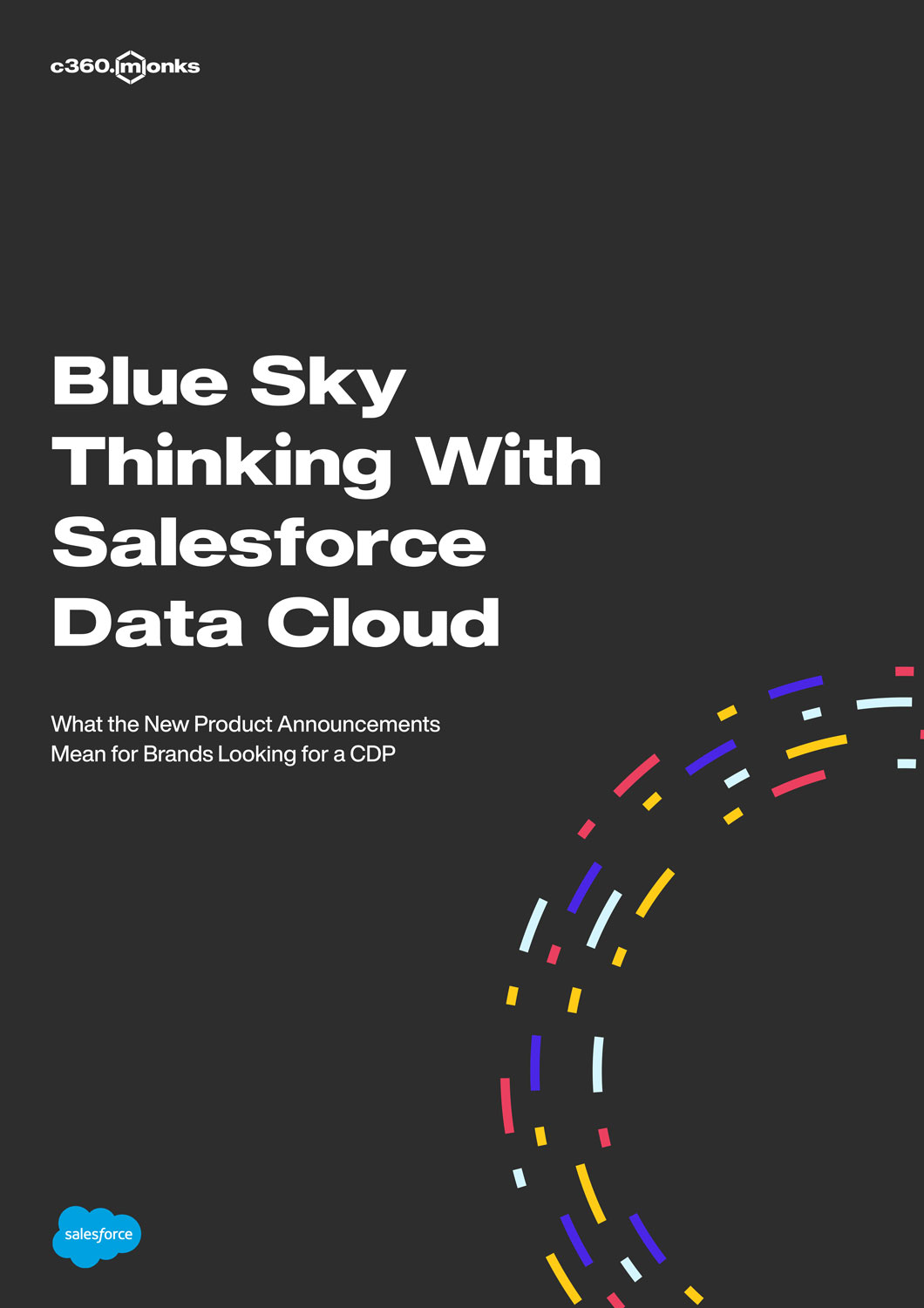
Blue Sky Thinking with Salesforce Data Cloud

Blue Sky Thinking with Salesforce Data Cloud

Consumer Insights & Activation Consumer Insights & Activation, Data, Data Privacy & Governance, Data Strategy & Advisory, Data maturity, Death of the cookie 1 min read
Profile picture for user mediamonks

Written by
Monks

gray background with colorful lines

Unlock deep customer insights with a CDP

While the nomenclature of Data Cloud might sound soft and fluffy, a CDP is anything but. CDPs can deliver value across an organization, from marketing operations to IT, data science to paid media, but it’s important to take a few key considerations into account before making the leap.

In this report, you will learn how to handle key considerations like data governance, efficiency management, virtualization principles, consent management, unification, and activation to build a holistic view of what is happening in your business.

gray background with text that reads "Blue Sky Thinking with Salesforce Data Cloud"

You’re one download away from…

  • Understanding governance and privacy standards that come with CDP adoption
  • Seeing how CDPs bridge the gap between the CMO and CIO
  • Assessing your readiness to implement a CDP

This experience is best viewed on Desktop.

Download Now
Thinking about a Customer Data Platform (CDP)? This report guides you through essential considerations like data governance, consent management, and data unification to help your organization gain a holistic view of its customers. AI Personalization customer data artificial intelligence creative technology emerging technology automation Data Data Privacy & Governance Consumer Insights & Activation Data Strategy & Advisory Data maturity Death of the cookie
A hand holding a phone with the Built In application on it
A person sitting at a desk working on a laptop enjoying a cup of coffee
A person sitting on a couch working on a laptop

Enabling Hyper-Growth Across Communities • Optimizing Salesforce to Fuel Growth

  • Client

    Built In

  • Solutions

    DataCRMConsumer Insights & Activation

A laptop on a marble countertop displaying the built in application

Connecting content, data—and people.

Built In is a network of local online communities for startups, tech companies and tech professionals. A powerful connector of people, the company enables startups and tech companies to post and recruit candidates for open positions, promote their brand and culture, share news, and participate in community events.

However, having a network of communities in eight different markets meant Built In needed a way to streamline content and data for its employees, tech users and company clients to connect in one place. Built In already used Salesforce CRM, but like many companies, they hadn’t been reaping the full benefit of the CRM or other Salesforce products—missing out on key opportunities to optimize, streamline business processes and unlock revenue. Built In reached out to Monks, a Salesforce Consulting Partner, to connect the dots across their Salesforce marketing and enable a more personalized user experience.

An illustrated cellphone with a notification icon

In partnership with

  • Built In
Client Words We would recommend [Monks] to any company. [Monks] wants to be a partner. Speed of implementation and communication flexibility is really good, which you don’t always see from third-party vendors.
Jeff Hurd headshot

Jeff Hurd

Director of Product, Built In

Building trust through a transparent planning process.

Before making any moves, we connected with the Built In team to align our strategy with the goals of the business. We met with the team in person to walk them through each step involved in implementing and optimizing Salesforce Experience Cloud, Sales Cloud, Service Cloud and Marketing Cloud Account Engagement. Taking the Built In’s needs into account, we then verified and documented project steps with our engineering team—ensuring everyone was on the same page throughout the entire process.

Three employees listening to a presentation with their laptops
A person working at a whiteboard with sticky notes

An executional approach built on close collaboration.

Strong partnership is built on transparency, so once the planning phase concluded, we continued to give Built In clear visibility into our implementation of Salesforce products and platforms. We began by making daily check-ins with the Built In team, then hosted bi-weekly meetings to fully communicate our progress. The speed of communication throughout the engagement enabled additional flexibility in our approach.

Three employees looking at an iPhone together laughing

Fueling connection across platforms and people.

Now better able to connect content and data across regional communities, Built In was able to greatly improve customer satisfaction. Previously, finding companies, talent and communities were manual and complex processes; but now, tech professionals appreciate a more streamlined and transparent approach to discovering jobs, browsing salaries, connecting to networking opportunities and more. Overall, the collaborative approach between Built In and our CRM experts sowed the seeds that would fuel connection across the entire tech industry.

Results

  • 37%+ in sales forecasting
  • 19%+ increase in CSAT score

Want to talk CRM? Get in touch.

Hey 👋

Please fill out the following quick questions so our team can get in touch with you.

Can’t get enough? Here is some related work for you!

Choose your language

Choose your language

The website has been translated to English with the help of Humans and AI

Dismiss