Choose your language

Choose your language

The website has been translated to English with the help of Humans and AI

Dismiss

Google Marketing Platform Services

Global support, licenses, enablement and delivery for GMP services.

Google Marketing Platform logos - 6
Google marketing platform logo
Employees working together around a table

We are a Certified Google Marketing Platform (GMP) Sales and Service Partner, and Google’s longest-standing GMP partner.

Our team of award-winning GMP experts have provided licenses, full-scale platform implementation services and client enablement to organizations.

With full Global support, including Google Marketing Platform licensing and contracting for Campaign Manager 360, Display & Video 360, Search Ads 360, and Google Analytics 4, our team can help transform your insights into data-driven strategies, unlock growth through maximizing cross-channel media investment and elevate your marketing with the next-level of data and media platform transformation.

Our solutions and services

    • Platform Implementation & Onboarding

      Platforms: Google Analytics 4, Campaign Manager 360, Ads Creative Studio, Display Video 360, Search Ads 360, Tag Manager 360

      Regions: NAMER, APAC, EMEA, LATAM

      Experience a customized onboarding journey with Monks. Together, we’ll unlock the full potential of Google’s GMP suite for your business.

      If you’re new to Google’s GMP suite or considering a transition from other platforms, we are here to facilitate a seamless onboarding experience. With dedicated teams and specialized tools, we guide you every step of the way.  Our specialists collaborate with you to assess your specific marketing needs and identify the optimal platform mix and point solutions tailored to your business. We develop a comprehensive implementation plan that aligns with your goals, ensuring the successful integration of the GMP suite into your operations.

      As part of our service, we offer Onboarding & Testing, where highly trained platform specialists help your teams determine the best setup across platforms and campaigns. We instill confidence in initial tests and activations, validating that your campaigns are set up in alignment with your objectives while utilizing the correct platform features and avoiding unnecessary, costly errors. We also assist you in measuring and understanding the results, mapping out what’s next.

      In addition, our Platform Training services aim to enhance your team’s confidence in using new tools. We address the confusion that often comes with getting started on new platforms by offering tailored training sessions ranging from introductory 101 sessions to deeper topic-specific training. Our curriculum is customized to fit your team’s unique needs.

      With Ongoing Support & Advisory, we leverage our thorough understanding of your business needs and the digital media landscape to help you navigate marketing goals and digital strategy. We provide best practices, systems architecture recommendations and responsive problem-solving to ensure your success. Our in-depth platform knowledge enables us to quickly identify and address any issues that may be hindering campaign delivery.

      Finally, through our Activation and Execution Support, we stand as an extension of your team, running campaigns and platform activities directly when needed. Our experts collaborate closely with you to develop comprehensive execution plans optimized in real-time, ensuring mutual success aligned with your campaign goals. We maintain consistent communication with your team to build a clear roadmap for ongoing plans and support.

      Reach out
    • Platform License Resale & Support

      Platforms: Google Analytics 4, Display Video 360, Search Ads 360

      Regions: NAMER, APAC, EMEA, LATAM

      Experience the difference in support and partnership with Monks as we help you optimize your GMP platform use while ensuring your business runs smoothly.

      Whether you’re new to Google Marketing Platform, or are already using GMP platforms and tools but are seeking a new partner, we provide licenses and access backed by comprehensive global support levels and options tailored to your needs. Backed by a team that is fully certified across GMP, our flexible services ensure your teams have the necessary support across Google’s tools, enabling you to optimize your operations. We collaborate with you to identify current pain points and requirements, assisting you in building a transition plan to keep things running smoothly.

      Our Onboarding & Testing services ensure your teams are effectively set up and confident in their use of the platforms. Our highly trained specialists support you in determining the best configurations across platforms and campaigns. We validate that your existing campaigns align with your objectives, utilize the correct platform features and avoid costly errors. Additionally, we help you measure and understand results while outlining next steps.

      Through Platform Training, we empower your team with the knowledge needed to excel. Understanding that adopting new tools can be challenging, we offer tailored training sessions that range from introductory overviews to more in-depth, topic-specific training. Our training programs are designed to fit your team’s unique requirements, instilling confidence and competence in their abilities.

      For Ongoing Support & Advisory, we leverage our extensive expertise in the digital media landscape to address your business needs. By working together, we provide best practices, recommendations for systems architecture, and responsive problem-solving. Our goal is to ensure your marketing goals are supported by a robust digital strategy, enabling smooth operations and success through our strategic insights.

      Finally, with our Activation and Execution Support, we act as an extension of your team, providing hands-on support to run campaigns and manage platform activities directly, ensuring everything aligns with your campaign goals. Our experts develop comprehensive execution plans that can be optimized in real-time and collaborate closely with your team to maintain ongoing alignment and build a clear roadmap of support over time.

      Reach out
    • Platform Management

      Platforms: Google Analytics 4, Campaign Manager 360, Ads Creative Studio, Display Video 360, Search Ads 360, Tag Manager 360

      Regions: NAMER, APAC, EMEA, LATAM 

      Choose Monks for your Platform Management needs, and discover a partnership that elevates your activation and execution efforts within the GMP ecosystem, ensuring sustained success and growth. 

      If you’re looking for additional support across activation and execution within the GMP ecosystem, our dedicated global team is ready to help. We ensure you have access to experts who can manage and optimize your campaign activation and measurement efforts. Whether you need short-term assistance to support team changes or campaign demands, or if you seek a long-term partnership, we are here to strategize, support, and execute across your marketing efforts.

      Our Onboarding & Testing services are designed to get your teams confidently set up within the GMP ecosystem. Our experienced specialists will work with you to evaluate current campaign setups and ensure that your activation processes align with your objectives. We validate that campaigns are correctly configured and leverage the right platform features, all while helping you measure and understand performance to identify actionable insights.

      For Platform Training, we offer customized educational sessions tailored to your team’s needs. We recognize that navigating new tools can pose challenges, so we provide training from foundational 101 sessions to deeper, specialized topics. This ensures your teams are well-equipped to execute their tasks efficiently and effectively within the GMP ecosystem.

      With Ongoing Support & Advisory, we delve into your specific business needs and the nuances of your marketing strategy. Our experts provide best practices, systems architecture recommendations, and proactive problem-solving. We aim to empower your team with the insights and support necessary to enhance your campaign performance, ensuring seamless operations as your marketing needs evolve.

      Finally, our Activation and Execution Support allows us to function as an extension of your team. We provide hands-on assistance with campaign activation and management, ensuring your efforts are optimized in real-time to meet your strategic goals. Our experts collaborate constantly with your team, crafting comprehensive execution plans and maintaining alignment, ultimately building a clear roadmap of support over time.

      Reach out
    • Custom Projects & Engagements

      Platforms: Google Analytics 4, Campaign Manager 360, Ads Creative Studio, Display Video 360, Search Ads 360, Tag Manager 360

      Regions: NAMER, APAC, EMEA, LATAM 

      Some examples of our engagements with clients include foundational platform and feature training, burst hands-on-keyboard support for campaign executions, custom reporting, and site-side audits. Choose Monks for your Custom Projects & Engagements, and let us partner with you to navigate challenges and enhance your GMP marketing efforts for sustained success. 

      If you have a specific or one-off problem to solve, or if you’re encountering ongoing roadblocks in your GMP marketing efforts, we are here to help. Our diverse and experienced global team is equipped to diagnose issues and craft the right solutions tailored to your needs. We bring a wide range of expertise and backgrounds to effectively address challenges in partnership with our clients.

      Our Onboarding & Testing services focus on understanding your unique challenges and ensuring that your teams are prepared to operate within the GMP ecosystem. We provide foundational platform and feature training aimed at upleveling team members’ abilities, enabling them to utilize the tools effectively for optimal performance.

      With Platform Training, we offer tailored sessions that empower your team to overcome specific obstacles. Whether you require comprehensive training or burst hands-on-keyboard support for specific tests and campaign executions—especially during busy seasons or after staffing changes—our specialists deliver engaging and practical learning experiences.

      Our Ongoing Support & Advisory leverages our vast experience within the GMP ecosystem. We collaborate with you to conduct site-side audits, ensuring data fidelity and diagnosing errors that may impact your media campaigns. Additionally, we specialize in custom reporting, as well as model creation and implementation, providing precise data insights to support your existing or planned media efforts.

      Through our Activation and Execution Support, we provide focused, hands-on assistance for your specific needs. Our experts ensure seamless execution and support during critical phases, allowing you to maintain momentum and achieve successful outcomes.

      Reach out
Google Marketing Platform logos with the TaxSlayer logo

Case Study

Data-Driven Marketing for Tax Prep •TaxSlayer acquires customers for 32% less, slashing waste by streamlining taxonomy, targeting, and trafficking.

See Full Case Study

How can we help you on your GMP journey? Let’s talk.

Hey đź‘‹

Please fill out the following quick questions so our team can get in touch with you.

Dive Deeper

`

Wednesday Oct 23, 2024

BigQuery: ML based approach to identifying your high-value users

No more wasting effort, time, and money.

BigQuery process flow map

You're one step closer to unlocking Instant Big Query Machine Learning.

With our step-by-step guide, you'll unlock the magic of machine learning to find greater insights for your audience data. Harness the ability to constantly refine audience targeting in order to boost your business, discover the process of machine learning-based audience creation using Google Analytics 4-BigQuery activation , and improve your marketing strategies to improve cost efficiency and ROAS gains.

iBQML report cover

You’re one download away from learning how to:

  • Easily automate your BigQuery set-up
  • Understand how to initiate Cloud Shell initialization to audience generation within GA4
  • Unlock more insights with your exported GA4 Data

This experience is best viewed on Desktop

Download Now

Dive Deeper

Your Metrics Are Lying: How to Manage the Impact of Bot Traffic on Your Data

Your Metrics Are Lying: How to Manage the Impact of Bot Traffic on Your Data

Data Analytics Data Analytics, Data maturity 4 min read
Profile picture for user Francisco Regoli

Written by
Francisco Regoli
Analytics Project Manager

Image depicting a robot typing on a computer

It's estimated that around 40% of all internet traffic is generated by bots, according to Cloudflare’s “Radar Report.” For those of us in marketing and data analysis, this is a big deal—bot traffic can skew our reports and lead us to trust inaccurate metrics, often without us even knowing. With data, it’s hard enough to make sure everything is being collected properly; but with traffic bots, how can you get real insights?

As a response to this issue, the most popular digital analytics tools have started to offer bot filtering features. While it is advisable to activate them, they have shown very low effectiveness against the different types of bots that abound on the web; or worse, it could filter out real, and beneficial bot traffic, skewing data in favor of inaccurate traffic. 

Bottom line, our data is at risk.

bot filtering check box image

How does bot traffic impact your business?

For companies making business decisions based on data, bot traffic can have detrimental consequences on their digital strategies. It skews various metrics like conversion rates, bounce rates, total users, and sessions, leading to unexplained fluctuations. Additionally, increased traffic can raise costs for digital analysis tools, as many pricing models are based on the number of visits. AI tools and implementations that train on data impacted by traffic bots can produce inaccurate insights. Bot traffic can also bog down websites by overloading servers, resulting in slow page load times or, in severe cases, making the site inaccessible to users. In extreme situations, allowing unwanted traffic can create security vulnerabilities and lead to leaks of sensitive information.

Recently, one of our clients asked us for assistance in reviewing certain sudden increases in traffic originating from Frankfurt during the early hours of the morning, which did not align with their historical data. After analyzing the reports and cross-referencing the different available dimensions, we discovered that, during certain periods, 90% of the total users recorded in the reports exhibited behavior that was difficult to attribute to humans. This not only seriously affected the data quality but also incurred significant expenses due to the volume of visits the website was receiving.

However, it’s not just extreme situations that can affect our data quality. Even a small percentage of anomalies can lead to unreliable reports. So, how can we stop this and keep our data reliable?

Know the enemy

The first step to effectively counteract bots is to understand them. Not all bots are alike; each type demands a unique strategy. A common classification distinguishes between malicious and non-malicious bots. Let’s examine some typical examples of malicious ones.

Types of malicious traffic bots

1. Scalper bots:

These programs snap up tickets and other limited-availability goods at lightning speed, only to resell them later at higher prices.

2. Spam bots:

Designed to flood your inbox or messages with junk, often laden with malicious links. Who hasn't been on the receiving end of annoying spam?

3. Scraper bots: 

These bots automatically extract data from websites, often copying content from competitors to gain an edge.

On the other hand, non-malicious bots are the ones that can quickly handle tedious tasks. They gather large amounts of data that would otherwise take days or even months to retrieve, easing the burden on humans for repetitive tasks.

Types of beneficial traffic bots

1. Spider (web crawler): 

Google's bots are some of the most advanced. They relentlessly search the web for videos, images, text, links, and more. Without these crawlers, websites wouldn't get any organic search traffic.

2. Backlink checkers: 

These tools help you find all the links a website or page receives from other sites. They’re crucial for SEO.

3. Website monitoring bots: 

These bots watch over websites and can alert the owner if, for instance, the site is under attack by hackers or goes offline.

My goal isn’t to exhaustively detail every type of bot out there, as they are constantly evolving. Instead, I want to highlight the various behaviors that influence our filtering and removal strategies, as well as the complexity involved. In the end, whether they are good or bad, all bots are unwanted in our reports, and we need to minimize their impact on our data.

Countering bot attacks with the right tools

Nowadays, you can find both automated and manual strategies to tackle this challenge. In the case of automated solutions, bot filtering programs stand out, either integrated into analytical tools or specialized software for AI-driven bot detection. However, as mentioned earlier, their effectiveness tends to be low, and in many cases, they come with associated costs.

On the other hand, we have non-automated solutions that provide better results, and we can categorize them based on the filtering approach they adopt:

Reactive Approach: Apply custom filters at the report level. This method is simple and flexible, requiring no development-level changes. It's an effective first step for early detection. Utilizing tools available in analytics platforms—like GA4 segments, Looker Studio filters and data warehouse queries—makes it easy to implement, though it’s less robust.

Preventive Approach: Implement filters before collecting data. Although this can be challenging and resource-intensive, it effectively prevents the impact on reporting and restricts bots from accessing the website and its servers.

Establishing a data quality review cycle

To keep our data free from bot traffic and ensure optimal results, it’s best to use a comprehensive strategy combining both preventive and reactive measures. This is known as the data quality review cycle, a model of continuous monitoring designed to constantly detect anomalies. It involves collaborative efforts from analysts, developers, and product owners to find efficient solutions that safeguard the integrity and reliability of the data.

graph illustrating the data quality review cycle

Although we can’t entirely eliminate bot traffic from our reports, proactively implementing data quality review strategies offers us practical and effective ways to address this issue.

In summary

  • Bots can serve both harmful and benign purposes; in both cases, it's crucial to keep them out of reports.
  • Bot traffic has negative consequences for both digital and commercial strategies.
  • While analytics platforms have features that automatically block some bot traffic, their effectiveness is limited.
  • Constantly monitoring anomalies in the reports is essential for identifying bot traffic.
  • To avoid unwanted traffic influence and ensure that the data is not biased or contaminated, it’s necessary to implement both preventive and reactive measures.
  • Including a data quality review cycle in the workflow is crucial for keeping the reports free from bot traffic.
Learn how to manage the impact of bot traffic on your data and safeguard the integrity of your metrics with effective bot filtering strategies and continuous data quality review. Learn how to manage the impact of bot traffic on your data and safeguard the integrity of your metrics with effective bot filtering strategies and continuous data quality review. bot data analytics Google Analytics Data Analytics Data maturity

Your UA Data is About to Expire—Here’s How to Save It

Your UA Data is About to Expire—Here’s How to Save It

Customer Data Platforms Customer Data Platforms, Data, Data Analytics, Data Strategy & Advisory, Data maturity 3 min read
Profile picture for user Candace Riddle

Written by
Candace Riddle
Director, Growth - Data Science & Technology Sales

A digital illustration of a cloud symbol on a dark, grid-like background with intersecting lines, representing cloud computing and data connectivity.

In recent years, July 1 has loomed large over the data analytics industry. Back in 2022, Google announced that Universal Analytics would cease collecting new data exactly a year later, prompting organizations to start transitioning to Google Analytics 4 (GA4). This year, July 1 brings another major milestone in UA’s phase-out: its official shutdown.

For those who already migrated to GA4, the retrieval of historical UA data might still be a challenge, but one that needs to be addressed as soon as possible. The end of UA brings the irrevocable loss of priceless historical data, which is key to understanding performance over time. This loss prevents you from identifying trends or addressing questions about past purchases or campaigns, creating gaps that can impact your bottom line. 

That said, If exporting historical data from UA properties was easy, I wouldn’t be writing about it. To tackle these challenges, Media.Monks has developed our own Universal Analytics Data Export & Archive Tool, a custom tool that helps clients efficiently extract and store their historical data.

A tailored solution designed to solve common challenges.

Unlike off-the-shelf tools, the UA Data Export & Archive Tool offers tailored data extraction, ensuring data is accurately captured and organized according to your specific business needs. On top of that, standard UA users had very limited data export capabilities. But even with an upgraded 360 version, achieving a seamless and comprehensive export is difficult due to backfill limitations.

With a focus on frictionless delivery, the UA Data Export & Archive Tool addresses these limitations to guarantee a smooth transition. “Our data scientists have created a custom script to solve our clients UA export issues, whether your property was upgraded to 360 and linked to BigQuery or not.” says Brianna Mersey, Senior Director, Data. “The tool uses the Google Analytics Reporting API (v4) to export data into BigQuery or any designated data warehouse.”


Monk Thoughts We can go back and export the data as far as it sits in your property.
Brianna Mersey headshot

In other words, UA Data Export & Archive Tool lets you export and own your UA historical data in a first-party environment—even if you don’t have the 360 version. 

Seven steps for a straightforward process.

The UA Data Export & Archive Tool is designed to make the data extraction and archiving process seamless and efficient. Here’s a breakdown of how it works:

  • Initial Assessment: We begin with a thorough assessment of your current UA setup and data needs. This helps us understand the scope of data to be exported and any specific requirements you may have.
  • Custom Python Scripts: Using Python code in Google Colab, our data scientists have developed scripts that automate the data export process. These scripts are customized to create aggregated reporting tables aligned with your desired dimensions and metrics.
  • Data Aggregation and Structuring: The exported data is aggregated and organized into structured tables. 
  • Data Storage: Once the data is exported and structured, it is securely stored in the data warehouse of your choice, such as BigQuery or any other designated storage solution. This ensures you maintain control over your historical data.
  • Custom Reporting: Our solution offers the ability to build up to five custom tables or reports based on your specific requirements, enabling you to access the most relevant insights for your business.
  • Expert Support: Throughout the process, our team provides expert support to ensure your data is accurately captured and properly aligned with your new analytics system. This includes assistance in setting up a secure data warehousing solution if desired.
  • Privacy and Compliance: The tool adheres to industry best practices for privacy and data security, ensuring that your data remains confidential and compliant with all relevant regulations.

Efficiently organized data turns into capitalized opportunities.

In times of economic uncertainty and in a data era where everything is moving faster, having historical data is essential for adjusting marketing strategies and making predictive and informed business decisions. That’s why the urgency to properly export your UA data cannot be overstated. “If you have even the slightest concern about losing your data, for benchmarking and year on year comparisons, now is the time to act,” says Mersey.

With only weeks left before UA shuts down, every day counts. Don’t risk losing valuable historical data and keep the insights crucial for your business’s success.

If you need to retrieve and store your historical UA data, we're here to help. Fill out the form below to get in touch with one of our data experts. 

Need to retrieve your UA data? We're here to help

Before Google shuts UA down, learn how our custom export tool ensures seamless transition to GA4.

data analytics Google Analytics customer data Data Customer Data Platforms Data Analytics Data Strategy & Advisory Data maturity

Navigating Consent Mode in GA4 & BigQuery

Navigating Consent Mode in GA4 & BigQuery

Data Data, Data Analytics, Data Privacy & Governance 3 min read
Profile picture for user Data Monks

Written by
Pedro Ginel & Brianna Mersey

add

In today’s day and age, where we see a large amount of privacy litigation and fines, the application of Consent Mode is a step towards keeping inline with privacy compliance regulations. Join us as we explore two distinct approaches to Consent Mode—Basic and Advanced—and highlight the implications for data collection in Google Analytics 4 (GA4) and BigQuery.

Basic Mode: Compliant but at the cost of data collection.

Implementing Basic Consent Mode via GTM is a straightforward path to compliance, ensuring that Google tags remain dormant when the user denies consent. Google tags are not loaded until a user grants consent. While this expedites compliance efforts, it comes with a trade-off: data generated by unconsented users is not tracked in either BigQuery or GA4. You will not receive modelled data in your GA4 property to fill in the data gaps from unconsented traffic to your website. Though efficient in meeting compliance requirements, Basic Mode sacrifices the depth of GA4 data utilization, impacting data tracking significantly when compared to the Advanced mode implementation. Often clients see up to 30% or more of data loss.

Advanced Mode: Unveil deeper insights responsibly.

Advanced Mode takes a more sophisticated approach, allowing Google tags to trigger even without user consent. However, it omits identifiable client data, such as the _ga cookie used by GA4 for identifying users by browser and device. The use of Advanced Mode impacts both BigQuery and GA4 in different ways, which we’ll dive into below.

BigQuery: Track unconsented events.

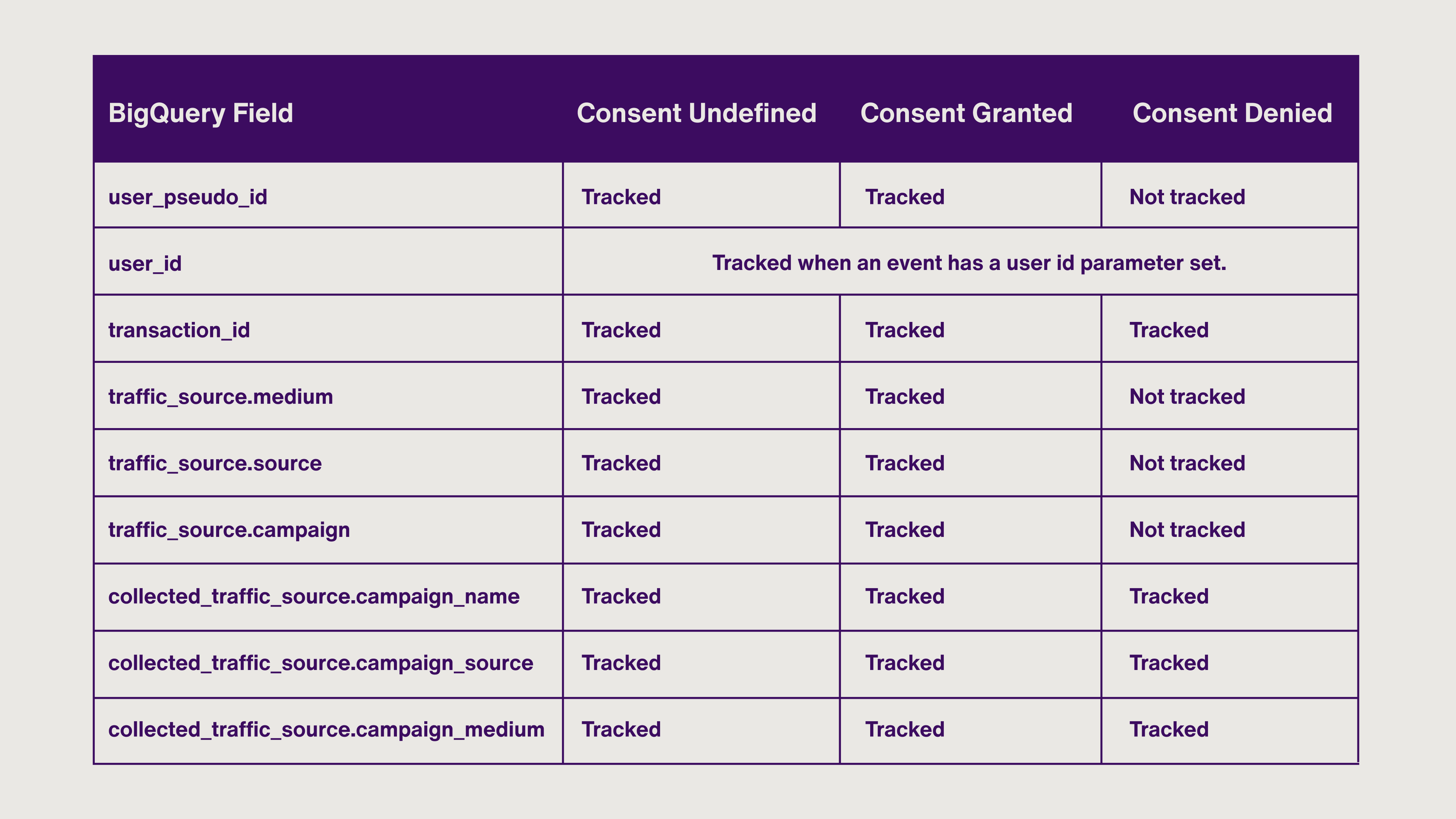
When using Advanced Mode in BigQuery, unconsented events are still tracked, but they lack certain parameters used to identify users. This becomes evident when attempting to calculate metrics like user count, because the absence of the _ga cookie in events means the user_pseudo_id value (used to help GA4 identify users and calculate user metrics) is missing, resulting in an underestimation of user count. While BigQuery captures all events, the exclusion of critical information affects the accuracy of reporting, particularly in metrics relying on unique identifiers.

This concern doesn’t apply if the user has authenticated and their user ID is sent to GA4. That data will be then sent to BigQuery.

In short, BigQuery retains all events, including unconsented ones. Unfortunately, missing information influences the reporting of metrics like user count, demanding a strategic approach in data analysis.

Based on experiments ran with a custom GTM container & custom GA4 tags

GA4: Model metrics beyond consent.

When using Advanced Mode in GA4, you may notice an initial drop in metrics because unconsented users and their events are not reported. However, the innovative aspect of Advanced Consent Mode lies in its ability to model data: over time, Google analyzes both consented and unconsented traffic, then builds estimations of the relevant metrics. While this modeling occurs programmatically and beyond our control, GA4 users are not restricted to reporting limitations. Metrics like user count, initially affected by unconsented data exclusion, become estimable through Google's modeling efforts.

GA4’s UI modeling will become active as soon as you implement Advanced Consent Mode. You don't necessarily need to use GTM for that; you can use any other tag manager or run it directly in your banner code

Tip: To see modeled data in your reports, choose the Blended reporting identity, under Admin > Data display > Reporting Identity > Blended, otherwise select Observed to view strictly consented data. You may switch back and forth between options without impacting data collection.

Strike the Right Balance.

Dedicate time to implementing Advanced Consent Mode to prevent complete data loss on unconsented hits. This mode provides a nuanced solution for those ready to navigate the intricacies of unconsented data tracking. Additionally, selecting a Cookie Management Platform (CMP) is essential for managing the cookie consent banner and directing the consent management process that is initiated when visitors arrive on your website and choose to allow or deny cookies. As global regulations evolve, it becomes crucial to have robust, privacy-centric measurement solutions accessible to marketers worldwide.

And finally, before you start Advanced Consent Mode implementation, get your legal team onboard and discuss any possible ramifications of collecting cookieless pings from users who declined tracking.

Unlock GA4 and BigQuery insights with our experts! Navigate consent mode complexities, explore basic and advanced approaches, and ensure privacy compliance. Google Analytics data privacy big data data analytics Data Analytics Data Data Privacy & Governance

A Comparative Analysis of Google Analytics 4 and Adobe Analytics

A Comparative Analysis of Google Analytics 4 and Adobe Analytics

Data Data, Data Analytics, Data maturity 3 min read
Profile picture for user Brianna Mersey

Written by
Brianna Mersey
Director of Data, NAMER

Google Analytics 4 and Adobe Analytics

In the dynamic landscape of data analytics, choosing the right platform is crucial for businesses seeking actionable insights. Two major players in this space, Google Analytics 4 (GA4) and Adobe Analytics, cater to distinct needs and come with their own set of features. In this article, I will compare the two based on their key differences, features, and use cases, along with ways you can identify which platform may be the best fit for your team’s needs and objectives.

Understand the fundamental differences in platforms.

One prominent distinction between each platform lies in their parent suites. GA4 is an integral part of the Google Marketing Platform (GMP) suite, focusing on advertising-driven analytics. On the other hand, Adobe Analytics is an essential component of the Adobe Experience Cloud, emphasizing the delivery of customized user experiences. This fundamental difference is reflected in their core objectives, features and functionalities.

Keep cost in mind.

One of the initial differentiators is the cost factor. GA4 offers a free entry-level product, making it accessible for businesses of all sizes. In contrast, Adobe Analytics typically starts at around $100,000, with costs influenced by features, server calls, and negotiations (ask for discounts!). The pricing structure is a crucial factor for businesses when deciding on the analytics platform that aligns with their budgetary constraints.

Be aware of differences in data collection and reporting.

Adobe Analytics excels in enterprise level data collection. Notably, it provides advanced segmentation options and robust custom reporting and tracking capabilities. Nevertheless, setting up Adobe Analytics demands a higher level of technical expertise.

In contrast, GA4 offers a more straightforward data collection process with minimal technical implementation complexities and less customization. Enhanced by machine learning and AI-powered insights, GA4 stands out for its web and app architecture and audience linking with the GMP platform. Additionally, GA4 proves adept at tracking cross-device user journeys and effectively measuring campaign ROI.

Consider ease of use.

Both Adobe Analytics and GA4 feature user-friendly interfaces, with GA4 being notably more accessible, particularly for non-technical users. GA4 boasts a straightforward and streamlined interface, enhancing ease of navigation and setup. This now includes a feature that lets you customize your home page. 

In contrast, Adobe Analytics presents a more intricate interface, which demands a greater level of technical knowledge and a steeper learning curve. I like the fact that Adobe Analytics’ menu button names can be changed in the Admin section, but I don't suggest changing the order of the buttons.

GA4 and Adobe Analytics

Strengths of Google Analytics 4

  1. Seamless Integration with GMP Stack: GA4 seamlessly integrates with the Google Marketing Platform stack, even at the free version level. This integration offers users a comprehensive view of channel performance, covering social, direct, organic, and paid media.

  2. Behavioural Insights from Chrome: GA4 leverages behavioural information collected from Chrome, including interests and demographic user data. This information, encompassing demographics and interests, proves valuable for building retargeting segments.

  3. Cost-Effective Entry with Free Products: Google Analytics 4 provides a cost-effective entry point with free products, making it an attractive option for businesses with budget constraints.

Strengths of Adobe Analytics

  1. Unparalleled Customization: Adobe Analytics stands out for its exceptional customization capabilities, empowering users to tailor analytics solutions according to their specific needs.

  2. Overcome Sampling Challenges: Unlike GA4, Adobe Analytics does not face data sampling issues. GA4 users seeking unsampled data must integrate with BigQuery, adding an extra step to the process.

  3. Advanced Segmentation Tool: Adobe Analytics boasts a more advanced segmentation tool, allowing users to create intricate segments with a broader array of operators

Which platform is right for you?

In conclusion, the choice between Google Analytics 4 and Adobe Analytics hinges on various factors, including the existing tech stack, business requirements, use cases and budget considerations. For ecommerce-centric businesses heavily reliant on paid media, simple report customizations, and looking to track apps, GA4 emerges as a strong option, despite some features being in beta and occasional bugs.

On the other hand, if you are an Adobe Experience Cloud customer, opting for Adobe Analytics ensures a seamless integration within the Adobe family, offering a customizable and robust implementation tailored to your unique needs, which may include collecting data from very diverse sources.

Ultimately, the decision rests on a thorough evaluation of your organization's priorities, goals, and resources, ensuring that the chosen analytics platform aligns perfectly with your business strategy.

If you’ve already invested time and energy into one product, stick it out and keep moving forward. Switching products won't solve the core issues, it just means more time and money.

Our Data.Monks provide insights on the fundamental differences between GA4 and Adobe Analytics and how both could help with your unique analytics needs. data analytics Google Analytics adobe analytics Data Data Analytics Data maturity

The EU Digital Markets Act (DMA): A Game-Changer for Digital Marketing

The EU Digital Markets Act (DMA): A Game-Changer for Digital Marketing

Data Data, Data privacy 4 min read
Profile picture for user Julien Coquet

Written by
Julien Coquet
Senior Director of Data & Analytics, EMEA

Digital Markets Act

In March 2024, a significant shift in the digital marketing landscape will occur with the implementation of the Digital Markets Act (DMA). This new legislation aims to regulate the digital market and protect user rights, marking a paradigm shift in how businesses engage with consumers. 

One key feature that will play a crucial role in ensuring compliance and maintaining effective marketing practices is Google's Consent Mode. In this blog post, I will explore—with insightful contributions from my colleagues Asli Yidiz, Deborah Widdick and Valentina Villino—the impact of the DMA on digital marketing and delve into the details of utilizing Google’s Consent Mode.

Understanding the DMA.

The Digital Markets Act is a legislative framework developed by the European Union to address the challenges posed by dominant online platforms—or, gatekeepers—and ensure fair competition in the digital market. It aims to regulate the behavior of tech giants, prevent unfair practices, and safeguard user rights. The DMA will introduce stricter rules for digital services, including requirements for transparency, interoperability and non-discriminatory access.

Specifically on consent for marketing, recital 37 of the DMA states that “When the gatekeeper requests consent, it should proactively present a user-friendly solution to the end user to provide, modify or withdraw consent in an explicit, clear and straightforward manner.” In other words, collecting user consent should now better inform how gatekeepers respect choices in collecting and processing user data and offering personalized online experiences.

The act’s impact on digital marketing. 

The DMA will have a profound impact on how businesses approach digital marketing strategies. One of the main areas of focus is users' privacy and acting with valid consent defined in GDPR. The act places a stronger emphasis on user consent and control over personal data, especially when it comes to personalizing online experiences based on user data and preferences. It requires businesses to obtain explicit consent from users for data processing activities, ensuring transparency and empowering individuals to make informed decisions about their data.

One can see the DMA as an extension of the GDPR, where the gatekeepers, also known as “the Big 6” (Google, Amazon, Apple, ByteDance, Meta, Microsoft), need to guarantee that they will provide the right options for consent collection and processing of personal data.

What does this mean for my advertising campaigns?

The DMA mandates that without appropriate measures, our capacity as marketers to retarget within advertising campaigns could be significantly restricted. Due to this regulation, each phase of our audience strategy funnel could suffer. The absence of retargeting lists implies:

  • Many customers, who use exclusion retargeting lists to avoid targeting already converted users, might end up wasting a portion of their budget.

     
  • The restricted segmentation options hinder our ability to deliver diverse personalized experiences. Consequently, marketing messages become generic, which results in decreased click-through rates and reduced engagement in ad campaigns.

     
  • The lack of retargeting lists also presents challenges for businesses aiming to identify cross-selling or upselling opportunities by analyzing purchase histories and customer interactions.

     
  • Without retargeting lists, leveraging similar audiences in social media, for instance, becomes infeasible.

Ultimately, this may impact the ROI we can achieve from our advertising campaigns, making it more challenging for marketing departments to demonstrate the value of their paid media campaigns in driving results for their business.

Given that our ability to retarget our audiences based on website activity signals will be affected, we need to consider how audience strategies should evolve in 2024 to ensure that we:

  • Continue to test methods to generate value for our businesses through paid media campaigns, despite the new limitations on existing audiences.

     
  • Actively plan for how to adapt reporting and establish new benchmarks that accommodate these regulatory changes.

The importance of Consent Mode in these times.

Google introduced Consent Mode as a privacy-friendly tool that enables businesses to adapt to the changing landscape of user consent requirements. This API provides a framework for obtaining and managing user consent across various Google advertising products, including Google Analytics 4, DV360, SA360 or CM360.

In a digital marketing ecosystem where brands use Google products for marketing performance measurement and advertising, the Consent Mode tool offers the following benefits:

  • Enhanced user experience: Consent Mode allows businesses to deliver personalized and relevant ads to users who have provided consent. This targeted approach enhances the user experience, ensuring that ads align with the user's consent, interests and preferences.

     
  • Improved compliance: Consent Mode enables businesses to meet the stringent requirements for user consent outlined in the DMA. By implementing this feature, businesses can ensure that their marketing practices are compliant with the legislation, avoiding potential penalties and reputational damage.

     
  • Optimal performance and measurement: With Consent Mode, businesses can optimize their ad campaigns and accurately measure their performance while respecting user consent preferences. It allows for the use of aggregated data that maintains the anonymity of individual users, striking a balance between effective marketing and privacy protection.

Preparing for the Digital Markets Act. 

To prepare for this significant shift in March 2024 and work towards compliance, businesses can take the following steps:

  • Familiarize yourself with the DMA: Gain a thorough understanding of the legislation's requirements, particularly regarding data privacy, user consent and fair competition. Stay updated on any changes or guidelines issued by regulatory bodies.

     
  • Implement Consent Mode: Integrate Google's Consent Mode into your digital marketing strategy. This will enable you to adapt to evolving user consent preferences, deliver personalized ads, and stay compliant with the DMA. This is best achieved with Google Tag Manager or the Google Tag (gtag.js).

     
  • Review and update privacy policies: Ensure your privacy policies are clear, transparent and aligned with the DMA's requirements. Provide detailed information on data processing activities, user rights, and how consent is obtained and managed.

     
  • Educate and train your team: Educate your marketing and advertising teams about the DMA and the importance of complying with the new regulations. Train them on the proper use of Consent Mode and how to navigate the changing landscape of user consent.

In short, the DMA represents a significant milestone in the regulation of the digital market. As businesses prepare for its implementation early next year, understanding the impact on digital marketing strategies is crucial. Ultimately, leveraging tools like Consent Mode can help brands adapt to the changing privacy landscape and build trust with their audience in the digital realm.

Download our whitepaper below to get a quick guide on navigating the new DMA legislation.

Prepare for new DMA regulations cover image

You’re one download away from learning

  • The impact of the Digital Marketers Act and how to prepare your teams now 
  • The importance of accurate modeling for campaign measurement 
  • The benefits of using Google's consent mode

This experience is best viewed on desktop

Download Now
In light of the new Digital Markets Act legislation, our Data.Monks argue Google's Consent Mode can help ensure compliance and maintain effective marketing practices. digital marketing Google Analytics data privacy Data Data privacy

Collect the Data You Need, Right Where You Need It

Collect the Data You Need, Right Where You Need It

Data Data, Data maturity 4 min read
Profile picture for user Julien Coquet

Written by
Julien Coquet
Senior Director of Data & Analytics, EMEA

Abstract square shapes in orange and blue tones.

So you went ahead and deployed your digital analytics solution with all the bells and whistles. Your data collection plan is exhaustive, privacy-friendly, sophisticated and will track more data points and attributes than you will ever use or need. Your data integrates seamlessly with your online marketing campaigns and you’re able to gain valuable insights, optimize and activate your data. No, is that not the case? Then get in touch and make sure to keep reading. 

In times of endless data, it is crucial to collect smarter.

As an analytics expert and practitioner, I know first-hand that collecting data across multiple digital assets and channels can be daunting. This is especially the case when the number of devices connected to the global internet exceeds 21 billion in 2023. Thankfully, our current Iinternet addressing system can handle a lot of these devices, namely up to 3.4×10E38 (that’s 34 followed by 37 zeroes). 

Out of these 21 billion devices, about 66% is made up of Internet of Things (IoT) devices, all of which generate data about their operation, features and settings. Call it connected black boxes or telemetry on steroids, but these devices are sending data home to service providers who use that data for product enhancement.

Such a scale of data collection provides not only the ideal fuel for AI and machine learning, but also the means to establish performance baselines and outliers. Feature usage models, insights and action plans can all be derived from such an unfathomable well of information.

(Re)introducing the Measurement Protocol.

How do these devices measure activity, you ask? This post is a perfect excuse to look at Google Analytics 4's Measurement Protocol as an alternative data collection method that can help you measure all the IoT data you need—and make it compatible with the flat data model you have come to adopt and love. The Measurement Protocol was introduced in the early 2010s with the former version of Google Analytics, the now sunsetted Universal Analytics. Back in the day, the Measurement Protocol was used in very creative ways, so seeing it reborn for GA4 is a great opportunity to (re)discover this lesser-known yet powerful feature in Google Analytics.

In essence, the Measurement Protocol is an API that allows you to send events directly to Google Analytics servers, bypassing the need for bulky software development kits and complex integrations. The minimal software footprint of the Measurement Protocol means it is easily embeddable in every system that can call a URL. As you can imagine, this can be used for all IoT—everything from kiosks to points of sales to IoT devices. Some clear advantages include:

  • Standard protocol, so it is compatible with a wide range of devices and platforms
  • Easy to use, even for developers with limited experience
  • Scalable, so it can be used to collect data from large numbers of users
  • Security, through the use of data collection secret keys

Because of its lightweight approach, using the Measurement Protocol means you can collect just the data you need. The lack of an explicit user consent mechanism on most IoT devices will encourage you to adopt a privacy-first approach, so focus on telemetry and not on personal data. 

Uncovering the Measurement Protocol’s inner workings.

How does it all work? Well, when creating a Google Analytics 4 (GA4) property for your IoT project, you first need to create a new web property and then simply click on this newly created data stream to access the Measurement Protocol API secrets panel.


Data streams in GA4 measurement protocol

The next step is to create a key, which you will reference in your Measurement Protocol API calls. All you need to do is provide a nickname for your key and you can use the provided ID in your API calls. As you can see from the list below, our Data.Monks use it quite a lot!

Measurement protocol API secrets

Once your keys are set up, make note of your GA4 Measurement ID for your IoT stream and use code to create a URL to the Measurement Protocol service that combines everything we need, including event parameters. In the example below, our connected fridge will send an event when the fridge door is open.

The desired URL should look like this:

https://www.google-analytics.com/mp/collect?measurement_id={your ID}&api_secret={your key}

Now we need to send the above URL as a POST request, with a JSON payload containing the event parameters we want to send along. Keep in mind that, because this is not like a GA4 event sent from a browser or a mobile app, there is no automatic detection and collection of extra elements, as with GA4’s enhanced measurement. In fact, the Measurement Protocol only measures what you send it. From there, post the request in your favorite programming language—Python, in my case.

Sure enough, the event registers in the GA4 real-time interface and subsequent hits will become part of your GA4 reports—and live on to BigQuery if you’ve linked your property to Google Cloud Platform.

And of course, as I’m sure you can already guess, creating dashboards on your devices’ activity is a breeze in Google Looker Studio. That’s all there is to it!

Time to try out the Measurement Protocol yourself.

We have seen that the Measurement Protocol, like other event-level data collection platforms, uses an API-friendly format to send data out to Google Analytics. From a technical standpoint, this is a very easy and efficient implementation, so feel free to get creative for all your IoT projects.

We’ve discussed using the Measurement Protocol primarily for IoT devices (or any device that isn’t a computer, mobile phone or gaming console). Bearing that in mind, you can also use it as a data exchange method in a cloud environment as an API callback after a process completes. This means the Measurement Protocol works great with Cloud Functions or messaging queues like Google Pub/Sub or Kafka.

Finally, circling back to the remark I made about AI, this kind of measurement is indeed an ideal way to collect fuel for an AI/ML model, but AI can also be used to trigger the right event at the right time, and with the right data payload. At this point, AI can improvise and improve on your intended data collection plan, start sending events outside of the scope of its original program, and unlock even more insights. Coupled with Google Cloud Platform’s Cloud ML, the results may surprise you! 

In short, here are your key takeaways about the Measurement Protocol:

  • Simple mechanism: any system that can generate a URL can use it
  • Encourages concise, compact, privacy-friendly data collection
  • Can be used on anything, about anything
  • Leverages the power of the Google Analytics 4 flat data model
  • Small software footprint: very limited resource consumption
  • Complements an AI strategy and unlocks new opportunities
Our Data.Monks recommend Google Analytics 4's Measurement Protocol as an alternative data collection method to measure all the IoT data you need. data analytics Google Analytics AI Data Data maturity
`

Data

Data Analytics

Unlock audience insights and boost growth with data analytics.

Business people discussing data
A line graph spiking and falling on a laptop

Take your web and app analytics practice to the next level with our Google Analytics expertise.

Gain access to our Google Analytics experts to help you deliver on mission-critical analytics projects, improve tracking efficiencies, get actionable insights and hit growth targets. Our offering is rooted in helping clients maintain an innovative, competitive and privacy-centric approach to their data analytics implementation. As technology and consumer mindset continue to evolve, we’ve got your back by building durable, scalable solutions that apply advanced data analytics to drive top-line and bottom-line impact.

Data Analytics at Scale

Football players go up for the ball
Girls playing field hockey
A baseball player throws a pitch to a batter

Case Study

Data Analytics at Scale •By deploying Google Analytics and Tag Manager across 1,400 of SIDEARM sports partner sites, our automated approach provided quality data in record time.

See Full Case Study

How can we help you innovate? Get in touch.

Heyđź‘‹

Please fill out the following quick questions so our team can get in touch with you.

Geomarketing: What It Is and When You Should Use It

Geomarketing: What It Is and When You Should Use It

Data Data, Data maturity, Media 4 min read
Profile picture for user gabriel.ribeiro

Written by
Gabriel Ribeiro
Marketing Head

People using tablets and smartphones

The first step to relocating, opening a new store or planning how to stand out in a particular region is to first study where the best location for your business actually is. Once you’ve settled on where to go, the next step is to focus on attracting the attention of the public. This is where geomarketing comes in, an essential form of marketing that can help a company attract leads and increase conversions.

What is geomarketing?

Geomarketing is a technique that uses location data to optimize campaigns, helping you engage with customers at the right place and time. Geomarketing can be used for both online and offline touchpoints, making it a versatile part of your toolkit. It can take several forms: a set of information that helps you with decision-making, an analytical approach to building campaigns, or a strategic channel that helps you gather demographic data. It can even be a combination of these tools.

Why do brands use geomarketing?

Demographic surveys have long been used by brands to learn more about existing and prospective customers, and historically geomarketing has been used to help retailers choose the right region to open a physical store based on that data. Now, geomarketing is continuing to evolve along with demand for services within specific geographic areas. For example, an estimated 97.1% of users in Brazil access the internet via smartphones—and with so many customers always on the move, the need for geographically relevant messages and services has increased. There are three main advantages of geomarketing:

Audience segmentation. Geomarketing is a great way to segment your audience. This way, your campaigns can extract greater results from specific locations. Use this data to drive better placement in local searches, like “pharmacies in Rio de Janeiro.”

Increased ROI. Without a geomarketing strategy, it’s possible that your campaigns will reach people located far away—who might have no use for your services. For example, that pharmacy in Rio de Janeiro won’t want to advertise to people several cities away. By employing geomarketing, brands have the power to choose exactly where their campaigns run, meaning they’ll spend less for more effective results.

More qualified leads and higher conversion. The previous point shows how targeting more specific, engaged audiences is more cost-efficient. But it can also earn you more leads, because you’ll be reaching an audience likely to have a greater interest in your product or service—especially when taking other data, like purchasing behavior or interactions on social media, into account.

If you own an ice cream parlor in BrasĂ­lia, for example, and you're on a tight marketing budget, geomarketing will help you to get leads who are in BrasĂ­lia, close to the neighborhood and interested in ice cream. This way, you'll get more conversions at a much lower cost than advertising to the whole city, or to all of BrasĂ­lia, the state.

Here’s how to use geolocation marketing in your business.

Once you understand the concept of geolocation marketing and how important it is, you can use one of many pieces of software available to manage data and optimize your geomarketing efforts, like Google Analytics or Meta Ads. Here are three tactics to get the most out of geomarketing.

Geotargeting. Geotargeting is a way of showing users content based on their location. With a database that maps IP addresses onto specific locations, you can target by country, state or even ZIP code depending on your platform of choice.

Geofencing. Geofencing is the use of technologies such as the Global Positioning System or radio frequency identification to create a virtual geofence. In other words, it involves collecting location data from electronic devices in order to take action based on it. You can use geofencing to deliver real-time content to your customers based on their GPS data. Note that geofencing requires the use of a branded application that your audience has already downloaded and authorized to track location data.

Another way to serve content to customers is by leveraging third-party platforms like Waze, a collaborative traffic and navigation app. By using Waze Ads, your content can be shown to drivers within a certain vicinity.

Geotagging and check-in. Another interesting geomarketing tactic is the strategic use of the check-in feature. For example, if you create a Facebook and Instagram page that includes your business address, both apps will allow customers to check in. Marking the location helps others easily find the profile of the business, along with other useful info.

Geotagging is similar, in which users tag the business location to a photo or other piece of content when sharing it to social media. Again, this helps people discover the business and generates publicity for the brand. Because people tend to be influenced by their peers, this can be a great factor in analyzing consumer behavior.

You can leverage geomarketing alongside other marketing strategies, too.

Geomarketing becomes even more useful when tied to other marketing strategies. Having access to customers' location is a great way to build efficiency across your brand’s actions. You can analyze market competition in your region of choice as well as the behavior of your target audience.

Geomarketing involves large volumes of information, and you can use that additional info to optimize your processes and improve business strategies overall—like directing investments to regions with the greatest potential for conversion, or identifying areas with high demand for your products or services.  

Geomarketing truly shines when you look for quality information that can provide insights into consumption patterns or other data obtained through studies, thus improving your geomarketing performance. For example, you can look into public databases of sociodemographic data. My team in Brazil uses IBGE, PNAD and Ipea.

With that, you should be ready to begin supporting geomarketing. For my team, geographical diversity is a big part of what we do, and leveraging insight into the interest and behaviors across different regions, cities and places is a fascinating way to deliver content to build your business. By using the strategies above, you’re well on your way to meeting the diverse needs of your own customers.

Learn how to leverage insight into the interest and behaviors across different regions, cities and places with geomarketing. data analytics Google Analytics data consumer insights Data Media Data maturity

Choose your language

Choose your language

The website has been translated to English with the help of Humans and AI

Dismiss