
Choose your language

Choose your language

The website has been translated to English with the help of Humans and AI

Dismiss

Systems Modernization • Modernizing Mindset, Methods and Operations

  • Client

    First American

  • Solutions

    Technology ServicesTechnology ConsultingDigital Product DeliveryFull Stack TeamsTechnology Training & Coaching

Results

  • 14 different IT systems rationalized to one new platform
  • 200+ pain points eliminated
  • 1.2M working hours saved in offices
  • 90% fewer employees lost to workload attrition
  • 45% of workload offloaded from offices to new tooling
First American software running on a laptop

A long-term partner devoted to speed, efficiency and scale.

Our partnership with First American, a global provider of title insurance and settlement services, is punctuated by numerous projects focused on digital transformation and overhauling legacy systems, all designed to ensure First American’s employees connect with each other and their customers more efficiently. These initiatives have not only helped the business save millions but have also unified teams and core systems while adapting to global challenges.

A mosaic of First American application screens

Overhauling legacy systems to boost efficiencies.

A key focus of our partnership with First American is modernizing systems. For instance, the brand had an urgent need to overhaul outdated systems at the core of their business: managing sensitive documents and processing billions of dollars in transactions. We built a platform to automate deal flow, reduce manual data input, and securely manage user access rights—consolidating five disparate systems into one scalable platform that improved employee training times, customer retention, and order volume. This led to increased revenue and bolstered First American’s reputation as a technology and customer experience leader.

Speeding up collaboration and connection across teams.

Often, these digital transformation efforts help unify key roles throughout the business. When First American needed to unify digital file management across departments, replacing obsolete technology and reducing cost from multi system inefficiencies in the process, we built a shared library of components, ensuring rapid product delivery while implementing a technology strategy to allow for IT innovation. This new system set First American up to save millions annually and helped align senior executives across the organization.

First American software running on a laptop

Improving the employee and customer experience in one swoop.

Helping First American teams work and collaborate ultimately helps the business connect with its customers. When First American wanted to upgrade their marketplace experience, we developed and prototyped products to reimagine how employees and customers worked together, which formed the basis for a production system we built over the subsequent 13 months. These efforts provided the corporate IT group with more effective product development capability.

First American email from from user interface to conversion

Unlocking a global workforce.

First American realized the cost-benefits of leveraging an international workforce but was struggling to adapt to global challenges. We designed a next-generation platform that simplified areas of employee turnover, training, domain expertise, and technological efficiency, which empowered First American to claim these cost benefits by profiting off increased output from international teams. This, along with other engagements above, showcase how our strong partnership with First American has successfully driven numerous efficiencies and growth for the brand.

  • A person using the First American platform on a laptop
  • Mobile app of the First American platform
  • A person using the First American platform on a iPad

In partnership with

  • First American
Client Words We have tried [reinventing the marketplace experience] before and failed. We could not have done this without you.
First American Logo

C-Level Executive Stakeholder

First American

Overhauling legacy systems.

First American needed to unify digital file management across departments to replace obsolete technology and reduce cost from multi-system inefficiencies. We built a shared library of components ensuring rapid product delivery while implementing a technology strategy to allow for IT innovation. This new system set First American up to save millions annually and helped align senior executives across the organization.

Want to talk tech? Get in touch.

Hey 👋

Please fill out the following quick questions so our team can get in touch with you.

Can’t get enough? Here is some related work for you!

How to Integrate Firebase With GA4 Without Losing Valuable Data

How to Integrate Firebase With GA4 Without Losing Valuable Data

Consumer Insights & Activation Consumer Insights & Activation, Data, Data Analytics, Data maturity, Data privacy, Measurement 4 min read
Profile picture for user Zin.Hlaing

Written by
Zin Ko Hlaing
Senior Data Specialist

header image

Chances are you’re familiar with Firebase, the mobile and web application development platform. It provides developers with a vast array of tools and services to create top-tier applications, and on top of that, it offers full integration with Google Analytics 4, the latest iteration of Google’s analytics platform. This powerful combination enables you to unlock insights about user journeys across web and app platforms. That is, as long as you’re well aware of the collection limits and adequately link both properties.

Working as a Senior Data Specialist, I’ve come across a series of common mistakes that prevent enterprises from leveraging this tool to its full potential—and consequently, accessing the true value of their data. During a series of panels at Melbourne MeasureCamp, I was lucky enough to host a session on these observations and some recommendations so that brands can bank on actionable insights into user behavior and application performance. If you missed it, continue reading for the main takeaways.

Learning #1: Only one Firebase project can be linked to one GA4 property.

An important thing to consider when it comes to integrating Firebase with GA4 is that only one Firebase project can be linked to one GA4 property. This means that if there are multiple Firebase projects, it’s necessary to transfer all applications—regardless of operating systems or development cycles—into one project and link it to the main GA4 property. 

This requires careful planning and a deep understanding of how Firebase projects are set up.  Keep in mind the potential technical challenges and limitations in migrating apps from one project to another. For example, certain app developers may have their own preferences in terms of project setups, so you need to talk to your development team and understand what that looks like. 

Also, be aware of dependencies such as Crashlytics or BigQuery exports setup when moving apps from one project to another. Each Firebase project can have multiple stack integrations, and we should be ready to reconfigure all of them. Make sure you have historical data and map out timelines for these app migrations.

graphic that illustrates how to properly integrate Firebase with other properties

Learning #2: Standard naming unlocks customer insights. 

The main reason why you’d want to integrate Firebase with GA4 is that it provides valuable insights about user journeys across web and app platforms. However, the only way to unlock those insights is by ensuring standard naming conventions for web and app events. 

First, you’ll need to create a Google Sheet or an Excel spreadsheet to standardize the naming of events and parameters. Here’s an example:

chart explaining how to standardize the naming of events and parameters

As you can see, we recommend having standardized event names and parameters across web and app platforms in GA4. It may seem simple, but it's not uncommon for organizations to use different conventions on different platforms, making it harder to cross-reference the data.  

Other tips to make the process easier include:

  • If you have a website, but no app implementation yet, rely on your web and GA4 Recommended Events to name the event and implement these for the app.
  • If you already have an app implemented with Firebase, use the mapping sheet to understand which events from the app can be mapped to web. It is easier to rename web events with GTM than doing so for the app.
  • Align with both web and app development teams for naming conventions. For example, using camelcase (e.g. SignUp) vs snake case (sign_up)

Learning #3: Be Aware of Data Collection Limits.

When you use Firebase to collect data from your apps, it’s important to be mindful of the data collection and configuration limits. Firebase Analytics does not log events, event parameters, and user properties that exceed certain limits—which means that the platform will drop the events and stop tracking valuable data even if you exceed the limit by a few characters. 

In my experience, this mistake is especially common among developers who implement the Firebase SDK without really knowing about the limits. These are some of the main caveats and my respective recommendations for them:

  • Event parameters limits: 25 parameters per event may seem a lot, but it may add up if you’re sending ecommerce events. GA4 and Firebase will drop the events and event parameters if you exceed this limit.
  • Be careful not to go over the maximum length of the event parameter value, which currently stands at 100 characters. Be aware of user-generated values (e.g. listing name in marketplaces)
  • Remember that Firebase does not accept array type parameters.
  • When setting up BigQuery export for GA4 (with both app and web streams), check the usage in advance so that you don’t get shocked with the cost for the storage and querying the data. Pro tip: Set up daily aggregated tables for important metrics instead of querying directly from raw export tables.

In conclusion, it is essential to be aware of limitations around linking Firebase projects with GA4 property and plan ahead for your migration. Create a mapping sheet to map the events across the website and apps and standardize app and web events naming. Take note of Firebase data collection limits and make sure you are not going over the limits and risk losing your data. Finally, learn how to debug apps using Firebase Debug Mode, a bonus tip that can save you time and headaches.

Learn how to fully integrate Firebase with Google Analytics 4, and begin unlocking insights about user journeys across web and app platforms. Google Analytics Google data and analytics platforms Data Measurement Data Analytics Consumer Insights & Activation Data maturity Data privacy

How to Curb the Content Deluge on Enterprise Platforms

How to Curb the Content Deluge on Enterprise Platforms

AI AI, AI Consulting, Platform 4 min read
Profile picture for user mediamonks

Written by
Monks

A bunch of colorful dots swirling together

When it comes to a corporate website, quality over quantity can make a big difference to the user experience. Sure, an enterprise will have an excess of content across its various products and sub brands, each designed with different audience personas in mind. But for users—or even development teams preparing for a platform refresh—sifting through all of that content can be daunting.

Organizing content in a way that is easily navigable and actionable is crucial in developing a strong user journey—even more so for a corporate platform that exists to inform. “When it comes to companies that have so much existing content and information, how do you organize that massive number of things to say—and make it personalized and easy to find?” asks Group Creative Director Niels Dortland. The challenge lies not in representing the breadth of information available, but rather pushing users to the right content to act or purchase.


From microsites to enterprise platforms, our platforms team has worked with a wide variety of brands to implement new content management systems, design personalized journeys, and improve accessibility—and finding the right way to surface up key bits of content out of a massive library is key to each of those efforts. Here’s a look inside how the team did just that for Jacobs, an engineering company whose portfolio touches design, construction, consulting and maintenance across a wide range of industries around the world.

Overcome the homepage turf war.

What causes the content overload that is so common on corporate websites? “Everyone wants to say everything, so everything is on the menu,” says Fernanda González, Group Experience Director. That might be a welcome sight at an all-you-can-eat restaurant, but not so much when searching a website for information you need.

The maximalist approach is often the result of intra-political clashes between different business units. A company is a bundle of different teams with different goals and responsibilities, and it’s a reasonable expectation that each should be equally represented on the website. But the primary focus should be on understanding the different types of users who will visit the website and how to account for their needs. 

“What will get people to move forward, and how do we mix those things together into a good user experiences?” González asks, reasserting a user-led approach to content management. Our team’s solution: deliver dynamic content based on each individual’s needs, meaning no one is scrounging for homepage real estate.

Monk Thoughts We offer functionalities that don’t compete with one another and service different users.
Fernanda Gonzalez headshot

Tap into off-the-shelf solutions to make content easily searchable.

One way to move past messy menus and overwhelming content feeds is to put search front and center, helping visitors access the content they need in just a few keystrokes and clicks. For Jacobs, we implemented an AI-powered search engine that greets visitors by asking what they’re looking for. The sophisticated language model lets users answer in plain English, rather than strings of SEO-ified keywords.

The model also made search far easier to implement than a traditional engine, as natural language processing bypassed the need to index and structure data across Jacobs’ existing content—a lengthy and meticulous process that can stretch development cycles across months. “Many other search engines on websites like this need to be very structured with keywords,” says González. “Instead of that, we implemented a smart one that learns to search for content as quick as possible.”

The team further sped up development by choosing an existing search solution, rather than build one from scratch. “Taking tech off the shelf is smarter for brands because it’s faster,” says Dortland, compared to the work of big consultancy firms who easily get tied up in assessments, planning and processes instead of execution. This resourceful method of spinning up solutions means we can make a difference to the user experience now versus a year down the line.

Not only that, off-the-shelf tools are also backed by dedicated development teams and robust documentation should the need for troubleshooting arise. And that’s just the beginning, because as users browse and search around, the platform becomes more aware of their needs, employing a feedback loop to help enhance the user experience with speedier, more accurate results.

Take a cue from social media to make content actionable.

Easily finding content is one thing, but what should users do with it once they’ve landed? “We realized that people want to save content, so we activated that in the user journey,” says González. As users browse content, they can save it to their favorites board—a lot like saving creative inspiration on Pinterest. 

“You can shape boards around different topics of interest, and this lets you use the website more as a utility to gather information,” González adds. In addition to letting users build their own boards, the platform also curates topic-specific boards that pull content from both the CMS and social platforms like LinkedIn that are always changing and always relevant to provide a unique experience for every user.

Put accessibility at users’ fingertips.

A social-inspired interface is one way to make content easily accessible to users. But platforms should also comply with Web Content Accessibility Guidelines (WCAG), which a legal requirement in many parts of the world. Accessibility works best when it plays a key role in the design of an interface—not as an afterthought—and we went beyond Level AA compliance for Jacobs by also implementing a configurator that lets each user create the optimal viewing experience for themselves.  

Options include a reading mask—which creates a focus area on the screen that follows the user’s cursor, blocking out distractions—and the ability to turn off animations and motion graphics. The result is a platform that’s not only personalized in the sense that content conforms to a user’s interest; the interface itself adjusts to their needs. Both result in a more intuitive journey across the entire Jacobs brand story.

Keep up with solutions as technology evolves.

Building a state-of-the-art platform doesn’t mean spending years reinventing the wheel. Nor does trudging through a library of legacy content to make it easy for modern visitors to search and navigate. Rather, tapping into existing, modern tech solutions can help overcome hurdles that hamper the user experience—and do it fast.

Monk Thoughts We need to be knowledgeable about where a brand is at in their digital maturity, what are the tools they are using, and what existing technology we can play with to make the experience better.
Fernanda Gonzalez headshot

As new technologies emerge—hello, generative AI—platforms and user journeys will continue to evolve, underscoring the importance of a partner who can identify the shortest path to success among them. Remember: platforms are always evolving, meaning there’s never a shortage of options to streamline user journeys and make content more accessible.

Learn how our platforms team builds customized solutions to design intuitive, personalized journeys and improve accessibility based on our work with Jacobs. content platform platforms UI design content personalization Platform AI Consulting AI

How to Fuel Connection Through Custom, Flexible Web Experiences

How to Fuel Connection Through Custom, Flexible Web Experiences

Brand Brand, Brand Identity & Systems, Monks news, Platform, Websites & Platforms 4 min read
Profile picture for user mediamonks

Written by
Monks

Two hands trying to touch

When it comes to flagship brand websites, it’s important to keep content current and relevant to key marketing moments. Whether adding a desired “wow” factor or signifying a key moment for the brand, custom web experiences can differentiate a platform, a brand or its content—yet many content management systems (CMS) are rigid and difficult to adapt, resulting in experiences that can feel dull even when you have the resources to keep fresh content flowing.

This was key to the design of our website, particularly our homepage, which emulates the look and feel of a newspaper. The format calls for experiences that feel new and contemporary on a regular basis, compounded by the accelerated pace in which our industry changes. Now one year since the launch of our brand, we’re looking at how our approach to content curation has panned out, solving key challenges that many brands face when it comes to delivering distinct digital experiences or breathing new life into their legacy content.

Set a foundation for flexibility at scale.

“Our homepage was designed to mark special moments in time, like a turning point for the company or when something is trending industry-wide that we have a strong point of view on,” says Vinicius Araujo, Creative Director. One recent moment was the release of The Transformation of Digital, our report detailing how consumer behaviors are shaping a new era of virtualization. To celebrate the launch of the report, our homepage took a new look: a unique color scheme, a curation of thematic content and an animated logo that represents the report’s visual identity.

Such an overhaul to the homepage may seem like a significant investment of time and resources, though the flexibility baked into our CMS made it a simple overnight change. Easy-to-update components and customizable fields also ensure that bespoke designs are scalable into the future. “It’s always ready to be updated in a heartbeat,” says Araujo. “And it’s ephemeral: it’s only there for a week, and then it’s gone.”

Monk Thoughts Our system is easy to use, but it’s balanced very well with our identity and ongoing marketing strategy. When design isn’t built to complement marketing activities, websites can become stale and flatline.
Brad Gardner headshot

On the flipside, the flexibility baked into our website keeps our content timely while ensuring we can authentically represent the breadth of our capabilities. At the same time, brands following a similar approach can iterate experiences that support the different needs of diverse audiences. “In curating the content for the virtualization takeover, one thing we considered was: How do we get someone who doesn’t want to digest the whole report to understand what this is?” noted Gardner, who gathered a wide selection of content that make virtualization tangible while also representing the diverse skills of our team.

Collaboration enables new ways to shape and expand content.

With our homepage takeover, it was important to build an experience that felt distinct right from the jump—not exactly separate from the other content on the website, but something that commanded attention as soon as people landed on the website.

Monk Thoughts The homepage has the shock factor when you enter. The first impression is completely new and different from our typical content, and past that moment everything else feels more familiar. We don't want people to have to relearn how to read our dotcom, so it has to be a measured shock.
Vinicius Araujo headshot

The first thing viewers saw when loading the page was a reanimated Media.Monks logo that leverages the bespoke identity crafted for the report—all built around a design language of four quadrilateral shapes that represented key themes of the virtualization report: ownership, identity, community and experience. These adapting shapes interact with each other at different frequencies throughout the report, keeping the audience focused on the insights. “It was important to create a wrapper that wouldn’t alienate the audience,” says Benjamin Tuffy, Design Director, noting that using iconography like VR headsets or futuristic environments could either limit virtualization’s scope, overwhelm non-technical readers or simply feel irrelevant for those who aren’t engaged in those channels.

But the shapes are just one kind of graphical element that made their way from the report to the homepage design. In discussing the role that bespoke experiences can play in enhancing the original source material, Tuffy spoke about a collaborative approach between design, copy and growth teams to pull the content into previously unforeseen directions.

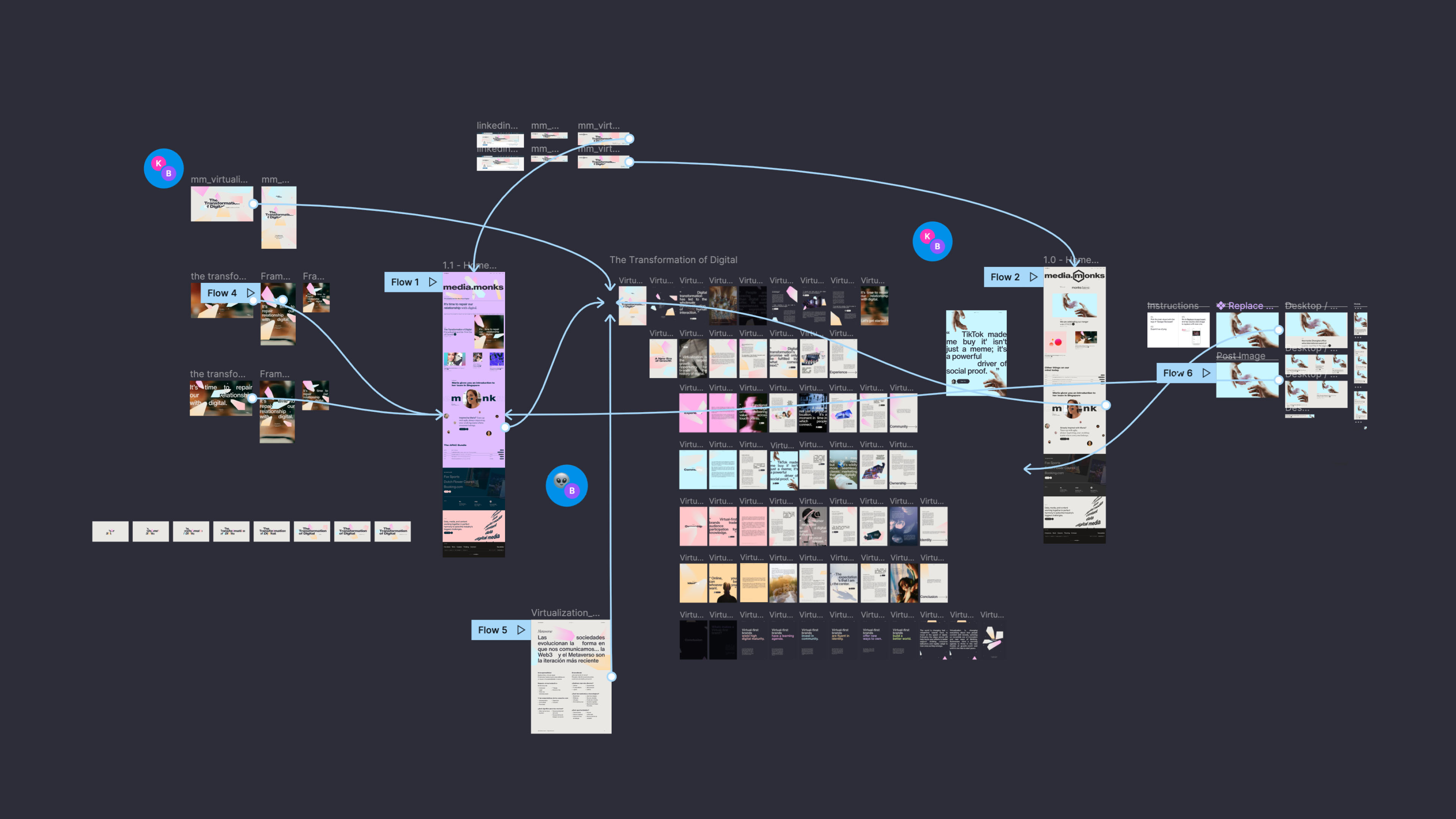
Figma mockup showing the connection between our report and custom web experience

Figma mockup showing the connection between our report and custom web experience throughout the design process.

Monk Thoughts The bit I enjoyed most from the experience was finding key hooks in the language of the report that we could use to visually pull people in. The result is a series of spreads that put us on the hook for the statements we’re making.
Benjamin Tuffy headshot

Curation breathes new life into legacy content.

In addition to finding new ways to visually represent content from the report, our virtualization-themed homepage takeover also provided an opportunity to highlight ways that virtualization impacts different categories and audiences. “Leaders across different regions are bringing the story out to their teams,” says Tuffy, and viewers could see this play out through the content we curated to substantiate the report’s claims.

This highlights another purpose to building around key marketing moments: breathing new life into some of your existing content. In our case, this meant further drawing lines and connections between our multidisciplinary team. “We saw we had some content from Jam3 and a recently published piece by Chief Diversity Officer James Nicholas Kinney, both of which spoke to the purpose of virtualization from two different directions,” says Gardner, noting that the content helped showcase how we’ve been grappling with these ideas long before the report’s release.

Our special-edition homepage sought to leverage our CMS’s flexibility to deliver custom web experiences as new moments arise. Brands seeking to build bespoke, scalable web experiences can follow a similar approach by thematically curating and remixing new or legacy content, while also enhancing it further through added fit-for-format design elements. The result? A differentiated digital experience that never overstays its welcome and dazzles audiences with something new every time they visit.

We spotlight our approach to content curation, solving key challenges that brands face when it comes to delivering distinct digital experiences, and breathing new life into legacy content. content marketing strategy digital marketing digital platforms platforms digital experiences Platform Websites & Platforms Brand Brand Identity & Systems Monks news

Distinguish Your Brand in the Immersive Web

Distinguish Your Brand in the Immersive Web

4 min read
Profile picture for user Zoe Anderson

Written by
Zoe Anderson
Client Partnerships Director, Jam3

An immersive website for T.I's new album

I played witness to brands’ torrid relationships with websites throughout my time at Superhero Cheesecake—a boutique digital creative studio founded in the Netherlands with the aim of building premium work for the web—which integrated into Media.Monks earlier this year after merging back in 2016. It's been amazing to see how the indie feel that made Superhero Cheesecake so attractive hasn't been lost in meeting the ever-growing demand for amazing web platforms.

Right now, a need to differentiate and capture first-party data is revitalizing the potential of the web experience. In my new role with the Jam3 team, we focus on combining insight, creativity and technology to align with culture and connect with people. Because websites have become the primary sales support and source of information for audiences once again, they must also pull their weight in building deeper connections with audiences. Yet many designers and development teams are focused on ticking every best practice off the list, resulting in websites that end up looking and feeling the same, lacking the unique spark needed to make an indelible impression with audiences. 

We need to raise the standards and expectations on what a website can achieve—so I say rip up the rulebook and trade best practices for bespoke, premium solutions that forge deeper connections with audiences and immerse them within the world of the brand.

Set Your Brand in Motion—Literally

There’s a saying we like to use: the interface is the brand. It means every experience across the digital ecosystem becomes a direct reflection of its core products and services. So when we set out to build an immersive web experience, we begin by examining the essence of the brand and how to communicate that through a series of moments. What is the emotion we want to trigger with visitors? Building a uniquely differentiated platform starts with defining what you want audiences to feel at every step.

This is where conventional wisdom to stick to standard best practices falls flat. Limiting your website interface to static text and images does little to bring brand moments to life. Interactive elements in particular—think real-time rendering and explorable 3D product models, or even full games themselves—enable user journeys that feel premium and personalized, but even little touches in motion design go far beyond user expectation.

Form Meets Function

Elements like those described above aren’t just for looking good; they can also help translate abstract concepts into tangible, memorable experiences. Product demonstrations are a great example of this. With 3D interactive models, you can break apart a product to explain its various pieces, like an exploded-view diagram.

A 3D animated Lucid Motors car

Above: An animation that highlighted the key features we needed to communicate to the consumer as part of our work with Lucid Motors

This was our approach to building a strong online identity for Lucid Motors, creators of the most luxurious electric cars on the market. We built the user journey around motion visuals and CGI assets that were animated to perfectly highlight key features of the automaker’s technology, including components of the chassis and the battery pack that powers it all.

The scalable platform is also lightning fast. This is an important consideration that can’t be overlooked: when you have resource-intensive, motion-heavy assets and animation, your team must ensure the experience doesn’t slow down and freeze up—especially for those on mobile devices. What’s the highest performance, most flexible way of representing the brand? This is a critical question but one that most production studios skimp out on, sacrificing performance for flashy visuals. But the fluidity of moving through a platform contributes just as much, if not more, to the experience than visual fidelity alone.

Building Effective Experiences

With the rise of the immersive web, much of the work that was once restricted to microsites has made its way onto brand platforms and commerce. Which means truly standing out requires a totally different set of skills than many teams may be accustomed to. Realizing the market need for experiences built upon a foundation of data-driven and strategic insights, we’re scaling up our own capabilities within the Media.Monks team to defy convention and create work that breaks new ground.

What we do is highly specialist—and that can make it tough to find the finest talent in-house to support brands’ growing ambitions. To combat this lack of talent, we recently launched a six-months paid immersive web traineeship to cultivate a pool of specialist creative web developers who have instilled our values and pursuit of perfection from the start.

This means tackling historic challenges like measuring the value of touchpoints like microsites. In the early aughts (when the microsite was king), they lacked the analytics to understand if their million-dollar investments were worth it. The present-day focus on conveying the feeling of a brand may not be as concrete as selling X amount of product, but it’s no longer immeasurable.

The ultimate goal is to forge a connection and relationship with audiences. While today’s immersive web thrives from CMOs willing to take creative risks to build something special, there’s opportunity to bridge together creative UX design, strategy and analytics to eliminate risk and enhance the brand—even without relying on best practices that have sucked the feeling out of the everyday digital experience.

With Wajer Yachts, for example, we used the website to transport visitors to the exact moment of casting off with a yacht in a single click. 360-degree product views and gorgeous imagery of the yachts’ interiors offered a vivid experience and a sensation of ownership. But it didn’t just look good: time spent on the website increased by 250% after launch and generated qualified leads increased by 450%, demonstrating the value of bespoke branded experiences.

The internet in its current form is closing to its end. A new era of immersive, personalized experiences is emerging, as evidenced in recent discussion around the metaverse. As brands aim to build relationships with consumers through bespoke touchpoints, the role of web experiences—enhanced by immersive web technology—has elevated to become an essential space to differentiate the brand and translate it into compelling experiences.

Our immersive web team outlines solutions that forge deeper connections with audiences and immerse them within the world of the brand. immersive brand virtualization platforms data-driven marketing

This Black Friday, Keep the Momentum Going With Data-Driven Marketing

This Black Friday, Keep the Momentum Going With Data-Driven Marketing

4 min read
Profile picture for user mediamonks

Written by
Monks

Title font with cursive and block letters

No matter where you are in the world, business cycles are determined by key dates and seasonalities that delineate brands’ marketing strategies. For those well-versed in ecommerce, every day brings new opportunities to engage with consumers, but these are never in such an approachable frame of mind as during Black Friday and Cyber Monday in the west or Singles’ Day in China.

Each one of these events has attained international relevance, playing a fundamental role in the sales of brands everywhere. Yet in the race to capitalize on them, many campaigns fall short of their true potential—whether they know it or not. The fact is, Black Friday can be much more than a one-off event to boost your sales for a few days. It’s a priceless opportunity to establish a lasting relationship with consumers all year long. 

Experiences That Stand on Their Own

A lot has been said about how to gear up for Black Friday—and with good reason. Its massiveness has turned the event into an advertising frenzy that spans a myriad of categories, products and services, which make it increasingly hard for a brand to stand out. As a response, sales are now popping up weeks before the event—to the point where some argue that Black Friday has long moved beyond its original meaning. 

But if anything, these changing dynamics stress the importance of enhancing the customer experience and establishing a relationship that will last far longer than the event itself. “You’re not only competing with other brands; you’re also competing against ad fatigue,” explains Platforms Lead Brook Downton.

Monk Thoughts Don’t limit yourself to offering discounts. Provide consumers with experiences that will remain engraved in their minds.
Brooks Downton headshot

A good example of this is what Tmall did for Singles’ Day. In the lead-up to the event, the Chinese website for online retail launched an immersive art exhibition where they showcased eight limited-edition collections from leading brands in the form of NFTs. In putting these experiences together, it’s not imperative to keep Black Friday at the center of it all. The ultimate goal is to provide an added value for consumers, so approach it with a customer-first mindset and let the event be merely the amplifier of an experience that stands on its own. 

Getting to Know Your Consumers

By the start of the Black Friday season, you should have a clear idea of who your consumers are, their behavior and nuances. But if your marketing efforts go according to plan, you can expect a significant influx of new data during these days—both from new and existing consumers. Knowing how to leverage the new data can help you carry this momentum forward, and provide tools you’ll fall back on in the quieter months of the year.

Monk Thoughts Although a robust strategy can’t be built overnight, make sure you’re implementing tools that will allow you to accurately identify each consumer, such as Google Analytics.
Gastón Fossati headshot

“At this stage, good data management is the equivalent of remembering our conversations with people,” says Gastón Fossati, VP of Data Growth, LATAM at Media.Monks. Having control over this data will bring your consumers’ needs into sharper focus. And when it comes to new shoppers, don’t look at Black Friday as the end of something; rather, as the start of an ongoing strategy. “In this scenario, the conversion already happened, it’s the opposite of what we’re used to,” says Downton. “Have a follow-up moment, acknowledge that new engagement and start building from there.”

That first touchpoint after Black Friday can take many forms, but Downton recommends giving consumers the opportunity to reconfirm their desire to connect with your brand and exchange information. In doing so, it’s important to demonstrate the value exchange that you offer—that is, the more personalized suite of services and benefits that having accurate data can lead to. 

Paving the Way for an Ongoing Relationship

Once the consumer has shown true enthusiasm about engaging with your brand, you can move forward with other marketing efforts, such as a cross-selling strategy. “Considering the products that your consumer already bought to recommend others is a great way to better serve your audience with a more personalized experience,” says Fossati. “It can also be helpful to have a model in place to predict their lifetime value, which will help you focus on the consumers with more potential.”

This point illustrates that the difference between a brand that waits for Black Friday to see their sales ramp up and one that builds on this date to maintain a consistent cycle lies in data management. In order to continue to reap the benefits of Black Friday weeks after the event, it’s important to nurture your relationship with consumers—something you can’t do unless you show up for them and provide real value.

Traditional data practices are en route to disappearing—and while working on a first-party strategy may feel daunting, that shouldn’t be the case. For most brands, the only thing preventing them from truly regaining control over their data is a matter of priorities. Knowing that Google will block third-party cookies in 2023, there’s still a misconception that developing a first-party data strategy is not urgent, when in fact, it’s never been more relevant. 

Now is the time to invest in modern solutions that provide valuable insights. While planting the seeds of anticipation with marketing campaigns and exclusive sales is essential, there’s as much to be done—if not more—after Black Friday. This year, aim at making data-driven decisions that incentivize consumers to keep coming back for more, and you’ll have the key to a consistent sales cycle.

Our data and platforms experts share their tips for maximizing the benefits of Black Friday weeks after the event. Our data and platforms experts share their tips for maximizing the benefits of Black Friday weeks after the event. data analytics platforms digital platforms ecommerce ecommerce strategy

From One Screen to Every Screen, A Fit For Format Approach to the Classic TV Special

From One Screen to Every Screen, A Fit For Format Approach to the Classic TV Special

4 min read
Profile picture for user mediamonks

Written by
Monks

Two years ago, Netflix launched one of its most popular international TV series to date: La Casa de las Flores. Teaming up with Manolo Caro, one of Mexico’s hottest directors, the series has not only become one of the country’s most talked-about shows because of its star-studded cast – including legendary soap opera actress Verónica Castro – but also because of its huge cultural and social relevance due to its open and positive portrayal of LGBT topics. The series’ third and final season made its debut last week on April 23rd.

The pandemic has significantly shifted the way audiences are spending their time, with a 57% increase in usage of streaming services and a 47% increase in time spent on social media, according to DataReportal. With more people at home using streaming services, brands can no longer rely on OOH and other flashy stunts to promote their content with relevance and fuel social chatter.

With our attention spread across many channels, and even more competing entertainment options, it’s important to understand how content performs differently on each with a fit-for-format approach. By tailoring social content to user behaviors that are unique to a given platform, brands can maximize effectiveness. Despite linear TV being a more traditional format, Netflix – in partnership with Circus Marketing, who merged with MediaMonks earlier this year – demonstrated how brands can extend the value of content to digital audiences with a fit-for-format strategy, just as it did by creating an ode to the classic TV special by celebrating La Casa de las Flores before its final season premiere. 

Extending the Experience

La Casa de las Flores rapidly became a phenomenon thanks to its careful portrayal of social topics and willingness to tell stories that viewers may not commonly see in the media, depending on where they live. Given its popularity and propensity to get people talking, Netflix decided to give fans a space to reflect on the series and create a dialogue through a TV special that extended into social platforms as well. Circus Marketing worked on the ideation, scripting and creative direction for the special, and executed in partnership with Plataforma who led remote filming and small crew shoots to work within recommended safety guidelines.

Hosted by the series creator, the special aimed to generate buzz for the upcoming season by connecting fans, turning them into active participants by voting on the best and most shocking moments from previous seasons. The very same digital channels that viewers use every day became the stage for the special, with cast members chatting in video calls (both in and out of character), fans contributing through polls, WhatsApp audio and other social content. Taking this digital format over a traditional production approach enabled us to create the program within local safety guidelines. “What is really exciting is not just the project itself, but the timing and how we approached the strategy to reach these goals,” says Bruno Lambertini, Founder of Circus Marketing. 

“We used animations, audio, polls, fan art, tweets and other types of social assets to connect with users on different platforms and in different ways,” says Israel Rojas, Content Lead at Circus Marketing, noting the importance of using an omnichannel strategy to reach such a wide and varied audience. The special itself took different forms based on where viewers saw it: without standard television ratings and regulations, for example, the YouTube version was uncensored, clocking at 40 minutes in its entirety. From there, we were able to develop dozens of smaller, snackable assets distributed across social channels.

Monk Thoughts What is really exciting is not just the project itself, but the timing and how we approached the strategy to reach these goals.
Bruno Lambertini headshot

Not All Platforms Were Created Equal

What makes La Casa de las Flores really special is that while it may fit in the classic format of a telenovela, it’s widely viewed as a millennial soap opera. Given this reaction, we knew the special couldn’t live on TV only – it would have to meet its audience in the very space where they meet and discuss the show itself: online.

To prepare fans for this event weeks in advance, Netflix shared hundreds of snippets for social media, each one adapted to different platforms. This content was shared on the series’ official social media channels on YouTube, Facebook, Twitter and Instagram, but also through influencer activations. “Not only did we create a 40 minute long video format, but we also took that to different platforms and levels from a single production – with fit-for-format,” says Yaneth Velázquez, Global Head of Client at Circus.

“Social content is really important when creating fandom,” says Velázquez. “We’re creating clusters of people looking for a show – spaces where you can consume content and extend the experience of watching it.” During the first 72 hours after launching, the special program registered over 2 million views on online platforms.

Monk Thoughts We created a 40 minute long video format and took that to different platforms and levels from a single production – with fit-for-format.

People go to various platforms for different reasons. What works on Instagram won’t work on TikTok, even for the same user, because the way one engages with content on each differs. By building upon the way that viewers discuss cultures and shows across different platforms, the La Casa de las Flores special successfully built impact in the leadup to the series’ third, final season. It serves as a great example of how a fit-for-format mindset is important to maintain relevance when casting such a wide net on digital audiences – especially when people are looking to connect with others and engage with them sharing their love for the show.

With the La Casa de las Flores TV special, Netflix delivered a piece of content that adjusted to the current times, pivoting OOH and other experience-led social campaigns into the means available today – cleverly rethinking the creative process to create buzz, connect with viewers and give these shows and social movements the interaction, engagement and recognition they deserve.

Netflix revolutionized the TV Special classic with a fit-for-format model designed for the social distancing era for the final season premiere of La Casa de las Flores. From One Screen to Every Screen, A Fit For Format Approach to the Classic TV Special Experience the TV Special classic like never before.
fit-for-format fit for format TV special Netflix social media platforms digital La Casa de las Flores Mexico social distancing social platforms

Our Prescription for the Future of Digital Healthcare Platforms

Our Prescription for the Future of Digital Healthcare Platforms

4 min read
Profile picture for user mediamonks

Written by
Monks

Our Prescription for the Future of Digital Healthcare Platforms

Due to the complexity of the healthcare industry, it can be easy for patients to feel confused or intimidated when engaging with medical organizations or touchpoints along the patient journey. In fact, a Forrester report focused on customer experience in the healthcare industry maps out ten different parties with which patients commonly interact across the healthcare ecosystem, including their primary physician, insurance company, labs, pharmacies and several more in-between.

According to the report, healthcare brands are often shortsighted in identifying where they fit along the patient ecosystem, highlighting a need to better understand their needs and behaviors—then deliver upon those expectations with better control of the end-to-end customer experience. A good starting point to approach this, writes Forrester Senior Analyst Faith Adams, is to refresh journey maps continuously. From there, “iterate and expand on your mapping activities to build empathy and trust with your customers.”

forrester2

Source: Forrester Research, "Seven Ways To Optimize Healthcare CX," August 21 2018.

Healthcare brands can achieve these aims through superior storytelling methods and smart platform design, both of which should provide people with better access to the information as they need it throughout the patient journey. From setting patient expectations before a visit or empowering them to take control of their treatment options, good digital storytelling and production are key for a better medical experience—here’s our prescription for how brands can improve.

Let Empathy Lead the Experience

One medical practitioner integrating digital storytelling into top-of-funnel touchpoints is Montefiore Medical Center, whose website won a DrupalCon 2019 Splash Award that recognizes the best Drupal projects on the web. The primary function of the Montefiore website is to connect patients with the physician that best suits their medical needs. When users reach a subdomain dedicated to the department most relevant to them—orthopedics or arrhythmia, to name a couple—they’re treated to multimedia stories that showcase the medical center’s empathetic approach to treatment.

Quite a bit goes into these stories, one of which was produced by MediaMonks. Because the physicians know their patients’ stories best, they recommend individuals with unique stories to tell. These often begin with one of the most common frustrations patients feel: that they aren’t being heard. By establishing a narrative that’s centered on the patient’s experiences and is told in their own words, the narrative demonstrates Montefiore’s focus on validating its patients and finding the precise treatment they need. Stories are produced through a series of interviews, a film shoot resulting in several visual assets and illustrations, bot static and animated.

See what happens when integrated content drives a narrative.

Such effective, actionable storytelling isn’t just about creativity and production chops; it requires a backend that supports the rich media you wish to include. MediaMonks worked with Montefiore to optimize its web platform to allow for more dynamic, modular forms of content creation that can empower each department to tell their unique stories while remaining consistent with the overall Montefiore brand.

“Every department has different treatments and different stories to tell,” says Brook Downton, Executive Producer at MediaMonks. “There needs to be some consistency in the way stories are told, but enough dynamism for how different departments can stand out.” An empathetic storytelling approach is a great way to enhance a top-of-funnel medical platform that puts patients at ease while connecting them to the physician they need.

Keep Ease of Access at Top-of-Mind

Two major challenges to proper treatment include lack of accessibility to health services and lack of medical knowledge. For healthcare brands to truly own the end-to-end patient experience, they must take both challenges to mind in designing platforms through which their audiences engage. Take myTomorrows for example, a platform that shortens the timeframe from lab discovery to patient-available medicine by connecting patients with early-access programs or clinical trials that could help treat what ails them.

myTomorrows4

We worked with myTomorrows to design a digital platform that facilitates this connection in a fast, simple way for patients. It not only provides audiences with access to research and clinical data, but lets them seamlessly get in touch with a live, professional medical team that can provide more context around a given program or trial. This ensures people receive the options that they truly need, and equips them with the right questions to ask their physician.

Much of the friendliness of the myTomorrows platform stems from its visual design. In addition to designing the search platform itself, we included a handful of cheerful illustrations into the platform’s design to help convey a sense of optimism—as users may be driven to the platform in response to hardships that bar access to other types of care. By placing their attention on both form and function, medical practitioners and health brands alike can help users quickly self-serve solutions within an environment that engages them in a friendly way.

All in all, the examples explored above show how insightful digital platform design provides great opportunities for brands to make themselves more approachable and user-friendly. By marrying creative storytelling with technical development, healthcare brands can respond to needs across the patient journey for a greater end-to-end experience.

The user journey in the healthcare industry can be confusing and complex, highlighting the need for tailored content, intuitive user interfaces and an empathetic approach to meeting user needs. Our Prescription for the Future of Digital Healthcare Platforms Judging from some of our favorite health-related projects, the prognosis looks good.
medical healthcare platforms digital platforms digital content content strategy integrated content

Choose your language

Choose your language

The website has been translated to English with the help of Humans and AI

Dismiss