Choose your language

Choose your language

The website has been translated to English with the help of Humans and AI

Dismiss

Welcoming Lil Miquela into Our World • How BMW Accelerates Innovation in Automotive Marketing

  • Client

    BMW

  • Solutions

    Artificial IntelligenceStudioSocial CampaignsVideo (TV/CTV)Influencer MarketingAnimation

00:00

00:00

00:00

Case Study

0:00

Colliding the physical with the digital world.

People tend to perceive automotive marketing as traditional, lacking novelty and the ability to connect with younger, tech-savvy audiences. Known for its innovative spirit, BMW launched its new all-electric and highly digital iX2 model. With the rise of AI, the metaverse and Web3, we saw a unique opportunity to bridge the gap between the physical and the digital: by letting the iconic virtual influencer Lil Miquela take the wheel and find her way into our world, bringing along her social audience of more than 8.2 million people.

Our Craft

  • BMW The new iX2 car in red seen from the back. Lil Miquela is sitting on top of the roof of the car. The car looks out on the city below.
  • BMW The new iX2 car in red seen from the side. In front of the car you see Lil Miquela dressed in a red pants. She stands on a pole.
  • You see the interior of the BMW iX2 car. Miquela dressed in a red pants is sitting on the driver car and makes a peace sign with her hand.
  • BMW The new X2 car in blue seen from the front. On the left of the car you see Lil Miquela dressed in a yellow skirt and a yellow jacket walking towards the car.
  • BMW The new X2 car in blue seen from the back. In front of the car you see Lil Miquela dressed in a yellow skirt and a yellow jacket.
  • BMW The new X2 car in blue seen from the front. In front of the car you see Lil Miquela dressed in a yellow skirt and a yellow jacket. She is blowing bubbles

Telling an emotive story of what it means to be human.

As part of The Marcom Engine, our creative team collaborated with BWGTBLD’s critically acclaimed director Stefanie Soho to capture an emotional story for the “Make it Real” campaign. The result: a bold and beautiful hero film with an unusual existential tone. Both serious and endearing, it shows Lil Miquela breaking into the real world with the new BMW iX2 and slowly but surely falling in love with human life—which ties it back to the brand vision of Freude Forever, which revolves around the joy of driving. The campaign is all about showcasing the diversity of physical existence through the eyes of virtual character, with the aim to fuel the message that reality isn’t a limitation, but a powerful canvas for rebellious spirits to drive progress.

  • Lil Miquela seen from the side. She sits in the New BMW X2 and drive to the sunrise.
  • Closeup from Lil Miquele while she is driving in the BMW X2. Two people seen from the back in bathing clothes almost kissing each other
  •  Close up of Lil Miquela. Her face is illuminated by different colored lights. She is looking around with a surprised expression on her face.
  •  Lil Miquela stands next to the new BMW X2 and the car is in the desert. In the distance you see a futuristic beam of light coming from the sky to the ground.
  • Closeup of the New BMW X2. The New BMW X2 is driving through the desert. You see the car from above.

AI serves as the perfect jump starter to automotive campaigns.

Harnessing the power of AI, we leveraged state-of-the-art tools and technologies to elevate traditional automotive storytelling. The story of Lil Miquela stepping out of the Metaverse to experience the real world is a truly touching poetic journey. To ensure the nuanced performance was translated perfectly, we made an early decision to use AI face replacement instead of CGI animated heads. This allowed the director, Stefanie Soho, to freely work her magic without any camera restrictions or losing the enchantment of her filmmaking.

Lil Miquela stands next to the new BMW X2 and stares at a futuristic beam of light that shines from the sky to the ground.

It takes a creative engine to drive automotive marketing forward.

By traveling around in BMW’s all-electric iX2 car, Lil Miquela gets to explore the full range of human emotions and experience at a high speed—an electrifying visual that has gained momentum ever since the release of the film, as it cleverly merges physical and virtual realms by tapping into pop culture. And so, once again, BMW stands out as a brand that disrupts traditional automotive marketing while preserving human-focused storytelling.

Awards

  • 1x CLIO Award

  • 1x Epica Award

  • 3x Lovies

Want to talk Studio? Get in touch.

Hey 👋

Please fill out the following quick questions so our team can get in touch with you.

Can’t get enough? Here is some related work for you!

A Look Back at a Year in AI

A Look Back at a Year in AI

AI & Emerging Technology Consulting AI & Emerging Technology Consulting, AI Consulting, Monks news 8 min read
Profile picture for user mediamonks

Written by
Monks

Collaged image of one person's eye overlaying another.

The 2020s got off to a roaring start, igniting a series of new technologies and digital behaviors—and as the tech world and brand marketers careen from one trend to the next, it’s a blessing that we’re making it out of 2023 without a serious case of whiplash. While the past year continued this tradition of disruption, the reigning topic on everyone’s minds—artificial intelligence—is shaping up to have serious staying power, along with many questions still to be answered.

Throughout the year that AI came of age, we’ve earned a significant new achievement of our own: in November, we were named Adweek’s first-ever AI Agency of the Year. Having experimented with the technology for years, both internally and in our work with brands, this moment has reaffirmed our approach to helping brands navigate new opportunities (and challenges) using AI with speed and confidence. 

“How you manage existing teams and processes and allow them to adopt, rather than compete with, AI will define success,” says Michael Neveu, Sr. Director ML & AI Solutions. “Rather than looking to maintain the status quo and asking if you have to adopt AI, most brands should be asking themselves how it will be of benefit, and for what.” As the year draws to a close, we’re looking back at how we’ve helped our clients and our own team manage navigate these questions.  Want to see the latest that we’ve been up to on all things AI? Check out our freshest AI-related content here. 

Monk Thoughts This is our opportunity to deliver on the original promise of digital: advertising and experiences that are personal, assistive, and highly effective.
black and white photo of Wesley ter Haar

We were fast and first in the AI race.

Early in the year, we launched our report, The AI Revolution Will Be Generated, which offers a practical vision of how brands can begin their AI transformation. The report confidently explores the early moves that brands can take using the technology that’s available right now, while also identifying key outcomes as they progress on their journey to AI maturation. This report drew on a variety of experiences, perspectives and existing work from people across the Media.Monks team.

Shortly after its release, we made the annual pilgrimage to Cannes, where we opened shop at Les.Monks Café once again—this time with a full program of AI-related talks and demonstrations. After weeks of sparring with chatbots, nothing beat meeting up with clients and colleagues face-to-face. Catch up on everything we covered at Cannes in our recap.

We gave our people superpowers.

Outside of our AI wins, we were thrilled to have made the list of Newsweek’s Global Most Loved Workplaces 2023—an important milestone to helping our people thrive. This goal continued to take shape through a series of initiatives aimed at upskilling our team to excel in a workplace transformed by AI.

This process began by quickly creating an AI-Core steering committee focused on ensuring that we adopted AI responsibly across the organization. Among the AI-Core are representatives from legal, procurement, infosec, engineering and marketing—a multidisciplinary team whose expertise helped us quickly navigate AI tool risks and selection.

Through the work of the AI-Core, we were able to provide our people unfettered access to the latest models from OpenAI in the form of our own internal large language model tool, MonkGPT. In addition to giving our people a sleek interface and the ability to share, upvote and export high-performing prompts to their colleagues, MonkGPT adds a crucial security layer that safeguards against data leaks or the danger of proprietary information being shared to further train the public model.

Michael Balarezo, our Global VP of Enterprise Automation who led the formation of the AI-Core and development of MonkGPT, says, "LLMs unlock a revolutionary gateway, empowering our teams to explore untapped possibilities and unleash unparalleled productivity. Swift and safe integration of this cutting-edge technology is vital to equip our workforce with the essential skills for embracing AI-powered workflows and transforming our operations."

We tinkered away in collaboration with deep partner relationships.

From highlighting emerging tools to brainstorming new efficiencies across the creative process, people throughout our global team gathered in Slack channels and hackathons to play with emerging tools. This inspired a series of innovation sprints focused on technologies from some of our key partners, including Amazon Web Services (AWS) and Google. These sprints allowed for the development of use cases that cater to brands’ emerging needs—notably, ownership and data security—and an enhanced understanding of commercially available tools. Through experimentation and by nurturing our tech partnerships, our team is now better equipped to build custom-made solutions for clients.

Having gained more hands-on AI experience across our team, we were able to envision a wide range of ways that AI is already transforming marketing workflows. This led to the launch of Generation AI, our second AI-focused report, which we published in collaboration with Salesforce. The report guides daring marketers on their path to amplify human creativity and marketing effectiveness across the full funnel, touching on themes like understanding customer behavior with incredible precision and how to effortlessly build content at scale with AI.

We helped brands set a solid data foundation to build AI solutions upon.

Behind every successful, AI-first company is a strong data foundation, because access to large amounts of data from across business units is a prerequisite to delivering value throughout the enterprise. The need to get one’s data in order has compounded this year with the sunsetting of Google Analytics 360, requiring brands to begin their transition to Google Analytics 4 (GA4). The Data.Monks have been helping brands like St. James’s Place make a smooth transition using a proprietary automation tool that ports over thousands of pages and partner properties within a just a few hours.

Tyler Pietz, Global EVP Data, spoke to Forrester about how CMOs can strategically integrate data across functions to overcome familiar challenges like disorganized data and departmental disconnects. The very same strategy sets brands up for success by unifying data to build a comprehensive understanding of the consumer and train AI models.

Monk Thoughts If data lives in disparate environments, that leads to low quality. And if we have to spend all our time harmonizing that data rather than using it, we’re wasting time and, consequently, money.
Kosta Demopoulos headshot

Earlier this year, we launched Blue Sky Thinking with Salesforce Data Cloud, a guide for marketers to understand what sort of features they should assess when looking into a customer data platform—and how one can help bridge the gap between the CMO and CIO. By helping provide a holistic view of what’s happening across the business, solutions like customer data platforms are essential for brands who are eager to invest in AI.  

We dove into strategies for optimization and effectiveness.

With data at your fingertips, you can harness AI to optimize the performance of your campaigns or individual assets. We’ve covered a handful of strategies throughout the year, including the development of bespoke tools built for specific client needs. This was the goal behind our work for Philips Domestic Appliances, in which we built an automated tool that identifies key creative elements that drive performance at scale, backed by campaign performance data.

Market mix modeling (MMM) is another approach that our Measurement.Monks have used to help brands better understand the market forces that influence sales. MMM employs advanced algorithms to drive insights for both CMOs and CFOs, speaking growth opportunities across the organization. Co-Founder Michael Cross explored this in more detail on our blog.

For marketers with insights at their disposal, but who are still looking to understand how AI and machine learning fit into their digital advertising and data strategies, look no further than Modeled Value-Based Bidding. Our data experts picked the brain of Drew Whitehead, Predictive Modeling Specialist at Google, in a webinar about the tech, covering how to determine if it’s right for your business and how it can help you draw insights in real time while safeguarding consumer privacy. 

Elsewhere on our blog, our media experts have kept a keen eye on other emerging tools from Google—like Performance Max—that may change the way marketing teams optimize discoverability in an age of AI.

We set our sights on delivering new, incredible consumer experiences.

By joining deep data insights with content production in an integrated marketing workflow, brands can leverage AI to enable truly personalized experiences like never before—and ultimately live up to the promise of digital.

We put this thinking to the test with the reveal of Fan-Focused AI Highlights at the 2023 International Broadcasting Convention in Amsterdam. Announced in partnership with AWS and NVIDIA, Fan-Focused AI Highlights is an offering within our software-defined production offering. The proprietary system utilizes AI and machine learning to select highlights from live broadcasts and more effectively distribute custom content highlights to tailored, interest-based audiences.

Monk Thoughts Our goal is to deliver a more personalized experience for consumers and brands as efficiently as possible.
Headshot of Lewis Smithingham

We leveled up our creative potential.

Did you ever wish you could speak one-on-one with history’s greatest? The Labs.Monks have given influential English playwright and poet William Shakespeare a digital double in the form of Asketh Shakespeare, a virtual Twitch streamer waiting to answer your questions either in verse or ye-olde turns of phrase. Asketh Shakespeare brings together a series of AI innovation—OpenAI’s text-to-speech capabilities, Wav2Lip lip-synch applied to real footage, and a voice clone made possible by ElevenLabs—and offers a look into how individuals and groups alike will be able to converse directly with mascots, characters from entertainment or other high-profile personalities. Learn more about it and dive deep into other creative innovations in our Creative Tech Inspiration series, which also launched this year.

At Amazon re:Invent, we demoed a similar experience, only in person: a moving, talking, interactive animatronic alien that converses with people in natural language. The robot relies on audio transcription to understand people, a large language model for response generation and audio synthesization to talk back. In addition to precise lip-synching, the robot uses eight axes of movement to achieve lifelike expressivity.

In addition to these unique experiences, we’ve also been helping brands overcome traditional production constraints and amplify their creative potential. Group Creative Director Chris Hoffman shared how he and his team have embraced AI in the realm of video and film projects. Meanwhile, our work for HP Omen demonstrates how AI, when joined with virtual production techniques, can scale the ambition of a creative idea. You can read more about the work here.

00:00

00:00

00:00

See how we helped HP Omen amplify the ambition of their back-to-school campaign.

There are other, less obvious ways that AI is making its way into the creative process. Our recently launched report, AR Unleashed, explores how AI-enabled workflows are helping brands quickly build 3D content and spatial experiences—often with little to no coding knowledge involved—as usage of mixed reality headsets continues to grow. AI’s role in 3D content development is a great example of how the technology can help teams adapt to new trends even if they historically lacked the expertise required.

We’re guiding brands on the journey to become AI-first.

Brady Brim-DeForest, CEO Tech Services, met with Fox Business to share more about the persisting role of the human within a creative process augmented by AI. This speaks to a larger theme that he’s explored within our technology services practice and other consultative work: that AI can help turn work into a more human experience by automating away mundane tasks and allowing employees to focus on deep, innovative work. Brim-DeForest shared more on that topic in an article for the Miami Herald.

Monk Thoughts We know that if we give our people the support and power to work autonomously, while providing a human-centric workplace, they will produce amazing things.
Headshot of Brady Brim-DeForest

For brands hoping to do the same, Brim-DeForest laid out a step-by-step strategy at Forbes. There, readers can learn more about how to set goals, balance scale against cost savings, address risks and liabilities, and more.

Speaking of reducing risk, Brim-DeForest’s team has launched a service that empowers decision-making by allowing professionals to quickly extract insights from corporate documents. DocRobot is a chatbot capable of answering questions based on data from PDFs that the user shares with it. The bot scrubs sensitive information and encrypts communication in real time, meaning all of your information is safe from being shared with third parties. It solves a critical need that many brands grapple with early in their AI transformation: how to use the tech while maintaining control, ownership and security of proprietary information.

Cheers to 2023!

It's been a fast-moving year, and with the accelerating rate of AI’s evolution, 2024 will probably move even faster. Throughout 2023, we have embraced AI as a powerful tool, helping brands navigate the ever-changing landscape with agility and confidence. These efforts have earned us the title of Adweek's AI Agency of the Year, a testament to our unwavering commitment to harnessing the potential of AI.

But more importantly, it’s helped us guide brands toward similar success in their journey to become AI-first. From establishing strong data foundations for brands, to forging strategic partnerships and seamlessly integrating AI into marketing workflows, we’re continuing to push the boundaries of tech—all with the aim to deliver personalized, assistive, and highly effective advertising and experiences. Here’s to more innovation in 2024!
2023 was packed with AI innovation, which set the agenda for our approach to talent, collaborating with clients and building toward a new partner model. AI Innovation AI & Emerging Technology Consulting AI Consulting Monks news

Always Look on the Bright Side of AI—Web Summit’s Peek into 2024

Always Look on the Bright Side of AI—Web Summit’s Peek into 2024

AI & Emerging Technology Consulting AI & Emerging Technology Consulting, Industry events 3 min read
Profile picture for user Felice Arborea

Written by
Felice Arborea
Head of Content

2024 AI predictions for environment, marketing and entertainment

The fact that AI was the talk of the town at Web Summit 2023—one of the world’s top tech conferences where policymakers, heads of state, technology companies and fast-growing startups talk about what’s next—came to no one’s surprise. The actual takeover of the event by this emerging technology, though, was impressive. While in 2022 it was the metaverse, the real thing this year was AI, which you could tell by looking at the summit’s schedule of about 80% AI-focused speeches and panels.

The main question that I tried to answer during my four days in Lisbon was, are we really taking a technological and cultural leap? So many things that once seemed like they were just futuristic concepts, from Bluetooth to laptops to the iPhone, have become our everyday tools. But with AI, to what extent are we recognizing that tomorrow will be markedly different from today? In the spirit of recognition, here are some things I thought (and spoke) extensively about at Web Summit. 

First up, the environment. To paint a rather dystopian picture, we’ve consumed enough film and literary content to envision a future where man and machine battle for domination, with one possibly wiping the other off of the face of the Earth. However, Web Summit allowed me to see a more utopian view: AI is an ally in our mission to safeguard our planet—and the tech will only grow in this ability. Melanie Nagasawa, Microsoft’s Chief Sustainability Officer, explained that AI will help us significantly reduce water and energy waste in electrical networks, as the tools enable us to produce assets more efficiently. Another astounding example is that AI can help revolutionize global food production systems, with AI-powered indoor farms offering safer, climate-resilient and thus more reliable food production.

Second, marketing. One of the talks that truly stuck with me was by Joana Vasconcelos, an incredible Portuguese visual artist. In her speech on the role of art in the “new world,” she reiterated that AI will not replace us, at least not in the fun things such as creative thinking, and any other aspect where the human touch remains indispensable—and I fully agree. That said, there’s no doubt that AI, along with virtual experiences, have firmly established their roles in the digital realm. From powerful tools for campaign creation, management and amplification to the development of premium content (think of AI lip-syncing, audio production and video adaptation), AI is taking a leading role. 

However, amidst the chaos of hundreds of martech startup pitches, one blue logo—coming directly from my friend’s bedroom in 1995—lit up my day: SEGA. The Japanese company’s COO Shuji Utsumi talked about transmedia; how an entertainment product like Sonic transmediated, adopting different shapes based on the channel, intended use and target audience, from video game hero to TV star to influencer. If you ask me, the concept of transmedia is what should be at the center of tomorrow’s digital marketing development. We should increasingly be thinking about campaigns, content, culture and communicative products in a way that, to quote Radiohead, “Everything’s in its right place.” 

As for entertainment, the operative word is gamification. Some thought it had gotten lost a long time ago when we interacted by clicking on the keyboards of our cell phones, but no. Gamification has returned to set new and higher standards with exceptional quality, supercomputing power and a humanized flow. Transforming advertising into advergames is a trend that I believe we should rediscover because AI now allows us to offer seamless experiences (I’m reminded of gamification’s old issues with convoluted mechanics and endless lags) that are completely tailored to users—and we know how important personalization is when it comes to effective communication. 

From the perspective of our company, it’s only right to say: we are now. In moving from speech to startup pitch to panel, I realized how the DNA, capabilities and values of our organization are fully on track with the direction the digital landscape is heading in. Our eagerness to come up with and provide creative and technological solutions today prepares us to address the challenges of tomorrow. And so, I couldn’t help but feel excited about these shifts and our task to support brands in navigating them. 

All in all, this year’s Web Summit recognized the rise of AI as a paradigm shift—not only is the tech transforming industries, but it’s also offering solutions that help us tackle environmental challenges, shape marketing strategies, revolutionize entertainment and drive innovation in the digital world.


Sharing our takeaways from Web Summit 2023, we highlight how innovative AI tools help tackle environmental challenges, revolutionize entertainment, and shape marketing strategies. AI marketing strategy Entertainment marketing state of the industry AI & Emerging Technology Consulting Industry events

Generative AI Goes Back to School • AI-Fueled Creativity Opens New Worlds for HP

  • Client

    HP

  • Solutions

    Artificial IntelligenceStudioOriginal ContentVideo (TV/CTV)Influencer MarketingOmni-channel Marketing

00:00

00:00

00:00

Case Study

0:00

From Back-to-School to Back-to-Cool.

Tech brand HP is well known for their high-performance OMEN gaming PCs. Less well known: a gaming PC can serve as an indispensable tool for every facet of your life—creative work, school work and, of course, fun. With OMEN you can do it all. That’s why we teamed up with HP to create a back-to-school campaign that highlights the versatility of OMEN PCs. With the goal to engage gamer students, we crafted two 15-second spots that pull audiences into anime and video game-inspired worlds, leaning on the power of AI to amplify creative potential.

Look inside our AI-powered production pipeline.

Within each spot, our protagonists and viewers are transported into one of two fantastical worlds. To bring these worlds to life, we built a production pipeline that spans three AI-powered technologies: Stable Diffusion, DreamBooth and ControlNet. DreamBooth allowed them to train the AI model to apply specific styles: one based on exaggerated, cartoonish video game graphics, and the other based on the anime aesthetic. We used Stable Diffusion to generate a series of virtual backdrops in these styles, which were minimally retouched by the team. Finally, ControlNet applied those backdrops to a depth map of the virtual scene, allowing the team to capture virtual footage from different angles. Using innovative virtual production techniques, we seamlessly blended our live actors and the virtual worlds.

  • Illustration of a living room with a coach, table, some plants and a big window the looks out to high flats. Women sitting on a couch looking at a laptop screen. A man looks at the same screen and is standing behind her.

A revolutionary approach to saving costs and accelerating time to market.

This project not only delivered impactful films but also redefined the creative process. Our AI-infused pipeline showcases the potential of augmenting traditional visual effects with the limitless versioning possibilities of AI. This same workflow can prove even more powerful in scaling up the brand’s creative ambition through automation—establishing HP as an early leader in realizing AI’s impact on creative marketing, ultimately saving on cost and accelerating time to market.

Want to talk studio? 
Get in touch.

Hey 👋

Please fill out the following quick questions so our team can get in touch with you.

Can't get enough? Here's some related work for you!

Media.Monks is Named Adweek’s Inaugural AI Agency of the Year

Media.Monks is Named Adweek’s Inaugural AI Agency of the Year

AI AI, AI & Emerging Technology Consulting, AI Consulting, Consulting, Monks news 4 min read
Profile picture for user henry.cowling

Written by
Henry Cowling
Chief Innovation Officer

Collage of four images: a plant-strewn wall with a window in a cartoon world, AV equipment overlooking a basketball court, virtual influencer Lil Miquela sitting on a car, and a smartphone featuring the words "Future Record."

The news is out: we’ve been named Adweek’s AI Agency of the Year!

Each year, leading marketing and advertising publication Adweek honors agencies and marketing services partners who have demonstrated exceptional creativity, innovation and success across various fields and themes. The AI Agency of the Year category is new this year, making us the inaugural winner, and is designed to honor an agency that has shown creativity and ingenuity with applying generative AI to clients’ work. In addition to the work itself, entrants must also prove how they are enabling new efficiencies with the technology. This achievement marks a major step in our becoming the premier AI-first digital marketing services partner, helping brands accelerate and scale their adoption of AI.

Brands often run into one of two common problems when making early moves in AI: they either understand the benefits of the technology but don’t know where to start, or they stitch together a Frankenstein’s monster of point solutions and tools that are ultimately disconnected from each other—inhibiting AI’s potential. Solving these operational challenges is our bread and butter as a consultative partner because we use AI each day—and have built our credentials in the technology over the last decade.

Integration lays the groundwork for AI transformation.

One of the major opportunities in AI is that it serves as a systems integrator, ingesting data and insights from across business units and customer touchpoints to enhance the customer experience and build new efficiencies. At least, that’s the ambition. Each element of the marketing mix—data, media, creativity and technology—must combine for AI to be deployed at its fullest potential.

Monk Thoughts To train a bespoke brand language model, you first need a solid data foundation and unified workstreams that bring both creative and data disciplines together.
sol

In the past five years, we’ve made the case for an integrated marketing services partner who can unify each of these practices. That process has laid the groundwork for building an AI-powered, end-to-end workstream extends across and merges each of our capabilities. Our recent release of Generation AI, a formative report launched in collaboration with Salesforce, offers a window into how the technology is helping teams shape the entire marketing remit from insight to idea to execution.

Breaking silos and building a culture of experimentation have accelerated our ability to build this mature AI offering for brands. In fact, experimentation with AI has long been part of our business, with Co-CEO, Content Wesley ter Haar telling VentureBeat in 2017, “[AI] will allow us to refocus our efforts on what’s really going to impact the project in a meaningful way––which is design vision, design thinking and real creative leadership.”

But experiments in AI have long been relegated to the realm of R&D rather than the hands of everyday talent. When the generative AI boom suddenly ignited a year ago, making the technology far more user-friendly to people regardless of their knowledge in AI, our team enthusiastically rallied around Slack channels dedicated to brainstorming ways it could help them in their work.

Screenshots of the BMW Tomorrowland experience, which features knobs and settings in a chat environment enabling users to create a song with AI.

In celebration of the Tomorrowland festival, BMW gave users the chance to create their own music with AI using a chat-based interface.

This collaborative spirit has matured from casual experiments to innovation sprints that push tech to its limits, to products and services built bespoke for brands. Just look at our work with BMW Group, in which we built an AI-powered music creation platform that celebrated the brand’s partnership with EDM festival Tomorrowland. Music fans worldwide could create their own custom festival track by selecting different options in mood, pace and feeling, enabling creative expression on an unprecedented level.

A cohesive, end-to-end workstream beats random acts of digital.

Every brand may have a different need for AI: enhancing the customer experience, overcoming production constraints, activating customer data, or even a combination of those needs. That’s why we’ve built a flexible, AI-driven pipeline that connects a wide range of proprietary and third-party microservices across a single workstream.

In addition to making it easier to develop content at scale, the workstream critically has the potential to break down siloes between marketing and adjacent parts of the business. For example, imagine if your product design team could share 3D renders used to iterate assets that are then tested for performance, ultimately identifying the product angles and other variables in creative that best fit customers’ interest. Marrying product design, creative production, market mix modeling and customer insights, this workstream results in a flywheel that can inform future product designs and content.

"Experimenting with AI is important, but what’s more important are the business workflows,” says Michael Dobell, Co-Founder and EVP Innovation. “AI has sparked the need for workflow transformation, and we guide them through that change, unlocking performance gains, lowering costs of production and finding new ways of working." While marketing may be the most natural place for AI to make an impact right now, it’s actually a harbinger for wider business transformation—and this view, in turn, sets a new expectation for the role that agency partners will need to play to help brands get there.

For Kraft Heinz, we took a strategic approach to helping their in-house agency, The Kitchen, identify where and how AI could drive high value by increasing efficiencies, saving costs and elevating creative output. Together with the team, we developed a roadmap that walked through four key takeaways: data security, internal adoption, testing use cases and establishing adaptable frameworks. Overall, the engagement resulted in actionable, initial steps for the brand’s own internal team to take calculated steps toward AI maturity.

Here's to many more wins in the AI race.

We’ve always called ourselves a new age, new era partner to the world’s most innovative brands. Earning the title of Adweek’s AI Agency of the Year demonstrates that we’re already ahead—and just in time at the dawn of what’s been called the fourth Industrial Revolution.

See what else we've been up to with AI here.

Media.Monks is Adweek’s first-ever AI Agency of the Year—the culmination of early integrative efforts and experimentation. AI Generative AI AI & Emerging Technology Consulting Consulting AI Consulting AI Monks news
Kraft Heinz Logo
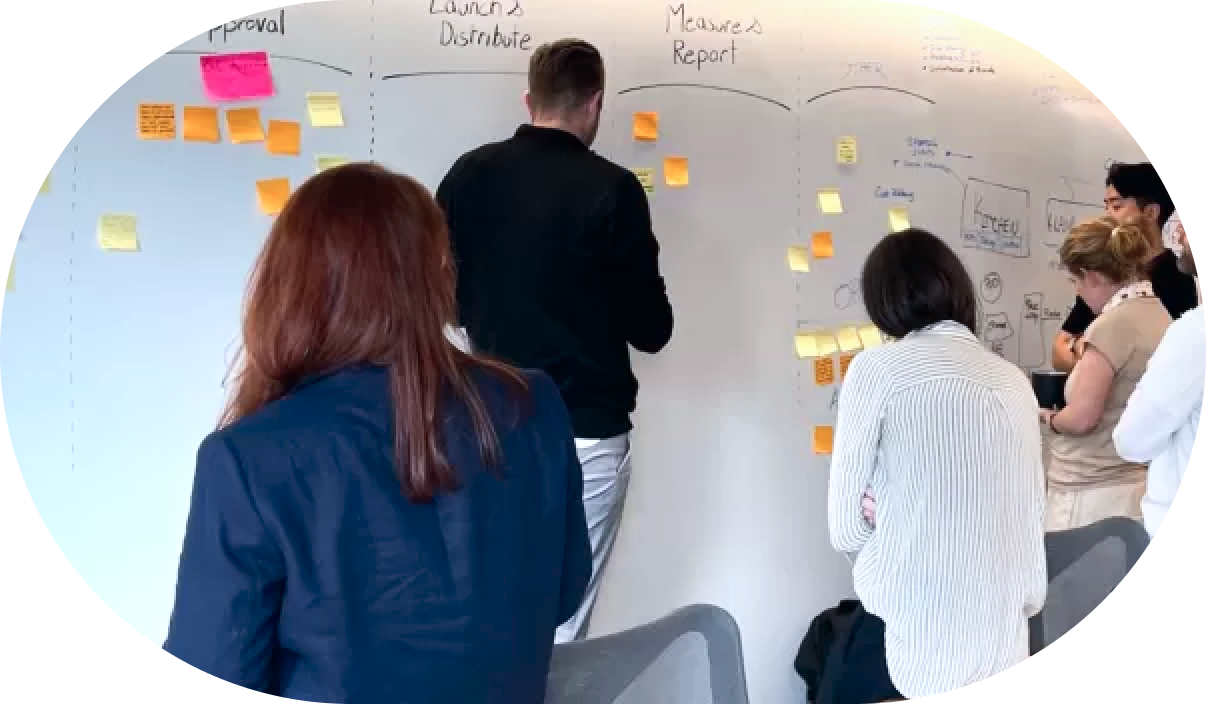
Team employees standing in front of a whiteboard discussing the post-its

AI Test Kitchen • Building a Recipe for AI-Powered Success

  • Client

    Kraft Heinz

  • Solutions

    AI & Emerging Technology ConsultingBusiness ConsultingTechnology ServicesTechnology Consulting

A freshly seasoned approach to identify AI opportunities.

When it comes to harnessing the power of AI, there are endless opportunities to cook up a storm. So, how does one know which recipes to use? The Kitchen—Kraft Heinz’s in-house agency and creative chef behind its iconic brands—could immediately see the value of AI technology, but simply didn’t know where to start. In need of a sous-chef, they asked us to help them develop ideas and create a roadmap to implement AI throughout their business model. Therefore, we organized an in-person workshop to identify where and how AI could drive high value across all of The Kitchen’s operations with the aim to increase efficiencies, save costs, and elevate strategic, creative and production output. The outcome? An action plan to power their business with AI.

Woman standing in front of whiteboard with post-its

Fully baked solutions help us roadmap to success.

We started off by centralizing the question of “how might we?” to uncover the numerous areas of opportunity. From establishing AI foundations to trendspotting, creative development and production, our shopping list of possible AI use cases included lots of ingredients. So, we made sure to boil our ideas down to four focus areas: sharpen the primary insight, social trendspotting, creative ideation, and brand virtualization. Then, we created pilot implementation plans for each theme, thus defining the business value, the proposed scope, recommended tools and technologies, and the estimated effort as the concept evolves. Ultimately, we distilled all of this information into a single strategic AI roadmap, outlining how The Kitchen can build a brand virtualization foundation, while executing pilots that spur adoption of tools, learning and development, and creative ideation.

Photo of a person at a laptop with an AI roadmap chart on screen

Four ingredients that are fundamental when you’re cooking with AI.

In addition to the main dish—the roadmap—we delivered four key takeaways. First, we advised The Kitchen on protecting Kraft Heinz’s data from AI model exposure, as we always say that any strong AI strategy starts with an airtight data strategy. Second, we highlighted the importance of communications around the role of AI within an organization, which can accelerate people’s acceptance and adoption of a new technology. Innovation sprints, for example, offer a safe space for talent to learn by doing and collectively push innovation forward. Third, we showed The Kitchen that the easiest point of entry is testing out AI use cases that don't require internal data, like those that spark creative processes. And as a final note, we emphasized that AI tools are constantly evolving, so it’s critical to have a solid foundation and establish a framework and process focused on adaptability— so that they're ready to adopt when the next big thing comes along.

With this strategic roadmap, The Kitchen can change the course of its value.

Through the workshop, we were able to show The Kitchen how they can use Kraft Heinz’s data to build a large language model ecosystem that supports various AI tools and use cases—and ultimately empower their talent by equipping them with flexible tools that can be used across a wide array of workflows. With that, they can now return to their chopping boards with a refined palate and a clear understanding of how to leverage AI to unlock new opportunities and add more value to their business model.

Results

  • Identified 64 AI use cases
  • Provided actionable key findings in the form of a strategic AI roadmap

Want to talk AI? Get in touch.

Hey👋

Please fill out the following quick questions so our team can get in touch with you.

Can't get enough? Here is some related work you!

Exploring New Avenues of Growth at Advertising Week LATAM

Exploring New Avenues of Growth at Advertising Week LATAM

Industry events Industry events 5 min read
Profile picture for user Sergio Escamilla

Written by
Sergio Escamilla
Managing Director, Mexico

Photos of our team at Advertising Week

After a year of eager anticipation, the fifth edition of Advertising Week LATAM has come and gone—and let me tell you, it was worth the wait. Organized annually by Insider, this event brings together the bright minds behind the world’s biggest brands and agencies to discuss the latest news and opportunities in our industry, both in Latin America and beyond. This year, in particular, the Papalote Museo del Niño in Mexico City was the place to be.

I always look forward to Advertising Week LATAM as it’s a rare opportunity to catch up with old friends and colleagues face-to-face—and in the city I call home, no less. Despite partially coinciding with the Day of the Dead, I have to say the event was more alive than ever, as I bumped into every imaginable brand manager, marketing director, client and podcaster. Representatives from world-class brands like Netflix, Spotify, Toyota were in attendance, and not a single seat was empty by the time Sir Martin Sorrell stepped onto the stage. Needless to say, our time spent in meetings and attending (and hosting) a diverse range of sessions has left us with some valuable insights. Here are some of those takeaways. 

As digital environments expand, AI is the key to maintaining brand relevance.

In today’s changing landscape, CMOs need to align strategies with transformative technology to optimize operations, improve customer engagement and drive conversion. That was the theme explored by our Co-CEO, Content Bruno Lambertini and Associate Vice President, Innovation Technology Carlos Tejeda as they took the stage on October 31. Rather than a conventional session, their discussion served as an exploration, beginning with an overview of the challenges that businesses encounter in the present day. 

"We surveyed top CMOs from major global brands, and they all agreed on four key points,” Lambertini explained to introduce the topic. “Firstly, the complexity of making decisions and seeing short-term results. Secondly, the fragmented media landscape makes it difficult to determine which channels truly yield outcomes. Thirdly, the delicate nature of brand reputation. And last but not least, how do we take advantage of AI?”

The truth is that as digital environments expand, driving conversions can feel like finding a needle in a haystack. For Lambertini, social media is the key (and I wholeheartedly agree).  As marketers, we constantly ponder how brands can secure or expand their market position, enhance brand equity and drive business performance in today’s technological context. The answer lies in two key aspects, the first of which can be summed up in one word: intimacy. No, not the romantic kind, but the kind that harnesses the power of genuine human connections and community. Audiences crave a sense of belonging, and by establishing a brand that fosters this feeling, we lay the foundation for success. An important consideration: social media is the only space where this can happen on a large scale. The second aspect involves how we achieve this.

Monk Thoughts We need to harness the power of AI in four key areas: insights, creativity, community management and measurement.
Carlos Tejeda headshot

AI helps us understand what is organically happening online, what people care about and the spaces where they connect with each other, both within and outside the brand context. We can then use these insights to inform the creation of assets. “Working with Meta, we analyzed input drivers for our AI algorithm to generate the best result. This allowed us to produce 500 assets, so when the brand noticed creative fatigue in the campaign, we already had these new assets prepared and sorted by their probability of success,” Tejeda exemplified.

Furthermore, AI assists community managers by handling repetitive queries at scale, in real-time, and in a personalized manner. The cherry on top? AI enhances measurement by enabling us to extract learnings from a centralized source that connects platforms and contains information from all our marketing efforts.

In times of global uncertainty, activation and performance take center stage.

Speaking of the nature of AI, S4 Capital Executive Chairman Sir Martin Sorrell sat down with Insider’s Director, Matías Stetson, to chat about this particular topic as it relates to the prevailing macroeconomic and political conditions in the region. Amid global uncertainties and geographical fragmentation, Sorrell explained, businesses need to carefully pick their territories. He went on to say: “If I look at the world now, I’m very bullish on North and South America.”

The second consideration is digital transformation. With businesses becoming more cautious not only in choosing their markets but in their general spending, we need to look at digital platforms. “Clients are becoming much more short-term in their thinking, so activation and performance are important,” said Sorrell. “It is quite extraordinary that platforms are growing by 6-11% this year. The money from package goods companies has gone into the platforms, and the reason is that they see better performance, better activation, better measurements and better results from those platforms. AI is going to make them even more important than they are today.”

In summary, technological advancements and the current political and economic uncertainties have led brands to focus more on their short-term return on investment. Now, the competition revolves around acquiring and leveraging first-party data, which plays a crucial role in understanding consumer behavior and making informed business decisions. “To my mind, the best model is the Netflix model. They are the greatest proponents of hyper-personalization at scale,” said Sorrell.

Monk Thoughts The advice to CMOs is agility, taking back control, first-party data, and signals from the platforms.
Portrait of Sir Martin Sorrell, smiling

That’s one of the areas where AI will have the most impact, as it transforms the way first-party data and platform signals are harnessed, decoded and utilized. When it comes to the realm of personalization and data-driven decision-making for brands, AI enhances brands’ ability to tailor their strategies to individual customers with precision and effectiveness. “We thought the web would drive personalization, but AI will take it to a totally different level. We may produce one and a half million creative assets. What took us three weeks, takes us three hours,” said Sorrell. This, coupled with the overall efficiency in areas like media buying, broadcasting and knowledge sharing, will shape the business models of brands and agencies in the years to come. 

Across industries and platforms, creative effectiveness reigns supreme.

During the two-day event, Advertising Week emphasized the importance of creativity in exploring fresh opportunities for growth across various industries and sectors. An illustrative panel by Eucerin, featuring our very own VP Creative Pablo Tajer, showcased how creativity in retail media can yield impressive returns, even when collaborating with third-party ecommerce platforms.

To distill the role of branding in retail, the speakers used a recent example of our work with the brand on the Mercado Ads platform. “We used storytelling to demystify the abundance of information we see on social media and provided consumers with accurate recommendations based on their skin type,” said Tajer. “This sector thrives on ideas and creativity. That’s why we partner with Mercado Ads and constantly push the boundaries of creativity, working on different proposals for major advertisers in the region.”

To emphasize a similar point, our VP Creative Francesco Vicenzi joined our partners at KFC Mexico and representatives from IAB to spill their secrets on creating award-winning campaigns that gain international acclaim. The key ingredients? Data, which uncovers valuable insights; creativity, which generates captivating concepts; and a comprehensive vision that brings everything together. Vicenzi exemplified this through our work on KFC’s The Battle of the Chickens: “We began by noting two important observations. Firstly, rap and freestyle ranked among the top three genres for Gen Z. Secondly, Gen Z has a fondness for promotions and discounts. These served as our starting points, and we recognized that to effectively engage with Gen Z, we needed to empower them. Thus, we provided them with a platform and space to express themselves.”

Striking a balance between short-term results and long-term brand growth.

If there’s one thing I learned from this massive event, it’s that CMOs face numerous challenges that demand immediate results without sacrificing long-term brand development. They must find a way to achieve short-term goals while also making significant contributions towards a larger impact. Those who establish robust data pipelines and effectively leverage new technologies are gaining a competitive edge, propelling their brands far ahead of the competition. It’s time to seize every opportunity within the social and digital landscape in order to become more agile, perceptive and responsive.

Our Managing Director shares key takeaways from the fifth edition of Advertising Week LATAM. advertising week AI marketing social performance marketing ecommerce creativity Industry events

How Our Innovation Sprints with AWS and Google Push Our Talent and Tech Partners Forward

How Our Innovation Sprints with AWS and Google Push Our Talent and Tech Partners Forward

AI AI, Experience 5 min read
Profile picture for user Iran Reyes

Written by
Iran Reyes
VP, Global Head of Engineering, Experience

Innovation sprints

“Given that AI technology is evolving rapidly, it’s extremely valuable to have a safe space to experiment with these technologies at an early stage,” our Executive Technical Director Andy McDonald tells me. So, we’ve created this safe space: innovation sprints are all about learning by doing and giving our talent the opportunity to get hands-on experience with building brand-new tools and technologies—and not just for our own gain, but to help push innovation forward at the world’s most impactful tech companies.

And opportunities there are. In the last few months alone, we’ve completed three innovation sprints in collaboration with some of our key cloud partners. First, we joined forces with Amazon Web Services (AWS) to host a challenge across time zones to create internal AI tools using Amazon SageMaker. A few weeks later, Google gave us, in our capacity as a large Workspace customer, the chance to play with Vertex AI and push the technology to its limits in two multi-day events focused on experimentation.

From the outset, the purpose of these sprints is to benefit our cloud partners next to our own business, as we collaborate on solving key industry challenges, developing use cases that drive brand results, and strengthening our partnerships.

Seizing every opportunity to tweak our expertise. 

The setup of innovation sprints is as follows: together with our partners—AWS and Google in this case—we come up with a challenge. Hereafter, our talent dedicates their time and creative chops to come up with ideas and execute on them by using the partner’s AI technologies. 

The needs of brands are at the heart of every sprint. Privacy, for one, is always a bright golden thread, as most brands are highly concerned with making sure everything is safe and sound. Collaborating with AWS and Google to develop AI tools guaranteed we were operating in a privacy-safe environment within their cloud computing platforms. For instance, when you’re deploying a project to Vertex AI, it’s going to be sort of sandboxed within your own hosting environment, which means it’s only pulling data from a knowledge base that you control. As for Amazon SageMaker, this service is GDPR-compliant. 

When it comes to AI-driven projects fully hosted by our partners, our Technical Architect and one of our AWS Certified Solution Architects Ben Moody says, “We used to tackle AI projects with high-level tools like Amazon Rekognition and Transcribe, among others. With Amazon SageMaker, we can be entirely flexible, covering any custom AI solution, high AI data privacy needs, and low latency requirements.” 

In developing AI-driven solutions for brands, it’s critical to know all the capabilities as well as limitations of the tools you’re working with. As our Senior Creative Technologist Angelica Ortiz highlights, “We use a lot of the latest tools from our cloud partners, and these innovation sprints are a great opportunity to formally dedicate the time towards testing their capabilities.” Such early-stage testing enables us to truly understand the limits of what we are pushing certain tools to do—and as a result, McDonald says, “New ideas get spun around all the different ways we could use a technology, which is 100% going to show up in our client work.” 

Accelerating experimentation to drive results for brands.  

As anyone who works in the field of technology knows, experimentation has a ripple effect. Whether you run into a roadblock or discover a new possibility, you’re always expanding your knowledge and skills. But these ripples have a much further reach than just the individual creative, designer or developer. By experimenting with building our own AI tools in partnership with leading technology brands, we’re able to create truly crafted, custom-made solutions for our clients. Let’s be honest, massive AI tools can’t really do that (yet).

“With tools like SageMaker and Vertex AI being made available to us, we’re really able to supercharge our experimentation processes,” says McDonald. “And then, we can feed these generative AI learnings back into our existing projects and new pitches for AWS and Google as our clients.” As it turns out, most of the solutions our Monks come up with during these innovation sprints are transferable and can be wrapped up and applied to various other scenarios. 

Feedback is a very powerful ripple. Once a sprint comes to a halt, we always share our learnings with the aim to help our cloud partners improve their tooling. For example, Moody says, “During the AI challenge with AWS, we had ten teams with members across different time zones, and so we quickly noticed that it was not easy to set up a seamless MLOps and Monitoring strategy. Since our team was lucky to have direct contact with AWS, they supported us right away and provided learning resources for future production iterations.” 

Similarly, innovation sprints allow us to offer our cloud partners an exciting new take on their technologies. “They’ve been working on their products for years and years, so we can provide fresh perspectives—and sometimes even discover bugs in the system—by applying what we know using their tech. While they help us learn more about these technologies, we give them valuable feedback on how they can improve their products and services, so it’s really a win-win situation,” Ortiz says. And as a fun bonus, it often makes our partners excited to explore uncharted territory together.

Nurturing partner relationships is an ongoing process.  

This feeling of excitement to keep experimenting has been echoed by every participant and organizer of our recent innovation sprints, including myself. Now, all there’s left for us to do is to keep carving out the time, so that we can continually develop our creative ideas inspired by the technologies that our cloud partners kindly make available to us. Our Technical Solutions Engineer Sarah Sheppard highlighted that it’s great to “finally get the time to build some momentum on something. We have so many day-to-day things that can slow us down, so to actually set aside time and create space so we can keep our ideas moving forward—I think that's the best thing these sprints do for us.” Her team, for example, had several weeks to flesh out ideas, while getting trained on the AI tools. “This made the whole experience feel like a sprint, as we tried to do as much as we could in the allocated time,” adds Sheppard. 

Ultimately, this time spent on experimenting with existing technologies and creating new applications allows us to not only drive technical solutions for our cloud partners (and ourselves), but also push our partnerships forward. As Sheppard tells me, “One of the best parts of these sprints has been working with our partners and seeing where their heads are at in a totally different context. Instead of reaching out about a fire that needs putting out, I was now messaging them to say I had some cool ideas and if we could work on it together.” In the end, when it comes to team play, you always want to make sure that you add some fun to the game.  

Our innovation sprints with AWS and Google enable our talent to build new AI tools and push innovation at our cloud partners forward. AI Google amazon Innovation Experience AI

Will Brands Sink or Swim in the AI Video Revolution?

Will Brands Sink or Swim in the AI Video Revolution?

AI AI, AI Consulting, Artists, Studio 3 min read
Profile picture for user Chris Hoffman

Written by
Chris Hoffman
Group Creative Director

Doodle image of different cameras on a pink backdrop

As a lifelong content creator, it’s easy to get stuck in your ways—I, for one, still use QuickTime 7 to play back videos I need to review. Despite being a bit of a stickler here and there, I’ve learned firsthand the importance of being technical as an artist and continually being open to change throughout my years in the field with each passing innovation. Without that, I wouldn’t have made the leap from CPU rendering to GPU rendering, a paradigm shift that required me to learn six different render engines. Altogether, this experience and many others have made me a better creative.

Sure, I’ve seen my fair share of over-hyped duds along the way—we all remember hyped-up “innovations” like 3D TVs that promised to change the way we create and consume video. But once in a blue moon, something comes along that will undeniably change the world. Recently, that’s generative artificial intelligence, yet I still see some brands shun the technology, worried about its risks.

As a creative, I’m not worried about AI taking my job away the way others might. I’m more concerned that by not embracing AI, I risk being left behind. The same risk is true for brands who are reluctant to fold AI into their workflows. Why? AI is making creativity more accessible than ever before; cinematic, high-quality content is no longer exclusive to the skilled few.

Monk Thoughts The cat is out of the bag, giving every brand a leg up in their creative capacity. The risk lies in not keeping up.
Headshot of Chris Hoffman

The democratization of AI will make some things easier, but not without challenges.

Technology has always transformed the creative process—in some ways making it simpler, and in other ways requiring creatives to adopt new skill sets. When the Lord of the Rings trilogy pushed boundaries, it led to the creation of new technology, like motion capture and its evolution into performance capture, and new talent hotbeds designed around making the most of those innovations. Today, AI is likewise challenging all of us to adapt.

First, there is the need to scale up production. The speed of creating content with AI is raising the expectation to make more. In this respect, AI doesn’t necessarily make content production easier; it makes it more sophisticated and ups creative potential. Making a mark remains a challenge.

We’ve already seen this before with CGI. Today, you can render a scene in three minutes in Maya that once took six hours. But fire up the program and it looks more like engineering software than something creative. Cobbling a scene together requires as much of an understanding of mathematics as it does of design. Using the technology to its fullest potential required the confidence to embrace it and tinker with it.

The biggest risk is in doing nothing at all.

It’s easy for brands to default to what’s familiar. I can relate; remember what I said about being stuck in my ways? But those who rest on their laurels risk losing market share to challengers who are quicker to the uptake and embrace experimentation. Smaller brands and influencers are already leveraging the availability of advanced video tools to make their mark. Closing that gap is key to reduce the risk of being forgotten.

Throughout my career, I have witnessed the transformative power of integrating technology and experimentation into one’s own creative DNA, and I am confident that this approach will continue to drive success for creative teams who dare to embrace it. On my team, we’re elevating our already best-in-class talent by augmenting their creative process with AI. As a team, we understand that it may require getting our hands a little dirty, and sometimes going back and forth with a chatbot more than expected, but the rewards are immense. By incorporating AI tools into every stage of the creative process, from ideation to concept art and beyond, we enable ourselves—and our clients—to surpass standard limitations, supercharge our output and create captivating content that leaves a lasting impact. And we can’t wait to see how it develops even further.

Start small, but think big.

The good news for risk-averse brands is that you don’t have to choose between being too conservative or too experimental, throwing caution to the wind. There’s no need for a binary approach to whether you’re in or out with AI adoption; there’s plenty of room to experiment within guardrails. You just need to start playing with the simpler ways to enhance your output (like generating numerous backdrops with AI, or digitally replacing products to make content more dynamic and personalized) and iterate from there as your team becomes more skilled.

If a creative with 20 years in the business can confidently embrace AI without reservations, so can you! While the AI boom may feel like untrod territory, it’s not the first time we’ve needed to creatively adapt—and with new customer expectations and increased competition through the democratization of content creation, there’s no better time than now to start. Otherwise, you might just be left behind.

The democratization of AI is revolutionizing the creative process, encouraging creative to embrace AI technology or be left behind. AI creative AI creative content Studio Artists AI Consulting AI

Choose your language

Choose your language

The website has been translated to English with the help of Humans and AI

Dismiss