






Choose your language

Choose your language

The website has been translated to English with the help of Humans and AI

Dismiss

`

17 - 21 June, 2024

Media.Monks Returns to The Cannes Lions Festival of Creativity

AI is bigger than marketing—it’s the beginning of a new economy. Join us to discover how AI is unlocking new realms of creativity and innovation for brands.

Les.Monks Cafe branding over an image of people speaking

We’re back at Les.Monks Café this year.

Get in touch with your favorite Monk to set up time to swing by, then find us right across from the Palais at 5 Sq. Mérimée.

Café Event Details

Join us at Les.Monks Café everyday for open sessions.

  • Why AI Cannot Replace the Need for Diverse Teams

    19 June, 11:00 - 12:30

    Les Monks Café, 5 Sq. Mérimée

    With Jordan Cuddy, EVP, Global Head of Experience, Media.Monks; Sheryl Daija, Founder & CEO, BRIDGE; Jordan Saxemard, Chief Marketing Officer, Sonos; Tony Coles, President, Black Information Network, iHeart Media

    Join us as we discuss the essential role of diversity in AI and how inclusive teams can drive equitable AI solutions. Delve into ethical considerations and actionable strategies for fostering inclusivity within organizations.
    Register your interest here.

  • The Marketing Society | Cannes Sundowner Spotlight Session

    19 June, 17:30 - 19:30

    Les Monks Café, 5 Sq. Mérimée

    With Sir Martin Sorrell, Founder & Executive Chairman, S4 Capital

    For brand-side marketers and partners, Sir Martin shares perspectives on creativity today, necessary disruptions, CMOs' needs, and preparing for future challenges.
    Register your interest here.

  • Media Mix Mastery: Optimize Your ROI with LinkedIn & Media.Monks

    20 June, 11:00 - 12:30

    Les Monks Café, 5 Sq. Mérimée

    With Paolo Provinciali, VP of Marketing Growth and Performance, LinkedIn; Brittany Blanchard, EVP, Head of NAMER Performance Media, Media.Monks; Nik Cuculovski, Global SVP, Analytics and Product, Media.Monks; Jonathan Hunt, Head of The Hustle, VP of Media, Hubspot

    Discover actionable strategies for media effectiveness, including automation, unified measurements across platforms, and leveraging real-time data for optimized budget allocation and media accountability.
    Register your interest here.

  • From Shortlist to Supreme: A Showcase of Next-Gen Creativity

    20 June, 17:30 - 19:00

    Les Monks Café, 5 Sq. Mérimée

    With Pau Bartoli, Dove Global Brand Director Masterbrand & Strategy, Unilever; Amy Luca, EVP, Global Head of Social, Media.Monks; Hitamara Tamizou, Motion Designer and Next.Up Supreme Winner, Media.Monks; Matias Marcossi, Copywriter and Next.Up Supreme Winner, Media.Monks; Tomas Almuna, Head of Creative, Media.Monks; Federico Duran, Social Executive Creative Director, Media.Monks; Marina Pires, Managing Director, Media.Monks; Jo Cotton, Managing Director, Media.Monks

    Explore groundbreaking work from this year’s Cannes Festival for Creativity, including projects like The Dove Code and Literacy Pen, which each illustrate unique points of view on how AI can be used for social good.
    Register your interest here.

Speakers

Meet the Monks presenting across stages and events throughout the week

Highlighted

Speakers

Swipe
For More!

`

Stay Updated

Want to keep up on all the happenings? Get in touch and get notified.

Learn more about our award-winning work

Exploring New Avenues of Growth at Advertising Week LATAM

Exploring New Avenues of Growth at Advertising Week LATAM

Industry events Industry events 5 min read
Profile picture for user Sergio Escamilla

Written by
Sergio Escamilla
Managing Director, Mexico

Photos of our team at Advertising Week

After a year of eager anticipation, the fifth edition of Advertising Week LATAM has come and gone—and let me tell you, it was worth the wait. Organized annually by Insider, this event brings together the bright minds behind the world’s biggest brands and agencies to discuss the latest news and opportunities in our industry, both in Latin America and beyond. This year, in particular, the Papalote Museo del Niño in Mexico City was the place to be.

I always look forward to Advertising Week LATAM as it’s a rare opportunity to catch up with old friends and colleagues face-to-face—and in the city I call home, no less. Despite partially coinciding with the Day of the Dead, I have to say the event was more alive than ever, as I bumped into every imaginable brand manager, marketing director, client and podcaster. Representatives from world-class brands like Netflix, Spotify, Toyota were in attendance, and not a single seat was empty by the time Sir Martin Sorrell stepped onto the stage. Needless to say, our time spent in meetings and attending (and hosting) a diverse range of sessions has left us with some valuable insights. Here are some of those takeaways. 

As digital environments expand, AI is the key to maintaining brand relevance.

In today’s changing landscape, CMOs need to align strategies with transformative technology to optimize operations, improve customer engagement and drive conversion. That was the theme explored by our Co-CEO, Content Bruno Lambertini and Associate Vice President, Innovation Technology Carlos Tejeda as they took the stage on October 31. Rather than a conventional session, their discussion served as an exploration, beginning with an overview of the challenges that businesses encounter in the present day. 

"We surveyed top CMOs from major global brands, and they all agreed on four key points,” Lambertini explained to introduce the topic. “Firstly, the complexity of making decisions and seeing short-term results. Secondly, the fragmented media landscape makes it difficult to determine which channels truly yield outcomes. Thirdly, the delicate nature of brand reputation. And last but not least, how do we take advantage of AI?”

The truth is that as digital environments expand, driving conversions can feel like finding a needle in a haystack. For Lambertini, social media is the key (and I wholeheartedly agree).  As marketers, we constantly ponder how brands can secure or expand their market position, enhance brand equity and drive business performance in today’s technological context. The answer lies in two key aspects, the first of which can be summed up in one word: intimacy. No, not the romantic kind, but the kind that harnesses the power of genuine human connections and community. Audiences crave a sense of belonging, and by establishing a brand that fosters this feeling, we lay the foundation for success. An important consideration: social media is the only space where this can happen on a large scale. The second aspect involves how we achieve this.

Monk Thoughts We need to harness the power of AI in four key areas: insights, creativity, community management and measurement.
Carlos Tejeda headshot

AI helps us understand what is organically happening online, what people care about and the spaces where they connect with each other, both within and outside the brand context. We can then use these insights to inform the creation of assets. “Working with Meta, we analyzed input drivers for our AI algorithm to generate the best result. This allowed us to produce 500 assets, so when the brand noticed creative fatigue in the campaign, we already had these new assets prepared and sorted by their probability of success,” Tejeda exemplified.

Furthermore, AI assists community managers by handling repetitive queries at scale, in real-time, and in a personalized manner. The cherry on top? AI enhances measurement by enabling us to extract learnings from a centralized source that connects platforms and contains information from all our marketing efforts.

In times of global uncertainty, activation and performance take center stage.

Speaking of the nature of AI, S4 Capital Executive Chairman Sir Martin Sorrell sat down with Insider’s Director, Matías Stetson, to chat about this particular topic as it relates to the prevailing macroeconomic and political conditions in the region. Amid global uncertainties and geographical fragmentation, Sorrell explained, businesses need to carefully pick their territories. He went on to say: “If I look at the world now, I’m very bullish on North and South America.”

The second consideration is digital transformation. With businesses becoming more cautious not only in choosing their markets but in their general spending, we need to look at digital platforms. “Clients are becoming much more short-term in their thinking, so activation and performance are important,” said Sorrell. “It is quite extraordinary that platforms are growing by 6-11% this year. The money from package goods companies has gone into the platforms, and the reason is that they see better performance, better activation, better measurements and better results from those platforms. AI is going to make them even more important than they are today.”

In summary, technological advancements and the current political and economic uncertainties have led brands to focus more on their short-term return on investment. Now, the competition revolves around acquiring and leveraging first-party data, which plays a crucial role in understanding consumer behavior and making informed business decisions. “To my mind, the best model is the Netflix model. They are the greatest proponents of hyper-personalization at scale,” said Sorrell.

Monk Thoughts The advice to CMOs is agility, taking back control, first-party data, and signals from the platforms.
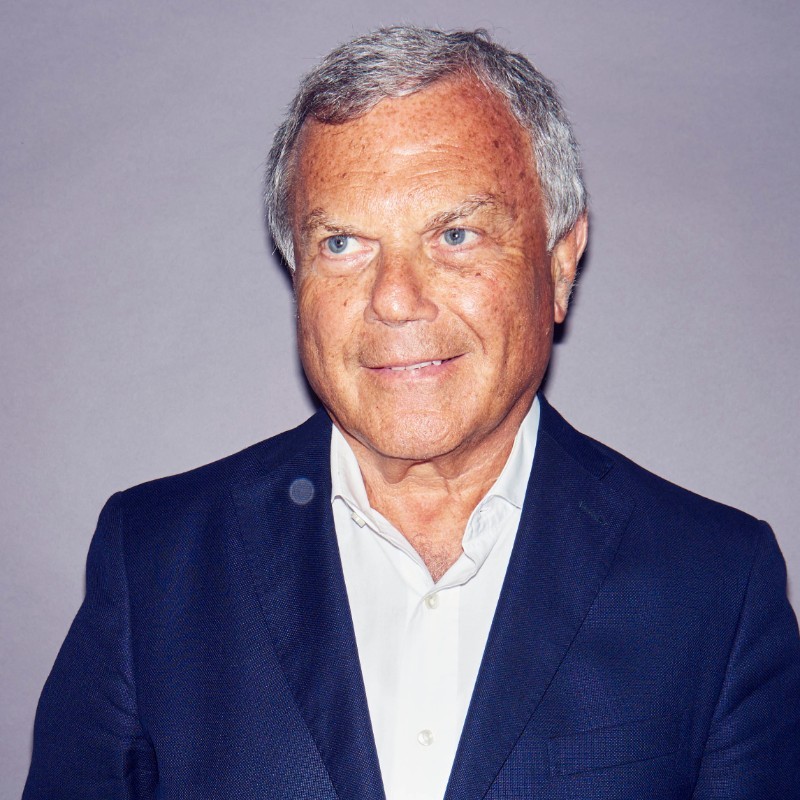
Portrait of Sir Martin Sorrell, smiling

That’s one of the areas where AI will have the most impact, as it transforms the way first-party data and platform signals are harnessed, decoded and utilized. When it comes to the realm of personalization and data-driven decision-making for brands, AI enhances brands’ ability to tailor their strategies to individual customers with precision and effectiveness. “We thought the web would drive personalization, but AI will take it to a totally different level. We may produce one and a half million creative assets. What took us three weeks, takes us three hours,” said Sorrell. This, coupled with the overall efficiency in areas like media buying, broadcasting and knowledge sharing, will shape the business models of brands and agencies in the years to come. 

Across industries and platforms, creative effectiveness reigns supreme.

During the two-day event, Advertising Week emphasized the importance of creativity in exploring fresh opportunities for growth across various industries and sectors. An illustrative panel by Eucerin, featuring our very own VP Creative Pablo Tajer, showcased how creativity in retail media can yield impressive returns, even when collaborating with third-party ecommerce platforms.

To distill the role of branding in retail, the speakers used a recent example of our work with the brand on the Mercado Ads platform. “We used storytelling to demystify the abundance of information we see on social media and provided consumers with accurate recommendations based on their skin type,” said Tajer. “This sector thrives on ideas and creativity. That’s why we partner with Mercado Ads and constantly push the boundaries of creativity, working on different proposals for major advertisers in the region.”

To emphasize a similar point, our VP Creative Francesco Vicenzi joined our partners at KFC Mexico and representatives from IAB to spill their secrets on creating award-winning campaigns that gain international acclaim. The key ingredients? Data, which uncovers valuable insights; creativity, which generates captivating concepts; and a comprehensive vision that brings everything together. Vicenzi exemplified this through our work on KFC’s The Battle of the Chickens: “We began by noting two important observations. Firstly, rap and freestyle ranked among the top three genres for Gen Z. Secondly, Gen Z has a fondness for promotions and discounts. These served as our starting points, and we recognized that to effectively engage with Gen Z, we needed to empower them. Thus, we provided them with a platform and space to express themselves.”

Striking a balance between short-term results and long-term brand growth.

If there’s one thing I learned from this massive event, it’s that CMOs face numerous challenges that demand immediate results without sacrificing long-term brand development. They must find a way to achieve short-term goals while also making significant contributions towards a larger impact. Those who establish robust data pipelines and effectively leverage new technologies are gaining a competitive edge, propelling their brands far ahead of the competition. It’s time to seize every opportunity within the social and digital landscape in order to become more agile, perceptive and responsive.

Our Managing Director shares key takeaways from the fifth edition of Advertising Week LATAM. advertising week AI marketing social performance marketing ecommerce creativity Industry events

Can You Really Cancel Cannes? – Highlights from Lions Live

Can You Really Cancel Cannes? – Highlights from Lions Live

4 min read
Profile picture for user mediamonks

Written by
Monks

Can You Really Cancel Cannes? – Highlights from Lions Live

Cannes has gone virtual this year, and while there’s no rosé to sip on La Croisette in between talks and parties, the reigning Festival of Creativity hasn’t skipped a beat in terms of insightful conversation and thought-provoking creative.

Against a backdrop of a global pandemic and social movements like Black Lives Matter, many of the conversations at Lions Live—Cannes’ (virtual) Festival of Creativity—centered around the importance of digital and its role in creating authentic conversation (and action that backs it up). From marketing effectiveness to fueling creativity with insights and tech, we’ve pulled together some of the biggest ideas of the week.

Tech and Creativity Make Good Bedfellows

We’ve long called for a confluence of tech and creativity to enable creatively differentiated experiences. Speaking to B&T about Cannes this year, S4Capital Executive Chairman Sir Martin Sorrell discussed the role that data and technology play in building effective creative. “You need to look at data as an enabler, it will give you insights that will make creative even more powerful.” In addition to making creative more effective, striking a balance between creativity and technology helps fuel innovation.

SMS

Sir Martin in conversation with B&T.

And speaking of innovation, Unity Head of AR/VR Ad Innovation Tony Parisi painted a thrilling picture of what the near-future of 3D digital content could look like powered by mixed reality in his Future Gazers segment. Ecommerce took much of his attention in particular. “All products will have a 3D virtual twin,” he said. “Imagine an ecommerce website today that had only text, no pictures. Absurd, right? The same will be said for 3D content.” Parisi noted that customers who interact with 3D models are 2.5 times more likely to complete a purchase, and that 65% are more likely to make a purchase when a platform includes AR features.

These predictions align well with MediaMonks Executive Producer Marie-Céline Merret Wirström, who told AdNews last month about the potential of 3D content and experiential retail. “Not only can you try something on at home, but you can easily assess how well the item matches up with what you already have,” she writes. “The emotional impact of being able to connect with the product personally and envision how it fits within your life (as opposed to flicking through images featuring a model that may look nothing like you) is powerful.”

Monk Thoughts Imagine an ecommerce website today that had only text, no pictures. Absurd, right? The same will be said for 3D content.

Forget What You Knew About Effectiveness

In collaboration with WARC, Cannes Lions dropped its Creative Effectiveness Ladder framework (and accompanying 122-page report), which offers a hierarchy of six effects that creative marketing produces, ranked from least to most commercial impact. The need for the framework came from an insight from last year’s festival: there was no clear, shared understanding of effectiveness and what it means for different goals and initiatives.

A key finding from the report is that an overbearing focus on performance can be threatening to brands—a point that Cannes Lions Head of Awards Susie Walker reiterated in her presentation, “Lions Intelligence Presents a Guide to Creative Survival.” A lack of balance between short-term goals and long-term investment can weaken a brand, which is why we advocate for creative experiences that build long-term loyalty.

In discussing the Creative Effectiveness Lions, Ann Mukherjee (Chairman and CEO, North America at Pernod Ricard) discussed the need for “magnet creativity” in addition to “mirror creativity” that reflects culture. “Great brands speak to human conditions,” she said. “Great brands help to elevate what we want to think, differently—the art of that possibility. It is what we call magnet creativity, not just mirror creativity. So, it’s really critical, even more so in this environment, for that human condition to really come to the forefront, as we judge the work.”

Monk Thoughts Great brands speak to human conditions.

Marketing effectiveness can be particularly challenging for small and medium-sized businesses, who are especially reliant on digital platforms. Our just-launched Boost My Business video series, covered in Adweek, aims to help smaller businesses achieve effectiveness through digital creative. Both informative and entertaining, the series follows Tan France as he meets business owners around the United States, teaching them how to use platform features to boost performance and engage their consumers in creative ways.

Authenticity Remains Essential

One of the hottest topics at Lions Live this year—authenticity—intersected with a social platform that’s definitely caught brands’ attention since this time last year: TikTok. In an inspiring CMOs in the Spotlight session, Katie Riccio Puris (Managing Director, Global Head of Business Marketing at TikTok) discussed how the platform is centered on active participation in culture. Offering advice to brands that are interested in marketing on TikTok, she said, “Don’t make ads, make TikToks. It’s not about like, comment and share. It’s like, comment, share and join.”

Puris’ segment came hot off the heels of the TikTok for Business launch. The platform provides brands with useful tools to amplify their efforts. Having partnered with the platform directly in China, UK, Germany, Spain and the Netherlands since its early days, here’s our advice to first-timers on the platform: first, delegate creative control, whether that means handing the creative reins to influencers or encouraging audiences to augment your core message through UGC. Second, understand that the platform is content-based, not connections-based, which means tapping into cultural trends (or starting new ones) is essential to success.

Monk Thoughts Consumers want to see what narrative you are helping to put out into the world.

In discussing cultural trends, Chelsea Clinton (Vice Chair of the Clinton Foundation) spoke with Bob Lord (Senior Vice President, Cognitive Applications, Blockchain and Ecosystems at IBM) about how emerging technology can help accelerate change. Clinton spoke about the importance of brand role: “Consumers want to see what narrative you are helping to put out into the world, how you believe yourself to be, and is that backed up by what you’re doing?”

It’s an important question for businesses to ask themselves. As brands aim to inspire audiences to shift their worldview, offer a unique perspective on society or integrate themselves authentically within digital communities and culture, they must take the opportunity to listen and understand their audiences—and bring about new solutions through creativity and emerging technologies. It’s fitting that these conversations should happen while Cannes takes a break from its regular programming; after taking learnings from a year that has challenged old ways of working from all angles, it will be fascinating to see what wins next year.

The Cannes Festival of Creativity has gone virtual this year, offering reflective discussion around tech, authenticity and creative performance. Can You Really Cancel Cannes? – Highlights from Lions Live Following a challenging few months, Lions Live puts a focus on the future.
Cannes Cannes Lions Lions Live Cannes festival creativity creative authenticity virtual event

3 Lessons for Brands from Adobe MAX 2019

3 Lessons for Brands from Adobe MAX 2019

4 min read
Profile picture for user mediamonks

Written by
Monks

3 Lessons for Brands from Adobe MAX 2019

Adobe MAX came and went this week in LA, bringing creative professionals together with hundreds of sessions, workshops and talks. Aiming to inspire the current and next generation of creatives, the event offered rousing insights into the state of creativity today—and opportunities that artists, entertainers and brands alike can look forward to in the near future, including the next stage in storytelling defined by MediaMonks Founder and COO Wesley ter Haar, who presented at the event.

The conference began with Adobe unveiling a slew of new product updates and features, each bringing the company closer to its vision of enabling “Creativity for all,” which served as a bit of a rallying cry at the event. These announcements included Photoshop Camera, which uses machine learning to offer advanced photo filters and quick, intuitive editing; Premiere Rush, which notably lets users create and share out content to creative social platform TikTok; Adobe Aero, which lets anyone develop AR experiences without coding knowledge; and much more.

Screen Shot 2019-11-06 at 5.38.55 PM

One of the biggest conferences on creativity, this year’s Adobe MAX offered much to think about in terms of identity, voice and emotionally resonant experiences. As Adobe aims to unlock creativity for everyone, it will become even more essential that brands differentiate by building emotional resonance through the experiences they offer.

brands

MediaMonks was in good company at the UX Leaders Summit hosted at the conference.

At the heart of software like Photoshop Camera is Adobe Sensei, the company’s decidedly not-very-humanlike assistant. At a time when many have concerns over how AI will influence professional (and creative) life, Adobe markets Sensei as simply a tool that helps humans focus on what only they can do: be creative, with Sensei handling the manual processes that function as a barrier to that. But when everyone has advanced creative tools at their fingertips, what does it take to stand out? We’ve extracted a handful of key creative insights from the course of the event.

Know Your Message and What You Stand For

Of course, being a conference centered on creativity, Adobe MAX featured several voices from the world of arts and entertainment. While their insights were delivered to an audience of creatives and designers, a lot of what they had to say serves as good advice for business, too—after all, being an artist in the modern world requires a bit of an entrepreneurial edge.

Visual artist Shantell Martin opened day two’s keynote segment with an inspiring talk about stylistic voice and identity. “You have to make people care for you by caring for yourself first,” she told the audience. Further in her talk, she noted that “You don’t discover your style, you extract it.”

Monk Thoughts You have to make people care for you by caring for yourself first.

The advice applies well to brands still defining a sense of purpose. For anyone to adopt your brand—and to truly differentiate it—you must first have a good hold on what its purpose is and what you stand for. This also makes it useful to consider how that purpose might resonate differently with different audiences. Digital-native brands in particular have succeeded in this by defining themselves out of a specific need or white space, then leveraging digital channels to align with consumers through that shared sense of purpose.

Take Comfort in Discomfort

Earlier in the conference, illustrator Lisa Congdon offered her own excellent advice on artist voice: “[Finding your voice is] both an exercise in discipline and process of discovery that allows for—and requires—loads of experimentation and failure.” While that’s certainly true for brand voice, it also applies to the innovation imperative.

Innovation requires you not only understand what your brand aims to achieve, but also have an intimate understanding of your audience and how they interact. In an age of hyperadoption, real innovation comes from evolving your brand experience in lockstep with user behaviors and continual experimentation. Congdon recommends that creatives adopt a learner’s mindset that’s open to risks and embraces discomfort—an attitude that not only fosters a creative environment but can also kickstart more agile ways of working.

Open a New Chapter in the Story of Storytelling

All of the above boils down to ensuring your message truly resonates with your audience. Throughout history, humans have used the power of narrative and storytelling to achieve this, but interactive digital culture has upended the storytelling norms that had traditionally prevailed. In an on-stage interview with Jason Levine, Principal Worldwide Evangelist for Adobe Creative Cloud, famed director M. Night Shyamalan remarked that “Everything in today’s society goes back to storytelling. Right now, we’re split between fighting for the old story, and fighting for the new story. It’s time to bring in the new story.”

IMG_2232

Wesley ter Haar's talk focused on the power of digital storytelling and what makes it so unique.

What does that new story look like? That’s what Wesley ter Haar aimed to define in his talk, “Augmented Creativity: Emerging Platforms that Drive the Next Generation of Storytelling.” Ter Haar railed against the variations of storytelling that frequently pop up at conferences—like “storydoing” or “storymaking”—by noting that each still relies on the same form of linear narrative that today’s marketeers should break away from. “We’ve taken what is this amazing medium for creativity and innovation—the web, the internet or what we now call digital—but we’ve made it about traditional linear formats,” he says.

Netflix’s Bandersnatch might have brought interactive film to the masses last year, for instance, but it was hardly groundbreaking or immersive compared to what’s come before it; video games had already explored what ter Haar calls the “interrupt to interact” narrative model for decades, and we’ve moved away from truly personalized experiences enabled by an API-driven open web. And when it comes to personalization as it’s commonly used, says ter Haar, “There’s a lot of engineering, but very little empathy.”

Screen Shot 2019-11-06 at 5.39.17 PM

In a new era of ecosystems and total brand experience, ter Haar calls for a new definition of storytelling: “A journey focused on the user that creates a personal path, driven by design and distinction, powered by innovation.” And these stories should show no end, either: “Digital storytelling is more input-based, trying to get the next ‘yes, and…’ moment,” says ter Haar, noting how each piece of content ideally leads into the next step within a content ecosystem. To offer stories that truly resonate, brands must use storytelling to bridge together creative and media. This requires breaking away from big ideas that function like film, and instead drive impact by recognizing user behaviors and shifting toward an insight-driven focus on the customer experience.

Focused on inspiring artists and creatives, Adobe MAX featured a lot of marketing insights for brands as well—like the importance in establishing purpose, voice and emotion. 3 Lessons for Brands from Adobe MAX 2019 Adobe MAX offered ample advice for brands on establishing voice, purpose and emotional resonance.
adobe max adobe personalization storytelling wesley ter haar creativity creative differentiation brand voice marketing insights

Linking Empathy and Engineering at Advertising Week New York

Linking Empathy and Engineering at Advertising Week New York

5 min read
Profile picture for user mediamonks

Written by
Monks

Linking Empathy and Engineering at Advertising Week New York

This week, New York welcomed not only foreign leaders and dignitaries at the United Nations headquarters—the city also embraced some of the best and brightest in the world of advertising, marketing and technology. Yes, Advertising Week New York—one of six Advertising Week events held around the world—came to offer thought leadership, workshops and more with 1,216 speakers and over 290 different events.

There was much to ponder and celebrate throughout the week. At the Clio Awards, eight awards were distributed among three projects that we contributed to: the Uncensored Playlist, Mind the Gap and the geolocation-based revamp of the “Runaway Train” music video. We also made placement on Adweek’s 100 Fastest Growing Agencies list, and our VP of Marketing Kate Richling was shortlisted for Advertising Week’s Future is Female platform.

But that’s enough patting ourselves on the back. What were the brands up to in all the fray? Our recap explores three big topics from one of the biggest weeks in advertising—namely what’s driving the in-housing trend, how brands are working creatively with data and the new collaborative partnerships that are helping brands respond to both those opportunities.

Getting Closer to Consumers through In-Housing

One thing that’s become undoubtedly clear across the course of the week is that brands are seeking ways to take back control. For many, this has manifest in a trend to take their creative and media capabilities in-house. Often attributed to goals like lowering cost or time to market, there are in fact many reasons why brands feel they can do creative better on their own terms and turf, as explored at the Brand Innovators summit, which coincided with Advertising Week.

A major goal behind the in-housing trend is a need to get closer to the consumer. As traditional brands grow with widening product lines and more channels to communicate through, they risk losing coherence or consistency within the brand-consumer relationship.

94_Panel_AdWeek_092419

The In-Housing panel at Brand Innovators. (Photo courtesy Kat Papera/Brand Innovators)

At a panel on in-housing, Spencer Gordon of Anheuser-Busch discussed how going in-house ensured that a dedicated team in the brand would always be thinking about creative. This enabled them to pursue consumers with greater relevance and brand understanding. But Gordon noted that the initiative achieved big results by first starting small; with four employees focused on providing social assets solely for the Michelob Ultra product, the team has since scaled to 63 members that deliver for all of AB InBev’s brands.

In the same panel, Ryan Riess, Director of Social Strategy and Content at the Hershey Company, similarly discussed how supporting such a large variety of brands (15 of them!) drove them to become more consumer-centric. Hershey felt they could do creative better on their own—particularly in creating platform-specific content that would better connect with their customers. That’s a very specific way that brands can better drive relevance by maintaining an always-on relationship with their consumers, requiring brands to have a clear idea not only of themselves, but their consumers as well.

Purposeful Use of Data for Empathy and Impact

How brands can gain that understanding of the consumer was another major topic of discussion throughout the week. But businesses have come up with interesting ways to accomplish this; a notable example is Target’s internal media company Roundel. In the Advertising Week panel “Climbing Over Walls: Real People Data in an Automated World,” Roundel’s VP Dave Peterson noted: “The data is extremely important, but it’s as much on the human side as it is on the data. We call it the IQ side for data and the EQ for the human side of things.”

This purposeful interplay between both the technical and emotional sides of data provides Roundel with learnings they can use to strengthen the relationship between the retailer, their customers and the CPG partners whose products line the shelves. “Going back to our enterprise view at Target about putting our guests at the center of everything we do, our goal really is to enhance the shopping experience,” Peterson said. “Media works best when it’s in everyone’s benefit.”

westalk1

MediaMonks Founder and COO Wesley ter Haar gave a keynote address at the Brand Innovators summit. (Photo courtesy Kat Papera/Brand Innovators)

westalk

Focused on leading tech trends, the presentation noted the use of machine learning to produce realistic, photo-editing trickery. (Photo courtesy Kat Papera/Brand Innovators)

And that’s a point that resonates well with MediaMonks founder Wesley ter Haar, who gave a keynote address at the Brand Innovators event on Tuesday afternoon. Exploring the challenge between what he calls “personalized pleasure versus personalized panic”—that delicate balance between consumers’ desire for relevance and concern for privacy—he honed in on the need for empathy to become a driving force in everything you do. “We can never stop prioritizing empathy,” he said. “Empathy and engineering must work hand-in-hand in the future.”

Closing the Creative and Data Divide

While Roundel is an interesting example of bridging together the intelligent and emotional quotients in data, they’re not alone: several brands noted the need for marketing and IT to come together to deliver unforgettable customer experiences that build brand love. On the panel “Rethinking TV: Driving Growth, Relationships and Experience Through Data,” Sir Martin Sorrell joined GM’s Global CMO Deborah Wahl, where the two examined how brands must look beyond the typical TVC approach for more scalable, personal and relevant creative.

Wahl gave her brand’s perspective on how impact and effectiveness are table stakes today, and how she works closely with data to achieve it. “We have a chief data officer at GM. We spend a lot of time together, really understanding: ‘What are you learning, what are the insights, how are we going after it?’” she said. “That helps you form better creative briefs so you get a big idea, and then really make sure we can execute that across different channels.”

Monk Thoughts With traditional work, there’s a conservatism that you can’t marry data with being creative.
black and white photo of Wesley ter Haar

It sounds like GM has a good rhythm going, but for many brands, closing that IT and creative gap can feel like a struggle. Showing teamwork in action, the S4 family—Sir Martin, ter Haar and Emily Del Greco (President of the Americas, MightyHive)—came together the following day to join Joana Coles (Founder and CCO, Boudica) in a panel discussion about the S4 Capital model and its place within the future of advertising. Coles set the scene for discussion: if you’re not a holding company, she asked, “What the hell are you then?”

The trio’s responses became a multi-faceted examination of collaboration and partnership. Sir Martin drew a line between how S4 operates versus holding companies that impose constraints around the businesses they contain. Instead, he suggested, S4 took inspiration from tech companies who are disruptive by nature. Ter Haar added: “With traditional work, there’s a conservatism that you can’t marry data with being creative.” It’s precisely that challenge that brands are grappling with now, driving that need for control examined above.

119_Wesley_092419

Wesley ter Haar at the Brand Innovators Summit. (Photo courtesy Kat Papera/Brand Innovators)

Del Greco noted how aligning data and creative so closely together enables brands to take more risks with confidence. “MediaMonks is about taking the risk, and MightyHive comes quickly with feedback [backed by data],” she said. As iteration and agility have become key to success in today’s always-on environment, this ability to experiment and take learnings will become crucial for future-focused brands.

As Advertising Week draws to a close, we’re energized by the creative wins that brands have have been able to share. Looking at the next year into the future, it will be interesting to see how the landscape further evolves—and how new partnerships will enable brands to achieve a more customer-led focus by closing the gap between data and creative.

A few challenges and opportunities dominated 2019’s Advertising Week New York: empathetic data, closer consumer relationships and a desire for brands to take back control. Linking Empathy and Engineering at Advertising Week New York We dive into some of the biggest questions (and answers) that dominated the week.
advertising week advertising week new york awnewyork mediamonks s4 capital sir martin sorrell wesley ter haar mightyhive brand purpose data consumer data data creativity creativity iha in house agencies

Enhancing LatAm Brands with Local Talent and Global Perspective

Enhancing LatAm Brands with Local Talent and Global Perspective

5 min read
Profile picture for user mediamonks

Written by
Monks

Mejorando a las Marcas Latinoamericanas con Talento Global y una Perspectiva Global

There’s a great opportunity ahead for brands in Mexico and Latin America, where access to the internet is still growing: only 55% of Latin Americans had access to the internet in 2017, according to Statista. As more of their audience go online, brands are met with a golden opportunity: offer differentiated, premier digital experiences that will impress the next generation of digital users in the region.

Of course, that’s easier said than done–and brands that fail risk losing their audience to major global players who have invested years in perfecting their UX learnings. And challenges in retaining talent or having the resources available to execute creative ideas exist for brands anywhere in the world, not just Latin America. But organizations navigating this new demand for premier digital experiences can still go far by standing on the shoulders of giants–or tried-and-true veterans of digital who know their stuff and can lead on the path of success.

In fact, helping unlock brands’ abilities to build these creative, digital experiences is a key goal of the MediaMonks Mexico City office. With a team native to the region and augmented by the larger, global MediaMonks network of talent, we’re uniquely positioned to respond to the greatest challenges that brands across Latin America face. “With the outstanding Mexican talent that has joined our Mexico office, we are able to create campaigns with international standards that work locally,” says Marcelo Planchart, Head of Expansion LatAm.

What’s Rafahu’s passion? Pop culture, which he tries to sneak into all of his work with a creative, unexpected spin. “I’m a geek of animation, science fiction, design, comic books, video games, illustration and art,” he says, “so I always try to put something of all that pop culture that I consume every day into my work.” Through this approach, he tries to create concepts that will resonate emotionally with audiences, while keeping the key message intact. It’s a perspective that differentiates his projects, making them a bit more unique and artful in the process–and shows how important it is for brands to provide their teams creative freedom and flexibility. 

Being creative should be fun, after all. “That part of exploring, of facing a void where there is nothing, starting to shape that idea visually and defining what is going to communicate–that is my favorite,” Rafahu says. 

Whether they face challenges in executing a creative idea or finding entirely new ways of adapting to the digital landscape, brands all over Latin America can augment their teams through strategic partnerships that fill those gaps. Guidance in digital transformation and cultivating the creative flexibility for teams to chase their passions or investigate their curiosities are just two of the ways that brands in the region can forever change the way they work. Through these processes, Latin American brands face great potential in strengthening equity and helping to differentiate from their competitors. 

clubpriemier_headerimage_1920x480

MediaMonks is driving the digital transformation efforts of Club Premier, Mexico's top loyalty program.

Putting Innovation at the Forefront

Innovation is a key element of MediaMonks’ philosophy around the world, and at the Mexico City office that’s made clear through its dedication to digital transformation, a service that’s strengthened by our vast expertise and insight from working around the world. These efforts are spearheaded by Carlos Rivera, Consulting and Platforms Lead, who is in charge of leading the platform development operation in addition to digital transformation. 

A great example of the digital transformation guidance provided by the office is the work we’ve done with Club Premier, Mexico’s top loyalty program. From the process of building the app to supporting it over the long term, we’ve worked side by side with Club Premier to make decisions and help envision the digital future of the company. “And that dedicated, long-term relationship has a lot of value versus projects where I do the work, then I leave and I don’t see you again,” says Carlos Rivera. “We are changing that, and our Mexico City office is one of our global offices spearheading this approach, and thinking about long-term projects where we sell not only services, but value and strategy.”

Rivera’s expertise on the matter is wide-reaching, as he has traced a journey not just across the sea and back, but through the early years in ecommerce and app development to today. Having founded an ecommerce startup in Mexico selling custom-made surf suits during the industry’s infancy, Rivera had an itch to learn more about how technology could help organizations succeed. This drive prompted him to pursue a master’s degree in France, before getting his PhD in Innovation and Technological Transference in Spain. While in Madrid, Rivera founded an app-developing startup, which quickly grew to become one of the top app developers in the country.

See how we helped Coppel scale up production for back-to-school.

Rivera’s expertise on the matter is wide-reaching, as he has traced a journey not just across the sea and back, but through the early years in ecommerce and app development to today. Having founded an ecommerce startup in Mexico selling custom-made surf suits during the industry’s infancy, Rivera had an itch to learn more about how technology could help organizations succeed. This drive prompted him to pursue a master’s degree in France, before getting his PhD in Innovation and Technological Transference in Spain. While in Madrid, Rivera founded an app-developing startup, which quickly grew to become one of the top app developers in the country.

Monk Thoughts Applying digital transformation to a brand can help it reach its business goals and revolutionize its relationship with clients.

“Europe is some years ahead of LatAm in terms of innovation and digital transformation. So there is an opportunity to apply trends, strategies and processes that you can’t find yet in the region,” says Rivera. Through the expertise and insights of talent like his, MediaMonks can apply its global capabilities, while imprinting local projects with the vision and knowledge to fill the clients’ needs.“I saw the opportunity to bring the know-how I had learned in Europe to the Mexican market and apply it to local brands,” says Rivera. Leading digital transformation for brands like Club Premier has allowed him to apply his acquired knowledge to enhance the brand’s capabilities to compete and succeed in an extremely competitive market.

Offering Flexibility to be Creative

Since joining MediaMonks, Rivera found that the company has an environment that invites him to be proactive and propose ideas. “The management team is very open to test these ideas and takes away your fear of being wrong,” says Rivera. “I really liked something [MediaMonks founder and COO] Wesley ter Haar said: it’s better to make mistakes trying to do something new to improve, than to always be wrong and keep repeating the same mistakes.” This goes hand in hand with his personal philosophy: “I am not afraid of change. My life path proves it.”

victoria_heart

Art done by MediaMonks' Mexico Art Director Rafael Aguilar "Rafahu" for Cerveza Victoria's 'Mestizo' campaign.

Brands should likewise cultivate an environment that facilitates flexibility and a passion to experiment and learn through creative problem solving–but they’d be forgiven if they don’t have the budget or time to allow for such an approach. These limitations are only some of the reasons why IHAs in particular struggle to retain the talent they need, but brands can make up for it by augmenting their teams with specialized, experienced talent through partnerships.

Rafael Aguilar–or  “Rafahu” as he is known in the creative world–is MediaMonks Mexico’s Art Director. Attracted to the variety of talent and disciplines cultivated in the MediaMonks team, Rafahu joined the monastery in early 2019, and has already made an impact through his very particular and striking visual style.

“There is no shortage of resources. If you look anywhere there is strength in any creative task,” he says. “Although the Mexico office may not have hundreds of employees…yet, you can get support or additional resources that you don’t have here, you can get them from any of the many offices MediaMonks has around the world, anytime.” What’s unique about his current position compared to other regional agencies is that he has the resources to fully develop the creative potential in every project he undertakes–and brands strapped for talent can just as easily tap into that pool of passionate artists and creatives.

From digital transformation to visually astounding art direction, MediaMonks' Mexico City office has attracted some of the top local talent to create a multidisciplinary team that offers differentiated, premier digital experiences with a global perspective that will impress the next generation of digital users in Mexico and Latin America. Enhancing LatAm Brands with Local Talent and Global Perspective Top local talent converge at the MediaMonks’ Mexico City office to create innovative and impacting digital experiences with a global perspective.
digital transformation in-house IHA LatAm Mexico Latin America art direction local talent innovation creativity

Get Creative and Get Out of Your CX Rut

Get Creative and Get Out of Your CX Rut

4 min read
Profile picture for user mediamonks

Written by
Monks

A new Forrester report by Jay Pattisall, unveiled at the start of Cannes Lions, highlights how the pursuit of customer experience (CX) as a go-to strategy has in fact inhibited growth for many brands. Instead, brands must invest in creativity (and identify the right partners to help them do so) to achieve higher returns. It’s welcome news at Cannes, which celebrates creative excellence and serves as a benchmark for best-in-class communications—and MediaMonks is proud to have been interviewed alongside other agencies for the report.

Pattisall relates CMOs’ focus on CX to a diminishing prioritization of creativity; one   finding in his Forrester report is that “Every brand offers the same digital experience because they all address the same customer needs, use the same technology platforms, and design for the same mobile use case.” Brands shouldn’t put all their eggs in one basket by focusing purely on function, but place greater attention on offering creative experiences.

A recent article published by Marketing Week agrees that brand creativity is on an overall decline, yet is a key indicator of success: 67% of companies with top ratings on McKinsey’s Award Creativity Score—measuring quantity, variety and consistency of Cannes Lions awards won—have above-average growth, according to the article.

Learn more about the cost of losing creativity.

Monk Thoughts Every brand offers the same digital experience because they all address the same customer needs.

What does this mean? Creativity might not be immediately quantifiable, but it can go a long way in increasing enterprise value. MediaMonks Global Executive Creative Director Jouke Vuurmans has long spoken out against brands failing to take advantage of the creative opportunities available to them. He has noticed a “suburbanization” of design where bold brand identity has taken a back stage to sanitized interfaces that tick off the same boxes. Because digital interfaces are often the most common—or even first—settings in which users will engage with a brand, this results in a lot of wasted potential for brands to differentiate themselves and deliver on the brand promise.

Building content and experiences requires input from many people across the organization, each perhaps pursuing their own goals—but they must collaborate to ensure their efforts are on the same page. “Just because so much focus is on digital doesn’t mean we should ignore brand within this relentless creation and distribution of content,” says ter Haar as quoted in the Forrester report, “The Cost of Losing Creativity,” highlighting the importance in remembering that even the most solutions-oriented approach shouldn’t dismiss the brand-building opportunities of creativity.

The Interface is the Brand

At MediaMonks, we believe every engagement that users have with a brand is an opportunity to represent its core products and services. Most apps that exist to fulfill a specific function essentially look and feel identical, lost in a sea of sameness where differentiating factors are slight, if they exist at all. This is especially true in travel brands, for example: any airline app will let you book a flight or check in with a digital boarding pass. But brands can stand out by fusing creativity and technology to fulfill a wider purpose. The Aeroméxico app is a great example of this by offering smart content based on users’ itineraries, helping them easily find offers most relevant to their trips.

Monk Thoughts People underestimate the creative value of always-on communication.
black and white photo of Wesley ter Haar

The use of highly relevant and targeted personalized content shows how even the smallest interactions can make a big impact on the user experience—and those interactions directly translate into brand loyalty. “Creative experiences that embed the brand’s purpose and values within a tech-fueled solution connect the uniqueness of the brand, the emotional needs of its customers, and the convenience of technology,” writes Pattisall in the Forrester report.

We agree. While brands have come under great pressure to engage their consumers through always-on content, it’s become easy to view small pieces of content as disposable or having limited impact on the overall consumer experience. “People underestimate the creative value of always-on communication,” cautions ter Haar. “Just because it’s 6 seconds on Facebook doesn’t mean you can’t think about distinction.”

Drive Purpose Across the Ecosystem

A remedy for unlocking the creative potential in any touchpoint or piece of content is to begin thinking in terms of ecosystems. The user journey extends beyond individual channels and platforms. Likewise, brands should take a more holistic approach at the creative experiences they provide. “We spend a lot of time thinking about creativity as a broader term—something as part of UX, digital design, flow—across anything that’s building people into an ecosystem,” says ter Haar. “How does the work we do for brands lock people into an ecosystem?”

Image from iOS (11)

Forrester's report on the importance of creative experience released at the Cannes International Festival of Creativity, shown above.

Take grilling brand Weber, who also realized audiences were beginning to care less about objects—like grills—and gravitate more towards experience. This shift in consumer focus provided Weber with an untapped opportunity: how could they use creativity through content and experience to position grilling (and by extension, their brand) at the center of social experiences that consumers crave?

The result is an all-encompassing digital ecosystem that serves not only as a place to learn about grilling products, but to seek out and discover inspiration about grilling as a lifestyle. By infusing this promise across an ecosystem that encompasses personalized web content, connected apps, interactive demos, in-person experiences and more, Weber has achieved a compelling digital ecosystem that accounts for a griller’s every need, infusing emotion and aspiration into every step of the experience.

Monk Thoughts We spend a lot of time thinking about creativity as a broader term, across anything that’s building people into an ecosystem.
black and white photo of Wesley ter Haar

In his Forrester report, Pattisall highlights the importance of infusing creative problem solving at the beginning of every creative process: “Rather than bolting creative on at the end of the process as an established look or defined list of deliverables, initiate the project with creative problem solving to help define the problem and craft a solution at the start,” he writes.

It all boils down to instilling your work with a sense of purpose. When working with clients to narrow their efforts and align those goals with moving the business forward, we enjoy quoting the NASA janitor who proudly told President Kennedy that he was helping to put a man on the moon. A similar sense of purpose should manifest from every step of the creative process, at every level of an organization and at every touchpoint at which users engage. Such an approach ensures customer experiences differentiate a brand and uniquely affect consumers to strike a stronger, longer-lasting connection.

Customer experience has long been the go-to strategy for growth, but a recent Forrester Research report suggests it’s time for a new kind of CX: creative experience. Get Creative and Get Out of Your CX Rut Stand aside, customer experience—it’s time for brands to focus on creative experience, too, according to a new report from Forrester.
creativity brand creative branding brand strategy creative content digital sameness digital ecosystem creative design

Choose your language

Choose your language

The website has been translated to English with the help of Humans and AI

Dismiss