Case Study
Salesforce
Unlock scalable personalization through data, innovation and Salesforce services.


We harness cutting-edge technology to build architectures that support every aspect of the customer experience, offering insights and intelligence for each stage of the customer journey. As a leading Salesforce partner—including the #1 Non-Profit (.org) Partner in APAC—we empower organizations to improve customer experiences with a unified tech stack. Our expertise translates technical solutions into seamlessly connected engagements, fostering lasting relationships. Additionally, as an OSP Partner, we deliver market-ready solutions tailored to specific industries. Together, transformative approach enhances content and elevates marketing, sales and customer service.
Summit Partner
-
Top 5 Global Agency Alliances Partner
-
Consulting Partner
-
OSP Partner
-
Managed Services Partner
-
#1 Org Partner in APAC
Our end-to-end Salesforce partner services




In partnership with
- GNC
Testimonial
Monks was a crucial partner in assisting us to fix some outdated, backend setup in Salesforce Marketing Cloud that we didn’t have the internal expertise to do ourselves. I would recommend them to any Salesforce client looking for a Salesforce Consulting Partner with proven expertise.

Jennifer Nordstrom
Senior Manager, Owned Customer Channels, GNC
How can we help you innovate? Let’s talk.
Dive Deeper
-
Report: Generation AI and the Path to Agile and Empowered Marketing Teams
-
Dreamforce Recap: Highlights and Key Takeaways from Salesforce’s Biggest Event
-
What’s New at Dreamforce 2024: Everything to Know About Marketing Cloud Advanced Edition
-
CMOs and Product-Led Growth: A Blueprint for C-Suite Synergy
-
Salesforce Marketing Cloud Growth Edition Was Just Announced—Here’s What It Means for You
Wednesday Oct 23, 2024
BigQuery: ML based approach to identifying your high-value users
No more wasting effort, time, and money.

You're one step closer to unlocking Instant Big Query Machine Learning.
With our step-by-step guide, you'll unlock the magic of machine learning to find greater insights for your audience data. Harness the ability to constantly refine audience targeting in order to boost your business, discover the process of machine learning-based audience creation using Google Analytics 4-BigQuery activation , and improve your marketing strategies to improve cost efficiency and ROAS gains.

You’re one download away from learning how to:
Dive Deeper


Amazon Web Services
We leverage AWS technologies to drive marketing & technology excellence.


At Monks, we partner with Amazon Web Services (AWS) to leverage cutting-edge cloud technology, delivering innovative marketing and technical solutions to clients around the globe. Through partnership with the AWS Advertising & MarTech team, we empower organizations across industries to harness data effectively, transforming it into actionable insights that drive new business value and create a competitive advantage.
This partnership also enables us to push the boundaries of innovation with generative AI, creating scalable experiences ranging from million-user UGC platforms to conversational voice, avatars and machine learning applications—and that’s just the beginning of what’s possible. Additionally, our collaboration helps clients in media, entertainment, games and sports evolve their broadcast needs while driving cost savings and sustainability efforts, delivering seamless solutions from camera to consumer.
Our strong focus on rapid application development, paired with expertise in DevOps practices, ensures we can build and deploy these transformative solutions with speed and efficiency. Together with AWS, we are committed to helping businesses unlock the full potential of digital marketing in an ever-evolving landscape.
Industries we’re furthering using AWS.
Use Cases
How we harness the power of AWS
Generative AI
Leverage Amazon Web Services to implement generative AI solutions, enabling organizations to create innovative content, automate processes, and deliver personalized experiences at scale.
DevOps
Streamline DevOps practices to facilitate continuous integration and deployment processes that enhance collaboration, improve efficiency and accelerate software delivery.
Data & Analytics
Empower organizations to derive actionable insights from their data, enabling informed decision-making and driving business growth.
Conversational AI
Conversational AI solutions enhance customer engagement through intelligent chatbots and virtual assistants, providing seamless, real-time interactions.
Machine Learning
We apply machine learning capabilities through AWS to help organizations build predictive models, automate tasks and enhance decision-making.
Migration & Modernization
Our partnership with AWS supports organizations in migrating systems and modernizing applications, ensuring a smooth transition to the cloud while enhancing performance and scalability.
Security
We implement robust security measures on AWS, helping organizations protect their data and applications through advanced security protocols, compliance solutions and risk management strategies.
Storage
Using AWS storage solutions, we provide scalable, secure and cost-effective options for managing and archiving data, enabling organizations to optimize their data storage strategies effectively.





Monk Thoughts
The future of production is software-defined. Partnering with AWS for Media & Entertainment has been a strategic decision for our business due to their end-to-end capabilities and investments moving from copper to cloud.

How can we help you innovate? Let’s talk.

Dive Deeper
September 17-19, 2024
Meet the Monks at Salesforce Dreamforce
Meet our team of Salesforce experts at Dreamforce and learn how to unlock personalization at scale.


Your Dreamforce Agency Partner of Record
Dreamforce can be overwhelming - let us help. Our team of Salesforce experts will be onsite at Dreamforce to help you learn how to supercharge your CRM strategy.
Book a meeting to chat with us about:
- Cross-Cloud Excellence: As a Salesforce Summit Partner our teams are certified experts in the full C360 suite of Salesforce products. Across Data Cloud, Marketing, Core, Commerce and Integration our team has the skillset to get your teams set up with an implementation that supports your business goals and drives results quickly.
- CRM Agency of Record: Build your end to end CRM systems from initial strategy development, content creation and messaging, all the way through to deployment and optimization of campaigns.
- Data Cloud Adoption & Acceleration: Translate business problems to Data Cloud use cases. We assess readiness and build use cases for Data Cloud to optimize your CRM data and support implementation.
- AI Integration: Integrate AI into your CRM strategy with our pilot Monks.Flow program designed to help you accelerate email asset production to deliver more personalized email programs.
Our onsite experts
Meet the Team
Highlighted
Our onsite experts
Swipe
For More!
-
Geoff Lopatka
Enterprise Client Partner, AMER
Equipping marketing, sales, and service teams with the solutions they need to establish deeper customer connections.
![Geoff Lopatka]()
-
Rocky Najdawi
Commercial Client Partner, AMER
I partner with brands to build a strong data foundation, drive deeper connections and accelerate top line growth.
![Rocky Najdawi]()
-
Carlos Garcia
VP Core and Integration Practice, AMER
I oversee the development & execution of advanced Salesforce solutions, ensuring seamless integration and optimization to meet client needs and drive business transformation.
![Carlos Garcia]()



Request a Meeting
Thanks! We'll be in touch shortly to discuss scheduling.
Keep an eye on your email. One of our monks will reach out to you shortly.
Dive Deeper
More From Our Experts
Leveraging Data to Elevate PersonalizedExperiences—Insights From Salesforce, Google and Lenovo
Leveraging Data to Elevate PersonalizedExperiences—Insights From Salesforce, Google and Lenovo


From the spectacular Sphere to our AI-powered alien robot Wormhole chatting it up with the press, there were numerous showstoppers at this year’s Consumer Electronics Show (CES) in Las Vegas. Futuristic attractions aside, we were especially impressed by the minds behind all the astonishing technologies and the many inspiring conversations we had with our tech partners. For one, during our “Brunching Up on Personalization: A Tasty Discussion on Data Foundations” panel, we asked experts from Salesforce, Google and Lenovo how to bridge the gap between adtech and martech to create groundbreaking experiences. Their response? Data elevates your personalization efforts. Here’s what we learned.
Start building your data culture now.
In the spirit of first things first, the speakers wasted no time to highlight the importance of initiating and nurturing a strong data culture. Once again, the CMO profession is evolving—while the Mad Men heyday revolved around big creative ideas, this changed when the industry started implementing martech and focusing on precision. Now, it’s all about data. “The advertising landscape has changed so much that today’s marketing professionals are almost scientists,” said Google’s Global Brand Lead Felipe Gomes.
Monk Thoughts
Successful companies, especially in tech and media, foster a strong data culture and weave that into everything they do.

However, many brands find themselves a bit stifled by how overwhelming data can be. In that case, Salesforce’s Vice President Tech Industry Strategy Lauri Palmieri argues that it’s critical to just get started—anywhere. “Choose the KPI and the segment that you care most about, obtain access to the data, and get going. Brands sometimes spend way too much time thinking about what they should do with their data instead of actually doing it,” she said.
Always make sure to establish solid and secure data foundations.
Once you get going, it’s crucial to govern the data. Before figuring out which sources of data to connect—think of information around clients, sales and marketing, cost and operations—brands must focus on taking care of their data. During the panel, Gomes stressed that data governance is the first thing he and his team at Google talk about with clients, raising questions such as what are the team’s roles and responsibilities, who is making sure the data is shared with a company’s core business units, how do you organize the data, how do you secure the data, and how do you ensure compliance.
The last question in particular was echoed by the other panelists, as the importance of privacy, ethics and trust can’t be overstated—any failure to comply with current privacy laws would not just affect the brand in question, but also the ones they collaborate with. “We don’t operate in silos, but we work very closely with our partners to understand all the governance, laws and regulations and ensure we meet them,” said Chin Wu, Lenovo’s Director of North America Marketing Consumer PC, Gaming, Tablets.
Chiming in, Gomes emphasized that education around privacy and safety is absolutely critical. “The amount of data, possibilities and, on top of that, regulations, it’s all really overwhelming. So, brands have the tendency to freeze,” he said. “Especially right now, with the main concern to transition to the cookieless future, [brands worry] what’s going to happen to the conversions or personalization strategies that are already happening with third-party data. That said, many tech partners are more than prepared to help brands on this journey towards safe and trusted data foundations.” Moreover, the good thing is that a lot of AI-powered solutions are built on first-party data.
Differentiate your brand in the new AI economy.
This brings us to the last topic of the day: AI and its unbreakable bond with data. We would be remiss if, at one of the top tech conferences in the world, we didn’t talk about this technology—particularly given the role it can play in advancing personalization efforts.
Establishing strong data foundations is key to the success of AI. From Google’s point of view, Gomes argues that when we talk about AI, we are essentially talking about two things that are available today: embedded solutions and applied solutions. Zooming in on the latter, this entails customized AI models that are related to factors like creative work, trends, insights and forecasting sales, to name a few. It should be noted that every brand that partners with Google has access to these solutions.
“This brings me to the point of distinguishing yourself using data, as the data serves as fuel for all these models,” said Gomes. “The better data you feed these models, the better your output is going to be. That is why it’s so important in 2024 and beyond to really focus on how you organize your data foundations. This is going to be the competitive differentiator for your company.”
Dialing it up a notch, Palmieri argued that the experiential piece—what you do with data—will ultimately differentiate your brand from another. “Since you can get to know your customers so well through data, the main question is: what do you actually do experientially as a result of that information? Marketing has an important role to play in using data to drive even more value for consumers,” Palmieri said. When it comes to personalization, first-party data and forward-thinking AI solutions leave today’s marketers with the opportunity to tailor best-in-class experiences to each and every individual.

Find Your Flow Digital Experience • Leveraging Spotify's Data to Connect With Young Fans
00:00
00:00
00:00
Engaging urban music fans through personalization.
Spotify is one of the most influential audio streaming platforms, a feat attributable to features like the ability to create personalized playlists and discover new music through curated recommendations. Constantly striving to offer unparalleled experiences, they pay close attention to their consumers’ behaviors and interests—which allowed them to notice an industry-wide increase of 170% in Latin music streams in the last five years. Recognizing this as a prime opportunity to establish stronger connections with younger listeners, we collaborated with Spotify to develop and amplify a digital experience that taps into urban music, one of Gen Z’s favorite genres, and their yearning for personalization.
In partnership with
- Spotify
Client Words
The music editorial team meticulously created custom playlists for every flow, considering song lyrics, subgenres, rhythms, and emotions. It’s a chance for users to express themselves and uncover what sets them apart through an enjoyable process.

Sol Naldi
Marketing Lead at Spotify Mexico

Adding value through data-driven insights.
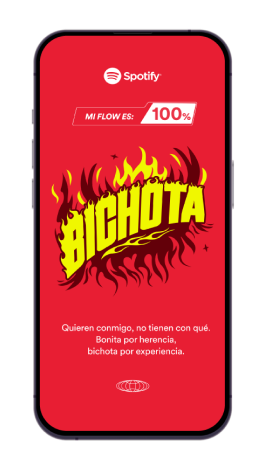
To establish Spotify as the ultimate hub for urban music fans, we developed Find Your Flow, an ingenious digital experience that leverages the platform’s consumption data to analyze people’s musical preferences and assign them a specific style within the urban genre. Known as a “flow persona,” each style is accompanied by fun and unique visuals inspired by its most prominent artists and producers, along with shareable assets for users to showcase their musical identities. Whether you identify as a “Pegao,” well-versed in the latest bangers and their accompanying dance moves, or a “Legend” with a penchant for reggaeton classics, the experience includes a curated playlist for each flow—enhanced by exclusive content, unique activations and merchandise.
Our Craft
Establishing brand awareness through a personalized experience.


A shareable experience that organically boosts engagement.
Thanks to the experience’s shareable features, which Spotify excels at, we were able to organically boost engagement through social media. On top of that, we developed content for each platform, which reinforced the call to action. With an overall impressive performance and excellent results, Find Your Flow has become one of Spotify’s most engaging experiences worldwide; a demonstration of the immense power of insight-driven creative solutions in establishing brand awareness.

Results
-
+34.6 M views
-
+350 M impressions
-
+15.6 M engagements
Want to talk social? Get in touch.
Can’t get enough? Here is some related work for you!


Partnering on Personalization for Ecommerce Revenue Growth • Salesforce Marketing Cloud Personalization
Results
-
$600k+ within 6 weeks of go-live
-
13% conversion in first several days of experience launch.

Supporting a smooth and swift transition to a new marketing stack.
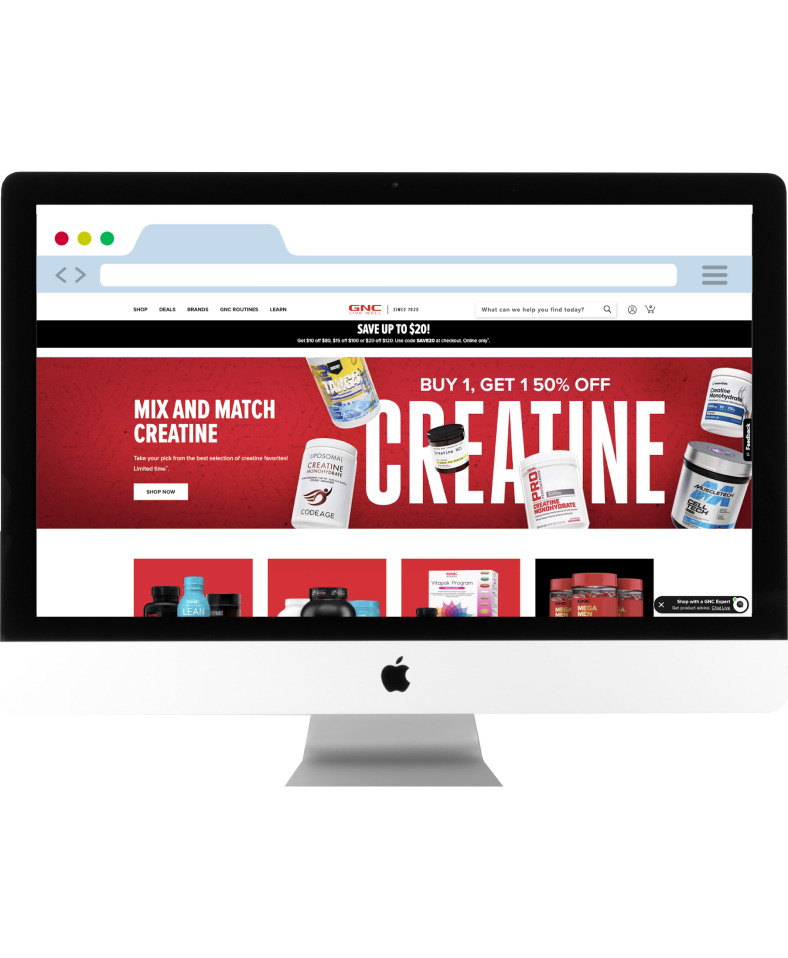
As a long-time and loyal Salesforce customer, with B2C Commerce Cloud, Sales Cloud and Service Cloud already in place, GNC decided to replace their legacy marketing stack and add another solution to the mix: Salesforce Marketing Cloud Personalization (MCP). However, this switch didn’t go as smoothly as planned, as some legacy triggers failed to reconnect. With the peak of holiday shopping season around the corner—and the goal to generate additional revenue beyond previous tech stack constraints top of mind—GNC needed to optimize ecommerce conversions, pronto. So, we stepped in as their Salesforce Consulting Partner to evaluate the impact and help expand usage upon proof of value.
In partnership with
- GNC
Client Words
Monks was a crucial partner in assisting us to fix some outdated, backend set-up in Salesforce Marketing Cloud that we didn’t have the internal expertise to do ourselves.
Jennifer Nordstrom
GNC’s Senior Manager, Owned Customer Channels
A test-and-learn approach homed in on solutions at speed.
To tackle the problem, we implemented MCP as a proof of concept, evaluating the solution before GNC was set to renew their contract—and helping them get to the so-called “aha moment.” This time to value was key to conducting analysis of event stream data and revenue attribution from the implemented use cases. Our Salesforce experts started off with discovery, planning and strategy, which primarily involved reconfiguring the solution. On top of this, we established four use cases to increase holiday shopping conversions, including Abandon Cart, Abandon Browse, Back in Stock, and Lightbox SMS Capture and Trigger. To make sure GNC’s team was completely set up for success, we hosted training sessions on how to best utilize this solution and any additional models moving forward.

Marketing Cloud Personalization is a (Sales)force to be reckoned with.
GNC needed to solve this issue fast, so we tackled it with full force. In just six weeks, we built robust listening capabilities. Three weeks later, we deployed three triggers in production. Finally, in week 12 of our collaboration, we created and implemented a complex Lightbox SMS capture and trigger with a unique couponing solution—equipping the retail company to optimize conversions by providing their audiences with much more relevant 1:1 customer experiences. Safe to say, it was truly a jolly holiday shopping season.
Want to talk CRM? Get in touch.
Can’t get enough? Here is some related work for you!


Solidify Your Data Strategy with The Unlocking Personalization at Scale On-Demand Video
Solidify Your Data Strategy with The Unlocking Personalization at Scale On-Demand Video

Maybe it has been awhile since you thought about your data. Over the decades, digital marketers stacked one tech solution on top of another to add functionality, but after more than 20 years the data is unregulated and sprawled throughout the organization. It’s all there somewhere, but data sets can’t connect, insights can’t be shared across departments and much of the data is no longer actionable.
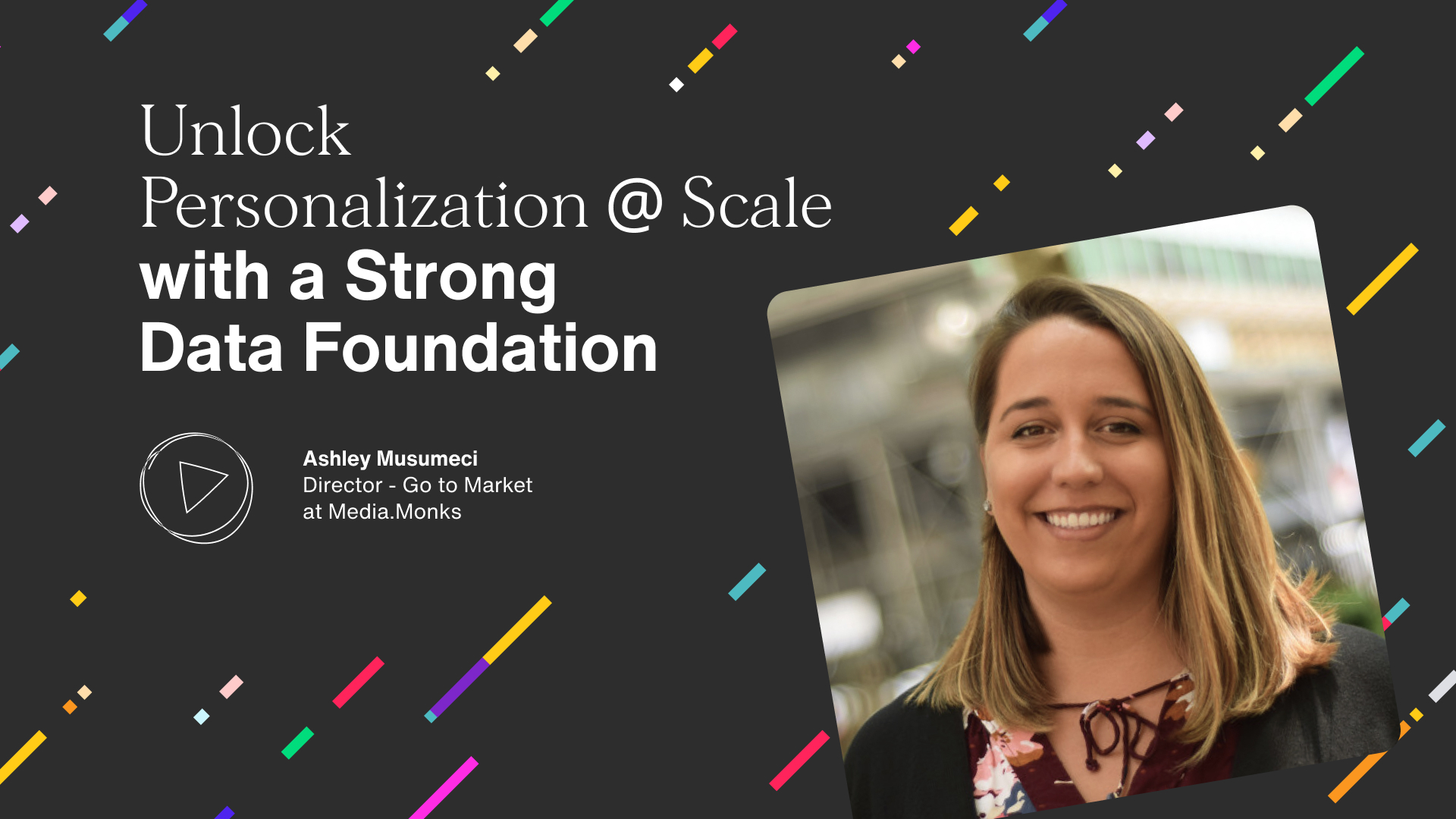
Earlier this year, Ashley Musumeci, Director Go-to-Market, CRM at Media.Monks, spoke to a packed house at Salesforce Connections. This exclusive 15-minute video captures her presentation in which she outlines how brand marketers are using Salesforce to deliver a personalized customer experience at scale when a clear data strategy is in place.
Build a strong data foundation by:
Can Topics Enable Personalization at Scale?
Can Topics Enable Personalization at Scale?


Google have recently announced their newest proposed mechanism for enabling interest-based advertising following the phasing out of third-party cookies, called Topics. Topics replaces Google’s previous proposal, Federated Learning of Cohorts (FLoC), and aims to improve on that proposed solution based on stakeholder feedback.
With Topics, Chrome determines several thematic interests, like “Fitness” or “Travel,” based on a user’s recent browsing history. Topics are calculated and stored entirely on a user’s device without communicating with Google’s servers. They are designed to be transparent and viewable by the user, as well as easily interpreted by potential advertisers via a JavaScript API. This makes Topics a future-proofed solution for simply and clearly providing user’s browsing interests for site owners and advertisers, without exposing detailed browsing history or cookie-based identifiers.
While Topics are aimed primarily at enabling advertisers, it could help with better onsite actions using tools like Google Optimize, Adobe Target, Optimizely, or other onsite testing and personalization platforms.
Brands Need to Look Beyond the Third-Party Cookie
Currently, most optimization or personalization tools cannot be used directly to customize onsite content based on interests. If they can, they are reliant on data management platforms (DMPs) and other brittle solutions that continue to require soon-to-be-deprecated third-party cookies.
For example, Google Optimize cannot be used directly based on interest or affinity information inferred from third-party cookies. Instead, interest data provided by users who consented to third-party cookie tracking is currently available in Google Analytics for reporting and analysis purposes.
Since this data is not available for use in audiences shared with Google Optimize, one is unable to target or personalize onsite experiences based on it. Alternatively, while Adobe Target may be able to access this data through API integrations with DMPs, it is also dependent on soon-to-be deprecated third-party cookies, making the data integration moot.
Chrome’s implementation of the Topics API meanwhile presents a ripe opportunity for personalization tools to leverage user interests, agnostic of the third-party ecosystem. In particular, a user’s interest topics will be stored entirely on the browser and accessible via API, meaning that they can be surfaced to a website or other API caller without reference to an opaque third-party cookie.
This change enables accessibility of users’ Topics directly within the browser, rather than having to be processed on Google’s servers—meaning that a tool like Google Optimize will be able to query and read a user’s Topics in real time when they land on a website, leading to better onsite personalization in a first party context on the browser.
How Topics Can Enable Post-Cookie Targeting
Imagine a user visits our site www.ecommerce.com. As they land on the site, a query to the Topics API returns a relevant interest for that user is “Fitness.” We can surface that topic to an optimization/personalization platform (e.g. Optimize or Target) for targeting, resulting in the optimization platform changing the homepage banner to direct that user to our Fitness product category.
In this way, Topics and a personalization engine could be used to:
- Update landing page copy and imagery to be more relevant
- Personalize a homepage banner to hero relevant product categories
- Feature content or articles more relevant to a user’s interests
- Feed personalized recommendations to users
Pending the exact specifications of how Topics are eventually rolled out, even more advanced use cases may be made possible via storing and linking a user’s topics with a first-party identifier. A first party identifier could be cookie based for anonymous users (e.g. a cookie ID like Google’s client ID), or an identifier linked to a known/authenticated user (e.g. a customer ID, a hashed email address etc). In the above example, it may be possible for the user’s “Fitness” topic to be tracked against their first party identifier in an Analytics tool (e.g. stored alongside a customer ID in Google Analytics).
Once associated with a user’s first-party Universally Unique ID (UUID), this topic could then be integrated with CRM data and used to power relevant marketing automation emails. The topic could also be used to generate more relevant retargeting audiences (e.g. via customer match) or be used to power dynamic creative. Personalization to that level now seems like a hygiene factor with a recent McKinsey report sharing how 71% of customers expect at least a basic level of personalization. However, a fine line needs to be maintained in how data informs the creative process rather than dominates it.
Prepare for Cookie Deprecation Now
Topics are still a very new proposal from Google that has been released in order to prompt discussion and feedback, meaning that the actual Topics API has not been thoroughly tested by partners and stakeholders yet. While we can speculate on use cases and possible applications to personalization, all of the above will have to be tested thoroughly as the Topics API is rolled out by Google.
While we await more detail and further evolution of the Topics API proposal, businesses can partially execute on these use cases by deploying a platform to test and personalize on their website, as well as targeting affinity/interest audiences either via media targeting or profiles available via data management platforms. This would mean a proactive approach to adapt to the eventual deprecation of third-party cookies. Topics may represent a way forward for providing more relevant customer experiences (both onsite and advertising) in a more robust, privacy-centric way.