Choose your language

Choose your language

The website has been translated to English with the help of Humans and AI

Dismiss

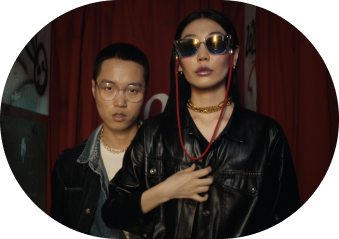
Two people in an urban inside environment. Both are wearing glasses. A guy wearing normal glasses stand aa bit behind a women who is wearing sunglasses with a red cord attachted to it.
Closeup of a women wearing Ray-Ban glasses with a dark heavy frame.

Reinventing Ray-Ban Together • Taking a Timeless Brand into New Creative Directions

  • Client

    Ray-Ban

  • Solutions

    SocialStudioExperience

Connecting a timeless brand with contemporary audiences.

A brand of stature deserves to show up as one—that’s why Ray-Ban continues to choose us as its partner in exploring new creative directions and delivering truly great advertising campaigns. This is the story of how we helped the timeless American sunglasses and eyeglasses brand embrace a new aura of cheeky attitude and coolness, while staying true to its incredible history.

  • The image features a woman wearing sunglasses and earphones, standing in front of a white background. She is the main focus of the image, positioned towards the center. The woman is also wearing a red cord, which adds a pop of color to her outfit. The image features a man wearing sunglasses and displaying various tattoos. He is shown in a close-up view, allowing for a detailed observation of his face and neck. The man's tattoos are particularly prominent, including those on his face and neck.  The focus of the image is on the man's face, with his sunglasses adding a stylish touch. The sunglasses themselves are not the main feature but contribute to his overall appearance. The man's lips are also shown in a close-up view, highlighting their details.

Introducing “You Are On” mode.

To promote Ray-Ban’s new-era vibe, we created a global content strategy around the concept of “You Are On,” which is all about living loudly, fearlessly, and with powerful self-confidence. How to activate this mode? That’s right, by wearing a pair of Ray-Ban glasses. Each campaign stars stunning hero content and is spotlighted across social media, 3D, OOH, TikTok challenges and videogames.

Lifting TikTok impressions with the elevator dance.

Ray-Ban wanted to raise brand awareness among younger audiences, and so we turned to TikTok. Besides delivering interactive posts and social media challenges, we partnered with 11 famous Italian TikTok influencers to create a fun and flirty dance challenge, inviting viewers to get their moves on—and mere moments after lift-off, our “elevator dance” became a global phenomenon. The campaign no doubt earned many second glances, as it reached a total of 12 billion views around the world and sparked users to create 3.2m+ videos. Think you can resist the beat? Give it a try!

Results

  • 17.2 billion views
  • 3.2m new videos created
  • 14% engagement rate

Transforming aviators into NFTs.

Not afraid to reinvent how it creatively expresses itself, Ray-Ban decided to step into the world of NFTs—and we made sure the journey was as smooth as can be. Emphasizing its status as a true pioneer of aesthetic innovations and trends, the brand launched its first-ever pair of NFT sunglasses. Created in collaboration with German artist Oliver Latta—who drew inspiration from the timeless silhouette of Ray-Ban’s iconic Aviator—this exclusive digital piece of art provides an unparalleled brand experience, as it lets fans explore new ways of expressing their uniqueness. Our task: to provide end-to-end support throughout the campaign, from the first idea to strategy, legal and out-of-home components in New York’s Times Square.

00:00

00:00

00:00

Case Study

0:00

Boosting Ray-Ban across the globe.

You can’t establish a strong global presence without driving local impact. So, we tapped into our talent pool around the world to help Ray-Ban deliver targeted campaigns. Whether it concerns a campaign to celebrate the Chinese New Year or a campaign to honor Mexico’s Día de Muertos, our on-site teams have the culture expertise and concrete skills to support Ray-Ban with end-to-end services in any market.

Other mind-blowing stuff

Feast your eyes on Ray-Ban’s creative journey.

  • The image showcases two pairs of sunglasses with the brand names "Killane & Corrian" displayed on them. One pair of sunglasses features red frames and blue lenses, while the other pair has a black frame with reflective blue lenses.   In the upper section of the image, the text "Ray-Ban" is repeatedly written across the glasses, employing a repetition pattern. This repetition of the brand name emphasizes its prominence.   At the bottom of the image, the sunglasses are labeled as "RAY-BAN LIMITED" and "KILIAN

Want to talk social? Get in touch.

Hey 👋

Please fill out the following quick questions so our team can get in touch with you.

Can’t get enough? Here is some related work for you!

Consumer Habits Are Changing. Why Isn’t the Industry?

Consumer Habits Are Changing. Why Isn’t the Industry?

4 min read
Profile picture for user Jouke Vuurmans

Written by
Jouke Vuurmans
Chief Creative Officer

Consumer Habits Are Changing. Why Isn’t the Industry?

Having served as our first Creative Monk in the MySpace days to building a team of more than 2,300 over the past 15 years, I’ve had the privilege of witnessing the immense evolution of digital culture and its effect on creativity. Now, as MediaMonks’ new (and first-ever) Chief Creative Officer, I aim to wield that experience by challenging the one-size-fits-all model that continues to remain popular with creatives today—even though it falls flat against consumers’ needs.

In a time when online experiences are paramount, our ambition to harness the power of technology and creativity is more important than ever. No stranger to adapting to our current realities, this moment offers an opportunity for us to look at the current state of creativity and the vision that sets true innovation from the rest.

Still in the infancy of a new decade, I find myself dismayed at how our industry still struggles to push itself forward. This year especially, brands find themselves with an unequivocal imperative to reassess the strategies they’ve relied on as digital behaviors have quickly evolved. In this age of hyperadoption — in which new behaviors are continually adopted and dropped — we as creatives must raise the bar and reimagine what’s possible.

Consider this: much of the most recently celebrated work may have been placed on digital and social media, but was designed specifically for TVC or print. So many social and digital ads are simple 15 or 8-second cut downs for the toolkit, but different rules and behavior apply to these channels than TV; for example, people on average only watch social ads for about 1.7 seconds, which already makes cut downs incongruent to the format.

Monk Thoughts This year especially, brands find themselves with an unequivocal imperative to reassess strategies as digital behaviors have quickly evolved.
Consumer Habits Are Changing. Why Isn’t the Industry?

The industry stunts itself by limiting its recognition of ads—what I would call all the paid media-related creative work that the industry makes—to include only the traditional formats of one-size-fits-all print and linear, 30-second TV scripts. Being so set in our ways risks our own irrelevance to modern-day consumers, whose customer decision journey (and attention) increasingly extends across digital platforms and channels, often simultaneously.

Rather Than Celebrate Innovation, We Repeat Our Mistakes

Feeling secure in sticking to established success parameters isn’t new for our industry—in fact, it’s not that far off from how we moved from radio into TV ads back in the days. Rather than take advantage of what film had to offer, the first TV ads were basically radio scripts with an image or two. Take the famous Bulova ad, which wasn’t filmed at all; while novel, it failed to take advantage of the creative impact that TV made in storytelling.

Frustratingly, the industry once again finds itself impeded in its ability to develop and recognize creative that takes full advantage of the abundance of opportunities afforded by today’s technology; the most-celebrated digital ads of 2019, for example, might as well be the best ads of 2009. In fact, Ad Age’s Top Campaigns of the 21st Century—which chronicles its first 15 years, ostensibly tracing the direction that advertising has taken in lockstep with gains in digital tech—offers little real distinguishing factor from year to year. Don’t get me wrong, these campaigns are great, culturally relevant ideas, but execution must be better aligned with current user behavior on the appropriate channels best-suited to drive engagement, connection and emotion.

Mind the Creative Gap

Creative teams drop the ball when they fail to mind the (creative) gap between the big idea and the media toolkit. What the industry needs to do is go even broader on the big idea, allowing integration across several channels or sources of data, rather than retrofitting it to one-size-fits-all toolkits that ultimately diminish its creative potential. What gets at the heart of this challenge is the need to recognize context, whether it be through media placement, user behavior, technology or with data.

Monk Thoughts We must use all the tools at our disposal to make sure we not only reach consumers at the right place and time, but truly meet their needs in the contexts in which they engage.
Consumer Habits Are Changing. Why Isn’t the Industry?

To this end, Forrester Research advises, “As experiences traverse digital, physical, and communication moments, each point of intersection should be inspired by the creative articulation of the brand and leave an indelible impression on customers.” Brands will struggle to achieve such an effect if their digital creative isn’t fit for both format and purpose toward the specific moments and places where consumers find it.

And if there’s anything digital isn’t, it’s static: through responsiveness to consumer interaction and data, digital creative enables brands to truly build a connection in a more personalized context. Essentially, the big idea must function as a two-way conversation that anticipates, responds to and builds upon user context and interaction—and as creatives, we must use all the technical tools at our disposal to make sure we not only reach consumers at the right place and time, but truly meet their needs at the contexts in which they engage.

Let’s Build Awareness for Contextual Awareness

One of the most clever examples of a brand [leaning on user behavior/strategy] was Wendy’s “Keeping Fortnite Fresh” campaign, in which a character with a striking likeness to the fast food chain’s mascot infiltrated the popular third-person shooter. Not interested in killing fellow players (which is the object of the game), this virtual Wendy sought to destroy the game world’s in-game freezers as a homage to Wendy’s pledge to never freeze its beef. Livestreamed on Twitch, the stunt represented how brands could skillfully participate in new social spaces online and is a modern, relevant take on the brand’s big idea: the “home of fresh.”

Monk Thoughts We as an industry face unprecedented opportunity to make better, more assistive and unique work.
Consumer Habits Are Changing. Why Isn’t the Industry?

We’re at a time where technology is deeply intertwined not only with the way people consume content, but also how they communicate and form deep relationships with one another. Given the abundance of data available through these myriad interactions, not to mention the many opportunities to act upon them, we as an industry face unprecedented opportunity to make better, more assistive and unique work—and when that work is produced, we must celebrate it rather than cling to the safe, established yet increasingly irrelevant success parameters of the past.

With all of this discussion about how advertising must change, and in a moment when we’re challenged once again to adapt to a new reality, I look ahead to a future where our industry rises to the creative challenge by building experiences that drive impact throughout ecosystems, resonating with consumers’ needs no matter where they are. This has always been our dedication; and as MediaMonks’ newly appointed CCO, I hope my voice resonates and serves as a catalyst for change.

MediaMonks CCO Jouke Vuurmans assesses the state of creativity today, and how marrying it with technology results in better experiences. Consumer Habits Are Changing. Why Isn’t the Industry? Jouke Vuurmans, our new CCO, assesses the state of today’s creative.
Digital advertising digital marketing mediamonks jouke vuurmans digital creative customer obsession creative storytelling

(Re)Focus Advertising on Value

(Re)Focus Advertising on Value

5 min read
Profile picture for user mediamonks

Written by
Monks

(Re)Focus Advertising on Value

It’s time to acknowledge the elephant in the room: during a time of instability and hardship, should brands halt their advertising and go dark? Data shows that most consumers still want to hear from brands, but their message should be focused on building value. Still, even the idea of what constitutes as an appropriate response varies day-by-day and by location, highlighting the need for brands to invest in truly understanding their audiences and how they can lend support to them at speed.

In fact, brands who continue to invest in advertising spend throughout a recession tend to benefit by experiencing revenue gains that persist beyond its passing. 44% of consumers plan to delay purchases until after the COVID-19 outbreak has ended, and brands must use this time to prepare for the inevitable need to quickly grow following significant revenue loss throughout the pandemic.

Still, brands must consider whether spending makes sense. “Traditional advertising response is spend, spend, spend,” S4Capital Chairman Sir Martin Sorrell told audiences in conversation with Ad Age. “But when companies are facing existential crises in Q2 and not sure if they have enough money to survive, it’s ridiculous.” Instead, he recommends that those in tech who planned campaigns and sponsorships for canceled sporting events “should divert that spending to doing good, purpose-driven campaigns. But those campaigns should be highly practical–equipment, vaccine development, therapy–supporting those on the frontline. It shouldn’t be self-seeking. You have to encourage clients to deploy their resources more effectively and divert money into digital because that’s more effective.”

Still how do brand ensure their focus is on providing real, authentic value to audiences in the coming months? The secret lies in redefining the role of the brand in consumers’ lives and being proactive to their shifting needs in a disruptive landscape.

Invest in Insights-Driven Creative

“In the first couple of weeks, data suggested that people didn’t want to hear from brands,” says Andre Rood, Global Advertising Director at MediaMonks. “Afterwards, you saw them slowly get into the mindset, as long as brands were being helpful.” He notes how brands’ initial response to the coronavirus from felt so repetitious, with so many brands reiterating the same message: wash your hands for 20 seconds and stay at home. They weren’t differentiating or cutting through to individuals’ specific needs at the time.

Now more than ever, customer obsession is critical to brand health.

Monk Thoughts The way you should target and personalize should be totally different now.

MediaMonks Founder Wesley ter Haar notes that in reacting to COVID-19, it’s more important than ever that brands invest in personalization, or they risk looking insensitive. This prompts brands to consider personalization beyond the typical categories of demographics and user preferences. Instead, they have to dig deep into the nuances of what their audiences are dealing with, and the myriad ways that the brand can help.

“The COVID curve is different everywhere, even affecting people differently who live in the same community,” ter Haar says. “For some that means looking for a cure to boredom—but that messaging is insensitive for a family of six that is homeschooling while working from home, who are too busy to be bored. It’s never been more important to actually understand who you’re talking to.”

Rood echoes this sentiment by cautioning that brands shouldn’t rely on the standard segmentation methods, which currently offer little relevance. “The way you should target individuals should be totally different now,” he says. Mood triggers, for example, can help a brand tailor the most supportive and relevant message to audiences whose experience with the pandemic can wildly differ.

Test New Production Solutions at Speed

The speed at which the COVID-19 situation can change also poses a challenge to brands focused on keeping connected with their audiences throughout the full scope of the pandemic. For example, a brand might be set to launch a campaign, only to find that it’s suddenly no longer relevant. In addition to offering a dynamic campaign as mentioned above, brands must employ rigorous testing to understand how people are responding to creative week by week.

Screen Shot 2019-07-31 at 3.23.38 PM

Our awareness campaign for Gladskin was optimized per channel and format based on weekly reportage.

“Due to the fact that this is moving so quickly into unknown areas, brands must be able to galvanize and shift content immediately,” says Patrick Kirby, Digital Strategist at MediaMonks, noting that becoming more agile is essential to success.

Ways to do this include repurposing archival material for legacy brands who have it, turning to quick and versatile animation as a production alternative or encouraging UGC and influencer content to build community engagement. Each of these approaches enable brands to reallocate budgets or refresh existing content, but more importantly, they can do so at speed.

Redefine the Brand’s Role

More than simply continuing to advertise to consumers with conversion-based content, now is a good time for brands to truly focus on building brand value and becoming more purposeful. For example, while brands should tread lightly in approaching the current moment with humor, there is value in using creative to lift spirits and boost morale.


Monk Thoughts What’s important isn’t just the product, but the full story around it.

There’s a lot of talk too about how manufacturers have done substantial good by shifting operations to produce much-needed masks, hand sanitizer, ventilators and more. This approach isn’t practical for many—for example, smaller or mid-sized brands. But there are still opportunities to get creative in how you leverage your channels and platforms, like HP and Folding@Home’s initiative that encourages users to donate a fraction of their computing power to aid in the research toward a COVID-19 cure.

Such approaches are rooted in customer obsession, in which brands pool together resources to listen to the customer and deliver upon those needs. Willemijn Jongbloed, Digital Strategist at MediaMonks, notes how Nike was able to adapt well to offer value to consumers under quarantine thanks to its customer obsession strategy. MediaMonks has partnered with the athletic brand and Wieden+Kennedy to host a weekly series of livestreamed workouts that get people active and moving despite staying at home.

Akin

“When Nike moved into events, that was a bold move at the time, but now you can clearly see the many sides of the brand. In a time when people have largely stopped buying clothes, they have created the ability to move into online events, and thus can instantly serve their audience in a different way.” What makes the experience powerful isn’t just the product itself, she says, “but the full story around it—including all benefits, use cases, mindset and emotional connection that will set a company up for success.”

That drives home an important point for brands as they seek to engage with and support consumers over the next few months. Wielding brand voice in a global pandemic isn’t a matter of simply keeping your name out there or driving conversions; it’s also about building trust, becoming more purposeful and experimenting with more agile ways of working. As brands hone these skills now, they’ll emerge from the other end of the pandemic stronger than before, and their audiences will come to appreciate those efforts.

"Spend, spend, spend" doesn't make sense for everyone–but some brands can take this time to invest in effective, purpose-driven ways to assist consumers. (Re)Focus Advertising on Value Now is the time for brands to invest in assisting audiences in truly purposeful, effective ways.
Digital advertising social advertising advertising strategy media strategy pandemic coronavirus insights driven creative data driven creative brand value brand differentiation

Choose your language

Choose your language

The website has been translated to English with the help of Humans and AI

Dismiss