Choose your language

Choose your language

The website has been translated to English with the help of Humans and AI

Dismiss

Performance Marketers Should be at the Center of AI Transformation

Performance Marketers Should be at the Center of AI Transformation

AI AI, Data, Digital transformation, Media, Performance Media 4 min read
Profile picture for user adam

Written by
Adam Edwards
EVP, Performance Media

A computer generated skeleton with guidelines around it

The meteoric rise of GPT-4, as well as generative AI tech more generally, has the digital marketing world focused on the wide-reaching implications on our industry. Understandably, the majority of the attention has been on the impact of ideating and scaling creative and content more efficiently. After all, generative AI unlocks the power to generate high quality content, and lots of it, like never before.

Performance marketers have been an underutilized resource to date, but their years of experience using AI for marketing success make them well suited to play a large role in broader AI adoption. Blind disciples of every generative AI shortcut will get burned and those resistant to change will become irrelevant. Nobody knows this more than performance marketers. 

As it relates to the digital marketing AI arms race, Google, and to a lesser extent Meta, weren’t nearly as proactive at highlighting their work relative to Microsoft (the largest investor in OpenAI, the company responsible for GPT-4). The irony is that Google and Meta had been at the forefront of incorporating their long-standing investments in AI, which was already deployed in almost every corner of Google and Meta Ads platforms and products.

Google and Meta represent nearly half of all digital ad spending in the US and represent an even larger share of the typical performance media budget. AI integration in Google and Meta has most prominently centered around machine learning algorithms for bidding and ad serving. That said, there are examples of generative AI as well (suggesting ad copy and creating distinct ad copy from permutations of existing headlines and body copy), and AI’s tentacles can be felt everywhere in the Google and Meta ad ecosystem. Prominent examples include:

  • Performance Max (Google) and Advantage+ (Meta) are effectively end-to-end automated campaigns that use AI to target, generate ads and optimize toward set goals.
  • Automated bidding sets dynamic bids in real time using machine learning to more efficiently optimize toward the highest ROI.
  • Responsive Search Ads (Google) uses AI to mix and match different portions of copy to deliver the best permutation for the individual searcher (right ad to the right audience at the right time).
  • Recent Google Marketing Live (GML) and Meta Connect 2023 conferences announced products around AI-powered assets, AI-generated images, generative AI to create ad copy and auto enhancements to text placement, brightness, etc.

In that same vein, performance marketers, most of whom earned their stripes running or overseeing Google and/or Meta Ads, are particularly well suited to guide advertisers through this next major stage in digital transformation. The nearly half decade of experience most performance marketers have both harnessing and reining in AI tools justify them playing a central role guiding marketing teams in developing and deploying generative AI adoption.

What about this experience gives performance marketers an advantage? 

  • Threading the needle between uncritical adoption and complete resistance to change
  • Understanding of the importance of high-quality data inputs 
  • Understanding the importance of setting guardrails and tweaking those over time 

Bringing healthy skepticism to the table.

Seasoned performance marketers have had to adapt and learn new types of automation many times over, and can share their war stories. From broad match keywords, Meta auto-placements and iteration after iteration of automated bidding on Google gone awry, we’ve seemingly seen it all. Google and Meta were trailblazers in incorporating AI into ad products, and reps would very earnestly push adoption of products that could be buggy and at worst underperform manual alternatives. However, Google and Meta were also diligent about refining those products over time and performance marketers who were not willing to continue testing at all over the last few years were quickly left behind. Broad match keywords, automated bidding, Advantage+ shopping campaigns and many more products delivered more scale at comparable efficiency to non-AI driven products. 

As AI plays a more permanent role across creative, customer journey, audience identification and more, this balance will be crucial. Blind disciples of every generative AI shortcut will get burned and those resistant to change will become irrelevant. 

Garbage in = garbage out.

One of the biggest distinctions in a strong performance marketer versus a mediocre one is her understanding that the inputs to automation can have a profound effect on outcomes. Performance marketers who press the easy button and switch from hundreds of manual bids per week to auto-pilot don’t get strong results. Worse yet, they’re quick to declare, “It doesn’t work!” Data volume and quality are the foundation of an effective AI deployment strategy. Knowing which data sources to use and exclude, and which campaigns to match with each specific type of automated bidding, is a crucial skill. Performance marketers know to incorporate lead quality data to B2B auto-bidding, initiate testing on campaigns with higher conversion volumes, and not to launch immediately after a strong holiday or back to school period.

In this sense, performance marketers have years of “prompt engineering” reps without even realizing there was a name for it. Marketing organizations stand to get AI into market faster, and benefit sooner from the positive results, by tapping into that experience. 

Performance marketers are masters at fine tuning.

The last level of mastery that performance marketers have achieved has to do with learning the intricacies of the algos. We have applied max CPCs, cost caps and negative keywords to rein in the occasionally deleterious effects of AI unchecked. At a high level, AI can be fickle and human intelligence is crucial to avoid these blips. We have seen a top performing ad set stop delivering seemingly out of nowhere, only to have a minor 5% increase in ROAS target return it to normalcy. We’ve learned to mine for insights around how, why and where AI is working:

  • Is stronger performance because we’re seeing increased CTR or conversion rate?
  • Are we getting in front of the same audience more cost effectively or reaching a better audience?
  • Did we create better ads, or did the platforms get better at matching them to the right people?

We ask these questions daily. That curiosity bordering on paranoia allows performance marketers to squeeze the most out of AI, as well as limit downside risk. 

Performance marketers have a feel for AI’s rhythms, like a mechanic knowing just which bolt to tighten to get the rattling sound in the car to stop. This mileage, or put anachronistically “human intelligence,” is tough to replicate. 

This AI mileage and its broad applications are why performance marketers should have a seat at the table. As an agency leader I’m better equipped to weigh in on how we utilize AI to address tasks, reporting, data integration, scripts and implement processes around AI because of that performance DNA.


Learn how performance marketers play a central role in guiding marketing teams in developing and deploying generative AI adoption. performance marketing Generative AI Google automation b2b marketing AI Data Performance Media Media AI Digital transformation
Paycor logo
A phone showing Paycor's application interface

Audience-Based Market Growth • Deep Data Dive to Improve the Customer Journey

  • Client

    Paycor

  • Solutions

    MediaPerformance MediaCRMDataPaid SearchPaid Social

Results

  • 67% increase in ad CTR
  • 240% increase in leads
  • 63% improvement in cost per acquisition
A computer showing the paycor app

Fueling audience-based marketing growth.

Paycor, a leading Human Capital Management SaaS platform, needed to find a new growth path for both overall leads and small business users. But there was a challenge: while reaching SMB prospects on networks like LinkedIn is straightforward, search ads don't offer the same level of dependable audience data. Realizing that pricing is a key decision criteria for that market, we worked with Paycor to develop a plan to segment and increase SMB leads for search using pricing as the central offer—overall scaling growth for the market.

Orange squares

In partnership with

  • Paycor
Client Words SMB leads are very important to us and the strategy that our two teams have crafted, using all data available to us, has meant that we are able to grow those leads in a cost-effective way.
Lauren Denison headshot

Lauren Denison

Manager, Digital Marketing at Paycor

Defining unknowns with behavior-driven insights.

To serve personalized messaging to enterprise and SMB separately on search, we created Customer Match audiences by cross-referencing known audience data from Paycor's CRM with searchers who are already categorized and known to Google.

Segmentation was harder for unknown searchers. With the help of our Compass reporting suite, Paycor integrated their CRM data to analyze keyword groups based on historical CRM behavior, including where prospects were in the funnel when they converted and the size of the company. These insights allowed the teams to categorize search markets into groups and to personalize the customer journey on search ads and other channels, like paid social.

A person using paycor on their tablet at a desk

Unlocking granular specificity—and results.

For the key SMB audience, the teams were able to reduce the number of clicks it took to find cost info at all stages, and added price-specific language to ad messaging for those closer to the purchasing decision. They also applied a funnel-specific call to action from ad copy to landing pages, increasing from three to 18 messaging and landing page combinations.

This kind of specificity had not been possible before, and was the result of SEM data analysis driven by Compass, aggregated client CRM data, and unique client-side customer research insights that gave the teams what was needed to personalize the customer journey. The updated approach to messaging for both known and extrapolated audiences led to surprisingly large gains in ad engagement and enabled even more growth in new business opportunities for Paycor.

Want to talk performance? Get in touch.

Hey👋

Please fill out the following quick questions so our team can get in touch with you.

Can’t get enough? Here is some related work for you!

A person riding a Harley Davidson motorcycle
A person rides a motorcycle down the road

Pan America Reveal • Transforming an Iconic Event Into an Unforgettable Experience

  • Client

    Harley-Davidson

  • Solutions

    BrandOriginal ContentVR & Live Video ProductionGo-To-Market StrategyWebsites & Platforms

00:00

00:00

00:00

Case Study

0:00

As the Harley-Davidson community geared up for another memorable model year launch we crafted an immersive virtual destination for Harley’s first-ever digital reveal of new models in the brand’s 118-year history. 

Embarking on a road less traveled for both enthusiasts and dealers, the experience included interactive elements for new bike exploration, access to product specialists via live Q&As, shoppable content and dedicated microsites that encourage riders to continue the adventure.

Our Craft

Showing possibilities as wide as the open road.

  • Jason Momoa sits on a Harley
  • Harley Davidson platform screen
  • Explore the icons screen from the Harley Davidson platform
  • Road King special Harley Davidson screen
  • Launch countdown clock on platform

Microsites took users on a real-world virtual journey, making pit stops for video content, merch and interactive 3D renders of each bike. Users got to customize a bike's look, digging into what makes each model unique. With an integrated approach localized for 11 countries around the world, better represent the brand's diverse ridership and reach a wider audience of riders than ever before.

We also created a series of docu-style films profiling riders and the values that drive them—no actors, scripts or sets—riding the Harleys they love. And a separate 26-minute documentary—Everything’s a Road: The Path to Pan America—kicking off the launch of Pan America, H-D’s highly anticipated entry into the adventure touring category.

Results

  • Over 2 billion media impressions.
  • 97% positive media sentiment.
  • Over 360K viewers of the Pan America virtual launch, 
plus global media acclaim.
  • Sold out of Pan America pre-order allocation.
  • 1x CSS Site of the Day

  • 1x FWA

Want to talk film? 
Get in touch.

Hey 👋

Please fill out the following quick questions so our team can get in touch with you.

Can’t get enough? Here is some related work for you!

A white windmill in front of a cloudscape
Flying birds
A winding river with lush green shrubbery

The Climate Pledge • Accelerating Climate Action With a New Digital Presence

  • Client

    Amazon, Global Optimism

  • Solutions

    PlatformWebsites & PlatformsBrand

Leading a net-zero carbon commitment.

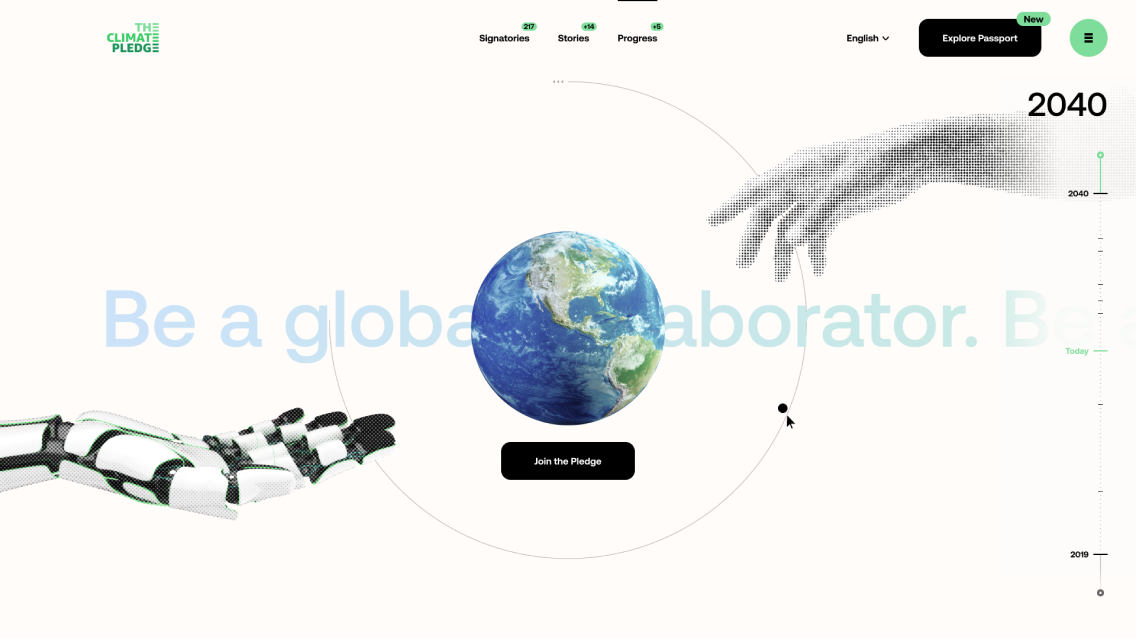
How can urgent climate action become every company’s business? This was the question that inspired the launch of a reimagined platform for The Climate Pledge—a commitment to reach net-zero carbon emissions by 2040. 

Powered by Amazon and Global Optimism, the initiative wanted to attract big-name signatories, grow quickly, and promote its newly articulated mission to “accelerate responsible climate action in every industry so our planet’s diverse communities, natural resources, and shared environments can thrive indefinitely.”

Owning responsibility to power possibility.

The platform plays up the need for action at the enterprise level while reinforcing that together is the only way forward. A modern identity system and comprehensive asset library was created to scale quickly and maximize flexibility. Interactive components, user interface animations, diverse compositions, and curated photography prompt contemplation and participation—and embed a sense of curiosity and suspense.

A fresh verbal identity builds on the initiative’s optimistic outlook and makes sustainable transformation feel personal, tangible, and accessible. Rotating narrative elements allow for dynamic storytelling and reveal how companies have the ability to change Earth’s trajectory. Localization was an important consideration, and the platform translates into multiple languages.

Traveling through time.

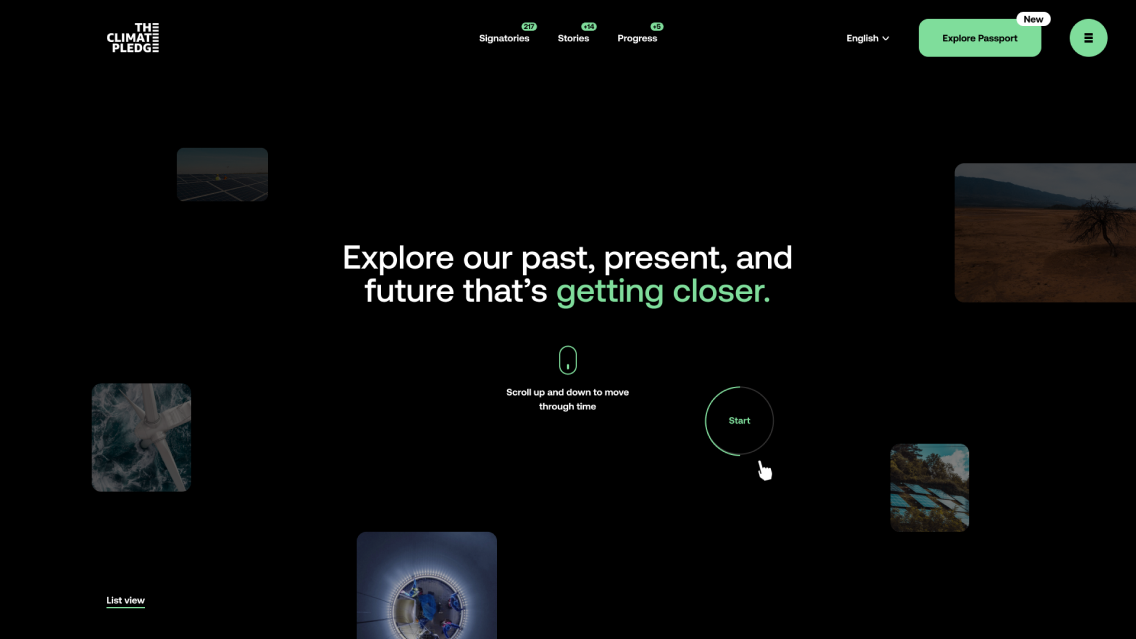
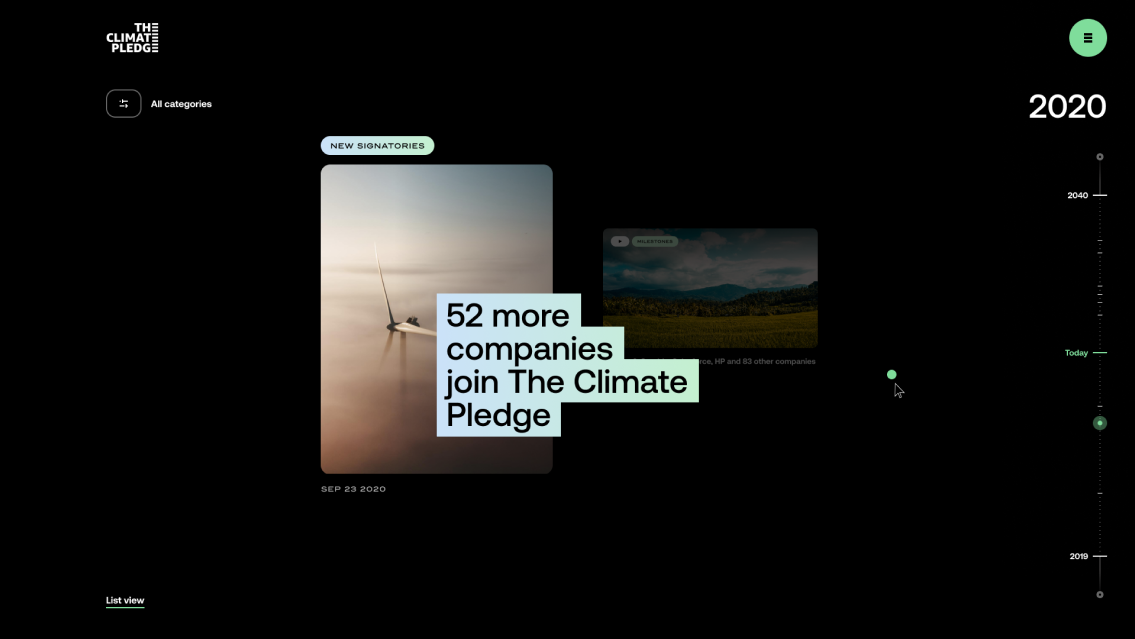
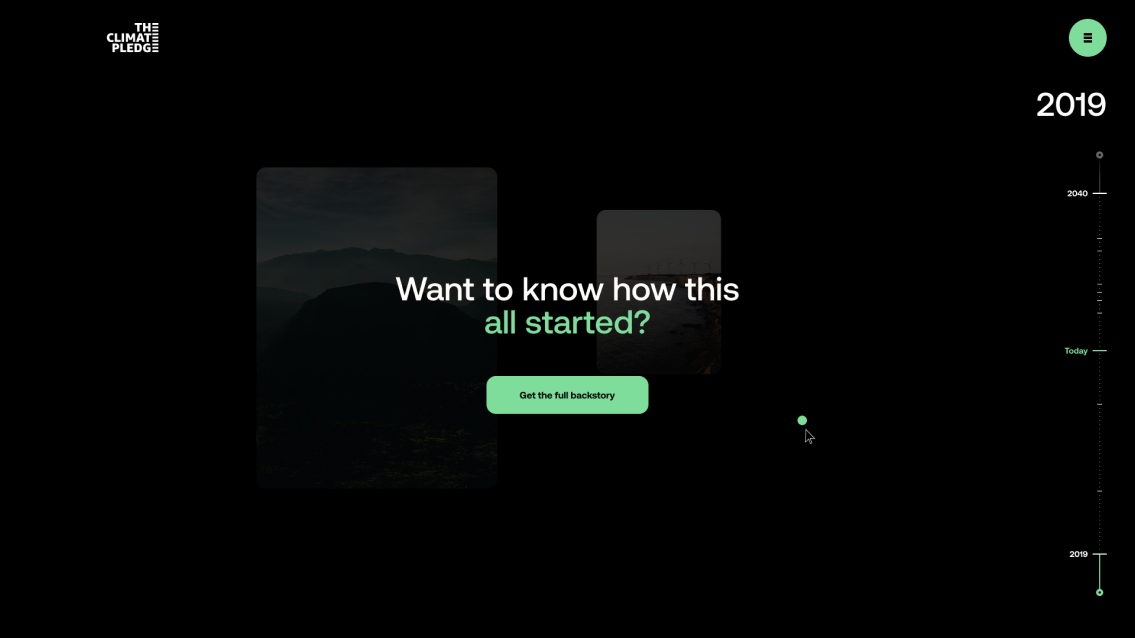
An immersive time tunnel lets visitors travel through the Pledge’s backstory, the collective progress being made by signatories, and the decades ahead. Two viewing modes accommodate different user needs. Filters enable sorting by milestones, new signatories, news, events, and more.

Seizing the moment

Fast-tracking a better forever

  • Climate Pledge website homepage
  • Climate Pledge website homepage
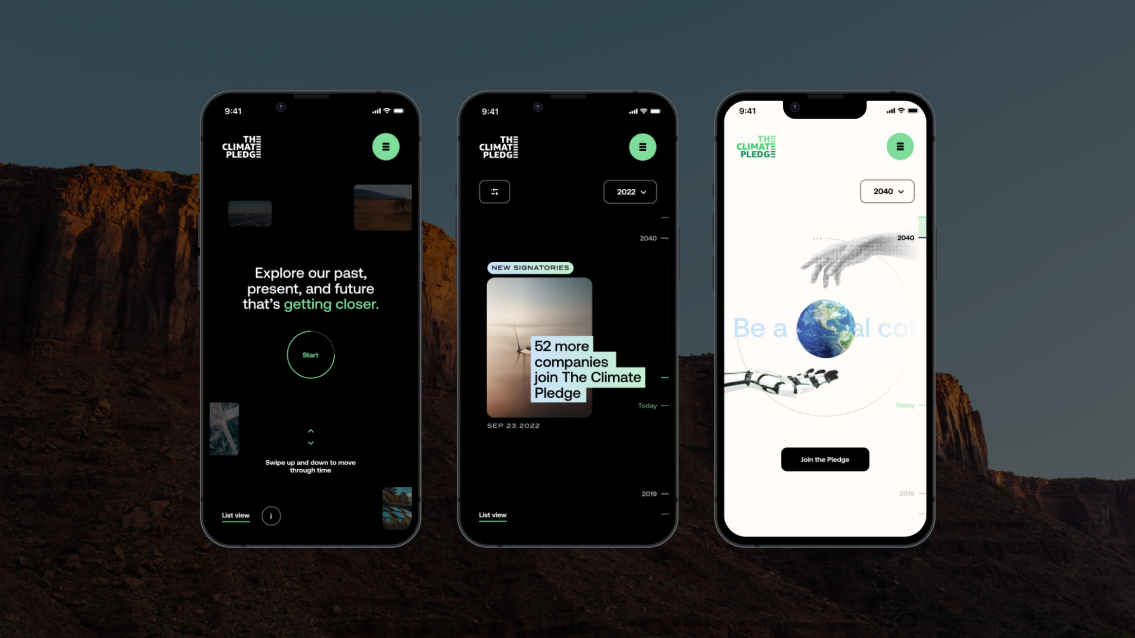
  • Climate Pledge website homepage on mobile screens
  • Climate Pledge website homepage
  • Climate Pledge website homepage

Automating signatory onboarding.

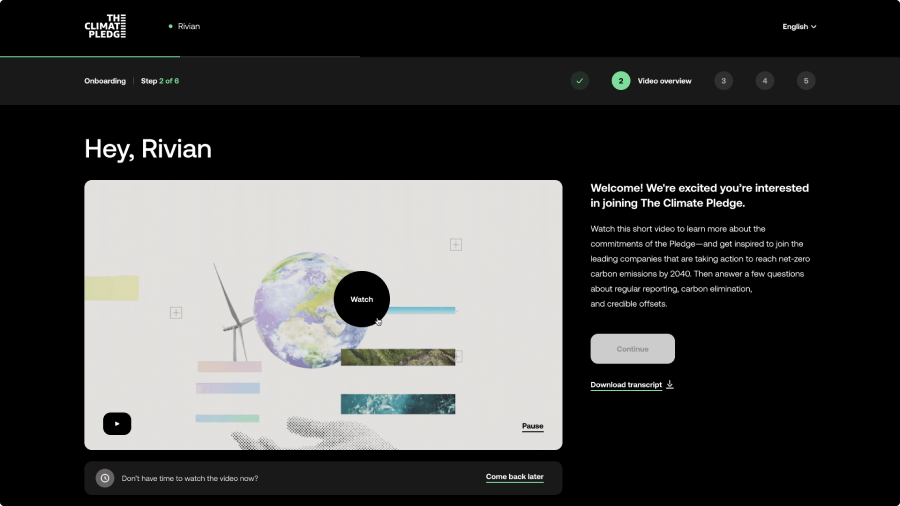
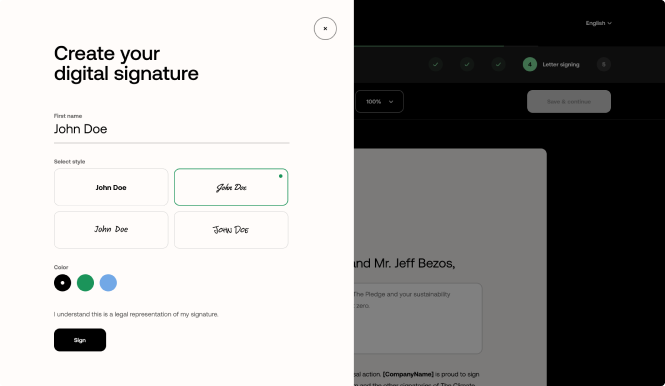
Behind the scenes, we developed a fully automated system for onboarding new signatories and publicizing their commitment to net-zero carbon. A multi-step process contains helpful tool tips and makes it easy for leading companies to submit their information and review required qualifications. Signatories draft and sign their own commitment letter, eliminating the need for manual moderation.

Climate pledge website interface
Windmills on a green rugged landscape

In partnership with

  • Amazon, Global Optimism
Client Words When it comes to the climate crisis, the stakes couldn’t be higher. Monks understood the urgency and weight behind our ask. They pushed our vision and delivered a solution that’s helping inspire companies around the world to take on this bold commitment.
Sally Fouts headshot

Sally Fouts

Global Leader, The Climate Pledge, Amazon

Launching an online community.

We designed Passport: an online destination where signatories of the Pledge can connect, find resources, share ideas, and take joint action. This virtual community is the newest addition to the Pledge’s platform—and is set to officially premiere in 2023.

00:00

00:00

00:00

Case Study

0:00

Want to talk platforms? 
Get in touch.

Hey 👋

Please fill out the following quick questions so our team can get in touch with you.

Can’t get enough? Here is some related work for you!

aerial view of people walking in a city square
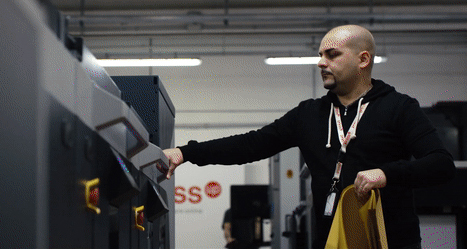
A person opening a large printer to add paper
Large professional HP printer in an office

Possibility City • Opening a World of Possibilities

  • Client

    HP

  • Solutions

    PlatformWebsites & PlatformsImmersive Brand StorytellingDataCRM

00:00

00:00

00:00

Case Study

0:00

A one-stop shop for printing professionals.

Beyond relying on traditional tradeshows and events, HP found a world of possibilities in launching its new printing press: the HP Indigo 6K. Tossing aside the traditional B2B journey—and the myth that selling an industrial printer hinges on physical, in-person demos—we worked with the brand to build Possibility City, a smart online platform showcasing the new press’s features and a home for webinars and one-on-one demos.

Our Craft

A detailed, immersive exploration of HP's 
new press.

  • HP Possibility City website screenshot of printer with woman in front
  • HP Possibility City website screenshot of recent events
  • HP Possibility City website screenshot of closeup of printer
  • HP Possibility City website screenshot of closeup of printer
  • HP Possibility City website screenshot of tiles

Tactile content brings the product to life.

Possibility City is a fully immersive virtual platform that connects customers across a personalized journey. Through the use of tactile 3D assets, visitors can look “under the hood” to inspect the HP Indigo 6K’s insides in close detail, discovering how every moving part enables the perfect print.

Curated content also helps visitors find the information they seek, whether they’re looking for efficiency, sustainability, security or other important business goals. Not sure where to begin? No worries; our live virtual assistant learns from visitor preferences to provide tailored content recommendations. Everything encompasses a hyper-personalized journey at its core—from start to finish, making good on our “business to human” approach.

HP Possibility City website screenshot of tiles

Supercharging sales on a streamlined journey.

Possibility City allows showrooming beyond in-person limitations—while continuing to build value. The platform supercharged sales by helping decision-makers along to the next stage of their journey, and by generating leads for HP in real time. Bringing together reports, webinars, demos and curated content, the always-on platform fully engages B2B customers through a resonant user experience—and offers new possibilities to engage with new and existing prospects.

Want to talk platforms? 
Get in touch.

Hey 👋

Please fill out the following quick questions so our team can get in touch with you.

Can’t get enough? Here is some related work for you!

Humanize the B2B Brand Story with Tactile, Relatable Content

Humanize the B2B Brand Story with Tactile, Relatable Content

4 min read
Profile picture for user mediamonks

Written by
Monks

Humanize the B2B Brand Story with Tactile, Relatable Content

As consumer needs change, so do business strategies. Realizing the importance of purposeful, personalized digital experiences to their audiences, future-thinking B2B brands have seek to engage their audiences in new ways, humanizing their brand stories in the process.

In essence, this means adopting a “business to human” approach through customer-driven digital experiences. Today’s B2B customers expect an experience that is similar to the shopping they do in their personal lives. “The B2H model involves maintaining coherence while extending your offering across context and environments, and being able to break down your brand’s message into personalized variations that are relevant to a myriad of customer interests,” explains Remco Vroom (Global Head of Business, Platforms and Ecommerce, MediaMonks) and Tobias Wilson (VP Growth APAC, MediaMonks) over at Marketing Interactive.

Even with traditional production hampered by social distancing, brands can still achieve the above through more personalized, customer-driven digital experiences. Powered by CGI content, virtual demos and influencer validation, these small experiences are relatively easy for brands to begin building and offer the opportunity to plug into larger content strategies—here’s how.

Build Tactile Brand Stories Through Interactive Experiences

In B2B services, there exists a gap in delivering interactive, branded digital content that provides potential customers with the information they need to make informed purchases. According to data from Bizfeel, more than half of consumers say that the biggest drawback to shopping online is the inability to touch, feel or try a product. Without being able to try a product themselves, they turn to other avenues: 80% of business decision-makers look toward articles rather than ads for brand information.

Bluecanyon 07

These findings highlight a big need for brands to own their brand storytelling through interactive content that provides a good “feel experience”—a tactile experience that immerses the audience—and differentiates the brand by showcasing product features and stories. A gorgeous example is the Blue Canyon Technologies website, which features 3D graphics developed by MediaMonks. Each 3D model portrays a product in the company’s fleet of spacecraft as well as the specific components that set them apart. Visitors are invited to click on these features to learn more about them in depth, demystifying the technology against the backdrop of deep space.

CGI Content Enables Scale

B2B brand stories are powerful because they help customers better understand processes that might seem complex and abstract. To help build awareness and understanding of the HP Indigo Digital Press—an industrial printer differentiated by a unique component that allows for shorter runs—we used an existing set of CAD designs to develop a fluidly animated CGI walkthrough of its inner workings.

“When you’re looking at presses this big and complicated, you can’t move around them or look inside very easily,” says Chris Bryne, Global Program Director at MediaMonks. “It’s a way of letting people see under the hood.”

The use of renderings to produce the video also came out of a particular constraint: the product wasn’t yet manufactured, which meant there was no physical product yet to film. Today, as so many brands are experimenting with new ways to produce content while social distancing, CGI serves as an excellent example of how to tell a compelling brand story through video without a traditional shoot.

HP Microsite LEPX 10

“CG assets are easy to update if features change or things are replaced,” says Byrne, noting that the technology is economical for scaling up and retailoring to other formats, too. “Experiences like these result in extra assets you can use to power different experiences across platforms.”

For example, following a video walkthrough, brands might want to add greater tangibility and intuitiveness by crafting an interactive demo with those assets, tying it into a larger customer obsession strategy. For HP, we built on the video offering by adding a WebGL demo that lets users get up close and personal with the LEPx technology that powers the Indigo printer. This way, users gain a tangible understanding of the product specifications through discovery.

Validate Your Brand Story Through Influencers

When you consider tailoring a B2H story to other platforms, don’t forget another strategy that’s risen to much fanfare in the B2C world: influencer marketing. Yes, influencer marketing does have a place in the professional world, too; in fact, 91% of B2B transactions are influenced by word of mouth.

Monk Thoughts Experiences like these result in extra assets you can use to power different experiences across platforms.

Influencer strategies can plug into customer advocacy (lending legitimacy through success stories), employee advocacy (adding relatability through employees’ experiences) and expert advocacy. The latter includes the thought leaders and industry experts who lend credence and validation to a product or service.

Each of those strategies fit within different channels, whether you intend to raise awareness or support audiences in the consideration stage—for example, validating the decisions that customers have made. On this note, Byrne cautions that before brands get too far into establishing what kind of content their audiences need, they must first consider where those audiences fit within the customer decision journey. “Focusing on awareness or conversion gives your content a very different purpose.”

Purpose is key to delivering on the needs of your B2B audience. Whether it’s authentically relating with your audience via influencers or scaling up virtual product demoes through CGI content, seek ways to humanize your brand story by injecting interactivity through unique, personalized digital experiences.

It’s time to go Business to Human.

By offering tactile, interactive content and partnering with influencers, B2B brands become "business to human," offering new ways to connect with digital audiences. Humanize the B2B Brand Story with Tactile, Relatable Content Become a “business to human” brand through customer-driven, interactive experiences.
B2b b2b marketing b2h b2h marketing business to human interactive content personalization influencer marketing webgl cgi virtual production

Choose your language

Choose your language

The website has been translated to English with the help of Humans and AI

Dismiss