







Choose your language

Choose your language

The website has been translated to English with the help of Humans and AI

Dismiss

Find Your Flow Digital Experience • Leveraging Spotify's Data to Connect With Young Fans

  • Client

    Spotify

  • Solutions

    DataExperienceSocialStrategy

00:00

00:00

00:00

Engaging urban music fans through personalization.

Spotify is one of the most influential audio streaming platforms, a feat attributable to features like the ability to create personalized playlists and discover new music through curated recommendations. Constantly striving to offer unparalleled experiences, they pay close attention to their consumers’ behaviors and interests—which allowed them to notice an industry-wide increase of 170% in Latin music streams in the last five years. Recognizing this as a prime opportunity to establish stronger connections with younger listeners, we collaborated with Spotify to develop and amplify a digital experience that taps into urban music, one of Gen Z’s favorite genres, and their yearning for personalization.

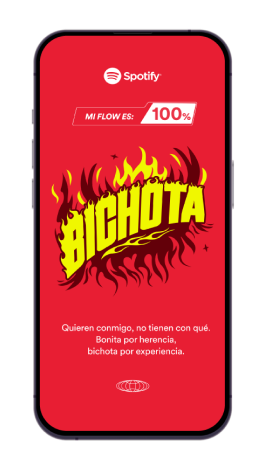
Mockup of a mobile phone with a red screen and in the middle yellow copy 'Buchota' in the form of flames.

In partnership with

  • Spotify
Client Words The music editorial team meticulously created custom playlists for every flow, considering song lyrics, subgenres, rhythms, and emotions. It’s a chance for users to express themselves and uncover what sets them apart through an enjoyable process.
Headshot in black and white of Sol Naldi - Marketing Lead at Spotify Mexico

Sol Naldi

Marketing Lead at Spotify Mexico

Adding value through data-driven insights.

To establish Spotify as the ultimate hub for urban music fans, we developed Find Your Flow, an ingenious digital experience that leverages the platform’s consumption data to analyze people’s musical preferences and assign them a specific style within the urban genre. Known as a “flow persona,” each style is accompanied by fun and unique visuals inspired by its most prominent artists and producers, along with shareable assets for users to showcase their musical identities. Whether you identify as a “Pegao,” well-versed in the latest bangers and their accompanying dance moves, or a “Legend” with a penchant for reggaeton classics, the experience includes a curated playlist for each flow—enhanced by exclusive content, unique activations and merchandise. 

Our Craft

Establishing brand awareness through a personalized experience.

  • Image with a bright red background. In the middle you see the copy 'Bighota' in yellow flame letters.
  • Image with a bright purple background. In the middle you see the copy 'Pegao' in white with black lines and small illustrations around it.
  • Image with a bright pink background. In the middle you see the copy 'Romantic' in green and blue graphic letters.
  • Image with a black background. In the middle you see the copy 'Toxic' in green illustrated letters with a yellow star behind it.
  • Image with a bright blue background. In the middle you see the copy 'Perreadorx' in white illustrated letters with a green shape behind it.
  • Image with a bright orange background. In the middle you see the copy 'Belack' in white illustrated letters.
  • Image with a bright yellow background. In the middle you see the copy 'Leyenda' in pink illustrated letters.

A shareable experience that organically boosts engagement.

Thanks to the experience’s shareable features, which Spotify excels at, we were able to organically boost engagement through social media. On top of that, we developed content for each platform, which reinforced the call to action. With an overall impressive performance and excellent results, Find Your Flow has become one of Spotify’s most engaging experiences worldwide; a demonstration of the immense power of insight-driven creative solutions in establishing brand awareness.

Bright green background with 2 mobile phone mockups showcasing the Sportify screens.

Results

  • +34.6  M views
  • +350 M impressions
  • +15.6 M engagements

Want to talk social? Get in touch.

Hey 👋

Please fill out the following quick questions so our team can get in touch with you.

Can’t get enough? Here is some related work for you!

Marketing Measurement

Maximize ROI with predictive insights and budget optimization.

  • Clients

    130

  • Number of Monks

    45

A person staring at an analytics dashboard on a computer and phone
30% ROI from our measurement services
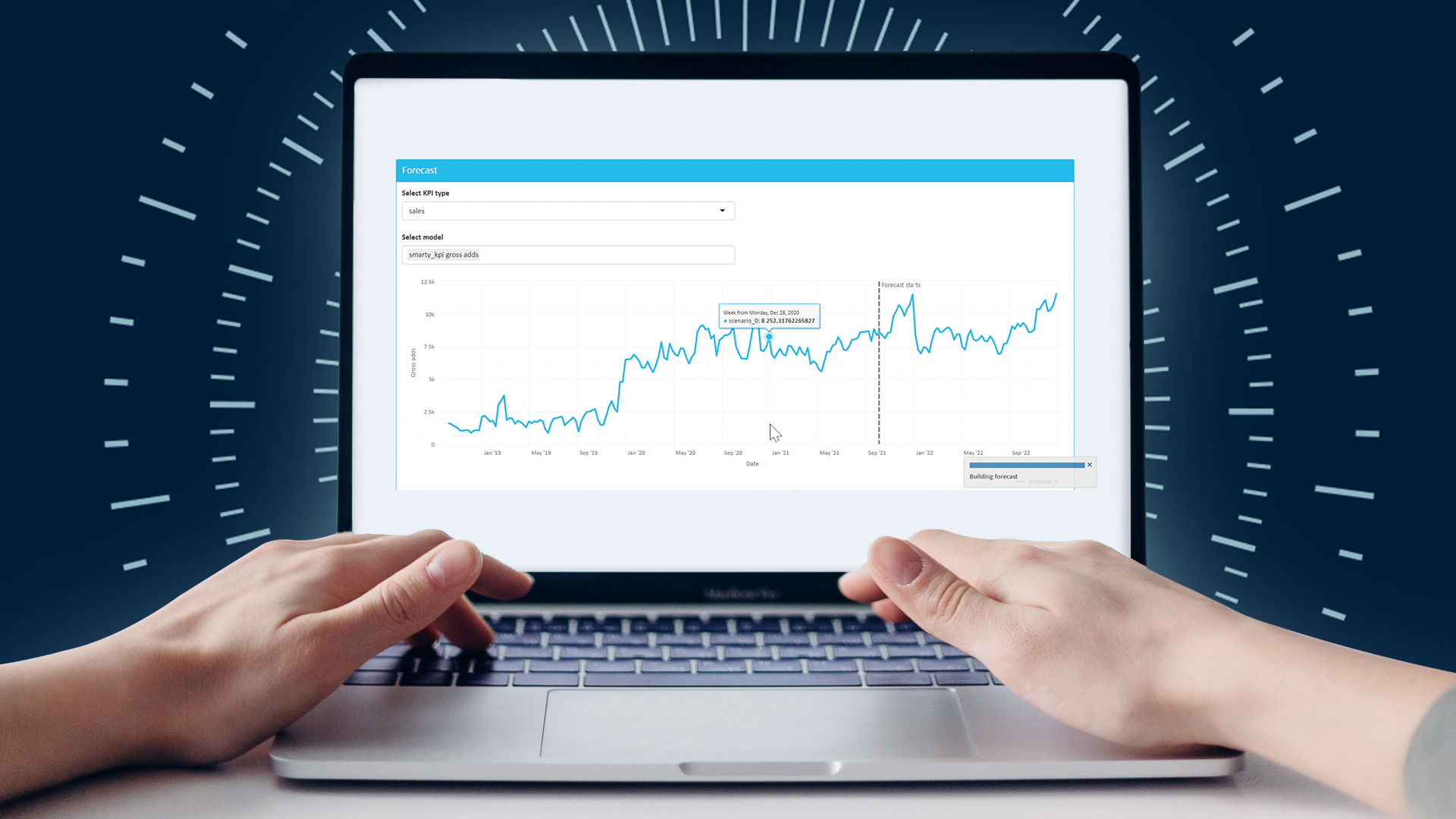
A person's hands on a laptop with a graphics platform on the screen

Delivering more profit from marketing.

By building marketing effectiveness models, we help our partners understand what drives sales with the aim to increase profit. This gives us the ability to answer a range of crucial client questions.

  • What is the incremental impact of our media?
  • What is the ROI of our media activity?
  • How can we optimize our media budget for more sales and profit?
  • Which campaigns perform the best and why?

Typically, we deliver between $2m and $20m profit per project, and on average improve a brand’s ROI by approximately 30%.

Business people discussing data

Service

Optimize your marketing strategy with Market Mix Modelling.

Gain insights on growth drivers and enhance decision-making for maximum profitability.

Learn more
Monk Thoughts In all, we deliver results 95% faster than our competitors—within only four days, rather than up to six months—and find that our partners, on average, experience a 30% improvement in ROI. The numbers don’t lie, that’s a serious profit gain.
Portrait of Michael Cross
Measurement holistic process diagram

Using the principles of Market Mix Modeling across the marketing funnel, we help brands create a level measurement playing field by taking everything that affects campaign performance into account—from media activities to internal operations decisions and even external factors such as seasonality and competitor activity.

Doing things differently.

De-silo media measurement

  • We connect measurement capabilities to de-silo digital and offline media measurement and deliver one unified ROI.

Speeding up MMM

  • We fast-track Market Mix Modeling to deliver model updates in only four days, rather than two to six months, by combining automatic data feeds, machine learning MMM and digital reporting.

Privacy compliant and future-proof

  • We help our partners build measurement capabilities in-house so that they are in control of the models, all the while taking a cookie-less approach to measurement to future-proof against deprecation of the 3rd party cookie.

Providing clarity

  • We translate complex data into really clear insights, helping our partners realize significant profit gains—typically between $2m and $20m profit gain per project—which has resulted in a 92% client approval rating, with brands citing clarity as our key attribute.

Get 30% improvement on your marketing investments. Drop us a line.

Hey 👋

Please fill out the following quick questions so our team can get in touch with you.

A measured approach tallies over one million in savings

  1. Work

    Retail Media Measurement • For a major retail brand looking to measure media spend, we built models across store and e-commerce traffic and sales while isolating the incremental uplift of each media channel, which helped the brand save millions of dollars.

  2. A laptop showing a retail ecommerce website

    How do we know £43m is the right media budget between digital and brand spends? By measuring the incremental and long-term effect of all media channels to set up our client for success.

  3. Retail store with clothing
    A woman lying on a couch on her cellphone shopping
  4. Reforecasting spend in media analytics
  5. By measuring long-term effects from each media channel and brand health data, we discovered that the client was overspending. 

    We maximized profit and reduced budget by taking money away from oversaturated TV and Paid Search. There was a net profit gain of £8.7m.

  6. Want to hear more about what we have to offer? Scroll down and get in touch.

Swipe
For More!

Drag
For More!

Monk Thoughts Our holistic, unified approach provides all marketeers with the evidence to act confidently in driving the greatest return on investment possible for each dollar spent, which is especially important when navigating more economically challenging times.
Amy Pritchard headshot

Want to talk measurement? Get in touch.

Hey 👋

Please fill out the following quick questions so our team can get in touch with you.

More on Measurement

A bowl with a healthy salad in it
A woman wearing glasses working as a pharmacist waits on a patient

Boosting Top-Quality Health Programs with Marketing Cloud • Power People’s Health

  • Client

    Digital Wellness

  • Solutions

    DataCRM

A doctor listening to a patient on a laptop during a digital appointment

Harnessing our Salesforce superpower.

Without an efficient partner or the right systems in place, managing your company’s data can be quite challenging. Like many other large-scale businesses, Digital Wellness, a leading global enterprise committed to improving people’s health, was also facing this challenge. Eager to move past manually handling the patient data of their digital Weight Management Program, they were in need of new scalable systematic processes to erase any room for error. To bring these ambitions to life, we leveraged our exceptional Salesforce skills and domain experience to provide Digital Wellness with a single view of patient details, activity and history, enabling them to improve their customer management and engagement capabilities.

A woman doing yoga next to hear couch and laptop
A person holding a cellphone tracking her health on an app

Lighting up your platform with cloud services.

With the expansion of their services in full swing, Digital Wellness’ top priorities included consolidating patient information, enhancing workflows and building an end-to-end user engagement model. To get there, we first set up Health Cloud to provide Digital Wellness with a platform that efficiently manages their client data, sales operations, partner network, customer service processes, progress reports and future care plans. Then, we implemented Marketing Cloud to enhance their marketing automation and support lead generation, campaigns and communications. Finally, we introduced Advertising Studio, a tool to strengthen online advertisement campaigns and customer engagement. Through these systems, Digital Wellness can continue to build on their holistic approach to patient care.

A laptop showing a doctor

In partnership with

  • Digital Wellness
Client Words [Monks] were fantastic and we had a wonderful Salesforce experience. We ran the project in an agile format blending their staff with our in-house team, [which] was very successful and allowed knowledge transfer to occur gradually.
Anna Crook headshot

Anna Crook

Director of Product Development, Digital Wellness

Streamlining digital solutions towards success.

By staying close to our skills and expertise, we were able to create a single view of Digital Wellness’ detailed client data, from personal patient information to company-wide health statistics. With that, we contributed to their mission to make the world a healthier place, one person at a time. A real game-changer for Digital Wellness, this development has allowed the business to enhance their operations and build on their mission to leave a positive mark on people’s health.

Want to talk CRM? Get in touch.

Hey 👋

Please fill out the following quick questions so our team can get in touch with you.

Can’t get enough? Here is some related work for you!

What to Expect with the New Search Ads 360

What to Expect with the New Search Ads 360

4 min read
Profile picture for user Jimmy Le

Written by
Jimmy Le
AUNZ Search Lead, Media.Monks APAC

A hand drawn journey with emojis and scribble designs

In early February, Google announced the launch of the new Search Ads 360 (SA360) experience with major changes to be rolled out to their leading search management platform throughout 2022. The planned updates will include a redesigned UI, improved search engine support and advanced enterprise innovation.

As someone who has spent countless hours switching back and forth between the previous SA360 and the Google Ads’ UI, the new experience is a long time coming. The updates will offer SA360 advertisers an efficient workflow and stronger cross-engine compatibility, all within a single search management platform. Below is an in-depth look at what to look forward to as SA360 rolls out in 2022.

Greater Workflow Efficiencies

Google has shaped the new SA360 experience around achieving greater workflow efficiencies by implementing updates designed to minimize unnecessary repetitive tasks. One of the updates that I’m most excited about is the new and improved cross-platform support of the Google Ads Labels feature. Advertisers will no longer be required to recreate and reapply the same labels, as any labels linked to Google Ads will automatically become available in the new SA360 interface. This was one of the most requested features amongst my colleagues and clients, so it’s great that it’s finally here. The previous requirement of recreating and reapplying labels in SA360 through manual operations, such as bulk edits and excel uploads, will now be a thing of the past! 

There are more avenues to scale with centralization through enhanced cross-advertiser management. With the previous SA360, customizing reporting views or campaign management done at the “Advertiser” platform level has always operated individually. The new SA360 experience will address this by granting the ability to report and manage campaign activities across multiple Advertisers at once. Noticeable workflow improvements include the option to create custom columns (previously called formula columns) at the Manager (previously “Agency”) level, to execute bulk changes to multiple accounts simultaneously and to duplicate entities across engines or the Advertiser level with a new copy and paste function.

These new SA360 updates drive greater productivity for advertisers with many search engine accounts and agencies who would like to organize client reporting tasks simultaneously. 

Above: The new Search Ads 360 user interface (Source: Google Blog - Introducing the new Search Ads 360)

A Familiar UI with Upgraded Navigation

Google has intentionally made the new SA360 look and feel more like the current Google Ads interface. Users that are already experienced in Google Ads will see immediate benefits and feel right at home with the new SA360. This is also useful for training and adoption, as any familiarity of the Google Ads UI navigation and workflow processes will translate over to the new SA360 (or vice versa) for one consistent experience and quicker adoption. It’s also an added bonus that Microsoft Ads has a very similar interface!

Vastly Improved Search Engine Support

The new SA360 and Google Ads now share core common technology powering the functionality and capabilities of both platforms, resulting in the ability to manage and process more data than ever, all while maintaining a fast user experience. This also means that previously unsupported features within SA360 will soon become available in the new version. Google has also confirmed the support for campaign types including Performance Max, Discovery Ads and Local Inventory Ads. 

To add to this, upgraded engine feature support such as extensions, audiences and creative formats for alternatives to Google (i.e. Microsoft RSA, DSA & smart shopping) will also be included in the upcoming updates. This improved support will allow advertisers to complete much more of their day-to-day workflow from within a single search marketing platform. Advertisers that are currently using SA360 to manage standard paid search campaigns and Google Ads to manage Performance Max or Discovery campaigns should be celebrating right now, as the management and reporting of all three campaign types can be done under the new SA360! This will also make it easier for dashboard reporting (i.e. third-party data or Data Studio) as users can include a single data source.


Updated Google Analytics Integration and Support for GA4

In the new SA360 experience, Google continues to develop SA360’s native integration with other GMP products, in particular with Google Analytics (GA4) properties. The new SA360-GA4 integration enables the import of GA4’s web and in-app event metrics into the SA360 reporting UI, allowing for additional measurement and optimization into how search activities are performing against web or in-app based events. Additionally, if Google Analytics Goals are your reporting and measurement source of truth, web or in-app-based GA4 Goals are available to use as a conversion source for performance automation and optimization—a handy alternative to Google Ads conversion tracking or floodlight tracking tags.

Bridging the Gap Between Platforms

When onboarding and training new clients in the previous SA360, one of the most frequently asked questions is: “Should we migrate our day-to-day workflow from Google Ads to SA360?”

I’ve always recommended that teams combine Google Ads campaign management workflows with SA360 performance optimization workflows (as opposed to using only one or the other) to get the most value out of both platforms. There will still be some instances that require switching between both. However, with the launch of the new experience, we’re seeing a big step with the new SA360 in the right direction in bridging the gap and enabling teams to use one interface for most tasks.


With the enterprise advantages of using a search management platform for engine consolidation, management, reporting and automation, we’re very excited for the streamlined and efficient workflows when transitioning search engine accounts’ daily tasks over to the new SA360 experience—and search marketers will be, too.

Get an in-depth look at what to look forward to as Google’s Search Ads 360 (SA360) rolls out in 2022. Get an in-depth look at what to look forward to as Google’s Search Ads 360 (SA360) rolls out in 2022. Google data analytics data driven

Sunset of Universal Analytics: What should businesses do for 100% data continuity?

Sunset of Universal Analytics: What should businesses do for 100% data continuity?

4 min read
Profile picture for user Jakub Otrząsek

Written by
Jakub Otrząsek
VP of Data APAC

A checklist outlined in white

This article was written in collaboration between Jakub Otrząsek, VP of Data, APAC and Edie Cheng, Head of Digital Marketing & Analytics, Media.Monks.

Google Analytics is the most commonly used tool by organizations to get an in-depth understanding of customer behavior on their website or app. Furthermore, it integrates with the Google Marketing platform and helps connect the dots between user behavior and digital marketing campaigns that impact brand experience.

Now Google Analytics’ third generation, Universal Analytics (UA), is approaching the end of its life cycle. Google is heralding its successor, Google Analytics 4 (GA4), as an easier and more seamless way to connect data across multiple touchpoints and provide marketers with a clearer picture of the end-to-end customer journey.

What is changing?

As GA4 matures, Google recently announced it is committed to retire the legacy version, Universal Analytics. Users of the free version will have until the end of June 2023. Premium (paying) customers will however receive an additional grace period of three months.

By that time, Universal Analytics will stop collecting new data and users will need to completely migrate to GA4. As most organizations need more than one year of data to run year-on-year analysis and prime for change, we strongly recommend brands implement tracking in GA4 before the end of June 2022. This is crucial as Google is not planning on providing any data migrations from Universal Analytics to GA4. 

Why does it matter?

As data will no longer be collected by Universal Analytics, multiple metrics and measurement will come to a halt, which will hinder a holistic view of traffic and marketing activities on your website and/or app. Here are things that require immediate attention to achieve 100% business continuity.

Metrics and goals 

As GA4 has a different data model to Universal Analytics (event based vs. session based), metrics will be defined differently, even if they might have the same name. For example, a lot of reporting in Universal Analytics was based on Goals. Universal Analytics Goals can be mapped to GA4’s Conversions, however the configuration is slightly different therefore comparing YoY results may be challenging as it isn’t exactly an apples-to-apples comparison.

GA4 allows 30 Conversions per property (50 Conversions for paying customers), and while Universal Analytics only allows 20 Goals per view, a single property could have more than 30 different types of Goals. If this is the case for your organization, we recommend reviewing your measurement approach and working to consolidate your Goals so that you are only tracking the most important events as conversions. Additional conversion points can be still tracked and presented in custom reports.

Reporting and dashboarding configuration

Regardless of how your dashboards or reports were implemented, changes are required to swap to the new version of GA. In many instances, additional work is required as there is no 1:1 functionality from GA360 to GA4. Actions to take include:

  • Create new reports and dashboards using GA4 metrics and properties.
  • Make sure commonly used reporting views in GA360 have counterparts in GA4 with data collected correctly.
  • Remove user access for obsolete dashboards to ensure everyone is using the right data.
  • Secure additional data exports so that you can create multi-year comparisons and conduct trend analysis.
  • If your organization has GA360, keep in mind that you can access more reports and data through the UI than what is stored in Google BigQuery. Data coming from integrations via Campaign Manager, Display & Video 360, and Search Ads 360 containing metrics and advertising dimensions (affinity, demographics) are not available in BigQuery. Review any dependencies on UI-based reporting and identify alternatives.

Audiences and integrations

Integration of Audiences shared with other Google Marketing Platforms—from Google Ads to Optimize 360 and DV360—will stop working, as Universal Analytics will not receive any additional data. Actions to address integrations include:

  • Reconfigure available platform integrations in GA4.
  • Identify custom-built integrations using the Core Reporting API. These will need to be recreated with the GA4 API.
  • Identify important audiences for analysis and media buying and create them in GA4.

Channel and cross-device attribution

GA4 shares a module for Attribution with Universal Analytics. However, the “old” conversion reports had a premium (GA360) module called Data-Driven Attribution (DDA). Data-Driven Attribution has not carried over to GA4. If you are using an “old” conversion report, be sure to understand the differences in the attribution of Channels because GA4’s event-based model calculates attribution differently to Universal Analytics. 

Cross-device attribution in GA4 is more sophisticated and leverages Google Signals, Google’s privacy-safe identity software that links Google user activity across devices, across all reports, if enabled. Universal Analytics only leverages Google Signals for some reports. Create GA4 vs. Universal Analytics Comparison dashboards to compare conversions attributed to channels and standard user metrics to create comparable GA4 baselines for decision making.

Remember, you will not be able to use Universal Analytics baselines for GA4 data analysis, so it’s important to set up a baseline GA4 implementation as early as possible.

Data collection methods

For data collection that doesn't use a typical tag manager, other considerations need to be made:

  • Measurement Protocol
  • Hard coded (not tag manager), or libraries (e.g. React Google Analytics Module)
  • Custom data imports 
  • Server-side tagging
  • Offline conversion importer

Simply leaving the code/scripts “as-is” may not break anything initially, but may cause issues down the line. Once you are ready, remove any old Universal Analytics code from the code base and move towards a tag manager.

Training and capability

As you can see from the points above, there are vast differences in collecting, managing, and using data between GA4 and Universal Analytics. Preparing your organization with the knowledge and skills to derive value from GA4 will require investment in time, technical resources and upskilling your workforce. Identify skill gaps across the organization and develop tailored training modules to upskill stakeholders in GA4.

Some examples of training could include:

  • Implementation and Data Collection in GA4 for developers or technical analysts.
  • GA4 Analysis Fundamentals for analysts or marketers who are concerned about website or campaign performance.
  • Foundations of GA4 Change Management and Migration for administrators, project managers, or decision makers who need to understand how migrating to GA4 will affect them and what they can do to prepare for it.

Dawn of new changes 

With Universal Analytics ebbing away, there is a lot to be done to get your organization ready. While July 2023 sounds far away now, if your team wants a year-over-year comparison of data, you will need to implement data collection by June 2022. Setting up data collection, getting familiar with the differences and benefits of GA4, and developing baseline reports are gradual and necessary projects to take on in the coming months to set yourself up for a seamless transition in 2023. Media.Monks can tailor a GA4 Migration Program for your organization to ensure business continuity and digital maturity uplift as you enter the new era of GA4.

With the sunset of Universal Analytics and users migrating to Google Analytics 4 (GA4), here's what brands can do now for 100% data continuity. With the sunset of Universal Analytics, here's what brands can do now for 100% data continuity. data analytics google data driven

The Top 5 Fintech Trends Reshaping the Financial Services Market

The Top 5 Fintech Trends Reshaping the Financial Services Market

4 min read
Profile picture for user mediamonks

Written by
Monks

A digital customer journey showing a cellphone and tablet to purchase

Last year was a fruitful one for fintech. With particularly explosive growth in Latin America, the financial technology sector became one of the fastest-growing in the world, collecting more than a hundred billion in funding globally. The reasons are simple: the further development of new technologies like artificial intelligence, the popularization of cryptocurrencies and the overall acceleration of digital transformation have all taken the industry to new heights.

Today, fintech apps and software have grown to become a big part of our day-to-day. They provide the infrastructure behind our payments, money transfers and ecommerce transactions—and more importantly, they’ve democratized access to financial services. Especially in countries where inequalities in income and wealth distribution are steeper, and access to financial services is hindered by a high rate of unregistered employment, fintech startups have arisen as a step toward financial inclusion. 

That said, fintech’s impact is also shifting the way traditional banks and other financial institutions are approaching their own long-established businesses. In the last few months working with fintech brands, we’ve identified at least five trends that are delineating the future of the industry—bleeding into all sorts of companies within the finance sector. Let’s take a look.

1. Agility Is Paying Off

A portmanteau of the terms finance and technology, fintech technically speaks to any kind of business that relies on technology to provide enhanced financial services. However, it’s not uncommon to limit its usage to digital-born startups specifically, which are built on the values of automation, flexibility and low-cost transactions achieved by high-end technology.

These startups possess what traditional financial institutions historically lacked: the agility to adapt and evolve at full tilt. It stems from necessity. In this highly-competitive market, only those who present accelerated rollouts of services can take the lead. As our SVP, Growth Daniela Glicenstajn explains, “Those who are quick to make decisions increase their chances of succeeding. We’re talking about constantly testing, learning, implementing, seeing what’s working and speeding down that road.”

Fintech brands need people and partners that are willing to stay on top of the latest technological advancements and changes in consumer behavior. However, identifying people’s needs is only the beginning: their organization must be characterized by a level of flexibility that allows them to deliver with aggressive time-to-market.

2. Taking Empathy Into Account

Despite the many advantages that young fintech companies present in terms of speed, accessibility and convenience, earning people’s trust remains one of the biggest challenges. But while tradition and reputation are defining aspects for consumers, fintech brands have found an even more engaging factor: empathy.

For anyone who’s ever been in debt, struggled with bad credit or was denied access to bank products, the concepts of finance and empathy may seem mutually exclusive—and with good reason. But all too often, these experiences come from a lack of understanding of the clients’ motivations. Fintech brands are better prepared to identify each person’s specific needs and better serve them with solutions that improve their financial wellbeing by removing needless friction.

At the very least, fintech companies have the tools to address their clients directly and more closely. “These brands need to prove their added value and differentiate themselves from traditional financial enterprises,” explains Maria Jimena Rojas, Sr. Account Lead, Growth. “One of the ways in which they are doing this is by taking a more empathetic approach to customer service and their overall relationship with clients.

Monk Thoughts Instead of being cold and distant, fintech brands focus on developing a closer relationship with people.
Maria Jimena Rojas headshot

3. Checking up on User Experience 

On that note about forging closer ties with people, UX plays a prominent role in the equation. Yet when it comes to fintech, balancing bureaucratic obstacles and user experience can be quite challenging. Today, the top fintech brands are looking for areas of improvement by performing UX audits and ISO quality testing—a series of computerized examination processes that offer certification opportunities for organizations according to the standard for quality management systems.

Our Director of Growth Alan Cripps explains, “The user experience needs to be in constant evolution. It’s not a one-time project, it’s something that needs to be worked on every day. Successful fintech brands are always thinking about how to make services more personalized, modern and how to offer relevant content at every stage of the consumer journey.”

4. Banking on Data-Driven Creativity

Especially now that third-party cookies are being phased out, no brand is blind to the importance of owning its data. Born in digital and raised in data protection compliance, fintech brands are usually well versed in first-party data, but should also be quick to bridge the gap between data and creativity. After all, their success depends on their ability to act upon the information. 

“The biggest fintech brands right now don’t see data and creativity as two different things. They are bringing them together in integrated workstreams that empower creatives to deliver campaigns that yield better results,” stresses Growth Manager Francisco Fortes.

Monk Thoughts We can only reach the right people at the right time and with the right message if we’re developing creative campaigns that are data-driven.
Francisco Fortes headshot

5. The Line Between Fintechs and Traditional Banks Gets Blurry

If fintech comes down to combining finance and technology, then we’re looking at something that even the most long-established banks can do. The truth is, the increasing demand for digital transformation is already changing the way these companies approach their client-facing operations. And with these new fintech startups as a source of inspiration, banks can offer the best of both worlds: the benefits of a reputable company built on tradition and the agility of a digital-first brand.

“If we think about companies like BBVA or Banco Azteca, they are already giving their clients the option to operate online,” points out Gastón Fossati, our VP of Data Growth SPLA. “Most of them are looking to bring as many people as possible to the digital space instead of the physical branch."

Monk Thoughts The fact that these companies are baking machine learning and analytics into their strategy is proof that they understand the need for the digitalization of their products and how it helps improve their marketing ROI.
Gastón Fossati headshot

Whether we choose to think of fintech as exclusively digital-born startups or any kind of financial services company that uses technology to enhance its offering, the truth is this industry has witnessed skyrocketing growth in the past couple of years. With numerous innovations in the making and the promise of crypto as the currency of the metaverse, fintech brands are poised to keep growing—as long as they are quick to respond to consumers’ ever-changing needs before their competition.

Our experts in LATAM explore fintech’s explosive growth and what brands are doing right in this space. Our experts in LATAM explore fintech’s explosive growth and what brands are doing right in this space. Fintech LatAm Latin America data driven Digital transformation

In Change Management, Relationships Are Everything

In Change Management, Relationships Are Everything

3 min read
Profile picture for user mediamonks

Written by
Monks

colorful data point diagram

There’s a mistake that many marketers fall prey to at one time or another: focusing on tools over people. It’s easy to see why this kind of silver-bullet thinking is so appealing. Tools have clear features defined for specific outcomes, and are often backed by promising results. The certainty that they’re sold on suggests you, too, can solve your most urgent problems with the push of a button. Meanwhile, people dynamics are messier because they’re invisible and tougher to quantify.

Tools can certainly help teams work better and more efficiently—but they alone won’t get your team where it needs to be. We know from experience that if you don’t address relationship challenges directly, your transformation effort won’t truly be transformative at all. We set out to solve this problem by making collaboration patterns tangible in a way that we could track and measure over time.

For a multinational pharmaceutical client, inefficiencies in team collaboration resulted in overburdened/underutilized teams, as well as creative delays between the in-house team and third-party vendors. “We found that rules of engagement hadn’t been defined,” says Vice President of Enterprise Consulting Matt Lentz. “So our solution lied in looking at emails received within Media.Monks servers, as well as the quantity of messages received from different sources, to help us develop a methodology to track rules of engagement.”

Lentz wrote a brief for our service automation team, which continually seeks out ways to build solutions that add value or enable a business unit by cutting time and costs internally or for our clients. Lead Technical Solutions Engineer in Media Dylan McBurnett answered the call by developing a tool that could assess communication patterns at scale. The communication analysis tool captures send-receive data from Media.Monks email servers. The data is then used to visually map out all of the communications between the client team and its partners—essentially capturing a snapshot of collaboration and connection across the in-housing effort.

The data helped enforce rules of engagement and proactively eliminate security breaches by identifying those who were not authorized to email media buyers independently. But perhaps even more compelling, data visualizations supplied a 10,000-foot view of what communication looked like throughout the organization—and how those relationships were changing over time as communication became more streamlined and efficient.

data diagram with a flurry of data points working together in a circle

Left: Fragmented communications and ambiguous roles and responsibilities within an organization often result in operational inefficiencies, as well as significant bandwidth constraints on resources. Right: Establishment of a media hub allowed centralization and ownership of communications between client and support teams.

data diagram with a flurry of data points working together in a circle

While communications with vendors may be loose when an in-house team is developing its processes and capabilities, establishing a consistent communication cadence with third-party suppliers is important in strengthening partner support in the long term.

Use Data to Design Better Workflows

Every brand is sitting on oceans of data that can help them work smarter—they just might not always realize it. And giving structure to this data can do far more than simply enforce rules of engagement; it can help you proactively avoid the obstacles that inhibit transformation mentioned above. Below are some of the key recommendations we were able to make for our client based on the output of our tool.

Ease burnout by finding people overwhelmed with communications. Emails shared between people implied ways of working together. We created a centrality score to measure which nodes (or people) on the network had the highest association with others. Having a 40% higher centrality score than the next person on the graph suggested an individual may be getting overwhelmed and burnt out. This data gave us the rationale to recommend hiring to ease the burden on some team members.

Build new bridges that help connect teams. While some teams were overburdened, others were underutilized. “We found that some teams and organizations our client had partnered with throughout the in-housing effort were very siloed and uncoordinated,” said Lentz. Likewise, when it comes to in-housing in particular, a common challenge is that new teams may lack the relationships they need with third-party vendors. Visualizations made it easy to spot these gaps, as nodes on the periphery illustrated a lack of connectivity with the rest of the network.

Assess communication improvements over time. The beautiful thing about data visualization is that you can quite literally see change right before your eyes. “Through network analysis and strict communication guidelines, we could see a shift in overall relationship patterns within the organization,” says Lentz. The core team’s increased centrality in the network—indicating high connectivity—emphasized it had achieved the interdependence required for successful media operations.

You can see how sets of communication data can help identify and influence better ways of working. No matter your approach to organizational transformation, relationship building is key. The best tech and tools won’t get you there alone; with the right insights, you’ll have fuel to carry you down the path toward transformation success.

Effective change management is more than a matter of tooling. Humanizing data to support stronger collaborative relationships is also key. Effective change management is more than a matter of tooling. Humanizing data to support stronger collaborative relationships is also key. data data driven tooling

Welcome 4 Mile, Building Custom Data Experiences That Meet Business Objectives

Welcome 4 Mile, Building Custom Data Experiences That Meet Business Objectives

3 min read
Profile picture for user mediamonks

Written by
Monks

Media.Monks and 4 Mile Analytics logos in white on a black background

The year may have just begun, but we already have exciting news to share. Today, we’re welcoming a new addition to the company: 4 Mile Analytics. 4 Mile is a full-service data consultancy that specializes in custom data experiences. Their expertise lies in helping brands drive better decision-making through best-in-class data analytics, engineering, UX design and product management—and more colloquially, the team is regarded as the go-to partner for Looker, a favored enterprise platform for business intelligence.

00:00

00:00

00:00

The team is led by Nick Fogler, Founder and CEO; and Sam Baron, COO. Founded in 2017, 4 Mile’s relationship with Looker runs deep: Fogler previously led Looker’s engineering team and supported the company’s transition into a larger-scale enterprise before founding his own. Since then, 4 Mile has supported some of the biggest brands to accelerate their strategic initiatives.

The Rising Need to Translate Analytics into Action

As brands transition away from third-party data to first, much has been said about effective data collection—but that’s only half the battle. Many brands are already sitting on mountains of data that isn’t actionable, and the value of that siloed or hard-to-access data pales in comparison to its frictionless counterparts. Throw in the fact that data platforms and dashboards are often overly technical and opaque, and it becomes clear that focusing merely on data collection—not its usability—simply isn’t enough.

Realizing this need, Looker has long been a favorite solution by our data and digital media practice. Others agree; Looker is now regarded as a core part of the Google Cloud Platform (GCP). What makes it special is that teams using the platform can easily integrate data from various sources into intuitive data experiences that are custom-built to their specific requirements. This functionality solves the crucial need of pulling together insights that are accessible and actionable not only to teams in marketing, but also those across the organization.

A Reputation for Excellence 

4 Mile’s significant history and relationship equity with Looker builds upon our own expertise with the platform. Before they worked directly with clients, 4 Mile was hired by Looker as an extension of its product development team. Through this partnership, they developed custom visualizations and third-party integrations in the Looker product code base, deepening their already intimate understanding of the platform. And while 4 Mile’s direct-client relationships continue to grow, solid collaboration with Looker Data Services remains a cornerstone of the business. 

Still, 4 Mile’s proficiency isn’t limited to Looker. By leveraging strong relationships with leading technology platforms like Fivetrain, DBT, Snowflake, Exasol and Keboola, the team has developed a wide breadth of solutions for the modern data stack:

  • Designing and building custom data experiences that blend analytical and operational capabilities.
  • Transforming raw data into business-ready data that allows end-users to explore, curate and take action on data insights.
  • Designing and employing modern data warehouse solutions to support business intelligence.
  • Orchestrating movement of high-volume batch and real-time data across the enterprise.

A Shared Human-Centric Approach

Both Media.Monks and 4 Mile believe that a human-centric approach to technology opens the path to better customer experiences. At the same time, successful data-driven strategies must begin with a strong foundation to build deeper, more meaningful connections with audiences. For 4 Mile, this principle has inspired a people-first mentality—valuing diversity, empathy and respect—that informs the team’s approach to partnership. This includes providing training and documentation to enable internal teams to execute new data solutions, as well as building products that realize specific use cases.

With 4 Mile now a part of our team, their existing clients will gain access to a global community of talent that excels not only in data and digital media, but also content creation and tech services. Meanwhile, Media.Monks clients gain even greater access to a powerful bench of analytics and machine learning experts, providing greater scale, deeper data analysis and more data-driven decision-making. This allows for an even more seamless activation of first-party data, unlocking highly effective and engaging experiences across the customer journey.

Challenges from all ends—government regulation, tech platforms and public sentiment alike—suggest 2022 will be the year in which modern brands must adapt their data strategies once and for all. Together with 4 Mile’s exceptional Looker and GCP expertise, we’re excited to empower brands on their journey to achieve top-line business goals at an even greater velocity.

We’re welcoming a new addition to Media.Monks: 4 Mile Analytics, a full-service data consultancy that specializes in custom data experiences. We’re welcoming a new addition to Media.Monks: 4 Mile Analytics, a full-service data consultancy that specializes in custom data experiences. data data analytics third-party cookies data driven technology

Challenge the Challengers with These DTC-Inspired Strategies

Challenge the Challengers with These DTC-Inspired Strategies

4 min read
Profile picture for user mediamonks

Written by
Monks

Challenge the Challengers with These DTC-Inspired Strategies

It can be tough to adapt to the relentless pace of change in digital. From a need to meet and engage with customers on new channels to the rise of digitally native competitors, there are many ways that established, legacy brands can improve their digital maturity—and they might begin that process by taking inspiration from what’s worked with DTC brands in particular, whose close connection with consumers is arguably unmatched.

The secret? Adopt a challenger mindset. DTC brands have honed their digital prowess by necessity. Newer and lacking the big marketing budgets of legacy brands, they’ve shifted focus away from broad-reaching TV spots to instead focus on digital marketing. Through this practice, they’ve developed measurable marketing strategies that aid in discovery and are backed by data.

Shift Toward Data-Driven Messaging

“DTCs opt for targeted appeal over mass appeal (at least initially),” write Ryan Skinner and Sarah Dawson in the Forrester report, “Lessons In Customer Acquisition: Learn From DTC Disruptors’ Awareness Strategies.” “Only when DTC brands more firmly establish themselves do we see them branching out into more expensive channels like broadcast TV.”

Remco Vroom, Head of Business Growth and Platforms Solutions at MediaMonks, notes the role that experimentation has played in getting to know what resonates with their customers, helping them increase the effectiveness of communication through fresh content. “Brands can learn from them by getting to know their audiences better, getting a feel for them how they operate,” he says. “In this area, these smaller, digital-native companies aren’t afraid to try things out, producing hundreds of pieces of content to see what sticks, then taking those things that were successful and building more content.”

Screen Shot 2019-07-31 at 3.23.38 PM

Our awareness campaign for Gladskin mixed up assets to find the most effective combination for audiences.

It’s a strategy that we’ve used with skincare brand Gladskin, enhancing the creative of their awareness campaign by mixing (and remixing) an initial set of assets, seeing how they performed with different segments. Depending on the performance, we tweaked the creative even further while also reassessing the media spend for those segments, incrementally zeroing in on the most effective and interested groups per each channel. The tactic provides a dependable way for budget- or resource-strapped brands to optimize creative and better understand their audience while avoiding the strain that even digital native brands may feel in a need to refresh branding and content at an increased rate.

Elevate Social’s Role in Your Marketing Strategy

The focus on the role of data above should drive one point home for brands that aim to take a page out of the DTC handbook: they must not treat social media as an afterthought. Instead, they must elevate the role of social media earlier in the planning cycle.

With a leaner and more agile approach, brands can strike close, one-to-one connections with consumers through smart use of data that leaves their audiences feeling heard. Yet bigger brands limit themselves by focusing their investment on traditional formats that focus on broadcast rather than the interactive elements of newer social channels like TikTok.

“Traditional formats like TVC or OOH are safe bets for the larger companies, because it’s something they’ve done for the past 20 years,” says Vroom. “They tend to put millions into these channels and pennies in social media, but that’s not substantial enough if one of your goals is to connect with your audience.”

IMA_NoisyMay_thelfashion-nandaschwarz

The #NoisyMayInfluenced campaign brought influencer audiences behind the scenes, mixing product development with content.

There are a couple ways that brands can adopt a challenger mindset by upping their social strategy. One way brands can adopt a challenger mindset is by helping consumers see themselves in the brand by breaking down barriers between audience and what goes on behind the scenes. For example, our influencer activation team IMA worked with womenswear brand Noisy May to help the brand partner connect with six regional influencers, who each designed a series of products for a capsule collection titled #NoisyMayInfluenced. The influencers documented and shared every step of the design process, reaching their target audience in an authentic and community-driven way.

Consider Building Brand Passion by In-Housing

Not every brand is going to be so radical in breaking down the barriers between product development and their audience. But they can take initial steps to a greater strategic investment in social by building a task team dedicated to seeking the potential benefits of tapping into novel, new formats and user behaviors on social platforms, which Vroom compares to the trend of brands taking their creative in-house.

“If you want to be successful, you have to bring the message really close to you—which is key for new channels like that,” Vroom says. When brands give creative freedom to passionate teams like this, they can break free from tradition while still remaining true to their core values.

And that gets at the heart of what legacy brands must do to keep up with digitally mature brands: connect authentically with consumers where and when it matters most. Through adopting data practices that inform the creation and delivery of content to elevating social media within the marketing mix, brands can do more than just weather disruption from competition—they can cut become challengers in their own right.

Brands have a lot to contend with: new consumer trends, emerging technology and increased competition from digital native brands. Here's how they can keep up. Challenge the Challengers with These DTC-Inspired Strategies Learn from digital-native brands’ most effective strategies.
Digital native dtc direct to consumer customer obsession digital transformation insights driven data driven social marketing

Choose your language

Choose your language

The website has been translated to English with the help of Humans and AI

Dismiss