Choose your language

Choose your language

The website has been translated to English with the help of Humans and AI

Dismiss

How a Unified Data Strategy Solves the CMO-CIO Paradox

How a Unified Data Strategy Solves the CMO-CIO Paradox

3 min read
Profile picture for user mediamonks

Written by
Monks

Brands face several challenges when it comes to using data effectively: organizing it in a way to ensure that it’s usable, extracting actionable insights that optimize creative, and envisioning how to translate abstract data into tangible value. That’s why we recently released Unlocking Data & Silos to Enhance Creative Potential, a guide touching upon each of these issues and more, opening with a foreword that explores one of the most urgent challenges defined by Forrester that CMOs face today: solving the CMO-CIO paradox at a time when both roles’ strategic alignment is so crucial to organizational success. You can read the foreword below, or grab the ebook in full right here.


The promise of big data was always to give organizations the insights they required to take their relationship with consumers to the next level. While some have achieved this, others have struggled to digitally transform and transition into an environment in which they can organize and activate the mountains of data that they’re sitting on.

This might make it sound like big data is a big problem for some, but that’s a defeatist way of looking at things; rather, the challenge offers an opportunity for organizations to break down silos and work together more effectively, particularly when it comes to the relationship between CMOs, CIOs and their teams. CMOs find themselves tasked with driving organizational growth through their ownership of the brand-customer experience, for example, and doing so requires joining together multiple streams of data into a comprehensive, single view of the customer—which means a data architecture must be in place to define the data and KPIs necessary to measure results and infer more about consumers.

Monk Thoughts Only 16% of B2C decision makers say their roles function together as strategic partners.

Of course, this presents an excellent opportunity for CIOs to tie their technology strategy to clear business goals, elevating their role into a more strategic one. The problem? In most organizations, the CMO and CIO aren’t closely aligned. In fact, Forrester Research reports that only 16% of B2C decision makers say that their roles function together as strategic partners. 35%, meanwhile, say that IT merely manages one-off projects that are prioritized by the needs of the company.

One way for CMOs to kickstart a closer relationship with their CIO is to build a unified data strategy and break down silos in the process. Historically, both have had differing business perspectives—sometimes so misaligned that marketing teams would turn to external point solutions rather than rely on IT for handling data. Such practices have only widened the divide even further because data extracted this way is often framed for a specific purpose and incompatible with other systems used within the organization—diminishing CMOs’ ability to forecast into the future and truly lead in the digital transformation process.

Monk Thoughts CIOs working closely with CMOs report a 1.3-time likelihood of substantial growth.

This presents the ultimate irony: CMOs find themselves with greater responsibility to drive growth and serve the brand strategically, yet often find marketing projects deprioritized. Strengthening their relationship with IT is key in establishing the tools they need to deliver on this responsibility, but first they must increase their data literacy and learn to better align marketing KPIs to clear business outcomes that move the needle.

With a greater understanding of data strategy and how to support it with a cross-organizational data architecture, CMOs can achieve the buy-in they need from IT and the brand as a whole—and take back control at a time when extracting consumer insights at a quickened pace has become so critical. According to the same Forrester report noted above, CIOs who have worked closely with their CMOs report a 1.3-time likelihood of substantial growth year over year. Now that’s a data point to get excited by. Through the lens of attaining a better understanding of your consumers and enhancing the power of creative, this book sets out to show how you, too, can break down silos and elevate your role into a strategic driver of growth.

There are many more benefits to strengthening your data strategy.

Organizations are stronger when CMOs and CIOs work together strategically. Both can leverage data to align their goals and achieve substantial growth. How a Unified Data Strategy Solves the CMO-CIO Paradox A data strategy that strengthens the CMO and CIO relationship for shared success.
data data marketing data organization data optimization creative optimization assets at scale creative production CMO-CIO paradox CMO-CIO dilemma creative agencies asset optimization marketing optimization consumer data consumer insights insight-driven marketing

Linking Empathy and Engineering at Advertising Week New York

Linking Empathy and Engineering at Advertising Week New York

5 min read
Profile picture for user mediamonks

Written by
Monks

Linking Empathy and Engineering at Advertising Week New York

This week, New York welcomed not only foreign leaders and dignitaries at the United Nations headquarters—the city also embraced some of the best and brightest in the world of advertising, marketing and technology. Yes, Advertising Week New York—one of six Advertising Week events held around the world—came to offer thought leadership, workshops and more with 1,216 speakers and over 290 different events.

There was much to ponder and celebrate throughout the week. At the Clio Awards, eight awards were distributed among three projects that we contributed to: the Uncensored Playlist, Mind the Gap and the geolocation-based revamp of the “Runaway Train” music video. We also made placement on Adweek’s 100 Fastest Growing Agencies list, and our VP of Marketing Kate Richling was shortlisted for Advertising Week’s Future is Female platform.

But that’s enough patting ourselves on the back. What were the brands up to in all the fray? Our recap explores three big topics from one of the biggest weeks in advertising—namely what’s driving the in-housing trend, how brands are working creatively with data and the new collaborative partnerships that are helping brands respond to both those opportunities.

Getting Closer to Consumers through In-Housing

One thing that’s become undoubtedly clear across the course of the week is that brands are seeking ways to take back control. For many, this has manifest in a trend to take their creative and media capabilities in-house. Often attributed to goals like lowering cost or time to market, there are in fact many reasons why brands feel they can do creative better on their own terms and turf, as explored at the Brand Innovators summit, which coincided with Advertising Week.

A major goal behind the in-housing trend is a need to get closer to the consumer. As traditional brands grow with widening product lines and more channels to communicate through, they risk losing coherence or consistency within the brand-consumer relationship.

94_Panel_AdWeek_092419

The In-Housing panel at Brand Innovators. (Photo courtesy Kat Papera/Brand Innovators)

At a panel on in-housing, Spencer Gordon of Anheuser-Busch discussed how going in-house ensured that a dedicated team in the brand would always be thinking about creative. This enabled them to pursue consumers with greater relevance and brand understanding. But Gordon noted that the initiative achieved big results by first starting small; with four employees focused on providing social assets solely for the Michelob Ultra product, the team has since scaled to 63 members that deliver for all of AB InBev’s brands.

In the same panel, Ryan Riess, Director of Social Strategy and Content at the Hershey Company, similarly discussed how supporting such a large variety of brands (15 of them!) drove them to become more consumer-centric. Hershey felt they could do creative better on their own—particularly in creating platform-specific content that would better connect with their customers. That’s a very specific way that brands can better drive relevance by maintaining an always-on relationship with their consumers, requiring brands to have a clear idea not only of themselves, but their consumers as well.

Purposeful Use of Data for Empathy and Impact

How brands can gain that understanding of the consumer was another major topic of discussion throughout the week. But businesses have come up with interesting ways to accomplish this; a notable example is Target’s internal media company Roundel. In the Advertising Week panel “Climbing Over Walls: Real People Data in an Automated World,” Roundel’s VP Dave Peterson noted: “The data is extremely important, but it’s as much on the human side as it is on the data. We call it the IQ side for data and the EQ for the human side of things.”

This purposeful interplay between both the technical and emotional sides of data provides Roundel with learnings they can use to strengthen the relationship between the retailer, their customers and the CPG partners whose products line the shelves. “Going back to our enterprise view at Target about putting our guests at the center of everything we do, our goal really is to enhance the shopping experience,” Peterson said. “Media works best when it’s in everyone’s benefit.”

westalk1

MediaMonks Founder and COO Wesley ter Haar gave a keynote address at the Brand Innovators summit. (Photo courtesy Kat Papera/Brand Innovators)

westalk

Focused on leading tech trends, the presentation noted the use of machine learning to produce realistic, photo-editing trickery. (Photo courtesy Kat Papera/Brand Innovators)

And that’s a point that resonates well with MediaMonks founder Wesley ter Haar, who gave a keynote address at the Brand Innovators event on Tuesday afternoon. Exploring the challenge between what he calls “personalized pleasure versus personalized panic”—that delicate balance between consumers’ desire for relevance and concern for privacy—he honed in on the need for empathy to become a driving force in everything you do. “We can never stop prioritizing empathy,” he said. “Empathy and engineering must work hand-in-hand in the future.”

Closing the Creative and Data Divide

While Roundel is an interesting example of bridging together the intelligent and emotional quotients in data, they’re not alone: several brands noted the need for marketing and IT to come together to deliver unforgettable customer experiences that build brand love. On the panel “Rethinking TV: Driving Growth, Relationships and Experience Through Data,” Sir Martin Sorrell joined GM’s Global CMO Deborah Wahl, where the two examined how brands must look beyond the typical TVC approach for more scalable, personal and relevant creative.

Wahl gave her brand’s perspective on how impact and effectiveness are table stakes today, and how she works closely with data to achieve it. “We have a chief data officer at GM. We spend a lot of time together, really understanding: ‘What are you learning, what are the insights, how are we going after it?’” she said. “That helps you form better creative briefs so you get a big idea, and then really make sure we can execute that across different channels.”

Monk Thoughts With traditional work, there’s a conservatism that you can’t marry data with being creative.
black and white photo of Wesley ter Haar

It sounds like GM has a good rhythm going, but for many brands, closing that IT and creative gap can feel like a struggle. Showing teamwork in action, the S4 family—Sir Martin, ter Haar and Emily Del Greco (President of the Americas, MightyHive)—came together the following day to join Joana Coles (Founder and CCO, Boudica) in a panel discussion about the S4 Capital model and its place within the future of advertising. Coles set the scene for discussion: if you’re not a holding company, she asked, “What the hell are you then?”

The trio’s responses became a multi-faceted examination of collaboration and partnership. Sir Martin drew a line between how S4 operates versus holding companies that impose constraints around the businesses they contain. Instead, he suggested, S4 took inspiration from tech companies who are disruptive by nature. Ter Haar added: “With traditional work, there’s a conservatism that you can’t marry data with being creative.” It’s precisely that challenge that brands are grappling with now, driving that need for control examined above.

119_Wesley_092419

Wesley ter Haar at the Brand Innovators Summit. (Photo courtesy Kat Papera/Brand Innovators)

Del Greco noted how aligning data and creative so closely together enables brands to take more risks with confidence. “MediaMonks is about taking the risk, and MightyHive comes quickly with feedback [backed by data],” she said. As iteration and agility have become key to success in today’s always-on environment, this ability to experiment and take learnings will become crucial for future-focused brands.

As Advertising Week draws to a close, we’re energized by the creative wins that brands have have been able to share. Looking at the next year into the future, it will be interesting to see how the landscape further evolves—and how new partnerships will enable brands to achieve a more customer-led focus by closing the gap between data and creative.

A few challenges and opportunities dominated 2019’s Advertising Week New York: empathetic data, closer consumer relationships and a desire for brands to take back control. Linking Empathy and Engineering at Advertising Week New York We dive into some of the biggest questions (and answers) that dominated the week.
advertising week advertising week new york awnewyork mediamonks s4 capital sir martin sorrell wesley ter haar mightyhive brand purpose data consumer data data creativity creativity iha in house agencies

Prepara Tu Estrategia de Data para el Cambio Hacia la Personalización

Prepara Tu Estrategia de Data para el Cambio Hacia la Personalización

4 min read
Profile picture for user mediamonks

Written by
Monks

Hace poco, los premios FIAP dieron lugar a cuatro días de charlas, rondas de preguntas y hallazgos sobre publicidad y comunicación.

Si no estás familiarizado con FIAP (Festival Iberoamericano de Publicidad), es uno de los eventos creativos líderes en Latinoamérica, llevado a cabo en Buenos Aires donde se encuentra una de nuestras oficinas. La edición de este año se destacó por varios oradores, como Sir Martin Sorrell de S4 Capital y el fundador de MediaMonks, Wesley ter Haar.

Uno de los temas recurrentes a lo largo de la conferencia fue las dificultades que las marcas enfrentan a la hora de usar data de manera efectiva, creativa y económica. Si esto te suena conocido, ponte al día con estas grandes ideas sobre las posibilidades que la data te brinda.

FIAP-SMS

Los presupuestos son ajustados, y la necesidad de contenido sigue aumentando.

“Hoy en día necesitas más por menos. Hay una demanda constante de contenido, pero los presupuestos se están reduciendo”. – Wesley ter Haar

En su charla, cuyo título en inglés, “Ten Techtonic Trends”, suena a trabalenguas, Wesley ter Haar mostró que los presupuestos de marketing tuvieron su auge en el 2016, y el año siguiente comenzaron a caer. A pesar de los presupuestos estancados y limitados, la necesidad de contenido sigue creciendo, así como la necesidad de brindar experiencias más personalizadas y customizadas. Y si eso no suena lo suficientemente difícil, el reto se magnifica por una explosión de nuevos medios: experiencias de realidad aumentada o virtual, videos en vivo, videos de 360 grados y más. Quienes temen quedarse fuera de la próxima gran plataforma pueden llegar a buscar, apurados, contenido para cada una, pero esto puede ser difícil; tanto para organizar como para costear. Cuando se produce tanto contenido para tantas plataformas diferentes, es fácil que todo se sienta un poco desconectado. Por eso es importante cambiar tu mentalidad y marco de referencia (entérate cómo más abajo).

Desarrollar recursos a escala es un modo de saciar el hambre de contenido. Es un proceso y un marco de referencia creativo que implica desarrollar cientos, miles y/o quizás millares de piezas únicas; destinadas a segmentos hiperespecíficos en tu mercado con sólo un puñado de piezas de contenido. Pero ¿cómo pueden las organizaciones hacer esto de un modo económico? La respuesta está en cambiar su modo de pensar, lo cual nos lleva a nuestra próxima gran idea:

Las marcas deben integrar data y métricas a lo largo del proceso creativo, no sólo al final.

“La data es información, y la información es poder. Lo que hace la diferencia es interpretarla y saber cómo usarla… y usarla como base para crear algo”. – Eva Santos

Santos mencionó una idea clave del FIAP: que relegar la data y métricas al final del ciclo creativo es obsoleto. Al contrario, las agencias deben incorporar data en todos los pasos del proceso creativo. Sir Martin Sorrell tuvo un mensaje similar cuando dijo que “La data va a sustentar lo creativo y va a dictar la planificación de los medios. Los van a mejorar, no a empeorar”.

Monk Thoughts La data va a sustentar lo creativo y va a dictar la planificación de los medios. Los van a mejorar, no a empeorar”.
Headshot of Sir Martin Sorrell

Sir Martin Sorrell usó el ejemplo de las recomendaciones de Netflix, que destacan los posters y trailers dinámicos hechos a la medida para las preferencias únicas de la audiencia. Es fácil ver cómo esto vuelve irresistible el contenido, pero también es un modo inteligente y económico de generar un montón de entregables con una cantidad pequeña de piezas: con tan sólo 115 escenas y 3 animaciones de intro, puedes crear casi 1.5 millones de piezas de contenido.

FIAP-Wesley AAS

Pero esto también requiere repensar un poco tu estrategia. Los recursos a escala dependen de los marcos de referencia de contenido provistos de variables dinámicas. Así que en vez de desarrollar una pieza de contenido diferente por segmento o por interés, simplemente desarrollas un marco de referencia que puedes utilizar para testear, escalar y crear más contenido sin costos adicionales.

La demografía ha muerto; vivan las preferencias.

“La información demográfica no nos da nada, todo está en las preferencias de los usuarios.” – Wesley ter Haar

Malas noticias: los datos demográficos como geografía, edad o género han muerto. Buenas noticias: con la tecnología de hoy, brindar servicios basados en las preferencias del usuario ha ganado terreno. Ter Haar elabora sobre la idea en su charla al darnos un ejemplo. Supongamos que una chica joven en la costa oeste ama Breaking Bad. Tiene muchos más gustos en común con otros fans del programa—como un hombre más grande en Kentucky que también está obsesionado con él—que con otras chicas en su comunidad que odian el programa.

El próximo campo de batalla es la personalización y el contexto, lo cual significa que tanto las marcas nuevas como con legado deberán revisar sus estrategias de data para mantenerse en la cima. Y las apuestas son grandes: Adobe pronostica que $800 billones irán tan sólo al 15% superior de las empresas que logran acertar la fórmula. Eso hace que sea más importante ahora que nunca tener una estrategia de data efectiva.

#FIAP2018 terminó, pero aquí tenemos cuatro ideas sobre cómo la data está transformando las tendencias y cambiando las reglas del juego. Prepara Tu Estrategia de Data para el Cambio Hacia la Personalización #FIAP2018 terminó, pero aquí tenemos cuatro ideas sobre cómo la data está transformando las tendencias y cambiando las reglas del juego.
FIAP FIAP2018 Sir Martin Sorrell S4 Capital Wesley ter Haar data contenido creativo contenido programático data analytics data es una oportunidad

Why Keeping it Simple is Key to Tactical Planning

Why Keeping it Simple is Key to Tactical Planning

4 min read
Profile picture for user mediamonks

Written by
Monks

Forrester Names MediaMonks Among Agencies to Supercharge Your Marketing

A new year is upon us, and with it comes the potential to find new opportunities for engaging with audiences and providing them fun, engaging experiences. In fact, according to a consumer trends report from Attest, customers have a large appetite for content that brands seek to satiate. As you settle into the year by gauging how to realize your goals with tactical planning, a couple Monks weigh in on steps to take.

When planning for the new year, it’s good to begin by stepping back and reflecting on the past. 2018 has prompted consumers and brands alike to consider the role data plays in our lives, highlighting a need to use it responsibly to add real value to users’ lives. With a proliferation of voices constantly vying for our attention, it’s in this spirit that we ask brands to keep things simple moving into the new year. Why? Because simplicity allows you to better provide a consistent, relevant experience for your audience wherever they are.

Jouke Vuurmans, Global Executive Creative Director at MediaMonks puts it plainly: “People are blind to what’s not relevant to them, which makes it easy for them to tune it out.” But simplicity is key to leveraging data in smart ways, which in turn “leads to higher likelihood that people will like and do something—that interactivity makes it stick.”

This Year, Less is More

By now you’ve likely set your budget and strategic goals for the year and are developing a tactical plan to successfully meet them. Easier said than done, right? Let this be your first step: take a deep breath and adopt a simplified approach in how you distribute information to your audience. Whether it be the information that helps customers make a purchase or content that demonstrates the value and relevancy of a product to customers’ lives, simplicity is the key to unlocking sticky, memorable and delightful experiences that have impact and drive conversions.

Monk Thoughts People are blind to what’s not relevant.
Consumer Habits Are Changing. Why Isn’t the Industry?

First, what do we mean by simple? Designing simpler experiences means providing users with greater clarity of information that they can act on immediately. For example, we built a car scanner for Uber in 2017 that would immediately and automatically alert drives if their car qualified for one of Uber’s services as they pulled up to a gas pump. The scanner provides users with a clear message and, by offering a link to signup if cars qualify, a CTA whose value becomes obvious—all without requiring any input from the user. The goal is to meet the user at the right place and the right time with the right information.

Gain Trust Through Transparency

In the past year, data collection and personalization have gotten a bit of a bad rap. Anticipating this unease makes it all the more important that brands rethink the way they collect and use data to benefit the user. The problem, according to Jason Prohaska, Managing Director at MediaMonks NY, is that access and understanding of this data has become over-complicated for both brands and users alike.

Take media buy, for example: the promise to users is that handing over data will result in more useful and valuable content for them—but it’s hard for brands to access that data in planning their media buys, providing less-than-stellar results for everyone. “What we do well is help brands navigate this challenge through programmatic solutions to provide small moments,” says Prohaska, “little bits of info applied properly to provide tremendous value.”


A new year means new challenges and opportunities.

Let’s look at one such moment. Taking inspiration from the trend of using smartphone cameras as mirrors for applying makeup, beauty brand Ulta wanted to make one of their own that could help add product relevance to users. Our solution, made in partnership with Google, is the Moxi Mirror. The smart mirror app scans the user’s face before providing them with a personalized stream of beauty content. Because they can access the mirror while viewing the content, users can apply their new know-how while applying their makeup.

Setting the Foundation for Personalization

The user experience detailed above is simple, though the tech under the hood may be a bit complicated for some organizations to design for. While everyone can see the value in personalization, the under-the-hood requirements often intimidates. But “personalization doesn’t need to be really complex to make a huge impact,” says Vuurmans. “You could create just three different segments for your audience and conversion will already improve.”

The first step to tactical planning for simpler user experiences aided by AI is to open up your strategy to different types of messaging and methods for distributing them. The singular creative thought behind your brand or campaign should be conceived as a platform from which related ideas can thrive—different ideas and messages you can tailor to segments.

Monk Thoughts We want to bring the best out of ad tech, evolving old practices into new value for our partners.

When planning or distributing your content, ask yourself: “What is the key information, and how are we tapping ad tech to solve that loop?” The second question can be a bit trickier to answer—but help is available for brands who need help making that next step. “Our focus at MediaMonks is largely on the user experience and value proposition,” says Prohaska, “then bringing the best out of ad tech on behalf of brand initiatives and UX, evolving the bad and old into new hotness that is more valuable to our partners.”

By keeping informed about what messaging works on a per-audience and per-channel basis, you can provide fun and simple, intuitive experiences across channels that drive conversions. This makes all the difference between content that annoys versus content users enjoy, helping you achieve your goals reaching into the new year with a stronger brand-customer relationship.

As brands dive into tactical planning to meet their goals for the new year, a simpler approach to messaging is a clear way for brands to strike a connection with audiences and drive conversions, realizing their goals for the year. Why Keeping it Simple is Key to Tactical Planning This year, it’s time to declutter. No, not your home or desk—your message. Let a simplified approach to distribution guide your tactical planning for 2019.
tactical planning branding personalization data user data strategy content strategy

Prepare Your Data Strategy for the Shift to Personalization

Prepare Your Data Strategy for the Shift to Personalization

3 min read
Profile picture for user mediamonks

Written by
Monks

Recently, the FIAP Awards kicked off for four days of talks, Q&As and insights on advertising and communications.

If you’re not familiar with FIAP (Festival Iberoamericano de Publicidad), it’s one of the leading creative events in Latin America, hosted in Buenos Aires and home to one of our offices. This year’s edition featured several key speakers including Sir Martin Sorrell of S4 Capital and MediaMonks founder Wesley ter Haar.

One of the recurring themes throughout the conference was the challenges brands face in using data effectively, creatively affordably. If this sounds relatable, get up to speed on these big ideas surrounding the opportunities that data affords.

FIAP-SMS

Budgets are tight, and the appetite for content isn’t slowing down.

“Nowadays you need more for less. There’s a constant need for content, but budgets are getting smaller.” – Wesley ter Haar

In his tongue-twisting talk “Ten Techtonic Trends,” Wesley ter Haar pointed out that marketing budgets peaked in 2016, only to fall the following year. Despite stagnant and decreasing budgets, the drive for content is always increasing as is the demand to provide more personalized, custom experiences. And if that doesn’t sound difficult enough, the challenge is expounded by an explosion of new forms of media: AR/VR experiences, live video, 360-degree video and more. Those in fear of missing out on the next big media platform might scramble to develop content for each, but this can be difficult to afford and organize. When producing so much content for so many different platforms, it’s easy for everything to feel a bit disconnected. That’s why it’s important to switch up your mentality and framework (find out how below).

Developing assets at scale is one way to satiate the growing hunger for content. It’s a process and creative framework that involves developing hundreds, thousands or maybe billions of unique assets tailored to hyper-specific segments in your market with only a handful of pieces of content. But how can organizations pull it off affordably? The answer lies in changing their way of thinking, which brings us to our next big idea:

Brands must integrate data and analytics throughout the creative process, not just at the end.

“Data is information, and information is power. What gives you the difference is to interpret it and know how to use it … and use it as a basis to create something.” –Eva Santos

Santos touched upon a key idea from FIAP: that relegating data and analytics to the end of the creative cycle is obsolete. Instead, agencies must incorporate data into every step of the creative process. Sir Martin Sorrell had a similar message when he said: “Data will inform creative and it will inform media planning. It will make them better, it won’t make them worse.”

Monk Thoughts Data will inform creative and it will inform media planning. It will make them better, not worse.
Headshot of Sir Martin Sorrell

Sir Martin Sorrell used the example of Netflix recommendations, which surface up customized posters and dynamic trailers tailored to audiences’ unique preferences. It’s easy to see how this makes content compelling, but it’s also a smart and economical way to generate tons of assets with relatively few pieces to begin with: with just 115 scenes and 3 intro animations, you could make almost 1.5 million pieces of content.

FIAP-Wesley AAS

But this requires a bit of rethinking your strategy, too. Assets at scale rely on content frameworks punctuated with dynamic variables. So rather than developing a different piece of content per segment or interest, you simply develop a framework which you can use to test, scale and create more content without an added cost.

Demographics are dead; long live preferences.

“Demographic information doesn’t give us anything, it’s all about the users’ preferences.” – Wesley ter Haar

Bad news: demographics like geography, age or gender are dead. Good news: with today’s technology, delivering on user preferences is king. Ter Haar elaborates on the idea in his talk by giving us an example. Consider a young girl on the west coast who loves Breaking Bad. She has much more taste in common with other fans of the show—like an older man in Kentucky who’s also obsessed with it—than with other girls in her community who hate the show.

The next big battleground is personalization and context, which means both new and legacy brands will need to revise their data strategies to stay on top. And the stakes are high:  Adobe predicts that $800 billion will go to the top 15% of companies alone who get the formula right. That makes now more important than ever to get an effective data strategy in place.

#FIAP2018 has come and gone, but it’s not too late to gain some insights from the conference. Here are four big ideas on how data is shaking things up and changing the game. Prepare Your Data Strategy for the Shift to Personalization #FIAP2018 has come and gone, but it’s not too late to gain some insights from the conference. Here are four big ideas on how data is shaking things up and changing the game.
FIAP FIAP2018 Sir Martin Sorrell S4 Capital Wesley ter Haar data creative content programmatic content data analytics data is an opportunity

How to Enrich Your Google Tag Manager Monitor Data with a New Google Analytics Integration

How to Enrich Your Google Tag Manager Monitor Data with a New Google Analytics Integration

4 min read
Profile picture for user jack_pace

Written by
Jack Pace

How to Enrich Your Google Tag Manager Monitor Data with a New Google Analytics Integration

Last year, our favorite Google Analytics and Google Tag Manager expert, Simo Ahava, wrote a great blog post about How to Build a Google Tag Manager Monitor. This tool is extremely helpful for unlocking statistics on site tag fires from various dataLayer event pushes.

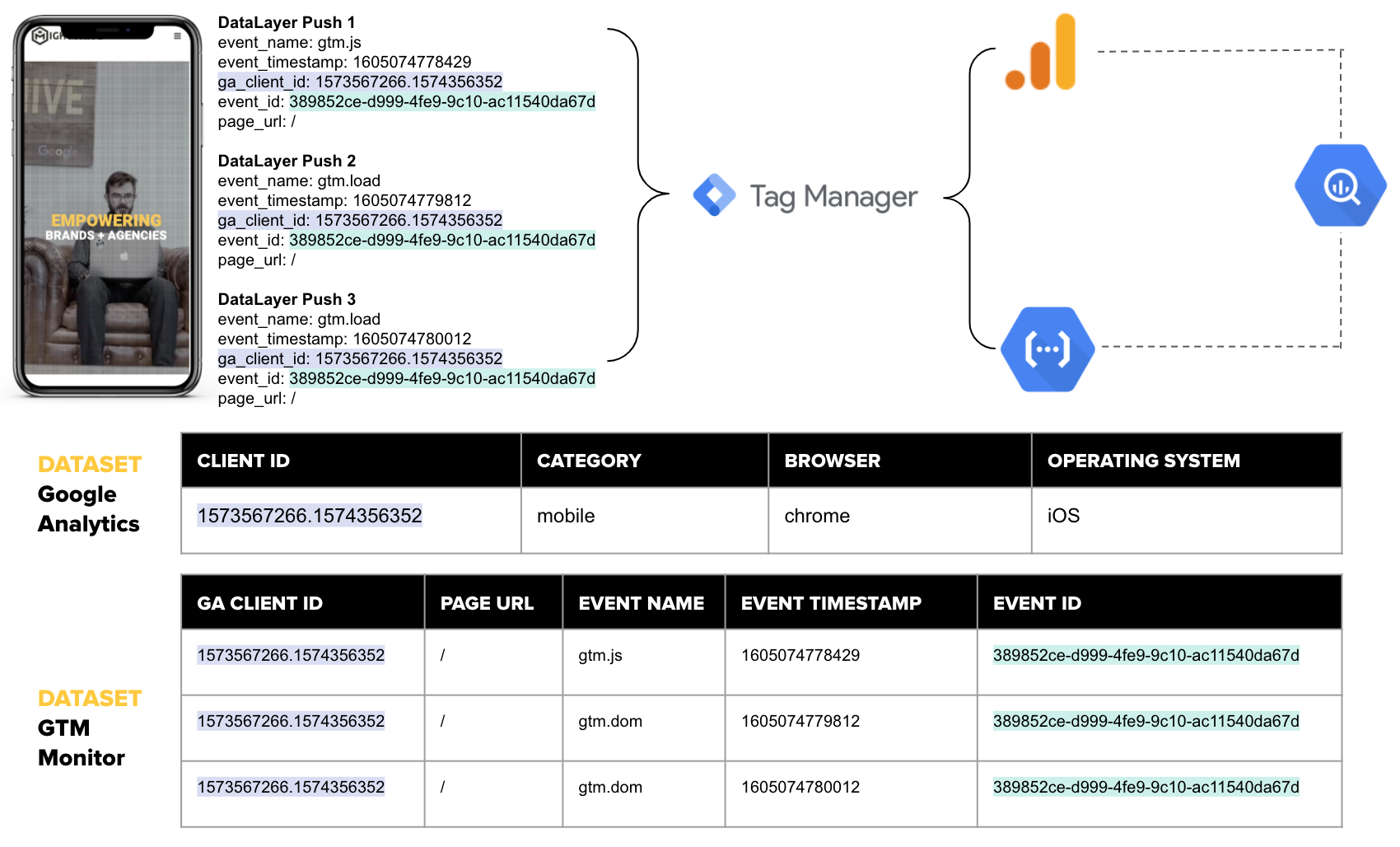
Architecture Diagram of GTM Tool Integrated with GA

Many crucial data points used for activation and measurement rely on successful dataLayer pushes. We’ve made a few updates to Simo’s Google Tag Manager Monitor framework that have allowed us to join data with Google Analytics. These updates help us unlock the ability to identify stability issue trends and patterns across devices, browsers, and operating systems that can negatively affect dataLayer pushes. For marketers struggling with data leakage, this is a BIG WIN.


We’ve Been Tinkering


Let’s explore the various adaptations we have made to Simo’s methodology in order to join results from the Google Tag Manager Monitoring Tool with a Google Analytics dataset in BigQuery, and what these enhanced capabilities mean for marketers. The join we’ve created enriches data collected via the Google Tag Manager Monitoring Tool with Google Analytics data points such as device, browser, OS—crucial information in understanding trends and patterns that impact performance. 

This post provides a high-level overview for how adding a new metric to your analytics toolset can help you measure the stability of your analytics implementation. If you’re interested in digging deeper into specifics or discussing real-world use cases, please reach out to me


TECH SETUP

There are a few prerequisites to have in place before joining data from a Google Tag Manager Monitoring Tool with Google Analytics data:

  • Pre-existing implementation of Simo’s Monitoring Tool (use his guide to get started)
  • Access to Google Tag Manager
  • Access to Google Cloud Platform project 
  • Google Analytics 360 Export


Here’s a look at an architecture diagram showing the Google Tag Manager Monitor Tool integrated with Google Analytics:


The Secret Sauce


The MightyHive Data Science team has designed a series of updates to Simo’s monitoring tool to provide enhanced data and diagnostic insights, including updates to the tool template to capture the Google Analytics Client ID, allowing us to join Google Analytics BigQuery data sets. Our team also realized that to connect all events on a given page together, a universally unique identifier (UUID) needed to be set via a new custom HTML tag. 

With the updated Monitor Tool template and the UUID tag set, the team updated the Cloud Function and created a BigQuery Table Schema for the enhanced tool using three additional fields: ga_client_id, event_id, and urlpath.

For a more detailed breakdown of the custom HTML tags we used, key Google Tag Manager settings, and code snippets for the template updates, shoot me an email.   


What Does this Look Like IRL?


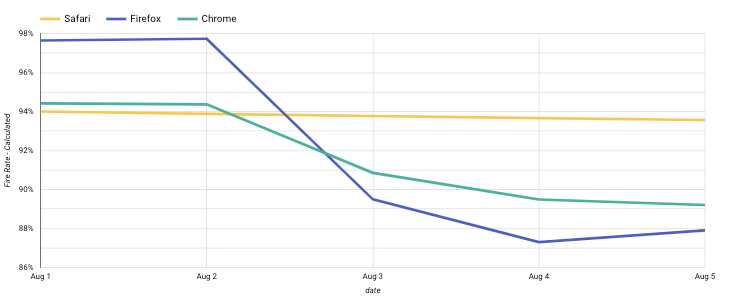
A client—let’s call them Company X—published a new version of their site around August 3. Once the updated site was live, Company X noticed that the gtm.load dataLayer event push began to fire later, or in some cases not at all. Because various tags were set to fire on gtm.load, those tags fired less frequently post-release. 

Tracking breaks like this are a marketer’s nightmare. Did the tag fail? Did someone publish an update with broken code or without the all-important dataLayer push? Is the break happening on a specific device, browser, or operating system? These questions and more can lead to a frustrating, time consuming wild goose chase, not to mention lost data until the issue is fixed. 


Calculating the Google Tag Manager Load Rate


To troubleshoot Company X’s misfire, we used a new metric: Google Tag Manager Load Rate.  We’ve calculated the load rate using the following simple formula:


GTM Load Rate Formula


Let’s say Company X has an order confirmation dataLayer event that occurs after gtm.js. Swapping out gtm.load for the order confirmation dataLayer event gives Company X its order confirmation fire rate. 


BIGQUERY GOOGLE TAG MANAGER LOAD RATE QUERY

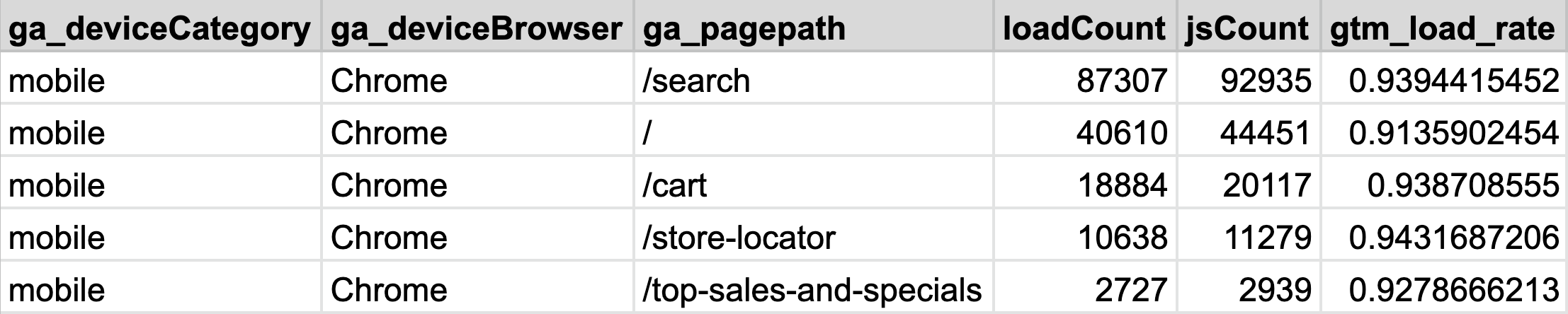
The Google Tag Manager Load Rate query calculates the fire rate in the following grouping:

  • Device Category - Google Analytics provided device category (desktop, tablet, mobile) 
  • Device Browser - Google Analytics provided device browser (Chrome, Safari, Firefox) 
  • Page Path - Page where the event occured
  • Load Count - Count of gtm.load events
  • JS Count - Count of gtm.js events
  • GTM Load Rate - Load Count / JS Count


Here’s what the query output looks like:


GA Query Output


In this example, using our BigQuery Google Tag Manager Load Rate query, we can quickly see that Company X’s home page, or “/”, has the lowest load rate at 91%. This means that 9% of gtm.loads on the home page did not fire, therefore leading to 9% (!!!) of traffic potentially being untracked. 


Better Insights, Faster Solutions


Our updates to the Google Tag Manager Monitoring Tool help take some of the guesswork out of the equation by automating a solution that audits dataLayer fires to quickly diagnose issues as they arise. By leveraging our version of the tool supplemented with Google Analytics data points, Company X was able to quickly pinpoint a sharp decline in fire rates post-release on Chrome and Firefox, while Safari was unaffected. A speedy and definitive diagnosis helped Company X fix the issue fast, reducing data leakage and bolstering its analytics setup against future issues.


dataLayer Firing Diagnosis

Data Leakage Be Gone!


In advanced analytics use cases, troubleshooting and diagnostics can monopolize an inordinate amount of time and resources, risking massive data leakage until an issue is resolved. Now that we have the ability to join Google Tag Manager Monitor Tool insights with Google Analytics datasets, we can pinpoint when and where dataLayer pushes fail and which devices, browsers, and operating systems they are failing on. For marketers, this means hours, days, or even weeks of time saved and minimal data lost. 

Learn how Google Tag Manager and Analytics can help unlock the ability to identify stability issue trends and patterns across all devices. data analytics data Google

Choose your language

Choose your language

The website has been translated to English with the help of Humans and AI

Dismiss