Choose your language

Choose your language

The website has been translated to English with the help of Humans and AI

Dismiss

Cinderella Shopping: How to Coach Yourself up for This New Trend

Cinderella Shopping: How to Coach Yourself up for This New Trend

4 min read
Profile picture for user Emilie Tabor

Written by
Emilie Tabor
Global Head of Innovation & Social

Influencers shopping and showing off their fashionable outfits

Ever since Shopee’s fist Midnight Mega Sale earlier this year, a new trend has caught the eye of astute marketers and ecommerce platform owners alike. Named “Cinderella Shoppers” by the Singaporean ecommerce giant, nocturnal consumers are beginning to shop after midnight, most commonly between 12 and 2 AM. Now, marketers are asking themselves what draws them to hit the purchase button in the wee hours of the night—and more importantly, what it means for their brands.

There’s been much ink spilled about emerging consumer behaviors of the new digital era, and of the spending mindset brought about by the proliferation of ecommerce. From the fear of missing out on in-demand products as they run out of stock to the popularity of retail therapy, consumers are changing why, how and when they buy—and online shopping has become an essential part of the equation. This shift spans a plethora of categories, from luxury items to grocery delivery, and will continue to expand as ecommerce expands to more industries.

These changes were accelerated by the Covid-19 pandemic—which, for instance, came with a steep increase in mobile online shopping. Although the possibility to shop from anywhere is not necessarily new, the comfort level reached during lockdown surely is—and it has caused old habits to go the way of the horse and carriage for most consumers. With Cinderella Shopping growing strong and steady in Asia and beyond, it’s time to reassess our strategies and consider the new opportunities that are opening up.

The Rise of a New Trend 

Before Shopee’s Midnight Mega Sale, the brand had already noticed a not-so-subtle tendency toward late-night shopping. It was their curiosity about this pattern that prompted them to do a midnight sale in the first place—a bid to target those audiences with flash deals that were available only during the first two hours of the day. Surprisingly, the sale recorded six times more purchases than on any average occasion, which incentivized the ecommerce platform to keep on rewarding these late-night shoppers with more benefits. 

This trend is not limited to any region or industry. As Global Head of Innovation & Social, I’ve witnessed the phenomenon first hand with one of the world’s largest producers of electronics. Not long ago, we supported a live event in Italy to promote the brand’s new product offerings, and saw the highest conversion rates between 10 and 11 PM, seven hours after the livestream had ended. At first, I was surprised by the stats, but with consumers being able to access on-demand content anytime and anywhere, it’s only natural that they will do so when they see fit. Moreover, it’s fair to assume that consumers may want to take their time to research the product before buying.

This isn’t to say that your efforts should exclusively focus on the wee hours of the night. Peak timings in general stand between 8 and 9 PM, but if consumers are skewing towards new routines, looking into—and rewarding—these late-night shoppers can be worth it. After all, all uncharted territory is a good opportunity to stand out among your competitors.

You Can’t Put the Same Shoe on Every Foot

When we think about the reasons that may have led to this sudden rise in late-night shopping, many different factors come to mind. One thing, though, is key: where it would normally be impossible to go to a store after a certain hour, the proliferation of online shopping made it feasible for consumers to purchase at any time.

Although late-night shopping can be commonly associated with impulsive purchases that are cancelled the morning after, this is not always the case. For some, the frenzy of the work day prevents them from finding the time to sit down and fill the shopping cart, or research the products they’re interested in buying. At midnight, though, when the household is asleep and the phone has stopped ringing, it’s easier to focus. At the same time, checking something off the to-do list helps people sleep more soundly, which explains why some may feel the urge to click the ‘order’ button before hitting the sack. 

You can’t put the same shoe on every foot, but you can try and see where the footprints lead to. That is, take the time to get to know your audience. By following their patterns, you’ll be able to provide a customer experience that adapts and responds to their habits—whether with online shopping, virtual events or any kind of content.

How to Be the Belle of the Ball

Once you’ve gotten familiar with your consumers, their behaviors and nuances, it’s important to deliver experiences that will reward and incentivize them. One way to do this is by offering special flash deals for night owls—but you can move further up in the funnel, too. After witnessing how our livestream views scaled later in the day, my team and I decided to complement future day-time streams with additional content for our audiences to enjoy later if they had missed the action live. 

Seeking new partnerships can also expand your reach. This includes marketplaces that can add visibility and sales, but also celebrities and content creators that will allow you to tap into their fanbase. It’s not merely about capitalizing on their followers; with creators that consumers already love, you can make shopping a more innovative and social experience that connects the dots across the entire customer journey. For their Mega Midnight Sale, Shopee offered users a unique experience with K-pop girl group Mamamoo, who performed through Shopee Live. 

This serves as a great example of how you can draw new audiences into your existing deals and benefits. Even when consumers are not necessarily in shopping mode, the right content and the right time can set the mood. Think about it: if audiences are leveraging the last couple of hours before going to sleep to make purchases, they must be using the time to watch other types of content, too. We know revenge bedtime procrastination is real, so take the opportunity to interact with your consumers when it works for them. That is, when they actually have the time to engage.  

Cinderella Shopping is still an emerging trend, but just like with any new audience, it’s never too soon to build a relationship. To do so, start by making sure you’re familiar with your consumers’ behavior, and give yourself the opportunity to experiment with new ways to target, incentivize and reward those with new habits. You can’t just wave the magic wand to engage with late-night shoppers, but the more equipped you are, the higher the chances of delivering a successful strategy that supports emerging behaviors while rewarding your most loyal customers.
Our Global Head of Innovation & Social dives into the latest trend in online shopping, and what brands can do to engage with late-night consumers. Our Global Head of Innovation & Social dives into the latest trend in online shopping, and what brands can do to engage with late-night consumers. ecommerce ecommerce strategy influencer marketing Fashion virtualized fashion

FLUX.Monks Are Reimagining the Fashion Industry

FLUX.Monks Are Reimagining the Fashion Industry

5 min read
Profile picture for user mediamonks

Written by
Monks

A persons standing in the desert wearing a luxurious outfit

It’s difficult to believe that it has only been a year since our fashion and luxury team—the FLUX.Monks—launched. And what an incredible year it’s been. As fashion weeks cancelled, retail stores closed and supply chains were disrupted, the FLUX.Monks had their work cut out for them. But they rose to the occasion, connecting the dots across a wide range of capabilities to drive fashion’s most powerful element—its human, emotional and expressive heart—into worlds that truly span digital and physical landscapes and platforms.

Contrary to the trappings of the traditional agency with siloed data and creative teams passing the baton, our teams work together from day one to come up with truly integrated and innovative solutions for clients. “The key,” says Liam Osbourne, Global Client Partner for FLUX, “is in maintaining the delicate balance between insight and instinct to preserve the aesthetics and signature style of a brand while exploring different channels, experiences and even audiences.” 

As the industry has transformed, the FLUX.Monks have been busy helping brands reimagine how they connect with customers across numerous channels and experiences by interlacing data-driven insight, purposeful creativity and world-class production capabilities to elicit elegant and meaningful campaigns, activations and experiences. And this past year has been nothing short of amazing, both in what we’ve been able to achieve for fashion and beauty brands during this remarkable time, and what we’ve learned. 

Stepping Off the Catwalk and Into an Interactive World

Over the past eighteen months, fashion shows around the world have enjoyed a period of digital experimentation. Stepping off the catwalk and onto immersive digital channels, fashion houses have had to reimagine the way they tell their stories and represent new collections. Digital experiences have enabled unparalleled access to the previously insider-only world of fashion shows. Now untethered from the catwalk, it’s likely that show formats will never return to the previous constraints of time and space. And with deep category expertise and world-class capabilities across new and emerging technologies, the FLUX.Monks are uniquely positioned to bring the fashion show of the future to life. The trick is in creating immersive, tactile experiences that engage new consumers without alienating, or inadvertently excluding, brand loyals.

Monk Thoughts Gen Z and millennials will dictate the future of luxury fashion, but how they engage with the luxury fashion market is a complete departure from previous generations.

Osbourne goes on to add: “They’re the most digitally sophisticated consumers to date and brands need to work with a team of experts that have deep understanding of platforms and emerging technologies while also being fluid in the nuances of fashion to succeed.”

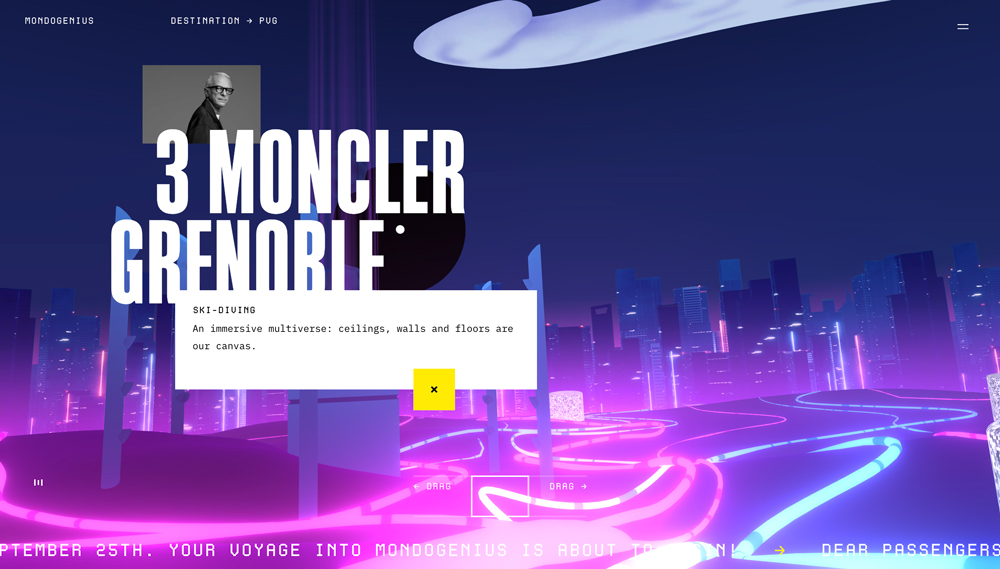
Moncler's mondogenius platform interface homepage

As Italian fashion luxury brand Moncler’s official interactive broadstream partner, the FLUX.Monks helped bring the brand’s 2021 #MONCLERGENIUS Fashion Show to life with an experience that took attendees on an immersive, game-like journey—a fantastical trip around the world. Working closely with Moncler’s physical installation and design agency, Villa Eugenie, our team helped build interactive, virtual worlds inspired by installations spanning New York, Shanghai, Milan, Seoul and Tokyo to bring a new dimension to Moncler’s physical events that allowed the brand to reach a broader audience.

Central to the show itself—which was broadcast on YouTube Live—was interactivity. From animation to live event support, our teams worked alongside Moncler to give users unprecedented access to the show as they interacted with other viewers and contributors via the live-chat system. More than 4 million people visited the dedicated microsite—numbers that will only continue to rise as the platform lives on long after the live event—and 80% engaged with the livestream, with viewing times 4.5 x longer on the interactive (vs non-interactive) livestream. 

Catering to Geographically Diverse Audiences

For most brands, no two markets are exactly alike. And that goes double in fashion and beauty where consumer tastes can be highly nuanced within even a single market. Global brands working to grow adoption across a number of markets need a multicultural partner who can help them show up meaningfully and authentically. So when Amazon Fashion Europe wanted to raise brand awareness and their cred in the fashion space, they turned to our FLUX team. 

Challenged with penetrating five key but distinctly different markets within Europe—UK, Germany, France, Italy and Spain—the team not only brought their fashion expertise, but worked very closely with our social influencer and data teams to become a relevant part of the fashion conversation and strengthen Amazon Fashion’s presence in the channels where fashion and lifestyle are the main drivers.

Amazon fashion influencer ad campaign

Spanning content and asset creation, social and influencer marketing, and community management, FLUX established the Amazon Fashion Council to ensure a humanized feel to the brand’s wide offering. Each member of the council—stylists, designers and fashion influencers—represents a key European market and shares their words of wisdom across the Amazon Fashion channel, engaging consumers in a targeted and personalized manner. Complete with language and translation support—all under one umbrella.

Bringing It All Together for an Iconic Brand

When Burberry wanted to expand their omnichannel presence and develop a 360-degree vision that includes digital, they selected our FLUX.Monks as lead social, creative, strategic and production partner. “Burberry is one of the most technologically innovative and digitally expressive brands in fashion,” says Osbourne, “and we have been equal parts awed and inspired to be partnering with them on numerous integrated campaigns and initiatives designed to reach millions of people globally.”

As part of the fifth installment of the “Burberry Generation” artist collaboration project, our team was tasked with creating bespoke storytelling and driving buzz on social platforms to promote the brand’s iconic handbag—the Olympia bag. We scouted and collaborated with installation and balance artists to build four breakthrough balancing art pieces that incorporated the bag, and delivered four hero short films and a pack of key visuals to showcase execution of the balancing installation. All launched across WeChat, Little Red Book, and social video platforms while the installations were covered in several media publications.

When asked to support Burberry on the launch of their smart retail store with Tencent in Shenzhen, we sought to create social buzz and to drive traffic, online and offline. Our strategy was to tap into media and various content creators, within both the fashion and tech worlds, to cater to Shenzhen as a high-tech hub, and to collaborate with celebrities and local influencers covering WeChat, RED, Weibo, Douyin and beyond usual platforms with Bilibili. Thanks to our launch strategy and local market insights the store was a destination—both online and bricks and mortar—generating massive social buzz and setting the benchmark for a flagship launch for the sector.

A shoreline of rock sculptures in the shape of the Burberry TB Monogram

And to celebrate this year's monogram campaign for Burberry, our team worked with four land artists to reimagine Riccardo Tisci's contemporary monogram design on the Welsh shoreline, where it stood for hours before being swept back into the sea. Our second installation featured a series of 300 drones choreographed to create the iconic monogram pattern in the Colorado sky—a striking constellation above a remote mountain reserve. Together, both embody Burberry's celebration of exploration and the unexpected, and the inspiration of the great outdoors.

Yes, the FLUX.Monks—a global strategic, experiential design and creative team specializing in driving desire and relevance for fashion, luxury, lifestyle and beauty brands across the end-to-end customer journey—have had quite a year. And with the fashion industry changing moment-to-moment there’s much, much more to come.

Maintaining a balance between data and instinct, FLUX experts engage in new channels, experiences and audiences for luxury brands. Maintaining a balance between data and instinct, FLUX experts engage in new channels, experiences and audiences for luxury brands. Fashion virtualized fashion virtualized events luxury digital experience end-to-end experience
Moncler's mondogenius platform interface homepage
Mondogenius website interface welcome screen

Fashion Show Livestream Partners • A Virtual Journey for Fashion Lovers

  • Client

    Moncler

  • Solutions

    ExperienceImmersive Brand StorytellingRetail Concept InnovationVR & Live Video ProductionExperiential Strategy & Production

Uniting fashion lovers on a next-generation digital platform

As Moncler’s interactive broadcast partner, we turned their 2021 Genius Fashion Show into a one-of-a-kind virtual destination for fashionistas everywhere. Working collaboratively with the brand and design agency Villa Eugenie, we conceptualized and engineered a bespoke digital platform that takes users on a journey through five cosmopolitan cities—interwoven with thrilling performances and unique experiences.

A journey of appreciation

To kick off MONDOGENIUS, we invited visitors to create their own boarding pass—which they would later use to visit Moncler’s virtual versions of New York City, Shanghai, Milan, Seoul and Tokyo. Brought to life in a WebGL environment, each interactive world was crafted in a unique visual style, from Milan’s sophisticated chic, to Shanghai’s neon night scene. In virtually recreating these spaces, the platform connected the physical locations where the Genius Fashion Show took place—but turned an exclusive event into an inclusive experience anyone could participate in.

Unprecedented access to an unprecedented event

On show-day, we hosted a live event on YouTube and through our own LiveXP tool, where people could comment and interact with each other. With polls, minigames and more, we turned viewers into participants—offering a truly engaging experience. By opening the door for all people to connect with the brand in new ways, we added a new layer to the concept of fashion shows and amplified Moncler’s reach to more than four million people.

Monk Thoughts To see our teams' creative concept and strategy amplify a 3D digital infrastructure to produce a holistic interactive experience that transcended mobile, social, and web was truly exciting.
Woman crossing her arms and smiling against a gray background

Our Craft

A virtual destination that made a fashion statement.

  • Moncler's mondogenius platform interface homepage
  • Moncler's mondogenius platform interface ticket purchase
  • Moncler's mondogenius platform interface livestream

Results

  • 1x CLIO Award

Want to talk experiences? Get in touch.

Hey 👋

Please fill out the following quick questions so our team can get in touch with you.

Can’t get enough? Here is some related work for you!

Diesel and Pronounce logo
An outfit behind glass in shown on a exhibition floor

Diesel x Pronounce: Launch Experience • A High-End Fusion of Two Fashion Philosophies

  • Client

    OTB Group

  • Solutions

    ExperienceExperiential Strategy & ProductionRetail Concept Innovation

00:00

00:00

00:00

Case Study

0:00

An experimental exhibition that’s dressed to impress.

Global fashion brand Diesel and Pronounce—the fresh, young Chinese designer label that attained worldwide recognition—collaborated to design a bold collection that uniquely weaves together Chinese fashion with Italian craftsmanship.

Given both brands’ spirit for experimentation, the Diesel x Pronounce collection deserved an enthralling event that highlighted this unique pairing. For the global unveiling in Shanghai, we transformed an empty 700-square-meter basement into a high-end, immersive exhibition that elevated the collection’s concept and art direction through lighting, music and bespoke digital artwork.

Sketchbook with designs and pen accompanied with a few photos of exhibit

Rolling up our sleeves to innovate.

Rather than just another collection launch, we set out to awe the audience with a visual journey that captivated minds and smartphones alike. A sense of fluidity defined the exhibition space through real-time artworks, including a projection onto a 50-square-meter structure and a mood film projected onto drapes to create the illusion of an indoor waterfall.

This visually stunning experience evoked both brands’ identities and provided a photo opportunity at every corner, encouraging visitors to share their experience online. Put together in the span of only four weeks, our multidisciplinary team handled every aspect—from space design, content creation and software development to fabrication and construction.

Results

  • 5,000 exhibit visitors.
  • 7,384 comments, likes and shares combined across social media channels.
  • 13,000 views on WeChat.
  • 1x FWA

Want to talk experiences? Get in touch.

Hey 👋

Please fill out the following quick questions so our team can get in touch with you.

Can’t get enough? Here is some related work for you!

From Runway to Gameplay, Fashion Goes Virtual

From Runway to Gameplay, Fashion Goes Virtual

4 min read
Profile picture for user Labs.Monks

Written by
Labs.Monks

From Runway to Gameplay, Fashion Goes Virtual

Retail customers stand outside in a queue to ensure a safer shopping experience. Dressing rooms are closed. Fashion Week has gone virtual. And today’s fashion design students can’t meet in a studio to cut and sew materials. But the fashion industry isn’t in peril—it’s just taking on a new look.

This month, our research and development team MediaMonks Labs is collaborating with FLUX, our fashion and luxury team, to offer a special Labs report focused on the future of fashion. Bursting at the seams in digital innovation—from production to customer experiences—the report spares no effort to serve looks and inspired insight on the virtualization of fashion in its many forms. 

Virtualization is In-Season

For a long time, fashion-forward didn’t necessarily translate to being tech-forward. But in recent years, there’s been a growing desire to shake things up and break free from the cycle of seasonal releases and endless fashion weeks around the world. Suddenly, events that had long been exclusive became available to everyone through social feeds, completely changing the way brands engage with their audiences—like video game-inspired activations.

“It’s not just about the tech changing, but also how consumer behaviors are evolving,” says Ben Lunt, Head of Experience Design, Fashion & Luxury. “Brands knew they’d have to adapt, but the time never felt right until the past year.” Thanks to the pandemic, customer-facing digital experiences are increasingly in vogue—just recently, MediaMonks partnered with Verizon Media and IMG to bring Rebecca Minkoff’s new Spring 2021 collection to fashion lovers everywhere through 3D renders.

Monk Thoughts It’s not just about the tech changing, but also how consumer behaviors are evolving.

The technology lets people inspect looks up-close from any angle, either on a desktop device or directly superimposed in their surroundings using augmented reality. Previously, Rebecca Minkoff noted that customers are 30% more likely to buy when given the chance to engage with 3D product models online.

3D Production Connects People and Experiences

While the virtualization of the consumer experience has received a lot of attention from the fashion industry, it’s also aiding efforts in design and production. In response to sustainability concerns, today’s fashion students are learning to design in CLO3D, which allows designers to design, develop and sample garments in real time—software that’s also proven useful in the pandemic. The tool does more than let users design and collaborate from a safe distance—it streamlines the entire process.

In the traditional process, draping and patternmaking for each change in design can be time-consuming and wasteful. Virtualized production lets designers visualize these variations at speed, opening them up to more experimentation throughout the process. But it’s not about speeding up an already fast industry. “It’s about pinpointing parts of the process that can be streamlined in order to slow down others,” says Brandi LaCertosa, a Creative at MediaMonks. “We can create more space and time for thoughtful design and production.”

And these same assets can pull double duty by powering the kinds of touchpoints discussed above—or even inspire entirely new experiences. On the Labs team, MediaMonks Innovation Director Geert Eichhorn says: “If you switch to this digital pipeline you can make new products, like exporting designs onto video game avatars or letting users try on outfits with a digital twin.” While the digital twin idea is still some time away, it inspires some of the exciting D2C ecommerce solutions that forward-thinking brands might try out.

New Feedback Loops Transform the Industry

 Accelerated production and design can transform the value chain—a linear process that moves from designing and planning to sourcing and supply, and finally the consumer experience—into more of a Venn diagram where different steps overlap. Consider if 3D garments worn by players in a video game were the same used in a virtualized look book for retail buyers—but were originally made during the design and production process of the physical garments.

Monk Thoughts It’s about pinpointing parts of the process that can be streamlined in order to slow down others.

These assets can also be used for market testing. RTFKT presents 3D designs to its audience, inviting them to vote on those that make it to physical production. Fashion brand Finesse uses AI and social listening to source data-driven designs. Using CLO3D, the brand can act on trends quickly through accelerated production. For brands that serve as tastemakers, this same data can act as a trend forecast report in the design process, helping curate which pieces of the collection to take from runway to production. “Many designers crave an understanding of the people who will wear their clothes,” says LaCertosa. “Take Virgil Abloh for example, who is extremely active on Clubhouse for exactly this reason.”

Emulating the Analogue Aesthetic

Despite the advantages of virtualization, could it all be a fad—is it the emperor’s new clothes, bound to fall out of fashion once the pandemic subsides? Lunt notes that there’s always been a tension between fashion labels—luxury ones in particular—and new technologies, particularly because those brands have honed a more analogue aesthetic that can feel at odds with virtualization at first blush.

“They operate at a deep, impressionistic level,” he says. “If you look at a campaign image from Bottega Veneta, there’s a lot going on there—it touches you at a deep level, but a lot of those soft signals are analogue. Digital currently has its own aesthetic codes which can often be antithetical to luxury.” But it’s not a zero-sum game. By way of example, Lunt mentions Pixar’s painstaking efforts to emulate an analogue aesthetic in its CG films—like the split diopter lens, a unique tool that puts two objects in focus with no continuous depth of field to provoke a specific emotion in the viewer. 

Virtualized fashion also runs the risk of falling into “uncanny valley” territory, in which the slightest imperfection in an otherwise faithful reproduction can induce revulsion. “From the way the trim falls when moved to folds in the fabric, the smallest thing that looks off can trigger that response,” says Eichhorn.

But these challenges shouldn’t turn brands away from virtualization. Instead, it should prompt them to think more thoughtfully about where technology has the most potential to fuel creative innovation or build stronger relationships with consumers. “Luxury codes are already evolving to accommodate, appropriate, and ultimately push digital aesthetics forward,” says Lunt. “And you can still take that stylized photoshoot to capture the human element, then use 3D so consumers can see how it actually looks on them,” adds LaCertosa. “It’s about using this technology to support your brand and its aesthetic, not replace it.” 

There’s more where that came from.

Spurred by sustainability concerns and accelerated by the pandemic, fashion’s virtualization extends from production to the consumer experience. From Runway to Gameplay, Fashion Goes Virtual Fashion-forward meets tech-forward.
Fashion virtualization virtualized fashion mediamonks labs flux

Choose your language

Choose your language

The website has been translated to English with the help of Humans and AI

Dismiss