Choose your language

Choose your language

The website has been translated to English with the help of Humans and AI

Dismiss

Data Governance and Business Considerations: A Strategic Approach to Implementing a CDP

Data Governance and Business Considerations: A Strategic Approach to Implementing a CDP

CRM CRM, Consumer Insights & Activation, Data, Data Analytics, Data maturity, Death of the cookie 4 min read
Profile picture for user mediamonks

Written by
Monks

A person working on a computer analyzing data

When we think about customer data, plenty of benefits come to mind: the ability to access valuable insights into customer behavior, identify gaps in the sales funnel and optimize product development, among others. Customer data is one of the most valuable assets a business can have, especially in the pursuit of developing more meaningful and personalized connections with consumers. But as those working in data analytics know all too well, simply collecting data doesn’t cut it—especially if it lives on different platforms and the collection points are spread across the entire customer journey.

To overcome that challenge, wise marketers and data scientists resort to customer data platforms: software systems that allow businesses to collect, centralize, and manage customer data from multiple sources in one place. A CDP can help answer an abundance of questions by providing a single source of truth; though before you can get there, it’s important to understand how to handle the complexities and responsibilities that come with it.  

Not long ago, our Associate Director of Customer Data, Elia Niboldi, penned an article on how to leverage CDPs to their full potential. This time, we’re taking a step back with a new whitepaper that explores the key considerations when implementing a CDP. Let’s dissect some of the main takeaways.

With CDPs comes great responsibility.

To put it simply, CDPs aim to provide a comprehensive view of the customer across all channels and touchpoints, which allows businesses to make informed decisions and create better customer experiences. They are incredibly powerful tools, but that also means the data collected by CDPs can be sensitive and needs to be handled in a responsible and ethical manner, even if customers were happy to share it with the brand in the first place.

In other words, CDP data comes with the need for strategy and clear governance around a brand’s interactions with their customers. Having a robust consent management system in place is the bare minimum, an essential process for allowing customers to determine what information they want to share with a business—something that Salesforce Privacy Center handles very well. And this shouldn’t be limited to brands’ first interaction with a client: when changes in regulation occur or customers’ preferences change, they should be provided with an option to manage and update these preferences, and brands can keep track of those from a centralized location through a CDP.

Once the customer has shown interest in creating a value exchange between their data and the brand’s services, it’s important to set frequency capping standards that alleviate brand fatigue and ensure brand communications are effective and positive—rather than annoying and frustrating. The frequency send caps are usually reset daily, weekly or monthly, and can be adjusted based on customer behavior to optimize marketing campaigns and improve the overall customer experience.

Consider the role of CDPs in the CMO’s business.

Because they provide a unified view, CDPs are both a technical and organizational tool that can help break down silos. Traditionally, customer data has been fragmented across systems and siloed within departments, making it difficult for marketers to access that data in meaningful ways. At the same time, it’s naturally hard for technology teams to fully understand marketing needs or their specific use cases for the data they manage. CPDs bridge this gap, serving both the CMO and the CIO.

However, in order for CMOs to access the real value of CDPs, we need to remember they play three key roles: ensuring cooperation between teams, improving optimization use cases and offering better segmentation. A CDP necessitates cooperation between different teams because it’s meant to break down silos and provide a single source of truth that everyone in the organization can draw from. Through that source of truth, marketers can keep track of which channels and strategies are performing particularly well and optimize accordingly. Finally, CDPs unlock superior targeting capabilities that allow businesses to provide personalized experiences that resonate with their customers’ needs and interests. 

Salesforce Data Cloud, for example, combines the data from Google and The Trade Desk to activate audience insights beyond messaging, journeys and onsite personalization into a brand’s search and digital media campaigns. Plus, it funnels a nearly infinite amount of dynamic data to Customer 360 in real-time. This allows for deeper audience engagement, as customer data is continuously updating and feeding audio, OOH, app, web campaigns and everything in between.

Interested in implementing a CDP? Assess your readiness. 

So, you’ve installed clear governance standards around your interactions with consumers and aligned both the CMO and CIO on the importance of having one source of truth. Are you ready to start extracting meaningful customer insights? Not just yet. First, you’ll need to follow a few initial steps to ensure a successful implementation of the CDP:

  • Outcome alignment: start by workshopping the priority use cases to deliver the minimum viable product. This needs to be a cross-functional exercise that ideates, quantifies and prioritizes use cases.
  • Identity resolution strategy: build the identity graph that allows a customer profile to be stitched together to form a single customer view.
  • Data model: design a consistent global measurement framework.
  • Team vision: make sure the CDP is coupled with a clear strategic vision and the right team to extract its full potential. This team should include champions from different departments, system integration partners, executive sponsors and operational users. 
  • Implementation plan: develop the operational model. For a customer data platform to be implemented seamlessly into a business, pre-built integrations are essential. Establish which integrations are required and use this to choose a CDP solution that suits your operational needs.

All things considered, CDPs shouldn’t be thought of as “set and forget,” but rather “implement and optimize.” A CDP like Salesforce Data Cloud can provide a wealth of benefits for a business, from more efficient data management to improved customer experiences. By setting a clear governance process and taking into account key considerations before implementation, businesses can ensure that they are ready for both the benefits and the responsibilities that come with utilizing a CDP.

A CDP can help by providing a single source of truth; though before you can get there, it’s important to understand how to handle the complexities and responsibilities first. customer data data analytics data and analytics salesforce marketing Data Consumer Insights & Activation CRM Data Analytics Death of the cookie Data maturity

Context is Key to Cementing the Value of Data Within a Company

Context is Key to Cementing the Value of Data Within a Company

Data Data, Data Strategy & Advisory, Data maturity 5 min read
Profile picture for user Juliana.Jackson

Written by
Iuliana Jackson
Associate Director, Digital Experience EMEA

A laptop and an analytics print out showing data tables and graphs

Ten years ago, my career looked totally different—I was in sales and didn’t know the first thing about data. Fast-forward to today, I have moved to a tech-first role and I’m loving every bit and bob of it. Interestingly enough, it is through my non-tech background that I’m able to thrive in my current role. Why? Because as a digital analyst, it’s important to understand business principles and how they influence your work—something that salespeople are experts in. Digital analysts must understand human behavior, the business landscape, and how their company and clients make money. This will enable them to make informed decisions and be truly impactful in their roles.

“It’s so much more powerful being a part of a team that’s full of mixed backgrounds and experiences,” says Doug Hall, VP of Data Services and Technology. “Tech isn’t just for computer science graduates. If we didn’t have a rich tapestry of skills and experiences woven into the team fabric, we’d have a homogeneous glom of great skills, but we’d be more likely to do the same things this week as we did last, and in the same way.”

My move from non-tech to tech-first taught me that many things surrounding data are isolated from business needs and outcomes, even though you don’t want this to happen. When teams operate in silos and data works in isolation, so does experimentation. This inevitably leads to random acts of marketing and chaotic reporting. Rather than siloing teams, data should unify them—even if they have totally different KPIs. For instance, marketing teams look at lead generation, engagement and visibility, while product teams focus on retention and acquisition. In short, if everyone has a separate way of tracking and collecting data, this also means that everyone is looking at different things. 

Viewing the full picture is pivotal to success. 

The bottom line is that all of this information is data, and everyone should be aligned on what type of data will actually help the company move forward. Companies may invest in tools that serve one or more departments—GA4, for one, can support marketing and product teams—but the way each team or department collects data should be a company-wide decision. In turn, this means that a company’s data collection mechanism needs to be strong and reliable to be able to support every team and department in a business and help spur progress. The goal is to unite, not separate. That’s why it’s critical to align what matters in terms of data collection and measurement with the company’s business needs. 

The operative word is context—whatever we do, we must keep this in mind. Getting your company or clients to believe in the data at hand starts with analysts and measurement marketers understanding where the business is right now and where it can go. By actively participating in the inner workings of a business—with a focus on resource allocation and the processes that generate money—and analyzing relevant and purposefully collected data, you can help steer your company or clients towards profit. 

As such, I recommend every digital analyst to get familiar with a business’ internal processes. You can use this knowledge to implement tracking and analytics systems that align with the company’s procedures. A good example of this is how we helped the multinational alcoholic beverage company Diageo deploy GA4 across its 150 brand websites. As Hall explains, “Due to alcohol regulations around the world, most countries require an age verification gateway, which is a major conversion blocker that goes above and beyond consent management. This means that measurement and optimization are crucial for Diageo—and that’s how we knew that deploying consistent measurement across all brand sites was the best solution.”

Monk Thoughts The deployment of consistent measurement was automated. Consistency comes not only from mirroring the tagging, but also from doing so across each site in the exact same way—perfect for automation to solve at scale. Ultimately, this increases efficiency and reliability.
Julien Coquet headshot

In short, every digital analyst should come to understand the business context and goals to make sure the tag management and analytics tools are both implemented effectively and in line with the needs of the business. The secret sauce here is to closely collaborate with business-focused team members like marketers, consultants and account managers, who can provide guidance on what data is needed and how it will be used. Sure, we can rely on our experience and heuristics, but that doesn't mean any of our assumptions can be valued as truth. Once you’ve actually combed through a specific business context, you can start to define the right strategy for your business—and even then, it’s a matter of seeing how things play out before you can confirm or reject your hypothesis. Experiment, experiment, experiment!  

Become data mature to make your cash flow. 

Ultimately, this all feeds into a company’s data maturity, which Forbes defines as “a measure of an organization's ability to use data, along with how well the organization leverages those capabilities.” It’s not just about making data-driven decisions, but also about making sure data resources are accessible across an organization. The more data mature you become, the more you can scale—a topic that Coquet will discuss in more detail during the upcoming SUPERWEEK conference.  

With scale comes growth, which, in turn, can lead to new opportunities—and let’s be honest, this is an outcome that every business is after in their search for better tools, better consultants, and better digital marketing partners. When it comes to collecting data and tracking user behaviors (with consent, but this goes without saying), businesses do not want to miss out on any opportunity to get new customers, while staying relevant to their existing ones so that they continue to trust and purchase from them. More happy customers equals more cash flow. In the end, profit is the ultimate validation of growth (and that you’re doing a good job), both from a product and a customer experience perspective. 

Three takeaways to make your data take off. 

While it may take some time to find the most advanced tech stack or the best digital marketing partner—one that truly understands your business and all its needs—there are some changes you can make today. Trust me when I say that these actions will pay off in the end and help your cash flow grow. 

First of all, start by defining the problems you are aiming to solve and the questions you are seeking to answer with your data before you implement anything. This will help fine-tune your efforts and ensure that you are using the right tools and approaches to address the specific challenges you face. 

Second, consider (and research) the possibility of teaming up with a data consultant or specialist, who is able to provide expert advice and guidance on what tools and approaches are best for your specific problems and questions. This is particularly helpful if you are working on a complex or unique challenge that requires specialized knowledge and skills.

Third, teamwork always makes the data dream work. It’s crucial to collaborate with your team members and exchange your knowledge and experience—as Doug said, the more mixed the expertise, the better. By closely working together and sharing what you know, you can pool your collective knowledge and experience in setting up your measurement strategy. Keep in mind that within a business context, every team has its own problems and questions. As a leader, it's important to begin by having them define these, which, in turn, will reveal how aligned your team is around the company’s needs.

The main lesson that you should learn from this article is that context is key. At the end of the day, understanding human behavior, the business landscape, and how a company and its clients bring in money is what makes a successful digital analyst. I didn’t know this ten years ago, but I do now and I’m very happy to share these insights with you—find Julien, Doug, me and many other Data.Monks at SUPERWEEK 2023 and learn more about what really matters in managing your data.

Our Data.Monks share how cross-functional collaboration is key to making data analytics more accurate and actionable. data analytics Google Analytics Google automation Data Data Strategy & Advisory Data maturity

The Sunset of Google Optimize: What it Means for You

The Sunset of Google Optimize: What it Means for You

Data Data, Data Strategy & Advisory, Data maturity 3 min read
Profile picture for user mediamonks

Written by
Monks

Google Optimize & O360 Sunset

With the announcement that Google is sunsetting their web testing and personalization tool, Google Optimize, brands who rely on the tool need alternative ways to continue to perform A/B testing, conversion rate optimization, and personalization of web experiences.

To help brands in their transition, our data experts have written a guide that explores how brands should approach personalization going forward—including how to assess new technology providers, frameworks and methodologies to structure your planning—and long-term goals to strive for. Access your copy by filling out the form immediately below.

Need answers at a quick glance? Continue reading on for a quick FAQ that will help you get started.

Google Optimize & O360 Sunset report cover

You’re one download away from…

  • Understanding Google’s announcement and what it means for you 
  • Discovering the steps to prepare for the Optimize sunset
  • Planning your post-Optimize ‘endgame’ goals

This experience is best viewed on Desktop.

Download Now

Fast facts for the Google Optimize sunset.

  • Google has announced that Optimize and Optimize 360 will be sunset as of September 30th 2023.
  • Google will build out more powerful integrations between GA4 and third-party testing platforms to allow GA4 to measure and analyze test results.
  • Organizations leveraging Optimize currently will need to assess and procure an alternative testing/personalization platform, which will come with a different commercial model to Optimize. Media.Monks can support this process to find the right platform depending on the needs.
  • Optimize can continue to be used until September 30, linked to either UA or GA4 properties.

FAQ: Quick answers for how to prepare.

If news of the Optimize sunset has left you wondering what to do next in your optimization and personalization journey, do not fear. We’ve collected the most urgent, need-to-know facts and FAQs about the announcement.

Will I still be able to use Google Optimize after September 2023?

No, Google plans to sunset the product entirely. This can be taken to mean that the product will no longer be accessible past this date, and experiments running at this date will turn off.

Does this apply to Optimize 360 as well as the free product?

Yes. Google intends to sunset the product entirely, across both the free and 360 tiers. Note that by the sunset date, all organizations should have migrated their GA360 contracts to GA4, meaning that Optimize 360 is provided free of charge.

Should I use Optimize with UA or GA4 up until the sunset date?

This is entirely dependent on your existing UA and GA4 setups. UA 360 will continue to be available until Optimize’s sunset date, so you can continue to use it if you are more comfortable with that dataset. Otherwise, you can use GA4 data to power reporting and audiences. Linking Optimize with UA is available even after renewing GA360 contracts with GA4.

What should I do if I want to continue testing and personalizing my website after Optimize is sunset?

You will need to procure an alternative testing and personalization platform. Our report details the factors that should go into making that decision, and you should note that alternative platforms will have different commercial models than Optimize.

Will I still be able to use Google Analytics with a new third-party Experience Optimization tool?

Google has announced that they are investing in integrations between GA4 and third-party tools, with the intent being that GA4 will act as a centralized measurement hub that can be used to analyze and report on experiments that are delivered via a different platform. Media.Monks can provide more details on these integrations as they are made available by Google.

What will happen to my historical data?

Optimize uses Google Analytics data for reporting, meaning the raw data from past experiments will still be available in GA (and BigQuery if using GA360). Regardless, we recommend our clients collate test results in a central register to build an insights and learnings repository to fuel future decision-making.  Media.Monks can support the creation of a learning repository before the sunset if required.

Key watch-outs:

  • An Optimize container can only be linked to UA or GA4 one at a time, not to both. Media.Monks do not recommend running experiments out of dual containers, so you should choose whichever dataset has the most actionable data.
  • There are many factors that go into selecting an alternate vendor, and a proper assessment takes time. Organizations should bring this process well ahead of September 30 to ensure the continuity of capabilities.
  • Deploying, validating and ramping up a new testing/personalization platform could take a number of months, meaning organizations should start the selection process now.

To get detailed steps on how to prepare for the Optimize sunset and plan your post-Optimize goals, simply fill out the form above to download our report.

Monk Thoughts While this may represent a short-term disruption, the platform is a very small part of the overall picture. This should not impact your long-term vision, which should be to leverage your content, data, and technology to test, optimize and personalize your customer experiences.
Ben Combe headshot
With Google announcing its sunsetting Google Optimize, our data experts have written a guide that explores how brands should approach personalization going forward. Google Personalization data analytics first-party data third-party cookies Google Analytics Data Data Strategy & Advisory Data maturity
A hand holding a phone with the Built In application on it
A person sitting at a desk working on a laptop enjoying a cup of coffee
A person sitting on a couch working on a laptop

Enabling Hyper-Growth Across Communities • Optimizing Salesforce to Fuel Growth

  • Client

    Built In

  • Solutions

    DataCRMConsumer Insights & Activation

A laptop on a marble countertop displaying the built in application

Connecting content, data—and people.

Built In is a network of local online communities for startups, tech companies and tech professionals. A powerful connector of people, the company enables startups and tech companies to post and recruit candidates for open positions, promote their brand and culture, share news, and participate in community events.

However, having a network of communities in eight different markets meant Built In needed a way to streamline content and data for its employees, tech users and company clients to connect in one place. Built In already used Salesforce CRM, but like many companies, they hadn’t been reaping the full benefit of the CRM or other Salesforce products—missing out on key opportunities to optimize, streamline business processes and unlock revenue. Built In reached out to Monks, a Salesforce Consulting Partner, to connect the dots across their Salesforce marketing and enable a more personalized user experience.

An illustrated cellphone with a notification icon

In partnership with

  • Built In
Client Words We would recommend [Monks] to any company. [Monks] wants to be a partner. Speed of implementation and communication flexibility is really good, which you don’t always see from third-party vendors.
Jeff Hurd headshot

Jeff Hurd

Director of Product, Built In

Building trust through a transparent planning process.

Before making any moves, we connected with the Built In team to align our strategy with the goals of the business. We met with the team in person to walk them through each step involved in implementing and optimizing Salesforce Experience Cloud, Sales Cloud, Service Cloud and Marketing Cloud Account Engagement. Taking the Built In’s needs into account, we then verified and documented project steps with our engineering team—ensuring everyone was on the same page throughout the entire process.

Three employees listening to a presentation with their laptops
A person working at a whiteboard with sticky notes

An executional approach built on close collaboration.

Strong partnership is built on transparency, so once the planning phase concluded, we continued to give Built In clear visibility into our implementation of Salesforce products and platforms. We began by making daily check-ins with the Built In team, then hosted bi-weekly meetings to fully communicate our progress. The speed of communication throughout the engagement enabled additional flexibility in our approach.

Three employees looking at an iPhone together laughing

Fueling connection across platforms and people.

Now better able to connect content and data across regional communities, Built In was able to greatly improve customer satisfaction. Previously, finding companies, talent and communities were manual and complex processes; but now, tech professionals appreciate a more streamlined and transparent approach to discovering jobs, browsing salaries, connecting to networking opportunities and more. Overall, the collaborative approach between Built In and our CRM experts sowed the seeds that would fuel connection across the entire tech industry.

Results

  • 37%+ in sales forecasting
  • 19%+ increase in CSAT score

Want to talk CRM? Get in touch.

Hey 👋

Please fill out the following quick questions so our team can get in touch with you.

Can’t get enough? Here is some related work for you!

Reaching Digital Maturity With Solid Data Foundations

Reaching Digital Maturity With Solid Data Foundations

3 min read
Profile picture for user mediamonks

Written by
Monks

An arm writing on notebooks and handouts with a laptop

In an ever-changing digital and privacy landscape, the benefits of well-regulated data are many. For starters, you can count on your reporting to provide reliable information about creative effectiveness and ROI. It saves time and money, as uncontrolled data takes too much time to search through and can provide incomplete views. But with expanding data sprawl, establishing solid data foundations is the only way to access these benefits.

As part of Google’s Learn With GMP series, our Sr. Director of Tech Consulting & Architecture, Jackie Saplicki, and Sr. Director of Enterprise Data Transformation, Kosta Demopoulos, hosted a webinar on how to identify realistic and effective solutions that respect consumer privacy and help catalyze your brand toward digital maturity. Together with Google’s Ads Privacy Specialist, Lisa Tanzosh, they dove into the steps needed toward building trust in the quality of data—complete with key considerations including the importance of taxonomy in creating a functional approach. In case you missed it, you can watch the full session below, or continue reading for the main takeaways.

A strong data foundation starts with control.

For every organization, reliable data systems and good decision-making go hand in hand. At its core, that’s exactly what building solid data foundations is about: ensuring that the information we have is accessible, timely, trustworthy and fit for purpose so we can take the right steps toward our business goals. But that doesn’t happen spontaneously. Instead, it hinges on our capacity to exercise control over the data we own.

A good first step to gaining that control is building a list of all known data sources, such as ad servers, buying platforms and analytics tools. Data lives in many different places, and we need to bridge that divide in order to access a complete view.

Monk Thoughts If data lives in disparate environments, that leads to low quality. And if we have to spend all our time harmonizing that data rather than using it, we’re wasting time and, consequently, money.
Kosta Demopoulos headshot

Once you’ve conducted that streamlining process, the next phase is establishing data standards and rigorous governance practices to assess the quality of the data. “We can do so by leveraging media buying platforms and Cloud infrastructure to understand how the data is being reported out, how we can automate pipeline ingestion, things of that nature,” says Saplicki. “Identify vulnerable or error-prone areas and ensure that they are protected and have the proper standardization around them.”

Data quality is critical. 

Proper data standardization means looking at the rules we’re using to make sure we’re off to a good start. And that includes how we’re naming things. “Solving the taxonomy challenge is a critical first step,” says Demopoulos. “A single error in an object taxonomy entry or in the glossary maintenance system will bring reporting issues, requiring manual effort to investigate the error and correct it.”

While it’s not always easy to have a full grasp of the relevance of taxonomy, the truth is this is the bedrock on which everything else is built—including all the steps that lead to more effective creative and cost-efficient campaigns. Working with Bayer, we built a highly complex but unified taxonomy that assists with analysis and provides a consistent data feedback loop. That way, the team was able to condense multiple sources of data into a single dashboard that empowered them to make optimization decisions with meaningful impact.

To build equally powerful taxonomy strings, take into account the different data sources and their specific terms and requirements. While doing so, consider future changes in the market or even within the organization. If done right, you’ll reap the rewards of this effort for years to come; and if you are ever faced with the need to make changes, minimize the risk by doing so during downtime. 

Earning the trust of your organization.

A solid data foundation with impeccable taxonomy doesn’t only lead to good reporting, it also provides a common language for everyone to rely on. Especially when collaborating with external partners or even as new hires join the team, data that is labeled and structured becomes accessible to the entire organization.

Monk Thoughts Working with our partners, we break down silos and ensure the right stakeholders have rapid access to the right data.
Jackie Saplicki headshot

After all, no single team is fully responsible for the data transformation program that building a solid data foundation requires. It spans data, tech, people, marketing, processes and more. Initially, putting together a series of use cases can be incredibly potent to get the buy-in from different stakeholders. As time goes by, trustable and transparent data will keep them on board. 

Overall, data foundations yield unified data sets in an organized, secure environment. If you want to improve the performance of your content campaigns and access advanced solutions such as machine learning, you need complete, standardized data. Especially now that the privacy landscape is changing, there’s no better time to buckle down and bolster your journey toward digital maturity.

Find out how to identify realistic and effective solutions that respect consumer privacy and help catalyze your brand toward digital maturity. privacy Google data analytics

Pushing Your Business Forward With Enterprise Automation

Pushing Your Business Forward With Enterprise Automation

AI AI, AI Consulting, Digital Product Delivery, Digital transformation, Technology Consulting, Technology Services 5 min read
Profile picture for user Michael B

Written by
Michael Balarezo
Global VP, Enterprise Automation

A circle made up of little black dots

When it comes to enhancing efficiency and trying to leave busywork behind, it’s important to rethink your approach to work and consider how you can be smarter about completing your tasks. Fortunately, there are many tools and technologies nowadays that can help you on your way.

The marketing and advertising industry is united by the common goal to leverage technology in new, creative ways—not only to translate data into personalized campaigns, but also to enhance internal operations. This is where automation could come in, if it wasn’t for the fact that marketing is traditionally quite limited in using such technologies. Simply put, many marketing teams haven’t been exposed to automation beyond connecting CRM to email marketing, even though there’s so much more out there.

From business to advertising, development and production operations, digital process automation can help unlock efficiencies across the entire enterprise. There are ample automation solutions for digital operations that can provide support across a company’s content, data, media and tech efforts. While the positive impact of enterprise automation reaches far and wide—from enhancing digital ad operations to improving internal people services—the biggest benefit is the ability to free employees from repetitive tasks or unnecessary complexities in the workflow, so as to enable them to direct their attention and energy towards more relevant work. Especially considering the current economic headwinds, it’s crucial to make sure that your talent can maximize their impact. 

My team of Automation.Monks is specialized in enabling the workforce to embrace automation as a new way of working and realize its full potential. We encourage people to automate as much as possible, no matter how big or small individual tasks are—if a machine can do the work, we should probably let it. This requires us to rethink how we operate within a business and how we collaborate with both tech and each other. The team not only focuses on automating our internal people, operations and processes, but also on supporting brands in automating their enterprise. So, let’s take a look at how we aim to achieve maximum efficiency, visibility and connectivity with automation solutions built by our analytics practice.

Helping brands future-proof their business with GA4.  

Our bread and butter is helping brands automate their people, platforms and processes. The objective is to ensure that these work in ways that businesses can accelerate their digital transformation and prepare themselves for the modern era. One of our go-to tools for measurement is Google Analytics. As Google’s GA360 is scheduled to sunset in the summer of 2024, many brands are busy migrating to the new GA4 product to take advantage of the measurement platform of the future. Among many other useful updates, this tool helps brands collect website and app data to get a better sense of the customer journey by utilizing event-based rather than session-based data. It also includes privacy controls and behavioral and conversion modeling that help fill the gaps in your data caused by the cookieless future.  

GA4 adoption requires collaboration between departments across an organization, and is therefore a change management process as much as it is a technology solution. The flatter, richer insights from GA4 data can help brands deliver more value and achieve faster competitive advantages—particularly when the adoption process is planned, communicated and managed to promote knowledge-sharing and digital maturity growth. Many brands have benefited a great deal from automating their business processes. Let’s take a look at the positive impact experienced by some of our key partners.

We’re supporting a global CPG brand that strives to increase their business revenue YOY by 3%, with a media objective of 3% ROI growth—ambitious, but certainly possible. As its partner for global content production, we advised the brand to focus on the efficient use of first-party data, while also establishing the use of connected data collected from across the customer journey. We pitched GA4 as the obvious solution, keeping in mind our pillars of quality, speed and value. Using custom built in-house automation, we helped the brand rapidly deploy 169 GA4 properties in minutes—all the while managing the shift to GA4 and maintaining top quality first-party data during the adoption. The results were impressive: through our collaboration, this brand has been able to unify its marketing efforts and metrics across 37 brands in 150 countries, ultimately realizing a growth of more than 70% in global ROI since 2017.

Another major brand that we were able to help automate at scale is Diageo, the multinational alcoholic beverage company. Diageo has made the ambitious commitment to increase their market share from 3% to 6% in FY 23. In order to realize this, the brand needs accurate tools with actionable insights. Once again, we presented GA4 as the straightforward solution. Considering the planned sunsetting of GA360, we immediately started planning the GA4 adoption process. Diageo’s scope covered as many as 150 brand websites, including 39 D2C sites (and counting) where we collect transactional data, which is a large-scale task. We leveraged custom Google Tag Manager templates for the GA4 tagging as well as our in-house automation tool to automate the GA360 rollout for the GA4 deployment in minutes versus what would normally take a team weeks to accomplish.

Deploying a common data layer taxonomy, harmonized across all brand sites, allowed for true apples-to-apples data comparison. On top of that, it was pivotal to delivering high-quality, privacy-first, consented first-party data. As a result, the team was able to both save over 200 hours of work and assure quality and reliable repeatability. Moreover, any future updates to measurement are consistently applied across all brand sites using the same solution—and align with Diageo’s overall strategic goals.

Designing the future of Media.Monks with clients in mind. 

Automation is critical to driving your enterprise into its next phase of digital transformation. Though solutions are largely technology focused, it’s important to be aware of the fact that automation can only truly succeed at scale and have a significant impact on your operations if it’s spread across and woven into every facet of your company culture. By incorporating many new, exciting and innovative tools into the tech stack and empowering your people, you can lift your business to the next level of operational excellence. For example, my team is currently working on productizing cloud-based “starter kits” that can easily deploy within a company’s tech stack and seamlessly integrate with existing or modified operational processes. CMOs can leverage these tools to connect their media efforts to the rest of the organization, which allows for better visibility, data interoperability, and measurement in aligning media efforts to business objectives. This is just one of the many ways in which automation can help organizations become more efficient in reaching their marketing and advertising goals.  

No matter the size of your business or the industry that you’re in, enterprise automation enables you to both streamline your people, processes and operations and enhance the output of different teams. In other words, it allows you to do more with less. Our advice? Start building an automation-first company culture now. Recognize where the biggest pain points are in your workflows and thus where your workforce needs to level up with new skills. When it’s deployed in line with your business goals and objectives, automation will maximize your existing talent and set up your business for future success. However, since there’s no one-size-fits-all solution for enterprise automation, the key is to start now.

Learn how we aim to achieve maximum efficiency, visibility and connectivity with automation solutions built by our analytics practice. automation data analytics Google Analytics Technology Services Digital Product Delivery AI Consulting Technology Consulting AI Digital transformation
Nissan ad on facebook showing a truck
A tablet showing a graph increasing
A grey nissan car on the road

Nissan Increased Conversion Tracking • Overcoming Obstacles to Follow the User Journey

  • Client

    Nissan Thailand

  • Solutions

    DataData Privacy & GovernanceConsumer Insights & ActivationMeasurement

Results

  • 96% increase in total conversions
  • 30% increase in conversion rate
  • 45% decrease in average cost per conversion

On the road to increase performance and efficiency.

In the automotive category, digital experiences and offline sales touchpoints are traditionally disconnected. With consumers following increasingly complex journeys that span both, Nissan United Thailand wanted to ensure they could not only gain insight into digital behavior, but also apply that knowledge to reach future buyers more efficiently. Yet platform changes designed around user privacy limited the tried-and-true methods of traffic tracking that Nissan relied on. To adapt, Nissan hired Monks to help steer the brand on a path to greater efficiency and performance.

A diagram showing the mapping of google tag manager

Maintaining success amidst new privacy constraints.

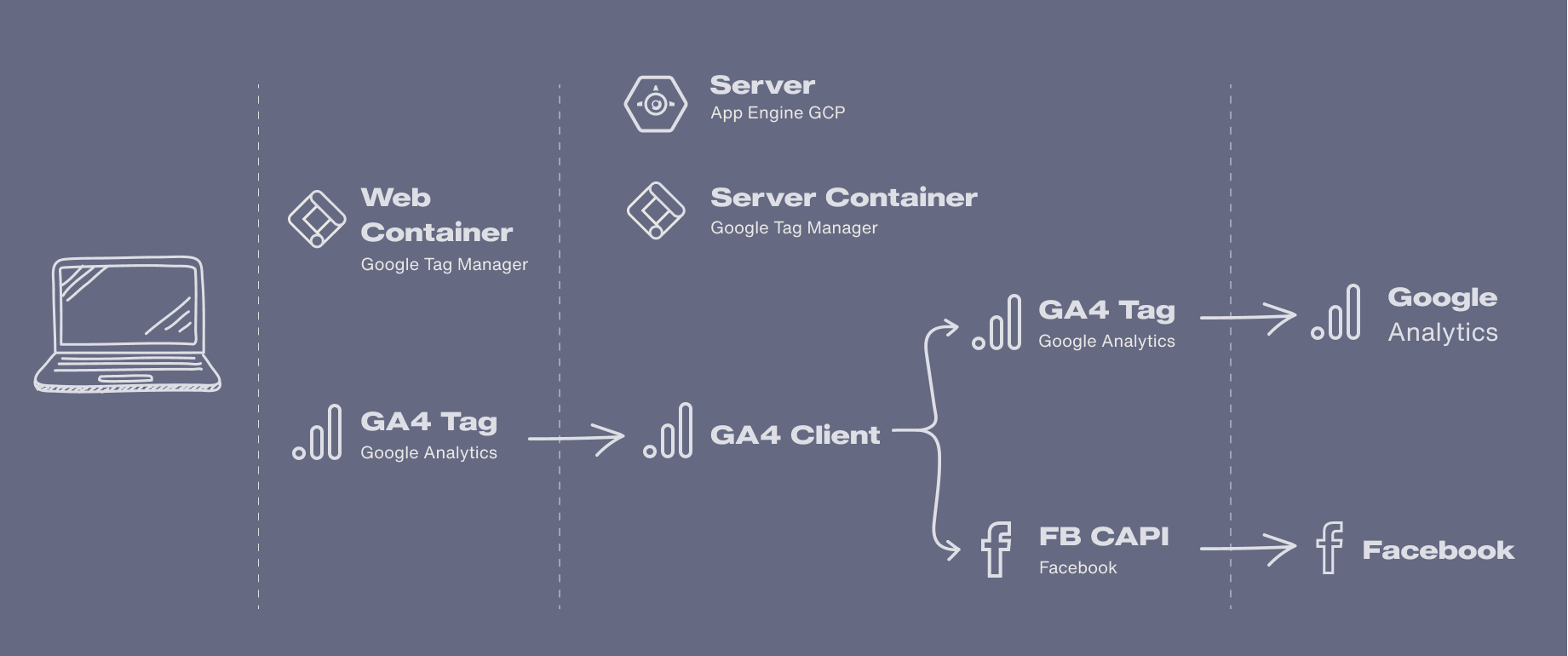
Historically, the client-side deployment of the Meta Pixel via Google Tag Manager has been the quickest and simplest way for Nissan to track activity across their website. But this method has suffered some setbacks since the introduction of Intelligent Tracking Prevention (ITP) by Apple, which limits tracking capabilities in the Safari browser. More recent updates to iOS have further limited web traffic by extending ITP restrictions to all browsers installed on the device by default. But these bumps in the road weren’t cause for panic; to increase Facebook campaign efficiency, we implemented Meta’s Conversion API to align traffic and behavior data in a way that still safeguards user privacy.

Nissan car wheel with a black rim

In partnership with

  • Nissan Thailand
Client Words We were excited by the idea of making the Facebook algorithm smarter by giving it signals coming from our proprietary data, as we heavily rely on it to locate our best customers. We have improved our Facebook campaign efficiency across the board since installing Conversions API, which has had a great impact on the business.
Nissan logo

Anuwat Eiamsa-art (Nu)

Head of Data, Tech, and Analytics, Nissan United Thailand

Increasing conversions with Conversion API.

The Conversion API is designed to reliably connect server-side marketing data to Meta’s business and marketing tools. We implemented the API by creating a Server-Side Google Tag Manager (SSGTM) instance. The SSGTM worked as a proxy between client-side user activity and the third-party vendor’s server. When a user triggers an event, the SSGTM container can read and transform the data before it reaches the vendor’s server.

Google cloud interface on a laptop

Unlocking new possibilities for data activation.

Our solution using the Conversion API gives Nissan new capabilities in terms of conversion tracking and remarketing, data governance, security and performance. We closely monitored Nissan’s eight active Facebook campaigns for a period of two weeks before and after the SSGTM implementation and saw a significant uplift in website conversions. The successful implementation not only helped Nissan continue to activate data despite new constraints, but also serves as another leg in the journey to future proof in the privacy era.

Want to talk data? Get in touch.

Hey 👋

Please fill out the following quick questions so our team can get in touch with you.

Can’t get enough? Here is some related work for you!

Rather Than Pivot, Take This Time to Perfect Your GA4 Migration

Rather Than Pivot, Take This Time to Perfect Your GA4 Migration

Data Data, Data Privacy & Governance, Data Strategy & Advisory, Data maturity, Digital transformation 5 min read
Profile picture for user mediamonks

Written by
Monks

GA4 logo with data points falling from the logo

On October 27, Google announced that it is postponing the sunsetting of GA360 to July 2024, which means that companies will have more time to fully migrate to the new GA4 marketing technology. Anticipating various questions and concerns, our experts in the field of data and technology services have joined forces for a conversation about privacy, first-party data and the importance of GA4.

When it comes to the privacy arena, what trends are you seeing agnostically?

Privacy is one of the fastest changing and most complex realms in the digital space, even more so than Web3. On top of that, privacy is an ever-present undercurrent—ongoing in everything that we do. With a plethora of global and regional players involved—the tech sector, regulatory bodies, public opinion—we can safely say there’s a complex interaction at play, which makes coming up with any long-term prediction or silver bullet solution practically impossible. As a consequence, our waterways can quickly go from clear to muddy. What follows is a sense of fear, uncertainty and doubt among many companies. 

In working with companies across the board, we still see a lot of confusion around technical terminology, with partners raising questions such as, “What is personal data compared to Personally Identifiable Information (PII)?” To be frank, we believe this is in part driven by clickbait. Headlines propagating that “GA is illegal” cause unnecessary confusion and concern, when the fact of the matter is that Google’s GA4 as a product has gone through a massive rebuild from the ground up to address and tackle the issues in question. As a baseline trend, we’re receiving more and more questions about privacy matters with regards to all products in the digital marketing ecosystem—and we welcome them with open arms, because we’re here to help solve the riddle. 

How are you helping clients navigate this new, data-focused advertising landscape?

Our objective is to help our partners take proper control of and ownership over their data collection and activation. Therefore, we first focus on basic data hygiene, conducting health checks and audits. It’s very important to know what your company has in store, so we ask questions like what data is collected, which cookies are set, how is the collected data used, and who else is getting the data of your users? Creating a graph of 3P consumers and beyond is complex and thus requires high levels of scrutiny. 

Though the third-party cookie deprecation has been pushed back until at least late 2025, we don’t like to wait around and carry on in the same way we have always done. Rather, we’re embracing a first-class, first-party and privacy-first strategy, for instance by helping companies migrate to GA4—because we see no reasons for taking a reactive approach. We make sure our partners get on the front foot as fast and efficiently as possible, with a strong emphasis on automation. When you’re working with large data volumes, you can’t rely on human-centric processes to manage compliance. For instance, we have implemented automated machine learning as part of the data pipelines in order to prevent PII ingestion. There’s no way that a company can afford to manage a breach retrospectively or be proactive without automation—simply put, this is the most efficient way to scale. 

What are the main lessons that you have learned on this journey?

First of all, we clearly communicate to every brand we partner with to always aim for transparency, make a plan, and move beyond the minimum. Let’s be honest, the economic headwinds that we are all currently facing mean that every dollar, euro and pound spent needs to deliver a return more than ever before. As such, preserving data quality is our top priority. To give you the full scoop: everything we do to be more transparent, protect users’ privacy, and apply rigor and governance to data collection and activation is, in fact, enhancing the data quality, too. So long as you go about your data the right way, you can’t go wrong. 

Speaking of data quality, another key lesson that we have learned is to use time to the fullest. Yes, industry leaders like Google may unexpectedly push back plans, but rather than seeing this as an issue, we believe it can work to our advantage. Setting up the privacy tech for this tool is quick and easy—the hard part is changing the people and processes, which we know can take a while to get completely right. Though we expect that many brands will interpret this extension of GA360 as extra time to look around and perhaps jump ship to another technology, we believe that this is a risky strategy. Instead, we recommend our partners to take this change of plans as an opportunity to perfect, rather than a chance to pivot. There are no excuses to delay GA4 migration. It's imperative to use this time to manage change, translate data workloads, dashboards and data pipelines, and ensure all those GA360 assets become high quality GA4 assets.

Do you see gaps in performance between brands that invest in privacy and those who don’t?

There's a clear and definite advantage to taking a strong privacy-first approach to data—and companies are catching on. People are realizing (or, at least, starting to realize) that we’re not playing a zero-sum game and the exchange of data in return for personalization and better ad targeting is the data privacy transaction we all engage in—with reciprocity being the key word. Those who are best able to complete this transaction at scale will be rewarded with the best results, whereas those who continue to walk the third-party cookie path will fall behind. For some time now, we’ve been helping many of our partners run on a healthy diet of deterministic and probabilistic data and not trip over the mix of consented first-party and modeled data, and we can tell you: they are in good shape. 

Want to discuss next steps? Get in touch. 

Everything you do for privacy feeds back into your data quality, hence the opportunity to sharpen and perfect your process of migration to GA4 is one to take with both hands. It’s essential for brands to look beyond the obstacles of GA4 and work to get the best first-party data off the back of the migration.

Monk Thoughts It’s a time to revisit, realign, clean out the data cobwebs, and move into a brand-new system which allows you to perfect not only your data and privacy strategies, but also your marketing strategy across the board.
Doug Hall headshot

We’re here to help make sense of changes in the privacy landscape, how to make use of GA4 data, and how such technologies can support all your marketing needs. If you have any questions with regards to GA4 migration, please reach out to growth@mediamonks.com. We’ll schedule some time to discuss any questions you may have and see how we can support your analytics needs.

Insights for this piece were contributed by Doug Hall, VP Data Services and Technology, EMEA; Julien Coquet, Director of Analytics, EMEA; Suzanne Jansen, Head of Data Strategy, EMEA; Véronique Franzen, Senior Director Business Consulting, EMEA; Jakub Otrząsek, VP Data, APAC; Sayf Sharif, VP Data, NAMER; Michael Neveu, Director of Data, NAMER; and Wenting Wang, Senior Director of Data & Analytics, UK.

Google announced that it is postponing the sunsetting of GA360 to July 2024, which means companies will have more time to fully migrate to the new GA4 marketing technology. Google Google Analytics data analytics data first-party data privacy Data Data Strategy & Advisory Data Privacy & Governance Data maturity Digital transformation

IMO: How Reitmans Used Cloud Computing to Pivot With Changing Times

IMO: How Reitmans Used Cloud Computing to Pivot With Changing Times

Consumer Insights & Activation Consumer Insights & Activation, Data, Data maturity, Digital transformation, eCommerce Platforms 2 min read
Profile picture for user mediamonks

Written by
Monks

A collage of speakers headshots from the IMO webinar with Reitmans

When customer behavior changes, so does the technology used to connect with them. When shifting consumer habits met an increasingly fragmented data and marketing ecosystem, fashion retailer Reitmans Canada Limited began to notice blind spots appearing in the customer journey. But with over 400 brick-and-mortar locations, maintaining a relationship with its customers meant building a single source of truth throughout the entire organization.

In the latest episode of IMO, Brianna Mersey, Media.Monks Associate Director of Data, sat down with Marc Laurent-Atthalin, VP Data & Digital Media at Reitmans, and Zamira Khamidova, Director of Data North America at Media.Monks, to discuss what it took to shift the traditional retail business into a modern data stack capable of enabling marketing use cases. Throughout the conversation, they shared insight into how to set your data foundation up for success, the importance of aligning stakeholders across the business, and the need for a “test and learn” mindset. If you missed the episode, we’ve got you covered—watch it in full below.

Reitmans was able to adopt such advanced analytic methods because the team had already established a strong foundation of data, making it easy to implement models that were more reactive to customer behavior and transaction histories. Marc and Zamira offered advice on how to select which data sources to start with (opt for rich, actionable data sets that give you lots to work with) and how to ensure that data is clean and reliable.

Marc also shared the importance of aligning with internal stakeholders to gain buy-in and chart the path forward. “It’s important to build a clear vision and strategy initially and communicate it properly, and then use data to build your case,” Marc said. By tying data objectives with business outcomes, his team was able to prioritize use cases and deliver results quickly, then test and iterate from there. For example, building a 360-degree view of the customer provided insights to drive conversion, fulfilling the key business need to propel growth.

When it comes to initiatives like these, treating your partner as an extension of your team is key. “Collaboration is hugely important,” Zamira said. “When it comes to data, there are lots of questions on the context—especially with historical data, so it was important for us to have two-way communication and hear back on any questions we had.” This level of regular communication also helps with further collaboration as the engagement evolves. 

So, where is Reitmans headed next? You’ll have to watch above to find out—including the brand’s plans around Web3, which is set to transform the brand-customer relationship even further. And if you’re eager for more insights from Media.Monks subject matter experts and our partners, mark your calendar for the next episode of IMO later this month.

Learn how together Reitman’s and Media.Monks shifted the traditional retail business into a modern data stack capable of enabling marketing use cases. Retail data analytics consumer data data-driven marketing Data eCommerce Platforms Consumer Insights & Activation Data maturity Digital transformation
`

The Product

Making way for marketing data transformation with Data.Monks Foundations.

Driven by our unified approach across people, process, and tech, we translate digital marketing data from isolated glimpses of consumers, channels, and campaigns into a clear and connected story.

Employees standing over a table working together
A pyramid of cubes on a black background

On your mark, the future of data-driven marketing is in view.

As part of Media.Monks’ data and digital media services, Data.Monks Foundations helps brands translate their digital marketing data—often isolated glimpses of consumers, channels, and campaigns—into a clear, connected story. Driven by our unitary business composition and our unified approach across people, process, and tech, Data.Monks Foundations paves the path for marketing data transformation—with incredible results as the (predicted) outcome.

Supporting brands with meeting the demands of a new era, Data.Monks Foundations represents the future of data-driven marketing infrastructure—and we’re excited to show you why facts and figures are the wave of the future.

Mondelēz is putting data.monks foundations to work

  1. Work

    Mondelēz Data and Measurement • By unlocking data from silos and transforming digital ad measurement, we helped Mondelēz achieve a +70% global return on investment.

  2. Mondelez logo within a purple teardrop shape

    Digital marketing is most effective when you know how to whet consumers’ appetite and play to their taste—and this takes on an entirely new relevance when you’re a global snacking brand like Mondelēz.

  3. A cookie and brownie mountain
  4. Two employees chatting in the hall of a media.monks office
    A hand pointing to a whiteboard with drawings all over it
  5. A person eating a cookie at the table
  6. Want to hear more about our partnership with Mondelēz, check out the full case:

Swipe
For More!

Drag
For More!

Making sense of common statistical challenges.

If you ask us, it was written in the stars—and the numbers—that data and digital maturity would turn out to be key drivers of marketing growth and efficiency. As such, it’s no surprise that more digitally mature businesses are seeing impressive results because of their data-driven efforts.

That said, the natural state of marketing data can be a mare’s nest, and it often takes two (or more) people to put this “unregulated” muddle into order. Having worked with a wide variety of brands, we’ve been able to distill frequently asked questions into three common concerns. 

  • Low data quality is an important problem, which stems from non-standardized data that’s lacking effective Quality Assurance processes and ultimately leads to a loss of trust in reports and dashboards. 
  • Data sprawl spiraling out of control is another significant issue, which results from disconnected adtech and martech solutions that are run by disparate teams and agencies and typically lack an authoritative system of record. 
  • Limited data access is another common challenge, meaning that the available data is not capable of driving innovation or decisions. This is a consequence of access issues, lacking intercompatibility, or slowness—leaving marketers unable to access reporting, query data sets, or perform advanced analytics in any centralized, timely or efficient way.

Want to talk data foundations? Get in touch.

In just 90 minutes,

we'll cover how to drive real change, productivity tools, activation use-cases, and take a look at your stakeholder priorities. Let's chat.

client logos that are using data foundations

Here's a handful of clients that are putting data.monks foundations to work.

a illustration of an ad in a newspaper

In partnership with

  • Mondelēz
Client Words We were the first CPG company in our category to be able to see the direct correlation between our digital advertising and sales.
Jon Halvorson headshot

Jon Halvorson

VP Global Media, Mondelēz International

Cleaning, connecting and creating access to your data.

Unregulated data doesn’t come without consequences, and marketing underperformance and inefficiency is merely one of them. In order to show up for your consumers in whatever way you want to, it’s crucial to get your data (back) on track—and we’re here to help you meet these matters head-on. How? Data.Monks Foundations entails three coordinated workstreams, enabling our team to deliver fast and efficient results.

  • First, we address your data quality, which involves standardizing your data and ensuring data accuracy and fitness. 
  • Then, we eliminate data sprawl by centralizing your data assets in the cloud and establishing a single source of truth. Such a common system of record is a true miracle maker for your marketing efforts. 
  • Finally, we focus on facilitating data access, which entails opening up new pathways to data and reporting for all teams and tech that need it. From here on, it’s simply a matter of scaling.
Three employees reviewing data on computers

Reach out, whether you want a demo or the real deal.

A bespoke solution for your business, Data.Monks Foundations brings together the planners, the plans, and the builders into a transformation program that’s customized to fit your current state and your future objectives. Our approach is structured to hit the ground running, offer flexibility, and leave you in complete control of your data, tech, and strategy.

Are you ready for your marketing data infrastructure to become an engine for innovation and growth? Then the time is right to reach out to our Data.Monks team and schedule a demo, so that we can take a technical deep-dive into your data. In just 90 minutes, we’ll cover how to drive real change, walk through our Data.Monks Foundations productivity tools, review activation use-cases, and take a close look at your stakeholder priorities.

Want to talk data foundations? Get in touch.

In just 90 minutes,

we'll cover how to drive real change, productivity tools, activation use-cases, and take a look at your stakeholder priorities. Let's chat.

Choose your language

Choose your language

The website has been translated to English with the help of Humans and AI

Dismiss