
Choose your language

Choose your language

The website has been translated to English with the help of Humans and AI

Dismiss

Three people in an office with computers discussing financials
BBVA bank building
A blue credit card

Online Customer Acquisition • Quality Customers Through Machine Learning

  • Client

    BBVA

  • Solutions

    DataMeasurementConsumer Insights & ActivationData Analytics

A woman holding a credit card and phone

Results

  • 82% recall of cases within the desired audience.
  • Reduced timelines from 120 days to 24 hours.
  • BBVA was able to make real-time decisions.

A journey of quality and speed.

In the financial industry, banks are accustomed to attracting new customers through credit card promotions and other benefits. But although the bank was investing in digital efforts to attract new clients, its usual audience failed to match their desired target. Faced with this challenge, we set a clear goal: to generate higher quality traffic without excluding any real users.

A drawing showing a computer, tablet, and hand
A drawing showing a phone, computer, and click mouse

Optimizing the online customer acquisition process.

Across the entire consumer journey, the multiple interactions between the bank and its clients provide valuable information that can be leveraged to optimize processes. In order to improve efficiency in the use of this data, we carried out an analysis and refinement procedure—to then dynamically send the data to Google Analytics 360.

Measuring user behavior within the site—from how much time people spent on it, to the kind of information they provided while registering—became an essential part of the process. Then, we proceeded to combine online and offline information to obtain a behavior per user data chart, ready to be treated in a machine learning model developed through AutoML.

a computer showing a BBVA sign up form

A predictive model that’s always on target.

The model allowed us to recover 82% of the cases that didn’t align with the bank's target and, through the Cloud functions, send this score to advertising platforms. Now with the necessary tools to make decisions in real-time, we reduced timelines from 120 days (the days it used to take the bank to draw conclusions about new clients) to 24 hours—achieving high quality at record speed.

Want to talk data? Get in touch.

Hey 👋

Please fill out the following quick questions so our team can get in touch with you.

Can’t get enough? Here is some related work for you!

This Black Friday, Keep the Momentum Going With Data-Driven Marketing

This Black Friday, Keep the Momentum Going With Data-Driven Marketing

4 min read
Profile picture for user mediamonks

Written by
Monks

Title font with cursive and block letters

No matter where you are in the world, business cycles are determined by key dates and seasonalities that delineate brands’ marketing strategies. For those well-versed in ecommerce, every day brings new opportunities to engage with consumers, but these are never in such an approachable frame of mind as during Black Friday and Cyber Monday in the west or Singles’ Day in China.

Each one of these events has attained international relevance, playing a fundamental role in the sales of brands everywhere. Yet in the race to capitalize on them, many campaigns fall short of their true potential—whether they know it or not. The fact is, Black Friday can be much more than a one-off event to boost your sales for a few days. It’s a priceless opportunity to establish a lasting relationship with consumers all year long. 

Experiences That Stand on Their Own

A lot has been said about how to gear up for Black Friday—and with good reason. Its massiveness has turned the event into an advertising frenzy that spans a myriad of categories, products and services, which make it increasingly hard for a brand to stand out. As a response, sales are now popping up weeks before the event—to the point where some argue that Black Friday has long moved beyond its original meaning. 

But if anything, these changing dynamics stress the importance of enhancing the customer experience and establishing a relationship that will last far longer than the event itself. “You’re not only competing with other brands; you’re also competing against ad fatigue,” explains Platforms Lead Brook Downton.

Monk Thoughts Don’t limit yourself to offering discounts. Provide consumers with experiences that will remain engraved in their minds.
Brooks Downton headshot

A good example of this is what Tmall did for Singles’ Day. In the lead-up to the event, the Chinese website for online retail launched an immersive art exhibition where they showcased eight limited-edition collections from leading brands in the form of NFTs. In putting these experiences together, it’s not imperative to keep Black Friday at the center of it all. The ultimate goal is to provide an added value for consumers, so approach it with a customer-first mindset and let the event be merely the amplifier of an experience that stands on its own. 

Getting to Know Your Consumers

By the start of the Black Friday season, you should have a clear idea of who your consumers are, their behavior and nuances. But if your marketing efforts go according to plan, you can expect a significant influx of new data during these days—both from new and existing consumers. Knowing how to leverage the new data can help you carry this momentum forward, and provide tools you’ll fall back on in the quieter months of the year.

Monk Thoughts Although a robust strategy can’t be built overnight, make sure you’re implementing tools that will allow you to accurately identify each consumer, such as Google Analytics.
Gastón Fossati headshot

“At this stage, good data management is the equivalent of remembering our conversations with people,” says Gastón Fossati, VP of Data Growth, LATAM at Media.Monks. Having control over this data will bring your consumers’ needs into sharper focus. And when it comes to new shoppers, don’t look at Black Friday as the end of something; rather, as the start of an ongoing strategy. “In this scenario, the conversion already happened, it’s the opposite of what we’re used to,” says Downton. “Have a follow-up moment, acknowledge that new engagement and start building from there.”

That first touchpoint after Black Friday can take many forms, but Downton recommends giving consumers the opportunity to reconfirm their desire to connect with your brand and exchange information. In doing so, it’s important to demonstrate the value exchange that you offer—that is, the more personalized suite of services and benefits that having accurate data can lead to. 

Paving the Way for an Ongoing Relationship

Once the consumer has shown true enthusiasm about engaging with your brand, you can move forward with other marketing efforts, such as a cross-selling strategy. “Considering the products that your consumer already bought to recommend others is a great way to better serve your audience with a more personalized experience,” says Fossati. “It can also be helpful to have a model in place to predict their lifetime value, which will help you focus on the consumers with more potential.”

This point illustrates that the difference between a brand that waits for Black Friday to see their sales ramp up and one that builds on this date to maintain a consistent cycle lies in data management. In order to continue to reap the benefits of Black Friday weeks after the event, it’s important to nurture your relationship with consumers—something you can’t do unless you show up for them and provide real value.

Traditional data practices are en route to disappearing—and while working on a first-party strategy may feel daunting, that shouldn’t be the case. For most brands, the only thing preventing them from truly regaining control over their data is a matter of priorities. Knowing that Google will block third-party cookies in 2023, there’s still a misconception that developing a first-party data strategy is not urgent, when in fact, it’s never been more relevant. 

Now is the time to invest in modern solutions that provide valuable insights. While planting the seeds of anticipation with marketing campaigns and exclusive sales is essential, there’s as much to be done—if not more—after Black Friday. This year, aim at making data-driven decisions that incentivize consumers to keep coming back for more, and you’ll have the key to a consistent sales cycle.

Our data and platforms experts share their tips for maximizing the benefits of Black Friday weeks after the event. Our data and platforms experts share their tips for maximizing the benefits of Black Friday weeks after the event. data analytics platforms digital platforms ecommerce ecommerce strategy

Dual Tagging Gotchas: Data Models & Mapping for GA4

Dual Tagging Gotchas: Data Models & Mapping for GA4

4 min read
Profile picture for user Brianna Mersey

Written by
Brianna Mersey
Director of Data, NAMER

Yellow background with words saying Make Yourself at Home on GA4

Universal Analytics (UA), a measurement platform dear to my heart, has served us well since 2012. But with the advancement and ubiquity of apps, the platform had to be re-imagined. Now, omnichannel marketers’ every wish has been granted with the launch of Google Analytics 4 (GA4 or  New GA), the next generation of Google Analytics that measures web and app data together.

Previously, you’d have to turn to separate platforms to measure different types of data: Universal Analytics is focused on web analytics, while Firebase—the app development platform Google acquired in 2014—focused on apps and offered less robust reporting. What made working with both platforms challenging is that their data structures are altogether different (think Adobe Analytics vs Google Analytics), with variables and metrics that just don't line up.

Now joining web and app data together, GA4 is here to stay—and it’s time you began thinking ahead on how to implement it into your existing solutions. There’s no question as to whether you should migrate from UA to GA4; if you don’t set up GA4 now, you’ll lose the chance to collect that historical data. 

And while there are many new features and benefits to GA4, there’s one place in particular I recommend you begin with: dual tagging. Dual tagging means deploying GA4 parallel to your existing UA tags. Let’s run through some important points you should know as you get started integrating GA4 into your setup.

Start Out with Event Mapping

Most importantly, be aware that the current UA data model is built on sessions, whereas the new GA4 data model is built on events. That means to migrate your data from UA to GA4, you’re going to want to create an updated measurement plan which details the mapping of all important variables.

Examples of user maps for GA4

Essentially, all our trusted UA events will be mapped to GA4 events and event parameters. And all the legacy hit types like social, page view, transaction fall under an “event” in GA4. This makes the tracking more robust and allows you to report on all types of legacy data points in one report, because now they are all events.

A map showing different measurement properties

Another point worth discussing is the death of the event category, action and label. Those are dead to you, adios amigos! Instead, your original event action now becomes the name of your event, while the event category and event label become parameters if you so choose (or not, if you’re using gtag.js).  

Left unattended, this could lead to a colossal data scramble, depending on your event action values, ie: “click.” In my experience with Dual Tagging, I often merge the event action and category as my event name and the event label slots into an event parameter with a more descriptive value than “event_label.” The GA4 events represent one action, so it can be more granular than the historical UA event, which at times encapsulates a range of actions. I’d recommend working with a partner like Media.Monks to discuss your measurement plan before your march ahead. Now is a great time to reset your data strategy and clean up your reporting. Write off the technical debt; you can’t break a dashboard that doesn’t exist. 

If you’re using gtag.js, note that once you implement GA4, your GTag code is automatically mapped to GA4, like this:

GA4 events in UA property

Setting Custom Dimensions

With that in mind, let’s dig a little deeper and take a look at our UA Custom Dimensions. You won't see “session” scope listed when you map custom dimensions—that scope does not currently exist. If you want to track user attributes, also called User Properties, they should be mapped to “Custom Dimensions, user scope.” And don’t get User Properties confused with Account Properties, which are two totally different things. (The naming could have been better on that one!)

GA4 custom dimensions setup

There is also one new step in GA4: you have to map your custom dimensions in the GA4 UI.  Otherwise you won’t see the data in your reports.

GA4 custom dimensions setup

Change Your Perception on Sessions

I also wanted to let you know that sessions themselves are now counted differently. A UTM parameter change won't start a new session! Nor will a late-night session that crosses over midnight. Sessions in GA4 are restarted only after 30 minutes of inactivity, just like in Universal Analytics. That means your session counts are going to be lower in GA4 if you try to compare reports directly to UA (don’t do that!).

Setting up Dual Tagging is a must, right now. Don’t delay in enabling that GA4 property.  It can all be done via the GA interface, and you can have pageviews and five other events firing out of the box (like scroll, downloads, exit links, internal search and YouTube interactions)! 

However, take your finger off the trigger before setting up your custom event tracking. We do not recommend directly mapping UA to GA4. You will need to carefully think through a new measurement plan, as mentioned above. It doesn’t mean you will start from scratch (although if you’ve wanted to do that, now is the perfect opportunity). There are a set of recommended events Google encourages you to use because future reporting and features will be based on them; for example, account signup is “sign_up.” If you don’t take time to think through how the data will appear in your reporting, along with the mapping and your variable quotas for the standard GA4, you could seriously regret your haste come six months.

Pyramid of measurement hierarchy

The variable quota can be found in your GA4 dashboard if you can’t remember how many you’ve created:

GA quota information interface

And that’s it—you’ve taken your first steps in getting acquainted with GA4. Again, the suite solves the crucial challenge of aligning your web and app measurements, fueling insights everywhere your audience turns within your owned platforms. Setting up GA4 sooner rather than later will help you future proof and collect greater historical data, so don’t wait—but if you need some help, you know who to call!

Google Analytics 4 is helping brands join their data from across platforms. Learn how to get set up with the tool using dual tagging. Google Analytics 4 is helping brands join their data from across platforms. Learn how to get set up with the tool using dual tagging. data data analytics Google
A stethoscope sits on top of a doctors notebook
Northwell Health logo

Northwell Data and Measurement • Teaming Up To Address The Pandemic Crisis Using Data

  • Client

    Northwell Health

  • Solutions

    DataData Strategy & AdvisoryMeasurementConsumer Insights & ActivationData Analytics

Northwell Health hospital building

Staying ahead of the curve.

Like many other healthcare systems, Northwell Health, New York’s largest healthcare provider and private employer, faced an unexpected crisis when COVID-19 cases began to rise in the United States. To address this public health emergency and anticipate future waves of the disease, Northwell Health needed to pinpoint first-party data sources that could serve as leading indicators in detecting and predicting surges in COVID-19 patients—and the need for care—earlier.

In partnership with

  • Northwell Health
Client Words Working with [Monks] to build out our analytics infrastructure allowed us to pivot quickly during a crisis, discovering a new use case for our marketing data that helped us stay weeks ahead of the curve, support public health, and save lives.
Paul Lambson headshot

Paul Lambson

Corporate Director, Customer Insights and Analytics, Northwell Health

Making a (bigger) impact with marketing data.

Just prior to the COVID-19 pandemic, Monks set up a privacy-compliant strategy and data architecture for the Northwell Health marketing team that allowed them to analyze vast amounts of site data white still protecting visitor and patient privacy. The data strategy measured key events and behaviors—like click-to-call, visit wait time tracking, looking up hospital directions, or checking for COVID-19 testing appointments. This data from Northwell Health’s Google Analytics dataset was pulled into a model built with Google Cloud Platform's BigQuery Machine Learning.

When the pandemic hit ground in the US, hospitals everywhere were quickly overwhelmed. Northwell Health started looking for ways to anticipate surges in visits to its facilities. Their newfound ability to analyze site data helped analysts identify patterns in web traffic before each wave of the virus hit. Looking closely at marketing data, they found that overall page views to the system’s website—along with searches for wait times at the emergency department and directions to a hospital—increased significantly leading up to each wave.

Stethoscope
Thermometer
Press Using data from the first six months of the pandemic in New York, officials found that changes in certain areas of web traffic preceded Covid-19 positive diagnoses in the hospital by two weeks.
Read on WSJ

Moving at the speed of digital.

By implementing advanced data and analytics technologies, Northwell Health now has an innovative predictive model to anticipate the next wave of the virus. Insights from the model signal when to proactively allocate resources and staff to serve their patients, support public health, and respond with greater agility to large-scale health crises such as the COVID-19 pandemic.

Want to talk data? 
Get in touch.

Hey 👋

Please fill out the following quick questions so our team can get in touch with you.

Can’t get enough? Here is some related work for you!

A colorful green and blue circle
Hands pilled on top of each other
Bayer sign on the wall

Bayer Consumer Health • Moving Digital Media Ops In-House For Greater Control

  • Client

    Bayer

  • Solutions

    MediaMedia AnalyticsTransformation & In-HousingMedia Strategy & PlanningDataMeasurement

Results

  • $10 million in cost savings within 
the first six weeks.
  • Increased working media, targeted impressions, category reach and, 
ultimately, ROI.
  • 35% ongoing efficiency improvement in media cost.

Taking the wheel.

Bayer’s Consumer Health Division brings consumers some of the world’s best-known and most trusted over-the-counter medications, nutritional supplements and other self-care products. In 2018, Bayer Consumer Health US sought to make its digital advertising more responsive, effective and cost-efficient. So the company embarked on a plan to bring digital ad operations in-house. 

The goal of transitioning to an in-house shop was to improve performance and transparency while reducing fees, improving speed to market and developing data insights for smarter decision-making. They also wanted to broaden and deepen digital expertise across their organization. To execute on this vision, Bayer partnered with Monks to support the transition and help build out the in-house team and systems.

A person on a bicycle along with the bayer logo and a colorful circle

Driving efficiency at scale.

Our team worked with Bayer to develop a two-phased approach to digital media self-sufficiency. In phase one, we took interim control of campaigns and technologies across two dozen brands while we helped Bayer establish frameworks and processes for digital ad buying that would drive efficiency at scale.

A few pictures of doctors working in a hospital

As a first step, we helped Bayer gain access to underlying campaign data and identify opportunities to reduce or eliminate fees from digital media buys. Bayer brand expertise, coupled with access to data, immediately unlocked opportunities for the team to quickly gather insights and make them actionable. Data fueled the creation of a highly complex but unified taxonomy to assist with analysis and provide a consistent data feedback loop. We integrated cleaner data into dashboards, giving the Bayer team fast and easy ways to interact with data and uncover insights. With ownership of media costs, weekly sales, profit data and competitive reports, the Bayer team was empowered to make optimization decisions that would have the most meaningful impact.

Bayer logo on a building
man sitting in front of a projected presentation at a conference
A person playing chess with a kid
Press As we start to onboard all of our data and put things into our system, there will be the question of the bandwidth of the team, which is why it’s so important to have a group like Monks support the business.
Read on Digiday

Impact

The road to self-sufficiency.

To build a self-sufficient team and ensure a smooth transition, we worked with Bayer to create and establish job descriptions, communication flow and performance and workflow standards. We implemented a staggered transition plan, with a period of overlapping support, so Bayer could hire and train the necessary talent to take over day-to-day ownership of media, search, social, programmatic, analytics and strategy—all achieved two months ahead of schedule.

Given the success of the Consumer Health engagement and the strength of our partnership, Bayer sought Monks’ advice and support on digital transformations for the Pharma and Crop Science divisions.

Results

  • 1x AdExchanger Award

Want to talk media? 
Get in touch.

Hey 👋

Please fill out the following quick questions so our team can get in touch with you.

Can’t get enough? Here is some related work for you!

Mondelez logo within a purple teardrop shape
A kid holding Oreos over their eyes
Brownie mountain with a sunny skyline in the background

Mondelēz Data and Measurement • Powering Advanced Advertising Analytics

  • Client

    Mondelēz

  • Solutions

    DataTransformation & In-HousingConsumer Insights & ActivationMeasurementData Analytics

00:00

00:00

00:00

Case Study

0:00

Results

  • +70% global return on investment
  • Became the first CPG company to see a direct correlation between digital advertising and sales

Building better consumer connections through data.

Digital marketing is most effective when you know how to whet consumers’ appetite and play to their taste—and this takes on an entirely new relevance when you’re a global snacking brand like Mondelēz. By unlocking data from silos and transforming digital ad measurement, we helped Mondelēz build better consumer connections through data.

Oreo package in a shopping cart
A person eating a cookie at the table

A strategy fit for cloud nine.

Mondelēz wanted to gain new insights into consumer buying habits and the effectiveness of its digital advertising, though silos inhibited its digital media team from building advanced data sets and running higher-order analytics.


First, we helped Mondelēz standardize one new global campaign-naming taxonomy—making it easier to compare apples and oranges, salty and sweet. Next, we brought together cross-platform media data and offline sales with Google Cloud. This automated, cloud-based approach was not only faster—it was also more flexible than legacy reporting methods, giving the brand a lifetime competitive advantage.

A purple tear drop

In partnership with

  • Mondelēz
Client Words A cloud allows us to be more nimble, agile, flexible, and safe. What we're going to move to is a world where we’re inspired to act that much faster because we have the confidence in the data to do it.
Jon Halvorson headshot

Jon Halvorson

Global VP, Consumer Experience

Freeing data to crunch (and munch on).

With multiple retail and marketing partners, it was difficult for Mondelēz to standardize digital measurement—a common challenge for CPG brands when retailers hold much of the relationship with customers.


We consolidated more than a baker’s dozen of Mondelēz ad server networks into four global regions, and established data governance standards to advance reporting data. We then built real-time spend and performance dashboards so its global teams could quickly access insights that previously took weeks to compile.

A person holding Mondelez snacks in arm

Want to talk data? 
Get in touch.

Hey 👋

Please fill out the following quick questions so our team can get in touch with you.

Can’t get enough? Here is some related work for you!

An U.S. Airforce jet
The earth with a U.S. Airforce logo above it

US Air Force Website • A Platform Taking Personalization to New Heights

  • Client

    US Air Force

  • Solutions

    PlatformWebsites & Platforms

00:00

00:00

00:00

Case Study

0:00

Proving the sky’s the limit for effective, personalized platforms.

As the most technologically advanced branch of the US Armed Forces, the United States Air Force has long attracted STEM-oriented, academic achievers. Together with GSD&M, we built an innovative platform that takes potential recruits on a digital journey through carefully curated content pathways tailored to their interests.

An iPad showing the U.S. Airforce website

Taking user experience to new heights.

Once users land on the US Air Force website, they’re ready to take their first steps to get to know the military service inside and out. And as they explore, the platform gets to know them better, too. Through intelligent UX design, the experience serves content based on individual viewers’ preferences and personas, helping them get a feel for what to expect from a career in the US Air Force. This way, the content bypasses time-consuming queries to identify the best career path for each qualified recruit.

Our Craft

From personalized paths to career paths.

  • A person in the Airforce with headphones on
  • The earth in space
  • A picture of the U.S. from space
  • Career screen from the U.S. Airforce website
  • Salary screen from the U.S. Airforce careers website

A data-fueled journey.

We believe that users should see a fair value exchange in return for their data. The US Air Force platform was built around this philosophy, generating each user’s path based on intrinsic and extrinsic motivators. Short breaks in the pages encourage readers to share details about who they are, what experience they have, and what they’re looking to gain from a career in the US Air Force. And these paths are always evolving; a variety of independent modules makes it easy to author and adjust bespoke pages as we learn more about the needs of the audience.

Airforce in action
A person in the Airforce standing in front of a plane

Results

  • Increased conversion rate of 47%.
  • 37% increase in qualified applicants.
  • 1x Awwward

  • 2x FWAs

  • 6x Addys

  • 1x Cannes Lion

  • 3x LIAs

  • 1x Webby

Want to talk platforms? 
Get in touch.

Hey 👋

Please fill out the following quick questions so our team can get in touch with you.

Can’t get enough? Here is some related work for you!

ace hardware app on phone
ace hardware employee

Ace Google Cloud Platform & App • Building Insights Across the Customer Journey

  • Client

    Ace Hardware

  • Solutions

    PlatformMobile AppseCommerce PlatformsCRMData Strategy & Advisory

00:00

00:00

00:00

Case Study

0:00

Results

  • Over one million app installs.
  • Over 150K new rewards accounts.
  • $30 million in omnichannel revenue.

Acing the customer journey through data and design.

Ace Hardware is the world’s largest hardware and retail cooperative, with more than 5,300 independently owned and operated stores in over 70 countries. As a fixture in communities all over the United States and around the world, Ace Hardware is affectionately known as “The Helpful Place” and prides itself on superior customer service. But to better deliver the hardware, advice and expertise that people need to improve their homes, Ace Hardware’s digital presence needed some refurbishing of its own—including the build of an entirely new mobile app platform.

Keeping the customer front and center.

Retail digitalization trends have accelerated at a breakneck pace and today’s customers expect a seamless, omni-channel experience. They may start product exploration minutes, hours, or days before a digital or in-store purchase, switching between app, web, and devices as they do. While Ace Hardware had an existing web analytics setup and webview app in its toolbox, these properties didn’t speak to one another—obscuring important first-party data and leading to inefficient analysis of data. To bring these signals together, we helped Ace Hardware connect its web and app analytics for a full picture of the customer journey—while improving the experience through a completely new mobile app, built from the ground up.


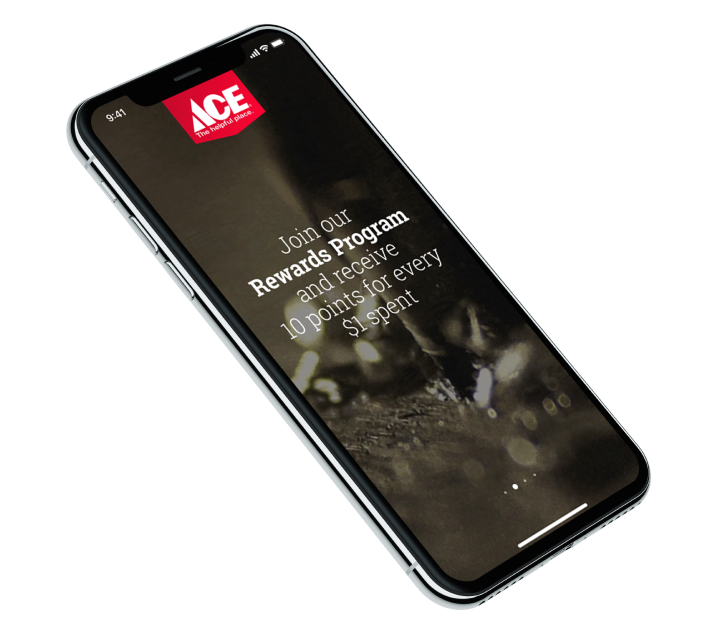
ace hardware app on phone
Ace Hardware employee with customer

Building loyalty—and first-party data.

With constantly evolving digital transformation comes an increased scrutiny on privacy. Marketers can offer more meaningful personalization if there is a fair value exchange for customers. That’s why a foundational step to our approach was to reimagine Ace Hardware’s loyalty program by building a rewards app user experience that continually earns customers’ loyalty by engaging their expectations, emotions and behaviors.

Keeping in mind Ace Hardware’s customer engagement KPIs focused on loyalty and rewards, we mapped out data collection points that would allow the business to measure and optimize to meet aggressive short-term goals, while also strategically collecting data like home type and home characteristics to allow for highly accurate personalization and relevance for the customer down the line—while helping customers gain rewards and information they need. 

Furthermore, we designed the analytics framework to capture location, demographic and purchase data in addition to loyalty and engagement data from the outset, creating a future-proofed app analytics setup that would eliminate the need for costly and time-consuming app rebuilds as business needs shift.

man drilling wood

In partnership with

  • Ace Hardware
Client Words [Monks] delivered an outstanding work product quickly and efficiently that not only addressed our project KPIs, but went above and beyond to anticipate our future needs.
Deanna Hernandez

Deanna Hernandez

Senior Ace App Manager, Ace Rewards & Analytics, Ace Hardware

Rebuilding from the inside out.

We tackled Ace Hardware’s analytics framework and mobile app with a lockstep approach to development. This joined together front- and back-end processes—which are typically siloed—to result in an experience that captures data critical to enhancing the customer experience. Integrated teams worked together to design the app with customer interaction framework, data collection points, and analytics built in from the start, producing the highest-quality output more quickly and efficiently.

Our Craft

Personalization and customer loyalty are just a tap and a swipe away.

  • Ace Hardware app
  • Ace Hardware app

An immediate payoff.

Working with Monks for both production and analytics streamlined communication, accelerated project timelines and culminated in a more cohesive final product and better customer experience. The app immediately generated results, too, and within seven months of launch:

Results

  • Over one million app installs
  • Over 150K new rewards accounts
  • $30 million in omnichannel revenue

Want to talk data? 
Get in touch.

Hey 👋

Please fill out the following quick questions so our team can get in touch with you.

Can’t get enough? Here is some related work for you!

My Marketing Channel Doesn't Work: A Digital Ad Fallacy

My Marketing Channel Doesn't Work: A Digital Ad Fallacy

3 min read
Profile picture for user adam

Written by
Adam Edwards
EVP, Performance Media

A hand drawn rocket ship flies through the sky

Digital marketers are testing more new tactics, channels and strategies than at any time in recent memory. During the early 2000s, digital marketing mostly meant search and display efforts without much variety beyond those two ad formats. Today’s advertiser has a slew of new arrows in their quiver. While the interest in trying new channels and tactics has expanded, the evaluation criteria hasn’t. Way too often I hear, “we tried _____, but it wasn’t working, so we shut it off.” The common thread in almost all of these cases is that the marketers are not evaluating a channel or tactic based on what it was designed to do.

How Do I Know It’s Working?

I recently talked to an advertiser for an enterprise software product who was leveraging target account marketing on LinkedIn to reach executive-level decision makers. He told me it “wasn’t working.” When I asked him, “what do you mean when you say it isn’t working?” he responded that it wasn’t generating any leads. I looked at his campaigns, and saw that he was showing ads to VPs and CXOs, driving them to a free demo signup page.

Put yourself in the prospect’s shoes for a moment: A senior executive isn’t interrupting their day to click on an ad from a company they’ve never interacted with, and then immediately signing up for a demo with a salesperson without interacting with any other content on the site. Heck, even a junior employee doing research for a senior executive probably wouldn’t request a sales demo without doing significantly more research than reading one ad and one landing page. Saying that these LinkedIn campaigns “don’t work” is like throwing a cheetah in a swimming pool with a dolphin and calling it slow when it loses a swim race.

Think Like a Customer

Last year we invested in a single sign on software (SSO) to enhance our company’s digital security. Our CEO was the ultimate decision-maker on the purchase and gave signoff on the investment, but there was no chance that he would take 30 minutes listening to a demo pitch. He assigned our Director of Technology to lead the evaluation process. That director did demo four different software platforms before ultimately making a recommendation that our CEO approved.

Ok fine, but then why worry about showing our CEO an ad at all? When our CEO tasked that director with leading the evaluation process, he mentioned that he knew Company A and Company B had offerings that were worth evaluating. So before any serious research took place, two of the four spots for consideration were decided. Influencing our CEO’s likelihood of mentioning, remembering, or just being aware of Company A and Company B is exactly why you show him an ad even if he’s never going to convert on a demo offer.

Evaluate the Right Way

So how should you evaluate success? That depends on what marketing tactic you’re using and what it is meant to accomplish. Or, continuing the metaphor from before, whether it was designed to sprint in the plains or swim in the ocean, so to speak.

If you imagine yourself as the SSO software marketer trying to influence our CEO, you should first divvy up targeting between prospecting and remarketing for evaluators and influencers. Each of the four segments would have a different measure for success.

If you’re getting in front of CXOs and driving heavy site engagement and lots of return visits, you’ve won. How much would you pay for the CEO of one of your top 500 target accounts to come to your site, spend five minutes clicking around, seeing that you are a leader on a recent Gartner report (or any other prominent award), and then download an ungated asset? For many B2B companies, that’s probably worth $500+. So who cares if you’ve spent $5,000 with two conversions if you’re driving killer engagement left and right?

The purchase funnel continues to get more complex. You’re rarely going to hit a home run on the first pitch, so start to weigh the walks and singles that ultimately lead to scoring runs. If you’re evaluating the right metrics and not giving up on channels and tactics for the wrong reasons, you’re going to end up with more deals and revenue, and those are the ultimate success metrics.

Learn more on how our performance.monks can help with these tough challenges as they arise.

Make sure you're evaluating the proper metrics for your marketing campaigns before you determine that they "don't work." Our SVP, Digital Strategy discusses how to evaluate the proper metrics for your marketing campaigns before you determine that they "don't work." performance marketing data analytics digital marketing campaign

Prepara Tu Estrategia de Data para el Cambio Hacia la Personalización

Prepara Tu Estrategia de Data para el Cambio Hacia la Personalización

4 min read
Profile picture for user mediamonks

Written by
Monks

Hace poco, los premios FIAP dieron lugar a cuatro días de charlas, rondas de preguntas y hallazgos sobre publicidad y comunicación.

Si no estás familiarizado con FIAP (Festival Iberoamericano de Publicidad), es uno de los eventos creativos líderes en Latinoamérica, llevado a cabo en Buenos Aires donde se encuentra una de nuestras oficinas. La edición de este año se destacó por varios oradores, como Sir Martin Sorrell de S4 Capital y el fundador de MediaMonks, Wesley ter Haar.

Uno de los temas recurrentes a lo largo de la conferencia fue las dificultades que las marcas enfrentan a la hora de usar data de manera efectiva, creativa y económica. Si esto te suena conocido, ponte al día con estas grandes ideas sobre las posibilidades que la data te brinda.

FIAP-SMS

Los presupuestos son ajustados, y la necesidad de contenido sigue aumentando.

“Hoy en día necesitas más por menos. Hay una demanda constante de contenido, pero los presupuestos se están reduciendo”. – Wesley ter Haar

En su charla, cuyo título en inglés, “Ten Techtonic Trends”, suena a trabalenguas, Wesley ter Haar mostró que los presupuestos de marketing tuvieron su auge en el 2016, y el año siguiente comenzaron a caer. A pesar de los presupuestos estancados y limitados, la necesidad de contenido sigue creciendo, así como la necesidad de brindar experiencias más personalizadas y customizadas. Y si eso no suena lo suficientemente difícil, el reto se magnifica por una explosión de nuevos medios: experiencias de realidad aumentada o virtual, videos en vivo, videos de 360 grados y más. Quienes temen quedarse fuera de la próxima gran plataforma pueden llegar a buscar, apurados, contenido para cada una, pero esto puede ser difícil; tanto para organizar como para costear. Cuando se produce tanto contenido para tantas plataformas diferentes, es fácil que todo se sienta un poco desconectado. Por eso es importante cambiar tu mentalidad y marco de referencia (entérate cómo más abajo).

Desarrollar recursos a escala es un modo de saciar el hambre de contenido. Es un proceso y un marco de referencia creativo que implica desarrollar cientos, miles y/o quizás millares de piezas únicas; destinadas a segmentos hiperespecíficos en tu mercado con sólo un puñado de piezas de contenido. Pero ¿cómo pueden las organizaciones hacer esto de un modo económico? La respuesta está en cambiar su modo de pensar, lo cual nos lleva a nuestra próxima gran idea:

Las marcas deben integrar data y métricas a lo largo del proceso creativo, no sólo al final.

“La data es información, y la información es poder. Lo que hace la diferencia es interpretarla y saber cómo usarla… y usarla como base para crear algo”. – Eva Santos

Santos mencionó una idea clave del FIAP: que relegar la data y métricas al final del ciclo creativo es obsoleto. Al contrario, las agencias deben incorporar data en todos los pasos del proceso creativo. Sir Martin Sorrell tuvo un mensaje similar cuando dijo que “La data va a sustentar lo creativo y va a dictar la planificación de los medios. Los van a mejorar, no a empeorar”.

Monk Thoughts La data va a sustentar lo creativo y va a dictar la planificación de los medios. Los van a mejorar, no a empeorar”.
Headshot of Sir Martin Sorrell

Sir Martin Sorrell usó el ejemplo de las recomendaciones de Netflix, que destacan los posters y trailers dinámicos hechos a la medida para las preferencias únicas de la audiencia. Es fácil ver cómo esto vuelve irresistible el contenido, pero también es un modo inteligente y económico de generar un montón de entregables con una cantidad pequeña de piezas: con tan sólo 115 escenas y 3 animaciones de intro, puedes crear casi 1.5 millones de piezas de contenido.

FIAP-Wesley AAS

Pero esto también requiere repensar un poco tu estrategia. Los recursos a escala dependen de los marcos de referencia de contenido provistos de variables dinámicas. Así que en vez de desarrollar una pieza de contenido diferente por segmento o por interés, simplemente desarrollas un marco de referencia que puedes utilizar para testear, escalar y crear más contenido sin costos adicionales.

La demografía ha muerto; vivan las preferencias.

“La información demográfica no nos da nada, todo está en las preferencias de los usuarios.” – Wesley ter Haar

Malas noticias: los datos demográficos como geografía, edad o género han muerto. Buenas noticias: con la tecnología de hoy, brindar servicios basados en las preferencias del usuario ha ganado terreno. Ter Haar elabora sobre la idea en su charla al darnos un ejemplo. Supongamos que una chica joven en la costa oeste ama Breaking Bad. Tiene muchos más gustos en común con otros fans del programa—como un hombre más grande en Kentucky que también está obsesionado con él—que con otras chicas en su comunidad que odian el programa.

El próximo campo de batalla es la personalización y el contexto, lo cual significa que tanto las marcas nuevas como con legado deberán revisar sus estrategias de data para mantenerse en la cima. Y las apuestas son grandes: Adobe pronostica que $800 billones irán tan sólo al 15% superior de las empresas que logran acertar la fórmula. Eso hace que sea más importante ahora que nunca tener una estrategia de data efectiva.

#FIAP2018 terminó, pero aquí tenemos cuatro ideas sobre cómo la data está transformando las tendencias y cambiando las reglas del juego. Prepara Tu Estrategia de Data para el Cambio Hacia la Personalización #FIAP2018 terminó, pero aquí tenemos cuatro ideas sobre cómo la data está transformando las tendencias y cambiando las reglas del juego.
FIAP FIAP2018 Sir Martin Sorrell S4 Capital Wesley ter Haar data contenido creativo contenido programático data analytics data es una oportunidad

Choose your language

Choose your language

The website has been translated to English with the help of Humans and AI

Dismiss