Choose your language

Choose your language

The website has been translated to English with the help of Humans and AI

Dismiss

Black History / Our History: Celebrating Black Excellence

Black History / Our History: Celebrating Black Excellence

Culture Culture, DE&I 16 min read
Profile picture for user mediamonks

Written by
Monks

Black history month design with photos of media.monks employees

At Media.Monks, we’re excited to celebrate and recognize Black History Month. Throughout February we’ll be highlighting our community groups and incredible employee base in their efforts to celebrate Black history and the incomparable impact of the Black community. One of the ways we’re honoring Black History Month is by celebrating our employees. Each week, throughout the month, you’ll have the opportunity to get to know a new colleague from our Melanin.Monks community group and other entities on our social channels. Here on the blog, we’re taking a look at what Black History Month means to them, along with the people and moments that have inspired them across their lives and careers. But first, a quick history lesson.

While we know February as Black History Month in the United States and Canada (the Netherlands, United Kingdom and Ireland have similar observations in October), its precursor was Negro History Week in the US, initiated on February 7, 1926 by historian Carter G. Woodson and other prominent Black Americans of the time. The second week of February was chosen because it coincided with the birthdays of Abraham Lincoln and Frederick Douglass, both of which were already celebrated by Black communities across the country. Today, we devote the entire month to commemorate, celebrate and honor the African diaspora and Black history—our history. Read more about the origins of Black History Month at the ASALH.

Black History Month is a time to look back on a history that affects—and was affected by—all of us. A time to remember and honor the people who have gone before us, to recognize the progress that’s been made in the ongoing struggle for racial justice—and to educate ourselves on all that is left to do.

At Media.Monks we operate under people-centric values that empower our employees to build, innovate and work together as one team—where everyone belongs and everyone has a voice.  For us, treating people as they want to be treated, encouraging others to raise their voices and working together to complement our differences fosters an environment where everyone feels heard. To that end, we support our employees in creating community groups (CGs) that recognize and celebrate our unique identities and affinities and create space for employees to celebrate and share common life experiences. Our CGs have an unparalleled impact and make up the fabric of our company's culture. Melanin.Monks is one of our groups, providing a space for exploring and understanding the Black diaspora while offering support and mentorship to our Black workforce.

In recognition of Black History Month, members of our DE&I Team, in conjunction with Melanin.Monks, have come together to reflect on the continuing history of Black excellence.

Quiana Haynes BHM quote

Quiana Haynes, Associate Account Manager

Tampa, Florida

I’ve been with Media.Monks for: 1 year and 8 days

What Black History Month means to me:

Black History Month means the absolute world to me. It is the month I was born in (2/2) and it's the month I celebrate and educate myself on our history. Graduating from one of the best HBCUs, Florida A&M University, I was able to surround myself with individuals who looked like me who wanted to succeed and continue to learn more about our history.

The title of this piece is “Black History/Our History.” Describe the significance of that title.

The significance of this title is that it captures everyone's definition and traditions of Black history and the legacy we continue to build.

How does Black history differ from traditional American history?

It differs because it is factual and cultural.

What moment in Black history has influenced your career or life, or resonates with you?

In 5th grade when I sat in my classroom full of other kids who didn't look like me watch the Obama's Inauguration. This moment gave me hope that I, too, can achieve anything I put my mind to no matter what.

What do you think is the most profound moment from Black history in the US? Why did you choose this event?

Jim Crow, because I would not be where I am today without them. The Jim Crow laws were state and local laws enforcing racial segregation in the Southern United States. The post-World War II era saw an increase in civil rights activities in the African American community, with a focus on ensuring that Black citizens were able to vote. This ushered in the civil rights movement, resulting in the removal of Jim Crow laws.

How do you celebrate Black History Month?

Food is my love language. Food has also created many monumental moments in Black history, from braiding rice into our hair for food during slavery to grounding corn to make grits. I will forever be grateful for Black food inventions and recipes that I could never live without.

AJayJohnson BHM quote

A. Jay Johnson -  Senior Strategist

Brooklyn, New York

I’ve been with Media.Monks since: 

I joined Cashmere Agency in February 2022.

What Black History Month means to you?

I try to celebrate Black history and futures on a continuous basis. But Black History Month is a beautiful way to compel non-Black folks to think about all the brilliant things we have done for the world, particularly as social media and the education system frequently fail us. 

The title of this piece is “Black History/Our History.” Describe the significance of that title:

“Black History/Our History” is important because it shows the love, excitement and pride we have for our history. We have to claim it. 

How does Black history differ from traditional American history?

Black history is not just a part of America's history, it is America's history. The country was built off the backs of my ancestors, by my ancestors, or stolen. 

What moment in Black history has influenced your career or life, or resonates with you?

The Black Panther Party has had a massive influence on me, personally and professionally. As a community organizer and activist, I’m always trying to promote and educate about the benefits of mutual aid and collective care movements. The Black Panther Party exemplifies both the strength of our community and how effective these programs can be. They laid the blueprint through projects like the Free Food Program, Free Breakfast Program, Health Clinic, Seniors Against a Fearful Environment (SAFE)—assisting elderly folks to their destination safely - and many others.

What do you think is the most profound moment from Black history in the US? Why did you choose this event?

Connected to my last answer, I'd say that the most profound moment from Black History in the US is the creation of the Black Panther Party and its subsequent movement. Their incredible vision, resilience and resolve enabled their core mission to spread across every corner of the country—and all before the advent of the internet and social media.

Describe (if you have one) a moment in your family's story that can serve as an inspirational Black history moment. 

When my grandfather retired from the US Army in 1970 and went to work for NASA for the next twenty years. This was inspirational as he was one of a select few Black men to work at NASA over that time. 

How do you celebrate Black History Month?

I strive to celebrate Blackness every day of the year, and Black History month will be no different. I will continue to take every opportunity to educate myself and others on our history, be intentional about how I represent myself and my community, and support those who are on their way to creating a brighter future

Johanna Lubin BHM quote

Johanna Lubin, Creative Producer

Los Angeles, California

I’ve been with Media.Monks for: 

Almost 3 years

What Black History Month means to you?

It's an opportunity to reflect and celebrate past accomplishments along with a reminder we have a lot more to do! 

The title of this piece is “Black History/Our History.” Describe the significance of that title.

It brings us all together. No matter who you are, we can all shape Black history! 

What moment in Black history has influenced your career or life, or resonates with you?

When Ketanji Brown Jackson was nominated to the Supreme Court last year! By being the first Black woman to serve on the Supreme Court, she is showing every Black woman that with resilience, anything is possible! 

What do you think is the most profound moment from Black history in the US? Why did you choose this event?

As an immigrant coming from France, Martin Luther King's “I Have a Dream” speech will always be one of the most profound moments that resonate with me—it was such a defining moment of the civil rights movement!

How do you celebrate Black History Month?

It's an all-year-long celebration for me by supporting Black-owned businesses; supporting incredible Black Women like Ketanji Brown Jackson, Stacey Abrams, Kamala Harris, Bozoma Saint John, etc.; and making sure to work with as many Black and crew members of color as possible.

AaronPD BHM quote

Aaron Parrish-Dean, Fellow

Atlanta, Georgia

I’ve been with Media.Monks since: 

April 2022

What Black History Month means to you?

The blueprint to world evolution: technological advancement, upgrade in consciousness, character development.

The title of this piece is “Black History/Our History.” Describe the significance of that title.

In order for us to not only reach our destination but decide exactly where we want to go, we must understand where we’ve come from and how that affects where we are now. Our history is the “why” to many questions—both answered and neglected. Ultimately, the significance is everything because there would be no explanation for our being—let alone anything to explain. Imagine how detrimental that would be to society (on a global scale).

How does Black history differ from traditional American history?

Firstly, I believe that Black history directly impacts American history and not the other way around, which intimidates the American education system from adequately teaching its students not only the horrors of Black oppression and genocide, but the magnitude of Black contributions that went on to disrupt the world as they knew it, multiple times. Lastly, Black history doesn’t begin or end with America; it’s so much bigger than this country.

What moment in Black history has influenced your career or life, or resonates with you?

February 14, 1867. The founding of Augusta Institute (which would later be renamed to Morehouse College) is everything to me and my life, and I owe it such.

What do you think is the most profound moment from Black history in the US? Why did you choose this event?

The Horse in Motion (1878). The first ever motion picture starred a Black man named G. Domm. The majority of people aren’t even aware of this fact. However, Jordan Peele popularized this moment in his film Nope (2022). I think this is the most profound moment in US Black history because it displays the blatant love/hate relationship America has with us since the invention of the motion picture. We’re thrown in front of cameras and adored, but despised in everyday life.

How do you celebrate Black History Month?

I don’t. I celebrate Black history every day by trying to become the best version of myself, indulging in Black ideologies and educating myself on those who’ve left their mark before me. Intentionally deriving my inspiration from these people is how I plan to incorporate their efforts with each and every way I create an impact and leave my legacy. That’s how I celebrate Black history.

Angelica George BHM quote

Angelica George, Social Strategist 

Atlanta, Georgia

I’ve been with Media.Monks for: 

I’ve been at Media.Monks as a full-time employee since October of 2022. I initially started at Media.Monks as an intern in July and was later hired for a full-time role.  

What Black History Month means to you?

Black History Month means so much to me as an opportunity to learn and inform. This month's importance is beyond measurable to me. To know the sacrifice and dedication it took for this month to exist and the resilience of the community is incomparable. I always do my best to highlight individuals as well as be an active participant in helping others be open to learning. 

The title of this piece is “Black History/Our History.” Describe the significance of that title.

The significance of that title stands on the truth! The truth is that though the month may be labeled as Black history, it truly is the history that shapes every part of the world’s history and should be acknowledged as that. No one can get rid of Black history because it’s woven into every single piece of history. 

How does Black history differ from traditional American history?

Black history is American history and beyond. I can’t say it differs other than it being glossed over in the school system. In any significant moment that’s considered “American history,” Black people and Black history are part of that moment as well. The Black history stories aren’t always told, but they show up in every moment of history. 

What moment in Black history has influenced your career or life, or resonates with you?

It’s so many moments that have shaped and influenced my entire being. I attended a historically Black university, Clark Atlanta University. Having the opportunity to attend an HBCU is an undeniable and unexplainable experience. Those years at that beautiful institution taught me so much beyond books and assignments. 

What do you think is the most profound moment from Black history in the US? Why did you choose this event?

The most profound moment from Black history in the US is tough to choose. For me personally, I’ll say the election of President Barack Obama. This moment holds significance as a whole because it was something that was rooted in positivity, a glimmer of hope. It was at a time when I was old enough to truly understand race relations in this world, and it made the impossible feel real. 

Describe (if you have one) a moment in your family's story that can serve as an inspirational Black history moment. 

My family is inspirational because of their resilience. My mother was born in the 50s and she lived through the civil rights movement. She has had experiences that most won’t understand. Despite being present in those times, she still persevered. My grandmother was a beautician and was able to own her own shop. My family's rich legacy is a testament to resilience. 

How do you celebrate Black History Month?

I honestly do my best to celebrate Black history every day. Whether it’s me personally learning new information about our history, sharing new information that others may not be privy to, but also enjoying the fact we deserve celebration. Black History Month gives us that designated time when essentially everyone has to pay attention, so I do my best to show up on social, attend events, and highlight contributions.

Devon Anderson BHM quote

Devon Anderson, Senior Art Director

Dallas, Texas

I’ve been with Media.Monks since: 

I joined Cashmere Agency in August 2022.

What Black History Month means to you?

It's a celebration of everything that makes us great, not only celebrating the past but the amazing things happening in Black culture today and all the ways we're building towards the future. It's about honoring the Black artists, scholars, activists, world-changers and making sure their visions continue to move not only Black people forward, but the entire world.

The title of this piece is “Black History/Our History.” Describe the significance of that title:

The words "our history" make me think about the weight of everything we've had to endure and all of the incredible things we've built, even while carrying that burden. Black people are truly roses from concrete, succeeding and thriving in a world designed for us to fail.

How does Black history differ from traditional American history?

It doesn't at all—you can't tell American history without the Black people who came here and physically built America as we know it today. Every chapter of American history was moved forward by Black people, from the slaves who came here by ship, to the academics and scholars that moved science and laws forward, to the tastemakers and culture creators that define our modern society today.

What moment in Black history has influenced your career or life, or resonates with you?

I was very new to the industry when the George Floyd protests of 2020 hit, and in a lot of ways it completely broke me. To feel the ever-present fear of knowing that could happen to me or any of my loved ones, to the wild range of responses from my non-Black coworkers and peers. It really made me sit back and evaluate what it means to be a professional and a human being, and put into perspective everything that we do in this industry. I think in a lot of ways, it directly led me to prioritize purpose and culture-driven work, and to never neglect the human being that is behind every professional.

What do you think is the most profound moment from Black history in the US? Why did you choose this event?

When we think of profound moments from Black history, the most iconic moment is the famous "I Have a Dream" speech, but I think an even more profound moment was the assassination of Martin Luther King, Jr. It's not the most positive and rosy answer, but I think it says a lot more about where we've been and where we are as a country.

The world looks to him now as a shining beacon of hope, a symbol of the ideal "post-racial society,” and even so, despite every effort to be peaceful, despite doing everything "the right way,” he still was gunned down. It serves as a microcosm of the catch-22 that Black people in America face. No matter whether you're peaceful or violent, kneeling on the ground or with a fist in the air, the oppressed cannot grant themselves freedom if the world is not ready for them to be free.

We as Black people can march and sing and protest all we want, but it takes all of us, the entire country, to believe that Black people and all people of color deserve liberation. We must be truly united in the vision of a world in which every person can live equally, equitably and freely, and until we do, we still have a long way to go towards achieving the utopia that Dr. King dreamed about.

Describe (if you have one) a moment in your family's story that can serve as an inspirational Black history moment. 

Just this past weekend, my great-grandmother celebrated her 90th birthday. Being able to hear her talk about the things she's seen and lived through in her time, and seeing every generation of family come together and celebrate our oldest living relative, was a wonderful thing to be a part of.

How do you celebrate Black History Month?

Year-round!

Jovonna Palmer BHM quote

Jovonna Palmer, HR Business Partner

Nashville, Tennessee

I’ve been with Media.Monks since: 

6 months

What Black History Month means to you?

Black History Month is an opportunity to highlight and honor the accomplishments of Black Americans throughout our history.

The title of this piece is “Black History/Our History.” Describe the significance of that title.

The significance is to honor the contributions and legacy of Black/African Americans across our history and society.

How does Black history differ from traditional American history?

Black history is rich in the fact that contributions have been made in the arts, science, technology, etc. However, the difference is that this information is not shared as much as traditional American history is shared. Black history should be celebrated more than just one month out of the year.

What moment in Black history has influenced your career or life, or resonates with you?

The year Barack Obama was elected president shaped my life in a way that change and progress were made. We as a country are still a work in progress, but I remain hopeful. 

What do you think is the most profound moment from Black history in the US? Why did you choose this event?

The most profound moment from Black history in the US is the year Barack Obama was elected president. This event shaped my thinking in that we were making strides in becoming a better country. Seeing and loving people for their work and character vs. the color of their skin was great progress.

How do you celebrate Black History Month?

I celebrate Black History Month by attending and supporting various Black-owned businesses and the arts.

Kaaya Allotey BHM quote

Kaaya Allotey, Senior Strategist

Los Angeles, California

I’ve been with Media.Monks since: 

I’ve been at Cashmere for over 2 years! Since December 2020.

What Black History Month means to you?

When I think of Black History I always go back to the Ghanaian principle of Sankofa, which means “go back to the past and bring forward that which is useful.” In essence, it speaks to the importance of learning from your roots, history and culture as a guide for steps building the future. This is especially important for us as Black Americans as so much of our history has been (and unfortunately continues to be) buried, erased, and misrepresented. 

The title of this piece is “Black History/Our History.” Describe the significance of that title.

The title Black History/Our History signals the power that we as Black Americans have during this month to take full ownership over our representation and reclaim our narrative. As previously mentioned, so much of our history has been (and continues to be) misrepresented, skewed, and erased by others. Black History/Our History our time to challenge these misrepresentations and remind others (and ourselves) of our influence and resilience.

How does Black history differ from traditional American history?

First thing first, Black history is American history. Let's make sure that’s super, super clear. Black Americans have literally built the economic infrastructure and culture of this country from the ground up so it is extremely frustrating that we have to constantly issue the reminder that our history is central to American history. In terms of the Black American experience, there’s no denying that we’ve had (and continue) to endure much more than our fair share of hate and systemic oppression here in the United States. Nevertheless, what is beautiful and Undeniably Dope™ about the Black American experience is that we still manage to be the blueprint for art, expression, style and culture even in the midst of it all. I love that about us.

What moment in Black history has influenced your career or life, or resonates with you?

I’ve been so inspired by the ascension of West African culture/appreciation into Black American culture that has happened over the last several years. As the daughter of a Black American Baltimorean and a Ghanaian-American immigrant, I struggled to find my place in between two very distinct cultures. It is the best thing ever to see those two worlds that I previously thought of as super separate, collide in ways that I would have never imagined. From the massive success of Afrochella (now known as Afro Future Fest) to Virgil Abloh bringing traditional Kente cloth to Louis Vuitton runways, it’s clear that the future of Black representation has ample diasporic synergy.

What do you think is the most profound moment from Black history in the US? Why did you choose this event?

The racial reckoning that followed the murder of George Floyd is something that will forever mark a seismic shift in the zeitgeist that Black American experience is validated. Previous to this time in culture, race was such a sensitive, opt-in-as-you-choose type of discussion. So many different ideas, histories, controversies that blatantly had racial undertones were largely unacknowledged or just broadly referred to as racist–or at least questionably so. There was very little nuance in these conversations that were happening at an interracial level and/or on large-scale platforms. Now, it is so much more commonplace for topics like bias, privilege, anti-Blackness etc. to be a part of the conversation. We have a long way to go, but I can appreciate the progress.

Describe (if you have one) a moment in your family's story that can serve as an inspirational Black history moment. 

My grandfather, John Sidney Sheppard, was a walking piece of Black history that inspired me and hundreds of people in his 96 years of life. During the heart of segregation, not only did he attend high school (which was a feat in itself at the time) but went on to earn his bachelor’s from Bowie State University and his master’s from NYU. He was the most loyal alumnus I ever met of his high school and especially his undergraduate college, BSU, where he served as chairman of both the BSU Foundation and Board of Visitors, was a life member and two-time president of the BSU National Alumni Association, and was a member of the Sports Hall of Fame, along with several other in his lifetime. Ultimately, he was awarded the status of Historian Emeritus along with being recognized as the oldest, longest active alumni at BSU and had the honor of getting his high school gymnasium named after him for his decades of service. Amazingly, his community involvement hardly stopped with his schools as he was a president, chairman of the board, amongst many other capacities for the James Mosher Little League Association, and a founding member and former president of Zeus Inc., a Baltimore-based men’s social and civic club.  His love for his HBCU, along with his relentless commitment to community service, truly set the precedent for my education and commitment to community advancement in my work and social efforts.

How do you celebrate Black History Month?

As a cultural strategist, I use Black History Month as a platform to celebrate the legacy and lasting influence that Black Americans have made and continue to make in culture at large. Today more than ever we see that Black culture is popular culture, and Black history is a great time to celebrate and amplify that truth.

To celebrate Black History Month we’re highlighting our resource groups and employee base in their efforts to celebrate Black history and the impact of the Black community. To celebrate Black History Month we’re highlighting our resource groups and employee base in their efforts to celebrate Black history and the impact of the Black community. diversity and inclusion diverse culture DE&I Culture

Are Ad Partners Doing Right by Plant-Based Brands?

Are Ad Partners Doing Right by Plant-Based Brands?

Culture Culture, Original Content, Studio 4 min read
Profile picture for user film.monks

Written by
Film.Monks

A plant based burger sitting on a table with leafy greens and veggies

Letters from the fringe.

The world’s first official vegan was a British man named Donald Watson, who coined the term in 1944 and shared his Vegan Society newsletter with 25 subscribers. By the time he died 61 years later, the vegan community comprised more than 2 million vegans in the US alone.

A number of factors have fuelled an increase in plant-based foods, from dairy alternatives to meat substitutes. The branding of these products tends to be bold, punchy and irreverent, with an equal emphasis on health and personality. The days of vegans being largely viewed as fringe weirdos wearing hemp shirts are gone. Instead, veganism has become almost sexy. It’s no longer a single carton of soy milk hidden at the back of the store, but it’s young brands like Oatly that turn a yearly profit of hundreds of millions of dollars by producing over ten different types of oat drink, ice cream, and vegan yogurt called “oatgurt.” Rather than having Donald Watson explain how to pronounce “vegan” to a small group of subscribers, it’s Ariana Grande sharing #vegan recipes with her 289 million followers on Instagram. 

This leaves our Creative Director Films & Content Ben Phillips, Executive Creative Director Christy Srisanan, and Senior Copywriter Omnya Attaelmanan wondering: Is the advertising industry helping plant-based brands lean into veganism’s popularity and perceived edginess? Or are we relying too much on tried and true food marketing techniques, failing to support these brands in setting themselves apart from more traditional ones with fresher approaches to advertising? 

More consumers are going for clean greens.

Surprisingly, vegans aren’t necessarily the driving force behind the rising popularity of plant-based products, as one in four consumers identify as flexitarian. This means that the largest, most significant consumer group for plant-based products might not be vegans or vegetarians, but omnivores trying to fit a few non-meat days into their weekly menu. 

For many consumers, concern for the environment is a driving factor behind choice of diet. A study by the University of Oxford found that animal products are responsible for more than half of all food-related greenhouse gas emissions, and according to the Intergovernmental Panel on Climate Change (IPCC), adopting a plant-based diet can help fight climate change. Simply put, plant-based food and drinks can offer up a flavorful experience without the carbon footprint associated with animal products. 

Flexitarianism, vegetarianism and veganism represent steps towards more climate-friendly ways of consuming. This opens up great opportunities for marketing and advertising plant-based products in a way that emphasizes their minimal impact on our planet. Such environmental messaging is likely to resonate more strongly than ever, especially considering recent extreme weather events around the world—because selling plant-based food is all about the mission.

Thinking outside the animal-based box.

As opposed to animal products, plant-based food and drinks are rarely advertised with a focus on the sensory pleasure of consuming them. That’s the case for beef burgers, not plant-based patties. For the latter, advertising always needs to account for a consumer mindset that’s deliberate and thoughtful in its approach to food. Besides trying to compete with animal products in terms of taste and texture, vegan brands also aim to focus on their mission and bake it into their branding at every level. 

This typically translates into positioning themselves as being morally superior to “old school” animal products. The messaging of plant-based products often tends to call out non-vegan competitors, from Oatly’s “It’s like milk, but made for humans” to Beyond Meat’s “You’ve evolved. So should your snacks.” Sometimes, this can have dramatic results. Oatly, for instance, was sued by the Swedish dairy lobby over an ad that featured their slogan and the line “Wow, no cow.”

These brands are navigating multiple fine lines—between confrontational and adversarial, between punchy and preachy, and, perhaps most importantly, between cool and commercially viable. Too quirky, and you might lose consumers who would otherwise be interested. However, too bland, and you don’t stand a chance in a market full of edgier brands. Maintaining the right balance is a real challenge, which is an opportunity for advertising partners to step up their game. 

(Re)planting the seeds for plant-based brands’ success.  

When partnering with vegan brands, it’s crucial to bear their mission in mind. It isn’t just important—the mission is everything. Even the most profit-focused vegan brands will want to highlight their commitment to fostering sustainability, animal rights and healthy eating habits. So, it is our job to tap into that shared passion between plant-based food producers and consumers. 

However, there’s still plenty of room to explore the sexier side of veganism and promote both the mission and the taste, texture and satisfaction of the product. So, we believe that the next step for advertising partners is to think about how, when and where we can help vegan brands add some sizzle to all the substances. How do we make plant-based food and drinks not just appealing, but actively tempting? How do we elevate both the mission and the marketing? How do we do all of this without rehashing old, stale techniques to sell food that the industry has relied on for decades?

“There’s usually a strong directive from brands to ‘stay in category’ to meet consumer expectations, resulting in a lot of food-related ads using similar tropes,” says Catherine Millais, our Film Director and tabletop photography expert. “Think of dairy products being shot in morning light, the classic chocolatier stirring his melted chocolate, or ads highlighting a burger’s ingredients through slow-motion footage—usually with a male voice-over and masculine energy.”

In addition, Millais argues that there’s room for much more storytelling in the plant-based product space. “Older, more established brands rarely introduce themselves to consumers anymore,” she says. “Why should they? The legacy has already been established and the origin story has largely been told. We all know about Ray Kroc and McDonald’s. Newer brands, however, have a chance to introduce themselves and tell their brand story in engaging, inventive ways that weren’t available ten or more years ago.”

By adhering to traditional food advertising tropes, we’re missing important opportunities to market plant-based products as an entirely separate category. This is a chance to substitute standard practices for new, innovative ideas and swap masculine energy for gender-neutral joie de vivre—all to exceed and subvert consumer expectations.

Plant-based food brands represent a bold departure from a long-established norm. This is as true today as it was back when Donald Watson started his Vegan Society. In trying to appeal to a consumer base of both vegans and meat-eaters, we can’t afford to tread the same old paths and forget that boldness—this does a disservice to brands that strive to fulfill a mission, consumers that try to take a more conscious approach to food, and advertising partners that aim to connect them through meaningful marketing.

Is the advertising industry relying too much on tried and true food marketing techniques, failing to support plant-based brands in setting themselves apart? Our Film.Monks weigh in. film content sustainability brand strategy Studio Original Content Culture

Social Bite: Live Commerce Comes Alive

Social Bite: Live Commerce Comes Alive

Affiliate & Influencer Advertising Affiliate & Influencer Advertising, Commerce, Culture, Emerging media, Influencer Marketing, Retail media, Social 1 min read
Profile picture for user mediamonks

Written by
Monks

black and white photo of a young guy filming himself on a phone with doodles around the photo

Accelerating the path to purchase through live commerce.

As a combination of livestreams and ecommerce, live commerce may feel similar to the traditional home-shopping TV model. But what separates live commerce from the days of call-in orders is its inherently social nature, which can take many forms.

In this Social Bite, we explore what live commerce can be and how it can help you not only activate your audience in the moment, but also build a relationship into the future. Discover the different forms of live commerce and the roles that brands and their ambassadors take to inspire their audiences.

In this guide, you will:

  • Discover the different types of live commerce activations available
  • Dive into the three elements that make a successful live commerce activation
  • Break down how to engage audiences at every stage of the journey

Historically, live commerce has been most popular in China, where the format makes up 10% of the overall ecommerce market. Accelerated in part by the pandemic, live commerce has continued to gain traction in the Asia-Pacific region. Now, brands elsewhere around the world are taking note—and so are social and retail platforms, both of whom are experimenting with new features and revenue streams to bring live commerce to life. Serving the need for new ways to engage their customers in social, shoppable and entertaining experiences that blend brand love and conversion, live commerce combines spectacle, presence and interchange to build excitement among highly engaged audiences.

In this Social Bite, we explore what live commerce can be and how it can help you not only activate your audience in the moment, but also build a relationship into the future. e-commerce ecommerce social media Livestream commerce livestream Social Commerce Affiliate & Influencer Advertising Influencer Marketing Emerging media Retail media Culture

Social Bite: The Evolution of Digital Wellbeing

Social Bite: The Evolution of Digital Wellbeing

Community Management Community Management, Culture, Experience, Social, Social AOR 2 min read
Profile picture for user mediamonks

Written by
Monks

photo of a woman holding a phone while smiling against a yellow to pink gradient backdrop with doodles floating around her

Expanding the idea of wellbeing–both online and off

With immersive technologies and other innovations bleeding into our daily routines, the line between online and off is blurring—and changing the way consumers engage with the world around them. We’re logged in for life, and as a result, concerns surrounding digital wellbeing are transforming the role of tech. We have a unique opportunity to help improve people’s relationships with digital, but to truly understand how, we need to expand our idea of wellbeing beyond the usual contexts.

Digital wellness is the process of reflecting on our behaviors and integrating tools to improve our lives. This snackable guide explores what digital wellbeing looks like and how brands can react to common tensions in tech.

In this guide, you will:

  • See how brands can evolve and adapt to consumers’ digital wellness behaviors
  • Discover the dynamic–not linear–process consumers use to incorporate wellness tools
  • Understand the key roles of technology that is shaping the digital wellness industry
  • Learn about the new tensions consumers face and how they attempt to combat them without the help of brands

From building communities and digital experiences that reinforce wellness goals, to giving people ownership of their own journeys, the Social Innovation Lab uncovers key strategies for staying on top of consumers’ digital wellness practices.

Born as a planning community to deconstruct and turn cultural topics into valuable strategies and business opportunities for brands, we are a 50-strong, multidisciplinary community of strategists. We provide critical thinking through collective intelligence, and through diverse points of view and experiences, we explore social phenomena with a focus on solving strategic challenges. This knowledge informs a variety of our projects around the world to help brands move at the speed of social.


This snackable guide explores what digital wellbeing looks like and how brands can react to common tensions in tech. This snackable guide explores what digital wellbeing looks like and how brands can react to common tensions in tech. Social Experience Social AOR Community Management Culture

How the Paris.Monks Bring Cultural Insight Through a Global Lens

How the Paris.Monks Bring Cultural Insight Through a Global Lens

Brand Brand, Culture, Economies & Content at Scale, End-to-End Agency Partner, Monks news 4 min read
Profile picture for user mediamonks

Written by
Monks

A skyline photo of Paris, France

Brand relevance speaks to an organization’s ability to connect with consumers at a deeper level, tapping into their emotions and satisfying their emerging needs. At a time when competition abounds and people expect more from the brands they engage with, the fight for relevance does not come down to how fast we can jump into the trend du jour. Rather, it’s about how well we are able to identify what the audiences truly crave—and how quickly we deliver it.

A little over a decade ago in Paris, the advertising services company Dare.Win was born out of the desire to help brands rise above the noise through daring experiences. Working with both French brands and international companies looking to tap into the local market, the Dare.Win team thrived by leveraging new formats across entertainment—a powerful tool to get audiences emotionally engaged. 

Eleven years after Dare.Win’s founding, the digital ecosystem has evolved beyond measure—fueled by an audience that’s more demanding, and in more control, than ever before. To achieve the agility needed to build brand relevance in today’s digital ecosystem, Media.Monks and Dare.Win combined forces in 2020 to operate at scale with an integrated offering across data, media, content creation, production and more. Now, we’re taking our unified approach to the next level. With a new name that cements a change in dimension, we’re proud to introduce our combined local team, the Paris.Monks.

Experiences imbued with cultural insight. 

Whether developing experiences that are fully virtual, physical or somewhere in between, our job as end-to-end partners is to create meaningful, branded moments that resonate with the target audience. Sounds simple, but here’s the catch: tastes are nuanced, and no two markets are exactly alike. In France, like in every market, brands need to factor in local insights—both to adapt their existing content and to inform future decisions.

During one of Paris’ hottest summers, our experts drew upon the extreme temperature to generate exposure for Get 27, a traditional French apéritif. The experience featured a “fresh street” where locals could cool down in a branded space—giving them what they needed when they needed it. Experiential activations like this thrive on local intuition, which is equally important in every aspect of a brand’s marketing. When it comes to media buying, for instance, brands need to know their publishers and their background. The same happens with influencer marketing. And even after you’ve mastered the cultural component, personal nuances enter the picture.
A green painted street with green tables, chairs, and street signs

The Paris.Monks partnered with Get 27 to provide a space for overheated Parisians to cool off and refresh.

First-party data fuels personalization.

Even within a specific market and cultural framework, consumer interests can widely vary, which is where the power of data comes into play. We know consumers expect products and experiences to be tailored to their interests and lifestyle, but this level of personalization only comes with a solid first-party data strategy.

How you use data can make or break your relationship with consumers. They want to feel seen, not spied on. No one likes to have a repetitive ad chasing them from platform to platform, or to share all their data before they can even assess how much value a brand can offer them. “Today, consumers expect personalization in a balanced way,” says Charles Moynet, the head of our DDM practice in France. “Tailored to their interests, but not creepy."

Monk Thoughts To get there, you need to gain control of your first-party data, but also effectively connect it with your content. That’s what most brands struggle with.
Charles Moynet headshot

Indeed, first-party data should be the fuel that feeds the rest of the supply chain. When capabilities are siloed, the value that the data team extracts rarely informs the work of creative teams, whereas in a unified approach, insights flow seamlessly between them. The goal is never to frantically collect data; rather, to reach a healthy feedback cycle in which users’ data improves the experience and vice versa. 

Local understanding through the bird’s-eye view of a global team.

Cultural insight and a solid first-party data strategy are key ingredients in the recipe for business growth—but above all, the secret sauce is banking on a multicultural team of professionals from all walks of life.

Monk Thoughts Our experience has demonstrated—if there was ever a need to do so—that diversity and inclusion are key factors in a brand’s success.
Wale Gbadamosi Oyekanmi headshot

For global brands, having a multicultural partner can help them show up authentically for various audiences. And while having specific cultural insight helps identify opportunities, banking on a global team comes in handy when tapping into multiple markets. A good example of this is how our fashion and luxury capability team, the FLUX.Monks, helped Amazon Fashion Europe build their cred in five different markets: France, Italy, Germany, Spain and the UK. Through a 360-degree campaign spanning content creation, influencer marketing, translation support and more, we established a council where each member represented a key market and gave a humanized feel to the brand’s wide offering.

The importance of an integrated approach stems from the fact that driving desire and relevance within a specific audience means being in touch with the topics, channels, formats and technologies they find alluring. says Liam Osbourne, Our Global Client Partner for FLUX.

Monk Thoughts Today’s consumers are the most digitally sophisticated to date, and brands need to work with a team of experts that have a deep understanding of platforms and emerging technologies while also being fluid in their nuances to succeed.
Liam Osbourne

Through a group of professionals belonging to a variety of cultures and subcultures, we foster opportunities for innovation—combining the best of all worlds for a well-informed pursuit of relevance. Working from Paris’ backyard and backed by a global team, the Paris.Monks will continue to reinvent marketing and support our partners through a digital-first offering that spans creative content, technology, performance, media buying and everything in between.

Working from Paris’ backyard and backed by a global team, our Paris.Monks continue to reinvent marketing and support our partners through a digital-first offering. global marketing strategy data-driven marketing data-driven creativity digital advertising experiential activation experiential marketing Brand End-to-End Agency Partner Economies & Content at Scale Monks news Culture

Your Guide to a Better 2023 Chinese New Year Brief

Your Guide to a Better 2023 Chinese New Year Brief

Brand Brand, Culture, End-to-End Agency Partner, Impactful Brand Activations, Seasonal marketing, Social Campaigns 1 min read
Profile picture for user mediamonks

Written by
Monks

Shanghai.Monks logo

Chinese New Year is the great marketing equalizer, revealing which brands truly understand their audiences versus those who simply see the world through their own myopic view. Consider the overabundance of product shots that dominate feeds and attention, versus realistic, people-focused moments that stir emotions. While the festival isn't upon us just yet, now is the time to plan—and it all starts with the brief from brands themselves.

Shanghai.Monks have developed an easy-to-use guide to identify key insights that can serve as a bedrock for more thoughtful, intentional CNY briefs. Inside, you’ll find the most salient consumer mindset shifts that will shape CNY sentiments in 2023.

In this guide you will learn:

  • How to create an inspiring Chinese New Year brief
  • How to translate holiday traditions into new contexts
  • Why leading with empathy is key
Monk Thoughts To help your Chinese New Year campaigns rise above the noise, our report spotlights 3 major mindset shifts shaping the ways audiences will perceive CNY content.
Nina Kong headshot
While Chinese New Year isn't upon us just yet, now is the time to plan—and it all starts with the brief from brands themselves. brand strategy creative brief project brief consumer insights consumer data Brand End-to-End Agency Partner Social Campaigns Impactful Brand Activations Seasonal marketing Culture

Find Value, Belonging and Experience in the The Search for Meaning

Find Value, Belonging and Experience in the The Search for Meaning

Consulting Consulting, Culture, Social, Social AOR 1 min read
Profile picture for user mediamonks

Written by
Monks

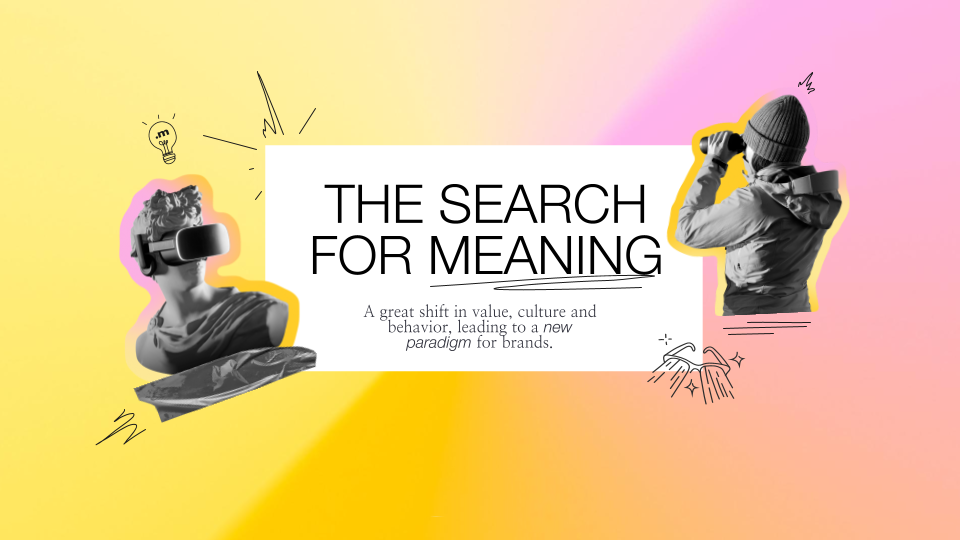
Greek statue with VR headset and women looking out with binoculars

A shift in meaning, driven by technology.

In the era of virtualization, people are using digital technology to refine their identities and enhance ways of connecting with those around them—physically, socially and mentally. And with virtualization’s ability to transcend constraints of time, space and physical limits, are we all cyborgs today? The Social Innovation Lab considers this question and more as the search for meaning redefines what it means to be human. When the social consciousness begins to appraise value, culture and behavior in new contexts, brands will have to fluidly adapt. In this report, readers will discover how they can leverage technologies such as Web3, the metaverse and today’s most popular social channels to provide impactful experiences for audiences in search of meaning.

Statue wearing VR goggles and women looking out with binoculars

You're one download away from:

  • Learning how technology shapes self-identity
  • Understanding how to build belonging across spaces both physical and virtual
  • Learning how value (personal and monetary) is built in a new digital era

This experience is best viewed on Desktop

Download Now
Monk Thoughts Considering the impact of this new era of virtualization on global societies, if humanity evolves by adopting these technologies at an accelerated pace, it also means that brands must embrace these changes, considering their relevance as critical shapers of culture and society.
Asahi headshot
Media.Monks explores how human needs are newly being met in the era of virtualization, and how brands can position themselves to provide meaningful experiences. virtualization metaverse social media marketing Social Social AOR Consulting Culture

Why Booking.com Sought a Social Partner of Record

Why Booking.com Sought a Social Partner of Record

Brand Identity & Systems Brand Identity & Systems, Culture, Social, Social AOR 4 min read
Profile picture for user mediamonks

Written by
Monks

Two people putting post-it notes all over a wall

Picture this: you’re the CMO of one of the biggest brands in the world, operating globally and connecting with consumers on multiple social media channels. Since joining the company a few months ago, you’ve been working hard on a unified strategy that covers every platform your target audience is spending time on: an integrated plan that drives the business forward. To have a real impact, however, you need to ensure your brand is driving culture, not merely following it. But how do you find the space for innovation when keeping up with our fast-changing culture is a challenge in itself?

For starters, it’s important to have a holistic view of the brand experience and how it manifests across the various touchpoints. In the wake of new behaviors, devices and channels, an end-to-end approach is needed to drive value across digital—the kind that includes branding, creative, social, go-to-market, UX and more. On top of that, consumers crave personalization, which adds data management to the equation. In the past, these needs could’ve been met by hiring different providers for each. Now, we know that the brand experience is more than the sum of its parts, meaning there can’t be disconnections between them.

For Booking.com, this realization came into sharper focus as its SVP and Chief Marketing Officer Arjan Dijk set out to leverage the accelerated shift in consumer behavior and the post-pandemic rise of travel intent. This prompted his search for an end-to-end partner that could bring all digital disciplines together. Fast forward to today, we’re proud to announce Media.Monks is Booking.com’s new social partner of record, and we’ll work together to deliver a future-proofed social strategy that covers everything from content creation to data management.

A person staring at film equipment on set

When every brand is a social brand, creative differentiation matters.

As previously hinted, the biggest brands today are the ones driving culture, which means they found success in leading the conversation—not chasing trends. In that, the role of social media can’t be overlooked. Social is the barometer of culture—a fundamental indicator of what people find exciting, the problems they face and the issues they care about. It’s also the entry point for any brand looking to make an impact.

Doing so, however, may be harder than it sounds. Creative competition is becoming fiercer, especially in the new era of virtualization. Consumers’ voices are stronger, expectations around personalization are higher, and audiences are well aware of the value of their data, money and attention—meaning they demand a clear value exchange. Meeting those needs is no easy feat, but here’s the good news: communities are hungry for opportunities to co-create alongside brands, and those who provide those opportunities for them will be greatly rewarded. 

In any case, this has prompted a new urgency for creative differentiation. To that end, having a partner of record can help. While consultancies spend more time consulting than creating, a partner of record is fully immersed in the day-to-day of working in data management, content creation, creative editorial, digital media and beyond. That constant exchange of insights and expertise is key to engaging with audiences on social media, where delivering relevant content can be challenging and coming across as authentic is table stakes. 

Creative innovation is a mindset, not a sum of capabilities.

To seize cultural opportunities as they arise, a brand and its partners need to be quick on the draw. That means not only delivering with speed-to-market, but also coming up with creative ideas in the first place. A social partner of record fosters that by having a constant exchange of knowledge and ideas with the brand. While the brand’s input is key to crafting a story that’s true to its identity, the social partner provides unique perspectives that come from years of working with thousands of clients in different industries. And because they work so closely together, they operate as one well-oiled machine.

With Booking.com, we’re building on a long-standing relationship with a history of driving value through culturally-relevant campaigns. Not long ago, we helped the brand show up across cultures during the world’s largest musical event, Eurovision. Through an integrated strategy that included everything from influencer partnerships to content creation, we inspired audiences to experience the music, language and cultures that Europe has to offer—fostering meaningful conversations between influencers from different countries. And on the day of the event, we enticed the audience with exclusive behind-the-scenes content from the venue.

A group of people around a desk on a film set

This, of course, is only the beginning. For Booking.com, the new, integrated social strategy includes managing PR campaigns, starting a global TikTok channel, doing a community management tune-up, adding paid social to the mix and aligning on how to communicate with the audience across platforms. “We will expand our partnership into end-to-end social that includes the launch of the first Booking.com TikTok channel, paid social, influencer marketing, community management and social strategy,” says Cedric Brunings, Head of Social Growth EMEA. “We will put together a team of social talent in Amsterdam and Madrid that will be fully dedicated to enhancing the brand’s social media presence.”

While mastering a variety of capabilities is key to seizing opportunities at the speed of social, it’s having the right mindset that sets you up for success. This means not only being adept at identifying the places, events or spaces where your brand should engage, but also knowing how you can show up authentically in every instance. That is why a social partner of record joins the conversations further upstream: because it helps marketing teams gain awareness on upcoming opportunities.

Monk Thoughts Our set-up with a single P&L allows us not just to collaborate on social capabilities, but also to provide Booking.com with data services, live stream capabilities, and more. This way, they can rely on a single partner for their entire social strategy.
Bruno Lambertini headshot

Working as Booking.com’s social partner of record, our job is to bridge innovative thinking with end-to-end creativity and speed-to-market to enable the brand to show up for consumers across platforms, regions and languages.

Media.Monks is Booking.com’s new social partner of record! Read more about our collaboration together and how we work to deliver a future-proofed social strategy. brand strategy social media marketing creative content influencer marketing Social Social AOR Brand Identity & Systems Culture

Social Bites: State of Play and the Augmentation of Self

Social Bites: State of Play and the Augmentation of Self

Culture Culture, Social, Social AOR 1 min read
Profile picture for user mediamonks

Written by
Monks

A person hitting a tennis ball and an augmented reality headset

Uncovering new tactics to win audiences over.

One of the best ways to learn is through play (consider the instructive and empathy-building power of role play as one example). When used to better oneself, it’s easy to see how aspects of play extend beyond games and frivolity: they’re embedded in many of the ways we interact with one another, from making negotiations to measuring how your work stacks up against KPIs.

Building on this realization, the Social Innovation Lab have dedicated the latest issue of Social Bites to examining “The State of Play” and its role in modern marketing. This means more than the gamification strategies of awarding badges or leveling up from one loyalty tier to the next; the function of play is quickly evolving, influenced by spaces like the metaverse that offer fresh opportunities to push oneself beyond traditional limitations. Whether to fuel competition or cooperation, “State of Play and the Augmentation of Self” illustrates how digital communities and the channels they call home are integrating playful design to augment the self.

Access the issue now and you’ll learn:

  • Game theory and its role in motivating choices and interaction
  • How to seamlessly integrate actions between physical and virtual spaces
  • How to build a sense of belonging in spaces like the metaverse by enabling a sense of play
Our Social Innovation Lab have dedicated the latest issue of Social Bites to examining “The State of Play” and its role in modern marketing. social media marketing brand strategy metaverse augmented reality Social Social AOR Culture

Choose your language

Choose your language

The website has been translated to English with the help of Humans and AI

Dismiss