Choose your language

Choose your language

The website has been translated to English with the help of Humans and AI

Dismiss

How Three Brands are Making Sustainability Second Nature

How Three Brands are Making Sustainability Second Nature

Sustainability Sustainability, Websites & Platforms 3 min read
Profile picture for user Regina Romeijn

Written by
Regina Romeijn
Global Head of ESG

A laptop on a wooden table surrounded by potted plants, with its screen displaying a digital illustration of a green plant with visible roots and leaves, overlaid with data and code graphics. The setting is lush and green, suggesting a connection between technology and nature. Sunlight filters through the foliage in the background.

This Earth Day, we’re shining a spotlight on some of the inspiring ways brands and organizations are stepping up to protect our planet. From bold sustainability commitments and innovative conservation efforts to the integration of eco-friendly practices into everyday business, their actions prove that environmental responsibility can take countless forms. 

Sustainability is a core value that shapes everything we do—represented in our commitment to reach net zero emissions by 2040 and achieve 100% renewable energy use by that same year. Beyond those ambitions, we’re embedding sustainability into every facet of our operations, from championing eco-friendly work practices and technological innovations to upholding transparent reporting.

As we celebrate Earth Day, we’re honored to partner with brands who share this vision and are making an impact in unique ways. In the stories that follow, I’ll highlight how some of our clients are leading by example—proving that environmental responsibility can be woven into business at every level, and that together, we can help build a healthier, more sustainable future for all.

Powerful experiences can spark collective action.

We’ve been longtime supporters of Amazon’s sustainability efforts, beginning with our involvement in the launch of The Climate Pledge—a commitment to reach net-zero carbon by 2040—which we also signed in 2021. Building on this foundation, we worked alongside Amazon to create a dedicated sustainability platform that would centralize their initiatives and progress, shaping its strategy, design and user experience to make complex information accessible.

As the partnership evolved, we developed comprehensive brand guidelines and led a full redesign of the Amazon Sustainability website. This work established a consistent visual and narrative identity for Amazon’s sustainability communications. Our collaboration continued as we brought Amazon’s Sustainability Report to life online, transforming dense data into dynamic, engaging digital storytelling year after year.

Most recently, we helped launch the Amazon Sustainability Exchange, an interactive website designed to educate and spark action. Each of these projects has allowed us to support Amazon’s sustainability communications across a broad range of digital experiences.

Helping kids connect with nature makes the need for conservation tangible.

Mandai Wildlife Reserve is on a mission to connect people with nature and ignite a lifelong passion for conservation—beginning with the youngest explorers. As the home to over 1,000 animal species, Mandai set out to transform the way children experience wildlife, inventing a first-of-its-kind pair of binoculars designed specifically for kids.

We partnered with Mandai to bring this vision to life, building innovative binoculars that turn a simple day at the park into a gamified adventure. By blending cutting-edge technology with scientifically accurate content, we created an experience that kids and parents can enjoy together—making learning about biodiversity both fun and meaningful.

This project was the culmination of over two years of research, design and development. The result? Learning that leaps beyond the classroom and into the heart of the wild. Thousands of children have already set off on personal journeys through Mandai’s parks, discovering the wonders of animals and nature through interactive, memorable adventures.

But Mandai’s mission goes far beyond the park gates. Their vision is to bring conservation education to classrooms everywhere, nurturing a new generation of nature lovers and wildlife guardians. By making conservation accessible, engaging and exciting, Mandai is paving the way for a brighter, greener future, one young explorer at a time.

Smarter business practices can make sustainability part of the routine.

Sustainability doesn’t always require sweeping changes—sometimes, it’s about making smarter choices in day-to-day business. In their quest for more engaging and efficient advertising, Evian adopted adaptive streaming technology for their creatives. By delivering instant-loading, high-quality ads that automatically adjust to each viewer’s connection speed, they improved the user experience and unlocked new levels of campaign effectiveness.

We helped Evian implement this forward-thinking approach, powered by SeenThis, ensuring that ads were only streamed while actually in view. This not only reduced unnecessary data transfers and improved performance but also lowered the carbon emissions associated with digital media delivery. While the primary goal was to connect with audiences more effectively, the campaign demonstrated how incremental operational changes—like rethinking how ads are served—can also contribute to a lighter digital footprint.

Evian’s experience is a reminder that making things better for people can also be better for the planet. Even small shifts in everyday practices can add up to a meaningful impact.

Leading by example inspires others to make sustainability the norm.

In reflecting upon these stories, it’s clear that there’s no single path to sustainability; every organization can make a difference in its own way. Whether it’s setting bold goals, reimagining education for the next generation, or making everyday operations a little bit greener, these efforts all contribute to a more hopeful future for our planet.

Earth Day reminds us that progress happens through collective action, creativity and a willingness to lead by example. We’re proud to work alongside brands that are not only raising the bar for themselves, but also inspiring others to rethink what’s possible. Together, we can keep moving forward—one initiative, one innovation and one small step at a time—toward a world where sustainability is second nature.
Discover how environmental responsibility can be woven into every level of business through bold commitments, innovation and smarter business practices. sustainability earth day environmental responsibility Websites & Platforms Sustainability

How Live Remote Production Keeps Sustainability Goals Grounded

How Live Remote Production Keeps Sustainability Goals Grounded

Emerging media Emerging media, Experience, Sustainability, VR & Live Video Production 4 min read
Profile picture for user mediamonks

Written by
Monks

A person on a laptop

As the effects of the climate crisis become more apparent and time is running out to act, sustainability has become a key focus for brands and consumers alike. Brands are setting up ambitious targets to turn the tide—and we’re no different, holding ourselves to UN Sustainable Development Goals and formalizing our commitment to become net-zero by signing the Climate Pledge in 2021.

Among our foundational environmental, social and governance goals, we aim to become a climate-neutral, environmentally conscious business—and a catalyst for change in our industry, leading by example and helping brands become more sustainable themselves. So while programs like carbon offsets are steps in the right direction, the key to meeting sustainable goals is to design operations that limit carbon emissions to begin with, and our live remote production workstream fits the bill.

Sustainable workstreams shouldn’t be a tradeoff.

Sometimes the road to being green can feel like making a series of concessions, but working sustainably often means working smarter. When reliance on digital grew throughout the Covid-19 pandemic, we adapted by designing a remote broadcasting workflow that limited the number of people needed on location. This production pipeline, with Amazon Web Services (AWS) as its backbone, did more than help us deliver incredible, live digital experiences to people everywhere—like immersing audiences in a VR Post Malone performance that transforms the experience of listening to an album. It also significantly reduced our carbon footprint.

Our live remote production connects teams to broadcasting software, eliminating the need for gas-guzzling broadcasting trucks on location. It also cuts out the need for specialized talent to travel to shoot an event: we’ve reduced our number of on-site broadcast talent by 83%. Adding to those benefits, our primary workload is based out of the AWS Northern Virginia region, which was powered by over 95% renewable in 2021.

Who wouldn’t want to trade lugging around energy-intensive equipment prone to breaking down—be careful not to trip on a wire and shut down the whole show!—for the cloud? This pipeline recently earned us the coveted Sustainability in Leadership award at NAB Show, the leading conference dedicated to the evolution of broadcast.

NAB awards ceremony with people on stage

Lewis Smithingham, far right, accepts the Sustainability in Leadership award at NAB Show.

Monk Thoughts We're incredibly honored and excited for this award because we believe sustainability can and should drive innovation and creativity throughout the production process.
Headshot of Lewis Smithingham

The benefits extend to talent as well. Gone are the long, grueling hours spent on set. The ability to collaborate remotely broadens our talent pool, ensuring the best person is cast for each job, even if they’re working across the country—or in a different one. Our experiential team has also developed a suite of tools like LiveXP that furthers the connection between audiences and the action beyond the screen.

One key benefit of live remote production is risk mitigation. First, the greatly diminished environmental impact reduces the social risk of a brand missing their pledged environmental, social and governance (ESG) commitments. Second, cloud-based tools are also more reliable. Traditional broadcast production teams have only a finite set of equipment that may break down. In the cloud, we can plan for redundancies and quickly spin up a new virtual machine should something happen to an existing one. You can learn more about what live remote production looks like on Amazon’s blog

Let sustainability be the byproduct of innovation.

Sustainability and innovation go hand in hand, and our low carbon, live remote production uniquely enables compelling virtual and hybrid experiences—filling a crucial whitespace in broadcasting as the culture shifts to more immersive and creator-led channels.

“Broadcasting is culture. It’s the vehicle by which culture spreads,” says Smithingham. Increasingly, culture is happening within immersive, interactive spaces like gaming, social feeds and metaverse worlds—behaviors that are challenging broadcasting to adapt. “A core undercurrent across all of this is if something is not interactive to younger generations, it feels broken and it feels disconnected.”

Look at award shows for example. Exclusive and invite-only, viewers must watch the fun from a mediated distance, chattering in backchannels like social media. We flipped the script by partnering with Logitech For Creators to host the first music award show in the metaverse—The Song Breaker Awards—which invited everyone to not only attend but actually become part of the show in Roblox.

What about hybrid experiences? When it comes to sharing an esports experience with audiences around the world, you’d be forgiven for using traditional sports broadcast as a blueprint. But with sports facing a decline in young viewership, it’s clear the formula is worth shaking up. In celebration of Valorant’s first anniversary, we translated the game’s rich lore into a recognizable IRL environment, then pit attendees against livestream viewers in a challenging bout. Viewers could frustrate on-site players by sharing hashtags in the chat that triggered traps—setting a new precedent for gamified broadcast experiences.

Both experiences were designed to connect with consumers in ways that weren’t possible before. If an experience calls for disruptive ways of working, why not use that as a forcing function to move a part of the operations to a low-carbon approach?

Live remote production balances efficiency and sustainability.

By leveraging live remote production, our experiential team can deliver interactive experiences that drive culture and ROI with incredible efficiency, reducing greenhouse gas emissions in the process. The best part? Those benefits contribute directly to brands’ ESG goals and industry mandates. This is a win-win as we connect with consumers in innovative ways, contribute to carbon reduction goals, and reduce risk along the way.

As consumers increasingly demand sustainability from the brands they engage with, offering environmentally friendly solutions becomes an urgent need. And because sustainability challenges us to accomplish our goals in new or different ways, it can unlock innovative ways of reaching audiences. So, whether it’s a matter of saving the planet or simply saving consumers from boredom in fresh ways, we’re down for the challenge.

Our live, remote production worksteam limits carbon emissions in a practical way—achieving sustainable goals and delighting audiences in the process. sustainability amazon livestream film production digital production virtual experiences hybrid events Experience VR & Live Video Production Emerging media Sustainability

Are Ad Partners Doing Right by Plant-Based Brands?

Are Ad Partners Doing Right by Plant-Based Brands?

Culture Culture, Original Content, Studio 4 min read
Profile picture for user film.monks

Written by
Film.Monks

A plant based burger sitting on a table with leafy greens and veggies

Letters from the fringe.

The world’s first official vegan was a British man named Donald Watson, who coined the term in 1944 and shared his Vegan Society newsletter with 25 subscribers. By the time he died 61 years later, the vegan community comprised more than 2 million vegans in the US alone.

A number of factors have fuelled an increase in plant-based foods, from dairy alternatives to meat substitutes. The branding of these products tends to be bold, punchy and irreverent, with an equal emphasis on health and personality. The days of vegans being largely viewed as fringe weirdos wearing hemp shirts are gone. Instead, veganism has become almost sexy. It’s no longer a single carton of soy milk hidden at the back of the store, but it’s young brands like Oatly that turn a yearly profit of hundreds of millions of dollars by producing over ten different types of oat drink, ice cream, and vegan yogurt called “oatgurt.” Rather than having Donald Watson explain how to pronounce “vegan” to a small group of subscribers, it’s Ariana Grande sharing #vegan recipes with her 289 million followers on Instagram. 

This leaves our Creative Director Films & Content Ben Phillips, Executive Creative Director Christy Srisanan, and Senior Copywriter Omnya Attaelmanan wondering: Is the advertising industry helping plant-based brands lean into veganism’s popularity and perceived edginess? Or are we relying too much on tried and true food marketing techniques, failing to support these brands in setting themselves apart from more traditional ones with fresher approaches to advertising? 

More consumers are going for clean greens.

Surprisingly, vegans aren’t necessarily the driving force behind the rising popularity of plant-based products, as one in four consumers identify as flexitarian. This means that the largest, most significant consumer group for plant-based products might not be vegans or vegetarians, but omnivores trying to fit a few non-meat days into their weekly menu. 

For many consumers, concern for the environment is a driving factor behind choice of diet. A study by the University of Oxford found that animal products are responsible for more than half of all food-related greenhouse gas emissions, and according to the Intergovernmental Panel on Climate Change (IPCC), adopting a plant-based diet can help fight climate change. Simply put, plant-based food and drinks can offer up a flavorful experience without the carbon footprint associated with animal products. 

Flexitarianism, vegetarianism and veganism represent steps towards more climate-friendly ways of consuming. This opens up great opportunities for marketing and advertising plant-based products in a way that emphasizes their minimal impact on our planet. Such environmental messaging is likely to resonate more strongly than ever, especially considering recent extreme weather events around the world—because selling plant-based food is all about the mission.

Thinking outside the animal-based box.

As opposed to animal products, plant-based food and drinks are rarely advertised with a focus on the sensory pleasure of consuming them. That’s the case for beef burgers, not plant-based patties. For the latter, advertising always needs to account for a consumer mindset that’s deliberate and thoughtful in its approach to food. Besides trying to compete with animal products in terms of taste and texture, vegan brands also aim to focus on their mission and bake it into their branding at every level. 

This typically translates into positioning themselves as being morally superior to “old school” animal products. The messaging of plant-based products often tends to call out non-vegan competitors, from Oatly’s “It’s like milk, but made for humans” to Beyond Meat’s “You’ve evolved. So should your snacks.” Sometimes, this can have dramatic results. Oatly, for instance, was sued by the Swedish dairy lobby over an ad that featured their slogan and the line “Wow, no cow.”

These brands are navigating multiple fine lines—between confrontational and adversarial, between punchy and preachy, and, perhaps most importantly, between cool and commercially viable. Too quirky, and you might lose consumers who would otherwise be interested. However, too bland, and you don’t stand a chance in a market full of edgier brands. Maintaining the right balance is a real challenge, which is an opportunity for advertising partners to step up their game. 

(Re)planting the seeds for plant-based brands’ success.  

When partnering with vegan brands, it’s crucial to bear their mission in mind. It isn’t just important—the mission is everything. Even the most profit-focused vegan brands will want to highlight their commitment to fostering sustainability, animal rights and healthy eating habits. So, it is our job to tap into that shared passion between plant-based food producers and consumers. 

However, there’s still plenty of room to explore the sexier side of veganism and promote both the mission and the taste, texture and satisfaction of the product. So, we believe that the next step for advertising partners is to think about how, when and where we can help vegan brands add some sizzle to all the substances. How do we make plant-based food and drinks not just appealing, but actively tempting? How do we elevate both the mission and the marketing? How do we do all of this without rehashing old, stale techniques to sell food that the industry has relied on for decades?

“There’s usually a strong directive from brands to ‘stay in category’ to meet consumer expectations, resulting in a lot of food-related ads using similar tropes,” says Catherine Millais, our Film Director and tabletop photography expert. “Think of dairy products being shot in morning light, the classic chocolatier stirring his melted chocolate, or ads highlighting a burger’s ingredients through slow-motion footage—usually with a male voice-over and masculine energy.”

In addition, Millais argues that there’s room for much more storytelling in the plant-based product space. “Older, more established brands rarely introduce themselves to consumers anymore,” she says. “Why should they? The legacy has already been established and the origin story has largely been told. We all know about Ray Kroc and McDonald’s. Newer brands, however, have a chance to introduce themselves and tell their brand story in engaging, inventive ways that weren’t available ten or more years ago.”

By adhering to traditional food advertising tropes, we’re missing important opportunities to market plant-based products as an entirely separate category. This is a chance to substitute standard practices for new, innovative ideas and swap masculine energy for gender-neutral joie de vivre—all to exceed and subvert consumer expectations.

Plant-based food brands represent a bold departure from a long-established norm. This is as true today as it was back when Donald Watson started his Vegan Society. In trying to appeal to a consumer base of both vegans and meat-eaters, we can’t afford to tread the same old paths and forget that boldness—this does a disservice to brands that strive to fulfill a mission, consumers that try to take a more conscious approach to food, and advertising partners that aim to connect them through meaningful marketing.

Is the advertising industry relying too much on tried and true food marketing techniques, failing to support plant-based brands in setting themselves apart? Our Film.Monks weigh in. film content sustainability brand strategy Studio Original Content Culture

Net Zero Marketing: A Guideline to Making the Marketing Value Chain Sustainable

Net Zero Marketing: A Guideline to Making the Marketing Value Chain Sustainable

1 min read
Profile picture for user mediamonks

Written by
Monks

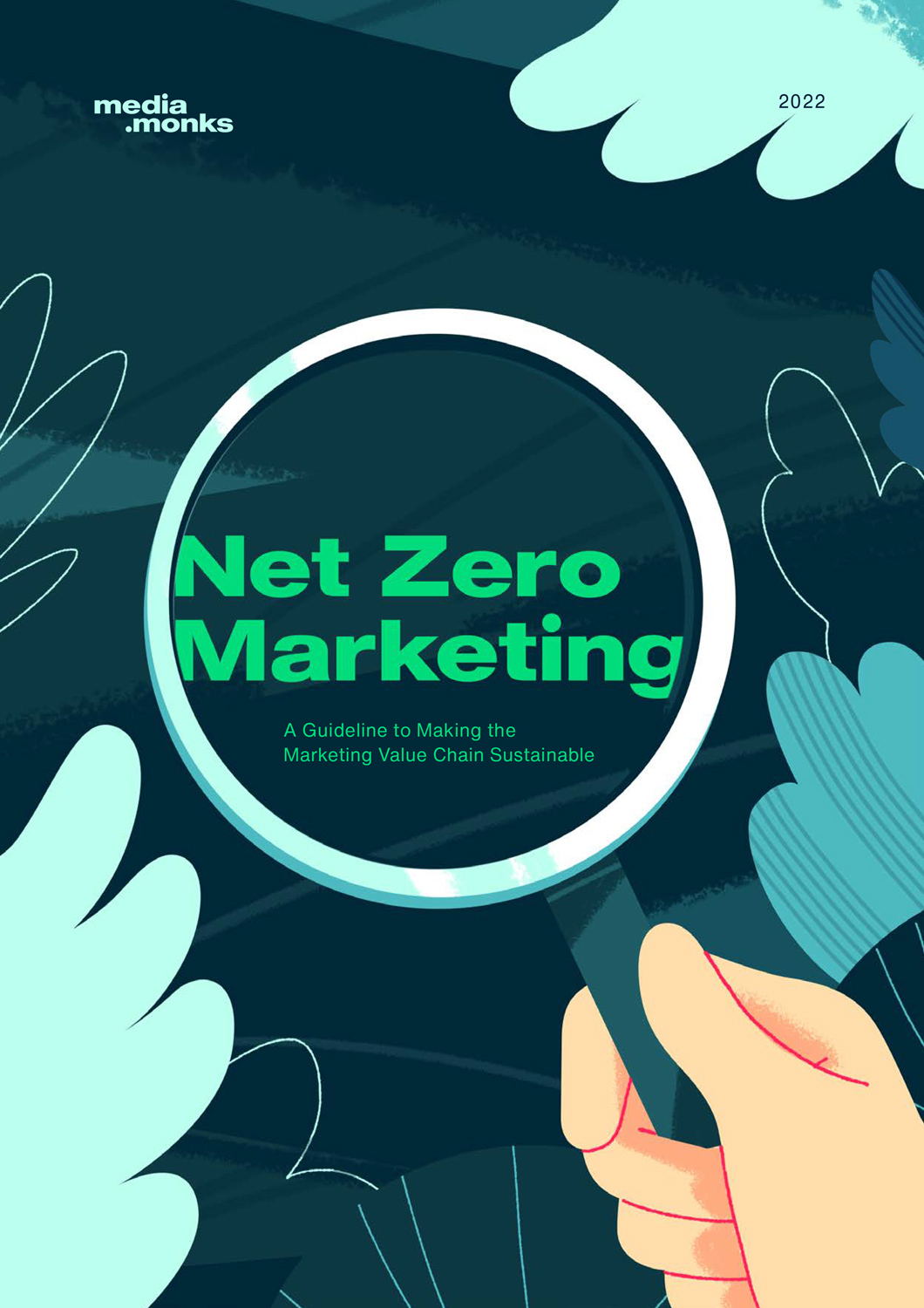
illustration of a hand holding a magnifying glass, encircling the words "Net Zero Marketing"

While sustainability used to be a matter of concern for the marketing department, it is now a boardroom topic that bleeds into a company’s targets and reporting. We’re on a journey of shared responsibility to cut emissions—this also goes for the marketing and advertising industry, which has a relatively large carbon footprint. Building the net-zero future requires a deep and thorough transformation of the marketing value chain, and many of the foundational blocks are already there. In this report preview, we will discuss the environmental impact of advertising and marketing and why, as such, acting on sustainability goals within our industry is absolutely necessary.

Rather than seeing this as a call for less advertising, brands should understand this as a push to do better: streamline ESG targets, optimize assets and tighten auditing and reporting processes. We have the opportunity to achieve more with less—benefitting clients, customers and our climate along the way.

Get access to a preview of our report, Net Zero Marketing: A Guideline to Making the Marketing Value Chain Sustainable, below. By submitting the form, you agree to receive the final report from us by email in just a few weeks.

illustration of a hand holding a magnifying glass, encircling the words "Net Zero Marketing", with leaves framing the illustration

You’re one download away from…

  • Reading a preview of the report.
  • Learning about the environmental impact of advertising and marketing.
  • Discovering why we need to take climate action specifically within our industry.

This experience is best viewed on Desktop.

Download Now
This report explores how brands can limit indirect emissions specifically in the marketing value chain. sustainability

Transparency: The First Step Towards Sustainability

Transparency: The First Step Towards Sustainability

4 min read
Profile picture for user mediamonks

Written by
Monks

An illustrative forest with different colored plants and trees surrounding it

“From the start, our focus has been, and will continue to be, on the well-being of our planet and its people,” says Victor Knaap, Co-Founder of Media.Monks and Executive Director of S4Capital. As we continue to grow in terms of employees and output, this becomes more and more important. This responsibility is cemented in our Environmental, Social and Governance (ESG) vision, which is founded in the firm belief that technology and creativity are powerful tools in transitioning towards a more sustainable society. Our latest ESG report highlights our focus on using these forces for good in giving back to the Earth. In order to meet our sustainability and diversity objectives, the past year has revolved around acceleration and taking action.

“2021 has been about getting up to speed, as an organization and an industry. Unified with our clients by a shared goal to reduce climate change, it has been a fertile soil for more transparency, collaboration and innovation. We’re not nearly there, but we are all on the same journey to get there and become climate negative,” says Regina Romeijn, EVP Business Strategy & ESG. 

The sustainability journey doesn’t end here. We strive to be industry leaders, both producing the best in class experiences and delivering them in the most environmentally and socially responsible way we can. Every day is a new day to be the catalyst for change and inspire others within our industry and beyond to be and do good, keeping in mind our overarching goal to build a sustainable and inclusive company. At both the heart and start of this mission is our commitment to transparency—it’s key to good governance, and good governance in turn is key to becoming a successful industry leader. 

Getting on with Good Governance 

Governance matters, it’s as simple as that. Corporate governance not only relates to how companies are managed, but also to how management is supervised. At Media.Monks, we hold proper corporate governance in very high regard as we consider it to be a leading factor in the successful execution of our business strategy. For this reason, we have moved from conducting Corporate Social Responsibility reporting last year to Environmental, Social and Governance reporting this year. This “governance” piece is crucial, because it means that we go beyond recognizing our social and environmental responsibilities as a global company, and focus on our duty to hold ourselves accountable and be completely transparent—about our wins as well as our losses. 

The Green Future, a Joint Effort 

Next to good governance, we need good guidance in realizing our goal to build a sustainable and inclusive company. So, we have established three pillars to boost our sustainability efforts, which make up the foundation of our ESG strategy. First, “Zero Impact Workspaces” concentrates on creating a climate-neutral and environmentally-conscious household, while making tangible efforts in our daily operations. Second, “Sustainable Work” serves as a catalyst for change, leveraging our expertise to innovate with technology and creativity for good, thereby impacting our supply chain. Third, “Diversity, Equity and Inclusion” highlights our goal to establish a workplace that fosters an inclusive culture that values people with different backgrounds, genders, sexual preferences, caregiving status and health. All in all, we focus on taking care of ourselves and each other, with a growing emphasis on the support that we offer to clients—because positive impact doesn’t have to stay within the confines of our company.  

Moreover, we strive to support the UN’s Sustainable Development agenda with our sustainability strategy and efforts. In the report, we elaborate on the SDG targets for each pillar and explain how we plan to contribute to those targets. To give you a sneak peek, in response to the World Economic Forum 2020 Davos Manifesto, S4Capital Executive Chairman Sir Martin Sorrell announced our commitment to achieve carbon neutrality by 2024. In 2021, we took the next step and became the first company in our industry to sign the Climate Pledge, a cross-sector community of companies and organizations working together to crack the climate crisis with a mission of reaching net zero carbon emissions by 2040. 

Three years ahead of schedule, we reached carbon neutrality through the growth of our S4 Forest, where more than 265,000 trees have been planted (and counting), capturing 10,617.95 tonnes of CO2 emissions. While we achieved this status by offsetting our emissions, we still need to reduce our emissions to the maximum to reach Net Zero. As digital companies are big consumers of energy, especially electricity, we are highly aware of this challenge. The biggest obstacle that we will need to overcome is business travel. We aim to keep our digital presence where we can instead of flying in, but realistically we expect the number of business flights to increase again as the world reopens post-COVID. Nevertheless, ain’t no mountain high enough to keep us from getting to that goal.  

The Only Way Is Making Headway 

“Looking ahead to our ambitions for the coming years, it’s essential to the health of our company and our aim of being the best place to work, that we stay focused on our priorities—the well-being of the planet and people. Our commitment to care is not something only captured in process documents and playbooks. We will continue to deliver on the ESG initiatives we launched in 2021, deepening our relationships with the charities that we support and acting on our vision to use creativity and storytelling as a force for good,” says Knaap. 

On top of that, the coming years will revolve around leveraging our capabilities and experiences to help our clients with their sustainability efforts, making good on the promise to maximize our impact on not only the world, but also our sector. In the meantime, we’ll keep reporting on our ESG accomplishments and challenges—because transparency is the first and foremost step in becoming an industry leader. 

For more detailed information and insights, read the full report.

To realize our main ESG goal to take care of the planet and its people, we focus on acceleration and taking action. Transparency is central to this mission. sustainability diversity and inclusion equity

Amplifying Sustainability: A Pledge For The Planet

Amplifying Sustainability: A Pledge For The Planet

4 min read
Profile picture for user mediamonks

Written by
Monks

two hands reaching out to each other, one made of metal and one made of leaves

Earth Day is the necessary reminder that we have to make good on our promises to never stop investing in our planet. A prosperous future doesn’t just happen overnight; it takes commitment and collaboration to get there. We began our own sustainability journey by assembling a passionate team of Sustainability.Monks, who pour their heart and soul into making our organization and work greener every day. Aligning our company values, three pillars form the foundation of our sustainability strategy: Zero Impact Workspaces; Sustainable Work; and Diversity, Equity and Inclusion. In other words, we take care of our home and household, our work and clients, and ourselves and each other. This holistic approach answers both the needs of our clients, who are on a similar mission to tackle climate change and reduce emissions, and those of consumers, 91% of whom want brands to demonstrate how they are taking environmental action. Moreover, this approach feeds back into our goal to win the decade.

What does this mission mean to us? It’s not just about being a Digital Partner of Record and delivering top-notch productions and services, but also prioritizing our responsibility to take care of our people and the planet. In light of this, our Labs.Monks have spent weeks creating a comprehensive report on sustainable production. With its results-oriented mindset, this R&D team plugs into categories across the business to help them understand and tap into emerging technology. Next to tackling and testing new innovations, the Labs.Monks consistently deliver fresh, exciting and delightful experiences that push the boundaries of what is possible—including sustainability goals. 

So, the team poses a pivotal question: how can we reduce our digital carbon footprint? The Labs.Monks share their ideas, processes and guidelines with one main goal in mind: inspiring others to help make digital greener. If you haven’t read the Sustainable Production Report yet, here are some insights into key challenges and chances to get you started. 

To Make Great Strides, Measure Environmental Impact 

On the road to achieving sustainability goals, what’s currently blocking our way? While raised awareness around digital carbon footprints is a step in the right direction, companies need to become more transparent. This ties into a fundamental challenge that the industry, Media.Monks included, is facing: the current lack of reliably accurate, coordinated carbon calculators is clouding our understanding of progress. We know that digital developments around the world are increasingly power-hungry, but how much more energy do they require? Though there are various carbon calculators out there—such as Audits.Digital, GreenFrame, Carbon Trust—these are all based upon different criteria and thus often produce completely different results, making it difficult for businesses to calculate their carbon footprint and determine if they are meeting sustainability guidelines.

So, we need to develop a coherent and coordinated carbon calculator that is endorsed and used by every company in the industry in order to create standardized outcomes in measuring and comparing environmental impact. Much like all marketing and business efforts, it’s basically impossible to gauge whether your business is on track to reach its targets or not without reliable data measurement instruments—and this is no different when it comes to sustainability efforts. In turn, implementing such tools and practices helps increase transparency around the digital industry’s environmental impact and lead the way towards a more sustainable future, because progress starts with tracking where you are now. 

Designing The Sustainable Future 

While establishing benchmarks for measuring the environmental impact of the digital industry is still a work in progress, we already know certain practices that will help reduce your company’s digital carbon footprint. Sharing success stories, best practices and lessons learned with other players in the industry is the key to effective collaboration—and let’s face it, you can’t save the planet by yourself. So, in the spirit of spreading the word, let’s shine a spotlight on one important opportunity that the digital industry should collectively seize: we are in the unique position to design and develop products and platforms with sustainability at their heart. 

The decisions that companies make during the production process ultimately influence consumer behavior. As such, these decisions do not only impact their own digital carbon footprint, but people’s global carbon footprint in general. As such, we should always be on the lookout for changes in the production process that are more sustainable to provide environmentally friendly options that people had otherwise not thought of choosing.

Monk Thoughts Whether it’s through converting in-person meetings into digital events to reduce the need for gas-guzzling business travel or incorporating QR codes on products to direct customers to digital user guides instead of printed materials, the digital industry has the power to inspire people to make more sustainable choices.
Portrait of Geert Eichhorn

For example, our Film.Monks now focus on green filmmaking, actively tackling the issue that film production uses a lot of energy and generates tonnes of waste. Besides switching to renewables to power the studio grid and replacing diesel generators with hybrid and solar solutions, they are working on providing clients with additional ‘greener’ services, think of impact reporting, strategies to determine mutual sustainability KPIs, and storytelling around a client’s sustainability efforts. Such initiatives not only inspire people to go for a greener alternative, but also increase awareness around the importance of meeting sustainability goals. 

In short, there are multiple roads to becoming a more sustainable business. When you follow the right directions—raising awareness, being transparent about carbon footprint, making ethical decisions—it stimulates other companies across the value chain to speed up their own sustainability journey.  

Caring For The Planet, A True Collective Effort 

The digital revolution has left major positive imprints on our planet—and it continues to give rise to new ideas, innovations and opportunities every day. While there are very real concerns about the carbon footprint of our industry, we believe that sustainability goals shouldn’t have to slow down the digital revolution, but can instead become part of it. Teams across the board are not only working hard on developing and adopting more sustainable technologies, but also on translating these into useful guidelines for the digital industry. While we’re still figuring out how to best measure our progress, the Sustainable Production Report is an important step in the right direction, as it echoes our commitment to being transparent, sharing knowledge and fostering effective collaboration. Above all, it emphasizes our belief that altogether we can take care of our planet.

Interested in learning more about sustainable production? Read the 30th report by our Labs.Monks to gain a more in-depth understanding of the challenges and considerations.

How can we reduce our digital carbon footprint? The Labs.Monks share their ideas with one main goal in mind: inspiring others to help make digital greener. sustainability film production digital content production
`

ESG

Navigating the New Now

Environmental, Social & Governance at Monks

a colorful globe showing both a Monks and S4 Capital logo
An animated butterfly flying around a colorful globe

At Monks, we are committed to driving industry progress and creating a sustainable, impactful future—where our clients and our people can thrive and lead with purpose.

2024 has been a landmark year in our ESG journey. In line with our commitment to The Climate Pledge, we received SBTi approval of our science-based emissions targets for reaching net zero by 2040. We also achieved global B Corp Certification, underscoring our focus on balancing profit with purpose.

As the global landscape becomes more complex—with new legislation, geopolitical shifts and economic challenges—we remain focused on responsible action and transparency. We’re leveraging innovative solutions, including AI, to support sustainable development and uphold ethical governance.

Our ESG strategy is built on three core pillars:

People walking down a colorful road towards a mountain and colorful sunset

People Fulfilment

Women made up 48.6% of our team this year, our highest representation to date.

We are committed to building a diverse, inclusive workforce and empowering leadership. Over 800 Monks applied for our Accelerate Monks management program, while the S4 Fellowship saw a 145% increase in applications, underscoring the appeal of programs rooted in both diversity and career development.

Hands holding a colorful globe

Our Responsibility to the World

We achieved a 21.2% reduction in our absolute total GHG emissions, exceeding our annual target of 5% across all three scopes.

Making measurable progress on environmental goals, sustainability initiatives and work for good is a priority. Our Purpose-driven client base grew by 11.9%, and For Good projects increased by 8.4% year over year. We are also on track to meet our long-term goal of reducing emissions by 90% by 2040.

A hand holding a colorful globe with a butterfly and mountain in the background

One Brand

We’ve implemented a range of internal policies to strengthen ethical conduct, enhance information security and improve overall governance standards across our operations.

In line with our competitor sets and client needs over the past several years, we’ve structured ourselves for now and the future, ultimately consolidating 34 companies into one operating brand and embedding ESG principles into all aspects of our business.

  1. ‘For Good’ work combines creativity and technology as a force for positive impact • This year, we continued to scale our efforts with Purpose-driven organizations and clients.

  2. A woman holding a child in an embrace

    Launched during Breast Cancer Awareness Month, this campaign features a moving video showcasing patients, survivors and their loved ones to promote the sale of Pink Ribbon Bracelets. All proceeds benefit breast cancer research.

  3. The image depicts an underground passage lined with posters promoting safe driving, using the slogan "CONDUISEZ COMME UNE FEMME," while statistics indicate that 84% of road fatalities involve men.

    Statistics tell the story: To stay alive, and to save lives, men need to drive like a woman. An OOH and social media campaign conveyed this simple yet powerful message, sparking a societal discussion that reached five continents.

  4. A pencil with a tech device on it called the literacy pen

    The Literacy Pen is a groundbreaking educational device designed to enable illiterate individuals to write and learn to read instantly, combining powerful AI with essential elements of traditional literacy-building methods.

  5. Pride 2024 campaign includes a video featuring rapper Big Mama leading a parade through a school to encourage inclusivity.

    Promoted by Sephora and nonprofit Arcigay to create safe places for the LGBTQIA+ community, this Pride 2024 campaign includes a video featuring rapper Big Mama leading a parade through a school to encourage inclusivity.

  6. A group of Indian women laughing with each other.

    We partnered with The Living Tongues Institute to save the endangered Santhali and Munda languages from being forgotten forever. A purposeful product demonstration shows how the Shure MoveMic enables this vital work being done.

  7. A group of people holding signs fostering unity and hope during the divisive US elections.

    Together with our partner One Million Truths, we collaborated with Common Ground USA on the #AllWeShare campaign, a powerful initiative intent on fostering unity and hope during the divisive US elections.

  8. Painted backdrops from art therapy workshops

    The unique brand expression that we co-created features painted backdrops from art therapy workshops and a dynamic animated logo that embodies community connection, visually representing the journey of grief and self-discovery.

  9. Want to learn more? Let's connect.

Swipe
For More!

Drag
For More!

The world is changing—climate, culture and business are happening now. We believe that action today defines the future of tomorrow. And we are committed to taking that action—now. Read our full 2024 ESG report.

Monk Thoughts We believe that technology and creativity can be used as forces for good. In our industry clearly, we primarily serve the needs of our clients, but it should also be a consideration whether the technology and creativity we develop can be used in a different environment where the outcome is beneficial for the planet or for people.
portrait of a woman

Want to learn more about our sustainable solutions? Get in touch.

Hey👋

Please fill out the following quick questions so our team can get in touch with you.

Dive Deeper

Sowing the Seeds of Office Innovation at the Monks Farm

Sowing the Seeds of Office Innovation at the Monks Farm

4 min read
Profile picture for user mediamonks

Written by
Monks

A collage of the media.monks garden on an office terrace in Brazil

Whether you’re reading this from your office downtown or haven’t set foot on your company’s grounds since the start of the pandemic, there’s a strong likelihood that your workspace looks a lot different than it used to a few months ago. For decades, the concept of the office had been almost stagnant, presenting little to no innovation beyond tearing down a few walls to fuel collaboration. But now with hybrid working models becoming the norm, the rules have changed—and there seems to be a perfect opportunity to use the workspace in smarter ways.

A lot is being said about what offices may look like in the near future, and the role they’ll play in the lives of employees. All over the world, companies from different industries are starting to rethink how they use their office space, and breathing new life into it with new purposes. Such is the case with the BR.Monks, who turned our terrace in São Paulo into a fully-automated vegetable garden. 

Powered by solar panels and an innovative system that automates the harvest of various produce, this initiative emanated from two fundamental needs from the Brazilian team, whose primary expertise lies in experiential and fabrication: leveraging empty space and putting their dormant passion for building installations to good use. While only a small team who’s working from the office has had the opportunity to enjoy the first harvests, they look forward to the day when everyone can eat from their vegetable garden.

00:00

00:00

00:00

The Office of the Future Comes Into Full Bloom

Step into our São Paulo office, and you’ll be dazzled by the myriad of objects straight out of a sci-fi film. Toys with pop-culture references, mementos of past projects and leading-edge robotics tell a story of unparalleled innovations that lurk behind the mysterious graffiti wall surrounding the office in Pinheiros, one of the city’s most vibrant neighborhoods.

At first glance, the vegetable garden stands in stark contrast to the mechanical nature of the office’s high-tech devices. But it’s just as much an innovation as anything else created by the team. About its origin, Executive Creative Director Rafael Fittipaldi explains, “The few of us in the experiential team who were working from the office realized that it was pretty much empty—and that it would continue to be until the end of this year, at least. We wanted to leverage all that space with something that was good for both the environment and our people.”

Fittipaldi and his team—which is led by Partner and Lab Director Andre Tatiyama—soon found that a vegetable garden ticked all those boxes. Together with a group of colleagues that specialize in engineering and the development of OOH installations, they poured all their energy into a passion project that was later called “Monks Farm,” which condensed all of their technical knowledge into a force for good. 

But just like with everything they put their hands on, it was imperative to take the project to the next level. “We are innovators, so as we started to conceive this idea, we asked ourselves, ‘What if the farm could take care of itself?’” says Fittipaldi. Fast forward to today, and you’ll find a fully automated program that tracks humidity, temperature, and sunlight, then feeds that information into a built-in system that evaluates when it’s time to irrigate or harvest. The cherry on top is that to communicate the information back to the team, the system uses Amazon Alexa’s virtual assistant technology—a great example of how to build on the existing resources to create something entirely new. 

Nurturing Employee Engagement With a Sustainable Initiative

Even though the innovative aspect of the garden has reached unexpected heights, Fittipaldi explains it’s not just the technology that makes the project a cause for celebration; rather, it’s about the feelings of joy and unity that the initiative awakens. “People are using their time and energy to work on the garden, which in return provides fresh vegetables they can eat,” he says. “Working on it, watching the plants grow, or even standing close to the garden during our breaks brings us a lot of joy.”

It’s no secret that the opportunity to get your hands dirty and breathe fresh air can definitely put you in a better frame of mind. The rise of biophilic design—a strategy that incorporates natural elements to the office to help with stress reduction—proves that affiliating with nature can bring countless benefits in the modern world; and yet, we rarely see organizations pushing for more time spent outdoors. To that end, tending to a vegetable garden is the perfect excuse to take a break, connect with nature and refuel the creative well.

A garden growing vegetables

Moreover, building a system that’s powered almost entirely by solar panels serves as an experiment on sustainable practices. Earlier this year, we sealed our commitment to achieving more efficient and sustainable workstreams by signing The Climate Pledge, Amazon’s initiative to meet the goals of The Paris Agreement 10 years early. Global commitments like this are what push the industry forward—but it’s also important to start by building a better environment with smaller projects that make a tangible impact people can see. 

Reaping the Rewards of Cross-Department Collaboration

Team-building work like looking after a vegetable garden can help people mix with colleagues from different departments and connect with others. While the doors of our São Paulo office are not yet open to all employees at once, the team is looking forward to the day everyone can work together on the garden, or cart home the harvest.

At the same time, the Monks Farm project will add value to the team’s greatly missed tradition of hosting barbecues with home-grown vegetables. “Before the pandemic, our office was known for its weekly get-togethers and big celebrations,” says Fittipaldi. “The next time we have one, people will help themselves to fresh products from our very own garden.” In more ways than one, the initiative has proven to be a driving force of good—so much so, our international offices are now looking to replicate it in their respective spaces.

All over the world, the universal experiment in working from home was more successful than anyone would’ve anticipated. This means that now, companies will have to compete against the comfort of working from home and lure people back to the office with tangible benefits that make it worth the effort. Although an office garden may not be the first thing that springs to mind when thinking about the corporate workplace, it’s a great example of how we can build spaces that raise spirits and make being at work more enjoyable.

The BR.Monks build the office of the future by turning our terrace in São Paulo into a fully-automated vegetable garden. The BR.Monks build the office of the future by turning our terrace in São Paulo into a fully-automated vegetable garden. sustainability culture OOH
A white windmill in front of a cloudscape
Flying birds
A winding river with lush green shrubbery

The Climate Pledge • Accelerating Climate Action With a New Digital Presence

  • Client

    Amazon, Global Optimism

  • Solutions

    PlatformWebsites & PlatformsBrand

Leading a net-zero carbon commitment.

How can urgent climate action become every company’s business? This was the question that inspired the launch of a reimagined platform for The Climate Pledge—a commitment to reach net-zero carbon emissions by 2040. 

Powered by Amazon and Global Optimism, the initiative wanted to attract big-name signatories, grow quickly, and promote its newly articulated mission to “accelerate responsible climate action in every industry so our planet’s diverse communities, natural resources, and shared environments can thrive indefinitely.”

Owning responsibility to power possibility.

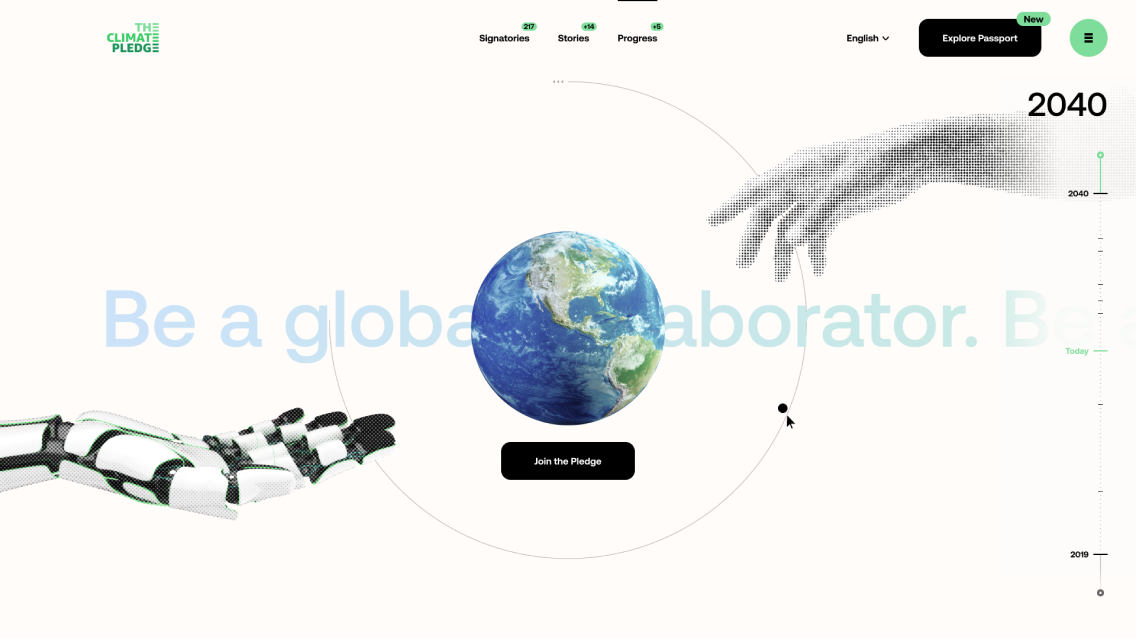
The platform plays up the need for action at the enterprise level while reinforcing that together is the only way forward. A modern identity system and comprehensive asset library was created to scale quickly and maximize flexibility. Interactive components, user interface animations, diverse compositions, and curated photography prompt contemplation and participation—and embed a sense of curiosity and suspense.

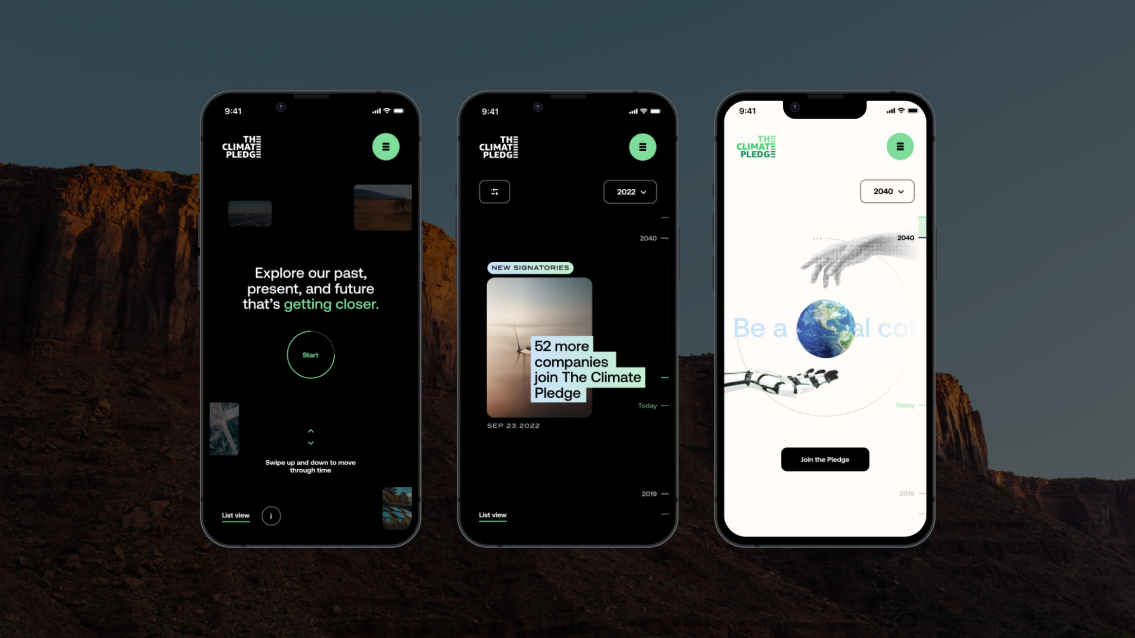
A fresh verbal identity builds on the initiative’s optimistic outlook and makes sustainable transformation feel personal, tangible, and accessible. Rotating narrative elements allow for dynamic storytelling and reveal how companies have the ability to change Earth’s trajectory. Localization was an important consideration, and the platform translates into multiple languages.

Traveling through time.

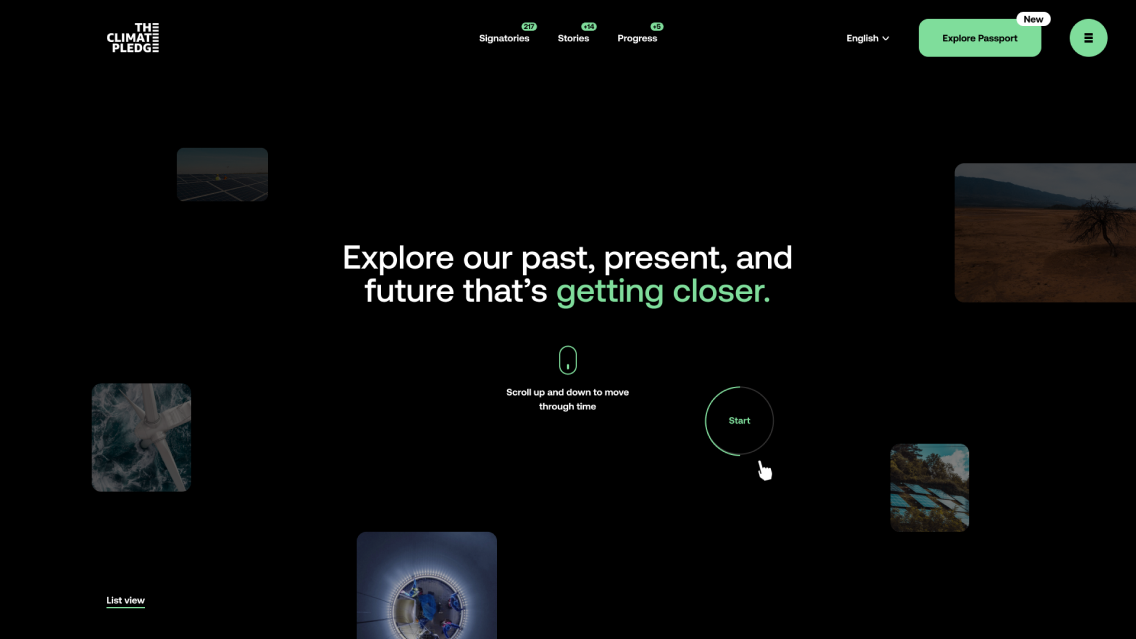
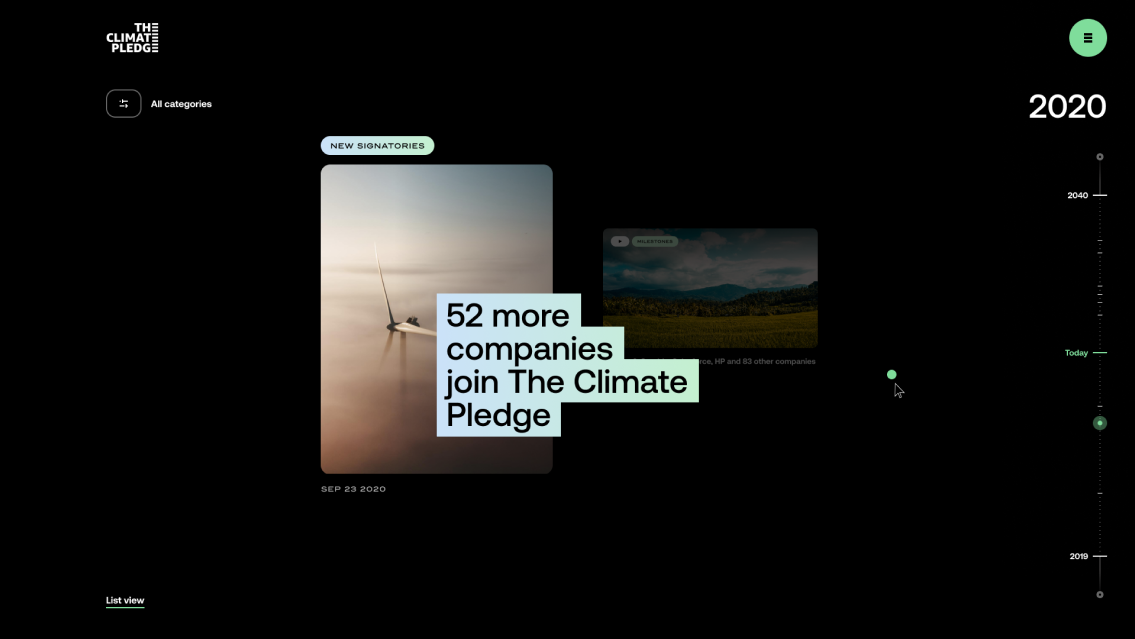
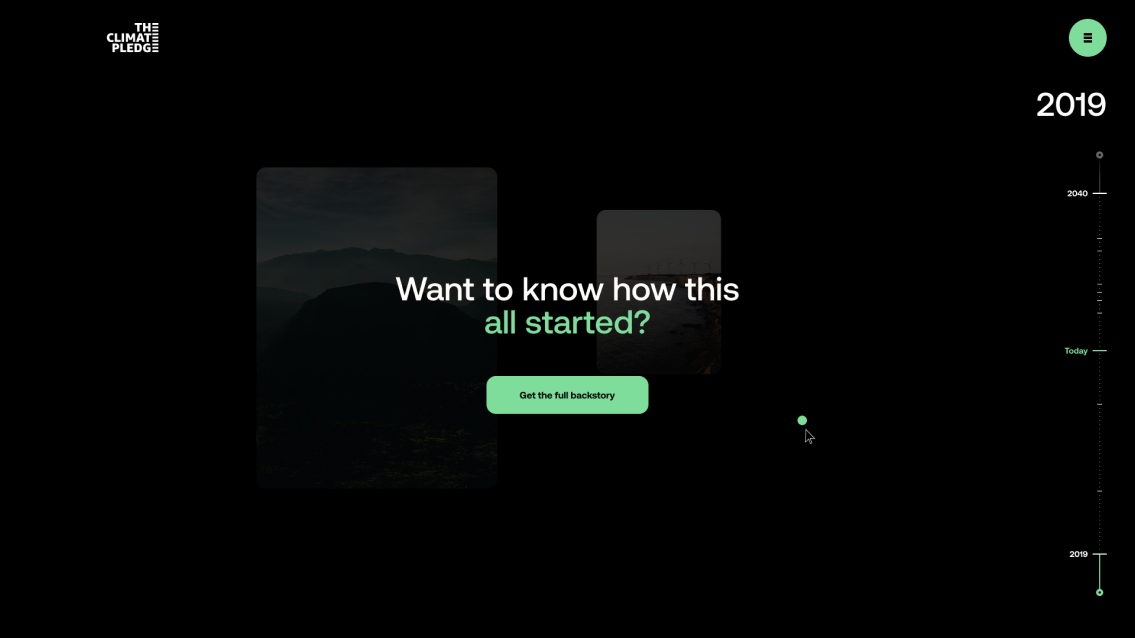
An immersive time tunnel lets visitors travel through the Pledge’s backstory, the collective progress being made by signatories, and the decades ahead. Two viewing modes accommodate different user needs. Filters enable sorting by milestones, new signatories, news, events, and more.

Seizing the moment

Fast-tracking a better forever

  • Climate Pledge website homepage
  • Climate Pledge website homepage
  • Climate Pledge website homepage on mobile screens
  • Climate Pledge website homepage
  • Climate Pledge website homepage

Automating signatory onboarding.

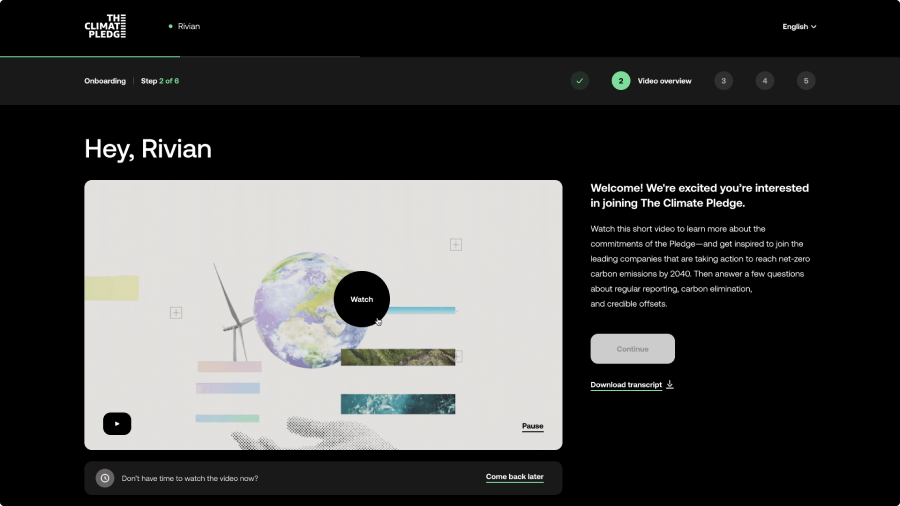
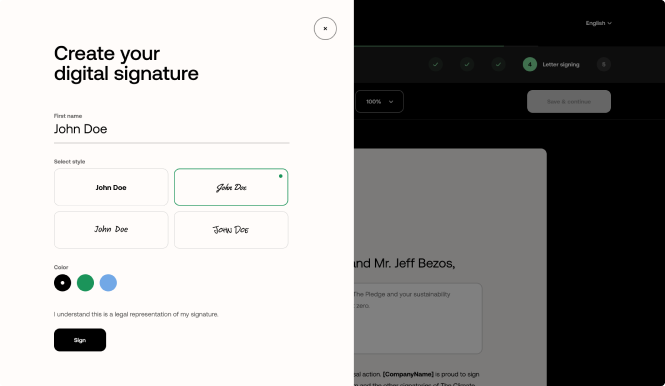
Behind the scenes, we developed a fully automated system for onboarding new signatories and publicizing their commitment to net-zero carbon. A multi-step process contains helpful tool tips and makes it easy for leading companies to submit their information and review required qualifications. Signatories draft and sign their own commitment letter, eliminating the need for manual moderation.

Climate pledge website interface
Windmills on a green rugged landscape

In partnership with

  • Amazon, Global Optimism
Client Words When it comes to the climate crisis, the stakes couldn’t be higher. Monks understood the urgency and weight behind our ask. They pushed our vision and delivered a solution that’s helping inspire companies around the world to take on this bold commitment.
Sally Fouts headshot

Sally Fouts

Global Leader, The Climate Pledge, Amazon

Launching an online community.

We designed Passport: an online destination where signatories of the Pledge can connect, find resources, share ideas, and take joint action. This virtual community is the newest addition to the Pledge’s platform—and is set to officially premiere in 2023.

00:00

00:00

00:00

Case Study

0:00

Want to talk platforms? 
Get in touch.

Hey 👋

Please fill out the following quick questions so our team can get in touch with you.

Can’t get enough? Here is some related work for you!

Choose your language

Choose your language

The website has been translated to English with the help of Humans and AI

Dismiss