Choose your language

Choose your language

The website has been translated to English with the help of Humans and AI

Dismiss

Find Value, Belonging and Experience in the The Search for Meaning

Find Value, Belonging and Experience in the The Search for Meaning

Consulting Consulting, Culture, Social, Social AOR 1 min read
Profile picture for user mediamonks

Written by
Monks

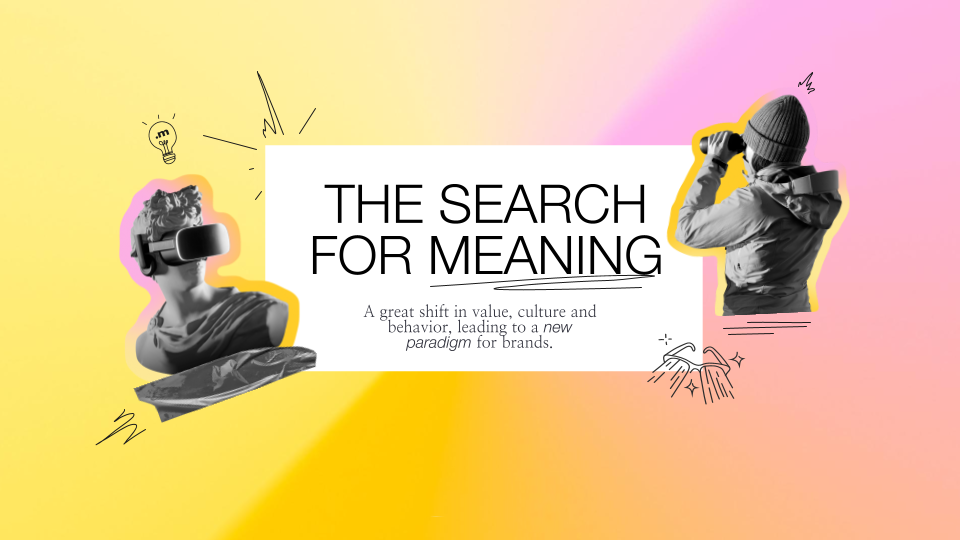
Greek statue with VR headset and women looking out with binoculars

A shift in meaning, driven by technology.

In the era of virtualization, people are using digital technology to refine their identities and enhance ways of connecting with those around them—physically, socially and mentally. And with virtualization’s ability to transcend constraints of time, space and physical limits, are we all cyborgs today? The Social Innovation Lab considers this question and more as the search for meaning redefines what it means to be human. When the social consciousness begins to appraise value, culture and behavior in new contexts, brands will have to fluidly adapt. In this report, readers will discover how they can leverage technologies such as Web3, the metaverse and today’s most popular social channels to provide impactful experiences for audiences in search of meaning.

Statue wearing VR goggles and women looking out with binoculars

You're one download away from:

  • Learning how technology shapes self-identity
  • Understanding how to build belonging across spaces both physical and virtual
  • Learning how value (personal and monetary) is built in a new digital era

This experience is best viewed on Desktop

Download Now
Monk Thoughts Considering the impact of this new era of virtualization on global societies, if humanity evolves by adopting these technologies at an accelerated pace, it also means that brands must embrace these changes, considering their relevance as critical shapers of culture and society.
Asahi headshot
Media.Monks explores how human needs are newly being met in the era of virtualization, and how brands can position themselves to provide meaningful experiences. virtualization metaverse social media marketing Social Social AOR Consulting Culture

Everything to Know About NFTs, in a Monk’s Opinion

Everything to Know About NFTs, in a Monk’s Opinion

5 min read
Profile picture for user mediamonks

Written by
Monks

Famous NFTs on a blue background

Technology moves fast, and often the most cutting-edge developments can feel challenging to wrap one’s head around. That’s why we’ve launched a new live webinar series, IMO (short for “In a Monk’s Opinion”) where subject matter experts and client partners explore the hottest trends in digital marketing through an accessible discussion. In addition to covering the latest trends in virtualization, panelists also explore the tactics you can use today to make the most of them.

Hosted by Director of Content Marketing Adam Remson, the first episode of the monthly series is a special “Ask Me Anything” edition focused on NFTs featuring Jam3 Strategy Director Rachel Noonan, Lead Creative Strategist Michael Litman and Strategy Director, FLUX Dan Lewis.

As one of the biggest trends in marketing last year, NFTs have gotten a lot of attention from marketing teams and have become an accessible entry into the metaverse. But the tech behind them can add a bit of an esoteric mystique. An NFT is a token showing ownership of a digital asset. Because they can be proven unique, they can be assigned value (and accrue more before being traded or sold). This has led to incredible interest in the space, including from people willing to pay top dollar to dress their avatars in designer sneakers, purchase unique digital artworks or even land in the metaverse. Watch the episode of IMO to see how NFTs are being used in a marketing context already:


Throughout the live webinar, our audience flooded our inbox with questions about the technology and how to use it effectively—more than we could cover in a single webinar. Here, we’re surfacing up marketers’ most urgent questions about NFTs, ranging from their fundamentals, safety and security concerns, costs involved and use cases.

What does it mean to own an NFT?

If you are considering creating your own NFTs, first think of them as a “certificate of ownership” and not as a copyright. It is like verifying a painting you own as an original piece. You own it and can now price it to sell based on its value in the art market. This however does not prevent people from printing out images of your artwork from the internet, framing it and hanging it on their walls.

Rebecca Minkoff’s NFT collection

Rebecca Minkoff’s NFT collection, unveiled at New York Fashion Week, comprises a mixture of unique items and limited editions, released on OpenSea and The Dematerialised.

How do NFTs have value?

The value in physical objects is clear: they’re tangible and unique goods that tend to grow in value as they become scarce over time. Digital assets meanwhile run the risk of being duplicated. Still, NFTs are widely understood to have tangible value; because each digital asset is unique or limited in quantity, NFTs have the potential to benefit from the same sense of scarcity that applies to physical goods. In minting your own NFT, you are in control of how many are produced (ie, the scarcity of the asset) or a specific window of time in which they are available to buyers.

Are there any moves being made to increase the accessibility of NFTs? 

NFTs are a nascent technology. That, paired with “gas” fees (essentially a transaction fee that changes throughout the day based on network traffic) can make minting NFTs an expensive and confusing affair. But many are already making the creation or purchase of NFTs simpler for the average user. Platforms have already emerged allowing the purchase of NFTs via credit card, for instance, cutting out the need to purchase cryptocurrency altogether. But for now, the sense of exclusivity may work for some—the fashion and luxury industries, priding themselves for being at the cusp of artistry and craft, have adopted the technology well.

Should I be concerned about security?

Blockchains are decentralized, relying on a network of servers that confirm and validate transactions along a digital ledger. This means the record of ownership of an NFT or cryptocurrency isn’t contained on a single server, making them tamper-proof and more secure by design. Therefore, even if the server where the NFT is hosted is taken down, the NFT is not lost due to the decentralized nature of the mechanism that verifies the authenticity of NFTs. Still, NFTs are not 100% safe. They can be stolen from their owners’ crypto wallets through phishing schemes, and marketplaces that mint or exchange them can be hacked. NFT thefts occur when an owner is tricked into opening up their digital wallets and transferring the ownership of their NFT property.

How much does it cost to create NFTs?

When it comes to the cost of minting one, look at a minimum of $70, with costs fluctuating based on gas fees (which can drive costs to over $100) and the volatility of the cryptocurrency used to pay. There is also a commision fee levied by the host server of the initial sale of the NFT that a seller bears, which ranges between 3% and 15%.

How can marketers utilize NFTs?

NFTs may not be right for every single brand or every single industry. A brand needs to understand what it wants to achieve with an NFT activation, and an NFT should be part of a longer-term roadmap where it can provide unique benefits and virtualized experiences for people that wouldn’t be experienced anywhere else.

One of the best examples in use case for NFTs can be seen in events and entertainment. For example, NFT concert tickets can open up a world of opportunities and ways for artists to connect with their audience. The NFT not only acts like a music pass but is also a collectible and a tradable asset. It can be a tactical enablement tool for marketers in which users can unlock exclusive experiences like early-access to sale tickets of the next concert, special meetups with the artists, and cross-promotions with other brands. Concert tickets are the one of the most obvious places right now, especially when there’s fandom or a community that hinges on it. Used this way, artists and creators benefit because they can bypass intermediaries to connect directly with their audience.
An image of a screen with a man speaking

An unreleased scene gifted as an NFT was given to the quickest code-cracker as part of our immersive web experience for Netflix's Army of the Dead film.

How might NFT ownership translate to physical goods and experiences?

Sometimes an NFT isn’t tied just to the ownership of a digital good but confirms the ownership of a physical good as well. This type of hybrid NFT arises when NFTs expand their scope and utility by bringing the real world on-chain. The Real-World Asset NFT (rNFT) is a way of tokenizing physical property or goods so they can be traded, collateralized, governed and owned using smart contracts on blockchains. Tokenizing products can generate new revenue streams for fashion brands by increasing the penetration of physical products and adding new services such as early access to limited collections, special events, experiences or even unique virtual products and activations. An interesting recent example of virtualization leveraging NFTs is Dolce & Gabbana’s Collezione Genesi, a nine-piece virtual fashion collection released as NFTs. Five of them offered their owner the opportunity to redeem the corresponding physical pieces. This type of utility is exciting in the world of luxury and art, but it’s safe to assume use cases will start to proliferate across many different categories.

The premiere of IMO, a new webinar series from Media.Monks, tackles some of marketers' biggest questions about NFTs. The premiere of IMO, a new webinar series from Media.Monks, tackles some of marketers' biggest questions about NFTs. metaverse webinar brand virtualization virtualization NFT

Putting Virtualization in Motion with Motion Capture

Putting Virtualization in Motion with Motion Capture

5 min read
Profile picture for user mediamonks

Written by
Monks

Two images against a lilac background: the left is a visualization of motion produced by a mocap suit in the form of light streaks; the right is a woman wearing a motion capture suit

Over the span of just a couple years, virtualization has transformed the ways we connect and engage with one another. There’s been an explosion of new platforms and user behaviors—as well as a renewed urgency for brands to support them. Operating at the cusp of new opportunities in digital, the Labs.Monks play a crucial role in pushing technology to its outer limits while examining its practical uses for our wider team.

These insights take the form of newsletters, podcasts and reports—the most recent one featuring motion capture and the ways it can plug into a variety of content production workflows. Because of motion capture’s growing influence across digital experience, the Labs.Monks’ research into the technology illustrates how the team plugs into different categories and talent to unlock new innovations.

Motion Capture in the Moment

Digital has gone from the place where you go to buy a concert ticket, to the place where you go for the concert. And as experiences in the metaverse continue to illustrate this concept, there’s a growing need for solutions that close the gap between the physical and virtual worlds—like expressive Vtubers, live events that star virtual characters, purchasable dances and greetings for avatars and more. And what each of these examples have in common is that they are activated by motion capture.

Motion capture technology records the actions of humans to digitally represent live movement. It takes many forms: suits outfitted with several accelerometers (the same tech that tells your phone if or how you’re holding it), camera-based tracking balls or dots on the body, and camera-based tracking powered by artificial intelligence (like a Snapchat filter). With so many ways to record motion in real time, mocap has become more affordable and accessible than ever—and has far-reaching application across building digital content and experiences.

Realizing the different ways that mocap can impact workflows across MediaMonks, the Labs.Monks have experimented with the Xsens MVN Link suit to better understand its accuracy in sensing fine movements. This took shape in a prototype VR experience in which users can play a digital instrument simply by moving their body. Learnings from that experience will help the Labs.Monks assist other teams interested in using mocap.

Monk Thoughts We investigated the mocap pipelines in order to get a solid idea of how it can be applied in a variety of other capabilities, discovering how we can help them get the most out of the technology.
Portrait of Geert Eichhorn

Streamlined Virtual Production

The history of motion capture correlates with the history of film, from rotoscoping footage by hand in traditional animation to an actor’s digital embodiment of Gollum in The Lord of the Rings and more. So it should be no surprise that one of the most obvious uses of mocap is in virtual production, eliminating the need to shoot in front of a green screen within a large studio setting.

“For one of our clients, we are doing a hybrid type of editing that mixes offline capture, VFX and animation,” says Cas de Brouwer, Head of Post Production. “We end up doing a lot of rotoscoping to add in the animation, but with motion capture, we can really benefit.” With tabletop production, for example, motion data captured from a robotic arm-mounted camera can be ported to Adobe After Effects to add in virtual objects and animations that are lined up with the camera’s perspective.

Patrick Staud, Chief Creative Technologist, has already experimented with mocap-enhanced virtual production for automotive clients—for example, using mocap in pre-production to capture actors’ movements and then reflect them on the car’s surface in post. But the technology can have a greater impact within fully virtual environments.

Monk Thoughts In automotive, you have a lot of influencer-style content where you have to touch the product. If done virtually, motion capture lets us interact directly by touching buttons and opening doors.
Patrick Staud headshot

New Efficiencies in Animation

 When it comes to efficiencies that are unlocked by motion capture, animation can benefit substantially. Animation as a capability is often the through line in producing digital experiences that range from original content to immersive metaverse environments. And while manually drawn or rigged animation isn’t going anywhere—the medium thrives on exaggeration and stylization best produced by an artist’s hand, rather than verisimilitude—in some cases, closely mimicking mannerisms is key.

This was true in a virtual performance starring Post Malone that we helped animate to celebrate Pokémon’s 25th anniversary. The singer’s movements were translated into the virtual environment through motion capture. “With live events on hold, this was a great opportunity to use motion capture to create an animated experience to engage our audience,” says Jessica Norton, Executive Producer, Experiential at Media.Monks.

Head of Animation.Monks Thymo van der Vlies notes how representing Post Malone realistically was key, despite his stylized look: “Because he is a celebrity, you want to capture his exact movements—he holds the microphone in a very specific way, for instance,” he says. “Use of motion capture is a huge time saver if we need to capture realistic movement.” 

This same need makes it useful for research and pre-visualization: “For one of our projects, a fun part of the process was that we had animators filming each other falling down to capture what the movements looked like,” says Van der Vlies.

Immersive Live Events Combine Fantasy and Reality

Animation and virtual production come together to create live experiences starring virtual characters who can be interacted with in real time. “We’re creating images in ways that in the past would take months of post-production work—and now they are live,” says Director of Creative Solutions Lewis Smithingham, who recently worked with motion capture to bring an animated character into three dimensions for the first time during a live event. “Audiences have a higher bar for quality than ever before, and these tools allow us to deliver them live.”

In addition to breaking the boundaries between fantasy and reality, motion capture used in a live events setting can also bridge together time and space. Actors can be recorded in separate locations and brought together digitally—a solution to working within ongoing pandemic restrictions as well as talents’ busy schedules. Connectivity like 5G ultra-wideband and multi-access edge computing can reduce onsite processing and latency to ensure both talents can interact with one another—and audiences—in real time no matter the location.

Monk Thoughts If something isn't interactive, it's broken. By creating high quality VFX in-camera, we're able to bring the character to life.
Headshot of Lewis Smithingham

Toward Future Innovation

The uses of motion capture are far-reaching, and the Labs.Monks continue to experiment and find ways for the technology to become integrated within our diverse production workflows. At the same time, the team is keen to forecast future innovations and their practical applications. “Labs has an opportunity to take more risks than other teams,” says Eichhorn. “We’re a little more flexible and have the resources to experiment with things. We can figure out if something is viable without having to invest too many resources.”

Their approach of connecting experimentation with collaboration for category teams—including automotivefashion and sports—has been crucial in keeping our people and our clients on the bleeding edge of technology. As virtualization continues to shape new ways to interact and engage digitally, the Labs.Monks will continue to connect insights and subject matter expertise in the space.

The Labs.Monks share insights on motion capture and ways it can plug into a variety of content production workflows, all the while unlocking new innovations. The Labs.Monks share insights on motion capture and ways it can plug into a variety of content production workflows, all the while unlocking new innovations. content production innovation virtualization

The Labs.Monks Reveal Their Top 10 Tech Trends of 2021

The Labs.Monks Reveal Their Top 10 Tech Trends of 2021

6 min read
Profile picture for user Labs.Monks

Written by
Labs.Monks

Disrupting insights and predictions text on a dark purple background

While 2020 felt slow, arduous and sometimes scary, 2021 seemed to have raced by—and the state of the world in January seems almost foreign to today (in the best of ways). That’s why we Labs.Monks—the innovation arm of Media.Monks—have come together to reflect on some of our favorite trends, disruptions and technologies that have emerged in the last year and will set the stage for the next.

First, let’s just talk about the elephant in the room: everyone is incredibly excited about the metaverse, and you’ll find that it’s a running theme throughout many (but not all) of the trends our team has highlighted. So if you’re looking for more ways to understand what “the metaverse” means beyond simply being a virtual world, consider this a nice way to get up to speed with many of the metaverse-adjacent technologies that are sure to mature in the near future. Now, without further ado, let’s dive in!

10. Fashion Gets a New (Virtual) Look

One of the earlier topics we explored this year, in collaboration with our fashion and luxury team FLUX, was the virtualization of fashion. The report anticipated many of the conversations that are now closing out the year—namely, the role of personalized avatars and digital assets within the metaverse. “If there ever was one timely trend we managed to point out and detail, it would be this one,” says Sander van der Vegte, Head of the Labs.Monks. One takeaway that Sander finds especially compelling about the virtualization of fashion is the opportunity that it opens up for a more sustainable industry. “I think sustainability is going to make a big step in 2022,” he says.

Monk Thoughts What’s not to love about testing a new clothing line in the metaverse before determining if it’s popular enough to put it in production? Good for business, good for the world.
Sander van der Vegte headshot

9. Digital Humans Come Alive

As a corollary to virtual fashion, digital humans were another trend we explored at the very start of the year that has gained new relevance in recent months. By casting a spotlight on Vtubers (content creators who represent themselves in the form of a virtual avatar), virtual influencers, AI-powered agents and more, our report examined how our perception of what it means to be human may be shifting.

Again, virtual agents and avatars in the metaverse will only accelerate the adoption and acceptance of virtual humans, especially as technology closes the uncanny valley. Andrei Ungureanu, Creative Tech Intern, says: “The digital humans lab report really opened my eyes to how much technology has evolved in breaking the uncanny valley. I always viewed this stuff as gimmicks for attracting attention to games or brands, but by seeing all of the applications I see more value in this area.”

8. Extended Reality Gets its Moment

Extended reality isn’t new; consumer VR headsets were made available as early as the 90s, and social media users have enjoyed AR lenses for years. But neither technology has reached its true potential—though that may quickly change in the next year thanks to lowered device costs and increased adoption throughout the pandemic. “I think the biggest trend for the next and coming years is that expensive and hard-to-use tools will become more easily accessible for the typical user,” says Lennart Croese, Creative Tech Intern, who mentions not only virtual reality headsets but also other emerging technologies like deep fakes.

7. Mirror Worlds Emerge

As extended reality becomes more accessible and palatable to end consumers, AR cloud technology—essentially a 3D spatial map overlaying the real world—is set to give way to a “mirrorworld” that doubles our own. Innovation Director Geert Eichhorn notes that many of the major players in AR are already working towards this goal, with Niantic’s Lightship platform, Google’s Cloud Anchors API and Snap’s acquisition of 3D mapping developer Pixel8Earth each serving as key examples. The benefit? More locally relevant, multi-user experiences. “AR Cloud may start to emerge finally, which will allow us to create very precise experiences and gather technologies together,” adds Luis Guajardo Diaz, Creative Technologist.

6. Motion Capture Captures Consumer Attention

Augmented reality and mirror worlds aren’t the only technologies that will bring the virtual and physical worlds together. With a desire to seamlessly interact with virtual objects and spaces, motion capture technology—with the use of suits or even digitally, like the Oculus Quest’s built-in hand tracking—will become an important link.

Monk Thoughts How do we move and see movement in the metaverse? Increasingly, it will be with mocap.
Portrait of Geert Eichhorn

Once reserved for film and video game production, motion capture suits may soon make their way into everyday users’ hands with consumer-level versions—providing more precise motion tracking than purely software-driven solutions like computer vision. With Vtubers gaining in popularity, it’s easy to spot the demand for more natural and 1:1 movements. “To embody ourselves in virtual worlds, we’re going to need more accessible ways to represent and visualize ourselves,” says Javier Sancho Rodriguez, Project Manager.

5. Healthcare Gets a Digital Checkup

The pandemic prompted mass adoption of telehealth and other innovations in healthcare—but not without contention. “Healthcare is one of those industries that is influenced by social, political, economic and technological opinions and affects us all so personally, and yet there is so little we can do individually,” says Rushali Paratey, Creative Technologist. “Any innovation or prototype in this field is looked at under the microscope, which makes it extremely tricky to get something into the wheel of the system—but I like thinking about difficult things!” She speaks from experience: as part of our report on how to heal healthcare, Rushali helped the team develop a prototype that translates medical jargon into plain English that anyone can understand, demonstrating digital technology’s power to empower patients.

“Our report hinted at how innovation powered by data could revolutionize the way we see and improve health,” says Geert. “This could have global implications when it comes to identifying new diseases, patterns and cures. DeepMind’s recent breakthrough in determining a protein’s 3D shape from its amino-acid sequence is a strong example.”

4. Game Engines Level-Up Content Production

Game engines—a software framework that includes several tools and features to aid in video game development—aren’t just for games anymore. Unreal Engine, developed by Fortnite developer Epic Games, has been famously used in shows like Westworld and the Mandalorian, not to mention several other films and series. And as the metaverse drives demand for immersive worlds and digital assets, game engines will become crucial in the development of digital experiences now and into the near future.

Monk Thoughts Gaming is an integral part of the metaverse trend, not only because of playful aspects but mainly because the metaverse relies on the same technology and skills we’ve developed over the years in gaming. The metaverse will leverage both and take them to a whole new level.
Javier Sancho Rodriguez headshot

3. We Break Some Rules–And Write New Ones

One undercurrent running behind many of the trends of the last year is a desire to break free from convention and old ways of doing—an attitude that drives our team’s thirst for innovation. There’s probably no better example of this in action than enthusiasm around the blockchain and NFTs, which can transform everything from how we shop online to how we pay content creators and much more. All this is to say: expect more disruption as users continue to shake up power structures and democratize their communities.

“I think the biggest innovations will be the ones that satisfy our collective need to break out of restrictions,” says Rushali. “The pandemic caused a lot of restrictions, so we are going to break out of those in the digital world: cryptocurrencies run by decentralized autonomous organizations or maybe even communities governed by them on platforms like Discord or Clubhouse, where people can connect under their own rules.”

2. Crypto Goes Mainstream

Speaking of crypto, many brands took the opportunity to experiment with NFTs and virtual assets throughout 2021. Yet for many, discussion surrounding NFTs remains focused on market speculation and quickly cashing in on hype, detracting from the more revolutionary and utilitarian purposes of the technology. Javier shares his wish for 2022: “We’re already seeing crypto-based products and metaverse as part of our mainstream discourse, but it is very polarized and motivated by a lot of wrong reasons. My hope is that this will settle down into a more nuanced discourse and we can use these opportunities to do good.”

1. Self-Expression and Identity Evolve

The internet has long been a liberating place where people can represent themselves on their own terms. And while anonymity has slowly faded through real-name registration rules on some platforms, metaverse worlds—like Roblox and VRChat—reinforce the utopian vision that you can be anyone online.

Monk Thoughts I’m looking forward to further growth of the metaverse because of the impact it can have on people having more freedom to connect and express themselves.
Angelica Ortiz headshot

In addition to that, the ability to adopt different personas can have profound implications for brand building and storytelling. “There’s added pressure to not just deliver any type of content, but content that makes us feel something, be someone and challenges us to think differently.” Angelica adds.

And that’s it! There certainly hasn’t been a lack of innovation over the past year, and as we look ahead to 2022, we can’t wait to see what happens next. But stay tuned, as the Labs.Monks will continue providing regular insights and experimentation into new trends as they emerge. See you then!

The Labs.Monks reflect on some of our favorite trends, disruptions and technologies that have emerged in the last year and will set the stage for the next. The Labs.Monks reflect on some of our favorite trends, disruptions and technologies that have emerged in the last year and will set the stage for the next.
emerging technology innovation trends emerging tech trends metaverse virtualization AR VR healthcare

Changing the Game: Bringing Sports to the Virtual Stadium

Changing the Game: Bringing Sports to the Virtual Stadium

4 min read
Profile picture for user Labs.Monks

Written by
Labs.Monks

Changing the Game: Bringing Sports to the Virtual Stadium

From the Fortnite challenge on late-night TV to politicians meeting constituents in-game, it’s no secret that gaming has risen to become an incredibly profitable entertainment industry—a trend that has accelerated in the past year as consumers have flocked to online environments for connection.

Just look at esports’ growth: the esports ecosystem is expected to surpass $1 billion in revenue this year, most of which will come from sponsorship and advertising. So, while gaming audiences have historically been difficult to connect with, emerging interest in esports has caught the attention of brands.

This development comes at a time when consumption of traditional sports has waned. So, will esports replace traditional sports completely? Of course not—but the ways that gaming audiences connect and consume could offer a glimpse at broadcast viewing experiences of tomorrow.

Esports Broadcasts Pull Fans into the Game

While esports organize in competitive leagues, they uniquely blend together what happens both in the game and in the arena. Technology like extended reality lets a broadcast drop character models directly in front of the characters who choose them. Meanwhile, commentators may stand beside an augmented reality diorama of the game to show replays in immersive detail. These innovations stand in contrast to watching a physical sport. “Cameras in a sports stadium are still very flat and traditional,” says Geert Eichhorn, Innovation Director at MediaMonks. “What fans want is an environment you can walk around and engage with.”

Traditional sports have long sought ways to make the viewing experience more engaging to audiences at home, though those experiences have largely remained linear. Today’s sports audiences connect through a variety of digital channels to seek new ways of getting closer to the action, and esports audiences are accustomed to interactive viewing experiences delivered through livestreaming channels like Twitch or YouTube. Sports can look toward esports’ innovation to enable more engaging experiences that break down the barriers between the audience and the game—with brands serving as the MVP’s that power these experiences.

Building the Virtual Stadiums of the Future

For esports and traditional sports alike, virtual stadiums set the stage for immersive and interactive viewing experiences. “You have to think: what can we offer in a virtual space—how are we using the third dimension?” says Eichhorn. “You can do more than just recreate a stadium by letting spectators look beyond the fixed angle of a camera.”

What’s more, much like a physical venue, a virtual one opens up unique sponsorship opportunities for brands, whether it’s more measurable and personalized ad targeting or branded stadiums

Map higher res

The MediaMonks Labs team has built its own virtual stadium that draws on data from Player Unknown's Battlegrounds, tracking each player's location on a 3D map in real time.

When it comes to consuming videogames within a virtual stadium, APIs are crucial. An API funnels data from the game in and into the viewing platform in real time—for example, the health of each player, their current equipment, whether they’re in a vehicle and more. In-game assets like maps, player models and animations can also translate seamlessly into the viewing environment.

MediaMonks Labs, our R&D team, has experimented with this technology by building their own virtual venue in Mozilla Hubs. Inside, a small group of viewers can meet together to watch a game of Player Unknown’s Battlegrounds both traditionally (a recording on a stream) and through a 3D map that shows each player’s location in real time—a lot like the park map featured in the HBO series Westworld.

Eichhorn explains why the prototype is limited in the in-game data it uses: “Many game developers are guarded with API access to data in an effort to minimize cheating,” he says. “But a brand or creative partner working directly with a developer to virtualize a competition would have access to much more.”

Sports can Take a Page from the Esports Playbook

We’re still a way off from watching a full traditional game at that level of detail. “Volumetric in real time is difficult for live sports, because it takes days to stitch together everything into a 3D file.”  Though some are bridging the gap, like NBA’s games broadcast in Oculus venues, which lets viewers from afar watch together in a virtual environment—albeit from a linear, fixed-camera perspective. 

18

The Soul & Science app made in collaboration with Intel Studios transports athletes to your immediate surroundings, letting you watch the action from any angle.

However limited immersive broadcasting within a virtual venue may remain today, there is a strong potential to fuel entirely new content experiences. “Intel creates replay clips through its True View volumetric capture,” says Nora Henrikkson, Managing Director at MediaMonks. “These clips pause at a key moment to let the viewer look around in 360 degrees. In the future, it would be cool to broaden that experience and put more control in spectators’ hands.” The same technology powers our work with Intel, which uses volumetric augmented reality to let sports enthusiasts watch, rewind and examine athletes’ moves from any angle.

Esports are branching out and following the lead of traditional sports—like franchising teams, organizing in season matches—but traditional sports can likewise learn from their digital counterparts. At the very least, virtual stadiums set the stage for more impactful, engaging and interactive digital experiences that bring people together, a goal shared by both industries. As brands aim to connect with audiences as well, virtualized environments and platforms that level-up the viewing experience offer an opportunity to change the game forever.

As esports grow and innovate in spectatorship experiences, traditional sports can borrow from their playbook. Changing the Game: Bringing Sports to the Virtual Stadium It’s time for sports to take a page from the esports playbook.
esports sports virtualization competition videogames video games

From Runway to Gameplay, Fashion Goes Virtual

From Runway to Gameplay, Fashion Goes Virtual

4 min read
Profile picture for user Labs.Monks

Written by
Labs.Monks

From Runway to Gameplay, Fashion Goes Virtual

Retail customers stand outside in a queue to ensure a safer shopping experience. Dressing rooms are closed. Fashion Week has gone virtual. And today’s fashion design students can’t meet in a studio to cut and sew materials. But the fashion industry isn’t in peril—it’s just taking on a new look.

This month, our research and development team MediaMonks Labs is collaborating with FLUX, our fashion and luxury team, to offer a special Labs report focused on the future of fashion. Bursting at the seams in digital innovation—from production to customer experiences—the report spares no effort to serve looks and inspired insight on the virtualization of fashion in its many forms. 

Virtualization is In-Season

For a long time, fashion-forward didn’t necessarily translate to being tech-forward. But in recent years, there’s been a growing desire to shake things up and break free from the cycle of seasonal releases and endless fashion weeks around the world. Suddenly, events that had long been exclusive became available to everyone through social feeds, completely changing the way brands engage with their audiences—like video game-inspired activations.

“It’s not just about the tech changing, but also how consumer behaviors are evolving,” says Ben Lunt, Head of Experience Design, Fashion & Luxury. “Brands knew they’d have to adapt, but the time never felt right until the past year.” Thanks to the pandemic, customer-facing digital experiences are increasingly in vogue—just recently, MediaMonks partnered with Verizon Media and IMG to bring Rebecca Minkoff’s new Spring 2021 collection to fashion lovers everywhere through 3D renders.

Monk Thoughts It’s not just about the tech changing, but also how consumer behaviors are evolving.

The technology lets people inspect looks up-close from any angle, either on a desktop device or directly superimposed in their surroundings using augmented reality. Previously, Rebecca Minkoff noted that customers are 30% more likely to buy when given the chance to engage with 3D product models online.

3D Production Connects People and Experiences

While the virtualization of the consumer experience has received a lot of attention from the fashion industry, it’s also aiding efforts in design and production. In response to sustainability concerns, today’s fashion students are learning to design in CLO3D, which allows designers to design, develop and sample garments in real time—software that’s also proven useful in the pandemic. The tool does more than let users design and collaborate from a safe distance—it streamlines the entire process.

In the traditional process, draping and patternmaking for each change in design can be time-consuming and wasteful. Virtualized production lets designers visualize these variations at speed, opening them up to more experimentation throughout the process. But it’s not about speeding up an already fast industry. “It’s about pinpointing parts of the process that can be streamlined in order to slow down others,” says Brandi LaCertosa, a Creative at MediaMonks. “We can create more space and time for thoughtful design and production.”

And these same assets can pull double duty by powering the kinds of touchpoints discussed above—or even inspire entirely new experiences. On the Labs team, MediaMonks Innovation Director Geert Eichhorn says: “If you switch to this digital pipeline you can make new products, like exporting designs onto video game avatars or letting users try on outfits with a digital twin.” While the digital twin idea is still some time away, it inspires some of the exciting D2C ecommerce solutions that forward-thinking brands might try out.

New Feedback Loops Transform the Industry

 Accelerated production and design can transform the value chain—a linear process that moves from designing and planning to sourcing and supply, and finally the consumer experience—into more of a Venn diagram where different steps overlap. Consider if 3D garments worn by players in a video game were the same used in a virtualized look book for retail buyers—but were originally made during the design and production process of the physical garments.

Monk Thoughts It’s about pinpointing parts of the process that can be streamlined in order to slow down others.

These assets can also be used for market testing. RTFKT presents 3D designs to its audience, inviting them to vote on those that make it to physical production. Fashion brand Finesse uses AI and social listening to source data-driven designs. Using CLO3D, the brand can act on trends quickly through accelerated production. For brands that serve as tastemakers, this same data can act as a trend forecast report in the design process, helping curate which pieces of the collection to take from runway to production. “Many designers crave an understanding of the people who will wear their clothes,” says LaCertosa. “Take Virgil Abloh for example, who is extremely active on Clubhouse for exactly this reason.”

Emulating the Analogue Aesthetic

Despite the advantages of virtualization, could it all be a fad—is it the emperor’s new clothes, bound to fall out of fashion once the pandemic subsides? Lunt notes that there’s always been a tension between fashion labels—luxury ones in particular—and new technologies, particularly because those brands have honed a more analogue aesthetic that can feel at odds with virtualization at first blush.

“They operate at a deep, impressionistic level,” he says. “If you look at a campaign image from Bottega Veneta, there’s a lot going on there—it touches you at a deep level, but a lot of those soft signals are analogue. Digital currently has its own aesthetic codes which can often be antithetical to luxury.” But it’s not a zero-sum game. By way of example, Lunt mentions Pixar’s painstaking efforts to emulate an analogue aesthetic in its CG films—like the split diopter lens, a unique tool that puts two objects in focus with no continuous depth of field to provoke a specific emotion in the viewer. 

Virtualized fashion also runs the risk of falling into “uncanny valley” territory, in which the slightest imperfection in an otherwise faithful reproduction can induce revulsion. “From the way the trim falls when moved to folds in the fabric, the smallest thing that looks off can trigger that response,” says Eichhorn.

But these challenges shouldn’t turn brands away from virtualization. Instead, it should prompt them to think more thoughtfully about where technology has the most potential to fuel creative innovation or build stronger relationships with consumers. “Luxury codes are already evolving to accommodate, appropriate, and ultimately push digital aesthetics forward,” says Lunt. “And you can still take that stylized photoshoot to capture the human element, then use 3D so consumers can see how it actually looks on them,” adds LaCertosa. “It’s about using this technology to support your brand and its aesthetic, not replace it.” 

There’s more where that came from.

Spurred by sustainability concerns and accelerated by the pandemic, fashion’s virtualization extends from production to the consumer experience. From Runway to Gameplay, Fashion Goes Virtual Fashion-forward meets tech-forward.
Fashion virtualization virtualized fashion mediamonks labs flux

Goodbye, 2020. Hello, 2021. We’re exhausted and excited.

Goodbye, 2020. Hello, 2021. We’re exhausted and excited.

6 min read
Profile picture for user Naomi Heckroth

Written by
Naomi Heckroth
Director, Strategy

Goodbye, 2020. Hello, 2021. We’re exhausted and excited.

Happy new year! To say the world changed in 2020 is obvious. And it’s clear that 2021 is off to a similarly wild and turbulent start.

But while the science isn’t conclusive about how long it takes to develop a new habit, we have lived through the pandemic and this transformative period long enough to shed old habits and develop new patterns and routines—good, bad or ugly. So, like any strategist, I chatted with teammates to reflect on what’s truly changed from last calendar year and what might stick to shape the new one for individuals, brands and organizations.

TL;DR: In a year that seemed to stand still for many, the most notable shifts weren’t new, but rather existing trends that accelerated at warp speed.

Goodbye, digital and physical. Hello, integrated living.

Brands have long drawn a distinction between digital and physical worlds. And individuals have often curated a version of our online selves that may not completely reflect the offline reality. While these lines have been blurring for some time, they completely collapsed once the world went into lockdown and we collapsed onto our couches. In 2020, we changed how we lived: we brought bosses and teachers into our homes via video chat, we shopped for groceries online that were delivered to our doors, we worked out in our homes with others across the country. No experience worked without the true integration of digital and physical.

Monk Thoughts We have to remember that the people and cultural factors are probably the most critical ones for success.

Even if 2021 doesn’t look exactly like 2020, the one constant is that change and emotional intelligence (or EQ-led leadership) are proven to build resilience. This doesn’t mean we abandon data or our “hard skills.” Instead, leading brands and organizations will understand how to listen and learn, find moments of emotion and empathy (at scale) in the data and continue to lean into what might feel uncomfortable. “We have to remember that the people and cultural factors are probably the most critical ones for success,” says Bruno Rebouças, Managing Director LATAM at MightyHive.

Whether you felt like everything came to a halt in 2020 or wouldn’t stop spinning, you made it to 2021. Breathe, but don’t rest too easy—for the strategists, designers and those who wake up every day to create the best experiences for others, this year is poised to be another one of change. Whether serving their teams or their customers, brands and organizations must know how to be resilient, nimble and empathetic. Fresh off a holiday break, I’m excited to explore and create better ways of living, learning, working and connecting with people at home and afar. Let’s get started!

This article contains contributions by Sarah Higbee, John O’Rourke and Joseph Sutton.

Monk Thoughts Brands must make sure they are using all the channels that are appropriate in ways that resonate with their customer.

Now, expectations are that winning experiences are truly integrated, adaptive and convenient. Even when it will be safe to socialize less than six feet apart, our hunch is the home will remain a critical hub that connects every aspect of our lives: Warner Bros. is eschewing theaters to premiere new movies at home through HBO Max, dating apps are connecting people from afar and virtual events offer greater accessibility than traditional, in-person counterparts. To continue to deliver on these new expectations of service, brands and platforms must adapt and rethink how, when and where consumers make decisions across increasingly nonlinear journeys—what Google calls “the messy middle.”

Michael Leen, SVP Growth and Partnerships at MediaMonks, recently discussed this new reality of everywhere commerce. “What differentiates brands and sellers today is their ability to show up where their customer is, whether it’s the dot-com, on TikTok or at an event. Brands must make sure they are using all the channels that are appropriate in ways that resonate with their customer.”

As marketers and designers, we must double down on human-centered design—and perhaps even think about home-centered design—by understanding how the present moment continues to shape content and connection.

Goodbye, surviving. Hello, thriving.

We’re living through a pandemic. We have to talk about our health—which includes physical, mental and emotional health. All too often, in US culture, “I’m busy” also signals “I’m important.” But in 2020, busy reached a breaking point without boundaries or rest, resulting in unprecedented burnout: for parents, for healthcare workers, for teachers and any and all essential workers (we see you, and we’re grateful). We couldn’t ignore our rising mental health challenges any longer.

Monk Thoughts In 2020, busy reached a breaking point without boundaries or rest.

Leading organizations understood this reality wasn’t just an individual challenge but also an organizational one stifling creativity, collaboration and problem solving, to name a few. With that, 2020 was the year we (finally) began to normalize mental health and take control of all aspects of our well-being—a priority that Firewood Co-founder and President Lanya Zambrano has championed by sharing her own journey.

Stressors won’t vanish when the pandemic ends. The good news is the rise and adoption of digital tools can help us better manage our health as individuals, like seeing a doctor via video chat with ease. But we’re also hopeful the conversation in 2021 moves beyond an afternoon of self-care to cultural norms of flexibility and balance.

Goodbye, traditional classrooms. Hello, lifelong learning.

Learning looked different this past year. So much so that metrics we’ve traditionally used to measure success (classroom size, test scores, etc.) essentially lost their relevance. What emerged in 2020 was something closer to the learner-centered approach that’s been championed for some time. Opportunities for anyone, at any age, to learn from anywhere with an internet connection took off: time spent learning on professional development platform LinkedIn Learning has tripled during the pandemic, while MasterClass saw a double in sales and raised $100 million to fund new content.

But the ways that education changed in 2020 weren’t all positive. Pandemic lockdowns exposed a digital divide that threatened to set underserved students and communities back further and showed how ill-equipped our institutions are in engaging students virtually when needed.

Monk Thoughts I believe that the most effective edtech experiences are built based on in-depth knowledge of what drives and engages kids and young adults.

As we look to this new year, there’s an incredible opportunity to imagine how we learn (anywhere) and who is a student (everyone) when we close the digital divide once and for all and consider new ways of learning. Might successful learning look like the Peloton model: personalized, entertaining and engaging group lectures supported by smaller discussion groups and communities?

“I believe that the most effective edtech experiences are built based on in-depth knowledge of what drives and engages kids and young adults,” says Vinne Schifferstein, Managing Director at MediaMonks Australia. “Only by truly stepping into their shoes can we motivate them to learn in a way that suits them best, ultimately resulting in better learner outcomes.”

I am not an educator and acknowledge that different solutions suit different ages and stages. But whatever this next year looks like, the opportunities for partnership, content and learning seem limitless.

Goodbye, geographical borders. Hello, shared values.

For the lucky industries and professionals who can work from the safe confines of home, how we work changed in 2020. And whatever model emerges (3-2-2 or others) this year, a distributed workforce will remain. Unrestrained by borders, the distributed workforce opens the door for more diverse backgrounds, experiences and perspectives, which will not only create better work but also means teams can source the best talent from all over the world.

Monk Thoughts Unrestrained by borders, the distributed workforce opens the door for more diverse backgrounds, experiences and perspectives.

But without shared physical spaces, norms or experiences that hold everyone together, leading organizations must instead rally around a set of common goals, values and purpose to create a community. Our values of humility, authenticity, inclusivity and responsibility have not only kept us connected and grounded throughout an unprecedented year, but have served as guideposts for designing content, programs and events across S4Capital—with a unified digital home on our bespoke internal platform, the Shift.

While this is not a new idea, it has become a cultural baseline to set future organizations and leading brands apart.

Goodbye, small talk. Hello, emotional intelligence.

Small talk changed in 2020. In a non-scientific, anecdotal survey of teams and client partners, platitudes about the weather and generally forgettable, time-filling conversations disappeared. They were replaced with conversations of grief, social justice, and wildfires (many of our teams live on the US west coast) because ignoring these topics felt tone-deaf. We had tough conversations. And consumers and communities expected brands to show up meaningfully to support their communities, customers and employees alike.

At the start of a new year and a new era, Naomi Heckroth examines the ways we can better live, work and manage our health. Goodbye, 2020. Hello, 2021. We’re exhausted and excited. Naomi Heckroth’s year in review says goodbye to bad habits—with optimism for the future.
Digital transformation virtualization future of work edtech values-based marketing brand role

Something Old, Something New: Virtualizing a Museum Visit with Netflix

Something Old, Something New: Virtualizing a Museum Visit with Netflix

4 min read
Profile picture for user mediamonks

Written by
Monks

Something Old, Something New: Virtualizing a Museum Visit with Netflix

Museums have long existed to make culture more accessible to their audiences, giving patrons access to artifacts and works of art that teach them about both past and present, as well as celebrate differences in culture across time and space.

But what appeals to audiences of one generation doesn’t necessarily translate to another, prompting museums to rethink and evolve their approach to outreach. Digital further helps museums inject new relevance into their collections, allowing patrons to engage with exhibits outside of visitor hours or across borders.

An outstanding example of this is the newly launched “The Queen and the Crown” digital exhibit by Netflix and the Brooklyn Museum, made in collaboration with MediaMonks. The exhibit highlights costumes featured in both Netflix-original series The Queen’s Gambit (a new limited series that premiered on October 23) and season four of The Crown, which returns on November 15.

Vogue calls the exhibit “the kind of immersive concept that could only happen with the help of the internet,” noting the ability to get a closer look at the costumes’ dazzling  details than would be possible in-person, as well as the brightly-lit virtual venue that would have damaged the costumes if they stood there in reality–a rare scene that must be experienced to be believed. W Magazine also covered the work, including additional insight and commentary from Brooklyn Museum curator Matthew Yokobosky, who paired some of the outfits on display with art pieces from the museum’s collection.

2Queen and Crown Dress

The concept resonates strongly with viewers, as costume design is integral to both series. In The Queen’s Gambit, protagonist Beth Harmon’s outfits reflect her rise in the ranks of competitive chess. The Crown meanwhile focuses on different eras of Queen Elizabeth II’s life in each season, featuring a new cast and wardrobe in each to reflect the historical context. The digital exhibit leverages the power of the period dramas and the fidelity of Netflix’s sartorial vision to make history a little more relatable.

Enter the Virtual Museum

The Queen and the Crown exhibit is not just a simple carousel of images; to provide a truly immersive digital experience, MediaMonks helped build and model the museum’s interior and exterior, paying tribute to its beautiful architecture and drumming up the sense of anticipation felt when entering into a museum lobby. “The intricate detail we were able to achieve in rendering the museum’s exterior façade is especially impressive,” says Celeste Acosta, Global Head of Client for Netflix at MediaMonks.

Step into the virtual museum yourself.

Once users click through, they enter a fully 3D, immersive rendering of the Brooklyn Museum’s iconic Beaux-Arts Court. This is where viewers can inspect the exhibit at every angle–just as they’d do in-person. The experience of entering the virtual hall is striking; in addition to the attention to detail the team took to recreate the space visually, music and the sound of footsteps reverberating off its walls add to the atmosphere as if you were really there. As viewers inspect each outfit in detail, written commentary from the shows’ costume designers, show clips, sketches, fabric swatches and detail photos add greater context to each.

Everything is artfully arranged on the digital exhibit floor–Acosta noted that arranging the virtual exhibit required carefully building a floorplan, much like how Brooklyn Museum would plan out a physical exhibit. Due to the challenging amount of outfits in one single space, one of the greatest challenges was combining the 360 photographs within the 3D space, then blending this together with the UI to create a seamless experience. The result is a digital destination that fans of either show and fashion enthusiasts alike can enjoy, demonstrating how brands can inject new relevance through original content that drive new ways for consumers to interact with culture.

Production Innovation Brought Costumes to Life

The experience of viewing the exhibit wasn’t the only innovation: the team employed cutting-edge production behind the scenes to bring the work to life for audiences far and wide. We used two shoots: one in LA for costumes from The Queen’s Gambit, and one in the UK for those from The Crown. Using a turntable, we captured each outfit from every angle, stitching the images together to mimic 3D.

exterior

Due to safety measures imposed by the pandemic, the brand team oversaw production remotely in both locations to ensure a COVID-safe production that captured a staggering volume of images. “The exhibit is a combination of 1,512 photographs: 72 images of each dress,” says Robert Burdsall, Film Producer at MediaMonks. “To capture this remotely was a true collaboration between teams in Los Angeles and London. By working closely with health and safety professionals, we were able to uphold our high safety standards ensuring our teams on set were protected from Covid-19.”

Activating New Audiences Through Partnership

Exhibitions like The Queen and the Crown can help make museum collections more relevant to digital-native audiences. As cultural centers evolve to become more relevant with their audiences, they’ll also need to rethink how they contextualize their collections: in the Wall Street Journal, Museum of Modern Art Director Glenn Lowry notes that museums have become “content providers,” signaling a growing change in mindset in how they serve artifacts and the histories that surround them.

As museums begin to see themselves as content platforms in their own right, serving not only local communities but patrons from afar as well, they’ll need to focus on creating digital destinations that engage with the cultural zeitgeist–whether that means repackaging exhibits for popular social platforms, collaborating with brands and influencers or even virtualizing the experience of visiting the museum.

Brands like Netflix who are adept in creating original content can prove essential to translating audience insights into impactful experiences that resonate with both broad and niche audiences. “At the end of the day, we’re all trying to tell stories to connect with audiences—whether through a museum exhibition, a drama series or both,” says MediaMonks CMO Kate Richling. “It’s cool to watch history unfold in new and entertaining formats, ultimately becoming more accessible to people around the world.” In this respect, the exhibit serves as an example of how brands can fuel creativity in making culture more relevant and accessible for audiences through digital.

The Queen and the Crown exhibit from Netflix and the Brooklyn Museum shows how brands and museums can rethink the ways they drive culture using digital. Something Old, Something New: Virtualizing a Museum Visit with Netflix Step into the (virtual) Brooklyn Museum, no ticket required.
Netflix the crown the queen's gambit brooklyn museum museums virtualization cultural center

Why Livestreaming is Just the Start of Virtualization

Why Livestreaming is Just the Start of Virtualization

4 min read
Profile picture for user mediamonks

Written by
Monks

A commissioned study out today, conducted by Forrester Consulting on behalf of MediaMonks, has found that the next phase of digital transformation is virtualization, a process that includes “creating distinct, digital environments in which customers can interact with brands.”

In the early stage of the pandemic, virtualization mostly took the form of livestreaming events. We’ve had our hand in making some: when we took BRIC’s Celebrate Brooklyn! Festival out of Prospect Park and onto the world stage, we were able to extend its audience globally while creating a more intimate viewing experience. With Pride marches canceled due to the pandemic, Netflix was able to unite the LGBTQ+ community through stories and culture, asking people to share stories of their own.

Monk Thoughts The future rests on much more than translating experiences and touchpoints into digital.

But these activations did more than simply try to recreate the in-person experiences that inspired them: they wielded technology and data to infuse experiences with new value that could only be achieved through digital.

This gets at the heart of what virtualization truly means. Marketers must re-energize their teams and deliver upon new opportunities to engage with consumers across channels and throughout the brand ecosystem. This requires brands to rethink how audiences connect with one another in virtualized worlds–environments in which people and brands increasingly exist today.

What Brand Virtualization Is — And Isn’t

A major distinction made in the research notes: “The pandemic has popularized the term ‘virtualization,’ but many efforts are just a small step.” Other areas of virtualization include virtual and remote production, connecting data across the customer decision journey and simply making the brand available to consumers across channels and platforms. These capabilities enhance every part of the brand ecosystem, including but not limited to events.

This makes the difference between experiences that feel inferior to their in-person counterparts versus innovations that enhance the customer experience, resulting in indelible experiences that weren’t possible before. When the pandemic hit, finding a way to recoup on existing event plans was top of mind for brands who wanted to show they can continue engaging with consumers digitally without missing a beat. This was an adaptation out of need; data from the study shows that “56% of decision makers reported shifting in-person events into digital ones.”

But brands shouldn’t stop there. Much like how digital transformation of old has put brands in a CX rut, failure to move beyond this initial investment in virtualization can make it tough to stand out and deliver differentiated experiences—for example, a livestream might look and feel no different than many other digital events or, in a worst-case scenario, a workplace videoconference.

Plans to Increase Investment

Brands Are Facing an Urgent Need to Broadly Transform

Before the pandemic exposed gaps in digital customer experiences, brands had taken a slow and incremental approach to digital transformation that didn’t always deliver on its promise. “The past decade has been defined by perpetual digital transformation: brands put it in the ‘important but not urgent’ category, consultancies made money on consulting rather than creating, and brands focused on laying technology pipes over enhancing the user experience,” says MediaMonks CMO Kate Richling. “Then COVID happened, serving as a stress test for how transformed brands actually are––revealing just how effective, and necessary, brands’ investment in all this time, money and resources have been.”

In 2020, the very notion of digital transformation has transformed. Likewise, marketers are shifting their priorities to accelerate digital, better align brand promise with customer experience and more. Research from the study indicates a drastic change in marketers’ priorities between the start of 2020 and today, with new focus on digital experience offerings and omnichannel digital experiences to engage with consumers anytime, anywhere.

2020 Reshape

Next Steps on the Path to Virtualization

Moving beyond initial steps to virtualization requires brands to strategically rethink how audiences connect with one another in virtualized worlds—the space in which brands and consumers increasingly find themselves today. Brands must look toward building discrete ecosystems and environments that drive culture and connect with consumers on an emotional level.

Powered by data and infused with relevance, virtualization enables brands to deliver content on par with that which consumers actively seek out and enjoy. It’s through the totality of these experiences that consumers fall in love with brands, says MediaMonks Founder Wesley ter Haar. “The hyperadoption of new user behavior has rapidly changed how we use tools to create and connect,” says ter Haar. “These changes offer an opportunity to become part of the conversation in interesting and meaningful new ways.” But they also require new skillsets, prompting marketers to switch focus and reskill their teams.

Insights Chart

For example, Forrester’s study found that “Currently, only 23% of marketing leaders strongly agree that they are able to use analytics to understand how marketing’s performing, and only half reported their firms are using customer lifetime value as a key KPI to track their success.” This gap in data maturity makes it harder to follow the consumer across ecosystems—online and off—to lend value when needed.

As brands seek to build creatively differentiated customer experiences across investments in virtual events, extended reality and virtual content production, they must not only hire for new skillsets, but also negotiate new KPIs that focus on long-term brand health. The commissioned study, which you may access to read below, lays out several areas where marketers aim to invest and digitally mature as they finally deliver on the promises of digital transformation.

Take a bold step to brand virtualization.

New research conducted by Forrester Consulting on behalf of MediaMonks anticipates the next phase of digital transformation: brand virtualization. Why Livestreaming is Just the Start of Virtualization A new study conducted by Forrester Consulting anticipates the next phase of digital transformation.
brand virtualization virtualization digital transformation forrester consulting forrester research report

Helping Brazil’s Beloved Flip Flop Brand Grow its Global Footprint

Helping Brazil’s Beloved Flip Flop Brand Grow its Global Footprint

5 min read
Profile picture for user mediamonks

Written by
Monks

Havaianas is a brand for everyone, owing its early success to the working class. But over the decades, Brazil’s biggest fashion export really has delivered on its promise that there’s a pair of flip flops for everyone, upscaling the affordable yet durable traditional pair into a wide range of footwear with broad appeal.

While the brand has achieved icon status in Brazil, Havaianas is a brand with a significant global reach. Circus Marketing, who joined our monastery earlier this year, has greatly supported and enhanced Havaianas’ efforts to accelerate success around the world, helping audiences everywhere come to know the brand like the Brazilians do: a truly democratic brand that stands for the people.

Circus and Havaianas march in perfect sync thanks to their close connection in Havaianas’ internal creative team, Hana. Hana is built for digital, and was established after Havaianas realized the opportunity to increase their digital investment to make creative more effective. While Hana is an internal team, its efforts are accelerated and supercharged by Circus–at home and around the world. Here’s how.

Legitimizing the Brand Story through Collaboration and Activation

A lot of what makes Havaianas such an iconic brand is through its marketing—not just in the messages it puts out, but even in how it produces work internally to live up to the brand image.

Speaking at a Brand Innovators event presented by MediaMonks and Circus centered on multicultural marketing, Havaianas CMO Fernanda Romano said, “By design we’ve made it a rule internally that we need to bring representation to the table. Our partners know…don’t even bother to bring a bid to the table if you haven’t bid with all sorts of people.”

Havaianas-Group

Guests gathered virtually in a series of online marriage ceremonies hosted by Havaianas.

The brand is further transforming itself to support marginalized communities: most recently, Havaianas launched its “All Love is Welcome” platform to celebrate LGBTQ+ pride. This is more than just a campaign: it’s a year-round commitment that demonstrates the brand’s role in supporting the LGBTQ+ community in an impactful way.

In addition to launching a Pride-themed line that will sell year-round, Havaianas is allocating part of product net income to All Out, an organization that operates locally and globally to advocate for the community. Havaianas will also cease categorizing by gender and will increase the size range for designs to make them more inclusive. “We made a point that representation wasn’t a checkmark to tick off,” Romano told the Brand Innovators audience.

To help launch its “All Love is Welcome” platform, Havaianas worked with Circus to host a virtual celebration of love. Three couples—and their guests—virtually came together to marry, renew vows and celebrate the spirit of Pride at home. In addition to real marriage officiating, couples were treated to serenades from Flutua and Johnny Hooker, who belted out an anthem to inspire and celebrate the LGBTQ+ community. In addition to the hero video that captures moments from the virtualized event, Havaianas is rolling out documentary-style shorts that dive deeper into the lives and stories of the featured couples for a global audience.

Monk Thoughts By design we've made it a rule internally that we need to bring representation to the table.

Depicting real stories was key to the campaign’s success and spoke to the challenges that LGBTQ+ people face in lockdown. “One of the creatives who worked on the campaign said that one of her friends had just come out to his mother because they were living so closely together now,” says Luciana Haguiara, Executive Creative Director at Circus. “Some people are arguing but many are becoming much closer with their loved ones, are starting to accept things and being more careful with one another’s feelings.” She notes that Sao Paulo has one of the biggest Pride parades in the world, a claim that the Guinness Book of World Records has confirmed from 2006 to at least 2016, making it incredibly important to still offer that celebratory space virtually.

Making the Pivot to Virtual

The Pride campaign is just one example of how Havaianas has rapidly virtualized to offer the brand’s trademark fun, summery spirit. Its Mother’s Day campaign, which depicts mothers in recognizable situations at home (keeping their kids entertained, being separated from family and more), was built out of insights gained from the brand asking how mothers feel during COVID-19.

Perhaps more excitingly, the Hana team also quickly pivoted its content strategy to host virtual events that provided its audience fun and comfort while at home. Havaianas very much represents the outdoor lifestyle, so the challenge became: how do we activate the brand while the majority of its customers are indoors and at home?

Circus’ idea was to help Brazilians continue to enjoy life through a series of livestreamed, at-home concerts featuring Marília Mendonça, Thiaguinho and Big Brother Brazil star Manu Gavassi. In Mendonça’s performance alone received over 11 thousand likes, three thousand posts from viewers showing off their Havaianas, and three million simultaneous viewers—a YouTube record that hasn’t been beat.

And as Havaianas continues to expand around the globe, the brand is focusing on virtualizing commerce as well. Its “Let’s Summer!” campaign and new Tmall store in China exhibits how the Havaianas really is for everyone, no matter where they are in the world. The store serves as a best-in-class example of how a brand can modernize and optimize its digital storefront by following the full customer journey.

Thiaguinho

Havaianas activated the brand in the home through a series of livestreamed concerts.

Havaianas was integral to normalizing flip flop use out of the home in its early days in Brazil, and has met a similar challenge in its expansion to APAC and China, where wearing flip flops in public isn’t common. Moving past this is the first test before engaging more deeply with the local culture. “The challenge was to establish a flip-flop culture in China, first and foremost by making people fall in love with the Havaianas brand and what it stood for: the colorful, fun and lively Brazilian summer spirit which is core to their brand DNA,” said Brandon Tucs, Creative Director at MediaMonks.

Achieving this was a truly global effort, connecting talent from Shanghai, Los Angeles and Brazil. “Since this was the first MediaMonks job with the Havaianas, we helped them understand the positioning, the challenges going global and translating their spirit to such a different market like China,” said Caio Del Manto, Managing Director at Circus. “In the end, this is the part of the brand’s main goal: to become a global lifestyle brand that carries this easy-going spirit so famous among Brazilians.”

We established master pages for the Home and product pages, making it easy for the brand to plug in content based on brand guidelines our team had established, ensuring the digital store looks inviting in any scenario.

Monk Thoughts The challenge was to establish a flip-flop culture in China, first and foremost by making people fall in love with the Havaianas brand and what it stood for.

A writeup in Marketing Interactive noted how useful digital investment was for the brand to emerge successfully through the COVID-19 outbreak. “During COVID-19 when stores were closed in most of the APAC countries, Havaianas invested disproportionally behind digital media to maximize its brand visibility. It also set up stronger social commerce platforms and built a relevant influencer strategy with local brand ambassadors, such as Luna Maya in Indonesia or Nelydia Nik Sen in Malaysia.”

In celebration of the launch of the brand’s new shape–the Japanese-inspired Tradi Zori, signalling Havaianas’ goal to take the streets with an urban audience–the Brazil team at Circus set up a global campaign of unboxing videos from influencers in the streetwear space. These included Leo Mandella (@GullyGuyLeo), Kofi McCalla (@Icykof), Enrico Cardoso (@EnricoCardoso) and Suyane Ynaya (@Suyane_Ynaya), whose content portrays the diverse ways that the Tradi Zori enhances personal style.

From virtualized commerce and events to driving real-world, societal impact, Havaianas has used digital to move the needle in several ways around the world. By establishing partners upstream in the planning process (like Circus’ involvement with the Hana team), the brand is able to quickly pivot campaigns without losing focus of long-term goals and tasks. Through this approach, it’s no surprise that Havaianas has achieved so much success in its march to digital.

Havaianas is treading new ground with a strategy that has transformed the brand both inside and out. Helping Brazil’s Beloved Flip Flop Brand Grow its Global Footprint How digital is helping Havaianas tread new ground and transform from the inside out.
Digital investment brand role brand purpose lgbtq pride virtualization in-house agency

Choose your language

Choose your language

The website has been translated to English with the help of Humans and AI

Dismiss