Choose your language

Choose your language

The website has been translated to English with the help of Humans and AI

Dismiss

How Aeroméxico Brought a Gold Cannes Lion Home to Mexico

How Aeroméxico Brought a Gold Cannes Lion Home to Mexico

4 min read
Profile picture for user mediamonks

Written by
Monks

Since opening our Mexico City office last year, we take immense pride in the work we’ve done to bring regional brands’ digital efforts to a global stage. In such a short amount of time, we managed to pull off a big win not just for a client, but for the country itself: a Gold Cannes Lion awarded to Aeroméxico’s “People are the Places” website at this year’s Cannes Festival for Creativity. The victory recognizes the region’s leaps in providing premier digital experiences, as well as the power in marrying global expertise with a local team’s insights and understanding of the market.

If anyone could pull it off, it would be Aeroméxico: airlines and other travel brands in particular must understand what kind of experiences and messages resonate not just with their primary domestic market, but with international travelers as well. And as an industry leader, engaging and unique digital experiences aren’t uncommon for Aeroméxico: the airline’s app topped the download charts in the first week since its launch. 

For Aeroméxico this was new, unexplored terrain, so it was fundamental that MediaMonks provided them with all the tools, capabilities and talent to face this exciting challenge. “What we did was build a bridge between creativity and technology,” said Carlos Rivera, Consulting and Platforms Lead at MediaMonks. One of the key elements of this process was a UX expert to guide the brand’s process with the new platform. 

Monk Thoughts At the beginning, we grounded the original idea to a platform that was technically viable, redefining it completely.

In creating the platform for “People are the Places”, we wanted to craft a website experience that conveyed emotion and humanity, design a story-driven interface that fostered relatability, and build a frictionless platform where users feel invited into a seamless experience. In the end, the campaign succeeded, because users truly feel as if they are traveling to someone in the process of creating their destination. 

“Our Mexico City office served as the main partner guiding Aeroméxico through the creative steps required for this campaign,” said Marcelo Planchart, MediaMonks Head of Latam Expansion. “This meant not only providing new technologies, but focusing on solutions that would directly benefit customers and make their experience rewarding in every way.” Taking home a Gold Cannes Lion, the airline has certainly taken the country to new heights–what more could an airline hope to achieve?

Interested in seeing how our team can help you reach new heights?

But “People are the Places”–made in collaboration between Aeroméxico’s in-house team, MediaMonks and our partners at Google–is a wholly new experience. “With ‘People are the Places,’ we want to go from being a company that transports people to a brand that builds personal relationships,” said Andrés Castañeda, Senior Vice President of Marketing and Customer Experience at Aeroméxico. “It is a huge satisfaction for Aeroméxico’s marketing team to win a Golden Lion with a campaign developed 100% at home in collaboration with Google.”

Monk Thoughts At Cannes, you’re looking for a great idea, a concept that’s been executed to perfection, at scale and with real-world impact.
black and white photo of Wesley ter Haar

Born from the belief that traveling is about people more so than the destination, “People are the Places” lets travelers experience locales like never before–through the people actually living there. Through a savvy site, users can select a person as a destination, resulting in a personalized e-ticket with the name of the user and their selected person, as well as a dynamic video that stitches together social media content. This information then becomes the basis for creating an actual ticket, transforming individual people into destinations themselves. With 60% of leisure and 41% of business travelers arranging their trips online, according to Smart Insights, it becomes essential for travel industry players to accurately measure customer experience and improve their services and products, enhancing the experience itself and directly impacting their business.

Aeromexico.Still005
Aeromexico.Still003

It’s a unique spin that prompts people to change the way they think about destinations. An airline can’t change the geography that divides or connects people, but it can provide novel new perspectives that change the logic of how people conceptualize places. Whether seeing the world for the first time from seven miles above ground or discovering a place through a person, Aeroméxico accomplishes such a feat in more ways than one.

To help accomplish this, we worked with Aeroméxico to build a web platform that integrates Google technologies and social media tools with Aeroméxico’s ecommerce backend. Instead of choosing a geographic destination, users can instead directly choose the person they want to fly to, wherever they are in the world.

Interested in learning how MediaMonks partners with our LatAm or Mexican clients?

Bridging Together Creativity and Technology

As brands have designed digital experiences that accomplish the same KPIs and goals, most digital experiences across industries—including travel—have begun to feel the same. There is little differentiating factor in travel destination search engines, for example, resulting in a proliferation of search aggregates with which price alone becomes the deciding factor in purchasing decisions. This trend highlights the importance of digital experiences that provide an emotional value to consumers’ interactions with the brand.

At MediaMonks, we often argue that the interface is the brand, and that no interaction is too small or insignificant to reflect a brand’s product or services. MediaMonks helped Aeroméxico take advantage of high-end technology to create a user experience never seen before for selling plane tickets, offering a truly unique and human-centered process for discovering and selecting a travel destination. And it’s not just a flashy customer experience: with this, Aeroméxico now offers a new, scalable way of selling tickets, offering a 100% data-centered and personalized solution to make each flight unique and human-driven. Marrying together a delightful engagement with clear business impact demonstrates the brand’s role as a major digital player in the industry.

Through premier, personalized digital experience and local talent, MediaMonks helped Aeroméxico take home Mexico's only Gold Cannes Lion of 2019. How Aeroméxico Brought a Gold Cannes Lion Home to Mexico We helped Aeromexico go for the gold at Cannes and reach new heights.
in-house agency personalization Cannes Gold Lions Aeromexico Mexico in house agency UX platform Google travel travel industry

Cómo Aeroméxico trajo a México un León de Oro de Cannes

Cómo Aeroméxico trajo a México un León de Oro de Cannes

5 min read
Profile picture for user mediamonks

Written by
Monks

Desde la apertura de nuestra oficina en la Ciudad de México el año pasado, nos enorgullecemos del trabajo que hemos realizado para llevar los esfuerzos digitales de las marcas regionales a un escenario global. En tan poco tiempo, conseguimos una gran victoria no sólo para un cliente, sino también para el propio país: un León de Oro de Cannes otorgado al sitio web “Personas que son destinos” de Aeroméxico en el Festival de Creatividad de Cannes 2019. El premio reconoce los grandes saltos de la región en el suministro de experiencias digitales de primer nivel, así como el poder de unir la experiencia global con las ideas y la comprensión del mercado de un equipo local.

Si alguien podía lograrlo, era Aeroméxico: las aerolíneas y otras marcas de viajes, en particular, deben comprender qué tipo de experiencias y mensajes resuenan no sólo con su principal mercado nacional, sino también con los viajeros internacionales. Y como líder de la industria, las experiencias digitales únicas y atractivas no son poco frecuentes para Aeroméxico: la aplicación de la aerolínea encabezó las listas de descargas en la primera semana desde su lanzamiento.

Para Aeroméxico, este era un terreno nuevo e inexplorado, por lo que fue fundamental que MediaMonks le proporcionara todas las herramientas, capacidades y talento para enfrentar este emocionante desafío. “Lo que hicimos fue construir un puente entre la creatividad y la tecnología,” dice Carlos Rivera, Consulting and Platforms Lead en MediaMonks. Uno de los elementos clave fue un experto en UX que guiaría el proceso de la marca con la nueva plataforma.

Monk Thoughts Al principio, aterrizamos la idea original en una plataforma que era técnicamente viable, redefiniéndola por completo

Al crear la plataforma para “Personas que son Destinos”, queríamos crear una experiencia de sitio web que transmitiera emoción y humanidad, diseñar una interfaz basada en historias que fueran reconocibles y construir una plataforma sin fricción donde los usuarios se sientan invitados a una experiencia perfecta. Al final, la campaña tuvo éxito porque los usuarios realmente sienten que viajan a alguien en el proceso de crear su destino.

“Nuestra oficina en la Ciudad de México sirvió como el principal socio que guió a Aeroméxico a través de los pasos creativos necesarios para esta campaña”, dijo Marcelo Planchart, Head of Latam Expansion de MediaMonks. “Esto significó no sólo proporcionar nuevas tecnologías, sino también concentrarse en soluciones que beneficiarían directamente a los clientes y hacer que su experiencia fuera gratificante en todos los aspectos”. Al llevar a casa un León de Oro de Cannes, la aerolínea ciertamente ha llevado al país a nuevas alturas, ¿qué más podría esperar lograr una aerolínea?

¿Interesado en ver cómo nuestro equipo puede ayudarte a alcanzar nuevas alturas?

Pero “Personas que son Destinos”, realizada en colaboración entre el equipo interno de Aeroméxico, MediaMonks y nuestros socios en Google, es una experiencia completamente nueva. “Con ‘Personas que son Destinos’ queremos pasar de ser una empresa que transporta gente a ser una marca que construye relaciones personales”, dijo Andrés Castañeda, Vicepresidente Senior de Mercadotecnia y Experiencia al Cliente de Aeroméxico. “Es una enorme satisfacción para el equipo de marketing de Aeroméxico ganar un León de Oro con una campaña desarrollada 100% en casa en colaboración con Google.”

Monk Thoughts En Cannes, buscas una gran idea, un concepto que se haya ejecutado a la perfección, a escala y con impacto en el mundo real. En ese orden en específico.
black and white photo of Wesley ter Haar

Nacida de la creencia de que viajar se trata más de las personas que del destino, “Personas que son Destinos” permite a los viajeros experimentar destinos como nunca antes–a través de las personas que viven allí. A través de un sitio inteligente, los usuarios pueden seleccionar a una persona como destino, lo que da como resultado un boleto electrónico personalizado con el nombre del usuario y su persona seleccionada, así como un video dinámico que une a contenido de redes sociales. Esta información se convierte en la base para crear un boleto real, transformando a las personas en destinos. Con el 60% de los que viajan por placer y el 41% de los que lo hacen por negocios organizando sus viajes en línea, de acuerdo con Smart Insights, es esencial para los jugadores de la industria de viajes medir con precisión la experiencia del cliente y mejorar sus servicios y productos, enriqueciendo la experiencia en sí e impactando directamente a su negocio.

Aeromexico.Still005
Aeromexico.Still003

Es un giro único que incita a las personas a cambiar la forma en que piensan sobre los destinos. Una aerolínea no puede cambiar la geografía que divide o conecta a las personas, pero puede dar perspectivas novedosas que cambian la lógica de cómo las personas conceptualizan los lugares. Ya sea viendo el planeta por primera vez desde siete millas por encima del suelo o descubriendo un lugar a través de una persona, Aeroméxico logra tal hazaña en más de un sentido.

Para ayudar a lograr esto, trabajamos con Aeroméxico para construir una plataforma web que integra las tecnologías y herramientas de redes sociales de Google, con el backend de ecommerce de Aeroméxico. En lugar de elegir un destino geográfico, los usuarios pueden escoger directamente a la persona a la que desean volar, en cualquier lugar del mundo.

¿Interesado en saber cómo se asocia MediaMonks con nuestros clientes de LatAm o de México?

Creando un Puente entre Creatividad y Tecnología

A medida que las marcas han diseñado experiencias digitales que cumplen los mismos KPIs y objetivos, la mayoría de las experiencias digitales en diferentes industrias, incluidos la de viajes, han comenzado a sentir lo mismo. Hay poco que diferencia a los motores de búsqueda de destinos de viaje, por ejemplo, lo que resulta en una proliferación de agregados de búsqueda con los que el precio por sí solo se convierte en el factor decisivo en las decisiones de compra. Esta tendencia resalta la importancia de las experiencias digitales que proporcionan un valor emocional a las interacciones de los consumidores con la marca.

En MediaMonks, a menudo argumentamos que la interfaz es la marca y que ninguna interacción es demasiado pequeña o insignificante para reflejar los productos o servicios de una marca. MediaMonks ayudó a Aeroméxico a aprovechar la tecnología de punta para crear una experiencia de usuario nunca antes vista para la venta de boletos de avión, ofreciendo un proceso verdaderamente único y centrado en el ser humano para descubrir y seleccionar un destino de viaje. Y no es solo una experiencia de cliente llamativa: con esto, Aeroméxico ahora ofrece una forma nueva y escalable de vender boletos, ofreciendo una solución 100% centrada en los datos y personalizada para hacer que cada vuelo sea único y enfocado en las personas. Unir un gran engagement con un claro impacto en el negocio demuestra el papel de la marca como un jugador digital importante en la industria.

Accede a nuestra colección de casos de América Latina.

A través de la mejor experiencia digital personalizada y el talento local, MediaMonks ayudó a Aeroméxico a llevarse a casa el único León de Oro de Cannes 2019 de México. Cómo Aeroméxico trajo a México un León de Oro de Cannes Ayudamos a Aeroméxico a llevarse el oro en Cannes y a alcanzar nuevas alturas.
in-house agency agencia in-house agencia interna personalización Cannes Gold Lions León de Oro 2019 México Aeromexico UX plataforma Google sitio web viajes industria de viajes turismo

Dispatch from Cannes 2019: A Time of Transformation

Dispatch from Cannes 2019: A Time of Transformation

5 min read
Profile picture for user mediamonks

Written by
Monks

This year’s Cannes Lions International Festival of Creativity captured an industry in transformation, with brands extending their capabilities in-house, embracing performance and shifting attention toward emerging platforms and formats that have disrupted the environment.

And of course, there were parties. MediaMonks teamed up with MassiveMusic to host an embassy-themed rooftop party in which every attendee represented a unique fictional nation. In all the revelry, the party offered a diplomatic neutral ground to celebrate creativity—much like the festival itself. If you were unable to attend, we’ve got a nice summary of emergent trends and things to look out for coming away from La Croisette. 

A Push for Inclusivity

On a sober note, the MMMMbassy party signaled the power in bringing people together with creativity. And it’s a prescient message, as inclusivity and values-based messaging has struck a chord: Nike’s “Dream Crazy” campaign, featuring Colin Kaepernick, took both an Inaugural Entertainment for Sport Grand Prix win in addition to an Outdoor Grand Prix win, while Johnson & Johnson’s 5B, a documentary following nurses who cared for patients during the AIDS epidemic, also took a Grand Prix win in the Entertainment category.

Image from iOS (9)

Google hosted a panel on diversity at Cannes.

Our own “Mind the (Pay) Gap” campaign, in collaboration with Serviceplan and German transportation company BVG, took away a Bronze Cannes Lion Direct. The campaign powered ticket vending machines throughout Alexanderplatz with facial recognition to determine passengers’ genders, rewarding women with a 21% discount on flat-rate tickets. The discount reflected the 21% gap in pay between women and men.

Maybe it’s time for a Cannes Lioness? Google showed off its Lioness AR app that surrounds the user with 3D lionesses representing women in the ad industry. When users tap a lioness, they hear a real woman’s story, then answer questions about their own workplace experiences. Users then see the percentage of others who answered similarly, breaking the silence of gender inequality with a lioness’ roar.

Günther

These ticket machines, enhanced with facial recognition, were sure to put a smile on some women's faces.

Renewed Focus on Responsibility

Social responsibility isn’t just about showcasing a great cause. Elsewhere, global brands and media partners alike came together to launch a Global Alliance for Responsible Media in response to growing unease from brands about sponsoring or appearing alongside harmful content. And with mounting anxieties about data practices, organizations will have to adopt responsible governance practices that place value and user benefit at the forefront. As MediaMonks Founder & COO Wesley ter Haar says, “People want to feel heard, not overheard.”

Our “People are the Places” campaign for Aeroméxico—which won a Gold Lion for Brand Experience and Activation—demonstrates how handing over personal data should be a value-based exchange. Noticing that travel destinations are just as much about the people and culture as they are the location, the “People are the Places” website prompts visitors to input information about themselves and the people they’d like to meet, resulting in a dynamic video pulling from social content that transforms individual people into destinations themselves.

Creative ingenuity can also poke holes through forms of oppression. On World Day Against Censorship, Reporters Without Borders launched an innovative playlist—found on major streaming services like Spotify, Deezer and Apple Music—that translates important stories by censored journalists into subversive songs. We worked with DDB Berlin to launch the platform for the initiative, which won a Titantium Lion award celebrating ground-breaking work. The campaign’s success shows the social impact that outside-the-box creative can achieve.

Offering a Taste of the Future

Of course, Cannes isn’t just about looking back at the most interesting creative produced in the past year; La Croisette was packed with demonstrations of new content formats and innovative ways to connect with consumers. Over at the Unity cabana, for example, attendees could step out of the French Riviera and into an alternate dimension powered by augmented reality with Pharos AR.

The AR experience, produced by MediaMonks in collaboration with Unity, Google and Childish Gambino, takes users on a cosmic voyage from an enigmatic cave to the furthest reaches of space and is infused with a soundtrack from the artist that features an exclusive new song. “The journey from cave to space feels like the story of humanity,” Donald Glover told Fast Company. As for the reason why he chose AR as a platform? “AR technology is going to play a huge part of everyday life in the future,” Glover said.

Not to be outdone, Facebook offered their own immersive stage for storytelling with its Stories Xperience, which we built in collaboration with 72andSunny. It comprises a series of monitors that display vertical video Story content, inspiring attendees to embrace the growing format. Users select the theme of content that plays, and can direct the kinetic monitors to come together or apart, offering several perspectives on the potential of Stories.

But you can’t highlight new creative opportunities without mentioning Fortnite, a game that’s dramatically risen in popularity over the past year and has turned into a hangout spot for digital natives. Fast food brand Wendy’s took the Social & Influencer Grand Prix for its Fortnite livestream, which recognized the brand for setting a new trend. “Fortnite is the new Facebook in some ways,” MediaMonks Creative Managing Director Henry Cowling told Ad Age earlier this month. “Millennials and Gen Z are much more used to living on platforms like Fortnite.”

Evolving Beyond Traditional Formats

In addition to flashy formats, attendees at Cannes showed an interest in reinventing and evolving more traditional types of advertising as well. In an interview with LinkedIn, S4 Capital Executive Chairman Sir Martin Sorrell discussed the importance in experimenting with tried-and-true formats, mentioning the 1.7-second videos that MediaMonks made with L’Oreal following a Facebook insight about video consumption behavior.

Even the humble radio ad has potential for an upgrade. Take Spotify, for example, who is looking to provide dynamic ad insertion for its podcast content. “The audio ad unit hasn’t seen any innovation in the last 80 years, so we feel we need to disrupt it,” Spotify VP and Global Head of Advertising Brian Benedik told Ad Age.

Similarly, Comcast expressed interest in opening up more inventory for addressable TV advertising, which is currently limited to two minutes on the hour. The growing use of addressable ads will vastly improve the personal relevance of TVC, whose strength had traditionally been to cast a wide reach across the general population. Both this and Spotify’s move toward dynamic insertion show how traditional formats are growing up—and brands will have to get their data in order to take advantage of these programmatic opportunities.

While the past year may have been a bit rocky for brands and agencies alike, you can’t deny that it’s an exciting time. This year’s Cannes International Festival of Creativity highlighted that energy, and conveyed an optimism for how the industry as a whole has set expectations for greater heights—not just in terms of creativity, but in social impact as well.

This year’s Cannes Lions festival pinpointed emergent trends, opportunities for traditional formats to evolve and an imperative for inclusivity. Dispatch from Cannes 2019: A Time of Transformation Missed the event—or partied too hard? We’ve got the highlights from La Croisette.
Cannes Cannes Lons Cannes Festival of Creativity Cannes 2019 Google Facebook Fortnite BVG MassiveMusic Aeromexico

Google I/O Puts Focus on Speedy, Accessible New Interfaces

Google I/O Puts Focus on Speedy, Accessible New Interfaces

5 min read
Profile picture for user mediamonks

Written by
Monks

Google I/O Puts Focus on Speedy, Accessible New Interfaces

At this year’s I/O conference, Google unveiled several new features related to its upcoming Android release and devices. Among the most exciting of these features are those that aim to change the dominant interface through which users engage with their devices: typing on a keyboard. While the touch screen revolutionized media about a decade ago, it looks like the camera and microphone are ready to take the baton, at least when it comes to accessing on-the-go info.

Google CEO Sundar Pichai’s keynote event was brimming with new features and products that are set to change how we interact with devices and each other in everyday situations. We paid tribute to this spirit of progress by producing an animated countdown video that kicked off the keynote, taking viewers on a journey through advances in tech over the decades.

Many of Google’s most interesting announcements centered on voice and visual search in particular, making the case that these new features could provide its users with information much faster than if they had to type it out. While this has always been the idea with voice interfaces, this year’s I/O event delivers on the promise by showcasing instantaneous voice recognition with its Assistant and surfacing up actionable information through augmented reality. Here are the feature’s we’re most excited about—and where the value lies for users and brands alike.

Google Assistant Becomes More Human

Google announced several improvements to its Assistant, many of which center around on-device voice recognition. Previously, Google’s voice recognition model was 100GB, requiring queries to connect to the cloud before getting a response. Now, Google has managed to shrink that model down to an impressive half-gigabyte, small enough to fit on devices for rapid, offline voice recognition.

“Now that Google can do recognition on the device itself, the device can actively listen and respond without the need to go through the loop of saying ‘Hey Google’ followed by a command,” says Michiel Brinkers, Technical Director at MediaMonks. “You can simply keep talking to the Assistant with follow-up questions.” It also allows for contextual commands, such as saying “Stop” to stop media playback on the device, no “Ok Google” required.

Google’s newly unveiled Nest Hub Max device—which is a mix between the Home Hub and Nest camera—even adds physical gestures to the interface. Thanks to facial recognition, the Nest Hub Max can alert users when it notices someone in the home it doesn’t recognize, or greet them with personalized content when they’re in view. The latter solves a crucial problem faced by Internet of Things devices: when multiple users in a home share a single device, how do you target them individually with personalized content? We’re excited to see Google crack the case while alleviating privacy concerns with on-device facial recognition.

Speedy Voice Recognition Will Change Users’ Lives

The greatly improved speed achieved through offline Assistant interactions is a game-changer on mobile devices, where wait times or lack of connection can be a huge pain point. “If a voice assistant doesn’t instantly do what you want it to, or if it gets it wrong, then it becomes more effort to use that system than to accomplish the task through typing or tapping,” says Brinkers. “But what Google showed offers a huge improvement.”

Monk Thoughts Accessibility initiatives are where Google shows its value to the greater good.

While on-device voice recognition can make many of our lives easier, but for some it will be life-changing: thanks to immediate transcriptions, Android devices will be able to provide users with auto-generated subtitles for any video or audio (including live content), an obvious benefit to the hard-of-hearing. In addition, Google announced its Project Euphonia program, which will provide larger data sets to train the Assistant to better understand those with speech impairments. “These initiatives are where a company like Google shows their value to the greater good,” says Brinkers.

As a Technical Director, the faster, improved speech recognition turns the creative wheels in Brinkers’ mind. “If voice does become a dominant input method, maybe we can listen to tone of voice—do more than just listen to what’s being said, but how it’s said,” he muses. “Then we could identify their emotion and design experiences around that.”

Google Lens Brings Printed & Digital Content Together

Voice isn’t the only interface Google is gunning for this year: the company also revealed several new AR features. While most consumers’ experience with AR has been focused explicitly on entertainment, I/O demonstrated how much the technology has matured in the past year to provide users with actionable, contextual information they can use in their daily lives.

Monk Thoughts We always ask ourselves what the utility use case is for AR. This is it.

One example shown in Google’s keynote is the ability to scan a restaurant menu with a phone using Google Lens. Doing so provides users with a list of a restaurant’s most popular dishes, reviews and photos. We’ve long said that the camera is the new browser, and new Lens features offer a textbook example of what that future could truly look like. “If I could read any restaurant menu in a foreign country and see what the food looks like through my phone, that would be amazing,” says Brinkers. “We always ask ourselves what the utility use case is for AR. This is it.”

In addition to providing greater contextual information, Google showcased Lens’ ability to animate traditional, static media—one of the coolest features for those who always wished they could read an animated newspaper as seen in the Harry Potter universe. One example demoed at the event is a poster depicting the Eiffel Tower. When scanned with Google Lens, clouds in the sky begin to move, bringing the image to life.

The tech isn’t just about cool visual effects, though—it also has utility, particularly with how-to content. Scan a recipe in a magazine with Lens, and a video tutorial can overlay atop it to show how the dish is prepared. What really places Lens at the forefront of AR is that the scanned media doesn’t require abstract, distracting markers or QR codes to activate; the content itself is the key, enabling a more elegant way to augment printed media.

Get Up-Close & Personal with Google Search Results Using AR

Later this year, users will find 3D models in Google search results, allowing them to examine the object or thing they’re searching for from any angle. If that’s not already cool enough, Google is upping the ante by letting users place the object in front of them using AR. This functionality offers a simple, intuitive way for users to learn about real-world objects and preview products.

Monk Thoughts You see a lot of synergy between AR and machine learning; Google is combining all these tools.

“If you searched a chair on Google, it would be neat to drop it down in your room and see how it looks,” says Brinkers. “It will be interesting to see how this competes with proprietary apps that already let you do something similar.” One benefit that searchable AR objects have over those native apps is that users can view them without having to download and install anything. Google is exploring brand partnerships for developing these models in search, signaling the potential value it can have for marketing.

What’s truly exciting about each of these developments is their potential to come together in one unified experience. Scan a sign in a foreign language with Lens, for example, and Google can verbally read it back to you in your own language through advanced text-to-speech. Marry visual and voice features with an augmented reality layer, and the way we interact with everyday devices—if not the environments around us—may radically alter in the next couple of years. “What’s interesting with this event is that you see a lot of synergy between AR and machine learning,” says Brinkers. “Google is combining all these tools that they’ve worked on separately, and we see it coming together in a way that no one anticipated.” Ok Google, what’ll it be next?

Google's I/O 2019 event offered several interesting interface updates: more mature voice interactions, purposeful AR and greater accessibility. Google I/O Puts Focus on Speedy, Accessible New Interfaces Ok Google, what’s new? Faster voice, more useful AR and greater accessibility.
Google Google I/O I/O conference augmented reality ar voice search voice assistant visual search google assistant

Why You Need to Start Using Google Analytics 4

Why You Need to Start Using Google Analytics 4

4 min read
Profile picture for user doug_hall

Written by
Doug Hall
VP of Data Services and Technology

Why You Need to Start Using Google Analytics 4

Announced by Google in October, Google Analytics v4, or GA4, has received a lot of attention. The level of excitement generated by the announcement reflects how significant this version of Google Analytics is. Exciting new features include:

  • A flatter, event based, user-oriented data model
  • A new reporting interface to reflect changes in the data model
  • One reporting interface for first-party data collected across devices
  • Machine-learning-powered insights and predictions
  • Audience triggers and conversions

You probably have a mature, stable GA implementation already so you need to consider the reasons to adopt GA4 now; streaming data into BigQuery in near real time, combining your first-party analytics data streams, and activating the data in remarketing audiences. Imagine this kind of data collection, processing, and activation functionality available now, for free.

Top Four Migration Myths About GA4

Despite the previously listed features, you might still have reasonable and valid concerns over seemingly drastic changes to your analytics setup.

We understand these reservations. You’ve invested in analytics, your business has a reliance on data, you don’t want to rock the boat with cost, risk, and complexity.  

Here are the four most common misconceptions about GA4 and the reality of the situation that should put your mind at ease.

1. GA4 will require extensive retagging of your site / app

GA4 requires a single tag and no additional code on your current property.

2. GA4 will affect your current GA implementation

An implementation of GA4 has no impact on current data collection or existing tagging.

3. GA4 requires additional budget for BigQuery

There is no cost or additional GCP costs with the free tier.

4. GA4 requires an additional DV360 license

GA4 has no impact on 360 billing nor does it require additional licenses.

The launch of GA4 is a great opportunity to revisit your digital measurement from the ground up, starting with a Minimum Viable Product (MVP).

The GA4 MVP

Here’s the bare bones proposition of dipping your toe in the GA4 water:

1. 30-minute setup - GA4 Property + streams config, GTM, BQ on GCP

2. One tag - NO CODE

3. No impact on current data collection

4. No impact on 360 billing

5. No GCP Billing

6. No changes to your site code

That’s a low risk, low skilled, low cost GA4 deployment. GA4 doesn’t mess with your existing GA tagging, you can add the tag, keep it in a zone, or just run it in preview mode to explore the DebugView output. 

What’s Possible with Only One Tag?

Just one tag.  Yes. Seriously – this is IT:

Google analytics interface showing a ID tag

The GTM summary is as sparse as it gets:

Google analytics interface showing ID tag numbers

Out of the box, one tag can handle:

Plus GA4 introduces the ability to modify and create events.

This means you can take existing page views, page paths, or clicks, and create new events without doing any tagging in GTM.

That means no extra tags just to measure a click on the “Home” button any more. This is a real game-changer for your data collection. There is less tagging happening in the browser and more control for you on the server side. This is better for the user and better for your data. 

For example, there’s no “contact_us” event in GA4.  There’s no tag in GTM to fire this event either but there it is, flagged as a conversion:

Google analytics interface

Where did it come from?  The page_view event, when combined with the page_location property value “/contact/” gives us a new event:

Google analytics interface

This is a bit like setting up goals in “old” GA, but with way more power and flexibility.  

Let’s cover one additional feature that makes the MVP really compelling. Head to the Admin section in your GA4 property, scroll to the bottom of the page, under “Product Linking” – go and set up the BigQuery linkage to start streaming your data into a cloud data store:

Google analytics interface

Access to your raw data in near real time gives you the ability to perform workloads on the data, join with other data sources, and activate it. Realize the value of the data isn’t just in the excellent reporting capability.

Furthermore, you will find that the BigQuery data has a degree of richness not apparent in the reporting interface. At the time of writing, the published quota limits apply to the reporting interface – not the data collection. You may have exceeded the number of custom dimensions and can’t see all your data in the reports.  ALL the data is collected though, and you will see this in the BigQuery export.

Start Your GA4 Journey Now

The power, flexibility, and feature richness of GA4 effectively eases the concerns over tagging, change, effort, complexity, and budget.

Plus, the volume and quality of online resources from Google and from the analytics community is growing faster than ever before. You won’t be alone in your journey. 

Start your GA4 journey as soon as possible to kick start the investment in your analytics future. See this as an opportunity to review and realign your analytics measurement with your business strategy. Consider the power of automatic, and enhanced analytics, combined first party data sets from your apps and your websites. The sooner you start streaming the data into BigQuery, the sooner you can build a robust body of raw data to activate.

The GA4 world is going to be different, and better in many respects. The MVP approach minimizes risk and cost while maximizing learning and value.

A deep dive into the exciting new features of Google Analytics 4 and reasons to adopt GA4 into your practice now. Google data analytics data organization

How to Enrich Your Google Tag Manager Monitor Data with a New Google Analytics Integration

How to Enrich Your Google Tag Manager Monitor Data with a New Google Analytics Integration

4 min read
Profile picture for user jack_pace

Written by
Jack Pace

How to Enrich Your Google Tag Manager Monitor Data with a New Google Analytics Integration

Last year, our favorite Google Analytics and Google Tag Manager expert, Simo Ahava, wrote a great blog post about How to Build a Google Tag Manager Monitor. This tool is extremely helpful for unlocking statistics on site tag fires from various dataLayer event pushes.

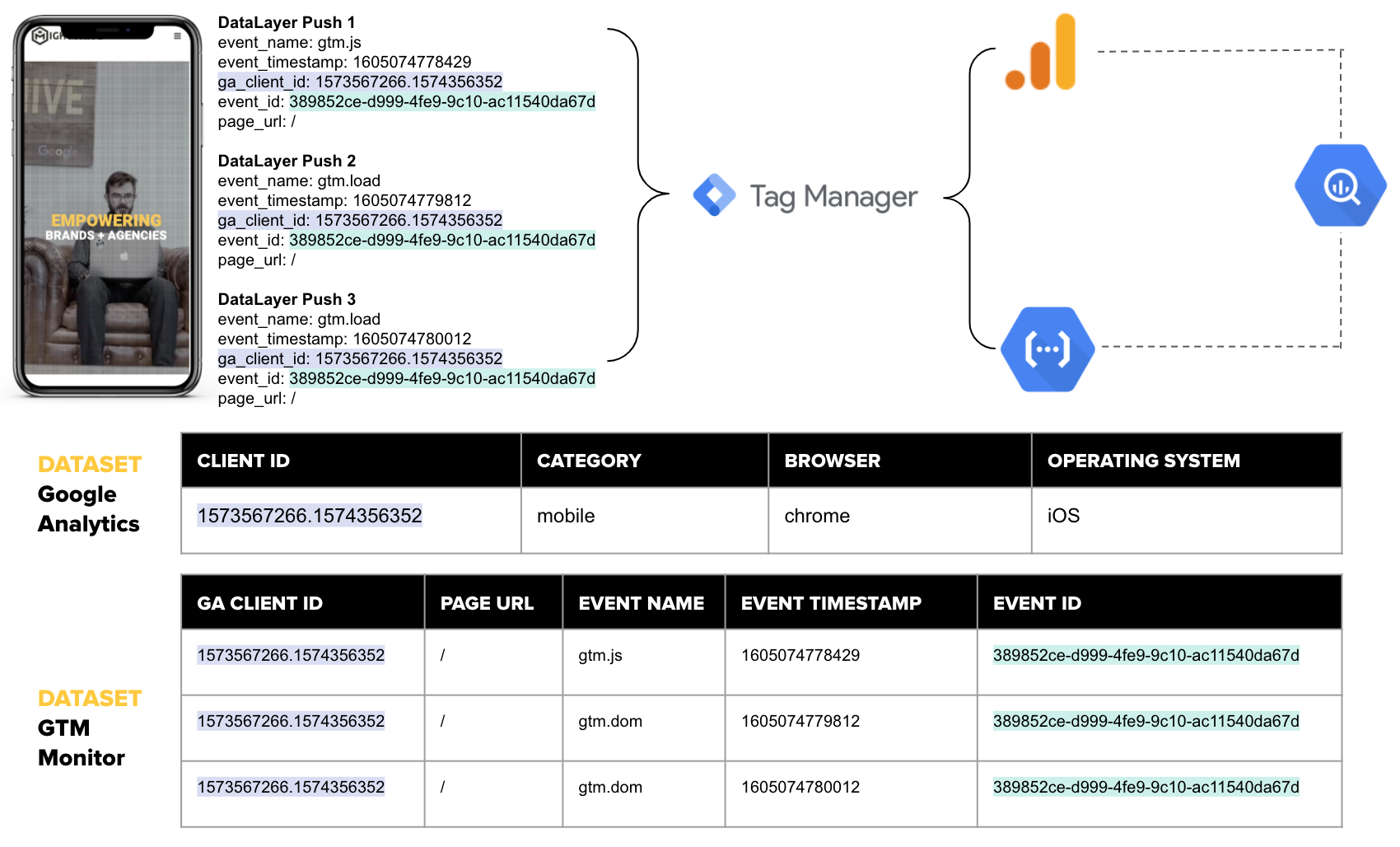
Architecture Diagram of GTM Tool Integrated with GA

Many crucial data points used for activation and measurement rely on successful dataLayer pushes. We’ve made a few updates to Simo’s Google Tag Manager Monitor framework that have allowed us to join data with Google Analytics. These updates help us unlock the ability to identify stability issue trends and patterns across devices, browsers, and operating systems that can negatively affect dataLayer pushes. For marketers struggling with data leakage, this is a BIG WIN.


We’ve Been Tinkering


Let’s explore the various adaptations we have made to Simo’s methodology in order to join results from the Google Tag Manager Monitoring Tool with a Google Analytics dataset in BigQuery, and what these enhanced capabilities mean for marketers. The join we’ve created enriches data collected via the Google Tag Manager Monitoring Tool with Google Analytics data points such as device, browser, OS—crucial information in understanding trends and patterns that impact performance. 

This post provides a high-level overview for how adding a new metric to your analytics toolset can help you measure the stability of your analytics implementation. If you’re interested in digging deeper into specifics or discussing real-world use cases, please reach out to me


TECH SETUP

There are a few prerequisites to have in place before joining data from a Google Tag Manager Monitoring Tool with Google Analytics data:

  • Pre-existing implementation of Simo’s Monitoring Tool (use his guide to get started)
  • Access to Google Tag Manager
  • Access to Google Cloud Platform project 
  • Google Analytics 360 Export


Here’s a look at an architecture diagram showing the Google Tag Manager Monitor Tool integrated with Google Analytics:


The Secret Sauce


The MightyHive Data Science team has designed a series of updates to Simo’s monitoring tool to provide enhanced data and diagnostic insights, including updates to the tool template to capture the Google Analytics Client ID, allowing us to join Google Analytics BigQuery data sets. Our team also realized that to connect all events on a given page together, a universally unique identifier (UUID) needed to be set via a new custom HTML tag. 

With the updated Monitor Tool template and the UUID tag set, the team updated the Cloud Function and created a BigQuery Table Schema for the enhanced tool using three additional fields: ga_client_id, event_id, and urlpath.

For a more detailed breakdown of the custom HTML tags we used, key Google Tag Manager settings, and code snippets for the template updates, shoot me an email.   


What Does this Look Like IRL?


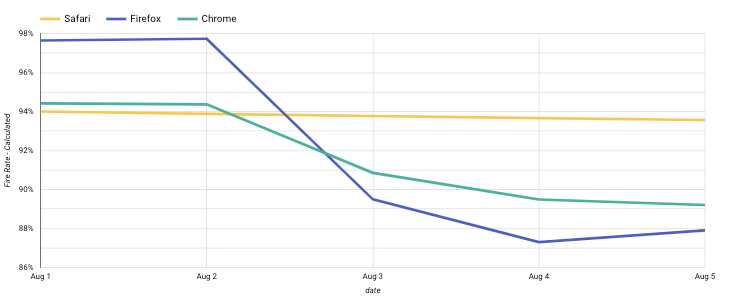
A client—let’s call them Company X—published a new version of their site around August 3. Once the updated site was live, Company X noticed that the gtm.load dataLayer event push began to fire later, or in some cases not at all. Because various tags were set to fire on gtm.load, those tags fired less frequently post-release. 

Tracking breaks like this are a marketer’s nightmare. Did the tag fail? Did someone publish an update with broken code or without the all-important dataLayer push? Is the break happening on a specific device, browser, or operating system? These questions and more can lead to a frustrating, time consuming wild goose chase, not to mention lost data until the issue is fixed. 


Calculating the Google Tag Manager Load Rate


To troubleshoot Company X’s misfire, we used a new metric: Google Tag Manager Load Rate.  We’ve calculated the load rate using the following simple formula:


GTM Load Rate Formula


Let’s say Company X has an order confirmation dataLayer event that occurs after gtm.js. Swapping out gtm.load for the order confirmation dataLayer event gives Company X its order confirmation fire rate. 


BIGQUERY GOOGLE TAG MANAGER LOAD RATE QUERY

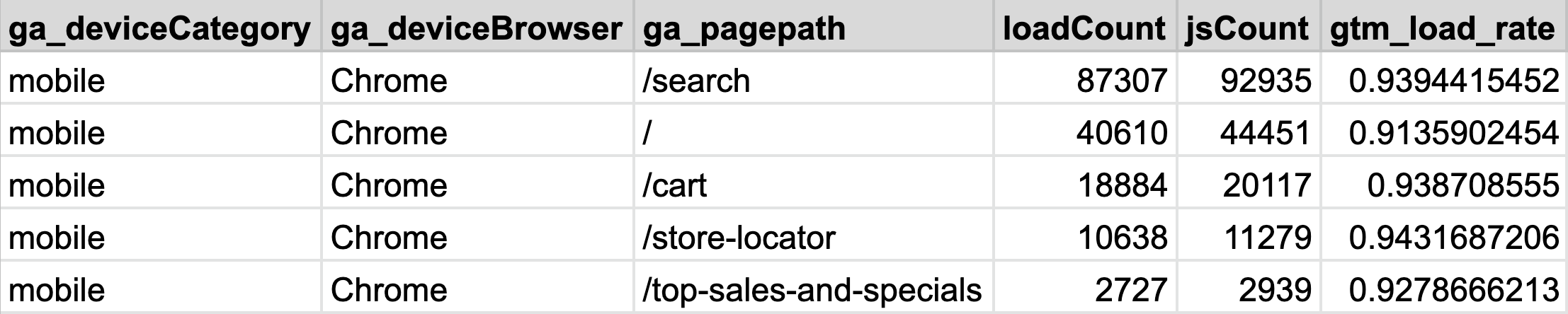
The Google Tag Manager Load Rate query calculates the fire rate in the following grouping:

  • Device Category - Google Analytics provided device category (desktop, tablet, mobile) 
  • Device Browser - Google Analytics provided device browser (Chrome, Safari, Firefox) 
  • Page Path - Page where the event occured
  • Load Count - Count of gtm.load events
  • JS Count - Count of gtm.js events
  • GTM Load Rate - Load Count / JS Count


Here’s what the query output looks like:


GA Query Output


In this example, using our BigQuery Google Tag Manager Load Rate query, we can quickly see that Company X’s home page, or “/”, has the lowest load rate at 91%. This means that 9% of gtm.loads on the home page did not fire, therefore leading to 9% (!!!) of traffic potentially being untracked. 


Better Insights, Faster Solutions


Our updates to the Google Tag Manager Monitoring Tool help take some of the guesswork out of the equation by automating a solution that audits dataLayer fires to quickly diagnose issues as they arise. By leveraging our version of the tool supplemented with Google Analytics data points, Company X was able to quickly pinpoint a sharp decline in fire rates post-release on Chrome and Firefox, while Safari was unaffected. A speedy and definitive diagnosis helped Company X fix the issue fast, reducing data leakage and bolstering its analytics setup against future issues.


dataLayer Firing Diagnosis

Data Leakage Be Gone!


In advanced analytics use cases, troubleshooting and diagnostics can monopolize an inordinate amount of time and resources, risking massive data leakage until an issue is resolved. Now that we have the ability to join Google Tag Manager Monitor Tool insights with Google Analytics datasets, we can pinpoint when and where dataLayer pushes fail and which devices, browsers, and operating systems they are failing on. For marketers, this means hours, days, or even weeks of time saved and minimal data lost. 

Learn how Google Tag Manager and Analytics can help unlock the ability to identify stability issue trends and patterns across all devices. data analytics data Google

Revisiting Measurement Strategy with the Advent of GA4

Revisiting Measurement Strategy with the Advent of GA4

3 min read
Profile picture for user doug_hall

Written by
Doug Hall
VP of Data Services and Technology

Revisiting Measurement Strategy with the Advent of GA4

Are your measurement strategy and tagging implementation aligned? It's OK, you’re in a safe space here—we know that keeping technology, tactics, and strategy in 100% alignment is nearly impossible in practice. Fortunately, the advent of Google Analytics 4 (or "GA4," formerly Google Analytics for App + Web) is an ideal time to approach a strategic measurement review.

Which came first, your tags or your measurement strategy?

Which came first, the chicken or the egg? Wikipedia refers to this question as a "causality dilemma"—we can't decide which event is the cause, and which is the effect.

Which came first, your tags or your measurement strategy?

Do any of these options sound familiar?

  • There is no strategy
  • The strategy and tagging bear no relation
  • The strategy is retrofitted to match the organically grown, free range, tag management

There is no shame in accepting that the strategy might not be up to date with the current tagging implementation. Tactical measurement is more volatile, for sure. Tag management is meant to help you move fast! However, lack of a strategy, significant disconnect between strategy and tagging, or strategy adapted to fit the tags (as opposed to the right way around) are not acceptable and must be addressed.

"Some people spend their entire lives waiting for the time to be right to make an improvement."

- James Clear, "Atomic Habits: An Easy & Proven Way to Build Good Habits & Break Bad Ones"

An opportunity presents itself

The advent of GA4 (formerly Google Analytics for App + Web) is an ideal time to approach a strategic measurement review. Don’t think this means you're going to throw away your existing Universal Analytics (UA) implementation and start again. Far from it. An existing reference point to work from is a valuable asset. You need to consider the following in your current tagging in order to decide the correct tactical and strategic alignment:

  • what currently works and aligns with strategy
  • what's currently broken and is misaligned
  • what's missing from tagging and/or the strategy
  • what's bloat and simply needs to be removed

Fix the broken stuff, fill in the gaps, and ditch the unnecessary to trim down and align your tagging and measurement strategy.

Connect measurement strategy and implementation

As a quick refresher, let us recall what is meant by a "measurement strategy":

  • Goals
  • Audiences
  • KPIs

A measurement strategy is a formalisation of what is measured, why, and what success criteria look like. The lack of an objective set of measurements is a key cause of digital marketing failure. Accepting that the current measurement implementation and strategy need to be reviewed and adjusted, this provokes a number of questions:

  • How did we end up here?
  • How do you fix it?
  • Why do you fix it? What’s the value?
  • How often do you realign strategy and measurement?

In the absence of any formalised process for tactical and strategic data alignment, measurement tactics will naturally diverge from the ideal mandated by the organisational aims. A good starting cadence for a process to address this issue is quarterly. This will be driven by the pace of change in your tag management, rather than your organizational strategy.

Start now.

Industry guru Avinash Kaushik has already written what needs to be written on measurement strategy so I won't repeat it here. The golden opportunity at hand is to reflect on the legacy measurement, consider what is possible with GA4 and ensure that the next generation of digital analytics instrumentation is as aligned with your global strategy as possible. Go beyond "fit for purpose" and strive for "OMG, this is digital marketing performance visibility I never thought possible!"

Priceless advice—don't get this bit wrong

When you embark on this process, be aware that UA tag types no longer exist. There is only one tag: an event. GA4 is event driven and user-centric. The GA4 core measurement is based on the concept of the event which means event name choice is critical to success. Use the GA4 event name to convey the meaning of the event. This needs strategic alignment of course, but, as much as possible, it is important to use the GA4 automatic, enhanced and recommended events before committing to a new custom event. This ensures the best/right reports are available for your data out of the box. Using customised event names might not enable all reports.

data diagram showing different outcomes

In conclusion

To not have a strategically aligned measurement approach is to court disaster. Recognizing that Google Analytics is changing, and in so many ways, for the better, is to embrace a fabulously valuable opportunity to address strategic alignment and remedy tactical issues in one swoop. Learn about GA4, and use it to plan the migration from UA. Build a measurement roadmap that complements the digital marketing plan. Be proactive, rather than reactive in measurement and strategy. Draw these components into a repeatable process, and ensure tagging remains aligned with strategy.

Learn how to implement Google Analytics 4 and align your data measurement and tagging strategies today. Google data analytics

Server-Side Google Tag Manager Deep Impact

Server-Side Google Tag Manager Deep Impact

4 min read
Profile picture for user doug_hall

Written by
Doug Hall
VP of Data Services and Technology

Server-Side Google Tag Manager Deep Impact

Before we dive into server-side Google Tag Manager (GTM), I’ll prefix the meat of this post with a caveat: always respect user privacy

Any data collection techniques discussed here must be applied righteously and not as a workaround to circumvent data collection consent regulation.


10,000 Foot View

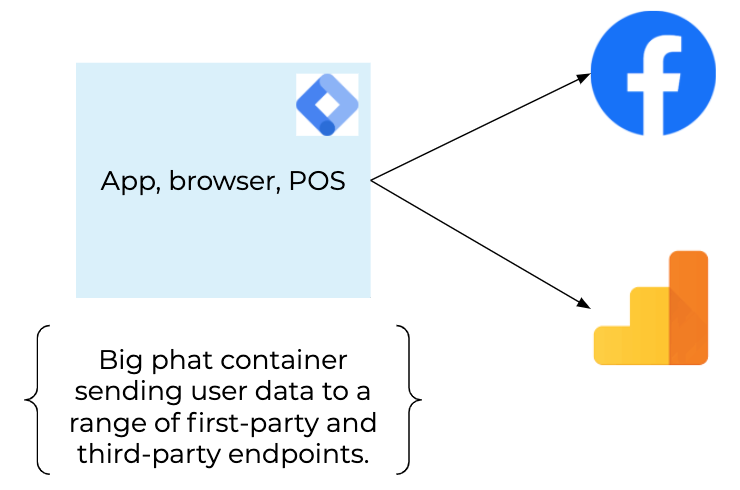
Here’s a familiar situation - Google Tag Manager as we’ve known it for years.

Your container is loaded on all pages, or screens in your site/app, and based on trigger events, data is sent to first- and third-party endpoints.


server-side-phat-container-1.png

It works, it’s fine, but it’s not perfect. Tracking blockers, JavaScript failures, many, many requests to endpoints, and inefficient JavaScript are all risks, and potential performance problems that can lead to data quality issues.  

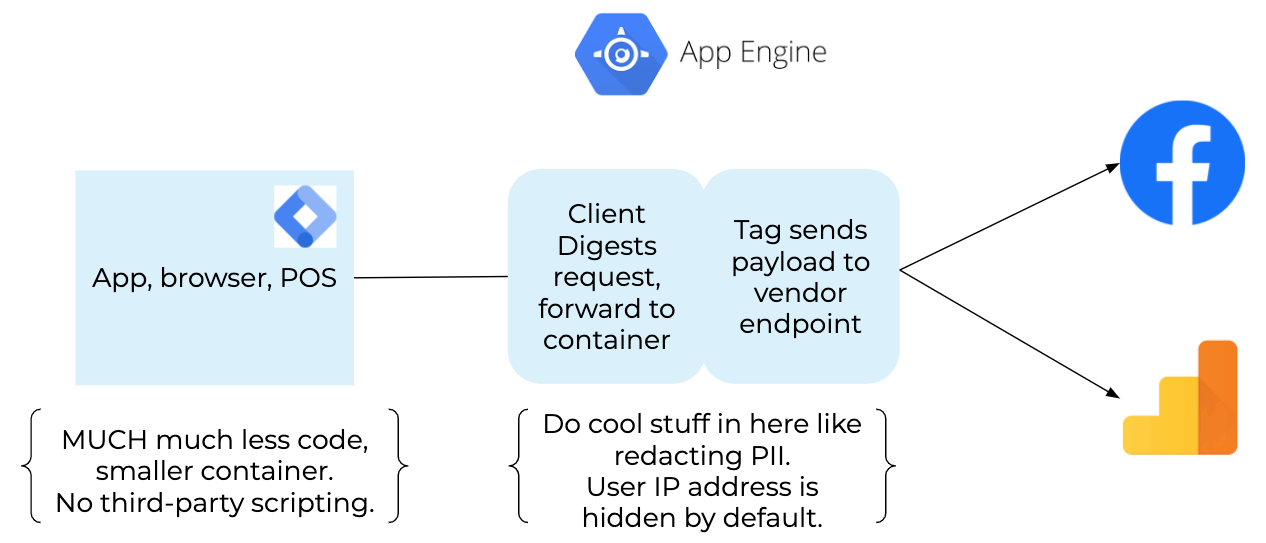
Server-side GTM moves the tag vendor request from the client to a server—a server on Google Cloud Platform living on a subdomain of your site. The container loaded in the browser/app still has tags and still sends a request but has way less code, sends fewer requests, isn’t necessarily affected by anti-tracking software, doesn’t send the user’s IP address to third-party tag vendors, and first-party cookies are correctly set in an ITP compliant manner.  


server-side-small-container.png


Out of the Box - What’s Cool?

There’s a lot to be excited about with server-side GTM in that, on the client side, it’s all very familiar—but way better! The “traditional” digital marketer can still set up their Facebook tag(s) with the same triggers, and deploy Floodlights as required. Same, same… but different.

As mentioned earlier, rather than sending data to the tag vendor endpoint, it’s sent to a subdomain. For example, if you’re on www.mysite.com, server-side GTM will send data to tracking.mysite.com, a subdomain you can have configured.  

And that’s great because…?

  • It respects user privacy: The user’s IP address isn’t sent to a third party.
  • It preserves data quality: Tracking prevention doesn’t happen on requests to your own domain.
  • It lightens code bloat from the client side: The tags require less work on the browser, shifting the workload to the server instead. This means what remains in GTM on the browser does less, so the site runs faster.
  • It consolidates requests from the client side: You can send multiple requests from the server based on one request from the client.

At MightyHive, we strongly advocate for focusing on what’s best for the user, not the ability to foil or circumvent anti-tracking software. Reminder: act righteously, not selfishly. As it stands now, data is collected, not captured. In the future data will be exchanged… Think about that for a minute.


Deeper Impact

Have you noticed that tracking requests are sent to your domain and not a third-party domain? The data collection workload is moved to your infrastructure.

Does that feel like just going back to web server logging? How different is this from web server logging?  

Very. 

Analytics data is formatted (sessionized), cleaned (PII removed), integrated (joined with data from Google Ads, Search Ads/Display & Video 360) and presented ready to perform its function: analysis and optimization of all aspects of the online business, which, let’s face it, is all about better marketing.  

Web server logs don’t collect all behavioral data. Typically, log-level data isn’t integrated with marketing channel data, meaning there’s no feedback loop for activation of the data. 

But! There are similarities between server-side GTM and web server logging. The web server receives a request, typically for a page, builds the page content and responds, possibly setting first-party cookies along with the response. The server-side GTM endpoint also receives requests, and responds, potentially with cookies (but with less content).

Now… the web server knows what page it’s returning.

It knows what data to render on the data layer to record a transaction (for example). 

The data layer is picked up by a tag firing in the browser and then sent back to the tracking endpoint. 

The end point then takes the same data and fires it off to Google Analytics (GA) to complete the round trip and get your analytics data recorded. 

Phew!

Wait one minute. If the web server knows it’s rendering a “thank you” confirmation page, and it knows what data to render on the data layer, why bother sending this to the browser for the browser to just send it back to the tracking end point and then to GA?  

Why not remove some steps for efficiency? The web server knows it is rendering a confirmation page. So it builds the exact same request the browser was going to, and sends the GA transaction data straight to the tracking end point. Cut out the client round trip.

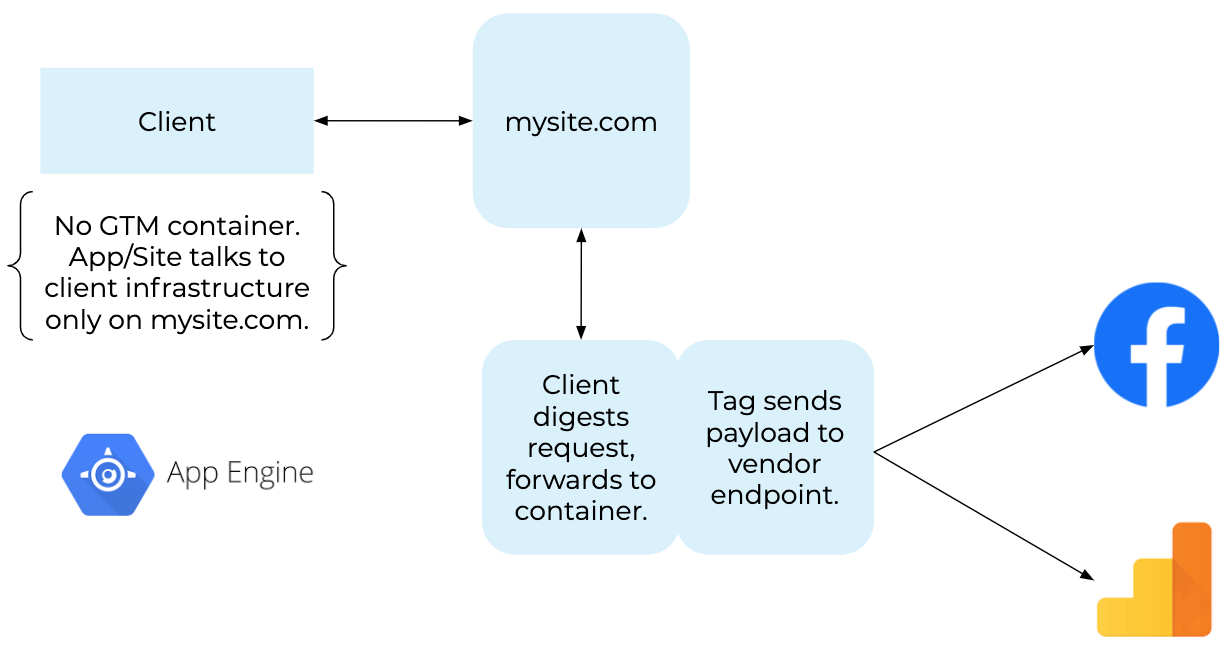
It’s quite normal to fire off conversion tags, Floodlights, FB pixels, Adnxs, TTD, and so on to record transactions. Don’t send those to the client to handle. As the web server responds with the confirmation page, send those requests straight to the tracking endpoint. The endpoint responds with the details of the cookies to set, and the web server sends those with the confirmation page content in the response to the client.


server-side-no-container.png

Think how many marketing tags and tracking pixels fire on page level events. How many tags actually need to fire on the client? How many tags don’t even need to be exposed to the browser? What if, just maybe, you only had page-level event-triggered tags? Maybe you only need page-level tracking if you’ve removed all of your data bloat? Then you don’t need to CNAME the tracking subdomain, you can restrict access to your tracking endpoint to only allow your web server to access it via https (think IP range restriction). That’s a bunch less complexity and a fair amount of moving parts removed from the solution.

Simpler is better. No code is better than no code, as the saying goes.


In Conclusion

The server-side GTM solution offers a good and correct solution to digital analytics measurement. It’s good because data quality can be improved, user privacy is further protected, and significantly, it’s a step towards doing less work in the browser, meaning sites and apps get faster.

Thinking about the possible solutions the technology offers, with the right motivation in mind, demonstrates how versatile the solution is, how much power is available and what avenues are still to be explored to leverage first-party data.


Gather data collection techniques that you can put into practice and apply righteously while respecting user privacy. data privacy data analytics Google

Digital Hygiene: Fighting Data Bloat

Digital Hygiene: Fighting Data Bloat

4 min read
Profile picture for user Julien Coquet

Written by
Julien Coquet
Senior Director of Data & Analytics, EMEA

Digital Hygiene: Fighting Data Bloat

Some years ago, as digital storage grew more affordable, the attitude towards data by many companies was to “store everything.” Every. Single. Data. Point. 

Next came “big data” and cloud computing, which brought even more data, more computing power, and ostensibly more opportunity and insights.  As a result, data consumption skyrocketed, driven by the Internet, social networks, and digital services.

To paraphrase my guru Avinash Kaushik, we now have more data than God ever intended anyone to have. 

The instinct to store everything is understandable. Why throw away data? But there have been a few unforeseen effects:

  • It increases the workload associated with data quality assurance
  • It increases data processing times
  • It makes data sets more complex and more difficult to work with
  • Most of the data is irrelevant to business analysis

The decision to keep all the data was an easy one. Discerning which data points should be considered is difficult. This consideration phase will be implemented either as companies are specifying a data project (BEFORE), or as they introduce a new release of their digital assets (AFTER).


For mature audiences only

Imagine you’re building the specification for your project and figuring out how to measure project success. You will most likely consider the following KPIs:

  • Key feature usage rate (conversion rate)
  • Marketing effectiveness (budget, cost per acquisition)
  • Vanity metrics (volume, users)

Sounds too basic? Fair enough. And yet that’s a great base to work from! 

Important Tip: Your project must be in sync with your organization’s maturity level.

First, you need to make sure the basic data you intend to collect from your site or app resonates with your product managers, your marketing team, or your analysts. They need to understand how these basic numbers can help shape your product or marketing strategies. 

Then, a specification document must be established. A Data Collection Bible of sorts. Call it a tagging plan, a data collection blueprint, a solution design document… get creative! That document will not be set in stone. It will evolve with your company as you enrich your data set to meet your measurement requirements. Make sure to include significant stakeholders in that process, or else...

Only after you’ve gone through a thorough data specification phase can you consider enriching your data during subsequent development cycles. Data enrichment will either be:

  • Vertical: more metrics to measure specific user events
  • Horizontal: more dimensions/attributes to give metrics more context

Keep enriching your data to assess the KPIs that support the measurement of your business objectives. Give them as much context as you can so the analysis is as relevant and actionable as possible.


Does your data spark joy?

All this talk about enriching your data sounds great, but you may be at a stage where you’ve collected way too much data already. Arguably, getting a ton of data means getting the fuel to power machine learning, artificial intelligence, or any reasonably advanced data processing.

Having said that, too much unidentified/non-cataloged data will ultimately yield confusion and storage/processing costs. For instance, if you have a contract with a digital analytics vendor (say Adobe or Google), it is very likely you’re paying a monthly/yearly subscription fee based on the number of hits your system collects and processes into reports, cubes, and miscellaneous datasets. Additionally, digital marketing teams are not known for questioning the status quo when it comes to data and tracking, in particular.

If you combine both facets of data cleanup, we’re looking at an optimization campaign that turns into a cost-saving effort. This is where you as a company should start asking yourself: “do I really need that data? Can my team function without measuring metric X and attribute Y?”

To borrow from Marie Kondo’s konmari method, you should keep only data points that speak to the heart. Identify metrics/attributes that no longer “spark joy," thank them for their service before brutally disposing of them with a firm and satisfying press of the DELETE button.


How can you tell whether you should discard a specific data point?

This requires a bit of investigation that can be done in your data repository by looking at your data structure (column names and values for instance). If you cannot make up your mind, ask yourself whether one particular data point really “sparks joy,” or in our case, drives analysis and can be used as a factor in machine learning. In fact, this is a great occasion to actually use machine learning to find out! 

Feed your data set into R/Python (insert your favorite machine learning package here) and look at the results:


Chart 1

You could also look at factor analysis another way and see where a specific factor really contributes to performance, metric by metric:


Factor Analysis

Once you’re done analyzing which data points still belong in your data architecture, it’s time for pruning. If you have made the decision to delete existing data, this can be as simple as deleting a column or a set of entries in a database, data lake, or data repository. But that’s only for data you already collected. What about data collection moving forward? 

If you want to change the way data is collected, you need to go konmari on your digital assets: web site tracking, mobile SDKs, OTT devices. Using a tag management system (TMS), you can start by deactivating/pausing tags you no longer need before safely deleting them from future versions:


GA Universal ID

From a management perspective, stakeholders need to make themselves known and express clear data requirements that can easily be retrieved. That way, when you prune/retire data that is deemed to no longer spark joy, you’re not inadvertently sabotaging your colleagues’ reports.

And this is why you needed that Data Collection Bible in the first place!

Which data stage are you at? Before or after? Basic or complex?

Find out how to implement a data tagging strategy and how to discern what data is most important to your project success. data analytics data privacy Google

Apple, Google, Privacy, and Bad Tech Journalism

Apple, Google, Privacy, and Bad Tech Journalism

5 min read
Profile picture for user Julien Coquet

Written by
Julien Coquet
Senior Director of Data & Analytics, EMEA

Apple, Google, Privacy, and Bad Tech Journalism

Wait, did they just say Safari now blocks Google Analytics?

(Spoiler alert: it doesn’t)

At the 2020 edition of the Apple Worldwide Developers Conference (WWDC), Apple announced that the new version of MacOS (nicknamed Big Sur) would ship with version 14 of the Safari web browser - promising Safari would be more privacy friendly. Which is a great move and in line with the regulatory and digital marketing landscapes.

However, based on fuzzy, out-of-context screenshots shown during the announcement, some digital marketing publications started asserting that the new Safari would block Google Analytics.

[Narrator’s voice: it didn’t]

Here are some of the articles in question:

Within minutes, that poorly researched bit of fake news was all over social media.

So what really happened? Should you worry?

Cooler heads always prevail, so let’s take a step back and look closely at what really happened.

What is ITP and why does it matter?

The WWDC is generally the occasion for Apple to announce new features and key developments in their tech ecosystem from desktop and mobile operating systems to SDKs, APIs, and all that good technical stuff.

In recent years, Apple has used the WWDC to announce changes to the way they handle privacy in web and mobile apps, namely with initiatives such as ITP (Intelligent Tracking Protection), which is used in Safari, Apple's Webkit-based browser on Macs, iPhones, and iPads.

In a nutshell, ITP restricts the creation and the lifetime of cookies, which are used to persist and measure someone’s visit on one site (first party, a.k.a. 1P) or across multiple websites (third party, a.k.a. 3P). ITP makes things more difficult for digital marketers because users become harder to track and target.

If we use Google Analytics as a comparison, ITP can "reset" a known visitor to a new visitor after only a couple of days, instead of the usual 2 years - assuming users don’t change devices or clear their cookies.

If we look at ITP with our privacy hat on, even collecting user consent will not stop ITP from neutralizing cookies.

ITP arrives at the right moment; just as online privacy starts to finally take root with pieces of legislation such as GDPR and ePrivacy in Europe, CCPA in California, LGPD in Brazil, APA/NDB in Australia, APP in Japan, PIPA in Korea, and a lot more being made into bills and/or written into law.

Arguably the above pieces of legislation allow for the collection of user consent prior to collecting. So we should not really be worrying about Safari potentially collecting information that users consented to, right?

That was not even a consideration in the aforementioned pieces on "Safari blocks Google Analytics."

Does the new Safari really block Google Analytics?

(Second spoiler alert: it still doesn't)

The most obvious way to show you is with a test. Luckily, I had MacOS Big Sur beta installed so I took a look under the hood - especially on the sites that published that "Safari blocks Google Analytics" story. Let's fire up Safari and turn on developer mode.

Bad Tech Journalism

Sure enough, Google Analytics sends a tracking call that makes it home to Google collection servers. Safari does not block Google Analytics.

Now let's take another look at that new privacy report: it shows "22 trackers prevented."

Wait, the list shows google-analytics.com?! Didn't we just establish that Google Analytics tracking went through?

Let's clarify: what the panel below shows are the domain names of resources loaded by the page that are flagged in the ITP lists as potential tracking vectors using third-party cookies.

Bad Tech Journalism

Other than that, ITP plays its role in drastically reducing the Google Analytics cookie’s lifetime to just a week as shown below.

Bad Tech Journalism

Let's drive this point home again if needed: Safari 14 does not block Google Analytics.

ITP is enforced as per the spec by blocking third-party cookies and limiting cookies to a lifetime of a week at most.

So what's the big impact?

As mentioned, ITP is primarily going to reduce the time during which a visitor is identified. After a week, ITP deletes/resets the user cookie and the visitor is “reborn”. Not a great way to study user groups or cohorts, right?

If you’re worrying about the impact of ITP on your data collection, may I suggest reading this awesome piece on ITP simulation by my colleague Doug Hall.

What is important to remember is that Apple is using ITP block lists built in partnership with DuckDuckGo, a search engine that has made a name for itself as a privacy-friendly (read: anti-Google). I, for one, have yet to see what their business model is but that’s a story for another post.

At any rate, ITP lists are meant to block cookies for specific domain names.

Even if Apple did decide to block Google Analytics altogether, how big a deal are we talking about? According to StatCounter, Safari accounts for roughly 18% of browser market share (as of June 2020). Let's round this up to a neat 20%. That’s an awful lot of data to lose.

Arguably, Google Analytics wouldn’t be the only tracking solution that could be impacted. Let’s not forget about Adobe, Criteo, Amazon, Facebook, Comscore, Oracle—to name a few.

So if you keep implementing digital analytics according to the state of the art, by respecting privacy and tracking exclusively first-party data, you'll be a winner!

Is it really just bad tech journalism?

Let's get real for a moment. If tech journalists posting the story about Safari blocking Google Analytics knew about ITP, they wouldn't have published the story - or at the very least with a less sensational headline. Even John Wilander, the lead Webkit engineer behind ITP spoke out against the misconceptions behind this "Safari blocks GA piece."

This is unfortunately a case of bad tech journalism, where half-truths and clickbait titles drive page views. Pitting tech giants Apple and Google is just sensational and does not highlight the real story from WWDC: privacy matters and Apple are addressing it as they should.

In this, I echo my esteemed colleague Simo Ahava in that this kind of journalism is poorly researched at best, intentionally misleading at worst.

Most of the articles on this particular topic backtracked and offered "updates" but they got caught with their hand in the cookie jar.

To be fair, it is also Apple's fault for using misleading labeling.

But is it so bad considering we’re talking about a beta version of a web browser? Ìf anything, Apple now has a few months ahead of them to make adjustments before Big Sur and Safari.

Beyond the fear, uncertainty and doubt, this kind of publication is symptomatic of an industry that is scared by the effect that privacy regulation is having on their business.

How is MightyHive addressing this?

While we at MightyHive have long been preparing  for the death of the cookie and digital ecosystem focusing on first-party data, we can appreciate that initiatives such as ITP can make a digital marketer's life very complicated.

We strongly believe that the future of digital marketing lies in first party data, consent and data quality.

Cookies are on their way out but this does not mean the end of the world.

We compare both Apple and Google's privacy updates that are in line with the regulatory and digital marketing landscapes of today. Google data analytics data privacy

Choose your language

Choose your language

The website has been translated to English with the help of Humans and AI

Dismiss