
Choose your language

Choose your language

The website has been translated to English with the help of Humans and AI

Dismiss

Tua Tagovailoa and Terry on a production stage filming
Coach Terry from GoNoodle

Coach Terry’s Totally Terrific Fitness Fantasy • A Fitness Fantasy Brought into Extended Reality

  • Client

    Verizon

  • Solutions

    ExperienceVR & Live Video Production

00:00

00:00

00:00

Case Study

0:00

Adding a new dimension to the world of GoNoodle.

With a massive presence in elementary schools and homes, GoNoodle inspires kids to be their best, silly selves through safe, quality health and mindfulness content. Through a colorful cast of animated characters, kids are encouraged to get up and move—and have built powerful relationships with personalities like Coach Terry in the process. To bring these relationships to life in a whole new way, we teamed up with Verizon, Fuel Up to Play, quarterback Tua Tagovailoa and GoNoodle to produce “Coach Terry’s Totally Terrific Fitness Fantasy,” a cutting-edge children’s fitness broadcast.

Four images showing the GoNoodle live stream

An innovative broadcast approach brings two fan favorites together.

Inviting children into the GoNoodle world added a new dimension to the fitness experience, challenging our artists to reconceive the 2D Coach Terry design as a 3D character. We built a new model and rig so that motion capture performers could give motion and expression to the character in real time. The broadcast itself came with its own challenge: in the show, Tagovailoa and Coach Terry appear to be standing in the same space, but they were actually shot live in two separate locations. Using Disguise hardware and Unreal Engine, our team was able to send motion capture data wirelessly from the mocap studio to the XR stage at Verizon’s 5G Lab, blending multiple camera feeds together into a seamless virtual world.

Our Craft

Software-defined production brings fans together from all over.

  • A stage with a person in a mocap suit being filmed
  • A bunch of computer monitors showing what's being filmed live
  • A person in a mocap suit and another person doing voice overs in real-time

5G connectivity unlocks seamless interaction at low latency.

Verizon’s 5G connectivity was essential to bring Tagovailoa and Coach Terry together—and to invite children into GoNoodle’s world through live interaction. We leaned on the speed and low latency of Verizon’s 5G network and mobile edge computing to create the natural conversational flow critical to making this broadcast concept successful. We took this even further by integrating live video of a classroom into Chicago, incorporating students directly into the 3D environment in real time, and using our LiveXP interaction platform to display polling and emotes throughout the show.

A winning formula for live broadcasts.

“Coach Terry’s Totally Terrific Fitness Fantasy” gave kids, teachers, and parents a fun, safe, and trusted real-time fitness experience featuring two popular and cherished personalities. With innovation and interactivity at the core, the show also established powerful new ways to use 5G and mobile edge computing to create interactive educational, sports and fitness programming—a perfect touchdown for live broadcasts.

Want to talk experience? Get in touch.

Hey 👋

Please fill out the following quick questions so our team can get in touch with you.

Can’t get enough? Here is some related work for you!

A large airplane hanger all lit up in the night
A large white circular exhibit piece with large screens on the inside of it

Ellinikon Experience Centre • An Experiential Look Into the Future of Urban Living

  • Client

    LAMDA Development

  • Solutions

    ExperienceImpactful Brand ActivationsImmersive Brand StorytellingExperiential Strategy & Production

00:00

00:00

00:00

Case Study

0:00

Translating a vision of the future into tangible reality.

Ellinikon is Europe’s largest urban regeneration project, and serves as an incredible look into the future of urban spaces. LAMDA Development, the leading real estate developer in Greece, hired Monks to build an experience center from the ground up that brings its 20-year vision for Ellinikon to life today. We transformed an old airport hangar into an interactive journey that invites visitors to immerse themselves within scenes from the area’s past, present and future—a synergistic experience that blends physical and digital design.

Step into lush, digitally enhanced landmarks and spaces.

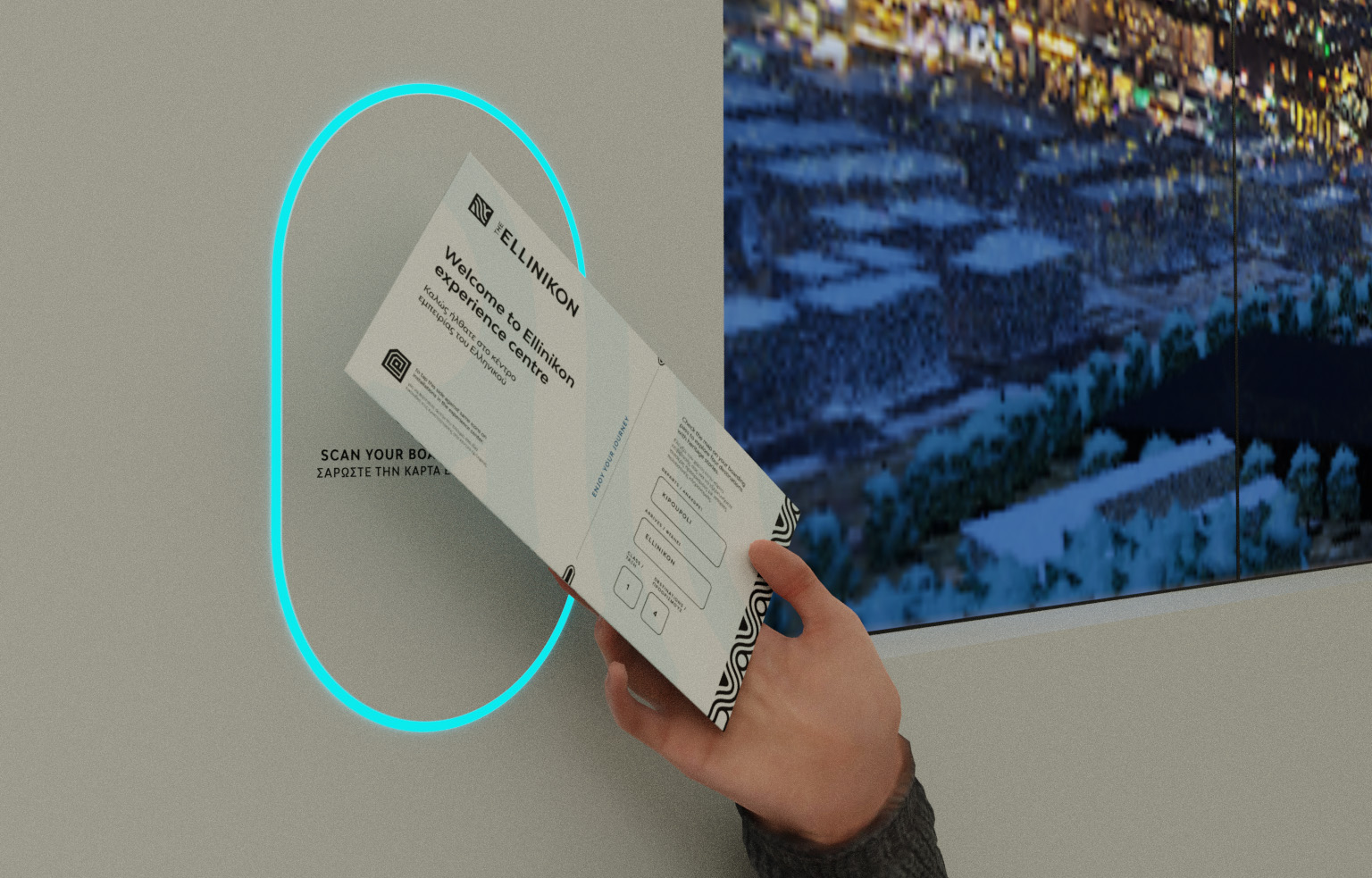
Upon checking into the Experience Center, visitors are given a personalized boarding pass—a reference to the space’s heritage of air travel. Augmented by RFID, the pass connects visitors to personalized experiences as they make their journey throughout the center. The first stop is an interactive maquette, or scale model, that showcases highlights of the development and provides a holistic, data-driven view of the Ellinikon master plan.

The beating heart of the development is the Ellinikon Park, which we paid tribute to through a multisensorial exhibit that invites visitors to become acquainted with the park’s landmarks and its native flora. An interactive map offers insight into local amenities and essential info, while a digitally enhanced botanical library display tells the stories of plants that are integral to the park and Greece at large. Those looking for a more active and scenic view of the park can take a virtual bike ride through the grounds and even enjoy a birds-eye view of its impressive sites. Meanwhile, those in a seafaring mood can explore the future vision of the Riviera on an XR-enhanced virtual yacht ride.

A person steering an XR boat into a virtual canal
A person looking at a small scale diorama of the experience centre
A person walking throughout the Ellinikon Experience Center

Picture your life in a reimagined urban landscape.

Elinikon will put Greece on the map as an example of human ingenuity and creating a new way of living: the smartest and greenest district of Europe. To help visitors reimagine a better urban future, we designed a series of displays that explore Ellinikon’s various innovations, all housed in a mesmerizing corridor mimicking the night sky. After getting a taste of Ellinikon’s vision, visitors are encouraged to share their own ambitions by wishing on a star and contributing to the shimmering galaxy above.

To help visitors truly envision life within Ellinikon, we staged a luxurious residential living space with story-driven, interactive experiences seamlessly embedded throughout. The RFID-enabled pass allowed us to personalize every interaction, making it even easier for people to imagine their home within the future of urban living. Finally, a panoramic view gives a glimpse into the Ellinikon vision, with sweeping views captured at different times of day and different floor levels.

Our Craft

Experiences that inform and inspire.

  • A screen shows a blueprint of cars charging in a parking lot
  • A person riding a bicycle that creates energy for an exhibit
  • A dark room with colorful exhibit pieces and a space visual on the ceiling

Shape the future through interactive experiences.

While flowing from one experience or display to the next, visitors can stop to take a rest in the Free City Space, which connects navigation patterns and play areas into one cohesive wayfinding system. Over the course of their journey, visitors engage with 22 bespoke experiences and 120 minutes of content. From creative direction to production to content development, we blended over a dozen capabilities to bring the Ellinikon master plan to life for visitors from around the world, translating an ambitious plan for urban living into tangible reality.

Want to talk experience? Get in touch.

Hey 👋

Please fill out the following quick questions so our team can get in touch with you.

Can’t get enough? Here is some related work for you!

Creating an Emotionally Resonant Customer Journey With XR

Creating an Emotionally Resonant Customer Journey With XR

5 min read
Profile picture for user mediamonks

Written by
Monks

Meet the XR.Monks

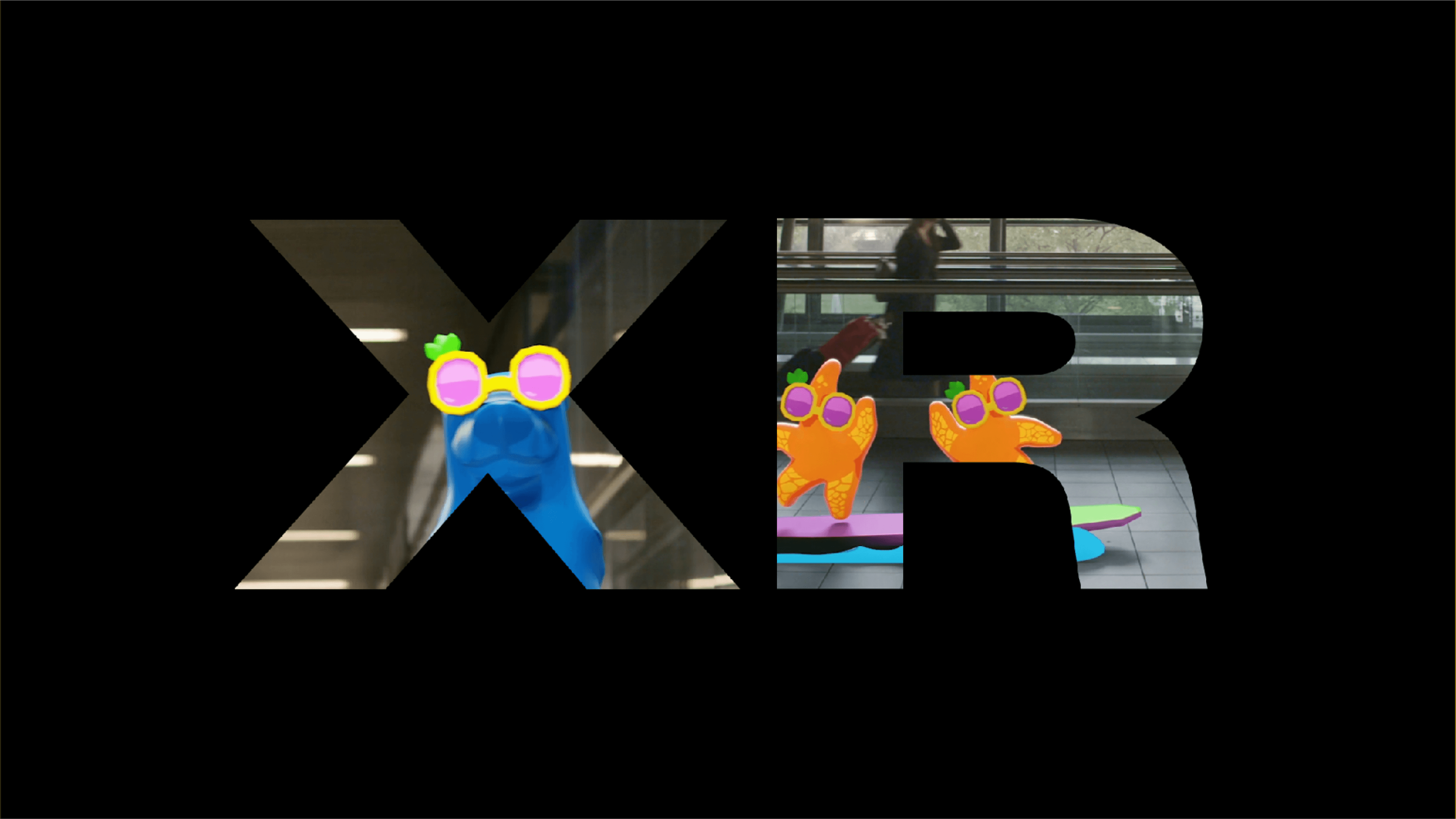
Behind the industry’s latest buzzwords like XR and the metaverse, there’s a lot to unpack. Extended realities (XR) and its two primary formats, virtual reality (VR) and augmented reality (AR), have been making waves across the marketing industry at large. With VR, users are immersed in new, virtual worlds experienced through headsets. AR, on the other hand, adds a digital layer of imagery to the real world through a smartphone or special glasses—like the selfie filters you may encounter on platforms like Instagram.

Although it’s constantly evolving, this technology is not necessarily new—and neither are the opportunities that come with it. When done right, XR can push reality beyond its limits, creating new experiences that may be artificial, yet fuel real and lasting memories. At first, XR may seem like your typical sci-fi innovation, so it’s easy to get wrapped up in the novelty. However, where the experiences truly shine lies in their emotional resonance, making them a useful component to campaigns and activations across brands and industries.
00:00

00:00

00:00

Start at the Customer Journey

Even if more and more brands are finding the value in XR, some still feel it’s exclusive to the most digitally-mature. But in reality, XR has become accessible enough for every brand to adopt it. “Oftentimes, vendors focus on the technological aspect of it all, the tools they have and all this jargon,” explains Creative Director Patricio Berrios Lobos. “This makes it harder for brands to understand the real value of XR beyond the tech gimmick. We have to focus on the value for the user.” 

Experiences both big and small, complex or simple, can each deliver impact. Think about product demonstrations in VR or trying on an outfit in AR—both of which can create a perception of ownership for users as they engage. By putting them at the center of an immersive experience, XR can help build a real connection between them and a brand’s product.

Monk Thoughts When you think about the stories you can tell from the lens of immersion and the emotions you can evoke, that’s when you realize the potential of XR.

A marketer’s goal is to turn the customer decision journey into engaging moments that resonate emotionally—and XR can impact these moments by transforming consumers, their spaces and their looks into the true protagonists. Especially with AR, the cherry on top is that it amplifies the shareability of the experience, as everyone feels enticed to share those they connect with.

“When you think about the stories you can tell from the lens of immersion and the emotions you can evoke, that’s when you realize the potential of XR,” says Berrios Lobos. “There’s an important element of play and joy that gets people actively engaged with the brand in a way that video or print just can’t achieve.” These moments of play are best served as part of a bigger narrative and strategy. Don’t build XR as just a one-off experiment; rather, truly consider how it can complement the overall journey.

Inspire Action Through Emotionally Driven XR

Again, XR’s value extends across industries—and isn’t just for commercial experiences. In fact, both VR and AR have become powerful tools in education and applied learning. Extended realities can turn complex concepts into interactive experiences—and although these may be artificial, a first-hand approach to learning can profoundly change a student’s perspective on a variety of subjects. 

People with VR lenses inside a spaceship

The multi-sensory VR education program virtually launches children into space to teach them about our planet.

Not long ago, we joined forces with SpaceBuzz, a nonprofit that focuses on teaching children about the importance of protecting planet Earth. Betting on the power of applied learning and technological advancement to further encourage curiosity, we built a multi-sensory VR education program that virtually launches them into space to see our planet in all its wonder and fragility. Seeing the Earth from space themselves instead of learning through the filter of others helped kids draw their own conclusions and create their own educational narrative.

But not all applications of XR have to be an out-of-this world journey. Partnering with Olay, we created a VR experience to immerse brand ambassadors in the science behind skincare—transporting them to the surface of the skin at a cellular level. Taking an entertaining approach to an otherwise complex topic, we helped the brand educate its advocates on the different causes of unhealthy skin, and challenged them to create their own treatments by mixing Olay ingredients. The result: better understanding of the brand’s unique formula.

More individual experiences without an on-site installation, like an AR game, can also build awareness. To help promote Red Bull’s national and regional activations, we built a suite of five AR games within the brand’s app—each one rendering a virtual landscape around a real Red Bull can. Users can play the games after purchasing a Red Bull product, with a chance to win a grand prize. 


A series of AR games

Each AR game renders a virtual landscape around a real Red Bull can.

Both on-site experiences and those at easy reach on everyone’s smartphone can positively impact your brand. While the latter offers greater accessibility and reach, dedicated venues can enable more immersive, technologically-advanced activations.  “When people are on site, we can build more complex experiences and have more fun overall,” explains Quentin de La Martinière, Executive Producer, Extended Realities at Media.Monks. “We tend to take more risks, because we’re there to guide them every step of the way and to make sure our message is getting across.”

Greater Adoption Means More ROI

As we move forward, the evolution of this technology will make it easier for mainstream consumers to afford and adopt. VR has benefitted in the past two years by the release of consumer-friendly headsets like the Oculus Quest, while WebAR and 5G connections offer engaging AR experiences without the need to download an app. “With WebAR being just one tap away, you don’t have to ask that much from the users,” says de La Martinière. “A mobile browser is enough to see how a pair of shoes would look on you. This idea of frictionless access to content is becoming the norm.”

With more people having XR experiences within easy reach, the potential ROI becomes more enticing for brands. But to optimize it, one thing is key: “As long as your focus is in the right place, and you know what you want to accomplish with XR, the balance will be positive,” de La Martinière explains. Add to that the technological advances, and XR ceases to be out of reach. “When done right, there’s no need to spend hundreds of thousands of dollars to create XR experiences for your brand.”

The possibilities are endless with XR. Regardless of what you want to accomplish with it, having a clear goal in mind is pivotal to deliver on its promise. Adopting this technology for the sake of appearing innovative is not nearly as valuable as truly leveraging the opportunities that come with AR and VR to deliver compelling, emotionally rich experiences.  And, as the technology continues to grow in fidelity, so too will it grow in user base and ease of access, making it crucial for modern brands to embrace its potential to impact the customer journey through personalized, user-driven experiences.

 

Our XR.Monks explain how to leverage AR and VR to build compelling experiences for your consumers. Our XR.Monks explain how to leverage AR and VR to build compelling experiences for your consumers. xr VR social ar spacebuzz red bull customer decision journey

What We Learned from Demoing Google’s New Depth API

What We Learned from Demoing Google’s New Depth API

4 min read
Profile picture for user Labs.Monks

Written by
Labs.Monks

What We Learned from Demoing Google’s New Depth API

Get ready for an upgrade: in early December, Google revealed its Depth API, a new functionality coming to ARCore that allows virtual objects and real-world environments to play nicer together, allowing for more convincing and immersive mixed reality experiences. A demonstrable way that Depth API achieves this is by enabling occlusion, or the illusion of virtual objects’ becoming obstructed behind real-world ones.

Convincing occlusion has historically been difficult to achieve, though Google has put together a video portraying demos of the new API that show off its features. One of those demos, which challenges the user to a virtual food fight against a levitating robot chef, was developed in collaboration with MediaMonks.

What’s exciting about Depth API is its ability to understand the user’s surroundings at an unprecedented speed and ease. “The API’s depth map is updated in real time, allowing AR apps to be aware of surfaces without complex scanning steps,” says Samuel Snider-Held, Creative Technologist at MediaMonks. This enables not only occlusion as mentioned above, but also the mimicry of real-time physics. For our virtual food fight against the AR-rendered robot, missing is part of the fun; users can take delight in the digital splatters of food on the objects around them without worrying about cleanup.

The Building Blocks to More Immersive AR

How does Depth API work, and what sets it apart from other methods of occlusion? “The Depth API uses an approach called ‘depth from motion,’ in which ARCore determines distances to objects by detecting variances between image frames while the camera is moving,” says Snider-Held. “The result is a high-resolution depth map that is updated in real time, allowing the device to better understand where objects are in relation to one another and how far away they are from the user.”

Depth API is software-based, requiring no new hardware for users with ARCore-enabled devices once it releases publicly. While sufficient occlusion significantly increases the verisimilitude of virtual objects, it follows a series of incremental updates that build on one another to allow for more realistic immersive experiences. Just last year—the same year ARCore debuted—Google released its Lighting Estimation API, which lights virtual objects to match the existing lighting conditions in the real-world setting, including light reflections, shadows, shading and more.

Screen Shot 2020-01-02 at 5.38.40 PM

Since then, a feature called Cloud Anchors allows multiple users to view the same virtual objects anchored in a specific environment. It’s the key feature powering the multiplayer mode of Pharos AR, an augmented reality experience we made in collaboration with Childish Gambino, Wolf + Rothstein, Google and Unity—which itself served as a de facto demo of what Cloud Anchors are capable of in activating entirely new mixed reality experiences.

“We have the creative and technical know-how to use these new technologies, understand why they’re important and why they’re awesome,” says Snider-Held. “We’re not scared to take on tech that’s still in its infancy, and we can do it with a quick turnaround with the backing of our creative team.”

A Streamlined Way to Map Depth

Depth API wasn’t the first time that MediaMonks got to experiment with occlusion or spatial awareness with augmented reality. Previously, we got to experiment with other contemporary solutions for occlusion, like 6D.ai, which creates an invisible 3D mesh of an environment. The result of this method is similar to what’s achieved with Depth API, but the execution is different; translating an environment into a 3D mesh with 6D.ai is fastest with multiple cameras, whereas Depth API simply measures depth in real time without the need of scanning and reconstructing an entire environment.

Similarly, Tango—Google’s skunkworks project which was a sort of precursor to ARCore—enabled special awareness through point clouds “When we had Tango from before, it used something similar to a Kinect depth sensor,” says Snider-Held. “You’d take the point clouds you’d get from that and reconstruct the depth, but the new Depth API uses just a single camera.”

Monk Thoughts We’re not scared to take on tech that’s still in its infancy, and we can do it with a quick turnaround with the backing of our creative team.
Samuel Snider-Held headshot

In essence, achieving occlusion with a single camera scanning the environment in real time offers a leap in user-friendliness, and makes it widely available to users on their current mobile device. “If we can occlude correctly, it makes it feel more cemented to the real world. The way that they’re doing it is interesting, with a single camera,” says Snider-Held.

Adding Depth to Creative Experiences

Depth API is currently opening invitations to collaborators and isn’t yet ready for a public release, but it serves as a great step in rendering more believable scenes in real time. “It’s another stepping stone to reach the types of AR experiences that we’re imagining,” says Snider-Held. “We can make these projects without caveats.”

For example, a consistent challenge in rendering scenes in AR is that many users simply don’t have large enough living spaces to render large objects or expansive virtual spaces. Creative teams would get around this by rendering objects in miniature—perhaps just contained to a tabletop. “With Depth API, we can choose to only render objects within the available space,” says Snider-Held. “It lets us and our clients feel more comfortable in making these more immersive experiences.”

As brands anticipate how they might use some of the newest features of fast-evolving mixed reality technology, they stand to benefit from creative and production partner that can bring ideas to the table, quickly implementing them with awareness of the current opportunities and challenges. “We bring creative thinking to the technology, with what we can do given our technical expertise but also with things like concept art, animation and more,” says Snider-Held. “We don’t shy away from new tech, and not only do we understand it, but we can truly make something fun and inventive to demonstrate why people would want it.”

MediaMonks built a demo featuring occlusion and realtime physics in AR, showcasing the functionalities of Google's new Depth API. What We Learned from Demoing Google’s New Depth API We go in-depth on ARCore’s new Depth API.
AR augmented reality mixed reality xr extended reality occlusion ar occlusion google arcore

Choose your language

Choose your language

The website has been translated to English with the help of Humans and AI

Dismiss