Choose your language

Choose your language

The website has been translated to English with the help of Humans and AI

Dismiss

From Dreams to Reality • AI-Powered Performance Creative for Hatch

  • Client

    Hatch

  • Solutions

    Artificial IntelligencePaid SearchMedia Strategy & PlanningPerformance MediaPerformance Creative

Results

  • 50% fewer design & production hours
  • 31% better cost-per-purchase
  • +80% CTR
  • +46% more engaged site visitors

00:00

00:00

00:00

Case Study

0:00

Managing the cost of consumer education.

Hatch, a sleep wellness company that teaches families how to develop better sleep habits with its restful technology devices, sought to engage new audiences for their Restore 2 product. Operating in a unique product category, Hatch needed their ads to balance consumer education with performance.  They opted for an audience-first approach to advertising that helps users envision an unfamiliar product slotting into their lifestyle. However, this comes with challenges. Namely, digital ad platforms require more creative assets to perform effectively, but photoshoots, customized ad ideation and design for multiple personas can be both expensive and time-consuming. To tackle this, we partnered with Hatch to leverage AI to strategize, concept, produce and launch personalized ad creative across diverse audience segments in a matter of weeks.

  1. The Process

    Monks.Flow In Action • Our AI-assisted workflows took us from research and concepting to ad launch in just six weeks using Monks.Flow and Google Gemini.

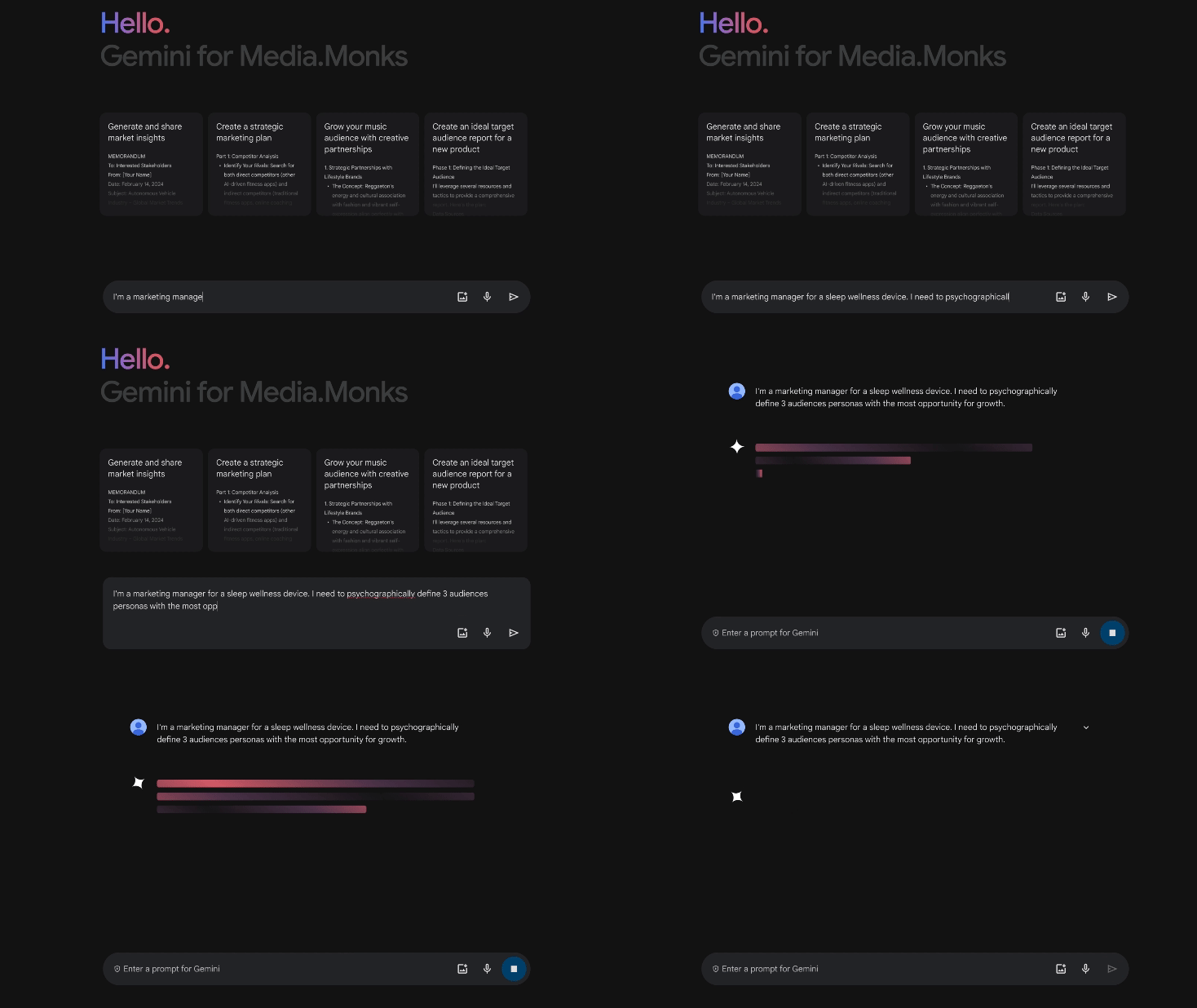
  2. Conversation with Google Gemini LLM to create personas for Hatch
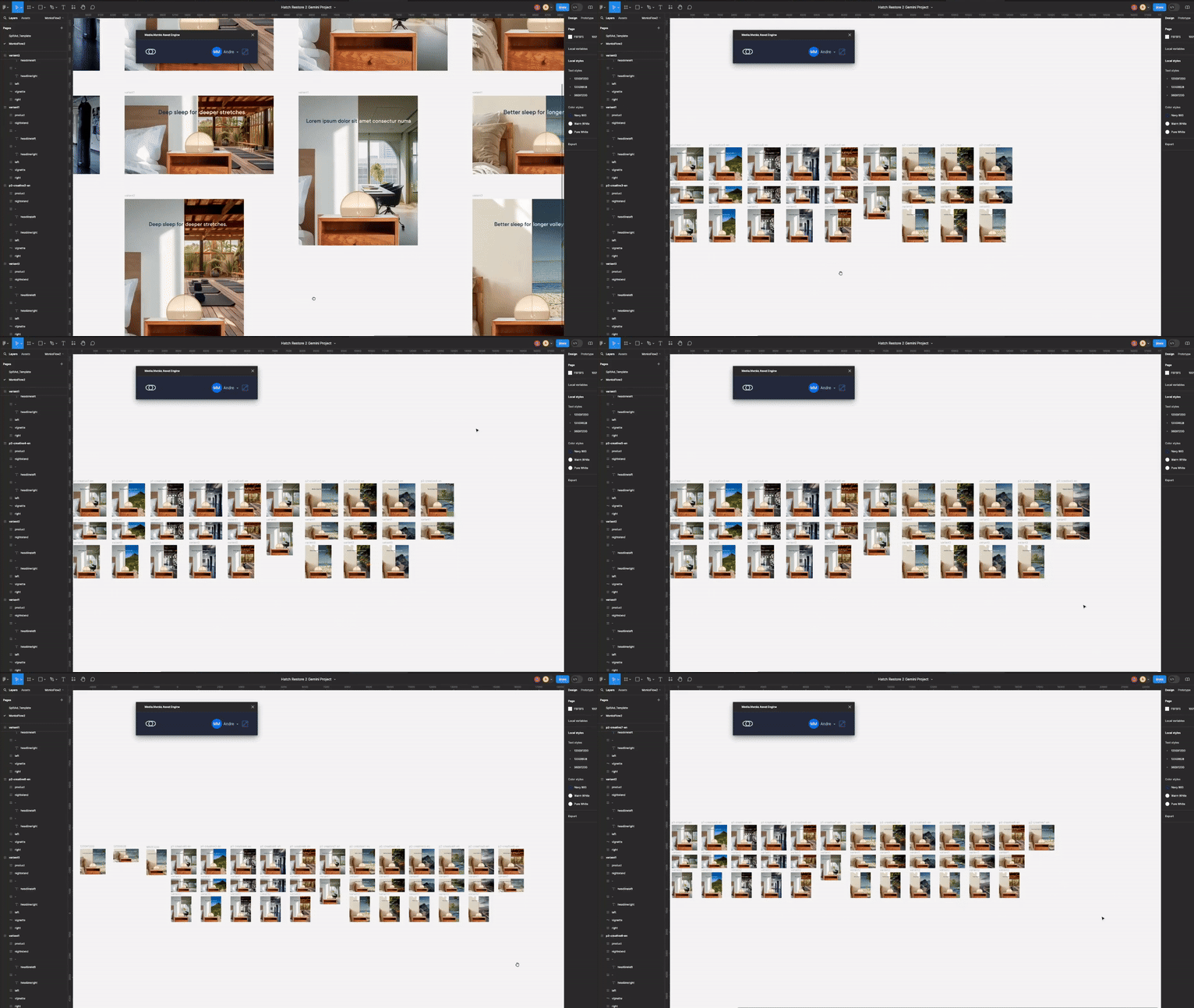
  3. Moving images of generative AI ad components for Hatch including pictures of a bedroom and a yoga studio

    From AI "conversations" with our new personas, we came up with a new modular creative platform we could customize to each.

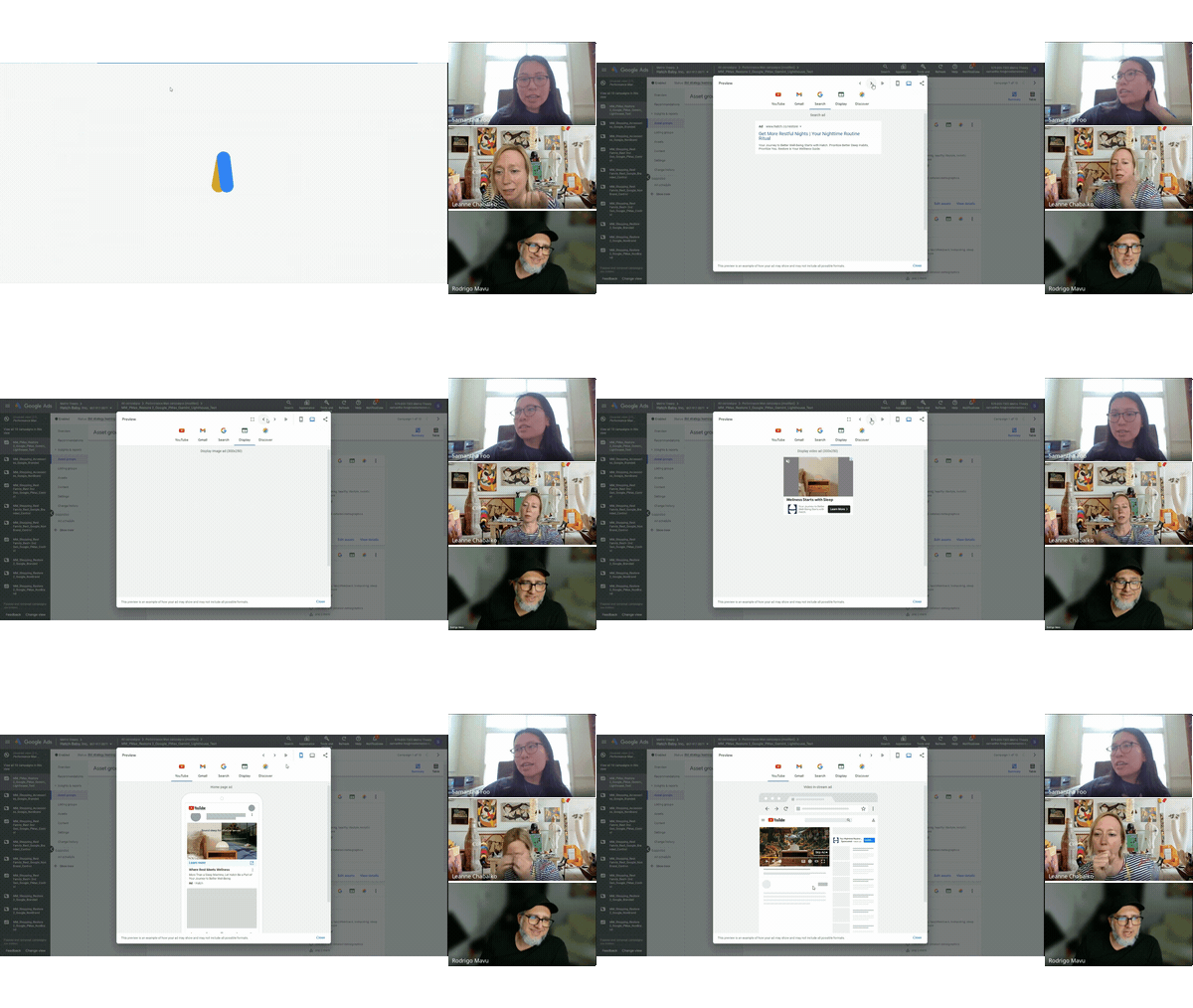
  4. Media.Monks team discussing Performance Max ad strategy on a virtual meeting
  5. Layouts and designs were crafted with Google Performance Max campaigns in mind, then our Generative AI workflows produced huge quantities of assets in a matter of hours.

  6. Generative AI production workflow from Monks.Flow
  7. Ready to integrate AI into your ad creation workflows?

Swipe
For More!

Drag
For More!

Incorporating AI from end to end.

We used an end-to-end AI-driven approach to tackle these challenges—from the audience research and ideation stage through the production and launch. Here’s what that process looked like:

  1. Persona Development: We leveraged Google’s AI tool, Gemini, to identify three distinct audience personas that would help us reach beyond the historical core buyer. By having “conversations” with the AI personas, we could better understand their lifestyles and preferences, from how they decorate their bedrooms to their hobbies and routines.
  2. Creative Framework: We accelerated the creative process by teasing out insights from the AI on what a good night’s rest means for our target personas. This led us to a new creative framework for the campaign that our human creative team could expand and run with quickly. The AI-assisted ideation helped us land on a fresh platform to test, positioning Restore as “the everything machine” that enhances daily performance through better sleep. Plus, this gave our team a springboard for new taglines, concepts and test themes.
  3. AI-Driven Asset Design: Building on this data-driven platform, our team crafted immersive visual environments that were tailored to each persona. Conversations with AI personas allowed us to marry visual cues from our personas’ lifestyles—from their aspirations and behaviors to their bedroom decor—with performance-first best practices, while honoring Hatch’s brand guidelines and their typical look-and-feel. Freed from the costs or logistics of location shoots and the limitations of repetitive and uncustomizable stock image libraries, generative AI helped us take relevance and personalization to a whole new level.
  4. Rapid Production: Monks.Flow, our proprietary AI workflow technology, facilitated the rapid generation of high-quality ad variations tailored to each persona. We quickly generated dozens of new ad variants in a matter of hours, designed specifically for Google’s Performance Max (PMax) campaigns.


    An effective PMax strategy isn’t just about imagery; it involves video and many text assets too. We used AI to create custom soundscapes using Hatch’s base audio and multiple descriptive text variants to ensure the algorithm had plenty of assets to choose from when serving tailored ads to each user.
hatch restore on a nightstand

In partnership with

  • Hatch
Client Testimonial Monks.Flow is helping our creatives focus more on being creative, and less on rote production tasks—amplifying our team’s mission to bring craftsmanship, speed, and a sense of relevance and culture to our marketing. Not to mention, more time for sleep!
Eric Pallotta, CMO of Hatch

Eric Pallotta

CMO

AI-assisted creative proves efficient and effective.

By integrating AI workflows into the creative process, we produced:

  •   Three original audience personas
  •   One innovative creative idea
  •   Three videos
  •   60 unique ad variants

…at faster speeds and lower costs than ever before. Overall, this campaign represented a 50% reduction in hours and 97% reduction in costs from legacy approaches, freeing up massive resources for creatives and marketers to focus on areas where the human touch is more critical. From ideation to campaign launch, the entire process was completed in half the time of a standard campaign, thanks to AI-powered marketing.

The Hatch team was thrilled: "Hatch is a company that is uniquely positioned to help so many different people and personalities develop better personalized sleep habits. Partnering with Monks to test AI integrations in our ad workflow that will appeal to all these different types of people and their interests, without spending a ton on net new shoots for every single one, has been incredibly exciting to test out," says Eric Pallotta, CMO. "Monks.Flow is helping our creatives focus more on being creative, and less on rote production tasks—amplifying our team’s mission to bring craftsmanship, speed, and a sense of relevance and culture to our marketing. Not to mention, more time for sleep."

00:00

00:00

00:00

Even better, these AI-generated ads are already outperforming legacy tactics. When combined with the power of Performance Max’s AI-fueled audience targeting and ad delivery, these campaigns are driving 31% better cost-per-purchase (CPA) than comparable campaigns.

Additionally, users are engaging more with the Monks.Flow-generated assets and staying engaged after the click: we're seeing 80% higher CTR and 46% higher site engagement rate than other campaigns.

Monks.Flow and Google Gemini were critical in enhancing efficiency without compromising creativity or impact. By integrating AI-assisted workflows into every step—from persona development to asset creation—we delivered an extraordinarily personalized and effective ad campaign for Hatch in record time.

Good nights indeed make great days—and exceptionally effective ad campaigns.


Want to try generative AI that performs? Get in touch.

Hey 👋

Please fill out the following quick questions so our team can get in touch with you.

Check out other AI-fueled client wins.

Google’s AI Overviews: FAQs & Action Items for Marketers

Google’s AI Overviews: FAQs & Action Items for Marketers

Paid Search Paid Search, Performance Media 10 min read
Profile picture for user Tory Lariar

Written by
Tory Lariar
SVP, Paid Search

Person holding a cell phone in an office environment

It has been a landmark few weeks for search advertisers: Google’s AI Overviews, formerly known as the Search Generative Experience (SGE), are moving from the experimental Search Labs to public usage, as announced at Google I/O. Then, hot on their own tracks, they confirmed at Google Marketing Live 2024 that the obvious missing component from the announcement—ad placements—are coming now as well. Initially rolling out in the US, with global adoption not far behind, we’ve officially arrived at an AI-powered SERP from both an organic and paid search perspective. Let's explore what this means for marketers and how they can optimize to this new landscape.

Recapping what Google is rolling out this year.

AI Overviews are designed to provide users with summarized, informative answers directly on the Search Engine Results Page (SERP). These overviews are aimed to offer a general response to the user's query and display clickable sources for deeper exploration. Beyond just answering queries, they will allow users to continue the interaction, refine their search and dive into specifics without leaving the SERP, or to view and click into the specific sources that informed that AI response.

Google is also bolstering AI Overviews with related features fed by its AI technology, Gemini. Among the notable new features rolling out over the coming months, their announcements included:

  • "Simplify" and "Break it Down" to make complex answers more digestible
  • Multi-step question handling, to tackle more intricate queries
  • Organizing search results into AI-curated categories
  • Enhanced planning features, to generate complex answers for leisure and travel activities
  • Integrated video search using Google Lens

AI Overviews experience example, with integrated ad placements, provided from Google.

With the announcement of ad placements for AI Overviews, marketers finally had confirmation of how ad placements would be affected by the rollout of the generative content above-the-fold. The ads will include both search and shopping results; the algorithm will coordinate the chosen ad variant or chosen SKU with the user’s query and the content generated in the AI overview, prioritizing relevance. The ads eligible to serve in AI Overviews will be selected from brands’ Broad match search campaigns and Performance Max (PMax) campaigns (which they’re terming “the Power Pair”).

Google also shared that at first, AI Overview Ads will be more focused on retail, travel, home improvement, moving, and similar consumer verticals—this is unsurprising given these are industries that rely heavily on feed-based data, giving the algorithm more data to assess ad relevance from than just some ad copy and a landing page.

With AI Overviews rolling out for both organic and paid search results, marketers are facing several key questions about how to position their brands best and avoid getting knocked down below the fold. Here’s everything you need to know about setting your brand up for success.

Will AI Overviews push my ads lower on the SERP? Not necessarily.

The announcement of integrated ad placements within the AI Overviews section of the SERP changes the initial understanding that many marketers had after Google I/O earlier in May. We can see now that AI Overviews do not inherently push paid results lower on the page, but will fit them into a new context, as part of the generated response. Since the public launch, regular ad placements have been continuing to serve below the AI Overviews as well.

We currently see in our testing that ads appear with the same frequency as before, but we are seeing more experimentation from Google post-GML. We’ve recently seen examples in the wild of AI Overviews showing below-standard ad units (i.e. ads that are not integrated into the AI Overviews content), as well as AI Overviews content serving for mid- and lower-funnel queries (more on that below, see our example images). Marketers should expect ad positioning to keep evolving this year and beyond.

Google search results showing AI Overviews

While AI Overviews are typically the highest result on the SERP (left), we're seeing Google continue to experiment with different layouts, so standard ads could still serve above AI Overviews (right).

Since ad placements are dynamic to each search, Google itself is continually gathering data about what layouts lead to more engagement and satisfaction from users. The launch of all the new ad features will keep impacting this; therefore, it remains to be seen how ad placements will be affected when AI-based search categories and multi-step answers roll out later in the year.

What about organic results? Yes, expect to appear lower and expect traffic decreases.

This has been one of the chief concerns from publishers and marketers since SGE was first announced: if users are getting information straight from the SERP, won’t that mean less traffic to my site? Yes, zero-click content from AI Overviews will take up real estate on the SERP, meeting some searchers’ needs directly.

However, this is part of a longstanding trend of SERP layout changes, from the shift of Shopping results from the right rail to the top of the page, to expansion of Knowledge Graph content like Featured Snippets, People Also Ask (PAA), and other panels. Because of this, “traditional 'Top 10' organic ranking positions no longer exist,” says Dang Nguyen, Sr. SEO Strategist at Monks. “Webpages ranking below the fifth position will be pushed even further out of searchers’ view, and inevitably will see a drastic drop off in CTRs.”

However, there will be more chances for brands to get content to appear in the AI Overviews, to balance out for the decrease. “Since Google is providing multiple links to sources in AI Overviews, there are more chances to get included compared to Featured Snippets, which only provide one source link,” says Nguyen. “If users want more than the brief AI Overview summary, they’ll click through.” This shifts the focus for SEOs and brands to optimize to what the AI Overviews algorithm seeks. More on that below.

Monk Thoughts Traditional 'Top 10' organic ranking positions no longer exist. Webpages below the fifth position will inevitably see a drastic drop off in CTRs.
Dang Nguyen smiling at the camera

Will this affect all queries? Mostly upper-funnel terms…for now.

Our testing shows the most impact at the top of the funnel. Our team has been monitoring key terms for our clients in both the Labs environment throughout Q1 2024 and now in the public SERP. In our live testing, we’re primarily seeing AI Overviews serve for head terms and informational queries; they’re typically mapping to users in a top-of-funnel research journey. For the last few months, we have seen less frequent use of AI Overviews when queries are more “consideration” oriented (typically aligning with mid-funnel or bottom-funnel searches), or especially when users seek out a particular brand.

However, we are seeing early shifts since AI Overviews moved from Labs to public usage: recently, more AI content is appearing for consideration queries, especially those comparing different types of product/service offerings or seeking instruction. See the example images below, captured only days after GML.

Most of the other features announced at GML 2024 focused on queries with high commercial intent; advertisers should expect that brand queries and bottom-funnel queries are more likely to be impacted by Visual Brand Profiles, for example, than AI Overviews.

Google search results comparing the SERP before AI Overviews and after AI Overviews

During Google's Search Labs testing, we observed AI Overviews most often for informational queries, while queries with bottom-funnel intent or brand names were less likely. After GML 2024, we’re seeing more mixed usage for consideration and conversion queries (right image).

Should advertisers be concerned about brand safety?

No, not enough to justify any resistance to these changes. With the public rollout came fresh scrutiny, including inaccurate AI responses going viral, causing a stir in the marketing and tech worlds. It’s not surprising that an LLM would generate some buggy content while being brought up to scale for the first time, or when the user base expands so broadly (from Labs users likely testing it for professional purposes, to any user) that it would need to adapt more human elements, like satire. At the end of the day, marketers should remember:

  1. The generated content is not a black box, for a reason. Google’s search results and Featured Snippets have always relied on user input to validate that they’re serving the right content, and this is no different. No matter what, AI Overviews list sources so users have full access to the original information, and can judge what source sites they trust.
  2. Google is incentivized to improve this product. Since other tools like Microsoft Copilot or Perplexity AI are regularly making headlines and receiving favorable reactions, Google has a competitive need to ensure AI Overviews are meeting users’ needs as quickly and seamlessly as possible—otherwise they’d be jeopardizing their search revenues in the long run.

How can marketers optimize their SEO to appear as sources for AI Overviews?

With the recent SEO algorithm "leak", uncovering documentation about Google’s ranking factors, marketers everywhere are buzzing with “gotchas” about how to hack the organic ranking algorithm; however, at its heart, content SEO is still about understanding your target audience’s needs and buying journey to produce valuable content that they will seek out. Even when AI-generated content was rolled out last year as the Search Generative Experience, we were already talking about how it doesn’t change the fundamentals for a strong SEO strategy as much as people might assume.

First, technical SEO principles are still critical for Google to even be able to effectively find and interpret your site’s content, and must always be addressed first. But beyond that, here are tips to evolve your content strategy for the AI-first SERP:

  1. Focus on depth and own your niche to be considered a topical authority. While many brands are leaning on generative AI to churn out surface-level content quickly and cost-effectively for a wide variety of keywords, Google will be more likely to view your content as meaty enough for the LLM to learn from if it goes deep and offers unique value. “Now more than ever, publishers need to provide much more value-add to their content to succeed,” says Nguyen. “Brands should produce niche-relevant content that doesn't exist anywhere else, eg. new knowledge and facts, interviews with industry experts, verification of accuracy and fact checking, etc… basically everything that good journalism represents.” Websites that show a deeper level of knowledge and expertise will thrive in the new Google search landscape.
  2. Instead of a discrete list of keywords, built content around topics in a hub-and-spoke model based on the buyer journey and natural language. Google touted at GML that searches are continually getting longer, as users query the search engine with more complexity. As searching becomes a more immersive experience, this behavior will be reinforced, until searches more closely mirror conversations. For example, instead of users searching “smartphone with best camera,” in the future they will be more likely to query “currently have a google pixel phone and looking for something better, price point max of $1,000, and a device where I can take great landscape pictures.” Basic keyword analysis won’t cut it anymore in that environment. “It’s important to understand the entire customer journey and how it relates to the user’s intent in that moment, then offering that exact information they’re looking for,” Nguyen adds. “Ensure that your content is covering the entirety of the customer journey.”
  3. Don’t neglect third-party credibility. Brands must reinforce overall site authority with good backlinks from other highly relevant and authoritative sites. This doesn’t just include press coverage and classic backlinking tactics, but also engaging where users are already having conversations. “Don’t forget to distribute content across various social platforms and UGC forums (serving the appropriate format), like Reddit.com and Quora.com,” Dang Nguyen suggests.
  4. Learn from the AI-generated content itself. Unfortunately, at this time Google Search Console won’t differentiate the traffic coming from AI Overviews specifically, but we can learn from the answers they receive when performing our own searches. Marketers should engage with AI Overviews themselves. On a recurring basis, see what content serves for your most relevant queries and analyze AI Overview responses to identify gaps and opportunities for enriched content creation.

     
header

How can advertisers serve in AI Overview Ads, and what’s the “Power Pair”?

AI Overview Ads are not fueled by their own campaign type the way Demand Gen and Performance Max campaign placements are. Instead, eligible ads come from the “Power Pair”— PMax campaigns and Broad match keywords in search campaigns. Therefore, it’s critical for advertisers to lean into both tactics, prioritizing budget allocation and testing to increase your odds of serving. To make sure you’re hitting performance goals when leaning into the Power Pair, advertisers should:

  • Pay attention to the top and the bottom. Monitor your top-performing keywords for any immediate performance losses across core KPIs as AI Overviews roll out. This would signal that users only sought a surface-level answer and didn’t get added value from clicking to your site. Also, reinforce your foundation by continuing to monitor for poor-performing queries on your Broad terms, maintaining robust negative lists.
  • Share knowledge more frequently. Continually align on cohesive keyword and topic strategies with SEO to share learnings about which paid keywords perform best and to supplement any burgeoning site content with paid ads.
  • Check ad strength, and perform more copy tests as needed. To combat expected decreases in CTR, ensure your ads have strong ad strength or you’ll risk serving even less frequently. If strength ratings aren’t as high as you’d like to see, launch new RSA tests that prioritize relevance (more directly work in the query to the ad copy and landing page experience).
  • Maximize audience signals to feed the algorithm. To thrive in this new landscape, brands must feed the ever-hungry algorithm as much data as possible. First-party audience data from a CRM or CDP is worth its weight in gold, in addition to increasing the number of (meaningfully different!) creative variants, and making your product feeds as robust as possible. All of these signals will point the algorithm the right direction towards users most likely to convert.

What other changes do advertisers need to make to gain a competitive advantage?

Nimble advertisers who can act quickly in these other areas will have the most to gain:

  • Utilize more visual ad formats to stand out as Google makes the SERP layout even more dynamic. Enhanced personalization means marketers must compete even more for relevance.
  • Establish new performance benchmarks. With CTR and traffic volume likely to shift rapidly, it’s important to update the SEM/SEO KPIs you measure against, to proactively understand MoM and YoY differences. Google Search Console won’t necessarily shed light on this directly: “At this point, clicks and impressions shown in GSC will not discern between regular SERP clicks and AI Overviews clicks,” says Nguyen. Therefore, to quantify the impact of zero-click content, leverage incrementality testing, such as matched market tests or holdout tests. Historically, most SEM marketers have focused their holdout tests on Brand terms, but with AI Overviews impacting terms at every stage of the funnel, it's now crucial for broader categories.
  • Combat rising CACs from lower traffic with CRO. While we anticipate a decline in CTR and click volume, the clicks that do occur will likely be of higher intent, leading to better conversion rates (CVR). To bolster this, brands should invest in conversion rate optimization, A/B testing their landing pages and site experiences to reduce friction or leaks in their conversion process.
  • Consider the impact to other media channels. For example, with lower site traffic from some search terms we can expect remarketing pools to decline; to avoid oversaturating your consideration audiences if they shrunk, set frequency caps on your remarketing campaigns.

The SERP of 2024 and beyond is personalized and interactive; are you ready to embrace the change?

Google's rollout of AI Overviews marks a significant evolution in the search experience. This AI-driven shift promises a more personalized and interactive SERP; if this pays off with  enhanced user satisfaction and engagement as Google projects, it’s ultimately a win for marketers hoping to reach engaged audiences. To benefit from this, it necessitates strategic recalibration for both advertisers and SEO professionals. Embracing this change with innovative approaches and enriched content will be key to thriving in the evolving search landscape. Welcome to the future of search—where AI Overviews lead the way.

Take action on recent news and ongoing developments about Google’s AI Overviews, with these FAQs and action items from the SEM and SEO experts at Media.Monks. Take action on recent news and ongoing developments about Google’s AI Overviews, with these FAQs and action items from the SEM and SEO experts at Media.Monks. paid search google Generative AI AI search engine marketing search engine optimization Performance Max Google AI Overviews Paid Search Performance Media

Get Ready: The Impact of Google Marketing Live 2024

Get Ready: The Impact of Google Marketing Live 2024

Emerging media Emerging media, Paid Search, Performance Media 7 min read
Profile picture for user Tory Lariar

Written by
Tory Lariar
SVP, Paid Search

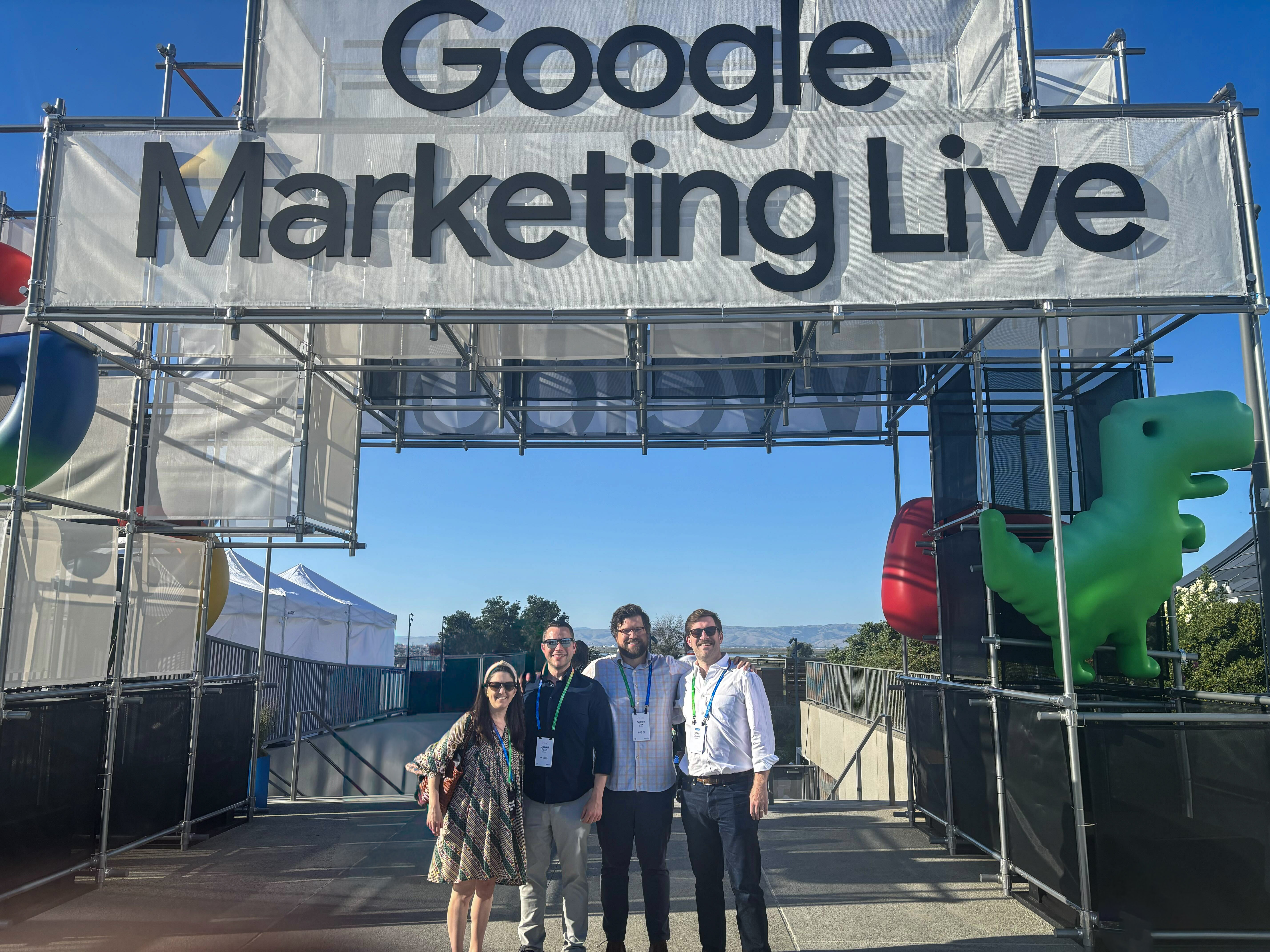
Three people in front of Google sign at GML 2024 event

Google Marketing Live 2024 on May 21st unveiled several game-changing features for advertising products, shaping the future of digital marketing. Our team was on the ground in all three locations – Mountain View, Los Angeles, and New York – to capture the announcements in real time and dissect their potential impact on marketers. Let’s break down the key takeaways for advertisers and what to do about these rollouts.

Here's what Google announced onstage.

The introduction of ad units within AI Overviews, the generative AI-powered section of the SERP, had long been speculated. These ad units were the missing component from Google I/O’s rollout of AI Overviews (formerly known as the Search Generative Experience, SGE) the prior week. AI Overview ads will integrate the power of Google's Gemini to deliver highly relevant ads based on user intent. Because the ad experience will be dynamic, this rollout is particularly impactful for verticals that can leverage product feeds like shopping and travel. We’re especially excited about the potential of AI Overview Ads when combined with complex search and visual search ads.

Google also announced several enhancements to Performance Max (PMax) campaigns, specifically asset and placement reporting. This long-awaited functionality allows advertisers to gain critical insights into how specific creative elements and YouTube video placements are performing in campaigns that previously did not have this transparency. Alicia Pachucki, Director of Search at Monks, mentioned: "The announcement of new Performance Max reporting by asset and by YouTube placement was met with huge cheers at the NYC event; clearly marketers were thrilled."

These insights will not only empower iterative creative learnings but also enhance the potency of hyper-personalized asset generation; with the potential to pair with generative AI workflows, such as those within Monks.Flow, this update will propel the scaled creation of high-performing, compelling assets. From there, performance marketers can do what performance marketers do best: test rapidly, with greater precision. Rob Shultz, Sr. Director of Ecommerce at Monks, added, "Asset-level reporting is a win for performance marketers everywhere. We’ve all been begging for more layers of the PMax black box to be unveiled to aid with optimization and creative strategy, and this is a massive step in that direction."

The introduction of profit optimization bidding for PMax, allowing advertisers to bid against product margins from their product data feed, is a “game changer” to Ezra Sackett, Associate Director of Search. “These columns have existed in Google Ads for a few years, but accurately uploading data to work with them has been out of reach for most ecommerce advertisers in the past.” Our team has seen positive success with the New Customer acquisition objective for PMax, and this complementing option caters to broader business needs for many ecommerce businesses. “It’s great to see that Google is bringing the algorithm closer and closer to the actual bottom line for the advertiser. This step from ROAS to POAS optimization has the potential to drive even more significant performance gains than the transition from CPA to ROAS bidding a few years ago,” says Sackett.

Several other PMax/Shopping features were announced, including:

  • Loyalty Promotions and New Customer Pricing, for personalized promotions in Shopping results based on a user’s prior purchasing status
  • Shopping ads in Lens Search results, fueled by the fact that “25% of Lens searches have commercial intent,” according to Google
  • Merchant Center Next auto-generated reporting/insights, to save marketers time
Monk Thoughts We're witnessing a shift in user behavior with how people are searching due to AI Overviews. It's our job as marketers to pivot with it, not try to resist.
Deanna Stein

Several new visual and experiential features were unveiled, including Image-to-Video, Virtual Try-On, Automated Product Highlights, and Visual Brand Profiles, all of which are powered by Google Gemini. These tools help ecommerce brands create more immersive shopping experiences and better convey the real-life look and feel of their products—without the need for costly and time-consuming physical product shoots. “Especially in my work with midmarket brands, the high costs of live product shoots can hold them back from producing enough motion and visual assets to effectively leverage YouTube ads and Demand Generation campaigns,” says Lauren Weisel, Sr. Director of Search. “Since the algorithm thrives off of more asset options, this can unlock great opportunities for performance, as well as differentiation in a competitive SERP environment.”

Other engaging ecommerce ad features that were announced include: 

  • Visual brand profile on Google Search, an image-forward companion to Google Business profiles to help brands stand out and differentiate. (Notably, Google shared that “more than 40% of Shopping searches mention a brand or retailer” in the query.)
  • More engaging ads on YouTube Shorts, including stickers, interactive gestures, and animated image ads generated from your product feed
  • Improved image generation for Performance Max and Demand Gen campaigns
  • Affiliate and Partnership program expansions for YouTube Shorts (powered by a Shopify integration and Google’s BrandConnect, respectively)

New updates to the Ads Data Manager are being made accessible to all advertisers, equipping them with the capability to organize and activate against disparate first-party data sources. The updated Data Manager capabilities will allow automated connection, transformation, and import of first-party data, making it easier to input the most up-to-date data with as little manual intervention as possible. Importantly, this is one of the few announcements from GML 2024 that is likely to have immediate impact beyond the ecommerce vertical—B2Bs and other brands with lead generation or signup objectives should take note. Since the ultimate goal of these updates is to enrich audience insights and targeting effectiveness by enhancing the quality of data inputs for AI-based bidding, B2Bs may stand to gain the most in the long run.

Other data features that were announced include:

  • Improvements in Lookalike segments for Demand Gen campaigns
  • Incorporation of AI Essentials into account optimization scores and recommendations
Images of Media.Monks team members at Google Marketing Live, and Shaquille O'Neal being interviewed onstage

GML 2024 was attended by Monks like SVP Search Tory Lariar and SVP Media Growth Greg Kirby (left), Alicia Pachucki, Group Director of Digital Strategy (right), hundreds of Google product leaders and key partners… oh, and Shaquille O’Neal (below).

Monks Takeaway: User behavior is shifting.

At a macro level, search behavior is evolving to favor longer, more complex search queries. During the GML keynote, Google highlighted that "search queries with 5+ words are growing 1.5x faster than shorter queries.” They also repeated that their long-touted statistic—that 15% of search queries every day are new to Google—still holds true today. It’s telling that even as the algorithm’s predictive capabilities evolve so drastically, users continue to seek information in unprecedented ways. There’s an interesting “what came first, the chicken or the egg” aspect to this: are users asking longer questions of search engines because it mirrors how they ask questions of humans (prompting Google to keep up) or are users’ queries more complex because the SERP results for shorter head terms are no longer meeting their needs? 

Advertiser Action Item: Optimize your keyword strategy for themes, not queries.

Regardless, the evolving SERP necessitates that advertisers pivot their keyword strategies to fit the changes in the product experience. Google’s discussion of the “Power Pair” of Performance Max and Broad match keywords is key here: Google recommends that brands lean into Broad Match to enhance relevance. This is true, but even beyond this: we believe advertisers must also incorporate long-tail terms as Broad match variations too, rather than just use Broad to pick up variants of head terms. Rob Shultz notes that moving forward, “keyword strategies will likely focus on Exact match for Brand terms and broad ‘themes’ everywhere else” to maintain relevance and effectiveness in search ads. Performance marketers must test into new best practices for Broad match variations, to determine ideal keyword lengths and clustering strategies to increase the relevancy of where we are trying to serve.

Monk Thoughts With every update we are moving more and more away from Exact and Phrase match types because we are moving further from being able to predict the variations of what a user will search.
Emmanuel Delamota

Monks Takeaway: We’ve arrived at the AI-powered SERP.

Through the keynote’s emphasis on the "Power Pair," Demand Gen campaigns, and ad placements within AI Overviews, it’s clear that automation will soon be the backbone of the entire SERP experience. The keywordless future is not a new concept, but GML 2024 does reinforce the inevitability of a future dominated by fully-automated campaigns. The role of marketers will shift to focus on managing the overlap between multiple black boxes (currently, Performance Max and Demand Gen with Feeds), rather than tweaking tactics ourselves. The verticals with the most to gain in the short term include ecommerce/retail and travel/hospitality; they’ll be the bellwethers marketers should monitor to understand what performs and what doesn’t in the AI-powered SERP.

Advertiser Action Item: Invest in improving the data you feed the algorithm.

Google’s sustained drive towards a dynamic, personalized, and AI-powered SERP experience will be underpinned by marketers’ inputs: product feeds, audience data, brand website content, and high-quality photography and video assets. The further brands can optimize the quality of these assets now, the better positioned they will be to be aiming the algorithm in the right direction to hit your goals. More importantly, as Google continues to incorporate more variations of optimization settings that are attuned to different business objectives (such as the ability to optimize to profit, as described above), advertisers who can build processes and data strategies to learn how to fuel the algorithm now will be best positioned to take advantage of more customized or relevant features down the line. There has never been a better time to invest in:

  • Optimizing your product feed for high-traffic terms and detailed product segmentation
  • A/B testing product images and testing generative AI and digital twin technology to get new images in market faster
  • Conversion-rate optimization, to balance out for potential decreases in site traffic
  • Enhanced 1P data strategies, both from a conversion tracking standpoint (server-side tracking, offline conversion imports, etc.) to audience data augmentation and segmentation (including CDPs and data integration tools)

If needed, brands should fund these initiatives by re-allocating from working ad dollars, using incrementality experimentation to identify non-incremental media spend that can be pulled away with little risk to the bottom line. Investing now in learning how to fuel the algorithms effectively will be one of the largest possible competitive advantages for brands as we continue moving forward into this AI-powered SERP.

At the nexus of the 2024 Google Marketing Live announcements lies a SERP and cross-channel landscape that are evolving in close conjunction with shifts in user behavior. These new features ultimately continue us on the path of evolving to a more streamlined advertising experience, combined with a more dynamic and immersive consumer experience. To avoid getting left behind, marketers must not only continue to evolve their strategies but ultimately reconceptualize their roles in this process as a hybrid of business analyst, prompt engineers, creative strategists, and more—in service of better arming ourselves to feed the algorithm the right kind of data, in the right way, at the right time.

See full recap and expert analysis of Google Marketing Live 2024, from Media.Monks' SEM leaders, with action items and recommendations for your ad strategy. See full recap and expert analysis of Google Marketing Live 2024, from Media.Monks' SEM leaders, with action items and recommendations for your ad strategy. paid search search engine marketing Paid Search Performance Media Emerging media

Search Generative Experience and Its Potential Impacts on Content and SEO

Search Generative Experience and Its Potential Impacts on Content and SEO

AI AI, Media, Paid Search 5 min read
Profile picture for user Maria Teresa Lopes

Written by
Maria Teresa Lopes
Content Technical Lead

header

In May 2023, Google announced the introduction of a new search experience that’s primarily based on the use of generative AI to adapt to new search behaviors. In Google’s own words, it’s a way to “unlock entirely new types of questions you never thought Search could answer, and transform the way information is organized, to help you sort through and make sense of what’s out there.” 

Search Generative Experience (SGE), or “generative Search Engine Results Pages (SERPs)” as I call it, serves as a facilitator for those seeking to find information on the web with greater speed. Instead of relying solely on keyword-based searches, you could pose complete questions and even follow up with additional inquiries, mimicking the conversational style of interacting with a language model-based chatbot.

However, since its launch, numerous discussions have arisen regarding this innovation—its advantages, disadvantages and potential limitations. For content marketing and SEO professionals, the question remains: what does this feature mean for our work?

What are the main changes we’ll see in the SERP?

Based on the various featured snippets and enhanced results currently available, it’s evident that the SGE will indeed greatly enhance users’ access to information. And if you are thinking, “I need a quick answer to a question, and I want it in an easily accessible place that allows me to navigate through complementary pages to delve deeper,” then Google will remain unrivaled. 

It’s like getting all you need in one search. And it makes sense, right? After all, Google held a global market share of 90.6% in June 2023, as reported by Similar Web. Additionally, according to Semrush's The State of Search, about one in five searches resulted in a click on the first search result. These are significant numbers, and when we talk about clicks in top positions, we are also referring to visits to sites that have a user-first mindset, promote quality content creation, respect the best practices of EEAT evaluations, conform to Google’s Helpful Content system and contribute to user engagement on the channel.

In terms of the interface, the biggest change brought about by SGE is at the top section of the search results page. Essentially, generative answers replace the traditional list of paid URLs, providing users with a more immersive and semantic experience.

The image below provides a clearer illustration—although it’s worth noting there are various result variations depending on the type of search, which I’ll explore below.

screenshot of how SGE looks

Source: Search Engine Land

Let’s look at some other examples I found.

1. Informational search for a public figure

screenshot of public figure search

The Knowledge Panel upon searching for Martin Luther King Jr. (In Portuguese)

When searching for a public figure, the Knowledge Panel still appears, and the SGE asks if you want to generate something from it. As the Knowledge Panel typically offers comprehensive information about public figures or brands, as long as the information on the corresponding Wikipedia page is reliable, SGE seems to recognize that it may not be necessary to generate or synthesize further information.

2. Transactional search

screenshot showing results after searching for smartphones

The main results page after searching for Samsung smartphones.

In the case of a transactional intent search, the SERP is predominantly taken over by ads. Upon reaching the end of the first scroll, SGE once again prompts you to generate information but doesn’t do it automatically. Since the search query involves a transactional keyword rather than an informative/transactional or commercial one (such as “best phones to buy on Black Friday”), SGE appears to comprehend that the user intends to view prices directly. For that, the Shopping results provided are deemed sufficient.

3. Geolocated search

sreenshot showing results after searching for restaurant in a specific location

The results page when searching for restaurants in a specific location.

In this example of a geolocated search, SGE does not appear in the first tab, and organic results are not altered in any way. This is probably based on the same reasoning behind the previous example.

4. Informational search about health


screenshot showing results when searching for health information on Google

The results page when googling health-related information.

In the case of an informative intent search, SGE generates a comprehensive answer while displaying the first three organic results as snippets on the side. This format allows users who are seeking detailed information to access a full article. This is one of the primary advantages that I envision in the Search Generative Experience scenario: users who visit blogs or similar platforms will likely be more qualified and engaged with the content they choose to explore.

5. Informational search about finance

screenshot of results when looking for financial info

The results page when googling "save money every month." The first thing that comes up is a line that reads, "Generative AI is experimental. The quality of information may vary. Find out more."

In another search involving a hybrid intent, encompassing both informative and commercial aspects, SGE is displayed in a condensed manner, while a list of Featured Snippets offers more comprehensive results just below. However, due to space limitations, SGE requires users to click on “See more” to access the complete information. Upon expanding the view, SGE provides somewhat more generalized tips compared to the Featured results—image below.

screenshot google search

Upon clicking on "Know more," the page expands and features a list of tips on how to save money and their respective sources.

Informational search about games

google search results page screenshot

The results page when googling "the evolution of videogames." The first thing that comes up is a line that reads, "Generative AI is experimental. The quality of information may vary. Find out more."

In a purely informative intent search, SGE once again appears in a condensed form, with the Ingram blog ranking as the top organic result. Additionally, a “People Also Ask” box is visible below. For SEO professionals, it is important to note that, according to data from Insight Partners, 57% of the result links mentioned by SGE are derived from the entire first page of organic results. This means that if your brand appears on that page, there is a significant likelihood that it will be referenced by the AI and consequently maintain high visibility.

How can brands prepare for SGE and succeed in this new landscape?

According to the information we have so far, the SERP will change. However, this is not the first time we’ve had to get used to changes, is it? Like other times, we are always preparing for future Google alterations. The extent to which this poses a challenge for brands depends on the quality and focus they put on SEO and content marketing.

SGE doesn’t change the core principle of SEO, which is to ensure visibility and relevance. It is important, therefore, that we see it as a new era for brands who want qualified organic visibility and are already working hard for it. It will still be very necessary to:

  • Continue evolving and seeking better practices for organic ranking, focusing on content that prioritizes being user-first and responding to search intent.
  • Increase care during article production, looking at expertise in the segment, optimizing features, and different ways to stand out in SGE.
  • Ensure continuous and in-depth understanding of SGE, delving into concepts like Answer Engine Optimization (AEO), for instance, rather than perceiving it as a “villain” in the SEO landscape.
  • Continue to adhere to the principle that content is king, and its quality will always be fundamental, with even greater emphasis on sharing authentic research and data, user-generated content (UGC), and utilizing various media formats. Incorporate linguistic inclusion, keywords from related semantic fields, and adapt to hybrid search intent. Additionally, ensure an optimized HTML structure.

To succeed in this new landscape, you have to immerse yourself in it and study it thoroughly. This is precisely what my team and I have been doing, and we recommend anyone interested in the subject to do the same. If your brand has not yet prioritized SEO, content marketing, and the essential work required to attract new users and populate the top of the funnel, now is an excellent time to do so. If needed, look for a team of specialists who can help you diagnose, detect, optimize, measure, and—of course—elevate your website to the top.

Our Content Technical Lead sums up everything you need to know about Google Search's new AI feature. Google search engine marketing content Media Paid Search AI

How AI-Driven Interfaces Help You Connect with Your Customer

How AI-Driven Interfaces Help You Connect with Your Customer

AI AI, AI & Emerging Technology Consulting, Digital transformation, Platform, Websites & Platforms 4 min read
Profile picture for user Niels Dortland

Written by
Niels Dortland
Group Creative Director

Stylized image of a woman looking at her laptop.

There’s a lot of talk about artificial intelligence (AI) related to marketing tools, trends and tech. But my latest obsession is how it can help build relationships between brands and customers—and how the current and coming changes will influence people’s behavior. As the AI revolution accelerates, how we interface with the internet itself stands to change. How will this be reflected in brand websites, apps and other platforms?

We’ve all seen and heard how generative AI can supercharge creative content production by creating large volumes of images, video and copy in just seconds. This is only one sliver of AI’s potential, because conversational interfaces that learn from us will profoundly transform the way we search for and discover products and information. And we’re already seeing it happen before our eyes: Instacart offers contextual advice for grocery shopping, Zalando created a virtual fashion consultant, and Intercom launched a GPT4-powered business messaging solution that can solve 50% of customer questions instantly. AI is changing the way people interact with your brand, and this is igniting a paradigm shift in brand interfaces and product design.

For many brands, this creates a challenge. How do we connect people with the right answer, content or product they are looking for? The examples above hint at an answer: AI and LLMs go a long way in making consumer experiences more intuitive. Here’s how we’re thinking about it in our Platforms practice.

New search behaviors will elevate the role of the dotcom.

One area that will drastically influence consumer behavior is search. Search is already the default starting point for consumers, but Google’s new AI-powered results page will soon be the only place a user needs to visit, bringing comparison and conversion onto one screen.

This brings some urgency to how brands approach their own platforms, because to bring their products to the top of search, they’ll need to think less about keywords and more about context and intent. What context would users search for around your products? What would they intend to do with it? What values do your offerings deliver to people?

No one yet can say how to solve SEO in the future. But we can help brands begin to integrate this layer of information into their catalogs and user experiences now to prepare for that kind of change—because in this new world, I see an elevated role for the brand dotcom. Think of Google as the department store that carries all brands, and your platform as the expressive branded spaces users will choose to go to connect and build a relationship. Delivering on this expectation will be the key factor to success in the age of AI.

AI is elevating the brand experience.

I’ll extend the department store analogy a little bit further to illustrate the role of AI on modern digital platforms. A good store employee only asks if they can help at the right moment, and AI will likewise be to gently and organically nudge users through conversation. The difference is that AI will be fully trained on your brand, products and services and can represent those perfectly. Think personal product advice, answers, cross- and up-sales, all in the context of a user’s intent.

A restaurant chain, for example, might use natural language to transform its ordering platform, especially for catering and large orders. Rather than scroll through a menu, users could describe an occasion, like “I’m throwing a birthday party for my 5-year-old son. We’ll have 15 people, mostly children.” The system can then take that information and recommend a customized party package. Any allergies among or dietary restrictions in the group? Not a problem—the AI can edit the order for the customer to review. Think of AI as a butler for your brand and its customers.

More personalized experiences give more opportunities for relationship building.

These little details—why you’re ordering, when you need it by, plus any additional personal requests—go a long way in getting to know your customers. The results are both better customer experiences and the ability to forge hyper-personal relationships, ultimately fulfilling the original promise of digital.

We are finally moving beyond segments and personas. A properly programmed AI understands every user’s personal sentiments, curiosities and needs, because it’s able to pull from and connect different pieces of data from across the consumer ecosystem. It can remember those facts and become more personal with every interaction, like offering personalized promotions and loyalty incentives honed to every user’s context. This new type of personalization shows great promise for conversion.

It's also great for building customer loyalty, because AI unlocks interactions that are designed specifically for building longer lasting relationships with them. As customers engage over time, their interactions across the platform produce greater and more detailed insights that can be used to further optimize the experience and deliver upon their unique needs.

Start with a sprint, then optimize and personalize.

AI will continue to shape consumer expectations and behaviors, underscoring the need for platforms that can pivot with speed and agility. It’s more important now than ever to be able to listen, learn and adapt to how your customers are engaging.

On the flip side, that means your implementation of AI is also always a work in progress. If any of the above sounds interesting to you, rest assured that you don’t have to make a full overhaul of your website. It starts with looking at what you already have and seeing if your tech stack can support these hyper-personalized experiences. Innovation sprints or experimenting with building better experiences—on the main dotcom or maybe in a separate domain—are great places to start, as are smarter search functions that are fairly easy to implement. Then optimize continuously to perfect your toolkit and extend your ability to personalize.

It's too early to say with utmost specificity how AI will shape customer experiences years down the line. But by realizing how recent AI developments are serving pre-existing marketing goals—more personalized user flows, greater customer loyalty, and an elevated brand experience—it’s clear that now is the time to lay the foundations for AI-powered customer journeys.

Want to learn more about how our platforms team can support you in building more personalized experiences?

As the AI revolution accelerates, how we interface with the internet itself stands to change. Find out how this will be reflected in websites, apps and other platforms. AI digital platforms apps mobile app development search engine marketing Platform AI & Emerging Technology Consulting Websites & Platforms AI Digital transformation

How AI is Influencing the Future of Search

How AI is Influencing the Future of Search

AI AI, Data maturity, Media, Paid Search 5 min read
Profile picture for user Tory Lariar

Written by
Tory Lariar
SVP, Paid Search

Two hands typing on a laptop

The future of search is undoubtedly going to be shaped by the integration of artificial intelligence, particularly large language models (LLMs) such as Google Bard and OpenAI GPT-4, and brands that want to stay ahead of the curve should seek to understand how AI will influence search.

Those who engage with AI will be better equipped to deliver personalized, relevant and effective content that engages users and helps them stand out in an increasingly competitive digital landscape, and they may do so by investing in first-party data integration, testing AI-driven bidding and creative tools, experimenting with more visual content, and preparing for the eventuality that AI will change the search engine results page (SERP) ad landscape as we know it.

Late last year, ChatGPT took the world by storm, becoming the fastest product in history to accumulate one million users in just five days. This same technology went on to power the launch of Microsoft’s new Bing search experience. Since then, Bing launched an ads experience that surfaces ads and recommendations based on relevance to the conversation. This seems to be working, as the search engine's audience has grown significantly to over 100 million daily active users.

Unsurprisingly, Google is beginning a limited release of the Search Generative Experience, with ad formats that are highly focused on travel and shopping experiences. Meanwhile, the traditional Google SERP will bring in generative AI responses to further improve how we search for, engage and ingest information we seek. Search ads will continue to show in traditional ad slots, but there will be a totally different experience based on the conversation, rendering relevant links and ads.

Still, artificial intelligence isn’t new to search; in fact, it influences a variety of factors that influence results, from bidding to search query matching to creative optimization. But the introduction of large language models (LLMs) into the equation will significantly impact not only the user experience, but also how content is valued and ranked on the results page and how we buy media. They’ll also significantly change the way we create content. Here are three big ways the future of search will force brands to adapt—and what you need to do now to stay ahead of the curve.

AI-generated content will be a double-edged sword.

 Conversational search opens the possibility of delivering highly relevant, personalized responses to users on the fly. While the benefits to this are obvious, AI’s talent for spinning up content on its own presents a double-edged sword. Some verticals—like healthcare, pharma and finance—will struggle to keep up with the pace of automation given the various rounds of legal and regulatory approval required for their creative before it goes live.  

AI-generated content risks circumventing these hurdles. It’s also vulnerable to spreading misinformation. But brands can mitigate these concerns by ensuring human review before the approval and publication of ads. Through proper tuning and training of AI models, brands can quickly spin up content that incorporates regulatory guidelines that they are beholden to.

Search will be more engaging, visual, and interactive.

The future of search isn’t all text. Search is also skewing toward more visual and experiential content. Sure, image extensions make search more visually engaging to users. But also consider more sophisticated platforms like Google Lens or Snapchat Scan, which use computer vision to make a user’s surroundings searchable. AR is another format that will add a new dimension to search and is already offered by Google, allowing users to engage directly with virtual animals, objects and places in real time.

The idea is to build a more immersive experience versus the infinite scroll. Travel, retail and lifestyle brands may benefit most from this because they already have robust libraries of visual assets to draw from. Others, like B2B brands, healthcare, pharma, and finance, will need to catch up by building libraries of visual and experiential content that engage users to avoid stock images. At the recent Google Marketing Live, new products for asset creation using generative AI were announced, making it easier for those without libraries to build creative in Google’s advertising platform. Generative AI can certainly help brands develop assets at speed and scale, although it’s important to remember that they aren’t yet production ready on their own. There may also be open questions of legal ownership and intellectual property rights.

Data streams will continue making search more predictive and proactive.

Search is already steering in a direction where it can serve more personalized results based on previous activity or what the search engine already knows about you—for example, suggesting local restaurants when searching for food on Google, or recommending related products on an Amazon product page. These experiences generally help users find what they’re searching for faster and keep them coming back for future searches.

It’s not a stretch of the imagination, then, to envision a future in which search engines anticipate user needs before they are typed. They will go beyond keyword query and apply previous behaviors and contextual information—like the intent unlocked by a conversational interface—to generate entirely unique responses for each user. That sounds amazing, but the more conversational search improves, the better it will be at delivering answers that satisfy users’ queries without their having to click through to another website—reducing opportunities for ads in the traditional sense.

The data streams that enable this experience will play an outsized role in how search continues to evolve. Brands who have first-party data will have opportunities to use it to enable even greater predictive and personalized experiences. While we don’t know for sure how this space will evolve—concerns about privacy and transparency, especially globally, may interrupt progress here—it seems likely that search experiences will continue to evolve in this trend. The lesson is clear for brands: the accumulation of data assets and the ability to deploy AI will be differentiators as the SERP ad landscape changes.

Don’t wait to update your search strategy.

Unsurprisingly, a strong data foundation will be crucial to keeping ahead of these changes. Maintain a competitive edge by investing in first-party data integrated across touchpoints in the conversion cycle. Apply conversion modeling to help fuel more relevant ads and higher returns. These insights will prove critical as brands adapt to conversational search, providing them with the insights and tools they need to deliver more personalized, relevant and effective content.

Speaking of content, brands can also future proof by updating their approach to activation and creative. Test AI though bidding, ad creative and playing with broad matches. Experiment with tools like Google’s Performance Max—an AI feature deployed in the GMP suite that allows for cross channel campaign launches and optimizations all from a single campaign configuration—and automated asset generation.

Finally, break away from relying on text by testing more image extensions and invest in performance creative to help stand out. Leveraging AI to optimize and find the best creative combinations will help brands adopt a more asset-based approach and prepare for search’s increasingly experiential, visual and conversational interfaces.

All of these developments are happening right now, and brands will need to adapt through experimentation with emerging AI tools.

By doing so, they will be better equipped to deliver personalized, relevant, and effective content that engages users and helps them stand out in an increasingly competitive digital landscape. And lastly, AI is far from perfect, so check the sources and verify the generative responses.

Learn how search will be shaped by the integration of artificial intelligence, and how brands can stay ahead of the curve. artificial intelligence paid search AI first-party data search engine marketing Media Paid Search AI Data maturity
`

Paid Search

Paid Search Performance

Achieve measurable growth with tailored paid search strategies.

search mapping
search

Goal-Driven Search Engine Marketing Strategy

Our SEM strategy starts with your business goals first. Our clients range from high-growth disruptors to major big box retailers and leading public companies, but they all have one thing in common: they all know that we drive measurable growth with paid search strategies that cover the entire customer journey.

Logos of notable brands that we have worked with

Drive Results with Paid Search, Get in Touch with Our Team Today

Hey👋

Please fill out the following quick questions so you can learn more about your business.

  1. SEM Services • Our teams specialize in all aspects of the ever-evolving search landscape where search is no longer keyword only, but inclusive of image, video, audience, feeds, and voice.

  2. Data & Measurement

    Data integration and measurement play integral roles when ensuring our partners are maximing their media dollars in SEM.


    eCommerce

    Our eCommerce experts drive direct sales through end-to-end feed & shopping optimizations.

  3. Ad Copy

    We turn your industry expertise into meaningful messaging that delivers proven results.


    Keywords

    While keywords remain at the forefront of traditional SEM, we are experts in the full funnel search experience that delivers results.

  4. Automation

    Automation is at the core of our SEM strategy. Our teams provide necessary human input to ensure optimal algorithm performance.


    Testing

    Our methodical and systematic testing through a robust learning agenda ensures consistent improvement in business KPI's.

  5. Lead Gen

    Our focus on Lead Quality & Offline Conversion Tracking means we deliver qualified Opportunities to your SDRs.


    Beyond Traditional Search

    The full-funnel approach doesn't end with Search. App, Video and Display are key components in our holistic media strategy.

  6. Find Out More About Our Paid Search Services.

Swipe
For More!

Drag
For More!

See How we Increased Paycor's Leads with Paid Search

Paycor logo
A phone showing Paycor's application interface

Case Study

Audience-Based Market GrowthWith our custom data reporting tool, we helped Paycor scale audience-based growth, resulting in a 240% increase in leads.

See Full Case Study

Get in Touch with Our Paid Search Team

Hey👋

Let us know how we can reach you and discuss how to grow your business.

Interested in more? Here's some related content for you.

Choose your language

Choose your language

The website has been translated to English with the help of Humans and AI

Dismiss