Choose your language

Choose your language

The website has been translated to English with the help of Humans and AI

Dismiss

Five Operational Shifts Every Amazon Vendor Should Prepare For in 2026

Five Operational Shifts Every Amazon Vendor Should Prepare For in 2026

Commerce Commerce, Retail media, eCommerce Platforms 3 min read
Profile picture for user mediamonks

Written by
Monks

amazon-in-2026

Amazon’s expectations for vendors are rising as the platform shifts from a simple point of purchase to a partner across the full customer journey. As Amazon builds a more integrated and efficient ecosystem, Vendor Central performance is expected to match that same level of discipline. The front end of the business is becoming faster and more connected, and vendors are now expected to remove friction in their own supply chains to keep pace. Operational precision now carries the same weight as product strength or advertising performance.

Here are the five operational realities vendors must prepare for in 2026.

1. Annual vendor negotiations will be more margin-focused.

As Amazon continues to formalize cost recovery and efficiency standards, annual vendor negotiations are expected to prioritize funding structure, freight terms and profitability. Clear, defensible cost data will be increasingly important in these conversations.

What to do now: Build a cost-to-serve model. Quantify the value you already deliver, such as high Electronic Data Interchange (EDI) accuracy, low defect rates and consistent on-time performance. These metrics translate directly into cost savings for Amazon and help you defend your terms. Shifting the conversation from “price” to “total value” is essential.

2. Inbound compliance is entering a zero-tolerance phase.

Amazon is tightening rules across EDI, carton-level accuracy and packaging standards. The goal is a fully automated receiving process. Anything that requires manual review will lead to rejections and chargebacks.

What to do now: Automate validation across the entire workflow. Every PO, label and ASIN should be confirmed before shipment. If your systems cannot catch issues immediately, you increase the risk of inventory being rejected at the dock, which stalls sales momentum and disrupts replenishment.

3. Low-inventory-level (LIL) fees at the FNSKU level raise the stakes.

For 2026, Amazon will apply LIL fees at the individual FNSKU level instead of the parent ASIN, meaning each variation you sell will be evaluated on its own. A single popular SKU selling out can now trigger fees even when the rest of the line is fully stocked, creating new margin pressure.

What to do now: Run a variation-level profitability audit. If a specific size or color cannot maintain the inventory stability required under the new rule, consider removing it from Vendor Central or shifting it to Direct Fulfillment. Slow-moving variations can no longer hide behind top-sellers.

4. Purchase order (PO) delays and partial orders will remain common.

Despite Amazon’s broader push for efficiency, PO volatility is expected to continue in 2026. Delayed or partial orders can create major disconnects between supply chain planning and campaign execution. A cut PO during a product launch can turn your ad spend into wasted investment.

What to do now: Strengthen real-time PO visibility. You need immediate insight into order changes, shipment status and confirmation timelines. This allows your teams to adjust spend, pacing or retailer promotions before inefficiencies compound.

5. Tariff and sourcing shifts will pressure margins.

Global trade volatility and rising tariffs, especially on goods from China, will continue to affect landed cost and vendor profitability. Relying on a single sourcing region increases risk in a year where Amazon is tightening its financial expectations.

What to do now: Pursue a two-track approach. Explore diversification into regions such as Mexico or Vietnam while also stabilizing near-term costs. Forward buying in early quarters, reviewing contracts for tariff pass-through clauses, and rebalancing your ASIN mix can help protect margin throughout 2026.

Aligning with Amazon’s direction. 

While recent conversation around Amazon has focused on advertising improvements, the larger message applies across the ecosystem. Amazon is pushing for fewer bottlenecks and stronger operational discipline, and vendors who match that rigor will be better positioned in 2026 negotiations, replenishment and long-term growth. The opportunity remains significant, but the margin for error is shrinking. Success now depends on connecting your marketing vision with operational accuracy so talent, technology and data work together rather than in silos. Now is the time to tighten your foundation and ensure your Vendor Central workflows meet Amazon’s rising expectations. Reach out if you want help assessing your readiness for the year ahead.

Learn about the key operational shifts coming to Amazon Vendor Central and what they mean for vendor negotiations, compliance, and inventory planning. Five Operational Shifts Every Amazon Vendor Should Prepare For in 2026 Learn about the key operational shifts coming to Amazon Vendor Central and what they mean for vendor negotiations, compliance, and inventory planning. amazon amazon ads Amazon Ads Partner amazon announcements vendor central amazon vendors amazon account management Commerce eCommerce Platforms Retail media

Winning on Streaming TV

Winning on Streaming TV

Emerging media Emerging media, Performance Media, Video (TV/CTV) 3 min read
Profile picture for user Ladipo Fagbola

Written by
Ladipo Fagbola
Ecommerce Account Director

A rear view of a standing crowd in a large, dimly lit indoor venue, focusing on a man in a plaid shirt in the center. To his left, a woman holds a small child who is looking sideways, while the foreground and background contain other attendees blurred out of focus.

At a glance:

The democratization of streaming TV advertising now enables mid-sized, non-endemic brands to leverage Prime Video’s premium inventory to drive proven performance. Here’s how this creates a competitive edge:

  • Premium access for all: Amazon Ads has leveled the playing field, granting independent agencies and mid-sized brands access to massive reach—covering 82% of UK households—that was previously reserved for massive budgets.
  • Attention over CPM: While Prime Video inventory may carry a higher initial cost (CPM), it delivers superior value by generating 3x the attention of social video platforms among a younger, affluent demographic.
  • Proven efficiency: Real-world case studies validate this high-quality approach, demonstrating that despite higher upfront costs, premium streaming placements can reduce Cost Per Action (CPA) by 26% while driving significant lifts in brand awareness.

Mid-sized brands can now access premium streaming TV.

Recently, Monks and Amazon Ads co-hosted the Alliance of Independent Agencies at Amazon’s Principal Place office in London. The room was filled with a diverse mix of agencies, some already advanced in Amazon Ads, others just contemplating direct access. However, the unifying theme of the event was clear: the democratization of high-attention, full-funnel media.

For brand managers at mid-sized companies, especially those in “non-endemic” sectors like finance, travel, and entertainment that don't sell physical products on Amazon, this shift represents a significant opportunity. High-quality Connected TV (CTV) inventory on Prime Video, once primarily the domain of massive budgets, is now accessible to independent agencies. Here are the key insights from the event on how brands can leverage this new landscape to drive performance.

Amazon Ads has democratized premium reach.

The event discussions centered on Amazon Ads' evolution into a “one-stop shop” for all advertisers, regardless of their retail presence. The strategy hinges on the massive reach of Amazon in 82% of UK households and Prime Video’s 22 million viewers monthly.

Speakers highlighted that the right partnership now levels the playing field for mid-sized non-endemic brands. Monks helps reduce three core barriers discussed at the event: making access and budget work through consolidated spend; handling the technical heavy lifting of DSP setup; and empowering teams with strategic knowledge. As noted during the session, this direct access allows independent agencies to compete for premium attention previously out of reach.

Prime Video delivers value through attention.

During a standout presentation, Joe Hayes, Senior Video Sales Specialist at Amazon, offered a deep dive into the value of the Prime Video audience, typically younger and more affluent viewers who subscribe to Prime. Accessing such a premium demographic often leads to additional audience fees in typical CTV media buys. On Prime Video, this is the core audience. 

Hayes argued that judging media efficiency solely by initial impression cost is a trap. The real metric to watch is attention. He cited research from Lumen indicating that Prime Video delivers 3X the attention compared to social video platforms, showing how paying for an affluent, engaged audience in a lower ad-load environment ultimately drives better efficiency.

Real-world data proves value of investment.

To prove that this strategy isn't just theory, we shared a case study from a recent partnership with a non-endemic entertainment brand focused on sign-ups and brand awareness. The data presented was stark: despite a 14% higher CPM versus a popular programmatic video provider, the campaign delivered a 26% lower Cost Per Action (CPA). These high-attention placements also drove a 5PP lift in brand awareness and a 3PP lift in favorability. The case study reinforced the event's core message: high-quality, high-attention inventory is a clear path to driving both brand building and lower-funnel efficiency when media is properly orchestrated.

Embrace a new competitive edge.

The gathering at Principal Place served as a signal that the playing field has been leveled. World-class attention and audience data are now available to engaged independent agencies.

However, the consensus was that access is only the starting point. The competitive advantage now rests with specialists capable of turning complex Amazon data signals into clear, measurable ROI. As the presentations concluded, it was clear that the future of media for non-endemic brands is being written on the largest screen in the house, streaming TV.

Mid-sized brands can now win with streaming tv advertising on Prime Video. Access premium inventory for 3x attention and proven efficiency. social video amazon ads streaming tv advertising prime video Video (TV/CTV) Performance Media Emerging media

Why Your Holiday Ads ROI Doesn’t Matter (Yet)

Why Your Holiday Ads ROI Doesn’t Matter (Yet)

Commerce Commerce, Data Strategy & Advisory, Media Strategy & Planning, Retail media, Seasonal marketing, eCommerce Platforms 3 min read
Profile picture for user Wyatt Burley

Written by
Wyatt Burley
Senior Advertising Manager

holiday-roi

Every ecommerce and retail advertiser knows the pressure placed on holiday ad campaigns. Budgets climb, expectations rise, and leadership starts asking one question: did we actually see a return?

Most brands look to return-on-ad-spend (ROAS) or advertising-cost-of-sales (ACoS) for the answer during their holiday ad flights. But those metrics often tell the wrong story for meaningful growth. Chasing a low ACoS or high ROAS in November might look like smart efficiency, yet it’s one of the fastest ways to hurt long-term performance.

The real ROI of Q4 shows up in Q1.

The real value of Q4 isn’t the short-term revenue spike but the audience and data foundation it builds for Q1 and beyond.

The purchase path data I’ve seen across brands reinforces this idea. Using five-year lookback windows from my clients’ Amazon Marketing Cloud (AMC) instances, the data consistently shows that Q4 shoppers often make another purchase within three months. These repeat purchases start meaningfully changing the unit economics of customer acquisition and strengthening organic visibility across product lines. This shows that strategic holiday spend can deliver returns long after the season ends.

When it’s time to defend your budget, position Q4 spend for what it is: a prepaid customer acquisition voucher for Q1, bought at a 50 percent discount. This framing eases CFO concerns about short-term efficiency when you have the data to show you are buying future Customer Lifetime Value (LTV) that outweighs the immediate cost. Effective brands measure beyond short-term revenue by tracking LTV, New-to-Brand (NTB) acquisition, and repeat purchase rate.

If you don’t have AMC, start by tracking NTB Purchase Share during Q4 and revisit those shoppers in Q1. Quantifying how many came back and bought more can demonstrate long-term value without a complex tech stack. 

But the groundwork for that ROI is laid earlier than you think.

Many brands still invest the majority of their ad dollars in an extremely short holiday window and hold their breath for marketing KPIs hour by hour throughout Cyber Week. However, there are two challenges with this.

First, ROAS and ACoS are shaped by two unpredictable variables that marketers do not have direct control over: cost-per-click (CPC) and conversion rate (CVR). When those shift drastically due to surges in shopping behavior (for example, we often see CVRs double in a matter of hours or days once deal periods begin around November 21), performance can look unstable even when it isn’t. If you react by lowering bids or cutting keywords that are performing, you’re playing a losing game of whack-a-mole and risk losing reach right when shoppers are ready to buy.

Second, the data shows that purchasing behavior is spread over a much wider window. Aligning spend with real shopper behavior makes every dollar work harder, and brands that stay active through this lead-in period capture the surge when shoppers move from browsing to purchasing. Brands should think of holiday in three phases with long bookends: late summer through early November builds awareness and consideration. Mid-November through Cyber Week drives conversion. Early to mid-December is for remarketing and retention, which trickles into that Q1 payoff mentioned before. Each phase compounds on the one before it. Instead of aiming for perfection in ad performance during a handful of days, focus on building momentum in the weeks and months preceding.

The payoff from investing early in generating demand dwarfs the effect of focusing so heavily on demand capture during Cyber Week, but requires time-sensitive shifts to your media planning. For example, video is one of the best ways to prime consumers earlier in the buying journey, but many DSPs and publishers of premium video placements (from Disney to Netflix, to Amazon) shift toward guaranteed buys during the holidays. Late planners or brands trying to react to in-flight micro trends during peak periods will be priced out of top placements. Securing them early gives you an edge competitors can’t match, and primes consumers for purchase of your products before the competition heats up.

Measure the health of Q1, not just the success of Q4.

When brands treat the holidays as an investment in future performance rather than a sales sprint, they start the new year ahead. The best-performing brands keep investing through the holidays and enter January with stronger visibility, more efficient ad spend, and shoppers who convert faster.

Watch your post-holiday data closely. Consistent traffic to product detail pages and steady organic conversion rates are signs that your strategy is working. These indicators show that visibility and intent built during Q4 are carrying into the new year.

The smartest brands see Q4 (and earlier) as the start of a new growth cycle, not the entire moment of payoff. Every dollar spent builds data, loyalty, and future revenue. That is how short-term spend becomes long-term strength, and how real ROI is earned.

If you want to refine your Amazon holiday planning or evaluate your Q4 to Q1 performance, connect with our team.

See how Amazon holiday advertising turns Q4 spend into long-term holiday ROI by driving new-to-brand growth, repeat buys, and stronger Q1 performance. Why Your Holiday Ads ROI Doesn’t Matter (Yet) See how Amazon holiday advertising turns Q4 spend into long-term holiday ROI by driving new-to-brand growth, repeat buys, and stronger Q1 performance. amazon holiday advertising holiday roi holiday advertising strategy holiday campaigns ecommerce strategy amazon ads amazon dsp amazon marketing cloud amc ROAS acos q4 success seasonal campaigns holiday marketing amazon advertising Commerce eCommerce Platforms Media Strategy & Planning Data Strategy & Advisory Retail media Seasonal marketing

What unBoxed 2025 Tells Us About the Future of Amazon Advertising

What unBoxed 2025 Tells Us About the Future of Amazon Advertising

Commerce Commerce, Retail media, eCommerce Platforms 4 min read
Profile picture for user mediamonks

Written by
Monks

unboxed-mainstage

Amazon Ads’ annual unBoxed conference gives advertisers a glimpse into how Amazon is evolving their advertising solutions to help brands reach shoppers more effectively. The Monks team was on the ground (and onstage!) to get the latest news, so we can help brands stay on top of the changes.

This year, Amazon’s keynotes reinforced a clear message: positioning their ad offering as “full-funnel, at scale, for everyone.” Every announcement aimed to unite ad types, streamline operations and measurement for advertisers, and make creative more accessible to brands of all sizes. Here’s what advertisers need to know about the new product lineup, and what it tells us about the future of Amazon Ads.

Here’s what’s rolling out across Amazon’s newest products.

1. Eliminating silos between awareness and conversion. 

Amazon is making it easier for advertisers to connect upper- and lower-funnel campaigns, closing gaps that often make measurement and optimization harder. Brands should keep an eye out for:

  • Full-Funnel Campaigns, a new campaign type that expands on last year’s Brand+ and Performance+ formats. Amazon cited examples in which Brand+ and Performance+ are most effective when run together, such as a 144% lift in conversion rate and a 35% improvement in cost per acquisition for H&R Block, so they created a product to deliver that effect in one.
  • New consolidated interfaces to unite upper- and lower-funnel ads in one view. The new Campaign Manager combines AMS/Ad Console and Amazon DSP into a single workspace. This provides a complete view of Sponsored Products, Sponsored Brands, and programmatic campaigns in one place. Crucially, it also includes new unified metrics so brands can make apples-to-apples decisions. Amazon is doing the same for streaming and linear TV, launching Complete TV and Inventory Hub to unite digital and traditional media planning.
2. Democratized access to creative generation and deeper insights, even for smaller advertisers. 

Amazon is improving access to advanced creative and analytical tools for brands of all sizes. These updates help teams large and small act faster and test new ideas with fewer barriers. Brands should experiment with:

  • Ads Agent, an AI assistant that uses natural language to understand ad performance, make changes instantly, uncover new audiences, and pull insights from Amazon Marketing Cloud (AMC) without SQL knowledge or data science support.
  • The improved Creative Studio produces image, video and audio ads using generative AI with greater fidelity and complexity than prior iterations of the tool. For brands without a deep bench of design resources, this enables faster creative production and more relevant messaging during shopping “micromoments” and holidays.
3. A more educational shopper experience to reduce “leaky” funnels. 

These updates make it easier for shoppers to educate themselves and overcome friction while in the middle of their Amazon search journey, ultimately boosting sales for brands who need to educate their buyer in order to win the sale. The Amazon results feed will now include:

  • Sponsored Products Video, for brands to showcase motion assets directly within search results. This could be key for challenger brands to highlight their differentiators without requiring users to reach the product detail page.
  • AI Prompts, powered by Rufus, to anticipate shopper hesitations and educate them while they compare products. The in-feed Q&A modules will guide shoppers toward purchase by educating them when they’ve slowed their scroll through the results list.

Amazon’s changes point to two major themes.

Amazon is making it clear that they’re investing in taking control of advertiser perception of their offering, and are aiming to get two major themes across to brands:

  • They’re in your corner and responsive to your feedback. In all main stage talks, Amazon leadership reinforced how many of the product evolutions they were announcing were direct results of feedback from brands and partners. For example, advertisers have long asked for more accessibility and actionability from the gold mine of shopping data Amazon controls; in response, they expanded AMC’s ad-traffic lookback window from 13 to 25 months, launched country-level budget/bids in Amazon Ads Console, and premiered the Ads Agent for generating SQL queries faster. Additionally, even evolutions of existing products—like the launch of Sponsored Products Video—achieved an audible reaction of delight on the conference floor because brands have long asked for more engaging ways to stand out on the results page.
  • They’re more than the largest point of purchase, they’re the most integrated ecosystem in digital commerce. Amazon is making the most of their huge investments in upper-funnel properties (from Prime Video to Thursday Night Football to Twitch) with the launch of dedicated products for closing the gap between discovery and conversion. In the context of their history as an ad platform, these rollouts are an even firmer push into efficient, insight-driven advertising across the full funnel. Amazon is solidifying their shift from a purchase-focused platform into a connected ecosystem that partners with brands to drive discovery and educate shoppers, not just convert demand.

Prepare for the next chapter of Amazon advertising. 

This year’s unBoxed event showed a clear direction for where Amazon advertising is heading. Campaign management, creative production, and performance measurement are becoming unified to give advertisers more speed and clarity across the funnel. Looking to 2026, Amazon is positioning itself as an integrated partner for brands throughout the entire buyer journey, not only at the point of purchase.

As innovation accelerates, the opportunity lies in choosing the advancements that support long-term goals and applying them in measurable ways. Amazon Ads’ unBoxed 2025 offered a preview of what the future of commerce media will look like when insights, creative and optimization work within one connected ecosystem. If you’re exploring how these updates could fit into your 2026 plans, reach out and we can help assess which changes are worth testing.

unboxed team photo-1
unboxed team photos-2
Learn about key updates from Amazon Ads unBoxed 2025 and what they mean for brands’ full-funnel growth strategies for holiday and 2026. What unBoxed 2025 Tells Us About the Future of Amazon Advertising Learn about key updates from Amazon Ads unBoxed 2025 and what they mean for brands’ full-funnel growth strategies for holiday and 2026. amazon amazon ads amazon advertising full-funnel media Amazon Ads Partner amazon unboxed amazon announcements amazon advertising updates full funnel advertising Commerce eCommerce Platforms Retail media

Amazon’s Full-Funnel Strategy Just Inverted, and It Changes Everything

Amazon’s Full-Funnel Strategy Just Inverted, and It Changes Everything

Emerging media Emerging media, Performance Media, Real-Time Brands, Video (TV/CTV) 3 min read
Profile picture for user Ladipo Fagbola

Written by
Ladipo Fagbola
Ecommerce Account Director

Amazon Upfront UK

For years, Amazon Ads has championed a full-funnel narrative, but its 2025 UK Upfront presentation made one thing clear: the strategy has undergone a fundamental, strategic inversion. The central theme moved beyond reach and content, signaling Amazon's ambition to become the central operating system for modern advertising.

Just a few years ago, the conversation was about pushing large, endemic brands (brands who sell products on Amazon’s marketplace) to consider Amazon’s DSP for upper-funnel activations. The argument was functional but limited, with owned and operated (O&O) video largely confined to Twitch. The introduction of Prime Video advertising flipped the script entirely: today, Prime Video's ad inventory is dominated by large, non-endemic advertisers, like BYD, Morrisons and Uber Eats. Major non-endemic advertisers have been drawn by the promise of massive, engaged audiences, now reaching over 22 million monthly viewers in the UK.

Amazon's full-funnel message has pivoted to compelling new, top-of-funnel advertisers to engage further down the funnel. The strategy leverages Amazon's entire ecosystem to drive mid- and lower-funnel activations.  It’s a culture shift that has happened in less than three years, transforming Amazon Ads from a retail media network into a comprehensive media powerhouse.

Amazon is applying its 'everything store' principle to advertising.

Amazon’s strategic evolution in advertising mirrors the DNA of its marketplace, resulting in an  "everything store" for advertisers. 

The 2025 UK Upfront made this most evident through the sheer diversity of its original content slate.  From the reality-comedy of Last One Laughing and the high-stakes thriller Steal, to Riz Ahmed’s decade-in-the-making project, Bait, Amazon is serving every genre and niche of the entertainment landscape simultaneously. In the original ecommerce marketplace, unparalleled selection is key; Amazon is now applying that same principle to content. The significant number of actor-, writer-, and director-led projects brings fresh perspectives that might not find a home within traditional broadcast frameworks. This commitment is underscored by a promised £40 billion investment in UK content, signaling an ambition to outmatch competitors on content diversity by several magnitudes. The wider the audiences Amazon can attract with this programming, the more firepower they have to entice both endemic and non-endemic advertisers.

Beyond O&O, Amazon’s recent partnership announcements reflect an “everything store” approach to buying ad inventory as well. With recent integrations with platforms like Spotify, Netflix, and Disney, Amazon is embedding its marketplace DNA into its media offering. If an advertiser’s ideal inventory isn’t on an Amazon property, Amazon Ads can act as the trusted pathfinder to connect them, all powered by the first-party data collected across the marketplace and O&O properties. The announcement at Upfront UK that Amazon DSP can now reach eight out of ten UK households underscores this immense scale.

New ad formats signal a shift from engagement to orchestration.

All of the announcements at the Upfront UK signal that engagement and customer centricity are top of mind. The introduction of interactive pause and video ads, which their data shows have already proven to lift orders by 36% in the US, was deliberately timed. By allowing competitors to introduce the initial friction of new ad formats, Amazon aims to follow with a superior, data-driven version that enhances rather than disrupts the consumer experience. 

The Upfront programming also highlighted the effectiveness of engaging consumers in high-attention cultural moments. For example, the Morrisons sponsorship of Clarkson's Farm stood out, having driven a 17% increase in brand favorability.  Prime Video is one of many content subscriptions for consumers, but Amazon’s roadmap makes it clear they’re capturing attention share in a way that advertisers can’t ignore.

This year’s Upfront UK marked a turning point. Amazon's business has evolved from selling media into building an orchestration system where content, commerce and technology converge to deliver full-funnel advertising at scale. The future of advertising now hinges on choosing a comprehensive platform over individual channels, and Amazon is making a compelling case to be the only one marketers need.

Want to learn more about these updates and how Monks can help you maximize your Amazon Ads strategy? Learn more about our Amazon Ads capabilities by following the link below. 

Explore the game-changing strategy shift revealed at Amazon's 2025 UK Upfront. Learn how Prime Video, new ad formats, and a massive content investment are transforming Amazon Ads from a retail network into the "everything store" for modern advertising. amazon ads amazon advertising Performance Media Video (TV/CTV) Real-Time Brands Emerging media
An Orbit hose being sprayed in a garden of yellow flowers
Hands turning on an Orbit sprinkler unit in a green lawn

Off-Season, On Strategy • Turning Seasonality into a Strategic Advantage

  • Client

    Orbit

  • Solutions

    CommercePerformance MediaMediaProgrammatic

Results

  • 30% YoY increase in Q4 sales
  • 4.5x ROAS on new product launch
  • 15% higher conversion rate in Q4
  • Finalist for "Best Use of Retail Media" at the Digiday Awards 2025
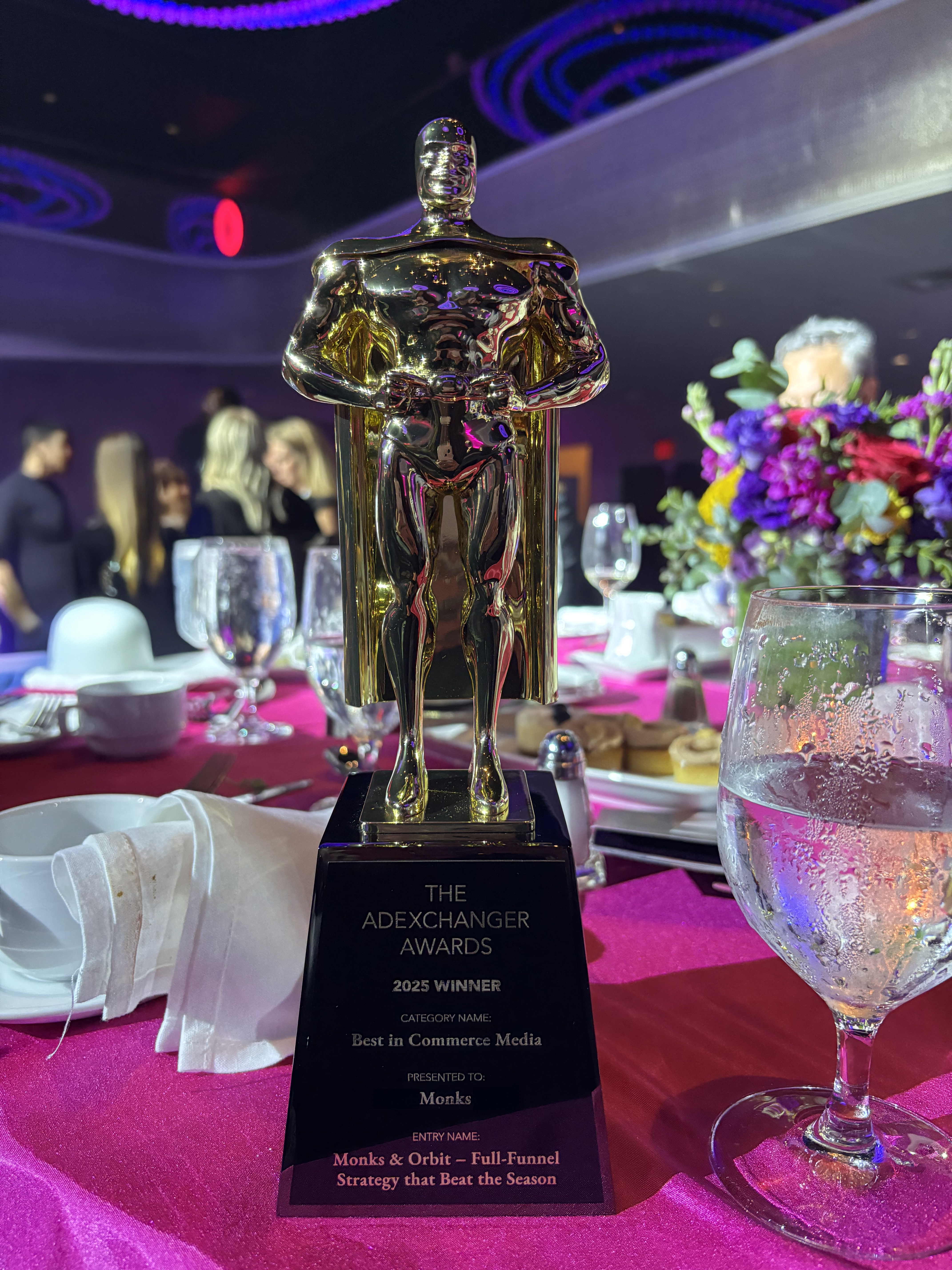
  • Winner of "Best in Commerce Media" at the AdExchanger Awards 2025

Challenging seasonal norms.

Orbit Irrigation, a trusted brand in home watering systems, typically sees demand spike in the warmer months, while Q4 has traditionally been slower. Orbit partnered with Monks to build a seasonal Amazon Ads strategy that turned Q4 from a quiet period into a meaningful growth opportunity. Instead of scaling back, we used the off-season to boost brand visibility and lay the groundwork for a high-stakes product launch.

A strategy built for seasonality and sustained growth.

To set the foundation, we optimized 50+ product detail pages, refreshed Orbit’s Amazon Brand Store, acquired early customer reviews and ensured inventory was positioned to meet demand. From there, we used insights from Amazon Marketing Cloud to rebuild Sponsored Ads and DSP campaigns around real shopper behavior. To increase visibility, we expanded keyword coverage and used variation testing to group similar SKUs under a single parent listing. This helped capture more long-tail search traffic, while high-intent retargeting kept Orbit top of mind during key holiday moments.

In partnership with

  • Orbit
Client Words Q4 has always been a quieter time for our business, but working with Monks helped us turn that off-season into a strategic advantage. Their team brought fresh ideas, clear strategy, and thoughtful planning. We stayed focused, moved quickly, and made confident decisions—all while building on what already works.
Logo for Orbit Irrigation, a subsidiary of Husqvarna Group

Jose Preza Torres

Account Manager

Off-season strategy. On-season results.

Orbit’s new approach set a higher bar for seasonal planning. Q4 sales increased 30% compared to the previous year, with a 391% revenue surge in their top product category and a 15% lift in conversion rates. New-to-brand purchases remained above 70%, while Amazon DSP emerged as a top driver of performance. That momentum continued into January, where the new product launch achieved a 4.5x return on ad spend, proving that strategic groundwork during slower months can lead to strong results when demand returns.

Setting the stage for year-round performance.

Monks’ vigilant approach ensured that as consumer demand returned, Orbit was not just ready to respond but positioned to accelerate—maintaining share of voice, protecting search rank, and investing in audience engagement when others paused. By rethinking seasonal investment and leaning into full-funnel planning, Orbit not only saw a stronger-than-ever off-season but also created momentum for an even more successful on-season.

Want to talk retail media? Get in touch.

Hey 👋

Please fill out the following quick questions so our team can get in touch with you.

See more examples of excellence in commerce.

Winning the Shift to a 360 Video Approach

Winning the Shift to a 360 Video Approach

Media Media, Video (TV/CTV) 1 min read
Profile picture for user mediamonks

Written by
Monks

Bryan Sherman, Global EVP of Monks, and Jeff Cohen, Tech Evangelist at Amazon Ads at Amazon Port

Marketers are faced with navigating the complexities of today's fragmented video ecosystem and challenged with making crucial advertising budget shifts from linear TV to streaming.

In this conversation, recorded live at Cannes Lions, Bryan Sherman, Global EVP of Monks, and Jeff Cohen, Tech Evangelist at Amazon Ads, unpack how advertisers can master this new landscape.

Discover how Amazon DSP has evolved into a full-funnel video consolidation platform. Learn how marketers of all sizes—from enterprise to mid-market—are leveraging the partnership between Monks and Amazon Ads to access a powerful combination of inventory, including:

  • Exclusive Amazon Properties: Prime Video, Twitch, Freevee and a growing slate of global live sports.
  • Premium Third-Party Supply: Consolidated access to top-tier streaming services like Disney+, Hulu and Roku.

The conversation goes beyond inventory, exploring the crucial role of measurement in proving the value of upper-funnel video investment. Learn how tools like Amazon Marketing Cloud (AMC) enable brands to connect video campaigns to real business outcomes, measure incrementality and justify shifting budgets toward new customer acquisition.

Listen in for actionable strategies to unlock valuable audiences at scale and ensure your video advertising resonates in the modern media landscape. 


A person viewed from over the shoulder, holding a smartphone and setting up a campaign in the Amazon Ads mobile app. The image is in black and white with the Amazon Ads logo in the center.

Supercharge Your Advertising with Amazon Ads

Unlock the power of Amazon Ads to create inspiring campaigns across Amazon’s complete advertising suite.

Learn More
Unlock your OTT and CTV advertising strategy with insights from Monks and Amazon Ads. Learn how to leverage the Amazon DSP to solve for media fragmentation, consolidate premium video inventory like Prime Video and live sports, and use advanced measurement to connect upper-funnel campaigns to real business growth. amazon ads ctv full-funnel media Media Video (TV/CTV)

Why Discounts Hurt Your Brand on Amazon (And What to Do Instead)

Why Discounts Hurt Your Brand on Amazon (And What to Do Instead)

Commerce Commerce, Industry events, Retail media, Seasonal marketing, eCommerce Platforms 3 min read
Profile picture for user Aaron Snow

Written by
Aaron Snow
Sr. Director of Sales

discounts-amazon

Amazon sales events such as Prime Day and Black Friday/Cyber Monday drive massive traffic and sales. But for brands, participating in every sales event can come at a cost. While deep discounts might deliver short-term revenue boosts, they also condition shoppers to wait for deals, ultimately damaging brand perception and long-term profitability. So, how can brands win Amazon sales events without falling into the discount trap? Let’s break it down. 

Discounting hurts your brand long-term.

As tempting as sales spikes are, aggressive discounting has hidden costs: 

  • It erodes margins. Short-term revenue gains are offset by lower profit margins. 
  • It trains consumers to wait. Shoppers begin expecting frequent discounts, hurting your ability to sell at full price.
  • It damages brand value. Consumers associate your products with price cuts instead of quality, undermining your brand’s premium positioning. 

Once shoppers become accustomed to discounts, shifting their mindset becomes increasingly difficult. Recent industry insights highlight that frequent discounts can significantly reduce consumers’ willingness to pay full price, leaving brands vulnerable to sustained margin pressures. Amazon thrives on a cycle of continuous promotions, encouraging consumers to hold out for lower prices and brands to participate in sales events to stay visible. But this turns pricing into a race to the bottom. When a brand tells me, “Sales are up, but our margins are suffering,” one of the things I ask is: Are you controlling your discounting strategy, or is Amazon controlling it for you? 

Here are smarter ways to win Amazon sales events.

To protect profitability while still benefiting from Amazon’s major sales events, brands need strategic alternatives to pure discounts: 

1. Bundle for value. Instead of slashing prices, create bundles to enhance perceived value. This naturally increases your Average Order Value (AOV) and maintains healthier margins.

Example: A skincare brand combined popular full-priced products with trial sizes in bundles for Prime Day, preserving margins and driving higher sales volumes.

2. Leverage Subscribe & Save and repeat purchases. Use sales events as a springboard for customer retention. Promoting Subscribe & Save discounts can drive long-term customer loyalty rather than one-time transactions. 

Example: A pet food brand promoted a 10% Subscribe & Save offer during Prime Day, securing ongoing monthly purchases and consistent long-term revenue.

3. Emphasize brand building and premium positioning. Sometimes the most effective strategy is not discounting at all. Instead, invest in branding, storytelling, enhanced product pages and high-quality creative content to justify premium pricing.

Example: A luxury kitchenware brand eliminated discounts entirely, focusing instead on premium branding, optimized listings and strategic ad placements to maintain full-price sales throughout Amazon’s sales events. 

4. But if you must, be selective with discounts. Not every product needs a price cut. Discount strategically, focusing on slow-moving inventory, new product launches or lower-priced items that attract new shoppers without sacrificing premium product margins. 

Example: A home goods brand offered discounts on select introductory items during Prime Day to attract new shoppers while preserving full prices on premium core products. 

Take control of your Amazon strategy.

Amazon’s promotional strategy doesn't have to dictate yours. If you control how and when you discount, you can win sales events without losing pricing power. But if you let Amazon dictate your pricing cycle, you risk becoming just another brand in the discount bin. At Monks, we prioritize your long-term success, guiding strategic decisions rather than short-term sales spikes. Our expert strategists are here to help your brand achieve sustainable, profitable growth on Amazon. Reach out today to start winning smarter. 

Strengthen your Amazon strategy during sales events without racing to the bottom. Learn how to use discounts, smart bundling, retention tactics, and premium positioning to protect profitability. Why Discounts Hurt Your Brand on Amazon (And What to Do Instead) Strengthen your Amazon strategy during sales events without racing to the bottom. Learn how to use discounts, smart bundling, retention tactics, and premium positioning to protect profitability. amazon prime amazon seller central vendor central online shopping ecommerce amazon ads amazon advertising eCommerce Platforms Commerce Seasonal marketing Retail media Industry events

Prosper & Shoptalk 2025: What You Missed and Why It Matters

Prosper & Shoptalk 2025: What You Missed and Why It Matters

Commerce Commerce, Industry events, Retail media, Seasonal marketing, eCommerce Platforms 4 min read
Profile picture for user mediamonks

Written by
Monks

Collage of Shoptalk and Prosper

Prosper Show and Shoptalk have earned their spots as the go-to events for retail media leaders and ecommerce operators alike. This year, both events focused on clarity, transformation, and the rising expectations of modern commerce. If you were heads-down managing Q1 campaigns or just couldn’t make the trip, we’ve got you covered. Our team attended both events and distilled the key takeaways ecommerce brands need to know now to stay ahead. Whether you sell on Amazon, Walmart, or DTC, these insights are designed to spark action.

These are our key takeaways from Prosper Show 2025.

  • Marketplace mastery was front and center. Prosper doubled down on how brands can win on marketplaces like Amazon and Walmart. Sessions focused on profitability through automation, scaling with Amazon DSP and Google Ads, fulfillment efficiency, and more.

Put it to work: Treat your product detail pages (PDPs) like your top-performing ad campaigns. Underperforming content is often the root of conversion loss. Start with A/B testing imagery and copy, and revisit your inventory planning to reduce stockouts and storage fees.

  • Retail media got tactical. With sessions diving into various ad formats, targeting options, and how to measure effectiveness within platforms like Amazon Advertising, retail media was a central focus at Prosper.

Put it to work: Stop viewing retail media as a cost center. Winning brands treat it as a revenue engine. Not using Amazon Marketing Cloud (AMC) yet? That’s step one. AMC unlocks signals like lifetime value, multi-touch attribution, and repeat purchase patterns.

  • Partnerships matter. The show floor was packed with tech partners, software providers, and ecommerce consultants. Each of them offers tools to help brands move faster.

Put it to work: Pressure-test your current tech stack. Are your partners helping you grow, or just maintaining the status quo? Now’s the time to evaluate and fill strategic gaps. 

Brush up on top insights from Shoptalk 2025.

  • Customer-centricity isn’t optional. Shoptalk was clear: everything must start with the customer. Sessions like “Embracing Welcoming Retail Experiences” and “Maximizing Shopper Value” reinforced that personalization, hospitality, and relevance are table stakes.

Put it to work: Every touchpoint either builds trust or breaks it. Map out your current customer journey and identify where friction or inconsistency exists. Whether it’s mobile UX or post-purchase communication, small improvements can drive big returns.

  • The rise of “The New Market.” Retail media grew up fast, and Shoptalk carved out an entire “show-within-a-show” for it. Think: connected TV, in-store ad tech, and the convergence of content and commerce.

Put it to work: If you’re not testing new ad formats, you’re falling behind. Explore influencer-led commerce, livestreaming, and video ads that blend shopping with entertainment.

  • Tech, innovation, and the retail road ahead. From generative AI to loyalty tech, Shoptalk showcased practical ways brands are applying emerging tools. The “Tech Solution Spotlights” were especially insightful for seeing what’s working now, not five years from now.

Put it to work: Skip the shiny objects. Invest in tools that directly improve your workflows (e.g., AI-powered content generation, dynamic promotions, or behavioral loyalty engines).

  • Future-proofing retail strategy. Shoptalk’s "Visions of the Future" track asked tough questions about what retail will look like in five to ten years. It’s clear that brands investing now in customer data, innovation, and agile operations will have the edge.

Put it to work: Think of this as your invitation to do a strategic audit. Where do you want to be in five years? Are your current tools and partners helping you get there?

  • Storytelling still wins. From brand voice to creator partnerships, Shoptalk underscored the importance of resonance in crowded markets. Sessions on brand narrative and talent-led growth made it clear that people connect with stories, not specs.

Put it to work: Revisit your brand messaging. Does it still resonate? Is it consistent across marketplaces, social, and DTC? If not, your customer experience is fragmented.

  • Unified commerce is the new normal. Digital and physical retail are no longer separate tracks. Sessions like “Store Operations that Blend Engagement and Efficiency” emphasized that shoppers expect one seamless journey.

Put it to work: Your customers don’t care about your internal silos. They just want a seamless experience. Audit your current ops and tech stack to make sure your front-end matches the back-end.

  • Data-driven decisions drive growth. Across the board, brands shared how they’re using analytics to better understand their shoppers and drive business decisions. The key here is actionable insights, not just dashboards.

Put it to work: Set clear KPIs for every campaign and channel. Then make sure your team has the right tools (and time) to actually analyze and act on that data. 

TL;DR: Let us simplify ecommerce complexity.

We attend these events so you don’t have to—because staying on top of ecommerce trends shouldn’t take you away from running your business. Our job is to make sense of what’s next and help your team turn insights into action. 

Prosper’s biggest lesson this year: Marketplace success is operational first, media second. If you want to scale, sharpen the basics and build your growth stack from there. Specifically:

  • Treat PDPs and inventory as growth levers, not maintenance tasks. 
  • Retail media needs strategic oversight and cross-functional alignment. 
  • The right partnerships can accelerate your growth trajectory.

Shoptalks’ biggest message: Future-proofing starts now. Customer experience, retail media expansion, and smart adoption of tech are no longer differentiators but expectations. Focus on the following:

  • Customer experience is your competitive edge. Start every strategy there. 
  • Retail media is evolving fast. Diversify your placements and lean into new formats. 
  • Practical innovation beats flashy tech. Invest in tools that solve real pain points. 
  • Think long-term. Your future strategy starts today. 

Whether your focus is retail media, marketplace growth, brand storytelling, or unified commerce, we’re here to help you take the next step. Ready to turn these insights into revenue? Let’s talk about what this means for your brand.

Get key takeaways from Prosper Show and Shoptalk for retail media and e-commerce leaders to stay ahead in modern commerce. Prosper & Shoptalk 2025: What You Missed and Why It Matters Learn about what went down at Prosper Show and Shoptalk 2025. amazon prime amazon seller central vendor central online shopping ecommerce amazon ads amazon advertising eCommerce Platforms Commerce Seasonal marketing Retail media Industry events

Unlocking the Potential of Amazon Video Ads: A Beginner’s Guide

Unlocking the Potential of Amazon Video Ads: A Beginner’s Guide

Media Media, Programmatic, Video (TV/CTV) 3 min read
Profile picture for user Ladipo Fagbola

Written by
Ladipo Fagbola
Ecommerce Account Director

A person holding a smartphone outdoors in a forested area, with sunlight streaming through the trees. The phone screen displays an image of trees and sunlight, with a play button icon in the center, suggesting a video. The background is softly blurred, highlighting the natural setting.

In the ever-evolving world of digital advertising, video ads have proved game-changing. With their ability to captivate audiences, deliver higher engagement, and drive measurable results, video ads are becoming a must-have for brands and advertisers. Among the many platforms offering video advertising, Amazon Ads stands out as a unique and powerful solution. Whether you're new to programmatic advertising or looking to expand your expertise, this guide will help you understand why Amazon Video Ads are worth exploring.

Discover why video ads are essential.

Let’s start with some numbers:

These stats highlight why video ads are outperforming traditional formats. But the real magic happens when video ads meet streaming platforms. Streaming has democratized TV advertising, making it accessible to advertisers of all sizes without the massive upfront costs of traditional TV. Plus, with real-time optimization and reporting, video ads offer unmatched flexibility and performance tracking.

When it comes to capturing attention, video ads also shine. Research from WARC shows that TV-style ads hold attention far longer than static ads, which often fail to cross the critical two-second mark. While linear TV has declined, its audience hasn't disappeared—they've simply moved online to platforms like BVOD, FAST, SVOD and Social Video. Consumers are now engaging with more video content than ever, though the primary platforms for viewing have shifted. For advertisers, this means more time to tell your story and connect with your audience.

Why should you choose Amazon Video Ads?

Amazon isn’t just an ecommerce giant; it is also a leader in programmatic advertising, thanks to its first-party data and unique ad inventory. Here’s what makes Amazon Video Ads special:

1. Precision Targeting

Amazon has access to deterministic first-party data from over 300 million active accounts worldwide. This data is incredibly accurate because it’s based on real purchase behavior, not just browsing habits or inferred interests.

Amazon also uses advanced modeling (based on its robust AWS platform) to create probabilistic audiences, giving advertisers even more ways to reach the right people at the right time.

2. Unique Video Inventory

Amazon’s video ad inventory is unlike anything else on the market. It includes:

  • Prime Video: Ad-supported content that reaches millions of viewers.
  • Twitch: A leading platform for live streaming, especially among younger audiences.
  • Fire TV: Amazon’s proprietary smart TV, which competes with LG Smart TV and Roku.

What sets Amazon apart is its ability to bring these diverse channels together under one roof, all powered by its first-party data. 

3. Brand Safety & Ad Effectiveness

A common concern in programmatic advertising is the prevalence of made-for-advertising sites—low-quality environments that can hurt ad effectiveness. Amazon minimizes this risk by prioritizing high-quality placements. Why? Because every ad served reflects on the Amazon brand itself. In addition to owned and operated inventory, Amazon has direct access to multiple premium video inventory via its Amazon Publisher Direct platform.

The algorithms driving this ecosystem are built to maximize effectiveness, rapidly suppressing underperforming sites while prioritizing optimal results for advertisers. With the recent AI investment commitment of up to $100 billion, the future becomes even more exciting. How will these current algorithms evolve, and what new possibilities could this unlock for advertisers?

4. Advanced Analytics with AWS

Amazon’s ad platform is backed by Amazon Web Services (AWS), which powers over 30% of the internet. This infrastructure enables advanced measurement and analytics, helping advertisers gain deeper insights into campaign performance. For those looking to analyze data from multiple sources, Amazon offers Amazon Marketing Cloud (AMC), a privacy-safe environment for advanced analytics.

The debate around performance versus brand marketing continues to grow more compelling, with WARC emphasizing "The Multiplier Effect" achieved by combining both. Amazon Ads has already cemented its presence in performance marketing, leaving little room for doubt. What makes AMC particularly exciting is its ability to immediately quantify the impact of brand marketing on performance outcomes. For non-endemic brands that don’t trade on Amazon, AMC simplifies measuring the incremental reach provided by Amazon’s video channels, offering clear insights into the value of brand investments. 

Now is the time to explore Amazon Video Ads.

Amazon Video Ads offer a unique combination of precision targeting, premium inventory and advanced analytics. Whether you’re a small business or global agency, this platform has the tools to help you reach your audience and achieve your goals.

As an Amazon Ads Advanced Partner, Monks operate across the full spectrum of Amazon Ads including resale partnerships. Contact us to explore how we can help you succeed with Amazon Ads.

Learn how Amazon Video Ads leverage data, unique inventory, and advanced tools to transform digital advertising and drive impactful results. amazon ads video advertising programmatic Media Video (TV/CTV) Programmatic

Choose your language

Choose your language

The website has been translated to English with the help of Humans and AI

Dismiss