Choose your language

Choose your language

The website has been translated to English with the help of Humans and AI

Dismiss

Google Halts Cookie Deprecation, but Privacy-First Is Still the Best Strategy

Google Halts Cookie Deprecation, but Privacy-First Is Still the Best Strategy

Data Data, Data privacy, Measurement, Media, Media Analytics 6 min read
Profile picture for user Michael Cross

Written by
Michael Cross
EVP, Measurement

A lock being overtaken by a wave

After years of anticipation and numerous delays, Google has announced it will not deprecate third-party cookies as initially planned. Instead, Chrome users will be given the ability to adjust their tracking preferences on an individual basis. Despite the change, our advice to brands remains consistent with previous guidance we’ve given in the past: don’t let this news halt your progress.

Google’s decision on third-party cookie deprecation—and what is still at risk for your brand.

Google's latest move doesn't signify a step back in prioritizing consumer privacy. Instead, it emphasizes giving users more individual control over their data. Similar to Apple's App Tracking Transparency (ATT) framework that rolled out in 2021, consumers will be given a more prominent opt-in/opt-out choice within Chrome. This functionality already exists within the browser’s settings, but will be surfaced in a “new experience” in the future, according to Google.

For brands who have not made significant progress in mitigating the impact of third-party cookie deprecation, this announcement might seem like a lifeline. However, even without a specific cut-off date from a centralized body like Google, there will still be a decline in use by consumers. With a gradual erosion as consumers opt out, the bigger danger is that many brands won’t realize that the third-party cookie pool is getting smaller and smaller, and therefore less useful for their ad strategy.

We expect the majority of third-party cookie signals to shrink, regardless of Google’s decision.

The digital industry has seen this scenario play out in the past, and the data shows the impact will still be huge, if just gradual. When Google switched to a third-party cookie for Google Analytics over ten years ago, Sayf Sharif, SVP Data, says that his analysis showed “some sites were losing over 80% of their traffic, depending on the industry, due to the adoption of ad blockers.”

This trend has repeated itself over the years; based on the impact from Apple’s ATT rollout, we’d expect to see cookies “capture maybe 15% of the available universe,” according to Liz DeAngelis, SVP Digital Strategy. Even if third-party cookies will continue to exist as an option within major browsers like Chrome, consumers have shown time and again that when made aware of their options, the majority will opt out.

Moreover, third-party cookies have proved increasingly ineffective in today’s digital landscape. Sharif points out, “We still face numerous challenges for measurement, activation and attribution (such as a high use of ad blockers, consent rules and fast cookie expiration), which make a focus on a cookieless approach to measurement and attribution a priority.” This shift to consumer choice underscores the reality that brands should continue to avoid over-reliance on third-party cookies.

Monk Thoughts Even though the indefinite pausing of the third-party cookie will come as a relief to some advertisers, there is still an ethical position that needs to be upheld in the careful use of them—as such, usage will continue to decline regardless.
Portrait of Michael Cross

Regulatory and consumer influences on third-party cookies helped shape Google’s decision.

The journey to Google's latest decision has been shaped by a blend of regulatory pressures and evolving consumer expectations. “Google has been caught in the crosshairs between evolving global privacy regulations and competition laws in a range of markets, most notably Europe,” says Benjamin Combe, Sr. Director, Data Optimization and Personalization. Similar regulations like the Australian Privacy Act have gained steam elsewhere, reinforcing that this is a global trend, not a regional or cultural one.

Meanwhile, consumer behavior has shifted toward greater consent and control over personal data. The move toward giving users the ability to set their preferences in Chrome, then, is well aligned with the experiences consumers seek online—and their changing attitudes and expectations toward digital privacy. Combe adds, “It merely reflects a more gradual end to a long-running, multi-factored trend. Google will no longer be the executioner, but third-party cookies are dying regardless—and their utility as the foundation of digital advertising’s targeting and attribution capabilities will not return.”

Still, cookies haven't been the only source of scrutiny in recent years. Google's Privacy Sandbox, a privacy-safe alternative to third-party cookie tracking, has faced several challenges since its announcement in 2020: the initiative has struggled with lack of adoption, anti-competitive scrutiny, conflicting industry feedback, mixed testing results and regulatory pressure. “Google’s Privacy Sandbox raised anti-competition issues with the UK’s Competition and Markets Authority (CMA), while simultaneously raising privacy concerns with the European Centre for Digital Rights and the UK’s Information Commissioner's Office,” Combe adds.

In short, both the regulatory landscape and consumer demand for greater data control led us here. So, what are brands supposed to do next?

Your brand’s first-party data strategies still need to evolve, or put your visibility and efficacy at risk.

Google's decision to give users control over third-party cookies rather than enforcing a complete deprecation has different implications depending on where brands stand in their preparation journey.

For businesses who may have used previous postponements of third-party deprecation as an excuse to delay action and conserve their resources, Tyler Stewart, Media Solutions Architect Lead, sees challenges down the line: “Smaller businesses may not have had the luxury of being on the front foot. In the longer term, this may only widen the gap between haves and have-nots as larger enterprises find themselves better positioned to compete in the privacy-first future.” Our advice to them: start prioritizing a cookieless approach now by focusing on first-party data and robust measurement strategies. Investing in AI-powered solutions and privacy-preserving technologies remains critical for future-proofing your marketing efforts.

Brands that have already embarked on their third-party cookie deprecation and privacy roadmap initiatives, meanwhile, have no need to pivot. “Strategies like the judicious use of first-party data, consent management, modeled measurement solutions and conversion recovery mechanisms will continue to be future-proofed strategies worth investing in,” says Stewart.

If you’re in this camp, don’t feel as if your efforts were in vain. “Those that have invested in reducing the impact of third-party cookie deprecation should take pride in being ahead of the curve with respect to utilization of first-party data, increasing compliance with global privacy regulations, innovating in measurement capabilities, and respecting their customers’ preferences,” says Combe. Staying the course will help future-proof your business’s data as the industry standards continue to evolve.

Monk Thoughts Judicious use of first-party data, consent management, modeled measurement solutions and conversion recovery mechanisms will continue to be future-proofed strategies worth investing in.
Tyler Stewart in front of a gray background

Better solutions for measurement will be customized for your business.

As an industry, the fragmentation and complexity we’re seeing across the digital ecosystem indicates we’re unlikely to move back to a uniform standard. “If you want to reach your customers wherever they are digitally, you need to be looking for new solutions for targeting, buying, and measurement. We can no longer rely on a consistent tactic that the entire industry adopts; brands need to move on from awaiting the next cookie alternative, and work on the solutions that are best for your company,” says DeAngelis.

The right strategy for your brand will depend on the complexity of your digital footprint and the data that’s most valuable for you to capture. To measure efficacy of your marketing activity, an important first step is to establish server-side tracking for your advertising, and take advantage of any event APIs from ad platforms, such as Meta’s Conversions API (CAPI). But in the long run, deterministic (user-level) measurement models will continue to weaken over time. Probabilistic models that assess changes across your entire business and media mix for causal contribution will be a necessity in the future, not an option. Strategies like Market Mix Modeling (MMM), or a Cookieless Multi-Touch Attribution (MTA) model offer viable alternatives to those challenges.

Similarly, identity resolution and user graph technologies are still viable for targeting, but a clear winner has yet to arise across the many providers that brands can choose from. As part of the announcement, Google emphasized that Privacy Sandbox will continue to be supported and developed as brands look ahead toward adapting their strategies beyond third-party cookie reliance—a goal that will remain important should users choose to opt out of third-party tracking en masse.

Move forward with a privacy-first marketing strategy.

No matter where your brand stands on the spectrum of cookie deprecation readiness, the path forward remains clear: continue to prioritize privacy-first strategies and the development of robust first-party data practices.

While third-party cookies have a new lease on life for now, they will never be as functional as they once were. They have already been deprecated in most non-Chrome browsers, and with Chrome indicating it will implement greater user permissions and controls, their availability is likely to continue declining—think of opt-in rates for ATT on iOS as a comparable scenario.

Brands should see this as an opportunity to stay ahead of the curve by continuing to invest in first-party data practices, consent management, and alternative measurement solutions—for teams that need advisory and executional support here, our data experts are ready to talk. The shift towards a privacy-first future is inevitable, and those who adapt proactively will be best positioned to thrive.

Google is keeping third-party cookies, but data signals will still erode. Experts from Monks advise brands to stay the course with privacy-first measurement. Google is keeping third-party cookies, but data signals will still erode. Experts from Monks advise brands to stay the course with privacy-first measurement. third-party cookies cookies Google Media Measurement market mix modelling media mix modeling marketing measurement multi-touch attribution cookie deprecation data privacy Measurement Data Media Analytics Media Data privacy

Next-Level Data Management: The Evolution of Consent Mode V2

Next-Level Data Management: The Evolution of Consent Mode V2

Data Data, Data Privacy & Governance, Data privacy 4 min read
Profile picture for user Oksana Davydenko

Written by
Oksana Davydenko
Analytics Manager

add

In an era where data privacy concerns are a hot topic, the demand for digital privacy and personalization has become increasingly important. Recognizing these pressing needs, Google made updates to the Consent Mode API that offer more nuanced consent settings.

To enhance user control over data collection and personalization, Google has introduced two new parameters in the Consent Mode arsenal. These parameters allow for more granular consent settings, specifically related to advertising data passed to Google:

  • ad_user_data: This parameter manages consent for passing user data to Google for advertising purposes.
  • ad_personalization: This parameter controls consent for personalized advertising.

In the following paragraphs, we delve deeper into the importance of Consent Mode Version 2 (V2) and its implications for user privacy and data management.

Why is it important?

Google stresses the importance of obtaining consent from end users in the European Economic Area for the use of their personal data, as required by law, when incorporating these new parameters. It is important to note that these requirements also extend to cases where Google Analytics data is shared with Google Marketing Platform (GMP). For example, if you are sending Google Analytics 4 (GA4) to GMP or importing GA4 conversion to optimize ad campaigns on the GMP side, you should collect these new consent parameters.

For customers who have implemented Consent Mode, the ad_storage parameter will be automatically mapped to the new ad_user_data parameter starting March 2024. This means that when consent is granted or denied for ad_storage, ad_user_data will respect the same setting, ensuring that the performance measurement capabilities of your original implementation continue to work as expected.

No changes will be made to the new ad_personalization parameter configuration, but it is necessary to integrate the new consent mode parameters to maintain access to tag-based audience and personalization features through Google Ads, GA4 or GMP. This can be done either directly in your Google tag (gTag) or through a consent management platform (CMP) that has successfully migrated to the new version of consent mode (for example, OneTrust recently confirmed they completed the updates for two new consent parameters in new integration).

Understand Consent Mode V2’s impact on data collection.

Deciding not to implement/upgrade to Consent Mode V2 will impact audience collection in your GA4 property. The size of audiences you use for remarketing will likely decrease since there is no user consent collected for the ad_personalization parameter.

And as we mentioned above, should you fail to collect the ad_user_data parameter, which is necessary for sharing conversion data from GA4 to GMP, Google ensures that it will be appropriately mapped to the existing ad_storage parameter. This means that at least a Basic Consent Mode implementation is mandatory.

It’s equally important to emphasize that obtaining user consent extends to data tracking in mobile applications as well as data uploads to Google. Make sure that you send consent parameters with this data. Otherwise, if data sent to GA4 is not labeled as consented, it will negatively impact conversion tracking and audience size for remarketing. You will not be able to share conversion data with Google Ads for campaign optimization and will not be able to leverage data modelling. And in the case of audiences, you might see a decrease in the size of your remarketing audiences if you do not collect ad_personalization consent.

Validate your Consent Mode V2 setup.

To validate Consent Mode V2 setup, you should check the network requests tab in the browser’s developer tools. In the Network tab, the gcd parameter should appear in all requests sent to Google (GA4, Google Ads, etc.)

The gcd parameter should appear in all requests sent to Google

Important: If you are sending data to the server side container, you should look out for a parameter called ‘sst.gcd’ in the same Network request. Its value should be the same as the gcd parameter value.

Look out for a parameter called ‘sst.gcd’ in the same Network request

Each value starts with the number 13 and ends with the number 5. In between, you’ll find a string of letters separated by the number 3. These letters correspond to different consent states (either default or updated), and their sequence corresponds to the following signals: ad_storage, analytics_storage, ad_user_data, and ad_personalisation.

If this sounds confusing, don’t worry. Using the table below, we’ll decode an example gcd string together:

Use the table to decode an example gcd string

Let’s decode the example 13v3u3v3v5:

  • ad_storage = granted (both by default and after update)
  • analytics_storage = denied (granted by default and denied after update)
  • ad_user_data = granted (both by default and after update)
  • ad_personalisation = granted (both by default and after update)'

Recap 

Google's release of Consent Mode V2 is crucial for businesses operating in today's privacy-focused landscape, ensuring:

  • Enhanced User Control: It empowers users with granular control over their data. This transparency builds trust and fosters positive user experiences.
  • Compliance with Data Privacy Regulations: Consent Mode V2 helps businesses comply with evolving regulations like GDPR and CCPA. 
  • Accurate Data Measurement: For businesses, Consent Mode V2 provides a clearer picture of collected data. This allows for more accurate measurement and analysis in advertising and digital analytics. This, in turn, helps optimize marketing campaigns and improve user targeting strategies.

Future-Proofing Data Practices: As data privacy regulations continue to develop, Consent Mode V2 positions businesses for the future and helps companies demonstrate a commitment to responsible data collection.

Discover the evolution of Consent Mode V2, ensuring enhanced user control and data compliance with Google's latest updates. data privacy google Data Privacy & Governance Data Data privacy

Navigating Consent Mode in GA4 & BigQuery

Navigating Consent Mode in GA4 & BigQuery

Data Data, Data Analytics, Data Privacy & Governance 3 min read
Profile picture for user Data Monks

Written by
Pedro Ginel & Brianna Mersey

add

In today’s day and age, where we see a large amount of privacy litigation and fines, the application of Consent Mode is a step towards keeping inline with privacy compliance regulations. Join us as we explore two distinct approaches to Consent Mode—Basic and Advanced—and highlight the implications for data collection in Google Analytics 4 (GA4) and BigQuery.

Basic Mode: Compliant but at the cost of data collection.

Implementing Basic Consent Mode via GTM is a straightforward path to compliance, ensuring that Google tags remain dormant when the user denies consent. Google tags are not loaded until a user grants consent. While this expedites compliance efforts, it comes with a trade-off: data generated by unconsented users is not tracked in either BigQuery or GA4. You will not receive modelled data in your GA4 property to fill in the data gaps from unconsented traffic to your website. Though efficient in meeting compliance requirements, Basic Mode sacrifices the depth of GA4 data utilization, impacting data tracking significantly when compared to the Advanced mode implementation. Often clients see up to 30% or more of data loss.

Advanced Mode: Unveil deeper insights responsibly.

Advanced Mode takes a more sophisticated approach, allowing Google tags to trigger even without user consent. However, it omits identifiable client data, such as the _ga cookie used by GA4 for identifying users by browser and device. The use of Advanced Mode impacts both BigQuery and GA4 in different ways, which we’ll dive into below.

BigQuery: Track unconsented events.

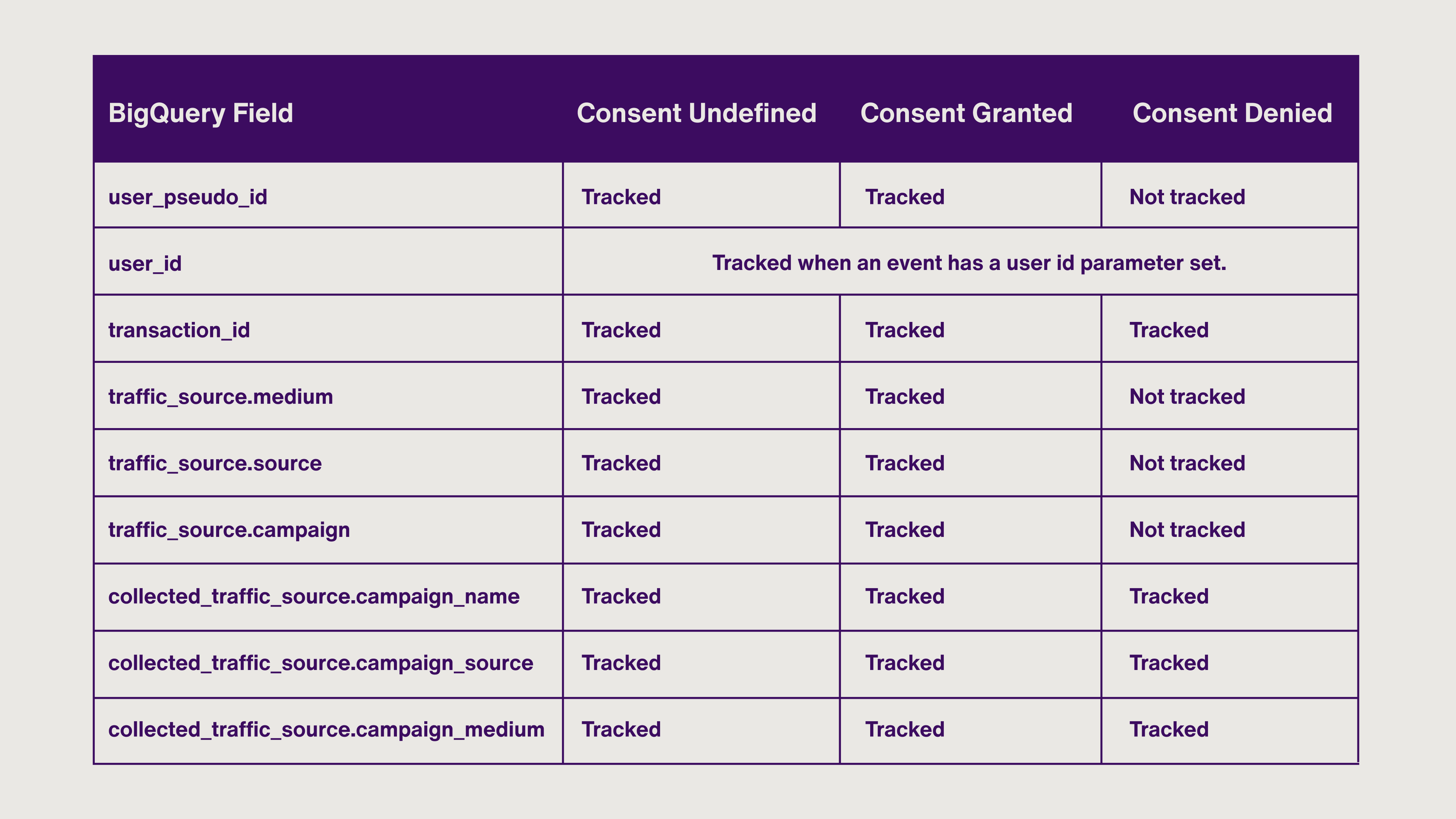
When using Advanced Mode in BigQuery, unconsented events are still tracked, but they lack certain parameters used to identify users. This becomes evident when attempting to calculate metrics like user count, because the absence of the _ga cookie in events means the user_pseudo_id value (used to help GA4 identify users and calculate user metrics) is missing, resulting in an underestimation of user count. While BigQuery captures all events, the exclusion of critical information affects the accuracy of reporting, particularly in metrics relying on unique identifiers.

This concern doesn’t apply if the user has authenticated and their user ID is sent to GA4. That data will be then sent to BigQuery.

In short, BigQuery retains all events, including unconsented ones. Unfortunately, missing information influences the reporting of metrics like user count, demanding a strategic approach in data analysis.

Based on experiments ran with a custom GTM container & custom GA4 tags

GA4: Model metrics beyond consent.

When using Advanced Mode in GA4, you may notice an initial drop in metrics because unconsented users and their events are not reported. However, the innovative aspect of Advanced Consent Mode lies in its ability to model data: over time, Google analyzes both consented and unconsented traffic, then builds estimations of the relevant metrics. While this modeling occurs programmatically and beyond our control, GA4 users are not restricted to reporting limitations. Metrics like user count, initially affected by unconsented data exclusion, become estimable through Google's modeling efforts.

GA4’s UI modeling will become active as soon as you implement Advanced Consent Mode. You don't necessarily need to use GTM for that; you can use any other tag manager or run it directly in your banner code

Tip: To see modeled data in your reports, choose the Blended reporting identity, under Admin > Data display > Reporting Identity > Blended, otherwise select Observed to view strictly consented data. You may switch back and forth between options without impacting data collection.

Strike the Right Balance.

Dedicate time to implementing Advanced Consent Mode to prevent complete data loss on unconsented hits. This mode provides a nuanced solution for those ready to navigate the intricacies of unconsented data tracking. Additionally, selecting a Cookie Management Platform (CMP) is essential for managing the cookie consent banner and directing the consent management process that is initiated when visitors arrive on your website and choose to allow or deny cookies. As global regulations evolve, it becomes crucial to have robust, privacy-centric measurement solutions accessible to marketers worldwide.

And finally, before you start Advanced Consent Mode implementation, get your legal team onboard and discuss any possible ramifications of collecting cookieless pings from users who declined tracking.

Unlock GA4 and BigQuery insights with our experts! Navigate consent mode complexities, explore basic and advanced approaches, and ensure privacy compliance. Google Analytics data privacy big data data analytics Data Analytics Data Data Privacy & Governance

The EU Digital Markets Act (DMA): A Game-Changer for Digital Marketing

The EU Digital Markets Act (DMA): A Game-Changer for Digital Marketing

Data Data, Data privacy 4 min read
Profile picture for user Julien Coquet

Written by
Julien Coquet
Senior Director of Data & Analytics, EMEA

Digital Markets Act

In March 2024, a significant shift in the digital marketing landscape will occur with the implementation of the Digital Markets Act (DMA). This new legislation aims to regulate the digital market and protect user rights, marking a paradigm shift in how businesses engage with consumers. 

One key feature that will play a crucial role in ensuring compliance and maintaining effective marketing practices is Google's Consent Mode. In this blog post, I will explore—with insightful contributions from my colleagues Asli Yidiz, Deborah Widdick and Valentina Villino—the impact of the DMA on digital marketing and delve into the details of utilizing Google’s Consent Mode.

Understanding the DMA.

The Digital Markets Act is a legislative framework developed by the European Union to address the challenges posed by dominant online platforms—or, gatekeepers—and ensure fair competition in the digital market. It aims to regulate the behavior of tech giants, prevent unfair practices, and safeguard user rights. The DMA will introduce stricter rules for digital services, including requirements for transparency, interoperability and non-discriminatory access.

Specifically on consent for marketing, recital 37 of the DMA states that “When the gatekeeper requests consent, it should proactively present a user-friendly solution to the end user to provide, modify or withdraw consent in an explicit, clear and straightforward manner.” In other words, collecting user consent should now better inform how gatekeepers respect choices in collecting and processing user data and offering personalized online experiences.

The act’s impact on digital marketing. 

The DMA will have a profound impact on how businesses approach digital marketing strategies. One of the main areas of focus is users' privacy and acting with valid consent defined in GDPR. The act places a stronger emphasis on user consent and control over personal data, especially when it comes to personalizing online experiences based on user data and preferences. It requires businesses to obtain explicit consent from users for data processing activities, ensuring transparency and empowering individuals to make informed decisions about their data.

One can see the DMA as an extension of the GDPR, where the gatekeepers, also known as “the Big 6” (Google, Amazon, Apple, ByteDance, Meta, Microsoft), need to guarantee that they will provide the right options for consent collection and processing of personal data.

What does this mean for my advertising campaigns?

The DMA mandates that without appropriate measures, our capacity as marketers to retarget within advertising campaigns could be significantly restricted. Due to this regulation, each phase of our audience strategy funnel could suffer. The absence of retargeting lists implies:

  • Many customers, who use exclusion retargeting lists to avoid targeting already converted users, might end up wasting a portion of their budget.

     
  • The restricted segmentation options hinder our ability to deliver diverse personalized experiences. Consequently, marketing messages become generic, which results in decreased click-through rates and reduced engagement in ad campaigns.

     
  • The lack of retargeting lists also presents challenges for businesses aiming to identify cross-selling or upselling opportunities by analyzing purchase histories and customer interactions.

     
  • Without retargeting lists, leveraging similar audiences in social media, for instance, becomes infeasible.

Ultimately, this may impact the ROI we can achieve from our advertising campaigns, making it more challenging for marketing departments to demonstrate the value of their paid media campaigns in driving results for their business.

Given that our ability to retarget our audiences based on website activity signals will be affected, we need to consider how audience strategies should evolve in 2024 to ensure that we:

  • Continue to test methods to generate value for our businesses through paid media campaigns, despite the new limitations on existing audiences.

     
  • Actively plan for how to adapt reporting and establish new benchmarks that accommodate these regulatory changes.

The importance of Consent Mode in these times.

Google introduced Consent Mode as a privacy-friendly tool that enables businesses to adapt to the changing landscape of user consent requirements. This API provides a framework for obtaining and managing user consent across various Google advertising products, including Google Analytics 4, DV360, SA360 or CM360.

In a digital marketing ecosystem where brands use Google products for marketing performance measurement and advertising, the Consent Mode tool offers the following benefits:

  • Enhanced user experience: Consent Mode allows businesses to deliver personalized and relevant ads to users who have provided consent. This targeted approach enhances the user experience, ensuring that ads align with the user's consent, interests and preferences.

     
  • Improved compliance: Consent Mode enables businesses to meet the stringent requirements for user consent outlined in the DMA. By implementing this feature, businesses can ensure that their marketing practices are compliant with the legislation, avoiding potential penalties and reputational damage.

     
  • Optimal performance and measurement: With Consent Mode, businesses can optimize their ad campaigns and accurately measure their performance while respecting user consent preferences. It allows for the use of aggregated data that maintains the anonymity of individual users, striking a balance between effective marketing and privacy protection.

Preparing for the Digital Markets Act. 

To prepare for this significant shift in March 2024 and work towards compliance, businesses can take the following steps:

  • Familiarize yourself with the DMA: Gain a thorough understanding of the legislation's requirements, particularly regarding data privacy, user consent and fair competition. Stay updated on any changes or guidelines issued by regulatory bodies.

     
  • Implement Consent Mode: Integrate Google's Consent Mode into your digital marketing strategy. This will enable you to adapt to evolving user consent preferences, deliver personalized ads, and stay compliant with the DMA. This is best achieved with Google Tag Manager or the Google Tag (gtag.js).

     
  • Review and update privacy policies: Ensure your privacy policies are clear, transparent and aligned with the DMA's requirements. Provide detailed information on data processing activities, user rights, and how consent is obtained and managed.

     
  • Educate and train your team: Educate your marketing and advertising teams about the DMA and the importance of complying with the new regulations. Train them on the proper use of Consent Mode and how to navigate the changing landscape of user consent.

In short, the DMA represents a significant milestone in the regulation of the digital market. As businesses prepare for its implementation early next year, understanding the impact on digital marketing strategies is crucial. Ultimately, leveraging tools like Consent Mode can help brands adapt to the changing privacy landscape and build trust with their audience in the digital realm.

Download our whitepaper below to get a quick guide on navigating the new DMA legislation.

Prepare for new DMA regulations cover image

You’re one download away from learning

  • The impact of the Digital Marketers Act and how to prepare your teams now 
  • The importance of accurate modeling for campaign measurement 
  • The benefits of using Google's consent mode

This experience is best viewed on desktop

Download Now
In light of the new Digital Markets Act legislation, our Data.Monks argue Google's Consent Mode can help ensure compliance and maintain effective marketing practices. digital marketing Google Analytics data privacy Data Data privacy

Looking Back at a Year of Digital Innovation

Looking Back at a Year of Digital Innovation

AI AI, AI & Emerging Technology Consulting, Extended reality, Metaverse, New paths to growth, Technology Consulting, Technology Services 7 min read
Profile picture for user mediamonks

Written by
Monks

Colorful crystals and shapes fly out of an image of person shaking their head

Lea este artículo en español aquí.

And just like that, another year comes to a close—twelve months packed with the emergence of exciting developments in technology and new consumer behaviors. The metaverse matured, commerce went social, and brands learned to move beyond vanity metrics and cookie consent to build actionable data with bottom-line impact. In essence, there’s been no shortage of challenges (and solid victories) over the past year—so as you begin to look ahead at the next, let’s take a quick review of 2022 highlights and trends.

Virtualization defines the transformation of digital.

As the world opened back up, an era of digital transformation gave way to the transformation of digital. By this, we mean virtualization: a set of new audience behaviors, cultural norms and technology paradigms resulting from 30 years of digital transformation, hyper-accelerated over the past five years. Virtualization, covered in our report earlier this year, marks a revolution in consumer behavior as people demand more from the digital platforms they engage with, which implicates the ways they look at digital experience, community, ownership and identity. For example, the design of ComplexLand, a virtualization of the hype-fueled annual event ComplexCon, was built around the insight that today’s fashion trendsetters are becoming just as invested in their digital identities as their corporeal ones.

The Social Innovation Lab, who explores up-and-coming trends in social, delved deeper into what motivates some of these behavioral changes in The Search for Meaning. By exploring how technology shapes the ways consumers find and make meaning in their lives, the Social Innovation Lab uncovers how brands can adapt to the new era in digital.

Monks Thoughts We're seeing the emergence of a new set of consumer expectations based on digital experiences that are richer, more meaningful, and more ownable. New tools, technologies, and talent on part of brands to show up and meet consumers in a new way. We call this virtualization

00:00

00:00

00:00

Doug Hall VP, Data Services and Technology

Experiments in the metaverse drive real success.

One of the biggest manifestations of the virtualization trend has been the rise of the metaverse, which many brands have experimented with this year to find their footing. Duolingo celebrated the birthday of its lovable (and persistent) mascot by hosting a game jam in Roblox and building larger-than-life public artwork in Decentraland. Logitech for Creators reinvented the awards show format by building the first music awards show in the metaverse, the Song Breaker Awards.

The fashion industry in particular has found a lot of success in the space. Liam Osbourne, Global Client Partner at the FLUX.Monks, our dedicated fashion and luxury team, shared with Vogue some insight on how the metaverse is an opportunity to become more inclusive. For brands exploring that question and more, the FLUX.Monks have authored a quick bulletin on why the metaverse matters.

Monk Thoughts Exploring the rules for access that are not the traditional levers of wealth or proximity to power would be great to see.
Liam Osbourne

As the metaverse continues to take shape, now is an excellent time for brands to continue experimenting in the space, which was a large part of a discussion shared between SVP Web3, Metaverse & Innovation Strategy Catherine D. Henry; Chief Innovation Officer Henry Cowling; and Mike Proulx, VP and Research Director at Forrester as part of our Meet Me in the Metaverse series. Eager to get started experimenting in the metaverse yourself? Our map of the metaverse can help you find the right home for your brand within this quickly evolving space.

Web3 and other emerging tech begin to mature.

In addition to the metaverse, other emerging technologies have fueled transformative digital experiences—most notably Web3. We showed up at NFT.NYC, the biggest Web3 conference on this side of the screen, with an immersive installation for Cool Cats that blurred the boundary between virtual and the real. Meanwhile, Gucci opened the virtual door to an immersive gallery space used to host an auction of NFT artwork.   

More than just a new tech infrastructure, Web3 marks a foundational shift in brand-consumer relationships, a topic covered in a bulletin we released in collaboration with Salesforce this year titled Web 3: The Future of Customer Engagement. For those wondering how to begin making moves in Web3, check out insights from our In a Monk’s Opinion series, which lays out everything you need to know about NFTs and the blockchain. One tip from the Labs.Monks: be sure to make your NFT projects sustainable.

Speaking of the Labs.Monks, our R&D team has continually released missives on the bleeding edge of tech throughout a year of innovation. Their most recent report on generative AI explores the potential of AI tools like Dall-E and Mid Journey that have captured creatives’ imagination (and people’s social feeds). One example of what the tech can achieve: unlocking efficiencies in animation and other production needs.

Creativity and media go hand in hand.

Throughout the digital era, it’s been tempting to focus attention on vanity metrics. But as CMOs invest more dollars into media (and face increasing budget scrutiny with a possible recession), they will benefit from transforming their approach to a more holistic strategy that blends media and creative to optimize their spend. Speaking to Digiday, Media.Monks Global Head of Media Melissa Wisehart unveiled how our integrated media pillar is designed to help brands make this leap.

Monk Thoughts We’re really looking at and drawing statistical correlation between what happened in the media universe and what is the downstream business impact.
Melissa Wisehart headshot

Uni's relaunch campaign demonstrates this more holistic approach through the development of both the creative and media placement by one partner. With three creative variations and four measurement initiatives, we ensured the creative rolled out across today’s most relevant channels according to their purpose within the brand ecosystem.

When it comes to creative optimization, wellness brand Hatch found great success—and shared some of their secrets in an episode of In a Monk’s Opinion featuring Hatch’s VP Growth Marketing Holly Elliott. Many brands that rely on digital platforms for their marketing face a series of challenges: rising acquisition costs; a limited ability to manage their performance, attribution and audience targeting; and the risk of losing brand authenticity. Hatch assuaged these concerns by striking a balance between creative and performance. In the episode, Holly and our creative performance experts offer insight into how historical performance data can fuel further creative iterations.

Brands prepare for the oncoming privacy era.

While media optimization and performance may be top of mind now, budget conscious CMOs are also eyeing another obstacle on the horizon: overcoming their reliance on third-party cookies as attitudes in privacy shift and as Google aims to sunset third-party cookies with the Chrome browser. And speaking of cookies, VP of Data Services and Technology Doug Hall recently shared ways marketers can rethink cookie consent and management using the Privacy Sandbox platform.

Add to the mix that Google is sunsetting GA360 to make way for its new GA4 platform, meaning brands have plenty of adjustments to manage in the near future. Thankfully, GA360’s sunset was postponed to July 2024, meaning they have more time to perfect their migration strategy. Our data experts put their heads together to create a short guide on how to maximize your move to GA4 before the deadline.

Monk Thoughts Google is postponing the Google Analytics 360 sunset. The move to GA4 is now 2024. This is not a time to pivot on your data and privacy strategy, this is the time for you to perfect your migration over to GA4.

00:00

00:00

00:00

Doug Hall VP, Data Services and Technology

We’ve also got some inspiration based on how other brands have future-proofed their data strategies with great success. We began our partnership with Molson Coors in 2021 with the goal to bring more of its digital media in-house. By taking an ambitious, holistic approach focused on modernization, we’ve since helped the brand future-proof with a robust, in-house digital media team: a data transformation that ranges from data acquisition, data activation and enrichment, and optimization.

And in the commerce space, leadership from Canadian retailer Reitmans shared the role cloud computing played in building a single source of truth throughout its entire organization, joining online consumer behavior with data from over 400 brick-and-mortar locations. Check out the episode of IMO to learn how a strong data foundation helped the brand adapt at speed.

Speaking of data foundations, emerging technologies like Web3 offer new ways of connecting with consumers and strengthening relationships. In an episode of Meet Me in the Metaverse, Ashley Muscumeci, our Director, Go-to-Market, sat down with Jordan Cuddy, Chief Client Officer at Jam3, and Avanthika Ramesh, Senior Product Manager, NFT Cloud at Salesforce, to explore how building a resilient data foundation will help brands get a head-start into the Web3 future. One key insight: despite being a new space, the same rules apply when it comes to user consent. “Even if you are bridging Web3 and Web2 data to bring all these identifiers about a consumer together, it’s really important that the user opts in and provides consent to merge these identities,” says Ramesh.

Commerce goes social and creators go virtual.

In recent years, creators have expanded their digital footprint into new spaces—like gaming and social audio—and have even adopted new content ventures to translate audience engagement into revenue for brands. So, what does the intersection of content, commerce and entertainment look like today? The Social Innovation Lab launched a report earlier this year, The Year of Digital Creators, to explore the state of the creator economy in depth, available in English, Spanish and Portuguese.

One example of how creators have transformed the consumer journey is through the rise of live commerce, the subject of a recently released Social Bite from the Social Innovation Lab. Live commerce blends communities and real-time connection to offer entertaining, interactive and personalized experiences for audiences, and the short deck offers a glimpse into the live commerce journey and how brands can activate audiences every step of the way.

What’s next in the realm of digital creators? Expect more and more virtual influencers in the form of CGI-rendered fictional characters or avatar alter-egos of real people. With the rise of the metaverse and more accessible motion capture technology, virtual influencers are primed to become a more common presence in brands’ influencer marketing strategies—and if you’re curious about the role one could play in your own marketing, check out another Social Bite about how virtual influencers are coming alive.

Here's to a new year of innovating!

With so much innovation in the last year spanning experiences, content creation and optimization through data, there’s a lot to celebrate as we cap off 2022. Looking ahead into the new year, these trends will continue to shape brands’ strategies as they seek to engage with hyper connected audiences in the new digital era.

Where will you begin? Reach out to start your 2023 journey with confidence.

As you plan for the new year, revisit innovations that defined 2022: virtualization, Web3, the metaverse, privacy and more. Innovation digital marketing trends innovation trends metaverse Web3 data data privacy media buying media strategy Technology Services Technology Consulting AI & Emerging Technology Consulting New paths to growth AI Extended reality Metaverse

Repasando los hitos de un año de innovación digital

Repasando los hitos de un año de innovación digital

6 min read
Profile picture for user mediamonks

Written by
Monks

Colorful crystals and shapes fly out of an image of person shaking their head

Y así sin más, otro año llega a su fin: doce meses repletos de desarrollos tecnológicos y nuevos comportamientos de lxs consumidorxs. El metaverso maduró, el ecommerce se volvió social, y las marcas aprendieron a ir más allá de las métricas de vanidad y el simple consentimiento respecto a las cookies para crear conjuntos de datos procesables con un impacto real. En esencia, los desafíos no han escaseado (ni tampoco las victorias) durante el último año. Mientras comenzamos a pensar en el próximo, repasemos rápidamente los hitos y tendencias del 2022.

La virtualización define la transformación de lo digital.

A medida que el mundo volvió a abrirse, una era de transformación digital dio paso a la transformación de lo digital. Con esto nos referimos a la virtualización: un conjunto de nuevos comportamientos, normas culturales y paradigmas tecnológicos que son el resultado de 30 años de transformación digital, particularmente hiperacelerada en los últimos cinco. La virtualización, como explicamos en nuestro informe a principios de este año, representa una revolución en el comportamiento de lxs consumidorxs, quienes demandan más de las plataformas digitales con las que interactúan, derivando en cambios en la idea de experiencia digital, comunidad, propiedad e identidad.  

Por ejemplo, el diseño de ComplexLand, una virtualización del popular evento anual ComplexCon, gira en torno a la idea de que lxs trendsetters de la moda de hoy en día se están interesando en sus identidades digitales tanto como en las corporales. De forma similar, la campaña de lanzamiento de Cielo Grande en Netflix incluyó la gamificación de la trama de la serie en Roblox, una plataforma extremadamente popular entre preadolescentes. Con misterios a resolver y ‘meet&greets’ con el elenco, se trata de una experiencia digital completamente nueva en la que la audiencia puede interactuar directamente con los personajes de la serie a través de avatares. 

Los experimentos en el metaverso llevan al éxito verdadero.

Una de las mayores manifestaciones de la virtualización ha sido el surgimiento y crecimiento del metaverso, en el que muchas marcas han comenzado a establecerse a través de distintos experimentos. Duolingo celebró el cumpleaños de su adorable (e insistente) mascota organizando un game jam en Roblox y construyendo obras de arte en Decentraland. Macy’s extendió su desfile del Día de Acción de Gracias a una experiencia virtual en OnCyber, donde fans de todo el mundo podían explorar cinco galerías con colecciones de NFT y votar por sus favoritas. 

La industria de la moda en particular ha sido muy exitosa en este aspecto. Liam Osbourne, Global Client Partner de lxs FLUX.Monks, nuestro equipo dedicado a ‘Luxury & Fashion’, compartió con Vogue algunas ideas sobre cómo el metaverso es una oportunidad para que las marcas sean más inclusivas. Para quienes quieran saber más sobre este tema, lxs FLUX.Monks elaboraron un breve boletín sobre la importancia del metaverso.

Monk Thoughts Sería genial explorar nuevas reglas de acceso que no sean los medios tradicionales de riqueza o proximidad al poder.
Liam Osbourne

Ahora que el metaverso está tomando forma, nos encontramos en un momento ideal para que las marcas continúen experimentando en este espacio. De eso mismo hablaron Catherine D. Henry, nuestra SVP Web3, Metaverse & Innovation Strategy; Henry Cowling, Chief Innovation Officer; y Nike Proulx, VP y Research Director en Forrester, en un episodio de nuestra serie Meet Me in the Metaverse. Si estás ansiosx por comenzar a experimentar, nuestro mapa del metaverso es de gran ayuda a la hora de encontrar el espacio adecuado para tu marca. 

La Web3 y otras tecnologías emergentes comienzan a madurar.

Además del metaverso, otras tecnologías emergentes han sido el motor de experiencias digitales transformadoras, principalmente la Web3. Durante NFT.NYC, la conferencia Web3 más grande de este lado de la pantalla, nos presentamos con una instalación inmersiva para Cool Cats que difumina el límite entre lo virtual y lo real. Mientras tanto, Gucci abrió su propia galería inmersiva para albergar una subasta de obras de arte NFT.  

Más que una nueva infraestructura tecnológica, la Web3 marca un cambio fundamental en las relaciones marca-consumidor, un tema tratado en un folleto que publicamos en colaboración con Salesforce este año. Para quienes se preguntan cómo comenzar a moverse en la Web3, pueden consultar los insights de nuestra serie In a Monk’s Opinion, que expone todo lo que necesitamos saber sobre los NFT y la blockchain. Un consejo de los Labs.Monks: debemos asegurarnos de que los proyectos NFT sean sostenibles

Hablando de los Labs.Monks, nuestro equipo de investigación y desarrollo ha publicado una serie de misivas sobre las tecnologías más avanzada a lo largo de este año de innovación. Su informe más reciente sobre IA generativa explora el potencial de las herramientas de inteligencia artificial como Dall-E y Mid Journey, que han capturado la imaginación de lxs creativxs (y los feeds de social media). Un ejemplo de lo que la tecnología puede lograr: desbloquear eficiencias en animación y otras necesidades de producción. 

Creatividad y media van de la mano.

A lo largo de la era digital, ha sido tentador enfocar nuestra atención en las métricas de vanidad. Pero a medida que lxs CMO invierten más dinero en medios (y se enfrentan a un escrutinio presupuestario cada vez mayor con una posible recesión), es más beneficioso adoptar un enfoque más holístico que combine medios y creatividad para optimizar su gasto. En conversación con Digiday, nuestra Head of Media Melissa Wisehart reveló cómo nuestro pilar de medios integrados está diseñado para ayudar a las marcas a dar este salto.

Monk Thoughts Realmente estamos observando y trazando una correlación estadística entre lo que sucedió en el universo de los medios y el impacto comercial posterior.
Melissa Wisehart headshot

Este enfoque más holístico se puede apreciar en nuestra campaña de relanzamiento de Uni, para quien desarrollamos tanto la creatividad como el posicionamiento en medios. Con tres variaciones creativas y cuatro iniciativas de medición, nos aseguramos de que la creatividad se implementara en los canales más relevantes según su propósito dentro del ecosistema de la marca.

Cuando se trata de optimizar la creatividad, la marca de bienestar Hatch parece haber encontrado la fórmula del éxito, como explicaron en un episodio de In a Monk’s Opinion con Holly Elliott, VP de Growth Marketing en Hatch. Muchas marcas que dependen en plataformas digitales para su marketing se enfrentan a una serie de desafíos: aumento de los costos de adquisición; límites en la capacidad de administrar su performance, atribución y targeting; y el riesgo de perder autenticidad. Hatch alivió estas preocupaciones logrando un equilibrio entre creatividad y performance. En el episodio, Holly y nuestrxs expertxs en performance ofrecen información sobre cómo los datos históricos de rendimiento pueden impulsar más iteraciones creativas.

Las marcas se preparan para la era de la privacidad.

Si bien la optimización y la performance de medios pueden ser de lo más importante hoy en día, lxs CMO que están pendientes del presupuesto también anticipan otros obstáculos: superar su dependencia en las cookies de terceros a medida que cambia la actitud en torno a la privacidad y Google busca eliminar las cookies de Chrome. Y hablando de cookies, nuestro VP de Data Services and Technology , Dough Hall, compartió recientemente formas en que lxs marketers pueden repensar la idea de consentimiento y la administración de cookies utilizando la plataforma Privacy Sandbox.   

Si le sumamos a eso el hecho de que Google se está despidiendo de GA360 para dar paso a su nueva plataforma, GA4, es evidente que las marcas tendrán muchos ajustes que hacer en el futuro cercano. Afortunadamente, el fin de GA360 se pospuso hasta julio de 2024, lo que significa que hay más tiempo para perfeccionar las estrategias de migración. Nuestrxs expertxs en data trabajaron en conjunto para crear una breve guía sobre cómo maximizar este proceso antes de la fecha límite. 

El comercio se vuelve social y lxs creadorxs se vuelven virtuales.

En los últimos años, los creadores y creadoras han expandido su huella digital a nuevos espacios, como juegos y redes sociales de audio, e incluso han utilizado su contenido para transformar el engagement de la audiencia en ingresos para las marcas. Entonces, ¿cómo luce hoy la intersección de contenido, ecommerce y entretenimiento? El Social Innovation Lab lanzó un informe llamado “El año de lxs creadorxs digitales”, que explora en profundidad el estado de la economía de lxs credorxs y está disponible en inglés, español y portugués

Un ejemplo de cómo lxs creadorxs han transformado el journey de lxs consumidorxs es a través del live commerce, o comercio en vivo. El live commerce combina comunidades y conexión en tiempo real para ofrecer experiencias entretenidas, interactivas y personalizadas para las audiencias, tal como exploramos en este informe (actualmente solo disponible en inglés). 

¿Y qué es lo que sigue en el universo de lxs creadorxs digitales? Para empezar, podemos esperar ver más influencers virtuales en CGI o alter-egos de personas reales en forma de avatares. Con el auge del metaverso y más acceso a tecnologías de motion capture, lxs influencers virtuales se convertirán en un elemento más común en las estrategias de marketing. 

¡Por un nuevo año de innovación!

 Con tanta innovación en el último año; desde nuevas experiencias y creación de contenido hasta optimización a través de datos; hay mucho que celebrar. De cara al nuevo año y a medida que le damos un cierre al 2022, estas tendencias seguirán dando forma a las estrategias de las marcas, siempre y cuando busquen interactuar con audiencias hiperconectadas en la nueva era digital. ¿Por dónde empezarás tú?

Repasamos las innovaciones que definieron el 2022: virtualización, Web3, el metaverso, privacidad y mucho más, para empezar a planificar el nuevo año. Innovation digital marketing trends innovation trends metaverse Web3 data data privacy media buying media strategy
Nissan ad on facebook showing a truck
A tablet showing a graph increasing
A grey nissan car on the road

Nissan Increased Conversion Tracking • Overcoming Obstacles to Follow the User Journey

  • Client

    Nissan Thailand

  • Solutions

    DataData Privacy & GovernanceConsumer Insights & ActivationMeasurement

Results

  • 96% increase in total conversions
  • 30% increase in conversion rate
  • 45% decrease in average cost per conversion

On the road to increase performance and efficiency.

In the automotive category, digital experiences and offline sales touchpoints are traditionally disconnected. With consumers following increasingly complex journeys that span both, Nissan United Thailand wanted to ensure they could not only gain insight into digital behavior, but also apply that knowledge to reach future buyers more efficiently. Yet platform changes designed around user privacy limited the tried-and-true methods of traffic tracking that Nissan relied on. To adapt, Nissan hired Monks to help steer the brand on a path to greater efficiency and performance.

A diagram showing the mapping of google tag manager

Maintaining success amidst new privacy constraints.

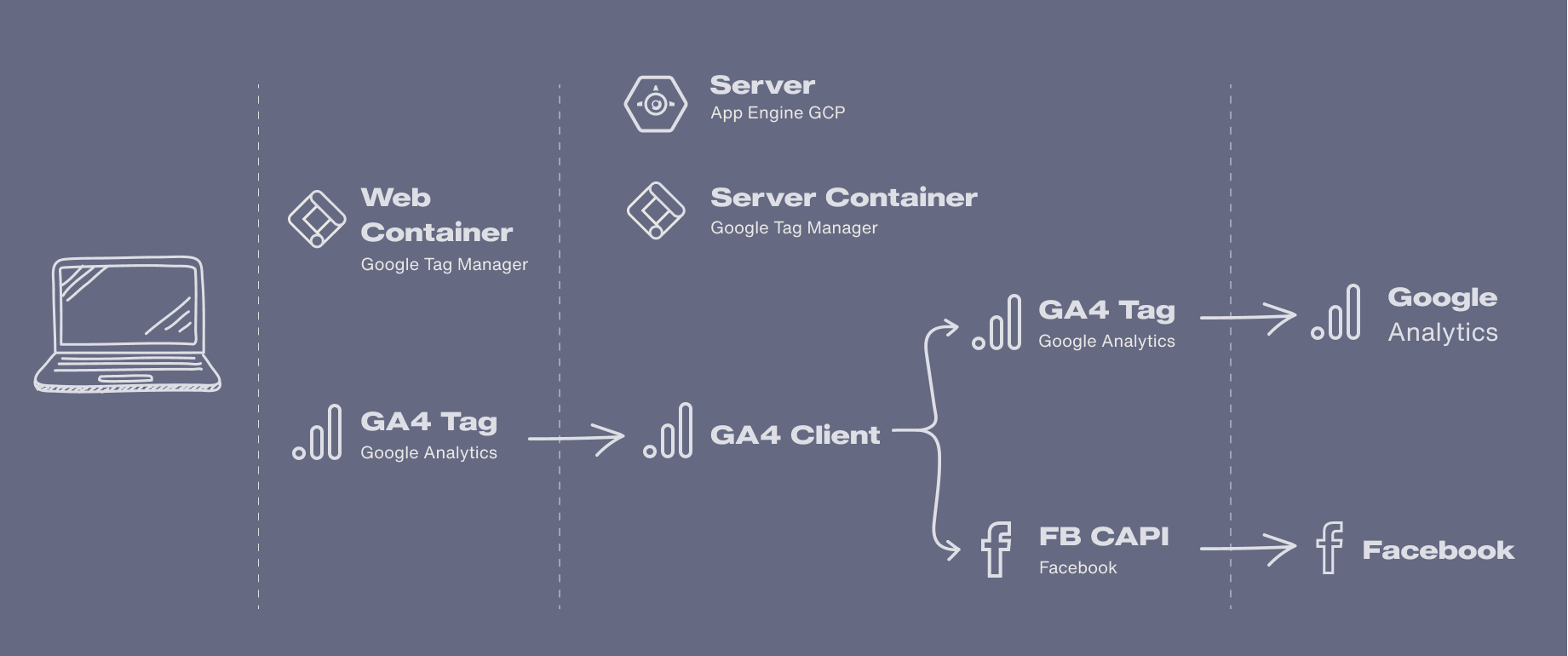
Historically, the client-side deployment of the Meta Pixel via Google Tag Manager has been the quickest and simplest way for Nissan to track activity across their website. But this method has suffered some setbacks since the introduction of Intelligent Tracking Prevention (ITP) by Apple, which limits tracking capabilities in the Safari browser. More recent updates to iOS have further limited web traffic by extending ITP restrictions to all browsers installed on the device by default. But these bumps in the road weren’t cause for panic; to increase Facebook campaign efficiency, we implemented Meta’s Conversion API to align traffic and behavior data in a way that still safeguards user privacy.

Nissan car wheel with a black rim

In partnership with

  • Nissan Thailand
Client Words We were excited by the idea of making the Facebook algorithm smarter by giving it signals coming from our proprietary data, as we heavily rely on it to locate our best customers. We have improved our Facebook campaign efficiency across the board since installing Conversions API, which has had a great impact on the business.
Nissan logo

Anuwat Eiamsa-art (Nu)

Head of Data, Tech, and Analytics, Nissan United Thailand

Increasing conversions with Conversion API.

The Conversion API is designed to reliably connect server-side marketing data to Meta’s business and marketing tools. We implemented the API by creating a Server-Side Google Tag Manager (SSGTM) instance. The SSGTM worked as a proxy between client-side user activity and the third-party vendor’s server. When a user triggers an event, the SSGTM container can read and transform the data before it reaches the vendor’s server.

Google cloud interface on a laptop

Unlocking new possibilities for data activation.

Our solution using the Conversion API gives Nissan new capabilities in terms of conversion tracking and remarketing, data governance, security and performance. We closely monitored Nissan’s eight active Facebook campaigns for a period of two weeks before and after the SSGTM implementation and saw a significant uplift in website conversions. The successful implementation not only helped Nissan continue to activate data despite new constraints, but also serves as another leg in the journey to future proof in the privacy era.

Want to talk data? Get in touch.

Hey 👋

Please fill out the following quick questions so our team can get in touch with you.

Can’t get enough? Here is some related work for you!

How to Strike the Balance Between Content and Context

How to Strike the Balance Between Content and Context

Media Media, Omni-channel Marketing, Performance Media 3 min read
Profile picture for user Shweta Khodade

Written by
Shweta Khodade
Associate Account Manager

A woman sitting on a bed with a towel around her head

In one day, the average consumer is bombarded by thousands of ads, each competing for their awareness and consideration. But how many ads are making an impact on the user? How many ads are providing the right information in the right place and at the right time?

We all know the age-old adage that content is king, but when all marketers use the same strategy by leveraging content to promote their product or service, the question remains: does this strategy still work? With millions of options available and thousands of alternatives in place, what can make your brand stand out as the most memorable? The answer to both questions lie in context marketing, a crucial strategy for helping your content resonate with audiences—and one that has enjoyed renewed interest and attention due to recent conversations about privacy and cookieless marketing.

Cut through the noise and drive memorability for your brand.

Context marketing provides the right meaning and insights to maximize relevance between people and your brand. Too often, brands focus fully on the content of their creative and not enough on the context in which people view them—the channels, cultural trends and other variables that shape their behavior online. But modern marketers know that there’s often a need to strategically balance content and context depending on their marketing goals. When building a content or context marketing strategy, there are a few factors that brands and marketers can consider. 

Frequency. How frequently will users see the ads? Too high a frequency can lead to ad fatigue. But if the ad frequency is low due to your budget or if your audience pool is smaller, there will only be a few chances to make an impact at speed. When users decide within a matter of seconds where to devote their attention, context can at times take priority over content. In Uni’s rebrand, focusing on enriching lives by inspiring creativity and connection, our paid media team worked closely with the creative team to ensure the media strategy was in line with the campaign’s creative vision. This approach enabled us to capture audience attention quickly through creative.

Shifts in preferences and trends. Over time, trends and shifts in consumer attitude will ebb and flow. For example, a particular skincare product is not useful for me in summer due to my skin type, but I did find it to be good for winter. Unfortunately for the brand, they never targeted me in the off season, which makes me wonder how things would have turned out differently had they re-evaluated audience targeting over time. Because trends and needs change, it’s wise to continually test audience targeting and exclusions over time. This will help you strategically adapt your marketing plan, its content and its context to meet changing tastes and preferences throughout the year.

Channel and vertical. The channel determines the format of creative and the content that will be delivered to the audience. For example, some channels favor video content while others are focused on images. Some are good for longform content, while content on others is more snackable. Some might even be interactive. Keep in mind how the channel may influence audience expectations, and also consider how your vertical may guide the approach to content. 

This is a strategy we used in helping Hatch, a fast-growing wellness and health brand, win over the hearts of countless people hoping to improve their sleep. We built a constant flow of fit-for-format content bespoke for each channel, each with narrative arcs that told the deeper story of Hatch Restore, the brand’s latest sleep assistant. The focus on format returned a 220% increase in click-through rate and 120% increase in view-to-completion rates.

Target audience. When it comes to your audience, it’s important to achieve the desired sentiment. This starts by selecting the right audience. For Hill House, a lifestyle direct-to-consumer brand, we analyzed audience signals from previous buyers to identify current and would-be customers. These insights allowed us to build data-driven creative we could optimize for this audience. These efforts not only drive performance—Hill House saw 80% higher ad engagement—but also enhance brand recall.

Maximize your marketing efforts with context marketing.

The above factors, while not all inclusive, offer a way to begin tapping into audiences more effectively through context marketing. Context marketing lets you deliver the right ad, at the right time, with the right message and format. By testing your creative relative to the variables above—frequency, trends, channel and audience—you enhance personalization and boost the strength of your marketing. This is especially useful as brands seek new strategies to adapt to a cookieless, more privacy-focused marketing landscape.

Ad fatigue is real: with so much content out there demanding our attention, it’s all too easy for audiences to tune things out. When it comes to building memorable creative, a strategic mix of content and context is key. That said, how will you build your next marketing strategy?

A crucial strategy for helping your content resonate with audiences is context marketing—which has a renewed interest due to privacy and cookieless marketing. third-party cookies content marketing strategy paid search paid social data privacy performance marketing Media Performance Media Omni-channel Marketing

Navigating the Absence of Third-Party Cookies

Navigating the Absence of Third-Party Cookies

Data Data, Data Privacy & Governance, Data Strategy & Advisory, Data privacy, Death of the cookie 7 min read
Profile picture for user Amber Knight

Written by
Amber Knight
Associate Account Manager

Hands holding an tablet shopping online

By now, you’ve heard the news: Google has shifted the phaseout of third-party cookies on Chrome until 2024. The move gives developers more time to evaluate and test the Privacy Sandbox technologies before deprecating third-party cookies altogether. With yet another extension, it’s important for businesses to ensure they are prepared for a world without third-party cookies.

When it comes to the reason why Google has chosen to deprecate third-party cookies to begin with, an increase in users’ demand for more control of their data is only the start.

Google must also comply with a long list of regulations surrounding privacy, the most notable being the General Data Protection Regulation (GDPR) and the California Consumer Privacy Act (CCPA). These regulations ensure that there are certain standards for what constitutes valid consent when collecting personal data, as well as giving consumers more control over the personal information that businesses collect about them.

The phaseout of third-party cookies will support these legislations and ensure the success of the privacy-first era. From an overall perspective, the deprecation of third-party cookies will impact how campaigns are implemented and managed by brands and their partners. Previously, brands relied on third-party cookies to learn about a target audience and their online behaviors. Without this information, we can expect significant impacts on remarketing, frequency management, personalization, attribution and measurement. 

New ways to identify are on the horizon.

Third-party cookies facilitate cross-site audience identification, which essentially allows marketers to “follow” users across the web, collecting data about their interests and online behavior. Each of the tactics above rely on this form of cross-site audience identification, and without third-party cookies, marketers will be unable to access this information about their target market so easily. 

But that doesn’t mean marketers will no longer be able to conduct successful remarketing campaigns, control the amount of times a user views an ad, deliver highly personalized ads, or identify a user’s touchpoints along the customer journey—provided they prepare for the cookie-less future now and minimize its impacts on their digital media activities. 

Since the announcement of the deprecation of third-party cookies, Google has been working on a range of solutions to continue to show relevant content and ads. FLEDGE and Topics are two examples of current Privacy Sandbox solutions for showing relevant content to audiences.  

FLEDGE’s purpose is to serve remarketing and custom audience use cases, without using third-party cookies. It enables interest-group-based advertising by asking the browser to choose which ads users see based on the sites they’ve previously visited. To keep this data secure, the browser conducts an on-device action to select relevant ads. 

Topics is a proposal that enables interest-based advertising without tracking the sites a user visits. It provides topics that a user may currently be interested in, based on their recent browsing history. These topics can supplement contextual information to help select appropriate advertisements. 

However, trials for FLEDGE and Topics are still a work in progress and the solutions are continuously changing, so we must focus on what we can do now to be able to navigate in a world without third-party cookies. Don’t take a “wait-and-see” approach. Those who look to prepare now will increase their chances of success and advancement in the privacy-first era. Here are some strategies to help you on your way to post-cookie marketing success.

Prioritize and invest in a first-party data collection strategy.

To prepare for the deprecation of third-party cookies, marketers should focus on growing quality customer data that informs both strategy and tactics. Utilizing the data from customers who have shown interest in your brand is more reliable and powerful than buying and selling access to third-party data. 

First-party data gathered from your websites, apps, physical stores (including offline transaction data), or other places where customers interact with your business, are all examples of first-party data that you passively—but directly—collect from consumers. Earning this data relies on building a fair value exchange, so that consumer data is understood to contribute to a better experience. Customer trust is built on transparency, hence it's always important to explain how you’re going to collect and use the data in your cookie consent banner or consent management platform. When collecting data about your customers, you must also make certain that you are compliant with regulations such as the GDPR, ensuring you are getting valid consent when collecting personal data and not collecting personally identifiable information (PII). 

With first-party data, brands can evaluate local touch points and preferred paths, while customizing interactions for a superior customer experience. Now is an excellent time to look inward and begin to build the foundations of your data strategy—one that will power your marketing with clean, unified and actionable data. Collecting first-party data and linking it together allows you to have a persistent, cross-device recognition for a single view of your customer, and an overall understanding of your audience. Mondelēz, for example, understood that digital marketing is most effective when you know how to play to consumers’ personalized taste. After helping them along the road to clean data, we achieved a +70% global return on investment.

Focus on collecting information and data you have access to.

As a marketer, you have access to a plethora of data about your customers, whether it be purchase data, device information or email engagement. Having an identification-first approach to customer data will give you an upper-hand to targeting effectively without third-party cookies. With data from third-party cookies being cut off, the priority should lay with first and second-party data, audience partners such as walled gardens, prominent publishers and media platforms, retailers and strategic partners. 

After prioritizing your first-party data and collection strategy, you should focus on building experience with reputable, trustworthy second-party data partners. Second-party data is essentially someone else’s first party data that you purchase access to from partners like Google, Amazon, or large publishers. You should focus not only on historical data, but real-time behavioral data such as users’ devices, interactions with your website, their carts, purchase history, media consumption, as well as the categories and products they visited while browsing on your website. By leveraging second-party data from trustworthy partners, you will have more data transparency and access to more precise and niche audiences which are crucial after the deprecation of third-party cookies.

Conduct a measurement audit. 

Conducting a measurement audit will consist of analyzing everything you’re currently tracking and identifying if it is necessary to be measuring it. It will help you to identify potential gaps and develop a roadmap to achieve measurement excellence that drives business results in a world without third-party cookies. A measurement audit includes the evaluation of current measurement tools and systems, as well as the alignment of key goals to further develop the practice. When conducting the audit, you’ll want to identify the necessary data, reporting and analysis methodology to improve measuring marketing effectiveness going forward to help with planning and forecasting.

Key considerations when conducting the audit are to understand the need and whether you can drive more value from your analysis and analysis partners. You want to develop a robust framework that will be effective and efficient to leverage in your decision making. You also want to ensure the roadmap provides added value, and is adaptive and not difficult to implement. By conducting a measurement audit, you hope to identify opportunities for maximizing the value of your measurement, strengthening your analytic capabilities and performance, and understanding how to holistically link together different techniques for marketing effectiveness in a world without third-party cookies. 

Evaluate your ad tech stack and partnerships. 

It’s important for you to evaluate your ad tech stack and partnerships to identify technologies and practices at risk of deprecation in the near future. Having a strong, well-engineered ad tech stack will create seamless, relevant, and meaningful experiences for consumers and give you a deeper insight into those interactions. When evaluating your tech stack, you must analyze how much control you have over fee transparency, brand safety, streamlined operations, data ownership, targeting and ad serving. Your tech stack should also be able to enable current operations and be able to incorporate future ones. 

A partner risk assessment should be undertaken to evaluate how reliant partners are on non-compliant tactics, data and technology; what their new publisher and media partner offerings are, and opportunities beyond basic ad units. Those partners who rely on non-compliant tactics, data and technology should be making it clear what they are doing to prepare for the third-party cookie deprecation. Marketers should carefully consider their platform partners and ad tech stack and focus on those that can deliver results without third-party cookies.

Consider a dedicated testing budget. 

Marketers should allocate a dedicated testing budget for first-party data practices, audiences and strategies across thousands of variables. These areas should be tested and leveraged, becoming an integral part of the targeting strategy where successful. One way to do this is by  testing and targeting customer experiences to improve digital performance using optimization and personalization. You’ll want to design net new campaigns and tests running without cookies, leveraging experimental design. 

As the data agency of record for Molson-Coors, we’ve spent the last year helping the brand undergo a data transformation that ranges from data acquisition, data activation and optimization. With hands-on-keyboard talent and an in-house team, Molson-Coors is able to use that data to better understand creative and media performance, then make tweaks to drive long-term growth.

By testing audiences and strategies across thousands of variables to build detailed customer profiles and to increase ad performance, scaled experimentation is the best alternative to third-party cookies when it comes to personalized customer experiences, and the performance benefits have consistently been shown to outweigh the costs of investment. 

Don’t wait to get your digital house in order.

Third-party cookies have played an instrumental role in the immense growth in online advertising. Yet their often-intrusive nature is misaligned with current attitudes toward privacy and transparency—so moving beyond our reliance on cookies, while maybe painful in the short term, is a net positive in building stronger brand-consumer relationships. That said, we can expect more changes to data collection and privacy on both the platform and legislative level in the long term; the only thing that’s certain about privacy is that there will continue to be uncertainty. A privacy partner can help you navigate the always evolving world of data privacy with ease, and our Data Foundations offering is designed to help brands build data maturity to meet the demands of a new era, including increased privacy scrutiny.

In a broad sense, laying the foundation of a first-party data strategy will enable a clearer understanding of your audience. Meanwhile, new solutions on the horizon like Topics and FLEDGE will help brands mitigate risk and continue to deliver relevant content to their audiences. But marketers shouldn’t wait for tech giants to implement new solutions before they act. Those who build and enhance the core components and practices of a customer-centric marketing strategy will be better positioned for a world without third-party cookies and thrive in the privacy-first era.

With another extension from Google, it’s important for businesses to ensure they are prepared for a world without third-party cookies. Google data privacy third-party cookies first-party data Data Data Privacy & Governance Data Strategy & Advisory Death of the cookie Data privacy

Future-Proof Growth with a Focus on Privacy

Future-Proof Growth with a Focus on Privacy

Data Data, Data Privacy & Governance, Data Strategy & Advisory, Data privacy, Death of the cookie 4 min read
Profile picture for user mediamonks

Written by
Monks

data points going through a lock

Smita Salagonkar and Shashwith Uthappa

When retail faced physical shutdowns, more consumers flocked to digital for shopping. While ecommerce long offered time and cost savings to consumers, it now had the benefit of providing them with a safer environment to purchase during a pandemic. Southeast Asia alone saw 20 million new digital customers.

For brands, a benefit of the move to digital was that wide swaths of consumers were now sharing their purchase intent—valuable data used to surface up precise results. Consumers expect relevance in the products and content that’s recommended to them, and this expectation will only grow; imagine having to search for what you’re looking for in the 8th page of Google Search results!

On the flip side, companies face increased ethical scrutiny in how they use customer data. Business strategies designed to covertly collect personal data and monetize it are myopic; they may have implications on the customer relationships in the long-term. It’s important that companies instead look at responsible, privacy-focused strategies to earn consumer trust, even more so as we move to a post-cookie future.

Privacy is the fulcrum to the future of marketing.

With many consumers increasingly becoming aware and wary of the use of their data, and with regulatory bodies coming forward with laws and legislations, now is the time for brands to give their audiences a seat at the negotiation table when it comes to their privacy. At the recent Google Marketing Live event for the Leadership Circle in Hyderabad, India, privacy was the key theme, including how it is the fulcrum to building the future of marketing. Some key interesting stats that were shared:

  • 48% of people globally have stopped buying or using a service from a company due to privacy concerns.
  • Four out of the top five countries that searched for online privacy (in English) were from APAC.
  • Three out of five companies globally report benefits of deeper loyalty and improved agility and efficiency with being privacy mature. 

Essentially, modern brands use data to serve customers and provide a meaningful value exchange—more relevant, personalized experiences that enhance the brand-consumer relationship—rather than treat audiences as another product to auction off and sell. So while examples of data privacy misconduct often make the news, it’s instructive to acknowledge and learn from those who are handling data with utmost care. Walmart embraces privacy in the design of its organizational processes and structures, products and services by constantly monitoring the technological landscape for potential threats, for example. This way they are self-reliant on the collection and protection of data and hence subject to lesser data vulnerability. Likewise, brands can focus on privacy not as an inhibitor, but rather the key to unlocking better customer experiences through more ethical and sustainable use of data.

Focus on consent and value.

Given the fact that data security and management require a significant investment of resources by digitally mature companies, it’s important to use those tools to serve customers better, because that’s where the return on investment lies.

Two ways that brands create value is by offering transparency about data collection and control in how it is used. Ultimately it is about delivering value to end users. Consented first-party data and insights from privacy-safe technologies like Topics API provide incremental value to marketers while keeping online content and services free. Data-driven marketing focused on transparency and control can transform marketing strategies, enhance customer relationships, and yield useful content to people or even inform the product design.

A greater focus on first-party data is important because over reliance on third-party cookies, a tactic brands have taken for granted, is increasingly unwelcome by consumers and increasingly unsustainable given future plans to phase them out. Expanding beyond third-party cookies is key to building a long-term marketing strategy of the future.

Our work for Ace Hardware illustrates this philosophy. Through revamping its rewards program, Ace Hardware was able to improve the customer experience and deliver on its reputation of being “The Helpful Place” for those wanting to improve their homes. The app rewards customers for their loyalty while enriching Ace’s trove of first-party data. By unlocking insights into customer interest and intent—without the use of third-party cookies or targeted ads—the brand was able to deliver a meaningful value exchange in return for data.

Zero in on the data you need.

Another benefit of shielding consumer privacy is preventing data bloat by collecting only the data necessary to drive value for your marketing—not gobbling all your customers’ data. This enhances data hygiene, yields cleaner analytics and helps minimize risks posed by data breaches.

Software giant SAP estimates that nearly 73% of data collected by companies is never used. When data minimization efforts are put into practice, there are limited opportunities for collecting information, thereby condensing the depth of detail and timeframe in which data is possessed. This forms the nucleus of GDPR regulations, helps weed out the excess data and focus on obtaining only relevant information with focused questions and being intentional in data collection efforts.

Activate insights through continual testing.

When companies build a customer-learning and serving culture, they determine the purpose of data before asking for consent and a clear explanation is provided to customers on what they stand to gain in parting with their data.

With a focus on learning about and serving customers, brands are able to build a “test and learn” culture to inspire increasingly valuable experiences reinforced by data. Amex has been able to do this successfully with initiatives such as the small business lending program, which they piloted after having a deeper understanding of their customer data signals. Incidentally the brand also ranks high in customer privacy in the Fortune 500 companies list. Likewise, brands who are agile in responding to imminent privacy changes are breaking down the privacy era.

The right approach to data privacy can create a ripple effect of positive outcomes: deterring churn to competitors, strengthening perception, overcoming privacy obstacles and ultimately earning consumer trust. With these benefits in mind, keeping privacy the focus of your data strategy can do more than keep a brand agile amidst new regulations—it’s also a key component to future-proof growth.

Learn privacy-focused strategies that earn consumer trust and future-proof growth, even as we move towards a post-cookie future. data privacy privacy third-party cookies first-party data Data Data Privacy & Governance Data Strategy & Advisory Death of the cookie Data privacy

Choose your language

Choose your language

The website has been translated to English with the help of Humans and AI

Dismiss