Choose your language

Choose your language

The website has been translated to English with the help of Humans and AI

Dismiss

Vision Pro Is a Mixed Reality Milestone—Here’s What It Means for Brands

Vision Pro Is a Mixed Reality Milestone—Here’s What It Means for Brands

Experience Experience, Extended reality, Immersive Brand Storytelling, Metaverse, VR & Live Video Production 4 min read
Profile picture for user mediamonks

Written by
Monks

A person wearing a AR headset

If the reveal of Apple’s Vision Pro has made one thing clear, it’s that we’re currently at an inflection point where hardware innovation meets consumer behavior. Though it isn’t the first mixed reality headset on the market, following Magic Leap and Meta’s Oculus, it comes at a moment when the industry is poised to redefine how we interact with digital content.

“This is perhaps one of the most hotly anticipated product launches in recent years,” says our VP, Interactive Projects Simon Joseph. “It not only gives credit to the field of augmented and mixed reality, but also to its staying power and the potential for the future to come. For the era of spatial computing and AR, this is only just beginning, and we are so excited to see where it goes from here.”   

Anyone who has ever dabbled in augmented reality (AR) knows that it’s a powerful tool for capturing people’s attention and standing out in a crowded market by seamlessly blending digital content with the physical world through visual overlays, engaging audio and motion control. Parallel to the metaverse’s rise in the cultural consciousness, these immersive features are proving advantageous to brands who aim to shine in an abundance of content, stuffed social feeds and crowded app ecosystems. On top of that, the technology promises to evoke truly memorable and emotional responses in consumers. 

Innovations across the board are helping AR advance at speed.

Compared to consumers, brands have been slower to recognize AR’s practical use. Data from Snap and Ipsos shows that 90% of brands think AR is primarily for fun, while only 57% of consumers think of it that way, instead seeing potential in activities such as shopping. As a trio of technological forces—not just hardware, but also software and heightened connectivity—converge to enable a new breed of AR experiences, we believe brands will realize AR’s potential across the customer journey. 

New AR headsets are gaining interest and intrigue—there will be over 1.7 billion active AR devices worldwide in 2024, and 18 million AR/VR headsets will ship this year—but software like visual positioning systems will also greatly enhance multiplayer digital experiences on mobile devices. Moreover, 5G Advanced is set to improve speed, coverage, mobility and power efficiency, which means no latency and no more cache limitations as people will stream high-quality experiences in real time. 

The fact that AR experiences will become more easily accessible for consumers is great news for brands, because AR’s value extends from the top to the bottom of the sales funnel. Research from WARC found that “AR ads capture the attention of broad audiences who are early in their purchase journey, with a +7% increase in aided ad recall among this group of consumers. And AR can help brands nudge consumers who are in the consideration phase by making the brand seem more up-to-date and differentiated.” 

Dive in head first to get ahead.

Time has shown that early adopters can reap first-mover rewards, and the present moment offers brands a chance to get ahead: with the launch of new hardware comes a new app marketplace, and early explorers of AR are primed to benefit from being quick to take the plunge. That said, effectively introducing AR into your customer experience journey requires careful consideration—questions around the medium, culture fit, and collaborating with vendors are bound to come up—so here are some chief concerns marketers should consider in setting themselves up for success.
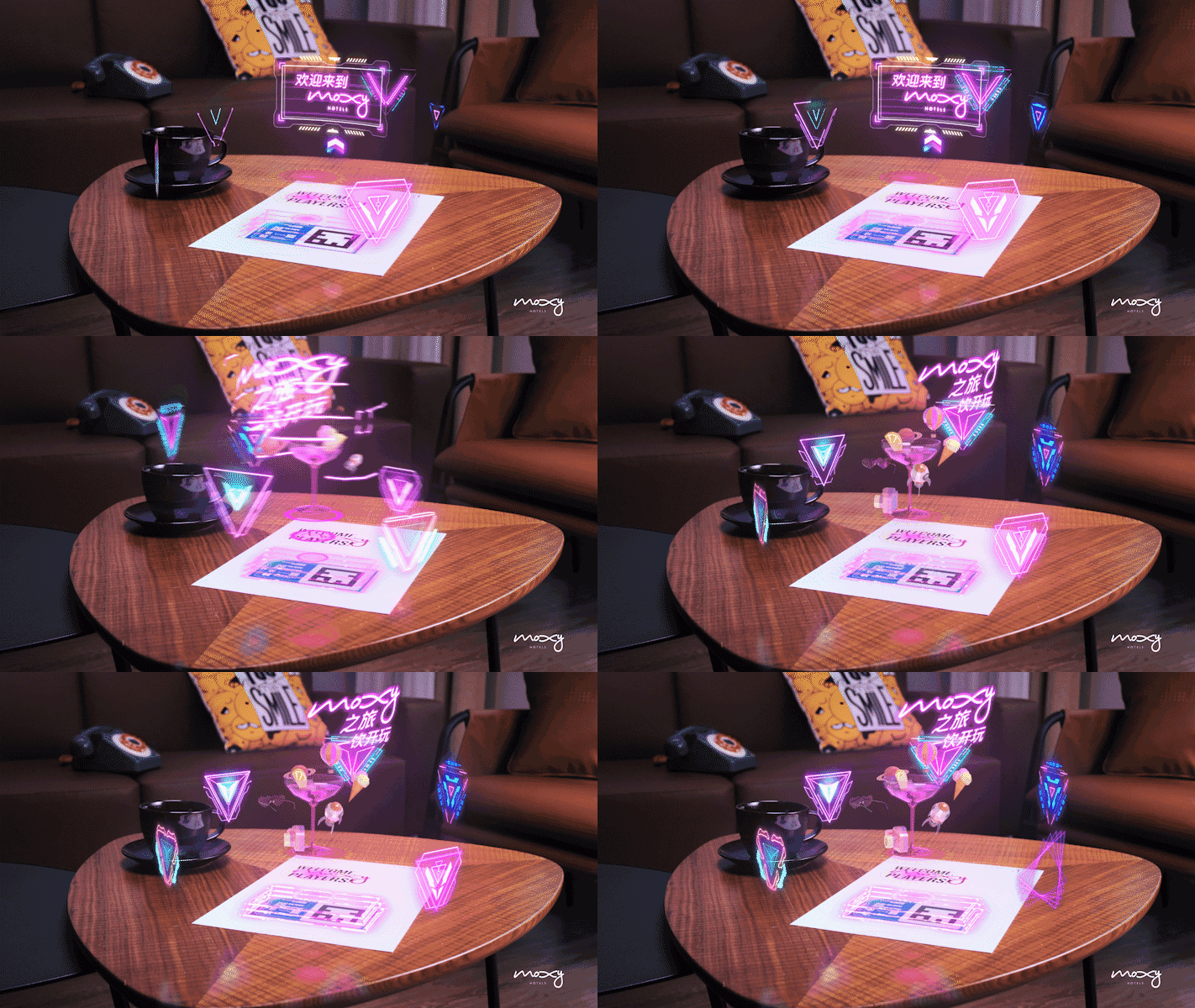

A table showing 3D moxy hotel perks
A phone showing an augmented avatar

For starters, find out whether immersive AR experiences will excite your audiences. To understand how AR might make sense for your brand, follow the “jobs to be done” framework, an important tool for assessing any innovation. Consider customer needs and the motivations that drive them, as well as the circumstances in which they achieve them. 

Furthermore, make sure you take advantage of the medium. Whether you’re aiming to drive powerful immersion through interactive content or overlay real-world contexts with useful information, the medium determines the benefits. That’s why it’s important to carefully plan how certain benefits from AR can help your brand achieve its goals. 

Finally, explore other tools that aid AR development. Thanks to software kits and frameworks, creating AR experiences has never been easier—and with new urgency to develop immersive 3D content, various AI-powered tools have emerged to streamline content creation. Nvidia’s Instant NeRF allows teams to quickly create digital doubles of photographed objects, while Stability for Blender adds the force of Stable Diffusion to 3D software and Unity AI leverages the power of Unity game engine and large language models by building entire scenes based on a written prompt.

It’s time to break the mold and trust the potential of AR. 

AR is an undeniably powerful tool for brands to connect with their audiences. Through immersive and interactive experiences, this technology is transforming the traditional customer journey, offering a blend of entertainment and utility that captures people’s attention and drives engagement. Several brands are already shaping the future of consumer engagement. By exploring the vast possibilities of AR, addressing key considerations, and leveraging innovative technologies, your brand can unlock the full potential of the technology, too, cementing your position as a leader in this rapidly evolving landscape.

AR is a powerful tool for brands to connect with their audiences. Learn how to unlock the full potential of the technology and cement your position as a leader in this landscape. AR augmented reality mixed reality emerging technology Experience VR & Live Video Production Immersive Brand Storytelling Extended reality Metaverse

The Labs.Monks Count Down to Most Anticipated Trends of 2023

The Labs.Monks Count Down to Most Anticipated Trends of 2023

AI AI, AI & Emerging Technology Consulting, Extended reality, Metaverse, New paths to growth, Technology Consulting, Technology Services 7 min read
Profile picture for user Labs.Monks

Written by
Labs.Monks

Labs.Monks logo with triangular designs

Firmly settled into the new year, we’re already looking ahead at tech trends that lie on the horizon. And who better is there to predict what they might look like than the Labs.Monks, our innovation team? As an assessment of their trend forecast from one year ago (spoiler alert: they got more than a few right) and a glimpse into the near future of digital creation and consumption, the Labs.Monks have come together again to share their top trends for the new year. Let’s count them down!

10. Digital humans get more realistic.

Digital humans may have earned a spot on our list of trends last year, but we haven’t grown tired of traversing the uncanny valley to play with the technology. In fact, the recent explosion of conversational AI will likely inject new life into digital humans and transform the realms of customer service, entertainment and more. Whether used to hand-craft original characters or refine scanned-in digital twins, digital human creation tools are becoming increasingly complex to deliver lifelike avatars. 

“We’ll see more competition between Unreal’s MetaHuman Creator and Unity’s Ziva,” says Geert Eichhorn, Innovation Director. In fact, Media.Monks has used Unreal’s tool to create a digital double of our APAC Chief Executive Officer, Michel de Rijk. Because why not?

00:00

00:00

00:00

9. Motion capture becomes more accessible.

Last year, we released a Labs Report dedicated to motion capture and how its increasing accessibility influenced content production for both professional film teams and everyday consumers. New technologies available at consumer price points are helping to bring motion capture into even more people’s hands. Meta’s Quest Pro headset, which released late last year, features impressive facial tracking that will be key to expressing the nuances of human emotion in VR. Move.ai, currently in beta, enables 1:1 motion tracking with a group of mobile devices—no bodysuits, no markers, no extra hardware needed. Using computer vision, the platform allows anyone to make motion capture video in any environment.

8. Mixed reality and mirror worlds mature.

With smaller and more comfortable AR headsets shown off already at CES, we can expect augmented and mixed reality to become more immersive, accessible and practical over the course of 2023 (check out more of what we saw at CES here). The VIVE Flow, for example, includes diopters so that users can replicate their prescription lenses in the device, amounting to a more comfortable experience overall. 

But it’s not just about hardware. “One of the major advancements is not in the headsets, but in the software,” says Eichhorn, noting that VPS has the power to pinpoint a user’s exact position and vantage point in the real world. “They do this positioning by comparing your camera view to a virtual, 3D version of the world, like Street View.” We covered mirror worlds in last year’s trend list, but the development of VPS is now bringing this vision closer to everyday consumers.

While VPS currently works only outdoors, we’ve already seen the power of the technology with Gorillaz performances in Times Square and Piccadilly Circus in December 2022.

Monk Thoughts This innovation ultimately unlocks the public space for bespoke digital experiences, where brands can move out of billboards and storefronts and move into the space in between.
Portrait of Geert Eichhorn

7. More enterprises embrace the hybrid model.

For many businesses the return to the office hasn’t been a smooth transition; while some roles require close collaboration within a shared space, others enjoy more flexible setups that support childcare, offer privacy for focus work or greater accessibility. Given the benefits of flexible work setups and the development of technologies that build presence in virtual environments, Luis Guajardo Díaz, Creative Technologist, believes more enterprises will embrace the hybrid work model.

Media.Monks’ live broadcast team, for example, built a sophisticated network of cloud-based virtual machines hosted on AWS to enable people distributed around the world to produce live broadcasts and events. Born out of necessity during the pandemic, the workflow goes beyond bringing teams together—it’s designed to overcome some of the challenges traditional broadcast teams face on the ground, like outages or hardware malfunctions. It stands to show how hybrid models can help enhance the ways we work today.

6. Virtual production continues to impress.

Virtual production powered by real-time become popular in recent years: the beautiful environments of The Mandalorian or grungy urban landscape of The Matrix showed what was possible by integrating game engines in the production process, while pandemic lockdowns made the technology a necessity for teams who couldn’t shoot on location.

Now, further advancements in game engines and graphics processing offer a look inside the future of virtual production. Sander van der Vegte, VP Emerging Tech and R&D, points to Unreal’s Nanite, which allows for the optimization of raw 3D content in real time.

Monk Thoughts From concept to testing, the chronological steps of developing such projects will follow a different and more iterative approach, which opens up creative possibilities that were impossible before.
Sander van der Vegte headshot

Localization of content is one example. “In 2023 we’re going to see this versatility in the localization of shoots, where one virtual production shoot can have different settings for different regions, all adapted post-shoot,” says Eichhorn.

5. TV streaming and broadcasts become more interactive.

With virtual production becoming even more powerful, TV and broadcasting will also evolve to become more interactive and immersive. “Translating live, filmed people into real-time models allows for many new creative possibilities,” says van der Vegt. “Imagine unlocking the power to be the cameraman for anything you are watching on TV.” 

It might sound like science fiction, but Sander’s vision isn’t far off. At this year’s CES, Sony demoed a platform that uses Hawk-Eye data to generate simulated sports replays. Users can freely control the virtual camera to view the action from any angle—and while not live, the demo illustrates the power of more immersive broadcasts. The technology could be a game changer for sports and televised events that let audiences feel like they’re part of the action.

Post malone singing with a large camera hanging
Post malone on a smokey stage

4. Metaverse moves become more strategic.

“2021 was a peak hype year for the metaverse and Web3. 2022 was the year of major disillusionment,” says Javier Sancho, Project Manager. “There are plenty of reasons to believe that this was just an overinflated hype, but it’s a recurring pattern in tech history.” Indeed, a “trough of disillusionment” inevitably follows a peak in the hype cycle.

This year will challenge brands to think of where they fit within the metaverse—and how they can leverage the immersive technology to drive bottom-line value. Angelica Ortiz, Senior Creative Technologist, says the key to unlocking value in metaverse spaces is to think beyond one-time activations and instead fuel long-term customer journeys.

Monk Thoughts NFTs and crypto have had challenges in the past year from a consumer and legal perspective. Now that the shine is starting to fade, that paves a new road for brands to go beyond PR and think critically about when and how to best evolve and create more connected experiences.
Angelica Ortiz headshot

A great example of how brands are using Web3 in impactful ways is by transforming customer loyalty programs, like offering unique membership perks and gamified experiences. These programs reinforce how the Web3 ethos is evolving brand-customer relationships by turning consumers into active participants and collaborators.

3. Large language models keep the conversation flowing.

With so much interest in bots like ChatGPT, the Labs.Monks expect large language models (LLMs) will continue to impress as the year goes on. “Large Language Models (LLMs) are artificial intelligence tools that can read, summarize and translate texts, and generate sentences similar to how humans talk and write,” says Eichhorn. These models can hold humanlike conversations, answering complex questions and even writing programs. But these skills open a can of worms, especially in education when students can outsource their homework to a bot.

LLMs like GPT are only going to become more powerful, with GPT-4 soon to launch. But despite their impressive ability to understand and mimic human speech, inaccuracies in response still need to be worked out. “The results are not entirely trustworthy, so there’s plenty of challenges ahead,” says Eichhorn. “We expect many discussions over AI sentience this year, as the Turing Test is a measurement we’re going to leave behind.” In fact, Google’s LaMDA already triggered debates about sentience last year—so expect more to come. 

2. Generative AI paints the future of AI-assisted creativity.

If 2021 was the year of the metaverse, the breakout star of 2022 is generative AI in all its forms: creating copy, music, voiceovers and especially artwork. “Generative AI wasn’t on our list in 2022, although looking back it should have been,” says Eichhorn. “The writing was on the wall, and internally we’ve been working on machine learning and generating assets for years.” 

But while the technology has been embraced by some creatives and technologists, there’s also been some worry and pushback. “These new technologies are so disruptive that we see not only copywriters and illustrators feel threatened, but also major tech companies need to catch up to not become obsolete.” 

In response to these concerns, Ortiz anticipates a friendly middle ground where AI will be used to augment—not erase—human creativity. “With the increasing push back from artists, the industry will find strategic ways to optimize processes not cut jobs to improve workflows and let artists do more of what they love and less of what they don’t,” she says. Prior to the generative AI boom, Adobe integrated machine learning and artificial intelligence across its software with Adobe Sensei. More recently, they announced plans to sell AI-generated images on their stock photography platform.

00:00

00:00

00:00

Ancestor Saga is a cyberpunk fantasy adventure created using state of the art generative AI and rotoscoping AI technology.

Monk Thoughts We’re suddenly seeing a very tangible understanding of the power of AI. 2023 will be the Cambrian explosion of AI, and this is going to be accompanied with serious ethical concerns that were previously only theorized about in academia and science fiction.
Javier Sancho Rodriguez headshot

1. The definition of “artist” or “creator” changes forever.

Perhaps the most significant trend we anticipate this year isn’t a tech trend; rather, it’s the effect that technology like generative AI and LLMs will have on artists, knowledge workers and society. 

With an abundance of AI-generated content, traditional works of art—illustrations, photographs and more—may lose some of their value. “But on the flip side, these tools let everyone become an artist, including those who were never able to create this kind of work before,” says Eichhorn. This can mean those who lack the training, sure, but it also means those with disabilities who have found particular creative fields to be inaccessible.

When everyone can be an artist, what does being an artist even mean? The new definition will lie in the skills that generative AI forces us to adopt. Working with generative AI doesn’t necessarily eliminate creative decision-making; rather, it changes what the creative process entails. New creative skills, like understanding how to prompt a generative AI for specific results, may reshape the role of the artist into something more akin to a director. 

Eichhorn compares these questions to the rise of digital cameras and Photoshop, both of which changed photography forever while making it more accessible. “The whole process will take many more years to settle in society, but we’ll likely see many discussions this year on what ‘craft’ really entails,” says Eichhorn.

That’s all, but we can expect a few surprises to emerge as the year goes on. Look out for more updates from the Labs.Monks, who regularly release reports, prototypes and podcast episodes that touch on the latest in digital tech, including some of the topics discussed above. Here’s to another year of innovation!

Our Labs.Monks have come together again to share their most anticipated and top trends for the new year. AI artificial intelligence metaverse emerging tech trends technology Technology Services Technology Consulting AI & Emerging Technology Consulting New paths to growth AI Extended reality Metaverse

Meet Your Digital Double: How Metahumans Enhance Personalization

Meet Your Digital Double: How Metahumans Enhance Personalization

AI AI, AI & Emerging Technology Consulting, Experience, Extended reality, Web3 4 min read
Profile picture for user mediamonks

Written by
Monks

A virtual human head inside a clear box

Picture this: you’re a well-known figure in your field, perhaps even a celebrity, who follows a similar routine every day. You shoot commercials for different markets, reply to every single message in your DMs with a personalized note, host a virtual event where you meet and greet thousands of fans and even teach an on-demand class where you and your students engage in meaningful conversations. It’s all happening at the same time and all over the world, because it’s not your physical self who’s doing it, but your digital double.

Since its launch in 2021, Epic Game’s MetaHuman Creator, a cloud-based app for developing digital humans, has extended its range of possibilities by adding new features—such as Mesh to MetaHuman. Using Unreal Engine, this plugin offers a new way to create a metahuman from a 3D character mesh, allowing developers to import scans of real people. In other words, it makes it easier to create a virtual double of yourself (or anyone else) almost immediately.

Inspired by this significant update and following our tradition of enhancing production workflows using Unreal Engine, our team of dedicated experts decided to build their own prototype. Needless to say, they learned a few things along the way—from the practical possibilities of metahumans to the technicalities of applying motion capture to them. As explained by the experts themselves, here’s what you need to know about creating and unlocking the full potential of virtual humans.

00:00

00:00

00:00

Be everywhere at once—at least virtually.

If you ever fantasized about cloning yourself to be able to comply with all your commitments or complete your pending tasks, metahumans may be just what you were looking for. Virtually, at least. As digital representatives of existing individuals, metahumans offer endless possibilities in terms of content creation, customer service, film and entertainment at large. Sure, they won’t be able to do your dishes—at least not yet—but if you happen to be a public figure or work with them, it’s a game changer. 

By lending likeness rights to their digital doubles, any influencer, celebrity, politician or sports superstar will be able to make simultaneous (digital) appearances and take on more commercial gigs without having to be on set. As John Paite, Chief Creative Officer of Media.Monks India, explains, “Celebrities could use their metahuman for social media posts or smaller advertising tasks that they usually wouldn’t have the availability for.” Similarly, brands collaborating with influencers and celebrities will no longer need to work around their busy schedules.

The truth is, virtual influencers are already a thing—albeit in the shape of fictional characters rather than digital doubles of existing humans. They form communities, partner with brands and are able to engage directly and simultaneously with millions of fans. Furthermore, they are not stuck in one place at a time nor do they operate under timezone constraints. In that regard, celebrities’ digital doubles combine the benefits of virtual humans with the appeal of a real person.

A new frontier of personalization and localization.

Because working with virtual humans can be more time-efficient than working with real humans, they offer valuable opportunities in terms of personalization and localization. Similarly to how we’ve been using Unreal Engine to deliver relevant creative at speed and scale, MetaHuman Creator takes localization to a new level. As Senior Designer Rika Guite says, “If a commercial features someone who is a celebrity in a specific region, for example, this technology makes it easy for the brand to replace them with someone who is better known in a different market, without having to return to set.” 

But not everything is about celebrities. Metahumans are poised to transform the educational landscape, too, as well as many others. “If you combine metahumans with AI, it becomes a powerhouse,” says Paite. “Soon enough, metahumans will be teaching personalized courses, and students will be able to access those at a lower price. We haven’t reached that level yet, but we’ll get there.”

For impeccable realism, the human touch is key.

To test how far metahumans are ready to go, our team scanned our APAC Chief Executive Officer, Michel de Rijk, using photogrammetry with Epic Games’ Reality Capture. This technique works with multiple photographs from different angles, lighting conditions and vantage points to truly capture the depth of each subject and build the base for a realistic metahuman mode. Then, we imported the geometry into MetaHuman Creator, which our 3D designers refined using the platform’s editing tools. 

“Because Mesh to Metahuman allows you to scan and import your real face, it’s much easier to create digital doubles of real people,” says our Unreal Engine Generalist Nida Arshia. That said, the input of an expert is still necessary to attain top-quality models. “Certain parts of the face, such as the mouth, can be more challenging. Some face structures are harder than others, too. If you want the metahuman to look truly realistic, it’s important to spend some time refining it.” 

Once we got our prototype as close to perfection as possible, we used FaceWare’s facial motion capture technology to unlock real-time facial animations. While FaceWare’s breadth of customization options made it our tool of choice for this particular model, different options are available depending on the budget, timeline and part of the body you want to animate. Unreal’s LiveLink, for example, offers a free version that allows you to use your phone and is easy to implement both real-time and pre-recorded applications, but focuses on facial animations only. Mocap suits with external cameras allow for full-body motion capture, but with mid-fidelity, and recording a real human in a dedicated mocap studio unlocks highly realistic animations for both face and body. 

At the same time, the environment we intend the metahuman to inhabit is worth considering, as the clothes, hair, body type and facial structure will all need to fit accordingly. Naturally, different software may adapt better to one style or another. 

While this technology is still incipient and requires some level of expertise, brands can begin to explore different ways to leverage metahumans and save time, money and resources in their content creation, customer service and entertainment efforts. Similarly, creators can start sharpening their skills and co-create alongside brands to expand the realm of possibilities. As Arshia says, “We must continue to push forward in our pursuit of realism by focusing on expanding the variety of skin tones, skin textures and features available so that we can build a future where everyone can be accurately represented.”

Our experts share what you need to know about creating and unlocking the full potential of virtual humans. Virtual humans unreal engine artificial intelligence AI Personalization Experience AI & Emerging Technology Consulting AI Web3 Extended reality

Looking Back at a Year of Digital Innovation

Looking Back at a Year of Digital Innovation

AI AI, AI & Emerging Technology Consulting, Extended reality, Metaverse, New paths to growth, Technology Consulting, Technology Services 7 min read
Profile picture for user mediamonks

Written by
Monks

Colorful crystals and shapes fly out of an image of person shaking their head

Lea este artículo en español aquí.

And just like that, another year comes to a close—twelve months packed with the emergence of exciting developments in technology and new consumer behaviors. The metaverse matured, commerce went social, and brands learned to move beyond vanity metrics and cookie consent to build actionable data with bottom-line impact. In essence, there’s been no shortage of challenges (and solid victories) over the past year—so as you begin to look ahead at the next, let’s take a quick review of 2022 highlights and trends.

Virtualization defines the transformation of digital.

As the world opened back up, an era of digital transformation gave way to the transformation of digital. By this, we mean virtualization: a set of new audience behaviors, cultural norms and technology paradigms resulting from 30 years of digital transformation, hyper-accelerated over the past five years. Virtualization, covered in our report earlier this year, marks a revolution in consumer behavior as people demand more from the digital platforms they engage with, which implicates the ways they look at digital experience, community, ownership and identity. For example, the design of ComplexLand, a virtualization of the hype-fueled annual event ComplexCon, was built around the insight that today’s fashion trendsetters are becoming just as invested in their digital identities as their corporeal ones.

The Social Innovation Lab, who explores up-and-coming trends in social, delved deeper into what motivates some of these behavioral changes in The Search for Meaning. By exploring how technology shapes the ways consumers find and make meaning in their lives, the Social Innovation Lab uncovers how brands can adapt to the new era in digital.

Monks Thoughts We're seeing the emergence of a new set of consumer expectations based on digital experiences that are richer, more meaningful, and more ownable. New tools, technologies, and talent on part of brands to show up and meet consumers in a new way. We call this virtualization

00:00

00:00

00:00

Doug Hall VP, Data Services and Technology

Experiments in the metaverse drive real success.

One of the biggest manifestations of the virtualization trend has been the rise of the metaverse, which many brands have experimented with this year to find their footing. Duolingo celebrated the birthday of its lovable (and persistent) mascot by hosting a game jam in Roblox and building larger-than-life public artwork in Decentraland. Logitech for Creators reinvented the awards show format by building the first music awards show in the metaverse, the Song Breaker Awards.

The fashion industry in particular has found a lot of success in the space. Liam Osbourne, Global Client Partner at the FLUX.Monks, our dedicated fashion and luxury team, shared with Vogue some insight on how the metaverse is an opportunity to become more inclusive. For brands exploring that question and more, the FLUX.Monks have authored a quick bulletin on why the metaverse matters.

Monk Thoughts Exploring the rules for access that are not the traditional levers of wealth or proximity to power would be great to see.
Liam Osbourne

As the metaverse continues to take shape, now is an excellent time for brands to continue experimenting in the space, which was a large part of a discussion shared between SVP Web3, Metaverse & Innovation Strategy Catherine D. Henry; Chief Innovation Officer Henry Cowling; and Mike Proulx, VP and Research Director at Forrester as part of our Meet Me in the Metaverse series. Eager to get started experimenting in the metaverse yourself? Our map of the metaverse can help you find the right home for your brand within this quickly evolving space.

Web3 and other emerging tech begin to mature.

In addition to the metaverse, other emerging technologies have fueled transformative digital experiences—most notably Web3. We showed up at NFT.NYC, the biggest Web3 conference on this side of the screen, with an immersive installation for Cool Cats that blurred the boundary between virtual and the real. Meanwhile, Gucci opened the virtual door to an immersive gallery space used to host an auction of NFT artwork.   

More than just a new tech infrastructure, Web3 marks a foundational shift in brand-consumer relationships, a topic covered in a bulletin we released in collaboration with Salesforce this year titled Web 3: The Future of Customer Engagement. For those wondering how to begin making moves in Web3, check out insights from our In a Monk’s Opinion series, which lays out everything you need to know about NFTs and the blockchain. One tip from the Labs.Monks: be sure to make your NFT projects sustainable.

Speaking of the Labs.Monks, our R&D team has continually released missives on the bleeding edge of tech throughout a year of innovation. Their most recent report on generative AI explores the potential of AI tools like Dall-E and Mid Journey that have captured creatives’ imagination (and people’s social feeds). One example of what the tech can achieve: unlocking efficiencies in animation and other production needs.

Creativity and media go hand in hand.

Throughout the digital era, it’s been tempting to focus attention on vanity metrics. But as CMOs invest more dollars into media (and face increasing budget scrutiny with a possible recession), they will benefit from transforming their approach to a more holistic strategy that blends media and creative to optimize their spend. Speaking to Digiday, Media.Monks Global Head of Media Melissa Wisehart unveiled how our integrated media pillar is designed to help brands make this leap.

Monk Thoughts We’re really looking at and drawing statistical correlation between what happened in the media universe and what is the downstream business impact.
Melissa Wisehart headshot

Uni's relaunch campaign demonstrates this more holistic approach through the development of both the creative and media placement by one partner. With three creative variations and four measurement initiatives, we ensured the creative rolled out across today’s most relevant channels according to their purpose within the brand ecosystem.

When it comes to creative optimization, wellness brand Hatch found great success—and shared some of their secrets in an episode of In a Monk’s Opinion featuring Hatch’s VP Growth Marketing Holly Elliott. Many brands that rely on digital platforms for their marketing face a series of challenges: rising acquisition costs; a limited ability to manage their performance, attribution and audience targeting; and the risk of losing brand authenticity. Hatch assuaged these concerns by striking a balance between creative and performance. In the episode, Holly and our creative performance experts offer insight into how historical performance data can fuel further creative iterations.

Brands prepare for the oncoming privacy era.

While media optimization and performance may be top of mind now, budget conscious CMOs are also eyeing another obstacle on the horizon: overcoming their reliance on third-party cookies as attitudes in privacy shift and as Google aims to sunset third-party cookies with the Chrome browser. And speaking of cookies, VP of Data Services and Technology Doug Hall recently shared ways marketers can rethink cookie consent and management using the Privacy Sandbox platform.

Add to the mix that Google is sunsetting GA360 to make way for its new GA4 platform, meaning brands have plenty of adjustments to manage in the near future. Thankfully, GA360’s sunset was postponed to July 2024, meaning they have more time to perfect their migration strategy. Our data experts put their heads together to create a short guide on how to maximize your move to GA4 before the deadline.

Monk Thoughts Google is postponing the Google Analytics 360 sunset. The move to GA4 is now 2024. This is not a time to pivot on your data and privacy strategy, this is the time for you to perfect your migration over to GA4.

00:00

00:00

00:00

Doug Hall VP, Data Services and Technology

We’ve also got some inspiration based on how other brands have future-proofed their data strategies with great success. We began our partnership with Molson Coors in 2021 with the goal to bring more of its digital media in-house. By taking an ambitious, holistic approach focused on modernization, we’ve since helped the brand future-proof with a robust, in-house digital media team: a data transformation that ranges from data acquisition, data activation and enrichment, and optimization.

And in the commerce space, leadership from Canadian retailer Reitmans shared the role cloud computing played in building a single source of truth throughout its entire organization, joining online consumer behavior with data from over 400 brick-and-mortar locations. Check out the episode of IMO to learn how a strong data foundation helped the brand adapt at speed.

Speaking of data foundations, emerging technologies like Web3 offer new ways of connecting with consumers and strengthening relationships. In an episode of Meet Me in the Metaverse, Ashley Muscumeci, our Director, Go-to-Market, sat down with Jordan Cuddy, Chief Client Officer at Jam3, and Avanthika Ramesh, Senior Product Manager, NFT Cloud at Salesforce, to explore how building a resilient data foundation will help brands get a head-start into the Web3 future. One key insight: despite being a new space, the same rules apply when it comes to user consent. “Even if you are bridging Web3 and Web2 data to bring all these identifiers about a consumer together, it’s really important that the user opts in and provides consent to merge these identities,” says Ramesh.

Commerce goes social and creators go virtual.

In recent years, creators have expanded their digital footprint into new spaces—like gaming and social audio—and have even adopted new content ventures to translate audience engagement into revenue for brands. So, what does the intersection of content, commerce and entertainment look like today? The Social Innovation Lab launched a report earlier this year, The Year of Digital Creators, to explore the state of the creator economy in depth, available in English, Spanish and Portuguese.

One example of how creators have transformed the consumer journey is through the rise of live commerce, the subject of a recently released Social Bite from the Social Innovation Lab. Live commerce blends communities and real-time connection to offer entertaining, interactive and personalized experiences for audiences, and the short deck offers a glimpse into the live commerce journey and how brands can activate audiences every step of the way.

What’s next in the realm of digital creators? Expect more and more virtual influencers in the form of CGI-rendered fictional characters or avatar alter-egos of real people. With the rise of the metaverse and more accessible motion capture technology, virtual influencers are primed to become a more common presence in brands’ influencer marketing strategies—and if you’re curious about the role one could play in your own marketing, check out another Social Bite about how virtual influencers are coming alive.

Here's to a new year of innovating!

With so much innovation in the last year spanning experiences, content creation and optimization through data, there’s a lot to celebrate as we cap off 2022. Looking ahead into the new year, these trends will continue to shape brands’ strategies as they seek to engage with hyper connected audiences in the new digital era.

Where will you begin? Reach out to start your 2023 journey with confidence.

As you plan for the new year, revisit innovations that defined 2022: virtualization, Web3, the metaverse, privacy and more. Innovation digital marketing trends innovation trends metaverse Web3 data data privacy media buying media strategy Technology Services Technology Consulting AI & Emerging Technology Consulting New paths to growth AI Extended reality Metaverse

Get Versed in the Metaverse

Get Versed in the Metaverse

AI & Emerging Technology Consulting AI & Emerging Technology Consulting, Experience, Extended reality, Metaverse 1 min read
Profile picture for user mediamonks

Written by
Monks

Metaverse Image

The Metaverse Demystified

As the next phase of transformation, virtualization is changing how we interact with the digital touchpoints in our lives—and has set the stage for the metaverse. As more headlines espouse the benefits the metaverse will bring to digital audiences, it’s important to step back and understand the overarching concepts and virtualized behaviors that shape the space. Our report provides a straightforward overview of the metaverse with the context you need to gain a better understanding of the reinvention of the web.

Making the Metaverse report cover page

You're one download away from:

  • Understanding exactly what virtualization is and how digital transformation plays into it.
  • Learning about tech-tonic trends and themes that are driving demand for immersive, new experiences.
  • Building an understanding of where your brand fits into the metaverse.

This experience is best viewed on Desktop

Download Now
This report provides a straightforward overview of the metaverse with the context you need to gain a better understanding of the space and the overarching concepts. This report provides a straightforward overview of the metaverse with the context you need to gain a better understanding of the space and the overarching concepts. metaverse brand virtualization virtual experiences virtual experiences Digital transformation AI & Emerging Technology Consulting Experience Metaverse Extended reality

Can Virtual Humans Provide Real Connection?

Can Virtual Humans Provide Real Connection?

AI AI, AI & Emerging Technology Consulting, Experience, Extended reality 4 min read
Profile picture for user Labs.Monks

Written by
Labs.Monks

Can Virtual Humans Provide Real Connection?

They’re on social feeds, collaborating with fashion brands and dabbling in politics. They’re starring in movies and performing for sold-out audiences. They’re live streaming on YouTube. And while you sit down to talk to one, they may be talking to dozens—if not hundreds or thousands—of other people at the same time.

They’re like people, but they’re not: they’re digital humans, and they may transform the way we think about how we connect to brands, each other and our own selves. “Digital humans” is a broad term that includes any realistic digital representation of a human, fictional or otherwise. That can include digital body doubles (like CGI actors), fictional CGI influencers, chatbots with bodies, 3D avatars and more. And while they can elicit excitement or unease—the uncanny valley continues to be a concern as technologies evolve—they have the power to connect people in unique ways.

Bringing Communities Together

One of the most appealing things about digital humans is that they can fulfill a sense of connection. Virtual influencers like Lil Miquela may feel like a novelty at first, but they’ve also built real communities around shared values and aesthetics. Hatsune Miku, the virtual Japanese pop idol, is essentially a crowdsourced brand: her songs, costumes and music videos are shaped by a community of creative, dedicated and collaborative fans. Both characters rose to prominence because digital audiences felt empowered to connect with them—and similarly, Riot Games created Seraphine, a digital influencer who appears in the massively popular game League of Legends, as a steward of the game’s community.

Monk Thoughts Those kinds of virtual humans are selling feelings and experiences.
Portrait of Geert Eichhorn

“Those kinds of virtual humans are selling feelings and experiences,” says Geert Eichhorn, Director of Innovation at MediaMonks. And that ability to create meaningful exchanges is what makes digital humans attractive to brands—for example, giving a branded chatbot a face. Text-based chatbots are ubiquitous on websites and apps all over, but businesses like Uneeq and Soul Machines have developed incredibly realistic, animated digital humans that engage with customers both online and within physical locations, like at a lobby’s check-in desk. Unlike their faceless chatbot counterparts, digital humans are able to communicate through body language and nonverbal cues—like eye contact—eliciting stronger emotional responses in people and enabling more meaningful experiences.

Enabling Self-Expression in New Ways

More than just fictional conversation partners or branded virtual assistants, the “virtual human” category can also include avatars controlled by humans, and this is where Eichhorn sees great potential for the tech: fulfilling people’s desire to better represent themselves as they spend increasing amounts of time online. “Avatars are really about self-expression,” says Eichhorn. “Maybe it helps you express the gender identity that you identify with, for example. In that way, avatars can be very liberating.”

On Fortnite, the massively popular online game developed by Epic Games, players have the chance to become some of their favorite characters—or even real-world people, like Travis Scott, Major Lazer and esports star Ninja—and these avatars have played a big part in shaping perception that the platform is more than just a game, but a virtual social world in its own right.

Monk Thoughts Maybe avatars help you express the gender identity that you identify with. They can be very liberating.
Portrait of Geert Eichhorn

On that note, Eichhorn believes the next big social platform could be based around avatars that connect across digital experiences—a bit like how Bitmoji not only connects to social apps, but also video games to let people play as cartoonish, 3D representations of themselves. “Think of an API connected to platforms like Fortnite, or retailers that let you try on and fit clothing on a body double,” says Eichhorn. “I see there being some kind of overarching platform that could integrate it into everything else.”

Ethical Considerations for Building Virtual Humans

Avatars and digital doubles could certainly be useful for shopping and socializing, as discussed above—but they also invite ethical considerations to keep in mind. Deceased celebrities have returned to screens as CGI actors or hologram performers, and the creation of digital doubles may call into question who owns the likeness and what they’re authorized to do with them.

Conversations around ethics haven’t kept up with the pace of the technology’s evolution. “There are some whitepapers from 2012 or 2014 on how to deal with the ethics of avatars, but they’re already so outdated,” says Eichhorn. “There isn’t really a common ground on this yet.”

Octagon_Bob_Paisley_TechBTS_v405.00_01_30_10.Still003

Working with Standard Chartered and Octagon, MediaMonks built a 3D representation of Bob Paisley, the legendary Liverpool FC manager.

Regardless, he and other Monks have already explored these questions when collaborating with Standard Chartered and Liverpool FC to celebrate what would have been the 100th birthday of Bob Paisley, the club’s legendary manager. In a series of meticulously created films and an AR experience, fans got the rare chance to engage directly with Paisley once again. “Our first consideration was if we could make the experience something genuine,” says Eichhorn. “We got the blessing of the Paisley family and brought them onboard as stakeholders to discuss any concerns of theirs before the project even began, ensuring everything was done responsibly.”

Throughout the past year, people have come to rely on digital more than ever, whether socializing in video games, shopping more online or even working in VR. As we grow more accustomed to these virtual environments, the presence of virtual humans may only become more ubiquitous. From activating communities and enabling self-expression like never before, “this technology will affect culture and society by changing our idea of what being human means,” says Eichhorn.

Avatars, virtual influencers and realistic digital assistants are part of a breed of virtual humans that will change the way we think about humanity and relationships. Can Virtual Humans Provide Real Connection? From enabling self-expression to building communities, digital humans are making a mark on consumers.
Virtual humans digital humans avatars chatbots AI virtual influencers Experience AI & Emerging Technology Consulting AI Extended reality

Choose your language

Choose your language

The website has been translated to English with the help of Humans and AI

Dismiss