Choose your language

Choose your language

The website has been translated to English with the help of Humans and AI

Dismiss

How Aeroméxico Brought a Gold Cannes Lion Home to Mexico

How Aeroméxico Brought a Gold Cannes Lion Home to Mexico
4 min read
Profile picture for user mediamonks

Written by
Monks

Since opening our Mexico City office last year, we take immense pride in the work we’ve done to bring regional brands’ digital efforts to a global stage. In such a short amount of time, we managed to pull off a big win not just for a client, but for the country itself: a Gold Cannes Lion awarded to Aeroméxico’s “People are the Places” website at this year’s Cannes Festival for Creativity. The victory recognizes the region’s leaps in providing premier digital experiences, as well as the power in marrying global expertise with a local team’s insights and understanding of the market.

If anyone could pull it off, it would be Aeroméxico: airlines and other travel brands in particular must understand what kind of experiences and messages resonate not just with their primary domestic market, but with international travelers as well. And as an industry leader, engaging and unique digital experiences aren’t uncommon for Aeroméxico: the airline’s app topped the download charts in the first week since its launch. 

For Aeroméxico this was new, unexplored terrain, so it was fundamental that MediaMonks provided them with all the tools, capabilities and talent to face this exciting challenge. “What we did was build a bridge between creativity and technology,” said Carlos Rivera, Consulting and Platforms Lead at MediaMonks. One of the key elements of this process was a UX expert to guide the brand’s process with the new platform. 

Monk Thoughts At the beginning, we grounded the original idea to a platform that was technically viable, redefining it completely.

In creating the platform for “People are the Places”, we wanted to craft a website experience that conveyed emotion and humanity, design a story-driven interface that fostered relatability, and build a frictionless platform where users feel invited into a seamless experience. In the end, the campaign succeeded, because users truly feel as if they are traveling to someone in the process of creating their destination. 

“Our Mexico City office served as the main partner guiding Aeroméxico through the creative steps required for this campaign,” said Marcelo Planchart, MediaMonks Head of Latam Expansion. “This meant not only providing new technologies, but focusing on solutions that would directly benefit customers and make their experience rewarding in every way.” Taking home a Gold Cannes Lion, the airline has certainly taken the country to new heights–what more could an airline hope to achieve?

Interested in seeing how our team can help you reach new heights?

But “People are the Places”–made in collaboration between Aeroméxico’s in-house team, MediaMonks and our partners at Google–is a wholly new experience. “With ‘People are the Places,’ we want to go from being a company that transports people to a brand that builds personal relationships,” said Andrés Castañeda, Senior Vice President of Marketing and Customer Experience at Aeroméxico. “It is a huge satisfaction for Aeroméxico’s marketing team to win a Golden Lion with a campaign developed 100% at home in collaboration with Google.”

Monk Thoughts At Cannes, you’re looking for a great idea, a concept that’s been executed to perfection, at scale and with real-world impact.
black and white photo of Wesley ter Haar

Born from the belief that traveling is about people more so than the destination, “People are the Places” lets travelers experience locales like never before–through the people actually living there. Through a savvy site, users can select a person as a destination, resulting in a personalized e-ticket with the name of the user and their selected person, as well as a dynamic video that stitches together social media content. This information then becomes the basis for creating an actual ticket, transforming individual people into destinations themselves. With 60% of leisure and 41% of business travelers arranging their trips online, according to Smart Insights, it becomes essential for travel industry players to accurately measure customer experience and improve their services and products, enhancing the experience itself and directly impacting their business.

Aeromexico.Still005
Aeromexico.Still003

It’s a unique spin that prompts people to change the way they think about destinations. An airline can’t change the geography that divides or connects people, but it can provide novel new perspectives that change the logic of how people conceptualize places. Whether seeing the world for the first time from seven miles above ground or discovering a place through a person, Aeroméxico accomplishes such a feat in more ways than one.

To help accomplish this, we worked with Aeroméxico to build a web platform that integrates Google technologies and social media tools with Aeroméxico’s ecommerce backend. Instead of choosing a geographic destination, users can instead directly choose the person they want to fly to, wherever they are in the world.

Interested in learning how MediaMonks partners with our LatAm or Mexican clients?

Bridging Together Creativity and Technology

As brands have designed digital experiences that accomplish the same KPIs and goals, most digital experiences across industries—including travel—have begun to feel the same. There is little differentiating factor in travel destination search engines, for example, resulting in a proliferation of search aggregates with which price alone becomes the deciding factor in purchasing decisions. This trend highlights the importance of digital experiences that provide an emotional value to consumers’ interactions with the brand.

At MediaMonks, we often argue that the interface is the brand, and that no interaction is too small or insignificant to reflect a brand’s product or services. MediaMonks helped Aeroméxico take advantage of high-end technology to create a user experience never seen before for selling plane tickets, offering a truly unique and human-centered process for discovering and selecting a travel destination. And it’s not just a flashy customer experience: with this, Aeroméxico now offers a new, scalable way of selling tickets, offering a 100% data-centered and personalized solution to make each flight unique and human-driven. Marrying together a delightful engagement with clear business impact demonstrates the brand’s role as a major digital player in the industry.

Through premier, personalized digital experience and local talent, MediaMonks helped Aeroméxico take home Mexico's only Gold Cannes Lion of 2019. How Aeroméxico Brought a Gold Cannes Lion Home to Mexico We helped Aeromexico go for the gold at Cannes and reach new heights.
in-house agency personalization Cannes Gold Lions Aeromexico Mexico in house agency UX platform Google travel travel industry

Cómo Aeroméxico trajo a México un León de Oro de Cannes

Cómo Aeroméxico trajo a México un León de Oro de Cannes

5 min read
Profile picture for user mediamonks

Written by
Monks

Desde la apertura de nuestra oficina en la Ciudad de México el año pasado, nos enorgullecemos del trabajo que hemos realizado para llevar los esfuerzos digitales de las marcas regionales a un escenario global. En tan poco tiempo, conseguimos una gran victoria no sólo para un cliente, sino también para el propio país: un León de Oro de Cannes otorgado al sitio web “Personas que son destinos” de Aeroméxico en el Festival de Creatividad de Cannes 2019. El premio reconoce los grandes saltos de la región en el suministro de experiencias digitales de primer nivel, así como el poder de unir la experiencia global con las ideas y la comprensión del mercado de un equipo local.

Si alguien podía lograrlo, era Aeroméxico: las aerolíneas y otras marcas de viajes, en particular, deben comprender qué tipo de experiencias y mensajes resuenan no sólo con su principal mercado nacional, sino también con los viajeros internacionales. Y como líder de la industria, las experiencias digitales únicas y atractivas no son poco frecuentes para Aeroméxico: la aplicación de la aerolínea encabezó las listas de descargas en la primera semana desde su lanzamiento.

Para Aeroméxico, este era un terreno nuevo e inexplorado, por lo que fue fundamental que MediaMonks le proporcionara todas las herramientas, capacidades y talento para enfrentar este emocionante desafío. “Lo que hicimos fue construir un puente entre la creatividad y la tecnología,” dice Carlos Rivera, Consulting and Platforms Lead en MediaMonks. Uno de los elementos clave fue un experto en UX que guiaría el proceso de la marca con la nueva plataforma.

Monk Thoughts Al principio, aterrizamos la idea original en una plataforma que era técnicamente viable, redefiniéndola por completo

Al crear la plataforma para “Personas que son Destinos”, queríamos crear una experiencia de sitio web que transmitiera emoción y humanidad, diseñar una interfaz basada en historias que fueran reconocibles y construir una plataforma sin fricción donde los usuarios se sientan invitados a una experiencia perfecta. Al final, la campaña tuvo éxito porque los usuarios realmente sienten que viajan a alguien en el proceso de crear su destino.

“Nuestra oficina en la Ciudad de México sirvió como el principal socio que guió a Aeroméxico a través de los pasos creativos necesarios para esta campaña”, dijo Marcelo Planchart, Head of Latam Expansion de MediaMonks. “Esto significó no sólo proporcionar nuevas tecnologías, sino también concentrarse en soluciones que beneficiarían directamente a los clientes y hacer que su experiencia fuera gratificante en todos los aspectos”. Al llevar a casa un León de Oro de Cannes, la aerolínea ciertamente ha llevado al país a nuevas alturas, ¿qué más podría esperar lograr una aerolínea?

¿Interesado en ver cómo nuestro equipo puede ayudarte a alcanzar nuevas alturas?

Pero “Personas que son Destinos”, realizada en colaboración entre el equipo interno de Aeroméxico, MediaMonks y nuestros socios en Google, es una experiencia completamente nueva. “Con ‘Personas que son Destinos’ queremos pasar de ser una empresa que transporta gente a ser una marca que construye relaciones personales”, dijo Andrés Castañeda, Vicepresidente Senior de Mercadotecnia y Experiencia al Cliente de Aeroméxico. “Es una enorme satisfacción para el equipo de marketing de Aeroméxico ganar un León de Oro con una campaña desarrollada 100% en casa en colaboración con Google.”

Monk Thoughts En Cannes, buscas una gran idea, un concepto que se haya ejecutado a la perfección, a escala y con impacto en el mundo real. En ese orden en específico.
black and white photo of Wesley ter Haar

Nacida de la creencia de que viajar se trata más de las personas que del destino, “Personas que son Destinos” permite a los viajeros experimentar destinos como nunca antes–a través de las personas que viven allí. A través de un sitio inteligente, los usuarios pueden seleccionar a una persona como destino, lo que da como resultado un boleto electrónico personalizado con el nombre del usuario y su persona seleccionada, así como un video dinámico que une a contenido de redes sociales. Esta información se convierte en la base para crear un boleto real, transformando a las personas en destinos. Con el 60% de los que viajan por placer y el 41% de los que lo hacen por negocios organizando sus viajes en línea, de acuerdo con Smart Insights, es esencial para los jugadores de la industria de viajes medir con precisión la experiencia del cliente y mejorar sus servicios y productos, enriqueciendo la experiencia en sí e impactando directamente a su negocio.

Aeromexico.Still005
Aeromexico.Still003

Es un giro único que incita a las personas a cambiar la forma en que piensan sobre los destinos. Una aerolínea no puede cambiar la geografía que divide o conecta a las personas, pero puede dar perspectivas novedosas que cambian la lógica de cómo las personas conceptualizan los lugares. Ya sea viendo el planeta por primera vez desde siete millas por encima del suelo o descubriendo un lugar a través de una persona, Aeroméxico logra tal hazaña en más de un sentido.

Para ayudar a lograr esto, trabajamos con Aeroméxico para construir una plataforma web que integra las tecnologías y herramientas de redes sociales de Google, con el backend de ecommerce de Aeroméxico. En lugar de elegir un destino geográfico, los usuarios pueden escoger directamente a la persona a la que desean volar, en cualquier lugar del mundo.

¿Interesado en saber cómo se asocia MediaMonks con nuestros clientes de LatAm o de México?

Creando un Puente entre Creatividad y Tecnología

A medida que las marcas han diseñado experiencias digitales que cumplen los mismos KPIs y objetivos, la mayoría de las experiencias digitales en diferentes industrias, incluidos la de viajes, han comenzado a sentir lo mismo. Hay poco que diferencia a los motores de búsqueda de destinos de viaje, por ejemplo, lo que resulta en una proliferación de agregados de búsqueda con los que el precio por sí solo se convierte en el factor decisivo en las decisiones de compra. Esta tendencia resalta la importancia de las experiencias digitales que proporcionan un valor emocional a las interacciones de los consumidores con la marca.

En MediaMonks, a menudo argumentamos que la interfaz es la marca y que ninguna interacción es demasiado pequeña o insignificante para reflejar los productos o servicios de una marca. MediaMonks ayudó a Aeroméxico a aprovechar la tecnología de punta para crear una experiencia de usuario nunca antes vista para la venta de boletos de avión, ofreciendo un proceso verdaderamente único y centrado en el ser humano para descubrir y seleccionar un destino de viaje. Y no es solo una experiencia de cliente llamativa: con esto, Aeroméxico ahora ofrece una forma nueva y escalable de vender boletos, ofreciendo una solución 100% centrada en los datos y personalizada para hacer que cada vuelo sea único y enfocado en las personas. Unir un gran engagement con un claro impacto en el negocio demuestra el papel de la marca como un jugador digital importante en la industria.

Accede a nuestra colección de casos de América Latina.

A través de la mejor experiencia digital personalizada y el talento local, MediaMonks ayudó a Aeroméxico a llevarse a casa el único León de Oro de Cannes 2019 de México. Cómo Aeroméxico trajo a México un León de Oro de Cannes Ayudamos a Aeroméxico a llevarse el oro en Cannes y a alcanzar nuevas alturas.
in-house agency agencia in-house agencia interna personalización Cannes Gold Lions León de Oro 2019 México Aeromexico UX plataforma Google sitio web viajes industria de viajes turismo

Is It Time to Go All-in on In-Housing?

Is It Time to Go All-in on In-Housing?

4 min read
Profile picture for user mediamonks

Written by
Monks

Is It Time to Go All-in on In-Housing?

The growing trend in brands taking their content production in-house has prompted both agency partners and their clients to do some soul-searching. Growing at what feels like an exponential rate—78% of ANA member organizations have taken work in-house, according to an ANA webinar on agency partnerships—some have said that the trend is just a fad.

But is it? Not likely. Half of ANA member organizations work with an agency of record, according to the same webinar above, but only 14% are satisfied with the model. Experimenting with in-housing has the promise of releasing brands from frustrations they may feel with juggling several different partnerships and vendors, though their malleability—every brand’s IHA operates differently, after all—can make it tough to understand which setup works best.

With each organization taking a different approach to in-housing, what are the shared benefits to the trend, and where do traditional agencies fit within them? Tackling both these questions together will help brands ensure their IHA is equipped to support their unique needs.

Why Everyone is Going In-House

There are numerous factors that encourage brands to work in-house. A major one is the need to produce content faster; the proliferation of social channels and their always-on nature requires a constant stream of content for brands to retain relevance. The idea is that in-house agencies offer greater proximity to decision-makers in the organization and can therefore produce content at a greater speed than an external agency relying on briefs and back-and-forth feedback. Though whether an IHA achieves this is dependent on how well aligned and integrated it is with its organization’s business needs, and whether it has the talent or workflows in place to support rapid content production at scale—more on that below.

Monk Thoughts 78% of ANA member organizations have gone in-house.

What IHAs do offer over the traditional agency model is extensive brand knowledge. Though this is a double-edged sword; wholly focused on the brand, in-house agencies often lack the broad experience that a traditional agency offers, which in turn can inhibit creativity. IHAs can enjoy the best of both worlds by tapping into new agency models that provide dedicated teams armed with broad, extensive creative experience.

And one can’t forget that in-house agencies can also save their organizations a significant amount of money. One of the key offerings of our sister company, MightyHive, is to help brands save by taking their media and programmatic in-house. The move not only saves them money, but offers transparency into a previously esoteric practice. As brands embark on taking on these new capabilities, partnerships will remain essential.

A Key Challenge for IHAs: Talent

Despite the benefits to in-housing outlined above, key challenges still remain for IHAs, especially those driven by a need for increased output of digital content. A shift to digital requires organizations to bolster their teams with new skillsets, and IHAs designed to support a growing need for digital content are likely to feel challenged in hiring and retaining this talent. Unilever CEO Alan Jope said as much in the Campaign article linked above: “It turns out that when you’re shifting directly and aggressively into digital, the constraint is not money in the [brand and marketing investment] line, it’s people to run the digital campaigns.”

adidas run for ocean 01

This skillset gap is where in-house teams will continue to benefit from working with external partnerships, often organized into specific skill rosters. We have worked a lot alongside sportswear brand Adidas in platforms and digital activations, perhaps most notably with the brand’s Run for the Oceans initiative in collaboration with Parley.

The global run united nearly a million runners from around the world to raise money for educational programs benefiting those in coastal communities affected by plastic pollution. We lent our technical and creative expertise to build a web platform that pulled running data from partner apps like Joyrun and Runtastic, which we translated into a hypnotic WebGL visualization that grew and changed based on the number of participants and distance run over the course of the event.

The platform is unique for visualizing the initiative’s theme of unity—but not every experience requires a best-in-class WebGL experience, nor does every brand need to hire a WebGL developer. In this case, the technology fit the goal of the campaign very well—and by reaching out to a partner, Adidas was able to meet that one-off need with ease.

Brands Still Draw on Agency Knowledge & Experience

And while an IHA’s dedication to its brand is certainly a unique benefit, this often means sacrificing the breadth of experience provided by an agency or production partner, which can make it more difficult to support new technologies and formats. Unilever is no stranger to tapping partnerships to augment the creative capabilities of its in-house teams. For their Magnum sub-brand, we put together a Snapchat game that’s almost as addicting as the ice-cream bars themselves. We also produced a series of educational Facebook AR Camera Effects for Unilever’s Signal toothpaste brand, which teaches children healthy toothbrushing habits.

Little Brush Big Brush Case Video.00_00_18_22.Still012

MediaMonks is a preferred partner for both Snap and Facebook platforms. The Signal Camera Effect was one of the first educational AR effects on Facebook Messenger, demonstrating the kind of innovations that IHAs can achieve by tapping into partners with a comprehensive understanding and experience in current and emerging digital platforms.

So, are Agencies Obsolete? Not with New Partner Models

As you might imagine from the shared challenges held by IHAs detailed above, agencies aren’t obsolete in the trend to go in-house. Rather, they must evolve their offerings into hybrid models that help “fill in the gaps” in their clients’ in-house capabilities. But there’s no simple answer to this; IHAs will each have different ways of integrating within their organizations, and might focus on different capabilities in the creative, production or media-buying processes. This is where partnerships can truly shine by offering more consultative services—like helping brands align their goals across the organization or achieve more agile workflows.

Partnerships can also solve the critical challenge of scalability. Resources are often tight within IHAs—but work is abundant. We saw this need in some of our clients, resulting in a partially in-house model that effectively allows clients to view us as extensions of their own teams, and dedicated content studios that make them achieve greater global and local relevance, like the one we made for Avon.

Given brands’ dissatisfaction with the traditional agency model, it’s clear that the shift in-house probably isn’t going away. In fact, it may just be the first step in an ongoing evolution in how agencies and clients can work with one another within a fast-changing digital environment.

The rush to in-house advertising is gaining traction. Find out whether it’s just a fad—and where partnerships still fit in the equation. Is It Time to Go All-in on In-Housing? We check in on the state of in-housing and where partnerships fit.
in-house agency iha in-housing in house agency in housing cpg unilever facebook adidas marketing trend advertising trend advertising environment agency environment

Writing Creative Briefs That Inform & Inspire

Writing Creative Briefs That Inform & Inspire

4 min read
Profile picture for user mediamonks

Written by
Monks

Writing Creative Briefs That Inform & Inspire

Every creative project begins with a brief that explains why, when and how the project will be executed. Coming straight from a client or written in collaboration between client and agency, writing a creative brief is no simple endeavor; first, it requires your organization to deeply reflect on what it hopes to achieve through a creative project. Second, it must excite creative partners to do their best work—from the mundane projects to those that seek to provide exhilarating new experiences.

That said, everyone has different ideas on how to write a creative brief that informs and inspires, including us. Coming from the perspective of a creative and production partner that not only executes ideas but often fulfills a consulting and educational role helping clients make the most effective use of emerging technologies, we’ve put together some of our own key tips for writing better, more effective creative briefs.

Include Everything You Know (And Everything You Don’t)

The easiest briefs to work with are those that list out all the details partners need to understand, plan and begin working on your project. This includes easy-to-forget points like specific tools you’re using, platforms you’re working with, project limitations and a list of every deliverable expected or needed.

But gaps are likely to occur when briefing for projects utilizing emerging tech, which requires added market awareness or understanding to use effectively. “We might get a brief asking for a WebAR project, when WebGL would lead to a better user experience,” says Michael Leen, Vice President of Growth at MediaMonks.

Emerging tech platforms can accomplish a variety of goals, which can make it difficult to pinpoint the best one for your need: appealing to a new audience, measuring brand alignment and optimizing budgets are just a few of the goals brands seek to achieve with tech at hand. Our global team consists of experts specialized in different tech disciplines, allowing us to provide a broad yet deep understanding of whichever platform interests our clients. Working closely with those clients, we can carve out a path to successfully meet their objectives.

Creative Briefs Don’t Need to be Brief

“Brief” is a bit of a misnomer—while some might suggest your best bet is to stay concise, your best bet is to be as thorough and detailed as possible. Otherwise, you run the risk of omitting crucial details as noted in the tip above. “I’ve never met a creative who has called a brief too long,” says Leen. While a brief should list out key details for a project, it should also inspire the creative team that will ultimately bring your idea to life.

Monk Thoughts I’ve never met a creative who has called a brief too long.

One way to inspire potential partners is to provide background or insight behind your brand and its mission, as well as the purpose of the product or service you aim to promote through the project. These details might seem fluffy or superfluous, but it’s a great exercise for ensuring your project aligns with your brand strategy or purpose. For example, a brand seeking to bring people together can highlight an AR project’s potential to provide tools for self-expression, while an organization dedicated to humanitarian aid can highlight the real-world impact of an animated series project that raises awareness of a crisis.

Don’t Forget Your Budget

It’s not uncommon for brands to send out briefs without budgets listed. “Brands might be afraid to include a budget because they think we’ll charge more than they’re asking,” says Leen. “But we build to suit the budgets provided, which means brands that include them get a more detailed response best fitting the budget.” In fact, we aim to over-deliver whenever possible by proposing clever production frameworks that stretch budgets far, ensuring clients get the best value in their investment.

But what should you do if you’re unable to commit to a hard number? Leen suggests offering a budget range or ballpark estimate to help zero in on solutions. “Knowing at least the budget tier, we can suggest different options or technologies to deliver upon a brand’s need,” says Leen.

Keep Focus on Audience Impact

Results are important for any project, though you shouldn’t solely focus on statistics and numbers. When writing any creative brief, focus your vision on the effect your project should have on your audience or the world around them. “Start with the emotional output,” advises Leen. “This approach puts your attention toward the customer perspective and helps us better understand their needs.”

Recognizing the real, tangible impact from a project also helps to inspire partners to get excited and give it their all. Do you want to delight your audience through a unique and unparalleled experience, or tear at their heartstrings through a culturally significant work of art? Do you seek to empower them with resources and information that will profoundly improve their quality of life? Whatever you hope to achieve with your project, highlight the goal for producing high-quality engagement and  why your brand is uniquely positioned to achieve it.

Monk Thoughts Keeping a focus on customer perspective helps us better plan how to meet their needs.

Define Keys to Success

 While emotional impact is key, the success of your campaign will be measured in terms of hard numbers. Include any keys to success or specific metrics to ensure both you and your partners are on the same page in your goals—for example, lowering cost per acquisition or optimizing click-through rates. Establishing this early enables partners to begin envisioning a strategy or path to accomplish those goals, baking them into the creative process from step one. Over time, your creative partner can even tweak and optimize long-term projects for better effectiveness, and the KPIs you define now can help them highlight opportunities to drive those results.

While any creative brief should provide all details necessary to bring a project to life, the key is that it inspires and builds excitement for everyone involved—including both the brand and the creative and production team. Fulfilling both these purposes ensures your project will get off on the right foot with minimal friction at the outset. From there, both you and your partner can collaborate to develop a unique, valuable experience for your audience.

A creative brief must list out every detail and deliverable needed to complete a creative project—so writing effective ones is no simple task. For best results, learn how your next brief can not only inform, but inspire. Writing Creative Briefs That Inform & Inspire A brief guide to writing more effective, inspiring briefs for creative projects.
creative brief agency brief project brief partnerships in-house agency

What We Learned from This Year’s Major Internal Shakeups

What We Learned from This Year’s Major Internal Shakeups

4 min read
Profile picture for user mediamonks

Written by
Monks

What We Learned from This Year’s Major Internal Shakeups

A transition to internal isn’t a panacea for every challenge a business faces with production, media buying or campaign strategy. In fact, going internal can cause problems when not done strategically—for one, internal agencies often encounter the same frictions with their own organizations as external ones might with their clients.

According to the 2018 Creative Industry Report, 71% of internal teams cite client behaviors (like frequent revision requests, not having enough time to deliver quality work and more) as their greatest challenge, while 37% said gaining respect from clients is a top challenge. This suggests that organizations can do more to use their internal teams more effectively.

Consider How Internal Efforts Align with the Business Strategy

For an IHA to be successful, it must serve a core business function with strategic value. Among the biggest advantages of an internal agency is its proximity to the board room and C-suite, allowing it to better act on strategic business needs. Niharika Shah, VP and Head of Brand Marketing and Advertising at Prudential, which employs its own internal agency, calls this the “in-house insight.” “I think of it as us owning the brand and being part of the business system,” she says, “which helps us understand what could be a very complex web looking outside in.”

Monk Thoughts 71% of internal teams cite client behaviors as their greatest challenge.

To really get a sense of how and why an internal agency should strategically serve business needs, consider the recent story of Agency Inside, Intel’s recently downsized in-house agency. The agency was built to support a specific function, which it excelled at: reinventing the brand for a modern global audience and simplifying its messaging to consumers. As new leadership came in, the business shifted from consumer-facing to B2B—a focus that Agency Inside wasn’t built for. Intel knew they would need a new approach to support its new strategy, which resulted in shrinking the agency to support external partnerships. When considering taking capabilities such as creative, media and production internal, it’s essential that you likewise consider specific goals you hope for it to achieve. If you have specific goals—like cutting costs or producing assets at greater speed, for example—but don’t know how to execute a team to achieve them, you might turn to one of the more collaborative models like outsourcing management of your team to a strategic partner.

Carefully Consider Costs vs. Savings

Cutting cost is often cited as a main reason why businesses go internal. But the old adage to “look before you leap” very much applies here, as several organizations have found that going in-house doesn’t automatically guarantee savings. This is because the transition to internal can result in unexpected costs that reduce the potential for savings.

Monk Thoughts 57% of internal practitioners have not measured cost of services vs. comparable external partners.

When Vodafone announced that they would take all their online ad buys internal, they discovered that doing so would require them to build a trading desk, an endeavor that would eat up a significant portion of the savings they’d make by cutting external agencies out of the equation. The snafu has prompted them to review their strategy—and any organization employing (or planning to employ) an internal creative production team should do the same.

On a related note, it’s worth measuring the cost of your internal team’s services with comparable external partners. According to the Creative Industry Report, a surprising 57% of internal practitioners have not been asked to do this. But identifying the value of an IHA’s services empowers them to impose chargebacks, which can help the business prioritize projects and ensure that most of the IHA’s resources don’t go toward projects with negligible perceived impact on the business’ growth.

Supporting Your Personnel

According to the 2018 Digital Trends for Creative and Design Leaders Survey, more than a third of in-house practitioners view finding and retaining talent as a major internal barrier. In today’s fragmented and shifting business landscape, if your employees aren’t growing and progressing, you don’t have an agency for the future—just an agency for today. In addition to growing talents’ skillset related to their daily duties, you should also expand their understanding of the overall business as well.

Monk Thoughts 37% of in-house practitioners struggle to find and retain people with the right skills.

This accomplishes a few things. First, increased business understanding helps you achieve the “in-house insight” benefit to an internal team as mentioned above. Second, individuals on your team will have a greater capacity to assert themselves as strategic assets within the business, which is increasingly important as creative strategy becomes more aligned with business strategy.

Offering these unique opportunities for growth can also offset worries that prospective employees may have that doing work for one company can limit their careers. The expectation is that external agencies offer more variety and therefore greater impact on a resume. But by fostering increased business acumen, you can reframe employees’ closeness to a single company as an asset, not a limitation. And this conveniently circles back to our first point: how you manage your IHA should be in service to the specific needs for your business. By keeping these points in mind, you can gain a smoother process between agency and client while keeping morale high.

Many organizations see the benefits to establishing an in-house agency for production and creative strategy, but reaping the rewards requires planning and care. From high-profile shifts to internal and back this year, we find that a key component to the in-house agency organizational structure is support from the organization. What We Learned from This Year’s Major Internal Shakeups We take a look at some hard lessons learned by organizations that made the shift in-house—or even shifted back out.
in-house agency internal agency IHA in-house agency organizational structure business strategy marketing strategy

In-House Agency Leaders Stress the Importance of Strategic Chemistry

In-House Agency Leaders Stress the Importance of Strategic Chemistry

4 min read
Profile picture for user mediamonks

Written by
Monks

In-House Agency Leaders Stress the Importance of Strategic Chemistry

That 78% of businesses have taken their marketing efforts in-house doesn’t mean it’s time to shutter up the windows and work by one’s lonesome. The latest trend in advertising is set to change the way businesses work and collaborate creatively.

The IHAF SHIFT Conference recently brought internal agencies together to celebrate their victories and discuss the biggest challenges they faced in the past year. The organization is dedicated to supporting in-house agencies through content, tools, and networking opportunities, and its roster includes members like Bloomberg, McDonald’s, Verizon and more.

Rather than rely solely on external agencies to conceptualize and deliver marketing materials and campaigns, these businesses have taken those responsibilities back within the organization. It sometimes feels like everyone is going in-house: according to an Association of National Advertisers report, 78% of polled businesses said they had some operations in-house. In addition to that, 90% of respondents with in-house operations said they saw an increase in in-house workload over the past year. There are many reasons why a business might take their marketing and media production internal, though every brand wants something different: lowered costs, faster turnaround times or to simply increase their marketing expertise.

In-house agencies aren’t just growing in numbers, though. They’re also growing in size, which means many find themselves tied to business-level results that were previously outside of their scope. This means cross-organization collaboration is more important now than ever: in this unprecedented territory of marketing, there’s safety in numbers.

Finding the Need with All Stakeholders

According to Teresa Herd, VP and Global Creative Director at Intel, many in-house agencies face several challenges from the inside. The problem isn’t just competition against other companies or external agencies, but rather the culture, strategy and infrastructure of the agencies themselves.

03

One of the biggest issues Herd says many in-house agencies grapple with? “I spoke to VPs of marketing at a large company who said they now have to pitch for every project they do,” she wrote over at AdAge. The problem, she mentioned at the conference, is that good chemistry between internal creative teams and the C-suite is essential for success. She attributes the achievements of Agency Inside, Intel’s own creative team, to its leadership’s willingness to take the time to define the business needs, then building the agency to support those specifically. The alternative is to go internal simply to save money or time without exploring what, exactly, the internal team will do and why.

In addition to understanding what the business needs, you must take a hard look at what it can do. What tasks are you equipped to accomplish? Agency Inside is a best-case scenario for an internal agency because it’s closely tied to Intel’s business strategy. But aligning with business goals doesn’t need to mean wearing all the hats in a project; while in-house agencies can own the creative concept and strategy, external agencies or production partners are available to help execute them. When you notice gaps in your resources or talent base, it’s time to consider specialized external partnerships that can meet those needs and help you realize your vision.

Restructuring to Execute the Need

While Herd discussed the importance of chemistry between creative teams and C-suite, Georgetown University Faculty Director Wendy Zajack went into more detail about how to revamp a business so their departments work together like a well-oiled machine. The best way to get all the cogs turning in harmony is to share skills and techniques in response to boundary-disrupting. For example, marketing and IT teams must come together to provide a better user experience by sharing objectives—perhaps even with team overlap. This is easier said than done: how do you create such cohesion between departments?

Monk Thoughts Technology is rapidly erasing these lines and redrawing the industry map.

The answer may lie in freeing data from silos. Limited in benefit when hoarded away, a freer data strategy has the potential to inform holistic business strategies that inform daily responsibilities across all departments in the company. To achieve this, businesses must first define where analytics can make the biggest impact, then prioritize use cases for that data. They might support more use cases when resources allow over time, but it’s important not to lose focus on where it’s most needed in the beginning. This process relies on team members who can “translate” this data and their uses between departments—like finding the overlaps between marketing and IT objectives mentioned above. Zajack says it’s increasingly important for organizations to use such innovative methods to “communicate in an increasingly crowded business environment.”

Collaborative Efforts Have a Huge Payoff

What does it look like when an internal agency uses their data more effectively? One example provided at the SHIFT conference was Avocados From Mexico, whose Super Bowl ad spot made in collaboration with GSD&M became one of the most talked-about campaigns of the year. While guacamole makes for a popular snack ingredient for the game, Avocados From Mexico noticed sales drop afterwards—and noted that Super Bowl ads alone aren’t that effective with loyalty or brand recall.

“The Super Bowl is an underrated opportunity,” Alvaro Luque, President of Avocados From Mexico, told the IHAF audience, perhaps turning heads. He elaborated: “If you see that as an ad, it will never pay off. But if you see this as an excuse to create a two-week campaign for the company, there’s no way you can do that and be that successful investing those dollars compared to the Super Bowl.” The sustained campaign was an effective response to slumping post-game sales. Compared to five years ago when the business had no digital marketing presence, Avocados From Mexico gained 14 billion additional brand impressions per year and increased Mexican imports by 73%.

“Here we’re seeing that the market is especially eager to create digital extensions of their campaigns,” said Louis Moncouyoux, Creative Director at the MediaMonks Mexico City office. “We’re working to educate and translate our global insights to them quickly, because campaigns are most effective when built comprehensively.”

Monk Thoughts In other words, the most successful elevated experiences are coming from campaigns articulated across brand touch points.

Building such campaigns is exciting, though agencies without the self-awareness discussed by Herd or the agility championed by Zajack might struggle to pull off such a big win. This is why it’s so important for businesses to get a handle on what they and their audiences need, how prepared they are to meet it and who to turn to when filling in all the gaps. This level of chemistry between departments and partners makes all the difference between campaigns that explode with a bang versus those that just fizzle out.

See our 2018 Year In Review for IHAs.

In-house agencies are growing, which means taking on responsibilities beyond their usual scope. Key takeaways from the IHAF SHIFT conference include how in-house agencies can collaborate with business leadership and external partners. In-House Agency Leaders Stress the Importance of Strategic Chemistry As in-house agencies grow and take on new responsibilities, inter-organizational collaboration is more important now than ever.
IHAF IHAF SHIFT IHAF awards agency collaboration in-house agency in-house agencies business leadership

Attracting the Right Talent to Future-Proof Your Organization

Attracting the Right Talent to Future-Proof Your Organization

3 min read
Profile picture for user mediamonks

Written by
Monks

Attracting the Right Talent to Future-Proof Your Organization

The three ingredients to a future-focused workforce are fostering new skills, finding passionate talent and empowering them with internal mobility.

Future-proofing your team isn’t just about investing in the hottest technology or pivoting to the next big media trend. While keeping up with the rate of change in the market gets tougher each day, revising your hiring process and management style are two great ways to ensure your organization is prepared to weather any surprise the future might have in store.

Seek Out Multi-skilled Talent

Don’t shy away from the millennial or gen-z workforce; learn to work with them. Today’s new breed of workers is multi-talented and adept at navigating today’s tech and media space, making them highly adaptive to sudden shifts in tech and media. A young writer who is also experienced in video editing social content won’t have much grief in a pivot to video, for example. And a graphic designer with back-end experience can prove essential to new platforms you might want to work with in the future. A team with variable skillsets is not only prepared for unforeseen requirements—they’ll also communicate with one another better thanks to a more thorough understanding of the various stages in a project cycle.

Strike a Connection with Brand Personality

Unfortunately when it comes to in-house agencies, marketing and advertising teams, there’s a sense that the work offers less variation and flexibility than with bigger outside agencies, which makes them less attractive to jack-of-all-trade creatives. But Warren Chase, COO of Verizon’s own internal agency 140, calls this a myth: “We see more and more rising stars coming out of school or leaving agencies,” he said at the ANA Masters of Marketing Conference. “They’re saying ‘I’m done with this pitching all the time, working all weekend—I want to build a career in a place that supports my ideas [where] I can actually have a life.'”

DSC06220

With a dwindling distinction between work and personal life, today’s workforce primarily seeks rewarding work that supports their passions. Carefully considering how your brand vision aligns with potential candidates’ values is a great way to attract talent that will help you translate that passion to customers. Shiny, flashy awards can go a long way to capture creatives’ attention as well. Creative prospects eye opportunities that can enhance their portfolios and resumes, including awards that lend their work a little cachet. If awards feel out of reach for where your brand stands now, consider forming partnerships with award-winning companies—begin by seeking out awards that fit your industry or model (for example, the In-House Agency Forum Awards).

Target Specific Skills with a Nurture Campaign

One way to discover and nurture talent that will help you achieve long- and short-term goals is to have a hand in their training. Participate in internship programs or host competitions with magnet schools and universities to help talent get their foot in the door (and to give them a taste of the projects you’d throw at them). This is a great way to hunt for specific skillsets that might currently be lacking in your organization.

DSC06232

Empower Your Team with Talent Mobility

When it comes to future-proofing your organization through finding the right talent, hiring is only half the battle. Once your team is in place, you’ll need to revise your management style to encourage talent visibility and mobility. This means having a pipeline in place to tap into any relevant skills at a moment’s notice when strategies shift and requirements change.

One clever way to enhance skill visibility is to take a cue from the gig economy and offer quick, short-term opportunities for those within your organization to experiment with roles unrelated to their typical everyday responsibilities. This not only lets your team gain new skills, but also helps them meet and work with others in the organization to foster collaboration and skill sharing. Adopting a horizontal, startup-like structure is another way to achieve this open environment of collaboration that fosters creativity. “I think there is an excitement to working in a slightly less formatted and structured way,” MediaMonks founder told the Looking Glass earlier this year.

Monk Thoughts We're trying to get people to have that slight amount of chaotic friction that I think you need in a creative business.
black and white photo of Wesley ter Haar

Other ways to keep abreast of employee skills include devoting some time to employees’ personal projects, providing accelerator programs or hosting internal creative challenges. The key is to encourage employee’s ambitions to see where their capabilities lie—and to understand how changes in technology might affect them. With a culture in place for continual learning and celebrating employee’s passions and skills, your organization should be equipped to anticipate the unexpected.

Future-proofing your organization isn't just about investing in new tech. Making changes in hiring and nurturing talent can both help your organization, marketing team, advertising team or in-house agency prepare for unexpected market shifts or emerging trends. Attracting the Right Talent to Future-Proof Your Organization Future-proofing an organization requires investing in talent, not just in tech. Here’s how to find the talent you need and put their skills to good use.
hiring creative talent human resources leadership in-house agency internal egency marketing team emerging tech emerging trends market trends innovation

Marketers Looking To Go In-House Must Evaluate Where They Fall on the Spectrum of Control

Marketers Looking To Go In-House Must Evaluate Where They Fall on the Spectrum of Control

2 min read
Profile picture for user mediamonks

Written by
Monks

Understanding the spectrum of control in text

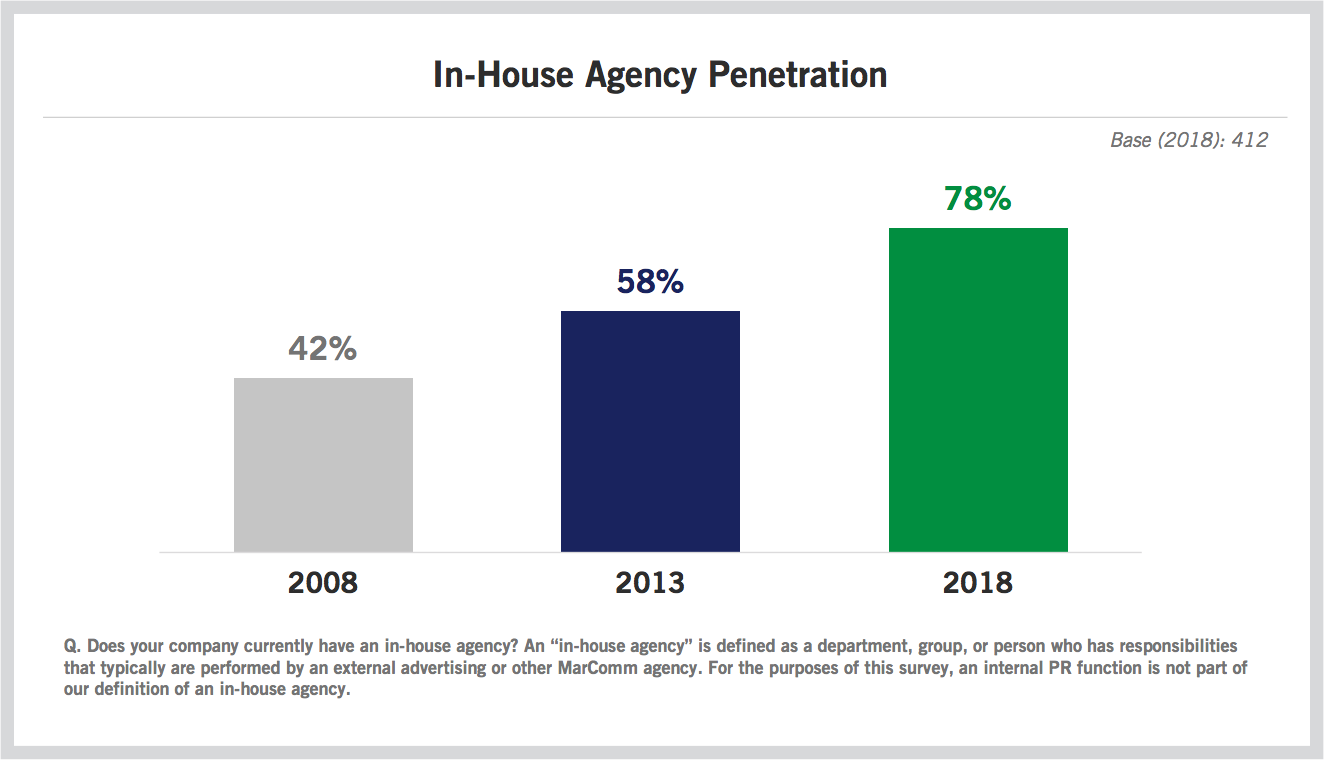
The ANA recently conducted a survey of their members asking about their in-housing plans. The results were compiled into a report, which revealed that 78% of marketers have some kind of in-house agency. Just five years ago, only 58% of marketers had these insourced resources. Research suggests that these numbers may be low, as many brands are hesitant to reveal their strategy by disclosing their plans.

There has been a trend towards increasing in-house capabilities over the last five years as marketers look to take more ownership of their data and digital strategy. With brands like GlaxoSmithKlineBayer, and Uber announcing that they are taking programmatic in-house, it’s a trend that’s quickly gaining widespread adoption. With greater transparency, control, and cost efficiencies on the table, in-housing is an appealing solution for enterprise marketers who are under pressure to deliver results while simultaneously reducing costs.

ANA in-housing graphs

Source: "The Continued Rise of the In-House Agency." ANA, 2018.

Driving Value With In-Housing

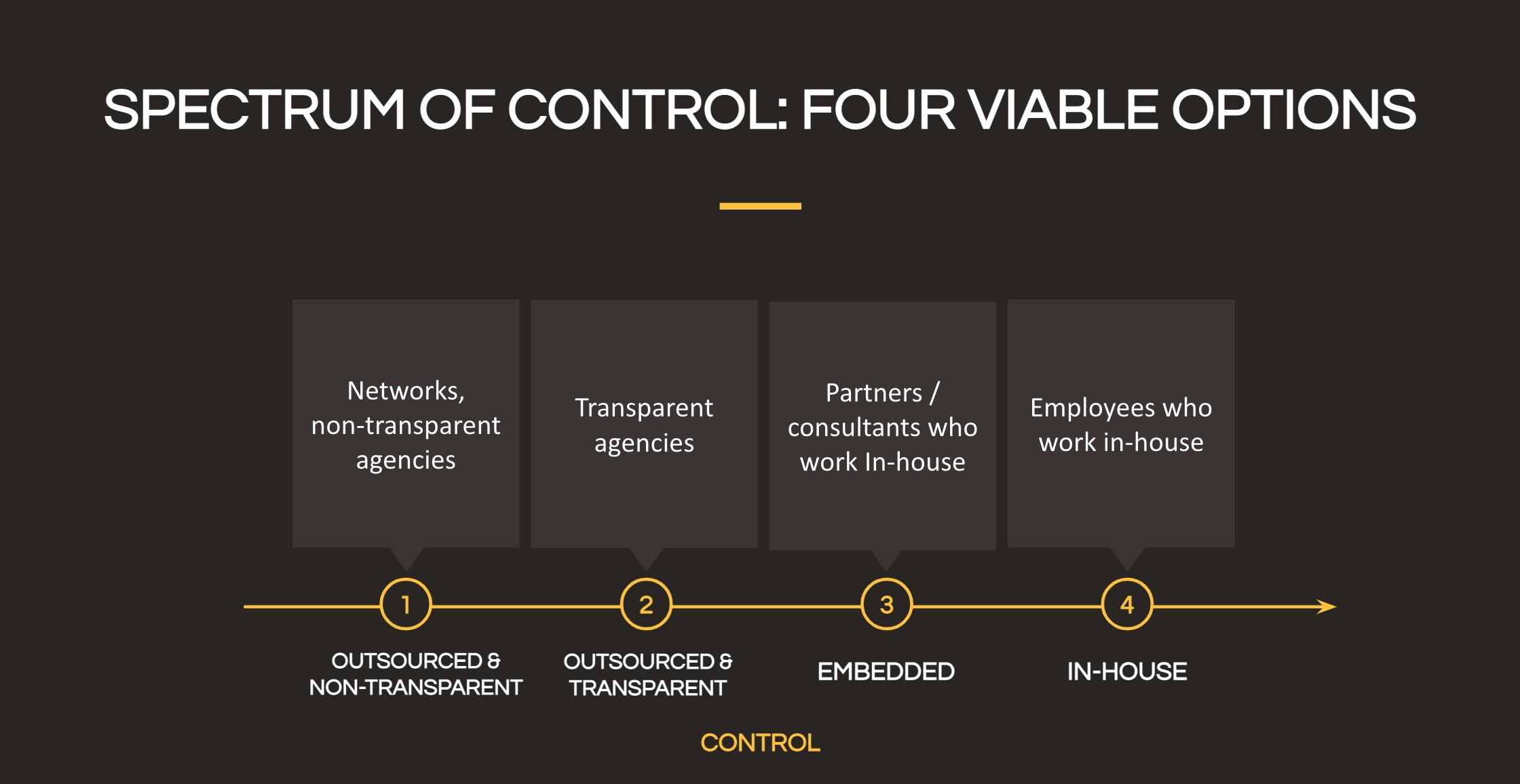
While there are benefits to be gained from in-housing, there are also considerations that marketers should evaluate when thinking about moving forward with an in-housing strategy. Taking any of your media or marketing in-house is not a binary decision, there is a full spectrum comprised of different levels of control.

Spectrum of control chart
Monk Thoughts Digital transformation doesn't happen overnight - you have to make an in-housing plan based on your goals and go step by step.
Pete Kim headshot

The Spectrum of Control

As Media.Monks Co-founder, Pete Kim, presented on stage at AdExchanger’s Programmatic I/O in October, there is not a one size fits all approach for digital transformation. Individual organizations need to evaluate their capabilities to determine the right mix of in-housing and outsourcing that aligns with their goals and resources.

There are multiple approaches to successfully and effectively execute any solution along the spectrum. However, each and every solution takes time to execute on — transformation doesn’t (and can’t) happen overnight.

00:00

00:00

00:00

With greater transparency, control, and cost efficiencies on the table, in-housing is an appealing solution for marketers to reduce costs and get results. With greater transparency, control, and cost efficiencies on the table, in-housing is an appealing solution for enterprise marketers looking to deliver results while simultaneously reducing costs. in-house marketing embedded agency media strategy in-house agency

Choose your language

Choose your language

The website has been translated to English with the help of Humans and AI

Dismiss