Choose your language

Choose your language

The website has been translated to English with the help of Humans and AI

Dismiss

Steering the Machine: Our Take on the Agentic Shift at Google Marketing Live 2026

Steering the Machine: Our Take on the Agentic Shift at Google Marketing Live 2026

AEO/GEO AEO/GEO, Industry events, Media Strategy & Planning, Paid Search, Performance Media 9 min read
Profile picture for user Tory Lariar

Written by
Tory Lariar
SVP, Paid Search

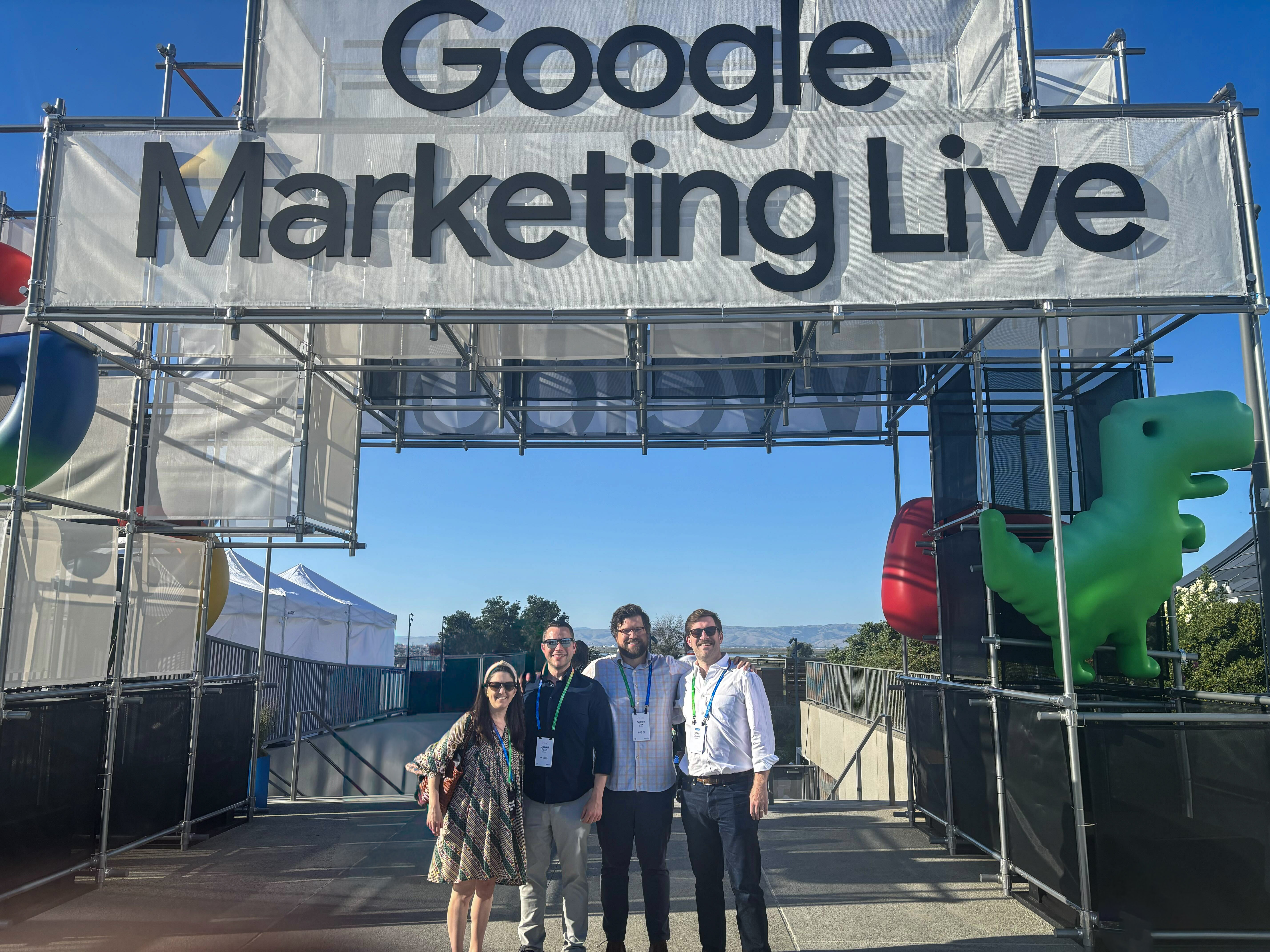
Monks leaders attending Google Marketing Live 2026, with our partner team at Google.

Executive Summary: The silos between text search, conversational AI, and YouTube have officially collapsed. It is now one single ecosystem. These new ad experiences arrive at a pivotal moment for Answer Engine Marketing (AEM) and search overall. Google is introducing ad units that are contextual and immersive, and with the power of agentic advisors, users won't ever need to leave their video or search experience to shop. Ultimately, with this shift to agentic products, your data architecture and your creative positioning remain the ultimate unlock for performance—the necessary “fuel” for a full-funnel approach to algorithmic buying.


Google Marketing Live 2026 made one thing abundantly clear: Google is going all-in on automation, framing its latest updates under the banner, “Our Gemini advantage is your business advantage.” Across search, shopping, video, and measurement, the platform is transitioning from a system of rigid knobs and dials to an agentic ecosystem driven by natural language desire and direction.

But while these updates drastically lower the barrier to entry for launching campaigns, they simultaneously increase the premium on human strategic oversight. The brands that win won't simply be the ones that click the new buttons—they will be the ones that understand how to steer the underlying AI models.

Google built this year's announcements around several big bets:

  • Transforming search across the purchase journey
  • Powering agentic commerce
  • Driving a new era of performance on YouTube
  • True ROI, verified

Here is our team’s deep-dive analysis of what was announced, what it means for your bottom line, and where we advise caution.

Transforming Search & Creative with Agentic AI

1. Ads in AI Mode

After sharing that AI Mode recently passed 1 billion monthly active users, Google announced that new ad placements will be introduced into the conversational search interface. Rather than looking like traditional search ads just placed into the response, these ads will look much more like a native conversational response, just with a “Sponsored” tag. To do so, they use Gemini to generate conversational text answers to long-tail user queries, drawing from asset libraries and brand guidelines. Brands can take advantage of these placements through AI Max and Performance Max.

Paired with the prior day’s announcements at Google I/O about asking follow-up questions directly from AI Overviews and the expanded “Ask YouTube” search functionality, Google is making it clear that across all products, they’re helping consumers move from queries to conversations.

Product example from Google of conversational ads in AI Mode.

Product example from Google of conversational ads in AI Mode.

2. AI Brief (Text Guidelines 2.0)
Google introduced AI Brief, a new natural language interface powered by Gemini that allows advertisers to use their own words to guide AI Max. Instead of relying entirely on traditional settings, advertisers can describe their business context, dictate what their messaging should focus on, identify what to avoid, and define specific searches they want to align with. The feature is rolling out globally in English for Search campaigns first, with Performance Max integration coming later.

“Most people use LLMs today by giving vague prompts and getting frustrated by average results,” notes Manny Delamota, Director of SEM. “If your brand brief is generic, your AI Max targeting and creative will be just as generic. With AI Brief, Google is giving us some of the ‘control’ we asked for, but now we have to prove we actually know our customers well enough to guide the machine.”
 

3. Asset Studio Multi-Modal Upgrades
Asset Studio has evolved into a unified creative workspace combining Google’s latest GenAI image and video creation tools. Marketers can now describe asset requirements in plain English, generate quick video concepts from text prompts, and utilize a new, one-click testing flow to pit newly generated brand assets against an account’s historical top performers during campaign construction.

While the automated capabilities sound impressive on paper, Ezra Sackett, Director of Paid Search, urges brands to distinguish between creative conceptualization and creative administration. “Where to lean into the natural language and where to lean away from it is going to be critical,” Sackett notes. “The net-new creative production of a video is probably better built by an AI-empowered creative team. But asset adjustments like video dubbing, resizing, and splicing to test different lengths of video? That is a great use of AI in Asset Studio that won't take up your creative team’s valuable bandwidth.”

Furthermore, the proliferation of purely AI-generated creative introduces a macro-risk to customer relationships. Delamota warns of a looming crisis of confidence: “One of the biggest challenges with brand trust in this environment is managing consumer skepticism with AI content that is not a direct reflection of the actual product. The way these GenAI capabilities proliferate will heavily impact long-term consumer trust.”
 

4. Ask Advisor
For hands-on-keys advertisers, Google’s new Ask Advisor is positioned as a helpful copilot in developing and executing your marketing strategy. The agent can answer questions and make recommendations for your business across a range of Google marketing products (Google Ads, Google Analytics, Google Merchant Center, and Google Marketing Platform).

Currently, there are brands and agencies alike surfacing these insights through MCP servers linked to other LLMs. This simplifies the experience by making the AI “analyst” live within the platform directly. “Ask Advisor feels like a major shift toward AI-powered orchestration across Google products, an always-on collaborator designed to proactively surface recommendations, solve problems, and guide campaign decisions,” says Suzanne Taylor, Group Director, Paid Search. “Brand-side advertisers will benefit from time savings they can invest into strategy, rather than manual optimization. It also shifts the expectations for agency partners: our value must come from translating AI-driven insights into smarter business decisions, validating what matters, and connecting platform recommendations back to real business outcomes.”

Powering Agentic Commerce & Profit Optimization

1. Universal Cart and Universal Commerce Protocol
The Universal Cart (announced the prior day at Google I/O) was another massive step forward in consolidating the entire customer journey down to a single experience hub. Powered by the Universal Commerce Protocol for agentic shopping support, consumers can now add products into one joint cart across the entire Google ecosystem (from search to YouTube to Gmail). From there, agents automatically help find deals, confirm compatibility of your products based on contextual reasoning, and compare loyalty offers and promotions for you—and then one native checkout experience completes the transaction without leaving the Google property you’re on.

Alicia Pachucki, Group Director of SEM, calls out that premium or challenger brands might miss out on critical exposure to audiences in this fully consolidated shopping experience. “In the old model, the ‘research tax’—those 15 open tabs when a consumer is shopping—was exactly where brands built equity, proved value, and won on nuance,” Pachucki explains. “That friction was a buffer that allowed high-priced brands to justify their price points or for challenger brands to differentiate themselves. Removing the work of research means removing the space where brands actually convince people. As Google owns the end-to-end experience and agents perform comparisons and evaluations on the consumer’s behalf, brand equity and impulsive traffic will both come at an even higher premium.”

Product example from Google for new Universal Cart.

Product example from Google of the Universal Cart analyzing loyalty and promotional opportunities.

2. AI Max for Shopping Campaigns
In an effort to prepare retail brands for conversational search behavior, Google announced a one-click upgrade toggle called AI Max for Shopping Campaigns. This feature allows retailers to dynamically transform their standard Merchant Center feeds into agile, conversational ad creatives capable of responding to long-tail, high-intent queries before shoppers even search for a specific product SKU. For brands with large product feeds, “not only will this save time on feed optimization, but it will quickly boost eligibility for longer-tail and conversational inventory that would have otherwise gone untapped without an unsustainable amount of keyword-stuffing,” says Eileen Lorenzo, Director of Paid Search.

However, this automation introduces a potentially crowded environment of overlapping campaign types. If AI Max for Shopping and Performance Max are both extending where shopping ads can serve, there’s a risk of cannibalization. We’ll need more hands-on experimentation to better understand the unique value each will provide in this context, and how to use them strategically together.
 

3. Product Value Adjustments (PVA)
A key tactical retail announcement is Product Value Adjustments (PVA), a pilot feature that allows advertisers to apply percentage multipliers to conversion values for specific items within Smart Bidding. This setup gives retailers the power to inject business intelligence—like inventory levels or profit margins—directly into the bidding algorithm, allowing it to bid more aggressively on high-margin or overstocked inventory. Google’s ultimate objective is to encourage brands to consolidate into fewer campaigns while relying on value adjustments to handle product-level variations.
 

4. Commerce Media Suite & Missed Opportunity Reporting
To round out its retail strategy, Google unveiled the Commerce Media Suite, which connects retail networks to provide SKU-level measurement in DV360, cross-retailer and cross-brand reporting in SA360, and omni-channel in-store bidding. Alongside this suite is the new Missed Opportunity Reporting dashboard, a visualization tool that uses Google AI to highlight lost conversion value resulting from restricted bids or budgets, offering “one-click” adjustments to instantly capture that traffic.

Redefining YouTube & Demand Gen Performance

1. View-Through Conversion (VTC) Optimization and Campaign Type Attribution
For mid-funnel visual formats, Google launched an open beta for Demand Gen campaigns allowing the bidding algorithm to actively optimize for View-Through Conversions (VTC) alongside traditional click-through signals. The goal is to accelerate the platform’s optimization learning window and maximize overall budget utility—and help Demand Gen data look more (accurately) competitive on paper against social platforms.

Sackett views this update as a functional fix, but warns against letting platform data dictate broader business decisions: “Demand Gen should not be compared directly to high-intent Search or bottom-funnel PMax. But at the end of the day, it really doesn't matter whether Meta and TikTok are inflating in-platform numbers and Demand Gen is underreporting... because in-platform is not the best source of truth here,” Sackett explains. “Yes, it will make them look more apples-to-apples with platform reporting on social, but smart brands are not purely relying on platform reporting for these decisions. Platform data should be used to report and optimize in-platform, not as the source of truth for the health of the business. To measure visual, mid-funnel mediums, brands need a trifecta of platform data, incrementality testing, and Media Mix Modeling (MMM)."
 

2. Affiliate Partnerships Boost & Demand Gen Uplift Experiments
To make visual commerce more actionable, the Affiliate Partnerships Boost pilot allows merchants to discover organic YouTube Shopping affiliate creator videos and directly boost them within paid Demand Gen campaigns. Monks has seen creator content on YouTube move the needle significantly for brands. For one client, Coursera, a creator “skits” video series pushed users down the funnel, lifting consideration and search volume: users who saw the ad were 24% more likely to search for “Coursera” than those who didn’t, proving that YouTube doesn’t just build a brand. It fuels the entire acquisition ecosystem.

Plus, to justify the investment, Google also rolled out Demand Gen Uplift Experiments, a turnkey A/B testing framework built to isolate and quantify the exact statistical lift that Demand Gen contributes to standard campaign mixes (such as PMax, Video, or Display) across core metrics like revenue, CPA, and ROAS. While this insight is critical for advertisers, Lorenzo also warns that it can’t be the end-all-be-all for measurement: “Isolating lift inside of Google’s ecosystem leaves us with a blind spot for other highly visual channels like paid social. Google might show an uplift, but multi-channel attribution tools might tell a different, and more complete story.”

Product example from Google for Affiliate Partnerships Boost in YouTube.

Product example from Google of Affiliate Partnerships Boost for YouTube.

True ROI, Verified: Measurement & Signal Resilience

1. Campaign Type Attribution
Building on the View-Through Conversion tracking above, Google doubled down on the need to prove the impact of Demand Gen campaigns by launching a dedicated attribution solution that isolates the effects of distinct campaign types. By removing the influence of most last-click-friendly campaign types, advertisers can understand and bid toward the upstream causes of conversions and keep fueling the funnel.

“Campaign Type Attribution will hopefully help show the exact role that products like Demand Gen plays in user paths, mapping it to what is truly driving true business KPIs instead of trying to falsely compare it to other bottom-funnel campaign types,” notes Taylor. “However, I would still caution brands to validate these results with MMM models to ground your budget allocation decisions in your overall business data, and treat this platform data as directional.”
 

2. Qualified Future Conversions
This new metric uses AI to project future value based on signals collected earlier in the consumer journey. Google is positioning Qualified Future Conversions as the bridge “from discovery to decision,” helping marketers prove out how branded searches and engaged site traffic will translate into revenue down the line. As text search, conversational AI, and YouTube collapse into a single ecosystem, we’ll continue to see further zero-click consumer behavior permeating shopping journeys and content consumption. “This is an exciting announcement for lead generation marketers,” explains Andrea Cruz, VP of Media Strategy for B2B. “Qualified Future Conversions can help marketers understand the paths consumers and buyers are taking and build business cases for investing in mid- and upper-funnel campaigns.”

Product example from Google for new Qualified Future Conversions metric.

Product example from Google of the new Qualified Future Conversions metric.

3. Tagging and Data Manager advancements
Acknowledging that AI models require clean, first-party inputs to succeed, Google expanded its Data Manager hub by launching low-code and no-code API connectors for major marketing tech platforms, including Klaviyo, Mailchimp, ActiveCampaign, and Google Drive. This update consolidates first-party customer matching and conversion data pipeline setup into a single, visual interface.

Additionally, in response to the ongoing degradation of client-side tracking, Google introduced the Google Tag Gateway (GTG) pilot in the US and Canada. GTG acts as a server-side routing mechanism that upgrades existing tag setups without requiring on-page code rewrites. By routing tracking scripts directly through a website’s integrated CDN or cloud platform—such as Cloudflare, Akamai, Fastly, Google Cloud, or Webflow—brands can safeguard data integrity, preserve signal tracking fidelity, and circumvent browser-level ad blockers securely.

GML 2026’s impact on the road ahead

For consumers, Google Marketing Live 2026 represents a shift toward more conversational, multimodal experiences where more and more product discovery and shopping can take place entirely within Google’s walls, supported by contextually-informed agents. For marketers, this solidifies that search is no longer “just search.” The technical expertise and strategic skillset being tapped to excel in the Google Ads ecosystem increasingly requires marketers to be more holistic and more human in their approach.

Additionally, Google clearly demonstrated that execution friction is disappearing from advertising. As natural language guidance and one-click optimization toggles become standard across accounts, the technical ability to build a campaign will no longer provide a competitive advantage for brands or for agencies (potentially even shaking up the traditional agency model). Instead, success will depend on an advertiser’s strategic inputs: the richness of its first-party data loops, the distinctiveness of its human-led creative strategies, and the business intelligence applied to automated bidding parameters and measurement methodologies.

Read more about the rest of Google’s announcements here.

Google is moving to an agentic ecosystem and marketers must learn to steer the machine. Monks' SEM experts break down what brands need to know from GML 2026. Google is moving to an agentic ecosystem and marketers must learn to steer the machine. Monks' SEM experts break down what brands need to know from GML 2026. Google Google Marketing Live AI search paid search search engine marketing Paid Search Performance Media Media Strategy & Planning Industry events AEO/GEO

Speeding Up Production with AI for Gemini • Driving Engagement With a Dream F1 Track

  • Client

    Google

  • Solutions

    Social CampaignsAI & Emerging Technology ConsultingImmersive Brand Storytelling

  • 16 hours from shoot to live
  • 138+ million total views (1.6 million organic views)
  • 370+ million total impressions
  • 162 million views
  • Top 3 in organic social performance for Google in 2025

00:00

00:00

00:00

Case Study

0:00

Showcasing the speed of Gemini through a fan-fueled experiment.

By tapping into the high-performance world of Formula 1, Google sought to demonstrate the speed and creative intelligence of Nano Banana, Gemini’s AI image generator and photo editor. To do so, they needed compelling social content that showcased the model’s creative power in real-time. But with a challenging four-week deadline and a single 30-minute session with McLaren F1 driver Oscar Piastri, the challenge was significant.

Our answer was “Oscar Piastri’s Dream Track,” a social-first campaign that established Gemini as the essential co-driver in the creative process.

  • A race track created by Oscar Piastri F1 driver with a papaya theme using Google Gemini Oscar Piastri F1 driver holding an RC car controller smiling

A social-first race from digital prompts to physical reality.

The campaign launched with a high-speed experiment where Oscar created his personal dream track. Captured for Instagram Reels and YouTube Shorts, the video featured the driver using specific Nano Banana prompts to visualize the circuit. We then brought this AI-generated vision to life using floor projection, creating a larger-than-life track complete with Singapore Grand Prix Easter eggs that Oscar raced using a radio control car. 

The original video served as the catalyst for a multi-phase rollout: it functioned as a call to action for influencers to invite fans to use the same prompts to design and submit their own dream tracks, turning it into a community-wide creative challenge.

Oscar Piastri's AI dream track brought to life so he could race it for real.

Accelerating creativity with an agentic AI ecosystem.

To execute this campaign in a fraction of the usual time, we leaned heavily on the capabilities of Gemini and Monks.Flow, our agentic AI ecosystem for marketing orchestration. Monks.Flow excels at revealing deep audience insights and behaviors, so we fed its agents with detailed data on Singapore F1, McLaren and Oscar Piastri. This allowed us to generate unique creative angles that served as the foundation for our brainstorming.

Finally, we deployed AI models to scout the perfect creators and to reverse-engineer Gemini Nano Banana, testing the specific prompts required to get the best visual outputs. The rigorous prompt engineering phase enabled us to not only guide Oscar on set but also teach influencers and fans exactly how to prompt the tool to design their own high-quality tracks.

  • AI generated F1 racetracks using Google's Gemini Nano Banana model

Driving high-speed engagement and community creativity.

The results show how an AI-first approach can drive high-quality engagement. Amassing 162 million total views and 138+ million total impressions, we successfully transformed a technical product demo into a viral, community-led creative session.

Oscar Piastri F1 driver standing with the Google team and Singapore Monks.

Want to talk artificial intelligence? Get in touch.

Hey 👋

Please fill out the following quick questions so our team can get in touch with you.

3 Key Takeaways and New Tools from Google Marketing Live 2025

3 Key Takeaways and New Tools from Google Marketing Live 2025

AI AI, Industry events, New paths to growth, Performance Media 5 min read
Profile picture for user evansparling

Written by
Evan Sparling

A group photo of Monks standing in front of a banner that reads "Google Marketing Live."

Google Marketing Live 2025 showed that the way people search, shop and make decisions is shifting—and Google’s ad ecosystem is shifting with it. With AI baked deeper into Search, new transparency tools for performance reporting, and ad formats designed for faster conversion, this year’s announcements reflect a platform trying to meet users in the moment while giving marketers better ways to steer outcomes. Here’s what stood out and how to make it work for you.

These are our three takeaways that defined GML 2025.

Takeaway 1: Ad delivery is getting more flexible across Google’s network.

Google is shifting away from channel-based ad setups and leaning into more fluid, moment-driven experiences. Instead of building separately for Search, YouTube, or Display, ad products are increasingly designed to find users wherever they are—scrolling, streaming, or shopping. This expansion means more opportunities to reach users but also more demand for creative that fits each touchpoint, which often requires brands to scale video visuals and messaging quickly with the help of AI (or not). Measurement tools are also being updated to support this shift, aiming to track how these moments connect and contribute to sales across the journey. Flexible measurement (going beyond pixel-based attribution by incorporating incrementality, MMM, etc.) is essential as customer paths rarely follow a straight line.

Takeaway 2: AI is now embedded in Search and how brands connect. 

The rollout of AI Mode and ads in AI Overviews marks a shift in how users navigate Search and how brands show up. These tools change not just ad placement, but the buying journey. Search is becoming more visual, more video-led, and more human in tone, which results in a search and shopping experience that’s more tailored and productive for users. For advertisers, what used to require multiple campaign types and formats is continuing to evolve into a single system of outcome-based products. This year Google’s messaging this as their “power pack”—Performance Max, AI Max and Demand Gen—for brands that use AI to reach consumers. If advertisers want to capitalize on the relevance and performance Google says the “power pack” provides, media buyers must focus on giving the AI the right quality inputs, in high volumes (conversion data, creative assets, etc.). 

Takeaway 3: Google is rolling back the black box for visibility and transparency.

Advertiser pressure for more transparency is starting to pay off. Google is introducing new Performance Max insights, lower spend thresholds for incrementality testing, and agentic tools like “Your Google Ads Expert” to make results easier to explain and optimize. But blind spots remain. For example, there’s still no placement-level reporting for ads in AI Mode or Overviews. Progress, yes. Total clarity, not yet.

These are the new features our team expects to be most impactful for advertisers.

AI tools are reshaping how we search, shop and advertise.

Search is no longer just a typed query in a box. With tools like Gemini, Google Lens and AI Overviews, the buying journey is becoming more visual, conversational and context-aware. The path from awareness to purchase is increasingly possible in one scroll, without leaving Google’s ecosystem. Google’s newest tools reflect this shift:

  • Smart Bidding Exploration (in beta) blends flexible ROAS targets with new bidding logic to uncover valuable queries you may be missing.
  • AI Overviews are live on mobile in the US, with desktop and other markets coming next. These ad placements are designed to align with broader search intent.
  • AI Mode, currently in testing, introduces a conversational, multimodal search experience with an AI-powered shopping layer launching in the US soon.
  • Agentic tools like “Your Google Ads Expert” and “Your Google Analytics Expert” (in beta) aim to speed up insights and surface optimizations. “Your Marketing Advisor,” a Chrome-based AI assistant, will soon help teams manage tasks and surface recommendations across tools.

Put it into practice: These evolutions in the SERP are reshaping user behavior and redefining what ad success looks like. For advertisers, your inputs—site content, product feeds, conversion data, creative assets, etc.—matter more than ever as the content and experience will be derived automatically with AI. Invest in shoring up those foundations to make sure you’re showing up accurately and effectively in these new SERP experiences.

AI Max for Search gives you automation with a clearer view.

AI Max for Search Campaigns is a one-click upgrade that uses AI to match your landing pages, ads and keywords to real-time search intent. Google reports early tests showed up to 27% more conversions at similar CPA or ROAS, especially when using exact and phrase match. Unlike Dynamic Search Ads, which auto-generate content with limited reporting, AI Max surfaces clear insights into which queries, headlines and landing pages are driving performance. It’s still automated, but with a clearer view of what’s happening behind the scenes.

Put it into practice: Try AI Max on a campaign where broad match is performing well but hasn’t hit its ceiling. Use the new reporting to spot high-converting queries and creative, then scale what’s driving results. 

Performance Max now shows where results are coming from.

Performance Max has always prioritized automation over transparency. But Google is finally pulling back the curtain. Channel-level reporting now shows results across Search, YouTube, Shopping and other surfaces. Asset-level insights and fuller search term visibility offer more granular data to understand what’s actually working. For brands running full-funnel campaigns, this is a significant improvement.

Put it into practice: Shift budget to top-performing surfaces using channel data by influencing Google's spending. Update or remove underperforming assets within your campaign. If YouTube is lagging, shorten your video creative or adjust your audience signals.

Monk Thoughts Having channel-level visibility in PMax makes the campaign more accountable, customizable, and measurable—turning it from a black box into a smarter, more collaborative tool for growth.

Video ads in Search and Shopping compress the funnel.

Video placements are now being tested directly within Search and Shopping results, giving advertisers a shot at influencing high-intent shoppers without relying on separate awareness plays. The line between discovery and purchase is disappearing, and Google wants to keep the entire journey within its ecosystem. Users aren’t skipping steps in the funnel, they’re completing all of them in a single scroll.

Put it into practice: Add horizontal and vertical video assets to your ad groups. Focus on short-form content that delivers value fast, such as how-to clips, testimonials or product highlights.

Monk Thoughts This is the new prime real estate. If your video doesn’t stop the scroll and say something meaningful, you’re wasting a huge moment.

Measurement tools are improving, but still require setup.

Google maintained its focus on measurement this year, sharing advertiser stories about the value of Meridian and unveiling updates to measurement features within Google Ads.  For example, they lowered the threshold significantly for in-platform incrementality testing, making it more accessible for brands to measure what tactics are creating incremental results. 

Additionally, Data Manager is Google Ads’ latest tool aimed at improving signal quality and measurement reliability. It helps advertisers connect and validate first-party data from websites, apps, CRMs, and in-store systems, making campaign data cleaner, more actionable, and privacy-compliant. It also supports better attribution by ensuring tags and signals are set up correctly. 

Put it into practice: Use Data Manager to set up and quality check your tagging configuration, confirm that key data sources are linked to your Google Ads account, and connect first-party data from third-party platforms like BigQuery, Salesforce, Shopify, Google Sheets, and more. A clean setup leads to better optimization and clearer insights.

Turn GML 2025 updates to real business outcomes.

GML 2025 showed that performance marketing is becoming more creative, more automated and more measurable. These updates are your chance to simplify workflows and scale impact. If you’re connecting creative, data and AI in one system, you’re going to move faster than your competitors.

Need help connecting the dots?
Let’s talk. We help brands turn updates like these into growth strategies that drive results.

GML 2025 rolled out new Google Ads features focused on AI, tracking and automation. Learn how to apply them to your performance strategy.
3 Key Takeaways and New Tools from Google Marketing Live 2025 GML 2025 rolled out new Google Ads features focused on AI, tracking and automation. Learn how to apply them to your performance strategy.
Google AI Overviews Google advertising industry AI agentic ai AI brand experience ai experiences Performance Media Industry events AI New paths to growth

From Insight to Impact • Increasing AOV by 29% for Euro Car Parts with Affinity Analytics

  • Client

    Euro Car Parts

  • Solutions

    Data AnalyticsDigital Experience Optimization

Results

  • 29% increase in average order value

Euro Car Parts, a key player in the UK’s automotive retail sector and part of LKQ UK & Ireland, sought to deepen customer engagement and uncover new cross-selling opportunities within their extensive product catalogue. Facing the challenge of harnessing transaction data to better understand product affinities and enhance promotional targeting, they turned to us for an innovative affinity marketing solution: building a dynamic, real-time view of customer behaviour to power smarter, more effective promotions.

EuroCarParts Logo on a black and white background of a garage with a car inside

Turning raw transaction data into actionable affinity marketing insights.

Our initial analysis focused on transaction data pulled from GA4 via BigQuery, to uncover meaningful patterns in customer purchasing habits. We developed a bespoke product affinity analytics tool within Google Cloud, which allowed us to generate actionable insights on product combinations that customers most frequently purchased together. With this custom affinity model, Euro Car Parts could base their promotional strategies and bundle offerings on clear, data-driven intelligence—unlocking the true potential of affinity marketing.

Tablet mock up of EuroCarParts website on tablet with taupe background
Man in autoshop stocking car parts

Applying customer behaviour analysis to deliver smarter promotions and bundles.

Armed with these insights, Euro Car Parts identified and launched optimal product bundles tailored to customer purchasing behaviour. This enabled them to deliver highly targeted promotions that encouraged repeat purchases and boosted sales across key customer segments. Our partnership gave them a sharper understanding of which product combinations resonated most, helping to refine their monthly promotional activity and ensure each offering was backed by real transactional data and robust customer behaviour analysis.

In partnership with

  • Euro Car Parts
The approach to leverage historical data along with machine learning to accelerate and access real-time cross-category insights has been invaluable. We’ve demonstrated incremental and measurable results which have driven commercial benefit through laser-focused analysis and working as a collaborative team with Monks.
headshot, picture of man wearing vest with beard and short hair

Dave Cain

Head of Digital Marketing, LKQ UK & Ireland

Data-driven transformation led the way to measurable growth and stronger customer loyalty.

As a result of this data-driven approach, Euro Car Parts experienced a 29% uplift in average order value. By integrating affinity insights into their monthly promotional planning, they now deliver highly relevant offers that adapt to customer preferences as they evolve seasonally and over time. This transformation has not only driven measurable sales growth but also strengthened customer loyalty by creating a more personalised, predictive shopping experience.

Want to learn more about what Affinity Analytics can do? Get in touch.

Hey👋

Please fill out the following quick questions so our team can get in touch with you.

Google Marketing Platform Services

Global support, licenses, enablement and delivery for GMP services.

Google Marketing Platform logos - 6
Google marketing platform logo
Employees working together around a table

We are a Certified Google Marketing Platform (GMP) Sales and Service Partner, and Google’s longest-standing GMP partner.

Our team of award-winning GMP experts have provided licenses, full-scale platform implementation services and client enablement to organizations.

With full Global support, including Google Marketing Platform licensing and contracting for Campaign Manager 360, Display & Video 360, Search Ads 360, and Google Analytics 4, our team can help transform your insights into data-driven strategies, unlock growth through maximizing cross-channel media investment and elevate your marketing with the next-level of data and media platform transformation.

Our solutions and services

    • Platform Implementation & Onboarding

      Platforms: Google Analytics 4, Campaign Manager 360, Ads Creative Studio, Display Video 360, Search Ads 360, Tag Manager 360

      Regions: NAMER, APAC, EMEA, LATAM

      Experience a customized onboarding journey with Monks. Together, we’ll unlock the full potential of Google’s GMP suite for your business.

      If you’re new to Google’s GMP suite or considering a transition from other platforms, we are here to facilitate a seamless onboarding experience. With dedicated teams and specialized tools, we guide you every step of the way.  Our specialists collaborate with you to assess your specific marketing needs and identify the optimal platform mix and point solutions tailored to your business. We develop a comprehensive implementation plan that aligns with your goals, ensuring the successful integration of the GMP suite into your operations.

      As part of our service, we offer Onboarding & Testing, where highly trained platform specialists help your teams determine the best setup across platforms and campaigns. We instill confidence in initial tests and activations, validating that your campaigns are set up in alignment with your objectives while utilizing the correct platform features and avoiding unnecessary, costly errors. We also assist you in measuring and understanding the results, mapping out what’s next.

      In addition, our Platform Training services aim to enhance your team’s confidence in using new tools. We address the confusion that often comes with getting started on new platforms by offering tailored training sessions ranging from introductory 101 sessions to deeper topic-specific training. Our curriculum is customized to fit your team’s unique needs.

      With Ongoing Support & Advisory, we leverage our thorough understanding of your business needs and the digital media landscape to help you navigate marketing goals and digital strategy. We provide best practices, systems architecture recommendations and responsive problem-solving to ensure your success. Our in-depth platform knowledge enables us to quickly identify and address any issues that may be hindering campaign delivery.

      Finally, through our Activation and Execution Support, we stand as an extension of your team, running campaigns and platform activities directly when needed. Our experts collaborate closely with you to develop comprehensive execution plans optimized in real-time, ensuring mutual success aligned with your campaign goals. We maintain consistent communication with your team to build a clear roadmap for ongoing plans and support.

      Reach out
    • Platform License Resale & Support

      Platforms: Google Analytics 4, Display Video 360, Search Ads 360

      Regions: NAMER, APAC, EMEA, LATAM

      Experience the difference in support and partnership with Monks as we help you optimize your GMP platform use while ensuring your business runs smoothly.

      Whether you’re new to Google Marketing Platform, or are already using GMP platforms and tools but are seeking a new partner, we provide licenses and access backed by comprehensive global support levels and options tailored to your needs. Backed by a team that is fully certified across GMP, our flexible services ensure your teams have the necessary support across Google’s tools, enabling you to optimize your operations. We collaborate with you to identify current pain points and requirements, assisting you in building a transition plan to keep things running smoothly.

      Our Onboarding & Testing services ensure your teams are effectively set up and confident in their use of the platforms. Our highly trained specialists support you in determining the best configurations across platforms and campaigns. We validate that your existing campaigns align with your objectives, utilize the correct platform features and avoid costly errors. Additionally, we help you measure and understand results while outlining next steps.

      Through Platform Training, we empower your team with the knowledge needed to excel. Understanding that adopting new tools can be challenging, we offer tailored training sessions that range from introductory overviews to more in-depth, topic-specific training. Our training programs are designed to fit your team’s unique requirements, instilling confidence and competence in their abilities.

      For Ongoing Support & Advisory, we leverage our extensive expertise in the digital media landscape to address your business needs. By working together, we provide best practices, recommendations for systems architecture, and responsive problem-solving. Our goal is to ensure your marketing goals are supported by a robust digital strategy, enabling smooth operations and success through our strategic insights.

      Finally, with our Activation and Execution Support, we act as an extension of your team, providing hands-on support to run campaigns and manage platform activities directly, ensuring everything aligns with your campaign goals. Our experts develop comprehensive execution plans that can be optimized in real-time and collaborate closely with your team to maintain ongoing alignment and build a clear roadmap of support over time.

      Reach out
    • Platform Management

      Platforms: Google Analytics 4, Campaign Manager 360, Ads Creative Studio, Display Video 360, Search Ads 360, Tag Manager 360

      Regions: NAMER, APAC, EMEA, LATAM 

      Choose Monks for your Platform Management needs, and discover a partnership that elevates your activation and execution efforts within the GMP ecosystem, ensuring sustained success and growth. 

      If you’re looking for additional support across activation and execution within the GMP ecosystem, our dedicated global team is ready to help. We ensure you have access to experts who can manage and optimize your campaign activation and measurement efforts. Whether you need short-term assistance to support team changes or campaign demands, or if you seek a long-term partnership, we are here to strategize, support, and execute across your marketing efforts.

      Our Onboarding & Testing services are designed to get your teams confidently set up within the GMP ecosystem. Our experienced specialists will work with you to evaluate current campaign setups and ensure that your activation processes align with your objectives. We validate that campaigns are correctly configured and leverage the right platform features, all while helping you measure and understand performance to identify actionable insights.

      For Platform Training, we offer customized educational sessions tailored to your team’s needs. We recognize that navigating new tools can pose challenges, so we provide training from foundational 101 sessions to deeper, specialized topics. This ensures your teams are well-equipped to execute their tasks efficiently and effectively within the GMP ecosystem.

      With Ongoing Support & Advisory, we delve into your specific business needs and the nuances of your marketing strategy. Our experts provide best practices, systems architecture recommendations, and proactive problem-solving. We aim to empower your team with the insights and support necessary to enhance your campaign performance, ensuring seamless operations as your marketing needs evolve.

      Finally, our Activation and Execution Support allows us to function as an extension of your team. We provide hands-on assistance with campaign activation and management, ensuring your efforts are optimized in real-time to meet your strategic goals. Our experts collaborate constantly with your team, crafting comprehensive execution plans and maintaining alignment, ultimately building a clear roadmap of support over time.

      Reach out
    • Custom Projects & Engagements

      Platforms: Google Analytics 4, Campaign Manager 360, Ads Creative Studio, Display Video 360, Search Ads 360, Tag Manager 360

      Regions: NAMER, APAC, EMEA, LATAM 

      Some examples of our engagements with clients include foundational platform and feature training, burst hands-on-keyboard support for campaign executions, custom reporting, and site-side audits. Choose Monks for your Custom Projects & Engagements, and let us partner with you to navigate challenges and enhance your GMP marketing efforts for sustained success. 

      If you have a specific or one-off problem to solve, or if you’re encountering ongoing roadblocks in your GMP marketing efforts, we are here to help. Our diverse and experienced global team is equipped to diagnose issues and craft the right solutions tailored to your needs. We bring a wide range of expertise and backgrounds to effectively address challenges in partnership with our clients.

      Our Onboarding & Testing services focus on understanding your unique challenges and ensuring that your teams are prepared to operate within the GMP ecosystem. We provide foundational platform and feature training aimed at upleveling team members’ abilities, enabling them to utilize the tools effectively for optimal performance.

      With Platform Training, we offer tailored sessions that empower your team to overcome specific obstacles. Whether you require comprehensive training or burst hands-on-keyboard support for specific tests and campaign executions—especially during busy seasons or after staffing changes—our specialists deliver engaging and practical learning experiences.

      Our Ongoing Support & Advisory leverages our vast experience within the GMP ecosystem. We collaborate with you to conduct site-side audits, ensuring data fidelity and diagnosing errors that may impact your media campaigns. Additionally, we specialize in custom reporting, as well as model creation and implementation, providing precise data insights to support your existing or planned media efforts.

      Through our Activation and Execution Support, we provide focused, hands-on assistance for your specific needs. Our experts ensure seamless execution and support during critical phases, allowing you to maintain momentum and achieve successful outcomes.

      Reach out
Google Marketing Platform logos with the TaxSlayer logo

Case Study

Data-Driven Marketing for Tax Prep •TaxSlayer acquires customers for 32% less, slashing waste by streamlining taxonomy, targeting, and trafficking.

See Full Case Study

How can we help you on your GMP journey? Let’s talk.

Hey 👋

Please fill out the following quick questions so our team can get in touch with you.

Dive Deeper

Google Halts Cookie Deprecation, but Privacy-First Is Still the Best Strategy

Google Halts Cookie Deprecation, but Privacy-First Is Still the Best Strategy

Data Data, Data privacy, Measurement, Media, Media Analytics 6 min read
Profile picture for user Michael Cross

Written by
Michael Cross
EVP, Measurement

A lock being overtaken by a wave

After years of anticipation and numerous delays, Google has announced it will not deprecate third-party cookies as initially planned. Instead, Chrome users will be given the ability to adjust their tracking preferences on an individual basis. Despite the change, our advice to brands remains consistent with previous guidance we’ve given in the past: don’t let this news halt your progress.

Google’s decision on third-party cookie deprecation—and what is still at risk for your brand.

Google's latest move doesn't signify a step back in prioritizing consumer privacy. Instead, it emphasizes giving users more individual control over their data. Similar to Apple's App Tracking Transparency (ATT) framework that rolled out in 2021, consumers will be given a more prominent opt-in/opt-out choice within Chrome. This functionality already exists within the browser’s settings, but will be surfaced in a “new experience” in the future, according to Google.

For brands who have not made significant progress in mitigating the impact of third-party cookie deprecation, this announcement might seem like a lifeline. However, even without a specific cut-off date from a centralized body like Google, there will still be a decline in use by consumers. With a gradual erosion as consumers opt out, the bigger danger is that many brands won’t realize that the third-party cookie pool is getting smaller and smaller, and therefore less useful for their ad strategy.

We expect the majority of third-party cookie signals to shrink, regardless of Google’s decision.

The digital industry has seen this scenario play out in the past, and the data shows the impact will still be huge, if just gradual. When Google switched to a third-party cookie for Google Analytics over ten years ago, Sayf Sharif, SVP Data, says that his analysis showed “some sites were losing over 80% of their traffic, depending on the industry, due to the adoption of ad blockers.”

This trend has repeated itself over the years; based on the impact from Apple’s ATT rollout, we’d expect to see cookies “capture maybe 15% of the available universe,” according to Liz DeAngelis, SVP Digital Strategy. Even if third-party cookies will continue to exist as an option within major browsers like Chrome, consumers have shown time and again that when made aware of their options, the majority will opt out.

Moreover, third-party cookies have proved increasingly ineffective in today’s digital landscape. Sharif points out, “We still face numerous challenges for measurement, activation and attribution (such as a high use of ad blockers, consent rules and fast cookie expiration), which make a focus on a cookieless approach to measurement and attribution a priority.” This shift to consumer choice underscores the reality that brands should continue to avoid over-reliance on third-party cookies.

Monk Thoughts Even though the indefinite pausing of the third-party cookie will come as a relief to some advertisers, there is still an ethical position that needs to be upheld in the careful use of them—as such, usage will continue to decline regardless.
Portrait of Michael Cross

Regulatory and consumer influences on third-party cookies helped shape Google’s decision.

The journey to Google's latest decision has been shaped by a blend of regulatory pressures and evolving consumer expectations. “Google has been caught in the crosshairs between evolving global privacy regulations and competition laws in a range of markets, most notably Europe,” says Benjamin Combe, Sr. Director, Data Optimization and Personalization. Similar regulations like the Australian Privacy Act have gained steam elsewhere, reinforcing that this is a global trend, not a regional or cultural one.

Meanwhile, consumer behavior has shifted toward greater consent and control over personal data. The move toward giving users the ability to set their preferences in Chrome, then, is well aligned with the experiences consumers seek online—and their changing attitudes and expectations toward digital privacy. Combe adds, “It merely reflects a more gradual end to a long-running, multi-factored trend. Google will no longer be the executioner, but third-party cookies are dying regardless—and their utility as the foundation of digital advertising’s targeting and attribution capabilities will not return.”

Still, cookies haven't been the only source of scrutiny in recent years. Google's Privacy Sandbox, a privacy-safe alternative to third-party cookie tracking, has faced several challenges since its announcement in 2020: the initiative has struggled with lack of adoption, anti-competitive scrutiny, conflicting industry feedback, mixed testing results and regulatory pressure. “Google’s Privacy Sandbox raised anti-competition issues with the UK’s Competition and Markets Authority (CMA), while simultaneously raising privacy concerns with the European Centre for Digital Rights and the UK’s Information Commissioner's Office,” Combe adds.

In short, both the regulatory landscape and consumer demand for greater data control led us here. So, what are brands supposed to do next?

Your brand’s first-party data strategies still need to evolve, or put your visibility and efficacy at risk.

Google's decision to give users control over third-party cookies rather than enforcing a complete deprecation has different implications depending on where brands stand in their preparation journey.

For businesses who may have used previous postponements of third-party deprecation as an excuse to delay action and conserve their resources, Tyler Stewart, Media Solutions Architect Lead, sees challenges down the line: “Smaller businesses may not have had the luxury of being on the front foot. In the longer term, this may only widen the gap between haves and have-nots as larger enterprises find themselves better positioned to compete in the privacy-first future.” Our advice to them: start prioritizing a cookieless approach now by focusing on first-party data and robust measurement strategies. Investing in AI-powered solutions and privacy-preserving technologies remains critical for future-proofing your marketing efforts.

Brands that have already embarked on their third-party cookie deprecation and privacy roadmap initiatives, meanwhile, have no need to pivot. “Strategies like the judicious use of first-party data, consent management, modeled measurement solutions and conversion recovery mechanisms will continue to be future-proofed strategies worth investing in,” says Stewart.

If you’re in this camp, don’t feel as if your efforts were in vain. “Those that have invested in reducing the impact of third-party cookie deprecation should take pride in being ahead of the curve with respect to utilization of first-party data, increasing compliance with global privacy regulations, innovating in measurement capabilities, and respecting their customers’ preferences,” says Combe. Staying the course will help future-proof your business’s data as the industry standards continue to evolve.

Monk Thoughts Judicious use of first-party data, consent management, modeled measurement solutions and conversion recovery mechanisms will continue to be future-proofed strategies worth investing in.
Tyler Stewart in front of a gray background

Better solutions for measurement will be customized for your business.

As an industry, the fragmentation and complexity we’re seeing across the digital ecosystem indicates we’re unlikely to move back to a uniform standard. “If you want to reach your customers wherever they are digitally, you need to be looking for new solutions for targeting, buying, and measurement. We can no longer rely on a consistent tactic that the entire industry adopts; brands need to move on from awaiting the next cookie alternative, and work on the solutions that are best for your company,” says DeAngelis.

The right strategy for your brand will depend on the complexity of your digital footprint and the data that’s most valuable for you to capture. To measure efficacy of your marketing activity, an important first step is to establish server-side tracking for your advertising, and take advantage of any event APIs from ad platforms, such as Meta’s Conversions API (CAPI). But in the long run, deterministic (user-level) measurement models will continue to weaken over time. Probabilistic models that assess changes across your entire business and media mix for causal contribution will be a necessity in the future, not an option. Strategies like Market Mix Modeling (MMM), or a Cookieless Multi-Touch Attribution (MTA) model offer viable alternatives to those challenges.

Similarly, identity resolution and user graph technologies are still viable for targeting, but a clear winner has yet to arise across the many providers that brands can choose from. As part of the announcement, Google emphasized that Privacy Sandbox will continue to be supported and developed as brands look ahead toward adapting their strategies beyond third-party cookie reliance—a goal that will remain important should users choose to opt out of third-party tracking en masse.

Move forward with a privacy-first marketing strategy.

No matter where your brand stands on the spectrum of cookie deprecation readiness, the path forward remains clear: continue to prioritize privacy-first strategies and the development of robust first-party data practices.

While third-party cookies have a new lease on life for now, they will never be as functional as they once were. They have already been deprecated in most non-Chrome browsers, and with Chrome indicating it will implement greater user permissions and controls, their availability is likely to continue declining—think of opt-in rates for ATT on iOS as a comparable scenario.

Brands should see this as an opportunity to stay ahead of the curve by continuing to invest in first-party data practices, consent management, and alternative measurement solutions—for teams that need advisory and executional support here, our data experts are ready to talk. The shift towards a privacy-first future is inevitable, and those who adapt proactively will be best positioned to thrive.

Google is keeping third-party cookies, but data signals will still erode. Experts from Monks advise brands to stay the course with privacy-first measurement. Google is keeping third-party cookies, but data signals will still erode. Experts from Monks advise brands to stay the course with privacy-first measurement. third-party cookies cookies Google Media Measurement market mix modelling media mix modeling marketing measurement multi-touch attribution cookie deprecation data privacy Measurement Data Media Analytics Media Data privacy

Leveraging Data to Elevate PersonalizedExperiences—Insights From Salesforce, Google and Lenovo

Leveraging Data to Elevate PersonalizedExperiences—Insights From Salesforce, Google and Lenovo

Data Strategy & Advisory Data Strategy & Advisory, Industry events 4 min read
Profile picture for user Ashley Musumeci

Written by
Ashley Musumeci
Global VP of Lifecycle Marketing & CRM

Brunching Up on Personalization at CES

From the spectacular Sphere to our AI-powered alien robot Wormhole chatting it up with the press, there were numerous showstoppers at this year’s Consumer Electronics Show (CES) in Las Vegas. Futuristic attractions aside, we were especially impressed by the minds behind all the astonishing technologies and the many inspiring conversations we had with our tech partners. For one, during our “Brunching Up on Personalization: A Tasty Discussion on Data Foundations” panel, we asked experts from Salesforce, Google and Lenovo how to bridge the gap between adtech and martech to create groundbreaking experiences. Their response? Data elevates your personalization efforts. Here’s what we learned.

Start building your data culture now. 

In the spirit of first things first, the speakers wasted no time to highlight the importance of initiating and nurturing a strong data culture. Once again, the CMO profession is evolving—while the Mad Men heyday revolved around big creative ideas, this changed when the industry started implementing martech and focusing on precision. Now, it’s all about data. “The advertising landscape has changed so much that today’s marketing professionals are almost scientists,” said Google’s Global Brand Lead Felipe Gomes.


Monk Thoughts Successful companies, especially in tech and media, foster a strong data culture and weave that into everything they do.
Ashley Musumeci headshot

However, many brands find themselves a bit stifled by how overwhelming data can be. In that case, Salesforce’s Vice President Tech Industry Strategy Lauri Palmieri argues that it’s critical to just get started—anywhere. “Choose the KPI and the segment that you care most about, obtain access to the data, and get going. Brands sometimes spend way too much time thinking about what they should do with their data instead of actually doing it,” she said. 

Always make sure to establish solid and secure data foundations. 

Once you get going, it’s crucial to govern the data. Before figuring out which sources of data to connect—think of information around clients, sales and marketing, cost and operations—brands must focus on taking care of their data. During the panel, Gomes stressed that data governance is the first thing he and his team at Google talk about with clients, raising questions such as what are the team’s roles and responsibilities, who is making sure the data is shared with a company’s core business units, how do you organize the data, how do you secure the data, and how do you ensure compliance. 

The last question in particular was echoed by the other panelists, as the importance of privacy, ethics and trust can’t be overstated—any failure to comply with current privacy laws would not just affect the brand in question, but also the ones they collaborate with. “We don’t operate in silos, but we work very closely with our partners to understand all the governance, laws and regulations and ensure we meet them,” said Chin Wu, Lenovo’s Director of North America Marketing Consumer PC, Gaming, Tablets. 

Chiming in, Gomes emphasized that education around privacy and safety is absolutely critical. “The amount of data, possibilities and, on top of that, regulations, it’s all really overwhelming. So, brands have the tendency to freeze,” he said. “Especially right now, with the main concern to transition to the cookieless future, [brands worry] what’s going to happen to the conversions or personalization strategies that are already happening with third-party data. That said, many tech partners are more than prepared to help brands on this journey towards safe and trusted data foundations.” Moreover, the good thing is that a lot of AI-powered solutions are built on first-party data.  

Differentiate your brand in the new AI economy. 

This brings us to the last topic of the day: AI and its unbreakable bond with data. We would be remiss if, at one of the top tech conferences in the world, we didn’t talk about this technology—particularly given the role it can play in advancing personalization efforts.

Establishing strong data foundations is key to the success of AI. From Google’s point of view, Gomes argues that when we talk about AI, we are essentially talking about two things that are available today: embedded solutions and applied solutions. Zooming in on the latter, this entails customized AI models that are related to factors like creative work, trends, insights and forecasting sales, to name a few. It should be noted that every brand that partners with Google has access to these solutions. 

“This brings me to the point of distinguishing yourself using data, as the data serves as fuel for all these models,” said Gomes. “The better data you feed these models, the better your output is going to be. That is why it’s so important in 2024 and beyond to really focus on how you organize your data foundations. This is going to be the competitive differentiator for your company.”

Dialing it up a notch, Palmieri argued that the experiential piece—what you do with data—will ultimately differentiate your brand from another. “Since you can get to know your customers so well through data, the main question is: what do you actually do experientially as a result of that information? Marketing has an important role to play in using data to drive even more value for consumers,” Palmieri said. When it comes to personalization, first-party data and forward-thinking AI solutions leave today’s marketers with the opportunity to tailor best-in-class experiences to each and every individual.

CES brunch with Salesforce, Google and Lenovo
During our data foundations panel at CES 2024, experts from Salesforce, Google and Lenovo argued that data elevates personalized experiences. data analytics personalization Google salesforce marketing Data Strategy & Advisory Industry events

Search Generative Experience and Its Potential Impacts on Content and SEO

Search Generative Experience and Its Potential Impacts on Content and SEO

AI AI, Media, Paid Search 5 min read
Profile picture for user Maria Teresa Lopes

Written by
Maria Teresa Lopes
Content Technical Lead

header

In May 2023, Google announced the introduction of a new search experience that’s primarily based on the use of generative AI to adapt to new search behaviors. In Google’s own words, it’s a way to “unlock entirely new types of questions you never thought Search could answer, and transform the way information is organized, to help you sort through and make sense of what’s out there.” 

Search Generative Experience (SGE), or “generative Search Engine Results Pages (SERPs)” as I call it, serves as a facilitator for those seeking to find information on the web with greater speed. Instead of relying solely on keyword-based searches, you could pose complete questions and even follow up with additional inquiries, mimicking the conversational style of interacting with a language model-based chatbot.

However, since its launch, numerous discussions have arisen regarding this innovation—its advantages, disadvantages and potential limitations. For content marketing and SEO professionals, the question remains: what does this feature mean for our work?

What are the main changes we’ll see in the SERP?

Based on the various featured snippets and enhanced results currently available, it’s evident that the SGE will indeed greatly enhance users’ access to information. And if you are thinking, “I need a quick answer to a question, and I want it in an easily accessible place that allows me to navigate through complementary pages to delve deeper,” then Google will remain unrivaled. 

It’s like getting all you need in one search. And it makes sense, right? After all, Google held a global market share of 90.6% in June 2023, as reported by Similar Web. Additionally, according to Semrush's The State of Search, about one in five searches resulted in a click on the first search result. These are significant numbers, and when we talk about clicks in top positions, we are also referring to visits to sites that have a user-first mindset, promote quality content creation, respect the best practices of EEAT evaluations, conform to Google’s Helpful Content system and contribute to user engagement on the channel.

In terms of the interface, the biggest change brought about by SGE is at the top section of the search results page. Essentially, generative answers replace the traditional list of paid URLs, providing users with a more immersive and semantic experience.

The image below provides a clearer illustration—although it’s worth noting there are various result variations depending on the type of search, which I’ll explore below.

screenshot of how SGE looks

Source: Search Engine Land

Let’s look at some other examples I found.

1. Informational search for a public figure

screenshot of public figure search

The Knowledge Panel upon searching for Martin Luther King Jr. (In Portuguese)

When searching for a public figure, the Knowledge Panel still appears, and the SGE asks if you want to generate something from it. As the Knowledge Panel typically offers comprehensive information about public figures or brands, as long as the information on the corresponding Wikipedia page is reliable, SGE seems to recognize that it may not be necessary to generate or synthesize further information.

2. Transactional search

screenshot showing results after searching for smartphones

The main results page after searching for Samsung smartphones.

In the case of a transactional intent search, the SERP is predominantly taken over by ads. Upon reaching the end of the first scroll, SGE once again prompts you to generate information but doesn’t do it automatically. Since the search query involves a transactional keyword rather than an informative/transactional or commercial one (such as “best phones to buy on Black Friday”), SGE appears to comprehend that the user intends to view prices directly. For that, the Shopping results provided are deemed sufficient.

3. Geolocated search

sreenshot showing results after searching for restaurant in a specific location

The results page when searching for restaurants in a specific location.

In this example of a geolocated search, SGE does not appear in the first tab, and organic results are not altered in any way. This is probably based on the same reasoning behind the previous example.

4. Informational search about health


screenshot showing results when searching for health information on Google

The results page when googling health-related information.

In the case of an informative intent search, SGE generates a comprehensive answer while displaying the first three organic results as snippets on the side. This format allows users who are seeking detailed information to access a full article. This is one of the primary advantages that I envision in the Search Generative Experience scenario: users who visit blogs or similar platforms will likely be more qualified and engaged with the content they choose to explore.

5. Informational search about finance

screenshot of results when looking for financial info

The results page when googling "save money every month." The first thing that comes up is a line that reads, "Generative AI is experimental. The quality of information may vary. Find out more."

In another search involving a hybrid intent, encompassing both informative and commercial aspects, SGE is displayed in a condensed manner, while a list of Featured Snippets offers more comprehensive results just below. However, due to space limitations, SGE requires users to click on “See more” to access the complete information. Upon expanding the view, SGE provides somewhat more generalized tips compared to the Featured results—image below.

screenshot google search

Upon clicking on "Know more," the page expands and features a list of tips on how to save money and their respective sources.

Informational search about games

google search results page screenshot

The results page when googling "the evolution of videogames." The first thing that comes up is a line that reads, "Generative AI is experimental. The quality of information may vary. Find out more."

In a purely informative intent search, SGE once again appears in a condensed form, with the Ingram blog ranking as the top organic result. Additionally, a “People Also Ask” box is visible below. For SEO professionals, it is important to note that, according to data from Insight Partners, 57% of the result links mentioned by SGE are derived from the entire first page of organic results. This means that if your brand appears on that page, there is a significant likelihood that it will be referenced by the AI and consequently maintain high visibility.

How can brands prepare for SGE and succeed in this new landscape?

According to the information we have so far, the SERP will change. However, this is not the first time we’ve had to get used to changes, is it? Like other times, we are always preparing for future Google alterations. The extent to which this poses a challenge for brands depends on the quality and focus they put on SEO and content marketing.

SGE doesn’t change the core principle of SEO, which is to ensure visibility and relevance. It is important, therefore, that we see it as a new era for brands who want qualified organic visibility and are already working hard for it. It will still be very necessary to:

  • Continue evolving and seeking better practices for organic ranking, focusing on content that prioritizes being user-first and responding to search intent.
  • Increase care during article production, looking at expertise in the segment, optimizing features, and different ways to stand out in SGE.
  • Ensure continuous and in-depth understanding of SGE, delving into concepts like Answer Engine Optimization (AEO), for instance, rather than perceiving it as a “villain” in the SEO landscape.
  • Continue to adhere to the principle that content is king, and its quality will always be fundamental, with even greater emphasis on sharing authentic research and data, user-generated content (UGC), and utilizing various media formats. Incorporate linguistic inclusion, keywords from related semantic fields, and adapt to hybrid search intent. Additionally, ensure an optimized HTML structure.

To succeed in this new landscape, you have to immerse yourself in it and study it thoroughly. This is precisely what my team and I have been doing, and we recommend anyone interested in the subject to do the same. If your brand has not yet prioritized SEO, content marketing, and the essential work required to attract new users and populate the top of the funnel, now is an excellent time to do so. If needed, look for a team of specialists who can help you diagnose, detect, optimize, measure, and—of course—elevate your website to the top.

Our Content Technical Lead sums up everything you need to know about Google Search's new AI feature. Google search engine marketing content Media Paid Search AI

Google Doodle • An Animated Gift Watched by Billions

  • Client

    Google

  • Solutions

    StudioAnimation

00:00

00:00

00:00

Case Study

0:00

An expertly crafted birthday gift for the one who has it all.

Few creative canvases are as iconic as the Google Doodle, a near-daily alteration of the Google logo that honors holidays, events, achievements and people. So when Google wanted to celebrate its 20th birthday on its homepage, we were thrilled by the opportunity to flex our creative muscle with a monumental doodle: an animation in 20 wildly varying styles, inspired by top-ranking searches throughout Google’s history. Ranging from 2D animation to 3D animation and more, the celebratory doodle showcases our wide range of animation capabilities.

Storyboard

Overview with tiles of all the illustration created for this project

Process

  • Overview of the creation of twee characters for the animation. Two blue circles with in darker blue noses and hair pasted on the faces. Setting of a frame that will be animated. Two puppets sitting on a coach looking at a blue tv.
  • The final animation with the two characters wacthing at the tv. They chear for happy new year. And the search bar states the copy 'What will happen on Y2K?'
  • Black and white illustration of a moon with a face holding a mobile phone in it's hands. A box seen from above with all shapes. Different round balls in different colours and somethign that looks like arms.
  • Animation of a planet with a face holding a device in it's arms. In the backgroudn you see different planets in the back on a stick. With at the top the search bar saying: 'is pluto still a planet?'
  • Two frames with in the first frame a collage of a robot holding a microphone that's attached to a radio. In the second frame you see this built out in a clay form.
  • Animation of a robot who is singing in a microphone that is attached to a radio. There is a google search bar at the top that holds the lines: how does autotune work?
  • Two animations next to each other. The first one shows a black and white animation of a bowl with klittens in it. The other animation shows the same frame but animated in 2D and with colour.

Stills

  • Animation of a maya calendar. With at the top a Google search bar with the question: profecia maya 2021
  • Animation of two cartoon figures that look like dogs who fight with each other. they both wear helmets with the word 'gif' on the helmet. With at the top a Google search bar with the question: how do you pronounce "gif"?
  • Animation of a shape based character holding a selfie stick. With at the top a Google search bar with the question: what's a selfie?
  • Animation of a sandwich with an avocado on top and all little half tomato's on the side. With at the top a Google search bar with the question: how do you make avocado toast?
  • Animation of three frames with animals, the first one with a sheep, then a dog and last a baby panda bear. With at the top a Google search bar with the question: show me pictures of cute animals
Animation of earth with the Korean and Japanese flag pinned to uit. As well as clouds. With at the top the search bar saying: 'what's the most popular sport in the world?'
Animation of a foot kicking a ball, the ball is flat. With at the top the search bar saying: 'what's the most popular sport in the world?'
Animation of two science people. In the background you a cell string. In the search bar is written: 'What's the human genome project?'
Animation of a frog in a pond. With at the top the search bar saying: 'is it leap year?'
Animation of two people dancing an Indian style dance. With at the top the search bar saying: 'how do you dance?'
A white background with on top in all languages the text 'Thank you Google' written.

Art Direction

Nico Piccirilli, Fran Marquez

Animation Direction

Nico Piccirilli, Fran Marquez

Associate Creative Director

Vincent Vercoutre

Art Team

Nico Piccirilli, Fran Marquez, Sergio Filho, Yan Jamacaru, Germán Di Ciccio, Juan Behrens, Lorenzo Milito

2D Animation

Declan Byrne, Nico Piccirilli, Sergio Filho, Germán Di Ciccio, Maxime Inden, Patrick Brem, Adriel Delgado, Tom Kamps, Floris van Raak, Michiel Schellekens, Oscar Sobrino

Stop Motion

Daniela Uribe (Blnd)

3D Animation

Oscar Sobrino, Martijn van den Broek, Adriel Delgado

Producers

Tara Conlin, Thymo van der Vlies

Global Head of Animation

Pierre Nelwan

Want to discuss our animation capabilities? Get in touch.

Hey 👋

Please fill out the following quick questions so our team can get in touch with you.

How Our Innovation Sprints with AWS and Google Push Our Talent and Tech Partners Forward

How Our Innovation Sprints with AWS and Google Push Our Talent and Tech Partners Forward

AI AI, Experience 5 min read
Profile picture for user Iran Reyes

Written by
Iran Reyes
VP, Global Head of Engineering, Experience

Innovation sprints

“Given that AI technology is evolving rapidly, it’s extremely valuable to have a safe space to experiment with these technologies at an early stage,” our Executive Technical Director Andy McDonald tells me. So, we’ve created this safe space: innovation sprints are all about learning by doing and giving our talent the opportunity to get hands-on experience with building brand-new tools and technologies—and not just for our own gain, but to help push innovation forward at the world’s most impactful tech companies.

And opportunities there are. In the last few months alone, we’ve completed three innovation sprints in collaboration with some of our key cloud partners. First, we joined forces with Amazon Web Services (AWS) to host a challenge across time zones to create internal AI tools using Amazon SageMaker. A few weeks later, Google gave us, in our capacity as a large Workspace customer, the chance to play with Vertex AI and push the technology to its limits in two multi-day events focused on experimentation.

From the outset, the purpose of these sprints is to benefit our cloud partners next to our own business, as we collaborate on solving key industry challenges, developing use cases that drive brand results, and strengthening our partnerships.

Seizing every opportunity to tweak our expertise. 

The setup of innovation sprints is as follows: together with our partners—AWS and Google in this case—we come up with a challenge. Hereafter, our talent dedicates their time and creative chops to come up with ideas and execute on them by using the partner’s AI technologies. 

The needs of brands are at the heart of every sprint. Privacy, for one, is always a bright golden thread, as most brands are highly concerned with making sure everything is safe and sound. Collaborating with AWS and Google to develop AI tools guaranteed we were operating in a privacy-safe environment within their cloud computing platforms. For instance, when you’re deploying a project to Vertex AI, it’s going to be sort of sandboxed within your own hosting environment, which means it’s only pulling data from a knowledge base that you control. As for Amazon SageMaker, this service is GDPR-compliant. 

When it comes to AI-driven projects fully hosted by our partners, our Technical Architect and one of our AWS Certified Solution Architects Ben Moody says, “We used to tackle AI projects with high-level tools like Amazon Rekognition and Transcribe, among others. With Amazon SageMaker, we can be entirely flexible, covering any custom AI solution, high AI data privacy needs, and low latency requirements.” 

In developing AI-driven solutions for brands, it’s critical to know all the capabilities as well as limitations of the tools you’re working with. As our Senior Creative Technologist Angelica Ortiz highlights, “We use a lot of the latest tools from our cloud partners, and these innovation sprints are a great opportunity to formally dedicate the time towards testing their capabilities.” Such early-stage testing enables us to truly understand the limits of what we are pushing certain tools to do—and as a result, McDonald says, “New ideas get spun around all the different ways we could use a technology, which is 100% going to show up in our client work.” 

Accelerating experimentation to drive results for brands.  

As anyone who works in the field of technology knows, experimentation has a ripple effect. Whether you run into a roadblock or discover a new possibility, you’re always expanding your knowledge and skills. But these ripples have a much further reach than just the individual creative, designer or developer. By experimenting with building our own AI tools in partnership with leading technology brands, we’re able to create truly crafted, custom-made solutions for our clients. Let’s be honest, massive AI tools can’t really do that (yet).

“With tools like SageMaker and Vertex AI being made available to us, we’re really able to supercharge our experimentation processes,” says McDonald. “And then, we can feed these generative AI learnings back into our existing projects and new pitches for AWS and Google as our clients.” As it turns out, most of the solutions our Monks come up with during these innovation sprints are transferable and can be wrapped up and applied to various other scenarios. 

Feedback is a very powerful ripple. Once a sprint comes to a halt, we always share our learnings with the aim to help our cloud partners improve their tooling. For example, Moody says, “During the AI challenge with AWS, we had ten teams with members across different time zones, and so we quickly noticed that it was not easy to set up a seamless MLOps and Monitoring strategy. Since our team was lucky to have direct contact with AWS, they supported us right away and provided learning resources for future production iterations.” 

Similarly, innovation sprints allow us to offer our cloud partners an exciting new take on their technologies. “They’ve been working on their products for years and years, so we can provide fresh perspectives—and sometimes even discover bugs in the system—by applying what we know using their tech. While they help us learn more about these technologies, we give them valuable feedback on how they can improve their products and services, so it’s really a win-win situation,” Ortiz says. And as a fun bonus, it often makes our partners excited to explore uncharted territory together.

Nurturing partner relationships is an ongoing process.  

This feeling of excitement to keep experimenting has been echoed by every participant and organizer of our recent innovation sprints, including myself. Now, all there’s left for us to do is to keep carving out the time, so that we can continually develop our creative ideas inspired by the technologies that our cloud partners kindly make available to us. Our Technical Solutions Engineer Sarah Sheppard highlighted that it’s great to “finally get the time to build some momentum on something. We have so many day-to-day things that can slow us down, so to actually set aside time and create space so we can keep our ideas moving forward—I think that's the best thing these sprints do for us.” Her team, for example, had several weeks to flesh out ideas, while getting trained on the AI tools. “This made the whole experience feel like a sprint, as we tried to do as much as we could in the allocated time,” adds Sheppard. 

Ultimately, this time spent on experimenting with existing technologies and creating new applications allows us to not only drive technical solutions for our cloud partners (and ourselves), but also push our partnerships forward. As Sheppard tells me, “One of the best parts of these sprints has been working with our partners and seeing where their heads are at in a totally different context. Instead of reaching out about a fire that needs putting out, I was now messaging them to say I had some cool ideas and if we could work on it together.” In the end, when it comes to team play, you always want to make sure that you add some fun to the game.  

Our innovation sprints with AWS and Google enable our talent to build new AI tools and push innovation at our cloud partners forward. AI Google amazon Innovation Experience AI

Choose your language

Choose your language

The website has been translated to English with the help of Humans and AI

Dismiss